


Wave Optics - What is, Types, Formulas, Topics
Wave Optics is a significant chapter in the Class 12 Physics syllabus that dwells on the wave nature of light and explains the phenomena which cannot be explained only in terms of ray optics. In this chapter, students learn about the behaviour of light as a wave, which results in interference, diffraction and polarisation. These optical phenomena are explained by physics based on the principles of waves, superposition and mathematical relationships, which are necessary to understand light behaviour at small scales.
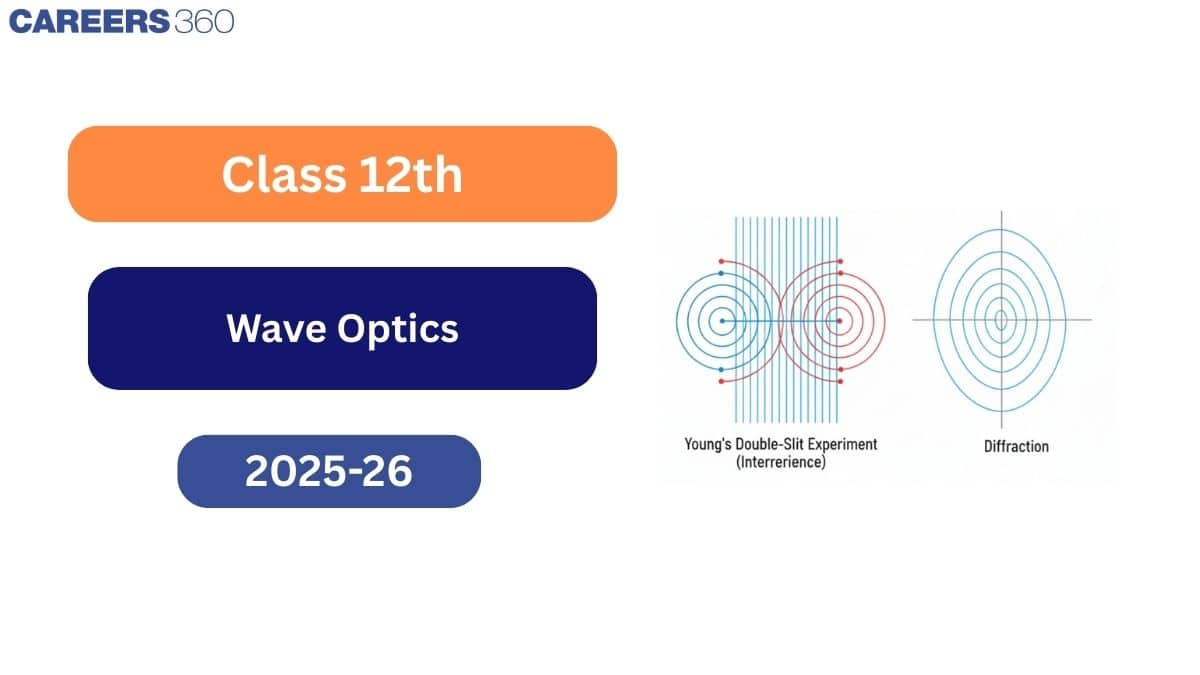
In order to understand wave optics, one has to define clearly various quantities, e.g., wavelength, frequency, phase difference, path difference, and intensity. It is not sufficient to mention that wave effects are caused unless it is clarified what conditions and parameters cause these effects. Likewise, it is impossible to explain phenomena such as interference and diffraction without involving principles that describe the nature of waves, their coherence and geometry. The wave behaviour of light can be analysed and compared with other well-established relations to determine its behaviour using standard definitions. Moreover, this chapter describes significant optical experiments, including the double-slit experiment by Young and also talks about conditions under which interfering patterns can be sustained. It also brings about the aspect of polarization where light waves are transverse in nature. The study of wave optics allows a student to be able to relate a theoretical concept with practical uses like optical devices, lasers, and other modern communication systems, as well as to have a solid base to pursue further in optics and modern physics.
Important Topics of Wave Optics
The chapter Wave Optics is concerned with optical phenomena which appear because of the wave character of light, which cannot be treated with the help of ray optics. The significant topics revolve around interference, diffraction, and polarization as well as the conditions under which these effects become possible. A clear understanding of these topics is essential for Class 12 board exams, JEE Main, and NEET, as most questions are concept-based and experiment-oriented.
1. Wavefront and Huygens’ Principle
Wave optics is based on the wavefront and the Huygens Principle, which describes how light will travel as a wave. In this topic, a wavefront is introduced as a surface of equal phase, and the principle of Huygens, which claims that all points on a wavefront are the sources of second wavelets, is elaborated. It assists in the study of the forward propagation of light and gives a wave-based description of optical phenomena. This is a fundamental concept towards the derivation of the laws of reflection and refraction through wave theory.
2. Reflection and Refraction Using Wave Theory
Reflection and Refraction Using Wave Theory describes how the law of reflection and refraction can be obtained through the Huygens principle. This topic reveals that the inversion in direction during reflection and refraction of light is due to the wave nature of light and variation in its speed in various media. It offers more insight into the optical laws other than the ray approach. The concept assists in creating consistency between the ray optics and the wave optics.
3. Interference of Light
Interference of Light refers to the process whereby two or more light waves merge and interact to cause redistribution of intensity in space. In this topic, we get to know how the principle of superposition of waves causes the creation of alternating bright and dark areas by constructive and destructive interference. It presents the circumstances that are needed to have sustained interference, including coherence and fixed phase difference. Learning about the interference of light is critical to the explanation of such experiments as the Young experiment of the two slits, and demonstrating that light is a wave.
4. Young’s Double Slit Experiment (YDSE)
The Double Slit Experiment (YDSE) by Young is a classic experiment which illustrates the wave nature of light by observing the phenomenon of interference. In this topic, one learns the way in which when a light is passed through two slits that are very narrow apart, the pattern of bright and dark fringes appears on a screen. It brings forth key notions of path difference, phase difference, fringe width and coherence. Knowledge of YDSE is critical to the analysis of interference patterns and the numerical problem analysis of wave optics.
5. Coherent Sources of Light
Coherent Sources of Light are sources that emit light waves having a constant phase difference and the same frequency. This topic explains why coherence is essential for producing a stable and sustained interference pattern. It also talks of the fact that two independent or ordinary sources of light cannot be used as coherent sources. Learning about coherent sources is significant when experimenting with interference, as in the Young double slit experiment and the study of phenomena of light waves.
6. Diffraction of Light
Diffraction of Light refers to the process whereby the wave of light diffracts and spreads when it travels through an opening or around the corners of an object. This topic explains how diffraction arises due to the wave nature of light and becomes significant when the size of the obstacle or aperture is comparable to the wavelength of light. It aids in differentiating between diffraction and interference and points out the shortcomings of geometrical optics. Learning diffraction would be useful in the study of optical resolution and wave action.
7. Single Slit Diffraction
Single Slit Diffraction is the pattern of diffraction of light, which can be considered by passing the light through a single slit. This topic describes how a central bright maximum is formed, and secondary maxima and minima are formed towards each side. It brings about the notion of the angular width of the central maximum and how it varies with the slit width and wavelength. The study of the pattern of diffraction and the power of resolution of optical tools is incomplete without the knowledge of the single slit diffraction.
8. Resolving Power of Optical Instruments
The capability of an optical device to differentiate between two objects spaced closely is known as the resolving power of Optical Instruments. This topic explains how diffraction limits the resolving capability of instruments such as microscopes and telescopes. It presents the idea of minimum resolvable distance and demonstrates the dependence of resolving power on factors such as the wavelength of the light and the size of the aperture. The resolving power is relevant to the understanding of the performance and limitations of optical instruments.
9. Polarisation of Light
The effect whereby the vibrations of the light waves are limited to a key direction perpendicular to the direction of propagation is known as Polarization of Light. This topic explains that only transverse waves can become polarized thus confirming the transverse nature of light. It brings about various ways of making polarised light, like polarisation by reflection and polaroids. Learning the polarisation is significant in the application in the field of optics, photography, and display technology of the modern day.
Important Formulas of Wave Optics
Significant Formulas of Wave Optics are important mathematical relations that are used to describe the wave nature of light and other related phenomena, including interference, diffraction, and polarisation. These equations are the fundamental ones to help in resolving number problems and interpreting experiments such as Young's Double Slit Experiment. These formulas should be regularly revised in case of Class 12 board exams, JEE Main and NEET.
1. Speed of light in a medium:
$v=\frac{c}{\mu}$
2. Interference of Light:
- Path difference
$
\Delta x=d \sin \theta
$
- Condition for constructive interference (bright fringe)
$
\Delta x=n \lambda \quad(n=0,1,2, \ldots)
$
- Condition for destructive interference (dark fringe)
$
\Delta x=(2 n+1) \frac{\lambda}{2}
$
3. Young’s Double Slit Experiment (YDSE):
- Fringe width
$
\beta=\frac{\lambda D}{d}
$
- Position of nth bright fringe
$
y_n=n \frac{\lambda D}{d}
$
- Position of nth dark fringe
$
y_n=(2 n+1) \frac{\lambda D}{2 d}
$
where
$\lambda=$ wavelength,
$D=$ distance between slits and screen,
$d=$ separation between slits.
4. Diffraction of Light (Single Slit):
- Condition for diffraction minima
$
a \sin \theta=n \lambda \quad(n= \pm 1, \pm 2, \ldots)
$
- Angular width of central maximum
$
\theta=\frac{2 \lambda}{a}
$
5. Resolving Power:
- Resolving power of a microscope
$
\mathrm{RP}=\frac{2 \mu \sin \theta}{\lambda}
$
- Resolving power of a telescope
$
\mathrm{RP}=\frac{D}{1.22 \lambda}
$
where
$D=$ aperture diameter.
6. Polarisation of Light:
Malus' Law
$
I=I_0 \cos ^2 \theta
$
where
$I_0=$ initial intensity,
$\theta=$ angle between transmission axes.
Wave optics: Previous Year Questions
Past Year Exam-based questions on Wave Optics can be used to assist students to learn the pattern of the exams and learn which concepts have been tested the most in this chapter. Such questions usually revolve around interference, the Double Slit Experiment, the patterns of diffraction, the power of resolving, and polarisation, which are high-weightage questions in examinations. PYQs practice enhances conceptual understanding, numerical precision, and develops confidence. Regular revision of previous year questions is highly beneficial for Class 12 board exams, JEE Main, and NEET.
Question 1:
To produce a minimum reflection of wavelength near the middle of the visible spectrum $(550 \mathrm{~nm})$, how thick should a coating of $\mathbf{m g f}_{\mathbf{2}}(\mu=1.38)$ be vacuum-coated on a glass surface?
Solution:
For destructive interference
$
2 \mu t=(2 n+1) \frac{\lambda}{2} \text { where } n=1,2,3 \ldots
$
To produce a minimum reflection, destructive interference should happen
So use $2 \mu t=(2 n+1) \frac{\lambda}{2}$ where $n=1,2,3 \ldots$.
at $n=0$
$
\begin{aligned}
& 2 \mu t=\frac{\lambda}{2} \\
& t=\frac{\lambda}{4 \mu}=\frac{550 * 10^{-9}}{4 * 1.38}=100 \mathrm{~nm} \\
& t=10^{-7} \mathrm{~m}
\end{aligned}
$
Question 2:
A thin glass plate of thickness $\frac{2500}{3} \lambda$ ( $\lambda$ is the wavelength of light used) and refractive index $\mu=1.5$ is inserted between one of the slits and the screen in Young's double slit experiment. At a point on the screen equidistant from the slits, the ratio of the intensities before and after the introduction of the glass plate is:
Solution:
We know that there will be a path difference due to the insertion of the glass plate, and this path difference will also lead to a phase difference.
Now, the path difference when the thin glass plate is inserted is given as $\Delta p$,
$\Delta p=(\mu-1) t$ $\_\_\_\_$ equation 1
Here, $t$ is the thickness of the glass plate
$\mu$ is the refractive index of the glass
Now, the phase difference when the thin glass plate is inserted $\Delta \phi$ is given as:
$
\begin{aligned}
\Delta \phi & =\frac{2 \pi}{\lambda} \Delta p \\
\Delta \phi & =\frac{2 \pi}{\lambda}(\mu-1) t \ldots \ldots \ldots \ldots . . \text { equation } 2
\end{aligned}
$
Where $\lambda$ is the wavelength of light used
The intensity at the centre $I_c$ after the insertion of the glass plate will be given as:
$
I_c=I_s+I_s+2 \sqrt{I_s^2} \cos \Delta \phi
$
Here, $I_s$ is the intensity of light from each slit
Solving this equation, we get
$
I_c=2 I_s(1+\cos \Delta \phi)
$
But from trigonometric identities, we know that $1+\cos \theta=2 \cos ^2\left(\frac{\theta}{2}\right)$
$
\begin{aligned}
& \Rightarrow I_c=2 I_s\left(2 \cos ^2\left(\frac{\Delta \phi}{2}\right)\right) \\
& \Rightarrow I_c=4 I_s\left(\cos ^2\left(\frac{\Delta \phi}{2}\right)\right)
\end{aligned}
$
Before the glass plate was inserted, the phase difference was zero, and hence the intensity was
$
\begin{aligned}
& I_c=4 I_s\left(\cos ^2 0^0\right) \\
& \Rightarrow I_c=4 I_s=I_0 \ldots \ldots \ldots \ldots . \text { equation } 3
\end{aligned}
$
Substituting the value of the phase difference, we get
$
\begin{aligned}
& \Rightarrow I_c=4 I_s \cos ^2\left(\frac{2 \pi}{\lambda}(\mu-1) t\right) \\
& \Rightarrow I_c=4 I_s \cos ^2\left(\frac{2 \pi}{\lambda}(1.5-1) \frac{2500}{3} \lambda\right) \\
& \Rightarrow I_c=4 I_s \cos ^2\left(2 \pi\left(\frac{1}{2}\right) \frac{2500}{3}\right) \\
& \Rightarrow I_c=4 I_s \cos ^2\left(2500 \frac{\pi}{3}\right)
\end{aligned}
$
But
$
\begin{aligned}
& \cos ^2\left(2500 \frac{\pi}{3}\right)=\frac{1}{4} \\
& \Rightarrow I_c=4 I_s \times \frac{1}{4} \\
& \Rightarrow I_c=I_s
\end{aligned}
$
Comparing this with equation 3, we have
$
\frac{I_0}{I_C}=\frac{4}{1}
$
Therefore, the ratio of the intensities before and after the introduction of the glass plate is $4: 1$
Question 3:
A Young's double-slit experiment is performed using monochromatic light of wavelength $\lambda$. The intensity of light at a point on the screen, where the path difference is $\lambda$, is $K$ units. The intensity of light at a point where the path difference is $\mathbf{A} \frac{\lambda}{6}$ is given by $\frac{nK}{12}$, where $n$ is an integer. The value of $n$ is $\_\_\_\_$ .
Solution:
$\begin{aligned} & I_{\max }=k \\ & I_1=I_2=K / 4 \\ & \Delta x=\lambda / 6 \\ & \Rightarrow \Delta \phi=\pi / 3 \\ & I=I_1+I_2+2 \sqrt{I_1 I_2} \cos \phi \\ & I=\frac{K}{4}+\frac{K}{4}+2 \times \frac{K}{4} \frac{1}{2} \\ & =\frac{K}{2}+\frac{K}{4}=\frac{3 K}{4}=\frac{9 K}{12} \\ & n=9\end{aligned}$
Wave Optics in Different Exams
Wave Optics is a concept-filled chapter of Class 12 Physics that challenges the comprehension of a student of the wave nature of light. Exam questions mainly assess concepts like interference, diffraction, polarisation, and resolving power, with limited but precise numericals. The awareness of the focus and weightage of the exam will assist students in focusing on NCERT theory, important formulas and standard problems as a way of preparing effectively.
| Exam | Focus Areas | Common Questions Asked | Marks / Questions Weightage | Preparation Tips |
|---|---|---|---|---|
| JEE Main | YDSE, fringe width, diffraction, polarisation | Numerical MCQs on fringe width; conceptual on polarisation | 1–2 questions (4–8 marks) | Practice standard YDSE numericals; revise Malus’ law |
| JEE Advanced | Interference & diffraction concepts, resolving power | Multi-step conceptual/numerical problems | 1 question (6–12 marks, occasional) | Focus on derivations, limiting cases, and reasoning |
| NEET | Interference basics, diffraction, polarisation | Direct NCERT-based MCQs | 1–2 questions (4–8 marks) | Memorise conditions, formulas, and definitions |
| UPSC CDS / NDA | Basic wave nature, interference | One-liners, simple concepts | 1 question (2–4 marks) | Revise definitions and key results |
| State-Level Exams (WBJEE, MHT CET, etc.) | YDSE, diffraction, polarization | Conceptual + numerical MCQs | 1–2 questions (4–8 marks) | Practice PYQs; keep units/signs consistent |
| GATE | Diffraction limits, resolving power | Conceptual engineering-style questions | Rare / 1 question (2–5 marks) | Understand physical meaning and limits |
| School-Level (CBSE, ICSE, State Boards) | Entire chapter | Short answers, numericals, derivations | 5–8 marks | Master NCERT text, diagrams, and examples |
| CUET | Conceptual clarity | MCQs, assertion–reason | 1–2 questions (4–6 marks) | Focus on the NCERT language and facts |
| SSC & Banking Exams | Basic optics facts | One-liners, matching | 1 question (1–2 marks) | Revise key terms and applications |
Important Books and Resources for Class 12 Wave Optics
In order to master the chapter Wave Optics, it is recommended that the students consult a mixture of NCERT textbooks, reference materials, and problem-solving books and resources that elaborate on the theoretical concepts, as well as the techniques to solve problems. These books discuss the most important areas, including interference, diffraction, polarisation, and resolving power, and are therefore a must-have in Class 12 board exam preparation as well as competitive exam preparation (JEE Main, JEE Advanced, NEET).
| Book Title | Author / Publisher | Description |
|---|---|---|
| NCERT Class 12 Physics (Part II) | NCERT | The official textbook covering all wave optics topics, including interference, diffraction, and polarisation, with clear explanations and examples. |
| NCERT Exemplar Physics (Class 12) | NCERT | Contains higher-order and application-based questions on wave optics concepts essential for depth and competitive exam preparation. |
| Concepts of Physics – Volume 2 | H.C. Verma | Offers strong conceptual explanations and well-structured problems on interference, diffraction, and other wave phenomena. |
| Understanding Physics: Waves & Optics | D.C. Pandey (Arihant) | Topic-wise detailed theory with solved examples and practice questions on wave optics and related experiments (YDSE, single-slit, etc.). |
| Physics for Class 12 | R.D. Sharma | Provides step-by-step theory and a wide variety of solved and unsolved problems on wave optics and related numerical techniques. |
| Arihant All-In-One Physics (Class 12) | Arihant | Comprehensive guide with concise summaries, solved examples, and practice questions, including previous year questions on wave optics. |
| MTG Chapter-wise Previous Year Questions – Physics | MTG | Helps analyse and practice past questions specifically from the Wave Optics chapter across boards and competitive exams. |
NCERT Resources for Wave Optics
The most significant study resources to use in learning the nature of light as a wave, as required in the Class 12 Physics syllabus, are the NCERT resources on Wave Optics. Interference, diffraction, polarization and the Double Slit Experiment of Young are the concepts that the NCERT textbook and sample questions shed light on through the usage of typical definitions, diagrams and examples. To score highly in the board exams, NEET, and JEE Main, one must be well prepared through the NCERT resources because most of the questions in this chapter bear a direct relation to the NCERT theory.
NCERT Subjectwise Resources
NCERT subject-wise materials are organised and syllabus-based learning content on various subjects, which assists students in developing a good conceptual basis. They consist of textbooks, exemplar problems, and solutions and can thus be very helpful in the preparation for the board exams and even competitive exams such as JEE and NEET.
Practice Questions based on Wave Optics
Wave Optics Practice Questions will enable students to reinforce their knowledge of the nature of light as a wave and the associated phenomenon. The major aspects of these questions are based on interference patterns, the Double Slit Experiment of Young, the effects of diffraction, resolving power and polarisation that are important in examinations. Practice helps in achieving a clear conceptual understanding, numerical precision and certainty with respect to formula use. The ability to solve broad problems is also very helpful in both Class 12 board examinations and competitive exams such as JEE Main and NEET.
Conclusion
Chapter Ray Optics and Optical Instruments provides a solid conceptual framework of the behaviour of light and how images are formed by the processes of reflection and refraction. Through frequent revisions of basic ideas, significant formulas, ray diagrams, and principles involving mirrors, lenses, prisms, and optical instruments, it is possible to build clear and correct conceptual knowledge with students. This organised training boosts confidence and is very effective in appearing in Class 12 board examinations and also competitive exams such as JEE Main and NEET.
