


Aufbau Principle - Definition, Example, Features, Configuration, FAQs
Have you ever wondered how electrons arrange themselves around the nucleus of an atom? The Aufbau Principle explains the specific order in which atomic orbitals are filled, helping us understand the structure and stability of every element. According to this principle, electrons occupy the lowest energy orbitals available before moving to higher energy orbitals. The word "Aufbau" means "building up" in German, reflecting the concept of filling orbitals in a stepwise manner.
This Story also Contains
- Aufbau Principle
- Features of Aufbau Principle's
- Aufbau Principle Exceptions
- Electronic Configuration According to the Aufbau Principle
- Some Solved Examples
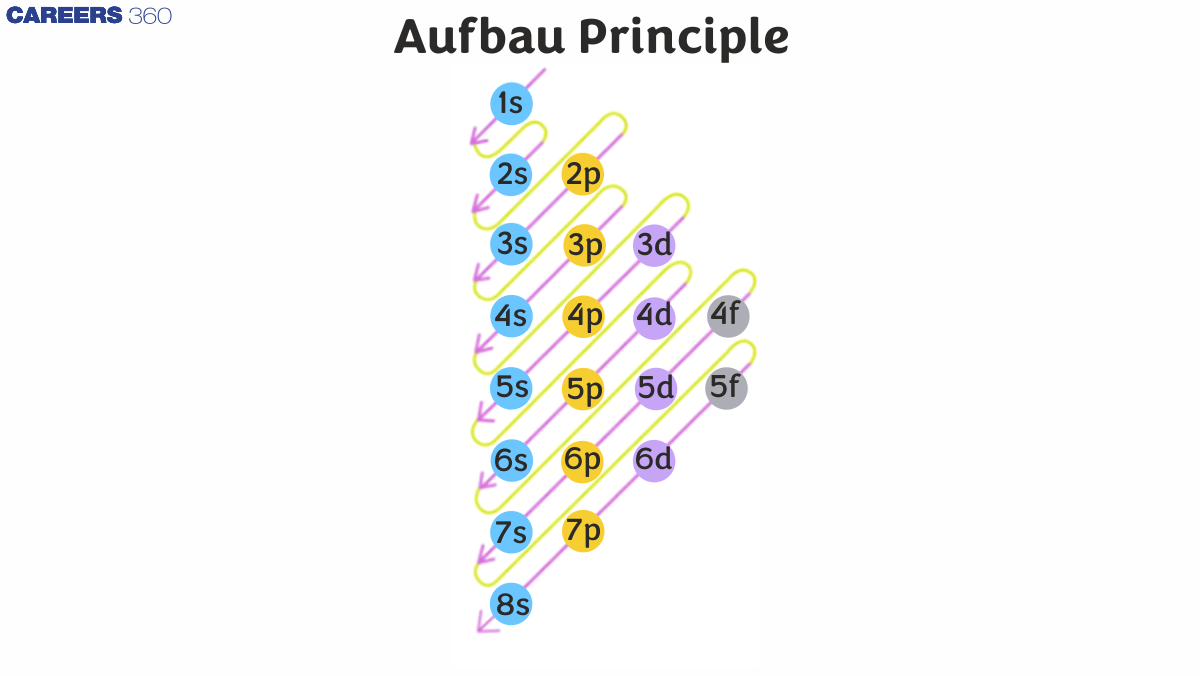
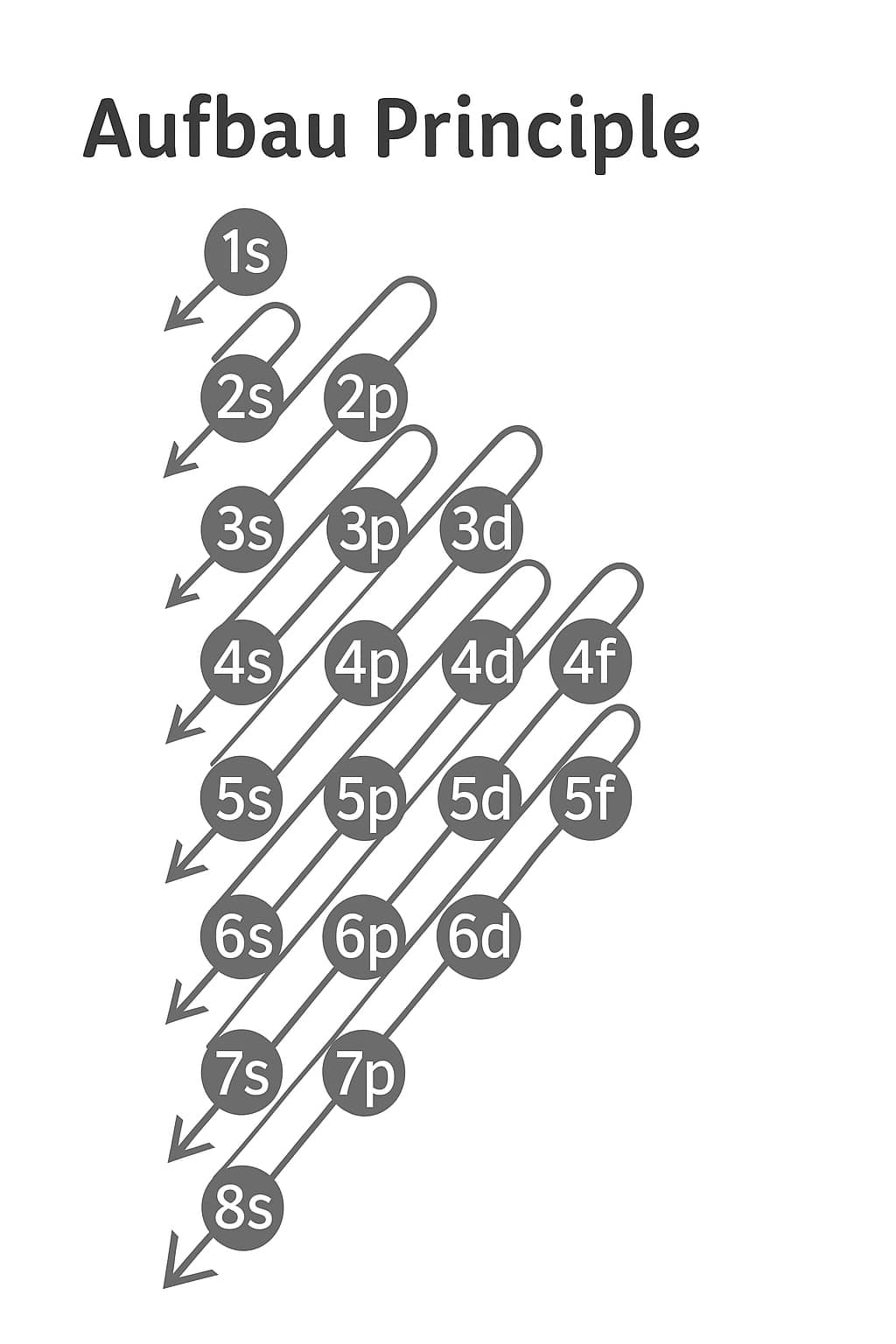
The order of filling generally follows this sequence: $1 s \rightarrow 2 s \rightarrow 2 p \rightarrow 3 s \rightarrow 3 p \rightarrow 4 s \rightarrow 3 d \rightarrow 4 p \rightarrow 5 s \rightarrow 4 d \rightarrow 5 p$, and so forth. The Aufbau principle is foundational for understanding electronic configuration and the structure of the periodic table, and helps predict the arrangement of electrons in an atom's orbitals. Below is the depiction of electron filling order in various orbitals.
Aufbau Principle
The Aufbau Principle states that:
"In the ground state of an atom, electrons occupy the available orbitals in the order of increasing energy. The orbital with lower energy is filled first, followed by orbitals of higher energy."
The word Aufbau is German for "building up" or "construction."
Basis of the Aufbau Principle
The order of filling of orbitals is determined by the (n + l) rule, proposed by Madelung.
(n + l) Rule
- The orbital having a smaller value of (n + l) is filled first.
- If two orbitals have the same value of (n + l), then the orbital with the lower value of n is filled first.
Where:
- n = Principal quantum number
- l = Azimuthal quantum number
Example
For 3p orbital:
- n = 3
- l = 1
n + l = 4
For 4s orbital:
- n = 4
- l = 0
n + l = 4
Since both have the same value, the orbital with lower n is lower in energy.
Therefore: 3p < 4s
Hence, 3p is filled before 4s.
Consider the electron arrangement of carbon, with an atomic number of six. The 1s and 2s orbitals each have four electrons. The 2p subshell is occupied by the remaining two electrons. There is the option of pairing the electrons in one of the 2p orbitals or leaving them unpaired in two different but degenerate p orbitals. The orbitals are filled according to Hund's rule: for an atom with electrons in a set of degenerate orbitals, the lowest-energy configuration is the one with the most unpaired electrons. Thus, the n, l, and ms quantum numbers of the two electrons in the carbon 2p orbitals are identical, but their ml quantum numbers differ (in accordance with the Pauli exclusion principle). With an electron configuration of 1s22s22p2, the orbital diagram for carbon is:
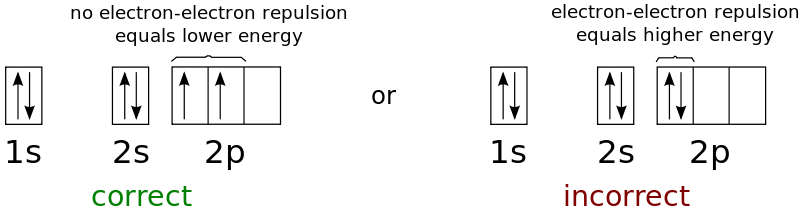
According to Hund's rule, nitrogen (atomic number 7) covers the 1s and 2s subshells and has one electron in each of the three 2p orbitals. The spins of these three electrons are unpaired. In any of the two 2p orbitals (the electrons have opposite spins), oxygen (atomic number 8) has a pair of electrons and a single electron in the other two. Fluorine (atomic number 9) contains only one unpaired electron in its 2p orbital. The noble gas neon (atomic number 10) has all of its electrons coupled, and all of its orbitals in the n = 1 and n = 2 shells are filled.
Features of Aufbau Principle's
-
According to the Aufbau principle, electrons inhabit the lowest-energy orbitals first. This means that electrons can only enter higher-energy orbitals after lower-energy orbitals have been entirely filled.
-
The (n+l) rule may be used to establish the sequence in which the energy of orbitals grows, with the sum of the primary and azimuthal quantum numbers determining the orbital energy level.
-
Lower orbital energies correlate to lower (n+l) values. When two orbitals have the same (n+l) values, the orbital with the lower n value is said to have less energy.
-
The orbitals are filled with electrons in the following order: 1s, 2s, 2p, 3s, 3p, 4s, 3d, 4p, 5s, 4d, 5p, 6s, 4f, 5d, 6p, 7s, 5f, 6d, 7p, and so on.
Aufbau Principle Exceptions
Chromium's electron configuration is [Ar]3d54s1, not [Ar]3d44s2 (as suggested by the Aufbau principle). This is due to several variables, including half-filled subshells, enhanced stability and the comparatively small energy gap between the 3d and 4s subshells.
Lower electron-electron repulsions in the orbitals of half-filled subshells increase stability by reducing electron-electron repulsions. Similarly, filled subshells improve the atom's stability. As a result, some atoms' electron configurations defy the Aufbau principle depending on the energy gap between the orbitals. Copper, for example, is an exception to this rule, having an electrical configuration that corresponds to [Ar]3d104s1. The stability given by a filled 3d subshell explains this.
Electronic Configuration According to the Aufbau Principle
Electronic configuration of Sulphur
-
Sulphur has an atomic number of 16, indicating that it has a total of 16 electrons.
-
According to the Aufbau principle, two of these electrons are in the 1s subshell, eight are in the 2s and 2p subshells, and the rest are dispersed between the 3s and 3p subshells.
-
As a result, Sulphur’s electronic configuration can be expressed as $1 s^2 2 s^2 2 p^6 3 s^2 3 p^4$.
Electronic configuration of Nitrogen
-
Nitrogen is a seven-electron element (since its atomic number is 7).
-
The 1s, 2s, and 2p orbitals are occupied with electrons.
-
Nitrogen's electronic configuration is written as $1 s^2 2 s^2 2 p^3$.
Also check-
| NCERT Solutions for Class 11 Chemistry | ||
| NCERT Solutions for Class 12 Chemistry | ||
| NCERT Solutions for All Subjects |
Some Solved Examples
Question 1: $4 d, 5p, 5 f$ and $6 p$ orbitals are arranged in the order of decreasing energy. The correct option is:
1) (correct) $5 f>6 p>5 p>4 d$
2) $6 p>5 f>5 p>4 d$
3) $6 p>5 f>4 d>5 p$
4) $5 f>6 p>4 d>5 p$
Solution:
Aufbau Principle -
In the ground state of the atoms, the orbitals are filled in order of their increasing energies.

Option 1
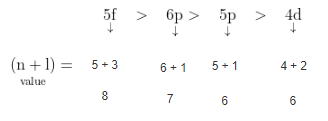
The energy of various orbitals is compared with $(n+l)$, the rule.
The orbitals having a lower value of (n + l) have lower energy. If the value of $(n+l)$ is the same for two orbitals, then the orbital with a lower value of 'n' would have lower energy and be filled first.
Hence, the answer is option (1).
Question 2: If $n=6$, the correct sequence for filling electrons will be:
1) (correct) $n s \rightarrow(n-2) f \rightarrow(n-1) d \rightarrow n p$
2) $n s \rightarrow(n-1) d \rightarrow(n-2) f \rightarrow n p$
3 )$n s \rightarrow(n-2) f \rightarrow n p \rightarrow(n-1) d$
4) $n s \rightarrow n p \rightarrow(n-1) d \rightarrow(n-2) f$
Solution:
As we learned in
Aufbau Principle -
In the ground state of the atoms, the orbitals are filled in order of their increasing energies.
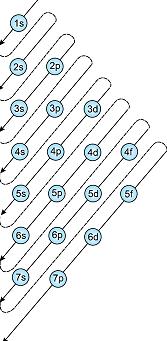
In the ground state of atoms, the orbitals are filled in order of their increasing energies.
Clearly for n = 6, we have the order 6s, 4f, 5d, 6p or ns, (n-2)f, (n-1)d, np
Hence, the answer is option (1).
Question 3: Identify the orbital of the excited electron in the atom with an electronic configuration of [Xe] 6s2 4f14 5d9 6p1
1) 4f
2) 5d
3) (correct) 6p
4) 6s
Solution:
As we learn
Aufbau Principle -
In the ground state of the atoms, the orbitals are filled in order of their increasing energies.
Energy order: 4f < 5d < 6p
Hence, the answer is option (3).
Question 4: Which of the following electron configurations violates the Aufbau Principle?
1) $1 s^2 2 s^2 2 p^6$
2) (correct) $1 s^2 2 s^2 3 s^1$
3) $1 s^2 2 s^2 2 p^3$
4) $1 s^2 2 s^1$
Solution:
The Aufbau Principle states that electrons fill orbitals in order of increasing energy, starting with the lowest energy level. In option 2, the orbital is being filled before the 2p orbital, which violates the Aufbau Principle. Hence, option B is correct.
Option 1 is correct because it follows the Aufbau Principle, where the 1s, 2s, and 2p orbitals are filled before the 3s orbital. Hence, option A is incorrect.
Option 3 is correct because it follows the Aufbau Principle, but it violates the Pauli Exclusion Principle because there are two electrons with the same spin in the 2p sublevel. Hence, option C is incorrect.
Option 4 is correct because it follows the Aufbau Principle, but it violates the Pauli Exclusion Principle because there is only one electron in the 2s orbital. Hence, option 4 is incorrect.
Hence, the answer is option (2).
Practice More Questions with the link given below:
| Aufbau Principle, Pauli Exclusion Principle and Hund’s Rule of Maximum Multiplicity | Electronic configuration of any element |
Frequently Asked Questions (FAQs)
The Aufbau Principle is a rule in chemistry that describes how electrons are added to atomic orbitals as an atom's atomic number increases. It states that electrons fill orbitals from lowest energy to highest energy, following the n + l rule.
The general order of filling is as follows:
1s → 2s → 2p → 3s → 3p → 4s → 3d → 4p → 5s → 4d → 5p → 6s → 4f → 5d → 6p, and so forth. This order follows the relative energy levels of each orbital.
The quantum numbers "n" and "l" in the (n + l) rule are used to specify the state of a specific electron orbital in an atom. Here, l denotes the angular momentum quantum number, which is related to the orbital's form.
It states that before any orbital in a subshell is doubly occupied, it is singly occupied with one electron, and all electrons in singly occupied orbitals have the same spin.
