


Waves - Definition, Types, Properties, FAQs
Waves and vibrations are fundamental concepts in physics that explain how energy travels from one place to another without the permanent movement of matter. From the rhythmic motion of sea waves to the vibrations of atoms and sound travelling through air, wave phenomena are present everywhere in nature. A wave is defined as a disturbance or oscillation that propagates through a medium or space with the transfer of energy. Waves can be mechanical, electromagnetic, or matter waves, each having unique characteristics and applications. Important properties such as amplitude, frequency, wavelength, time period, and wave speed help us understand wave motion clearly. Studying waves is essential for Class 11 and 12 Physics, as it forms the basis of sound, light, optics, and modern physics concepts.
This Story also Contains
- What is a Wave?
- Types of Waves
- Mechanical Waves
- Electromagnetic Waves
- Matter Waves
- Properties of Waves

What is a Wave?
A wave is a disturbance or vibration that travels through a medium or space and transfers energy from one place to another without transferring matter permanently.
In simple words, a wave moves energy, not particles. The particles of the medium only vibrate about their mean positions.
For example:
-
When a stone is dropped into water, ripples are formed. These ripples are waves.
-
When we speak, sound travels in the form of waves through air.
Also read -
Types of Waves
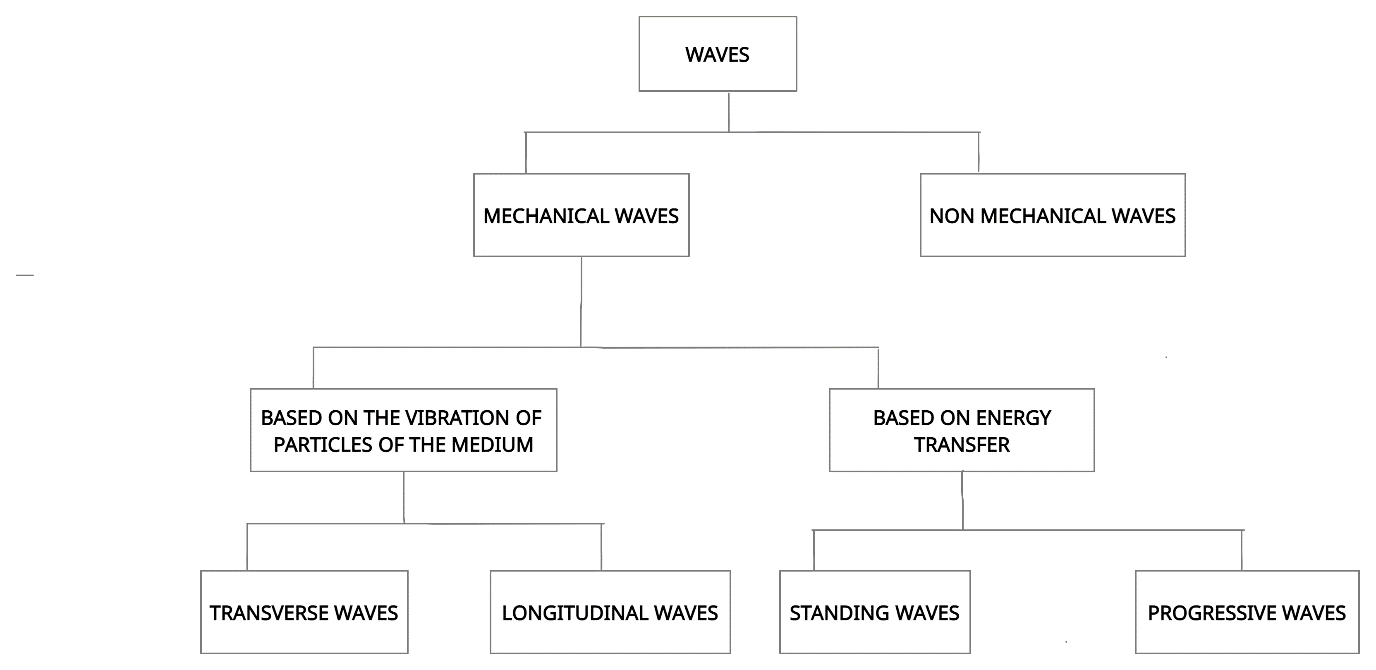
Waves come in a variety of forms, each with its own set of features. There are three categories based on particle motion orientation and energy direction:
- Mechanical Waves
- Electromagnetic Waves
- Matter Waves
Mechanical Waves
Mechanical waves are divided into two categories:
- Longitudinal waves - In this form of the wave, the particle movement is parallel to the motion of the energy, i.e. the medium displacement is in the same direction as the wave. Sound waves and pressure waves are two examples.
- Transverse waves - occur when the motion of the particles is at right angles or perpendicular to the motion of the energy. Light is an example of a transverse wave.
Electromagnetic Waves
There is no requirement for the presence of any medium for the propagation of electromagnetic waves. In other words, electromagnetic waves travel at the same speed from one place to another in a vacuum. Periodic variations in magnetic fields occur in these waves, which are referred to as electromagnetic waves.
The interaction of magnetic and electric fields produces electromagnetic waves. Electromagnetic waves are responsible for the light and colour that you see. Microwaves, light waves, heat radiation, X-rays, radio waves, and ultraviolet waves are all examples of electromagnetic waves.
Matter Waves
De Broglie waves are another name for matter waves. A beam of electrons, according to Louis de Broglie's hypothesis, can be deflected like any other ray of water wave or electromagnetic radiation.
These waves have properties that are analogous to those of matter, such as atoms and molecules. De Broglie's equation, which represents the "dual" nature of matter, is represented by a number of equations. Matter waves have a frequency that is proportional to their kinetic energy.
Based on the transfer of energy
- Standing Waves
- Progressive Waves
Standing waves are restricted to a region with no energy or momentum transfer, whereas progressive waves transfer energy and momentum between the medium's particles.
Properties of Waves
The organised transmission of disturbance from one place to another is referred to as a wave. Mechanical and non-mechanical waves are both possible. Mechanical waves, like sound waves, must propagate via a medium. Electromagnetic waves, on the other hand, are non-mechanical waves that do not require a medium to travel and can even go into space.
Transverse waves occur when the particles of the medium move in a direction that is perpendicular to the wave propagation. Longitudinal waves are waves in which the medium's particles vibrate in a direction parallel to the wave's propagation direction.
Amplitude
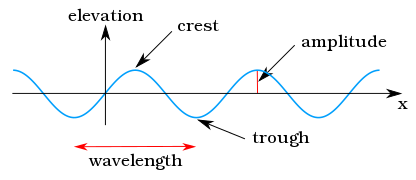
The amplitude of a wave is defined as its maximum displacement from its mean position. The maximum height is measured from the centre line to the crest or trough. The crest of the wave is the highest point, and the trough is the lowest point. The amplitude of a wave is measured in metres.
Also Read:
- NCERT solutions for Class 11 Physics Chapter 15 Waves
- NCERT Exemplar Class 11 Physics Solutions Chapter 15 Waves
- NCERT notes Class 11 Physics Chapter 15 Waves
Frequency
The frequency is defined as the number of vibrations travelling through a fixed point in a given amount of time. The frequency unit is Hertz.
Time period
The time it takes for a whole wave to pass through a particular point is referred to as the time period. The duration is expressed in seconds. The reciprocal of the frequency is the time period.
Speed
A wave's speed is defined as the distance travelled by a certain point on the wave in a given time interval. The speed of a wave is measured in metres per second.
Phase or phase angle (φ)
It denotes the state of vibration of a medium particle in relation to its mean position.
Phase difference (δφ)
It denotes a particle's various vibrational states at two different times (or any pair of particles at the same time).
$\Delta \Phi=\Phi 2-\Phi 1$
Also check-
- NCERT Exemplar Class 11th Physics Solutions
- NCERT Exemplar Class 12th Physics Solutions
- NCERT Exemplar Solutions for All Subjects
NCERT Physics Notes:
Frequently Asked Questions (FAQs)
Based on the orientation of particle and energy the waves are classified as
Mechanical Waves
Electromagnetic Waves
Matter Waves
The examples of transverse waves are:
Torsion Waves
Stringed instruments
Light Waves
Water Waves(ripples of gravity waves)
There are two parts to the longitudinal wave. They are the compression (where the particles come together) and rarefaction (where the particles are apart).
Sound waves, compression waves and p-type earthquake waves are some of the examples of longitudinal waves.
The distance between two identical points (adjacent crests or troughs) is measured in wavelength. Its length is measured in metres. The wavelength and the frequency are inversely proportional.
