To master any logical reasoning topic, a candidate must build strong concept clarity by practicing a variety of reasoning questions. Solving multiple problems helps understand different patterns and improves logical thinking and accuracy. Below, we have provided selected examples from both verbal and non-verbal logical reasoning, along with clear explanations, to help candidates analyze question types and strengthen their problem-solving skills for competitive exams.

Search Colleges, Exams, Schools & more


Login
Logical Reasoning: Topics, Questions with Answers, Examples
Imagine you are choosing the fastest route to reach school or deciding which option saves more money while shopping. Without realizing it, you are already using logical reasoning skills. Logical Reasoning is the ability to think clearly, analyze patterns, identify relationships, and make accurate decisions based on given information. It plays a major role in solving reasoning questions, puzzles, seating arrangements, syllogisms, coding-decoding, series, and data-based problems asked in competitive exams. This article on Logical Reasoning: Topics, Questions with Answers, and Examples will help you master important reasoning concepts, improve analytical thinking, and boost your problem-solving speed with exam-focused practice. Logical Reasoning is an essential section in more than 20+ competitive exams like CAT, SSC, IBPS, etc.
This Story also Contains
- What is Logical Reasoning?
- Why is Logical Reasoning important?
- Five Easy Steps to Solve Logical Reasoning Questions Accurately
- Logical Reasoning Topics
- Logical Reasoning Sample Questions with Answers
- Tips and Tricks to Solve Logical Reasoning Questions
- Logical Reasoning Questions for Order and Ranking
- Logical Reasoning Questions for Missing Numbers
- Logical Reasoning Questions for Arithmetical Problems
- Logical Reasoning Questions for Alphabet Test
- Practice Resources and Ebooks
- Logical Reasoning for Competitive Exams: Preparation Strategy
- Common Mistakes in Odd Letters Questions
- Logical Reasoning: Important Exams
What is Logical Reasoning?
Logical Reasoning is the ability to think logically, analyze given information, and make accurate and well-structured judgments. It is one of the most important problem-solving skills used in competitive exams, aptitude tests, and entrance examinations. Logical reasoning follows a systematic set of rules to reach correct conclusions and is widely used to test a candidate’s analytical ability, critical thinking, and decision-making skills. Questions based on logical reasoning help improve mental ability, logical thinking, and accuracy under time pressure.
Types of Logical Reasoning
Verbal Reasoning: Verbal reasoning tests the ability to understand and logically evaluate information given in words. It measures how well a student can draw valid conclusions from statements, passages, and data written in language form. Common verbal reasoning topics include syllogisms, assumptions, conclusions, cause and effect, statements and arguments, and critical reasoning. It plays a major role in exams like Banking, SSC, CAT, XAT, and other competitive exams.
Non-verbal reasoning: Non-verbal reasoning evaluates the ability to analyze visual patterns, figures, numbers, letters, and diagrams. It focuses on visual reasoning, pattern recognition, and spatial understanding. Topics such as series, analogies, mirror images, paper folding, figure classification, and coding-decoding with symbols are part of non-verbal reasoning. This section strengthens visual intelligence and logical pattern analysis, which is crucial for many competitive and aptitude tests.
Why is Logical Reasoning important?
Logical reasoning is an important skill that a person can use during all kinds of daily situations along with other cognitive skills. It helps in making important decisions, discerns the truth, solves problems, comes up with new ideas and sets achievable goals. It is asked in almost all competitive exams to check the candidate’s interpretation skills concerning patterns, figures and facts. It helps candidates in improving their decision-making skills, problem-solving skills and setting goals.
The logical reasoning section comprises various topics, which include the following types of questions:
Verbal Questions – These types of questions can be solved verbally if a person understands the logic behind the given information and practices several questions of all verbal reasoning topics for that person no pen-paper solution is required.
Sequence Questions – These types of questions can be solved by implementing mathematical formulas or by analysing the information. In such types of questions a series or sequence of objects/people/numbers/alphabets, etc. is given and questions based on the same are asked.
Puzzle Questions – These types of questions are based entirely on logical analysis of the information given in the puzzle question. It includes seating arrangement or arranging people/days/months/places, etc. in different forms.
Image-Based Questions – These types of questions are based on the images as some figures are given as a problem figure and a person has to identify the required figure. It may be water images, mirror images or paper construction-based images. Sometimes sequence pattern questions are also asked based on the images.
Five Easy Steps to Solve Logical Reasoning Questions Accurately
To score well in Logical Reasoning for competitive exams, you need a clear and structured approach. Follow these proven steps to improve your accuracy, speed, and analytical thinking while solving reasoning-based questions:
Read the Question Carefully
Thoroughly read the given information to clearly understand the conditions, data, and relationships. Proper reading helps avoid confusion and silly mistakes in logical reasoning problems.Analyze the Logical Facts and Conditions
Identify the key facts, rules, and constraints given in the question. This step is crucial for solving arrangement, puzzle, and analytical reasoning questions correctly.Note Important Points and Possible Outcomes
Write down essential details and consider all possible cases that follow the rules of logical reasoning. This improves clarity and systematic problem-solving.Compare and Eliminate Options
Match your derived answer with the given choices. Eliminate incorrect options using logical verification to reach the correct conclusion quickly.Finalize the Logical Conclusion
Select the most accurate answer based on complete logical analysis. Your success depends on practice, reasoning ability, and understanding of concepts.
For a deeper understanding of logical reasoning topics, question types, and solved examples, explore the linked sections below and strengthen your exam preparation effectively.
Logical Reasoning Topics
Logical reasoning covers a wide range of chapters that are important for competitive exams like SSC, Banking, CAT, CUET, and UPSC. Practicing these reasoning topics helps students build problem-solving speed and accuracy. In this article, we list important chapters of reasoning with examples and practice resources. Below are the major logical reasoning topics.
Logical Reasoning Sample Questions with Answers
Sample Questions on Verbal Reasoning
Q-1) Find the odd one out.
A) 121-144
B) 1444-1521
C) 1024-1156
D) 441-484
Solution:
In the above-given pairs, all pairs are squares of natural numbers
First Option: 121-144; (11 x 11) (12 x 12)
Second Option: 1444-1521; (38 x 38) (39 x 39)
Third Option: 1024-1156; (32 x 32) (34 x 34)
Fourth Option: 441-484; (21 x 21 ) (22 x 22)
All number pairs are squares of consecutive numbers except third option as in the third option a square of 34 is given instead of a square of 33.
Hence, the third option is correct.
Q-2) How many letters are there between the eighth letter from the left and the fourth letter from the right?
A Q W E R T S D C F S R F H J K L B N M X Z U
A) 2
B) 8
C) 7
D) 13
Solution:
Eighth from the left is - D
Fourth from the right is - M
Number of letters between D and M = 11 letters
Hence, the third option is correct
Q-3) Which one of the given alternatives is always associated with ‘justice’?
(A) Legitimate
(B) Hypocrisy
(C) Judgement
(D) Magnanimity
Solution:
Justice can be given according to the law only. Hence, the first option is correct.
Sample Questions on Non-Verbal Reasoning
Q1. Directions: Two different positions of the same dice are shown. Select the letter that will be on the face opposite to the one having A.

A) B
B) F
C) N
D) Z
Solution: Two different positions of a dice are given with one face common, ‘Z’ and the sixth face is A. So, move in the clockwise direction from the common face Z as shown below to get the opposite pair of faces.
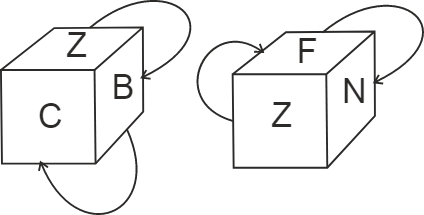
So, the pair of opposite faces - (B⇔F); (C⇔N); (Z⇔A).
Therefore, the opposite face of the A is Z. Hence, the fourth option is correct.
Q-2) Directions: Select the option figure that is embedded in the given figure (rotation is NOT allowed).
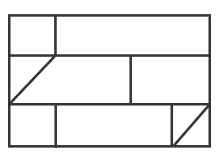
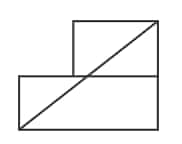
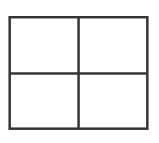

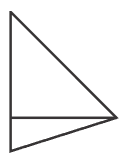
Solution- Since the rotation of the figure is not allowed, let's check which option figure can exactly fit itself in the given question figure.
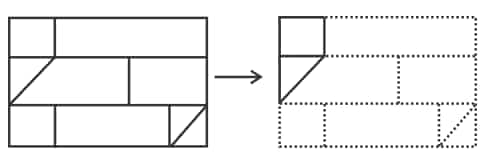
From the above, it is clear that the third option figure is embedded in the given question figure. Hence, the third option is correct.
Q-3) Directions: Find the odd figure from the given alternatives.
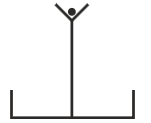


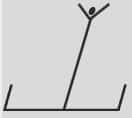
Solution- Let's check each option,
First option: In this figure, the bottom two vertical lines are above the bottom horizontal line.
Second option: In this figure, the bottom two vertical lines are above the bottom horizontal line.
Third option: In this figure, the bottom two vertical lines are below the bottom horizontal line.
Fourth option: In this figure, the bottom two vertical lines are above the bottom horizontal line.
Therefore, the figure in the third option is different from the others. Hence, the third option is correct.
Tips and Tricks to Solve Logical Reasoning Questions
The aspirants can follow various tips and tricks given below for solving the logical reasoning questions.
Tip 1: First of all you should understand the type of question and it is a must that you should be familiar with common logical reasoning question types, such as blood relation, coding-decoding, logical deduction, syllogism, order and ranking and pattern recognition. Knowing the question type helps you approach the problem strategically.
Tip 2: Now you should break down the information given in the question and analyse the given information. After breaking down the information into smaller points identify the main points, assumptions, and conclusions. This helps you to understand the problem in a better way and makes it easier to solve.
Tip 3: You should draw diagrams for certain question types, like syllogism, Venn diagram, blood relation, non-verbal reasoning etc. The diagrams can help you visualize the reasoning problems and you can find the solution more easily.
Tip 4: You should eliminate the incorrect answer choices and use the process of elimination to reach the correct options. Identify answer choices that are incorrect or don't relate to the given information. This can help you to focus on the remaining options and find the correct answer for reasoning questions quickly
Tip 5: You should manage your time effectively. Logical reasoning questions can be time-consuming. You must allocate your time wisely and don't spend too much time on a single question. If you're stuck, move on to the next question and come back to the difficult ones later if you have time.
Tip 6: You should practice regularly as it is key to improving your logical reasoning skills. Attempt various types of verbal and non-verbal reasoning questions to build confidence. You must practice various e-books of logical reasoning published by careers360.
Tip 7: You should learn from your mistakes after completing a practice test or solving a logical reasoning e-book. You must analyse your errors and understand the reason of occurring of those errors. This will help you to avoid making the same errors in the upcoming exams.
Tip 8: You should stay calm and have a focused mindset during the exam. Don’t panic if you are not able to solve 1 or 2 questions in the exam. Overthinking or stressing can hinder your ability to think logically and clearly. Stay confident in your ability and trust your preparation.
Logical Reasoning Questions for Order and Ranking
1) Directions: In a supermarket, there are seven toys, A, K, L, P, M, S and T, of different heights. L is taller than S, but shorter than M. K is taller than P. A is taller than only T. L is shorter than only three toys. T is the shortest and M is taller than K. The height of S is shorter than how many toys?
1) Two
2) Three
3) Four
4) One
Hint: Arrange all the toys in descending order according to their height and answer accordingly.
Solution
Given:
(I) L is taller than S but shorter than M.
M > L > S
(II) L is shorter than only three toys. A is taller than only T.
__ > __ > __ > L __ > A > T
(III) K is taller than P. T is the shortest and M is taller than K. After combining all the statements.
M > K > P > L > S > A > T
Therefore, the height of S is shorter than 4 toys. Hence, the third option is correct.
2) Directions: In a class of 64 students, Komal's rank is 6 positions lower (i.e. towards the bottom) than her friend Shikha, who is at the 59th position from the end. What is Komal's rank at the top of the class?
1) 15th
2) 12th
3) 16th
4) 19th
Hint: Determine the position of Shikha from the top in the class to determine Komal's rank.
Solution
Given:
Total Students = 64
Shikha End position = 59th
Shikha top position⇒ (Top position + Bottom position – 1) = Total
⇒(Top position + 59 – 1) = 64
⇒Top position = 64 – 58 = 6th
If Shikha top's position is 6th. Komal's rank is 6 positions lower means 6 + 6 = 12th
So, Komal's rank from the top is 12th. Hence, the second option is correct.
Practice Questions based on Order and Ranking PDF Download
Order and ranking reasoning questions help in testing comparison, arrangement, and logical placement skills in exams. Practising these regularly improves accuracy and confidence. Below is a useful PDF resource.
Download Now: Order and Ranking Questions with Solutions PDF
Logical Reasoning Questions for Missing Numbers
1) Directions: Study the given pattern carefully and select the number that can replace the question mark (?) in it.
7 | 9 | 63 |
6 | 8 | 48 |
5 | 7 | ? |
1) 28
2) 35
3) 42
4) 49
Hint: For each row, multiply the first number by the second number to get the third number.
Solution
The pattern can be observed running horizontally along the rows.
First row→7 × 9 = 63
Second row→6 × 8 = 48
Similarly, follow the same pattern for the third row→5 × 7 = 35
So, 35 is the missing number in the figure. Hence, the second option is correct.
2) Directions: Study the given pattern carefully and select the number that can replace the question mark (?) in it.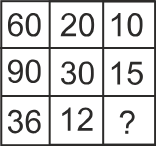
1) 6
2) 8
3) 5
4) 4
Hint: Divide the first number and the second number by 3 and 2, to get the second and third numbers, respectively.
Solution
In each row, divide the first number by 3 and the second number by 2, to get the second and third numbers respectively –
In the first column→60 ÷ 3 = 20 and 20 ÷ 2 = 10
In the second column→90 ÷ 3 = 30 and 30 ÷ 2 = 15
Similarly, follow the same pattern in the third column→36 ÷ 3 = 12 and 12 ÷ 2 = 6
So, 6 is the missing number in the given figure. Hence, the first option is correct.
Practice Questions based on Missing Numbers PDF Download
Missing number reasoning questions test logical thinking and pattern recognition in competitive exams. Consistent practice boosts problem-solving speed and accuracy. Below is a useful PDF resource.
Download Now: Missing Number Questions with Solutions PDF
Logical Reasoning Questions for Arithmetical Problems
1) Directions: One day, 90 students were travelling in a bus and the ratio of the number of boys to girls was 2: 1. The next day, the number of students remained the same, but the ratio of the number of boys to girls became 3: 2. What was the difference between the numbers of boys travelling in the bus on both the days?
1) 18
2) 6
3) 14
4) 30
Solution
Given:
90 students were travelling in a bus and the ratio of the number of boys to that of girls was 2: 1
According to the question,
2x + x = 90
3x = 90
x = 90 ÷ 3
x = 30
Therefore, Number of Boys = 60, Number of Girls = 30;
The next day, the number of students remained the same, but the ratio of the number of boys to that of girls became 3: 2
3x + 2x = 90
5x = 90
x = 90 ÷ 5
x = 18
Therefore, the Number of Boys = 54, The Number of Girls = 36
So the difference between the numbers of boys travelling in the bus = 60 – 54 = 6
Therefore, the difference between the numbers of boys travelling on the bus on both days is 6. Hence, the second option is correct.
2) Directions: A total of 60 students are travelling in a bus. The ratio of the number of boys to that of girls is 2 : 1. Then, 15 boys get down 5 girls get on the bus at the first stop, 5 boys get in and 10 girls get down from the bus at the second stop. What is the ratio of the number of boys to that of girls in the bus after the second stop?
1) 3 : 2
2) 2 : 1
3) 2 : 3
4) 3 : 1
Solution
Given:
A total of 60 students are travelling in a bus. The ratio of the number of boys to that of girls is 2 : 1
2x + x = 60; 3x = 60; x = 60 ÷ 3; x = 20
Thus, Number of Boys = 2x = 40; Number of Girls = x = 20
Then, 15 boys get down and 5 girls get on the bus at the first stop
The remaining boys after the first stop; 40 – 15 = 25
The remaining girls after the first stop; 20 + 5 = 25
At the second stop, 5 boys get in and 10 girls get down from the bus.
The remaining boys after the second stop; 25 + 5 = 30
The remaining girls after the second stop; 25 – 10 = 15
So, the ratio of Boys: Girls = 30 : 15; 2 : 1. Hence, the second option is correct.
Practice Questions based on Arithmetic PDF Download
Arithmetic reasoning questions are common in exams like SSC, Banking, and Railway where numerical problem-solving skills are tested. Regular practice from PDFs helps improve accuracy and speed. Below is a helpful resource.
Download Now: Arithmetical Problems Questions with Solutions PDF
Logical Reasoning Questions for Alphabet Test
1) Directions: Select the correct option that indicates the arrangement of the given words in a logical and meaningful order.
1. Sentence 2. Letter 3. Paragraph 4. Chapter 5. Book
1) 5, 4, 3, 2, 1
2) 5, 4, 3, 1, 2
3) 5, 1, 3, 4, 2
4) 5, 1, 4, 3, 2
Hint: Think about the hierarchical structure of written communication, starting from the largest unit and progressing to the smallest.
Solution
Book: A collection of chapters, usually forming a complete work or a substantial part of it.
Chapter: A division of a book, typically dealing with a specific theme or aspect.
Paragraph: A group of related sentences that focus on a single idea or topic.
Sentence: A group of words that expresses a complete thought.
Letter: The smallest unit of written communication.
So, Book→Chapter→Paragraph→Sentence→Letter
The meaningful order is 5, 4, 3, 1, 2. Hence, the second option is correct.
2) Directions: Select the option that represents the correct order of the given words as they would appear in an English dictionary.
1. Tattoo
2. Tatters
3. Tatting
4. Tattle
5. Taut
1) 2, 3, 4, 1, 5
2) 2, 4, 5, 3, 1
3) 5, 4, 3, 2, 1
4) 4, 5, 1, 2, 3
Hint: Compare the words, letter by letter from left to right, and determine their occurrence as per the dictionary.
Solution
Step 1: Compare the first two letters of each word. Since all the letters are the same, T, a, move on to the next letter.
Step 2: The third letter of each word is t,t,t,t, and u. Based on the alphabetical order of these letters, we can arrange them as Tattoo, Tatters, Tatting, Tattle, Taut
Step 3: Compare the fifth letters of (Tattoo, Tatter, Tatting, Tattle). According to the alphabetical system, the order is – Tatter, Tatting, Tattle, Tattoo.
So, the sequence is Tatters, Tatting, Tattle, Tattoo, Taut, or 2, 3, 4, 1, 5. Hence, the first option is correct.
Practice Questions based on Alphabet Test
The alphabet test is a key chapter of reasoning often asked in competitive exams like SSC, Banking, and Railways. Practicing from dedicated PDFs helps in spotting patterns and solving faster. Below is a useful resource.
Download Now: Alphabet Test Questions with Solutions PDF
Practice Resources and Ebooks
Practicing reasoning questions through ebooks is one of the fastest ways to learn reasoning for competitive exams. These cover key reasoning topics with solutions for exams like SSC, Banking, and Railway. Below are some useful resources.
1) Figure Counting Questions with Solutions PDF
2) Mirror and Water Image Questions with Solutions PDF
3) Direction Sense Questions with Solutions PDF
4) Syllogism Questions with Solutions PDF
5) Inequality Questions with Solutions PDF
6) Mathematical Operations Questions with Solutions PDF
7) Embedded Figure Questions with Solutions PDF
8) Figure Series Questions with Solutions PDF
9) Classification Questions with Solutions PDF
10) Critical Reasoning Questions with Solutions PDF
Logical Reasoning for Competitive Exams: Preparation Strategy
To score high in Logical Reasoning for competitive exams, you need a smart, structured, and exam-focused preparation plan. This section tests your analytical ability, logical thinking, and problem-solving speed, so strategy matters more than rote learning.
Build strong basics in both Verbal Reasoning and Non-Verbal Reasoning topics such as puzzles, seating arrangement, syllogism, series, coding-decoding, and blood relations.
Practice daily with logical reasoning questions to improve accuracy and develop fast decision-making skills.
Focus on understanding patterns, conditions, and constraints instead of memorizing answers.
Solve previous year logical reasoning questions to identify frequently asked topics and exam trends.
Use a step-by-step approach for solving reasoning problems to avoid confusion and calculation mistakes.
Improve speed by attempting mock tests and timed practice sets for competitive exam readiness.
Analyze your mistakes to strengthen weak areas in logical reasoning concepts and question types.
Maintain short notes of important reasoning tricks, shortcuts, and methods for quick revision.
Give equal importance to accuracy and speed, as both are crucial for cracking exams like SSC, Banking, CAT, XAT, CLAT, CUET, and other aptitude tests.
Revise regularly to retain logical reasoning formulas, concepts, and problem-solving techniques.
This preparation strategy helps you master logical reasoning topics, boost confidence, and maximize your score in competitive exams.
Common Mistakes in Odd Letters Questions
Odd letter reasoning questions look simple but many candidates lose marks due to common errors. Knowing these mistakes can help you avoid them and solve odd letters examples more accurately.
Ignoring Alphabet Sequence in Odd Letters
Students often skip checking the proper A to Z sequence.
Missing the alphabet order leads to wrong identification of odd letters.
Always cross-check the English alphabet series while solving.
Confusing Odd Letters with Odd Numbers
Many confuse odd letters with odd numbers like 1, 3, 5, etc.
Odd letters are about alphabet patterns, not mathematical numbers.
Keep the focus on reasoning topics related to letters, not arithmetic.
Misunderstanding Odd Letters Example in English
Some fail to grasp the correct meaning of odd letter in English.
Misinterpretation of odd letters examples leads to errors.
Practice multiple odd letter questions for competitive exams to avoid confusion.
Logical Reasoning: Important Exams
Almost every competitive exam covers the Logical Reasoning section to check the candidate's capability to deal with a particular situation or the ability of a candidate to understand and logically work through concepts and problems expressed in the form of images, diagrams, etc.
The list of various exams is given below in which logical reasoning covers almost all topics and plays an important role in scores.
SSC Exams
SSC MTS
SSC Stenographer
SSC GD
SSC CHSL
SSC CPO
SSC CGL
SSC JERailways
RRB Group D
RRB NTPC
RRB ALP
RRB JEFCI
STATE GOVERNMENT EXAMS
Placement exams
About the Faculty
Tanu Gupta, with over a decade of experience as a reasoning faculty, specializes in preparing students for various entrance examinations and career development. Her extensive work with multiple educational platforms and institutions has honed her expertise in logical and analytical thinking. Her dedication to innovative teaching methods ensures these articles provide practical insights and expert guidance.
Frequently Asked Questions (FAQs)
Q: How many types of questions are asked in competitive exams of Logical Reasoning?
A:
There are two types of questions asked in various competitive exams. The first type is verbal reasoning and the other type is non-verbal reasoning.
Q: Which logical reasoning topics should I prepare first for competitive exams?
A:
Start with high-weightage topics like seating arrangement, puzzles, syllogism, coding-decoding, blood relations, series, and direction sense. These appear frequently and carry easy scoring potential once concepts are clear.
Q: How much time should I give daily to logical reasoning practice?
A:
At least 30–45 minutes daily is ideal. Focus on solving 10–15 quality logical reasoning questions with full analysis rather than rushing through many without understanding.
Q: What is logical reasoning?
A:
Logical reasoning is defined as the ability to think logically, analyse situations and make logical and precise judgements. It is a type of problem-solving approach which works under some set of rules to reach an accurate conclusion.
Q: What are the 4 types of reasoning?
A:
Here, we'll concentrate on four different forms of reasoning: deductive, inductive, abductive, and analogous reasoning. By examining how they employ examples, rules, and outcomes, one may differentiate between these.
Q: Who is the father of logical reasoning?
A:
Aristotle was the first to create a formal framework for thinking and is regarded as the founder of western logic.
Upcoming Exams