


Input-Output: Meaning, Reasoning Questions with Answers, Tricks, Examples
Have you ever seen a sequence of words or numbers change step by step and wondered what rule is being followed behind the scenes? That’s exactly what input-output reasoning is all about. In competitive exams, input-output questions test your ability to identify patterns, understand the logic applied in each step, and predict the next stage or final output. At first, these questions may look confusing, but once you learn the right input-output tricks, they become much easier to solve. In this article, we’ll cover the meaning of input-output in reasoning, different types of input-output questions with answers, and explain them with clear examples and shortcuts to help you solve questions quickly and accurately.
This Story also Contains
- Input-Output Reasoning: Meaning, Questions, Tricks, Examples & Types (Complete Guide for Competitive Exams)
- Basic Concept of Machine Input-Output Reasoning (Step-by-Step Logic)
- Types of Questions Based on Input-Output Reasoning
- Best Approach to Solve Input-Output Reasoning Questions (Step-by-Step Strategy for Exams)
- Input-Output Reasoning Question Weightage in SSC, Banking & Competitive Exams
- Practice Questions For Single Shifting-Based Machine Input
- Practice Questions For Double Shifting-Based Machine Input
- Practice Questions For Operation-Based Machine Input
- Practice Questions For Box-Based Machine Input
- Input Output Questions for CAT
- Input Output Questions for SBI PO/ IBPS PO/ IBPS RRB PO exams
- Best Books for Input-Output Reasoning Questions (SSC, Banking, RRB Exams)
- Non Verbal Reasoning Topics

These questions are generally seen in competitive exams like CAT, CLAT, MAH MBA CET, SBI PO, etc.
Input-Output Reasoning: Meaning, Questions, Tricks, Examples & Types (Complete Guide for Competitive Exams)
Input-output reasoning is one of the most important topics in logical reasoning for exams like SSC, Banking, and RRB. In these questions, a machine or system follows a specific pattern to transform the given input into output step by step. By practicing input-output reasoning questions with answers and learning the right input-output tricks, you can easily decode patterns and solve questions quickly.
What is Input-Output in Reasoning? Definition and Basic Concept
Input-output in reasoning refers to a process where a sequence of numbers, words, or symbols (input) is rearranged or modified according to a hidden rule to produce an output.
Understanding Input-Output with Easy Explanation
In input-output questions, you are given an initial input and one or more steps showing how it changes. Your task is to identify the pattern and predict the next step or final output. These are commonly known as machine input-output reasoning questions.
Key Features of Input-Output Reasoning Questions
Based on step-by-step transformation of input
Involves patterns like sorting, shifting, or coding
Includes number-based, word-based, and mixed input-output questions
Frequently asked in SSC CGL, IBPS, SBI, and other exams
Importance of Input-Output Reasoning for SSC, Banking & Competitive Exams
Input-output is a high-weightage topic in the reasoning section of competitive exams.
Why Input-Output Questions are Important for Exams
Regularly asked in SSC, Banking, and RRB exams
Tests logical thinking and pattern recognition skills
Helps improve speed and accuracy in reasoning section
Why Input-Output is a Scoring Topic
Follows a fixed pattern once understood
Multiple questions can be solved from one set
Easy to attempt with proper input-output tricks and practice
Basic Concept of Machine Input-Output Reasoning (Step-by-Step Logic)
Machine-based problems are the most common type of input-output reasoning questions.
Understanding Input, Output, and Steps in Reasoning
To solve input-output questions, you must clearly understand three components:
Input (Initial Data)
The starting sequence of numbers, words, or symbols given in the question.
Output (Final Result)
The result after applying the machine’s logic step by step.
Steps (Intermediate Stages)
Each step shows how the input is gradually transformed. These steps help you identify the pattern in input-output reasoning questions.
How Patterns Work in Input-Output Questions (Logic Building)
Recognizing patterns is the key to solving input-output reasoning questions with answers.
Common Patterns in Input-Output Questions
Sorting (ascending/descending order)
Shifting positions of elements
Replacing or modifying numbers/letters
Grouping vowels, consonants, or digits
How to Identify Patterns Quickly
Compare input with each step carefully
Focus on one element at a time
Look for repetition or sequence changes
Apply known input-output tricks
Types of Questions Based on Input-Output Reasoning
Following are the types of questions asked from the input-output concept-
Shifting-Based Machine Input
Single Shifting-Based Machine Input
Double Shifting Based Machine Input
Operation-Based Machine Input
Box-Based Machine Input
Now let’s understand all of the types of input-output questions in detail -
1) Shifting-Based Machine Input
In this type of input-output-based question, shifting of numbers, words or letters takes place.
This is further classified into two types-
a) Single Shifting-Based Machine Input
In this type of input-output-based question, shifting of numbers, words or letters takes place from only one end, i.e., either from the left end or from the right end.
Example: Study the information given below and answer the following question:
Input: Treat Mouse Mobile Games Bag Box
Step I: Bag Treat Mouse Mobile Games Box
Step II: Bag Box Treat Mouse Mobile Games
Step III: Bag Box Games Treat Mouse Mobile
Step IV: Bag Box Games Mobile Treat Mouse
Step V: Bag Box Games Mobile Mouse Treat
And Step V is the final step.
Based on the pattern followed above, find the output for the given input:
Input: House Colony Yellow Bear Red White
Colony Yellow Bear Red White House
Red White House Colony Yellow Bear
Red White Yellow Bear House Colony
Bear Colony House Red White Yellow
House Red White Yellow Bear Colony
Solution:
Here, the words given in the input are arranged alphabetically in the given steps from left to right. One word at a time is rearranged in the given steps.
Similarly, the step-by-step arrangement of the given input is as follows-
Step I: Bear House Colony Yellow Red White
Step II: Bear Colony House Yellow Red White
Step III: Bear Colony House Red Yellow White
Step IV: Bear Colony House Red White Yellow
So, the output for the given input is Bear Colony House Red White Yellow. Hence, the fourth option is correct.
b) Double Shifting Based Machine Input
In this type of input-output-based question, shifting of numbers, words or letters takes place from both ends.
Example: Study the information given below and answer the following questions:
Input: 32 pigeon 46 89 sparrow peacock hen 80 92 22 parrot crow
Step I: crow 32 pigeon 46 89 sparrow peacock hen 80 92 parrot 22
Step II: crow hen pigeon 46 89 sparrow peacock 80 92 parrot 22 32
Step III: crow hen parrot pigeon 89 sparrow peacock 80 92 22 32 46
Step IV: crow hen parrot peacock pigeon 89 sparrow 92 22 32 46 80
Step V: crow hen parrot peacock pigeon sparrow 92 22 32 46 80 89
Step VI: crow hen parrot peacock pigeon sparrow 22 32 46 80 89 92
And Step VI is the final step.
Based on the pattern followed above, find the output for the given input:
Input: pasta 98 plate 89 spoon 10 15 fork knife 36 49 glass
plate 89 spoon 10 15 fork knife 36 49 glass pasta 98
36 49 glass pasta 98 plate 89 spoon 10 15 fork knife
spoon 10 15 pasta 98 plate 89 fork knife 36 49 glass
fork glass knife pasta plate spoon 10 15 36 49 89 98
10 15 fork knife 36 49 glass pasta 98 plate 89 spoon
Solution:
Here, the words given in the input are arranged in alphabetical order in the given steps from the left end and the numbers are arranged in ascending order from the right end. Two rearrangements are taking place in the given steps.
Similarly, the step-by-step arrangement of the given input is as follows-
Step I: fork pasta 98 plate 89 spoon 15 knife 36 49 glass 10
Step II: fork glass pasta 98 plate 89 spoon knife 36 49 10 15
Step III: fork glass knife pasta 98 plate 89 spoon 49 10 15 36
Step IV: fork glass knife pasta plate 98 89 spoon 10 15 36 49
Step V: fork glass knife pasta plate 98 spoon 10 15 36 49 89
Step VI: fork glass knife pasta plate spoon 10 15 36 49 89 98
So, the output for the given input is fork glass knife pasta plate spoon 10 15 36 49 89 98. Hence, the fourth option is correct.
2) Operation- Based Machine Input
In this type of input-output-based question, certain operations are performed on the numbers given in the input and the resultant are rearranged following a certain pattern.
Example: A number arrangement machine when given an input line of numbers rearranges them following a particular rule in each step. The following is an illustration of input and rearrangement.
Input: 734269 825497 647538 219354 961357 321658
Step I: 962437 794528 835746 453912 753169 856123
Step II: 453912 753169 794528 835746 856123 962437
Step III: 135924 135796 579248 357468 135268 379246
Step IV: 24 31 35 33 25 31
Step V: 24 25 31 31 33 35
Step V is the last step of the above arrangement as the intended arrangement is obtained.
As per the rules followed in the given steps find out the appropriate steps for the given input:
Input: 856347 745982 329584 512379 954267 463512
Q1. What will be step IV of the given input?
21 35 31 33 33 27
34 35 31 33 33 27
27 35 69 33 33 27
27 53 31 48 33 27
Solution: The pattern is as follows-
In step I, the digits of the numbers given in the input are reversed.
In step II, the numbers are arranged in ascending order.
In step III, first, the odd digits are arranged in ascending order followed by the even digits in ascending order of each number.
In step IV, the sum of the digits of the numbers is present.
In step V, the numbers are arranged in ascending order.
Following the above pattern, step IV of the given input will be 21 35 31 33 33 27. Hence, the first option is correct.
3) Box-Based Machine Input
In this type of input-output-based question, the numbers would be given in boxes and certain mathematical operations are performed on the set of the numbers given in the boxes.
Example: Study the given information carefully and answer the given questions.
An input-output is given in different steps. Some mathematical operations are done in each step.
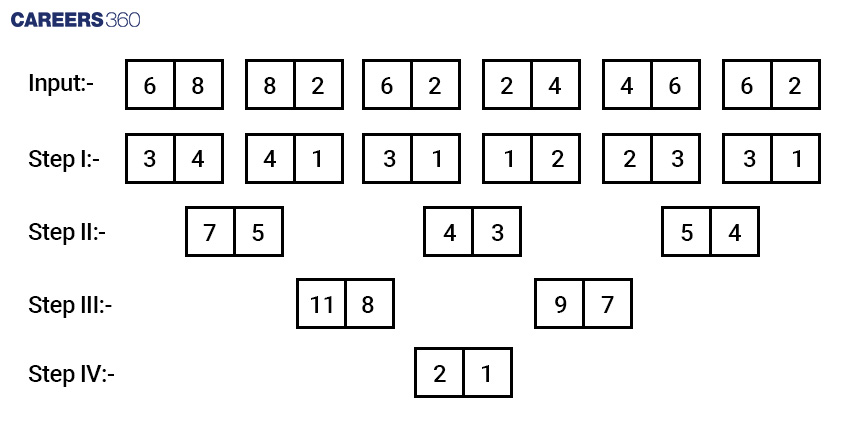
As per the rules followed in the steps given above, find out the appropriate steps for the given input.

Q1. What will be the sum of the digits of the number of step IV?
A) 3 B) 9 C) 5 D) 2
Solution:
The pattern is as follows-
In step I, the digits of the numbers given in the input are divided by 2.
In step II, the digits of the first number and the digits of the second number of step I are added and combined. Similarly, the digits of the third and fourth numbers and the fifth and sixth numbers of step I are added and combined.
In Step III, the first and the second numbers are added, and the second and third numbers given in Step II are added.
In step IV, the number is the difference between the first and second numbers of step III.
Following the above pattern, the sum of the digits of the number of step IV of the given input will be 2 + 1 = 3. Hence, the first option is correct.
Best Approach to Solve Input-Output Reasoning Questions (Step-by-Step Strategy for Exams)
A clear strategy is essential to solve input-output reasoning questions quickly and accurately. By following a structured method and applying the right input-output tricks, you can easily decode patterns in machine input-output questions for SSC, Banking, and RRB exams.
Step-by-Step Method to Solve Input-Output Questions in Reasoning
Step 1: Read Input and Steps Carefully
The first step is to carefully read the given input and all the steps. Understanding how the sequence changes at each stage is crucial in solving input-output questions with answers.
Step 2: Analyze the Pattern of Shifting or Arrangement
Observe each step and identify how numbers or words are moving or changing. Focus on patterns like sorting, shifting, or grouping, which are common in input-output reasoning questions.
Step 3: Use Rough Work for Better Visualization
Always solve input-output reasoning questions on a rough sheet. Writing each step helps in avoiding confusion and makes it easier to track changes in machine input-output problems.
Step 4: Do Not Skip Any Step in the Process
Every step given in the question is important. Skipping a step may lead to incorrect pattern identification and wrong answers in input-output questions.
Step 5: Apply the Identified Pattern to Solve the Final Output
Once you understand the pattern, apply it to the required input and find the final answer. This is the most important step in solving input-output reasoning questions with answers.
Input-Output Reasoning Question Weightage in SSC, Banking & Competitive Exams
Understanding the question weightage of input-output reasoning helps you prioritize this topic and focus on high-scoring areas in the reasoning section of competitive exams. The number of questions based on input-output varies from exam to exam -
1) In various Banking exams, such as SBI PO Mains and IBPS PO Mains 5-10 questions on this topic are asked.
2) In other competitive exams such as LIC, RRB, UPSC, State PCS exams, and CAT, 4-5 questions are asked from this topic.
The input-output reasoning questions with answers and input-output reasoning questions for bank PO are given below for the reference of candidates.
Practice Questions For Single Shifting-Based Machine Input
Directions (Q1- Q5): Study the information given below and answer the following questions:
Input: Mouse Biscuit Candle Computer Table Clock
Step I: Biscuit Mouse Candle Computer Table Clock
Step II: Biscuit Candle Mouse Computer Table Clock
Step III: Biscuit Candle Clock Mouse Computer Table
Step IV: Biscuit Candle Clock Computer Mouse Table
And Step IV is the final step.
Based on the pattern followed above, rearrange the given input:
Input: Orange Mango Apple Guava Cherry Strawberry
Q1. How many steps are required to complete the arrangements?
Four (Correct)
Six
Five
Nine
None of these
Solution:
Here, the words given in the input are arranged alphabetically in the given steps from left to right. One word at a time is rearranged in the given steps.
Similarly, the step-by-step arrangement of the given input is as follows-
Step I: Apple Orange Mango Guava Cherry Strawberry
Step II: Apple Cherry Orange Mango Guava Strawberry
Step III: Apple Cherry Guava Orange Mango Strawberry
Step IV: Apple Cherry Guava Mango Orange Strawberry
So, a total of four steps are required to complete the arrangements. Hence, the first option is correct.
Q2. What will be the Step III of the given input?
Apple Guava Orange Mango Cherry Strawberry
Cherry Strawberry Orange Mango Apple Guava
Strawberry Orange Mango Apple Guava Cherry
Mango Orange Apple Guava Cherry Strawberry
Apple Cherry Guava Orange Mango Strawberry (Correct)
Solution:
Here, the words given in the input are arranged alphabetically in the given steps from left to right. One word at a time is rearranged in the given steps.
Similarly, the step-by-step arrangement of the given input is as follows-
Step I: Apple Orange Mango Guava Cherry Strawberry
Step II: Apple Cherry Orange Mango Guava Strawberry
Step III: Apple Cherry Guava Orange Mango Strawberry
Step IV: Apple Cherry Guava Mango Orange Strawberry
So, step III will be Apple Cherry Guava Orange Mango Strawberry. Hence, the fifth option is correct.
Q3. What will be the Step II of the given input?
Apple Cherry Orange Mango Guava Strawberry (Correct)
Cherry Strawberry Orange Mango Apple Guava
Strawberry Orange Mango Apple Guava Cherry
Mango Orange Apple Guava Cherry Strawberry
Orange Mango Apple Guava Cherry Strawberry
Solution:
Here, the words given in the input are arranged alphabetically in the given steps from left to right. One word at a time is rearranged in the given steps.
Similarly, the step-by-step arrangement of the given input is as follows-
Step I: Apple Orange Mango Guava Cherry Strawberry
Step II: Apple Cherry Orange Mango Guava Strawberry
Step III: Apple Cherry Guava Orange Mango Strawberry
Step IV: Apple Cherry Guava Mango Orange Strawberry
So, step II will be Apple Cherry Orange Mango Guava Strawberry. Hence, the first option is correct.
Q4. What is the position of ‘Guava’ from the right end in Step III?
Second
Third
Fourth (Correct)
Fifth
There is no such step
Solution:
Here, the words given in the input are arranged alphabetically in the given steps from left to right. One word at a time is rearranged in the given steps.
Similarly, the step-by-step arrangement of the given input is as follows-
Step I: Apple Orange Mango Guava Cherry Strawberry
Step II: Apple Cherry Orange Mango Guava Strawberry
Step III: Apple Cherry Guava Orange Mango Strawberry
Step IV: Apple Cherry Guava Mango Orange Strawberry
So, Guava is fourth from the right end. Hence, the third option is correct.
Q5. ‘Apple Cherry Guava Mango Orange Strawberry’ represents which step of the given input?
Step IV (Correct)
Step III
Step II
Step V
None of these
Solution:
Here, the words given in the input are arranged alphabetically in the given steps from left to right. One word at a time is rearranged in the given steps.
Similarly, the step-by-step arrangement of the given input is as follows-
Step I: Apple Orange Mango Guava Cherry Strawberry
Step II: Apple Cherry Orange Mango Guava Strawberry
Step III: Apple Cherry Guava Orange Mango Strawberry
Step IV: Apple Cherry Guava Mango Orange Strawberry
So, Apple Cherry Guava Mango Orange Strawberry represents Step IV of the given input. Hence, the first option is correct.
Practice Questions For Double Shifting-Based Machine Input
Direction: Study the information given below and answer the following questions:
Input: 23 bold 64 98 call flat goal 80 29 22 worm gone
Step I: bold 23 64 98 call flat goal 80 29 worm gone 22
Step II: bold call 64 98 flat goal 80 29 worm gone 22 23
Step III: bold call flat 64 98 goal 80 worm gone 22 23 29
Step IV: bold call flat goal 98 80 worm gone 22 23 29 64
Step V: bold call flat goal gone 98 worm 22 23 29 64 80
Step VI: bold call flat goal gone worm 22 23 29 64 80 98
And Step VI is the final step.
Based on the pattern followed above, rearrange the given input:
Input: faster 54 dance 48 trade 72 91 drive classic 65 88 beast
Q1. What is the sum of all the numbers in step V?
400
500
418 (Correct)
572
454
Solution:
Here, the words given in the input are arranged in alphabetical order in the given steps from the left end and the numbers are arranged in ascending order from the right end. Two rearrangements are taking place in the given steps.
Similarly, the step-by-step arrangement of the given input is as follows-
Step I: beast faster 54 dance trade 72 91 drive classic 65 88 48
Step II: beast classic faster dance trade 72 91 drive 65 88 48 54
Step III: beast classic dance faster trade 72 91 drive 88 48 54 65
Step IV: beast classic dance drive faster trade 91 88 48 54 65 72
Step V: beast classic dance drive faster trade 91 48 54 65 72 88
Step VI: beast classic dance drive faster trade 48 54 65 72 88 91
So, the sum of all the numbers in step V is 418. Hence, the third option is correct.
Q2. Which is the last number in step V?
65
72
88 (Correct)
54
None of the above
Solution:
Here, the words given in the input are arranged in alphabetical order in the given steps from the left end and the numbers are arranged in ascending order from the right end. Two rearrangements are taking place in the given steps.
Similarly, the step-by-step arrangement of the given input is as follows-
Step I: beast faster 54 dance trade 72 91 drive classic 65 88 48
Step II: beast classic faster dance trade 72 91 drive 65 88 48 54
Step III: beast classic dance faster trade 72 91 drive 88 48 54 65
Step IV: beast classic dance drive faster trade 91 88 48 54 65 72
Step V: beast classic dance drive faster trade 91 48 54 65 72 88
Step VI: beast classic dance drive faster trade 48 54 65 72 88 91
So, the last number in step V is 88. Hence, the third option is correct.
Q3. Which of the following is step III?
beast classic dance faster trade 72 91 drive 88 48 54 65 (Correct)
beast faster 54 dance trade 72 91 drive classic 65 88 48
beast classic dance drive faster trade 48 54 65 72 88 91
beast classic dance drive faster trade 91 48 54 65 72 88
beast classic faster dance trade 72 91 drive 65 88 48 54
Solution:
Here, the words given in the input are arranged in alphabetical order in the given steps from the left end and the numbers are arranged in ascending order from the right end. Two rearrangements are taking place in the given steps.
Similarly, the step-by-step arrangement of the given input is as follows-
Step I: beast faster 54 dance trade 72 91 drive classic 65 88 48
Step II: beast classic faster dance trade 72 91 drive 65 88 48 54
Step III: beast classic dance faster trade 72 91 drive 88 48 54 65
Step IV: beast classic dance drive faster trade 91 88 48 54 65 72
Step V: beast classic dance drive faster trade 91 48 54 65 72 88
Step VI: beast classic dance drive faster trade 48 54 65 72 88 91
So, step III is beast classic dance faster trade 72 91 drive 88 48 54 65. Hence, the first option is correct.
Q4. Which element is the third element from the right end in step IV?
54 (Correct)
faster
88
trade
drive
Solution:
Here, the words given in the input are arranged in alphabetical order in the given steps from the left end and the numbers are arranged in ascending order from the right end. Two rearrangements are taking place in the given steps.
Similarly, the step-by-step arrangement of the given input is as follows-
Step I: beast faster 54 dance trade 72 91 drive classic 65 88 48
Step II: beast classic faster dance trade 72 91 drive 65 88 48 54
Step III: beast classic dance faster trade 72 91 drive 88 48 54 65
Step IV: beast classic dance drive faster trade 91 88 48 54 65 72
Step V: beast classic dance drive faster trade 91 48 54 65 72 88
Step VI: beast classic dance drive faster trade 48 54 65 72 88 91
So, the third element from the right end in step IV is 54. Hence, the first option is correct.
Q5. What is the sum of all the even numbers in the penultimate step?
168
262 (Correct)
287
292
312
Solution:
Here, the words given in the input are arranged in alphabetical order in the given steps from the left end and the numbers are arranged in ascending order from the right end. Two rearrangements are taking place in the given steps.
Similarly, the step-by-step arrangement of the given input is as follows-
Step I: beast faster 54 dance trade 72 91 drive classic 65 88 48
Step II: beast classic faster dance trade 72 91 drive 65 88 48 54
Step III: beast classic dance faster trade 72 91 drive 88 48 54 65
Step IV: beast classic dance drive faster trade 91 88 48 54 65 72
Step V: beast classic dance drive faster trade 91 48 54 65 72 88
Step VI: beast classic dance drive faster trade 48 54 65 72 88 91
So, the sum of all the even numbers in the penultimate step is 262. Hence, the second option is correct.
Practice Questions For Operation-Based Machine Input
1. Directions (1-5): Study the following information carefully to answer the given questions. Number arrangement machine when given an input line of numbers rearranges them following a particular rule in each step. The following is an illustration of input and rearrangement.
Input: 91 53 72 14 39 24 85 76 61 67
Step I: 15 91 53 72 39 85 76 61 67 25
Step II: 40 15 91 72 85 76 61 67 25 54
Step III: 62 40 15 91 72 85 76 25 54 68
Step IV: 73 62 40 15 91 85 25 54 68 77
Step V: 86 73 62 40 15 25 54 68 77 92
Step V is the last step
Input:- 58 40 99 28 63 84 16 34 71 87
Q1. How many numbers are there between 59 and the one which is 3rd to the left of 86 in step V?
One
More than three
Three
None
Two (Correct)
Solution: Following the above pattern the steps of the required input are as follows-
Step I: 17 58 40 99 63 84 34 71 87 29
Step II: 35 17 58 99 63 84 71 87 29 41
Step III: 59 35 17 99 84 71 87 29 41 64
Step IV: 72 59 35 17 99 87 29 41 64 86
Step V: 88 72 59 35 17 29 41 64 86 100
So, there are two numbers between 59 and the one which is 3rd to the left of 86 in step V. Hence, the fifth option is correct.
Q2. How many numbers are there between the one which is 2nd from the left end and 99 in step II?
One (Correct)
More than three
Three
None
Two
Solution: Following the above pattern the steps of the required input are as follows-
Step I: 17 58 40 99 63 84 34 71 87 29
Step II: 35 17 58 99 63 84 71 87 29 41
Step III: 59 35 17 99 84 71 87 29 41 64
Step IV: 72 59 35 17 99 87 29 41 64 86
Step V: 88 72 59 35 17 29 41 64 86 100
So, there is only one number between the one which is 2nd from the left end and 99 in step II. Hence, the first option is correct.
Q3. What is the position of 35 from the left end in the second last step?
First
Fifth
Second
Third (Correct)
Sixth
Solution: Following the above pattern the steps of the required input are as follows-
Step I: 17 58 40 99 63 84 34 71 87 29
Step II: 35 17 58 99 63 84 71 87 29 41
Step III: 59 35 17 99 84 71 87 29 41 64
Step IV: 72 59 35 17 99 87 29 41 64 86
Step V: 88 72 59 35 17 29 41 64 86 100
So, the position of 35 is third from the left end in the second last step. Hence, the fourth option is correct.
Q4. Which of the following numbers is 6th to the left of 29 in the III step?
35 (Correct)
59
17
99
None of these
Solution: Following the above pattern the steps of the required input are as follows-
Step I: 17 58 40 99 63 84 34 71 87 29
Step II: 35 17 58 99 63 84 71 87 29 41
Step III: 59 35 17 99 84 71 87 29 41 64
Step IV: 72 59 35 17 99 87 29 41 64 86
Step V: 88 72 59 35 17 29 41 64 86 100
So, 35 is the 6th to the left of 29 in the III step. Hence, the first option is correct.
Q5. Which of the following numbers is 5th from the right end in step V?
35
59
17
29 (Correct)
None of these
Solution: Following the above pattern the steps of the required input are as follows-
Step I: 17 58 40 99 63 84 34 71 87 29
Step II: 35 17 58 99 63 84 71 87 29 41
Step III: 59 35 17 99 84 71 87 29 41 64
Step IV: 72 59 35 17 99 87 29 41 64 86
Step V: 88 72 59 35 17 29 41 64 86 100
So, 29 is the 5th from the right end in step V. Hence, the fourth option is correct.
The candidates who are preparing for the upcoming entrance and Government exams can also refer to the links given below and master the reasoning ability section:
Practice Questions For Box-Based Machine Input
Directions: 1. Study the given information carefully and answer the given questions.
An input-output is given in different steps. Some mathematical operations are done in each step.
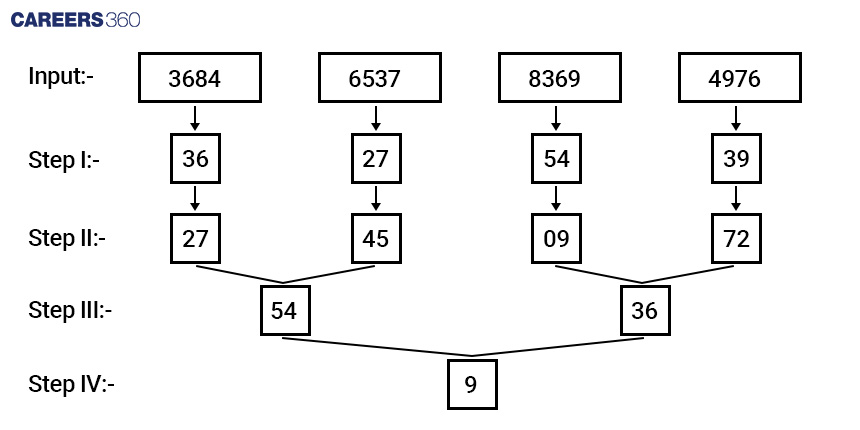
As per the rules followed in the steps given above, find out the appropriate steps for the given input:

Q1. What is the difference between the highest and lowest number in Step II?
33
9
48 (Correct)
24
None of these
Solution:
Following the above pattern the steps of the required input are as follows-
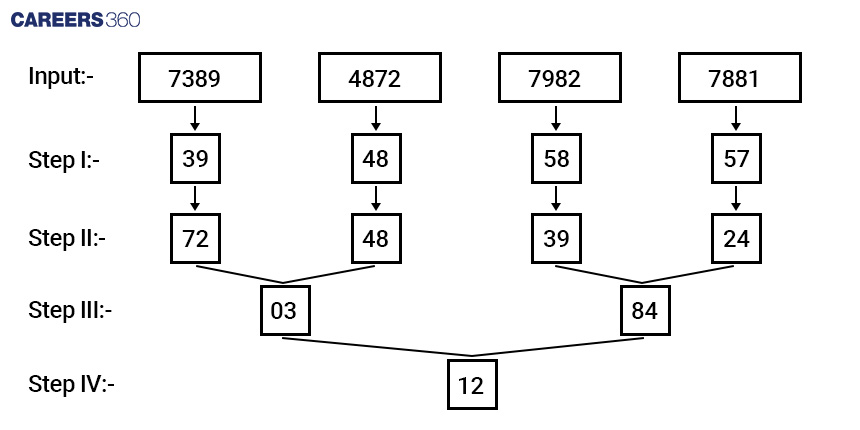
So, the difference between the highest and lowest number in Step II is 48. Hence, the third option is correct.
Q2. Which of the following will be the output in Step IV?
12 (Correct)
23
21
19
None of these
Solution:
Following the above pattern the steps of the required input are as follows-
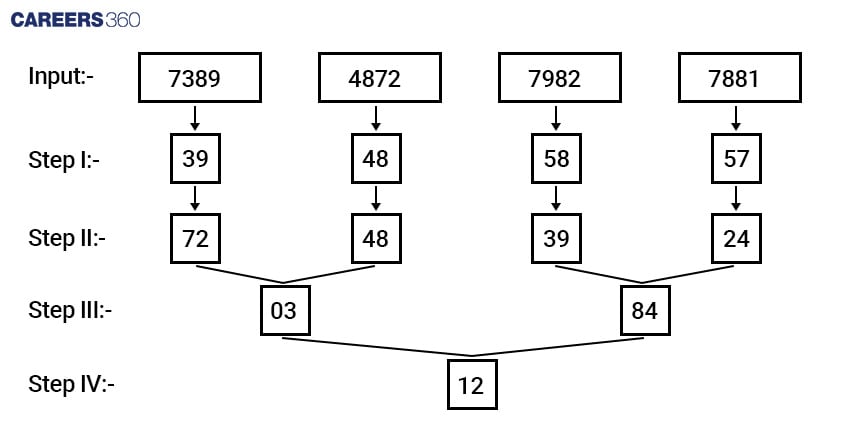
So, the output in Step IV will be 12. Hence, the first option is correct.
Q3. What will be the result when the highest number is divided by the lowest number in Step III?
24
28 (Correct)
32
18
None of these
Solution:
Following the above pattern the steps of the required input are as follows-
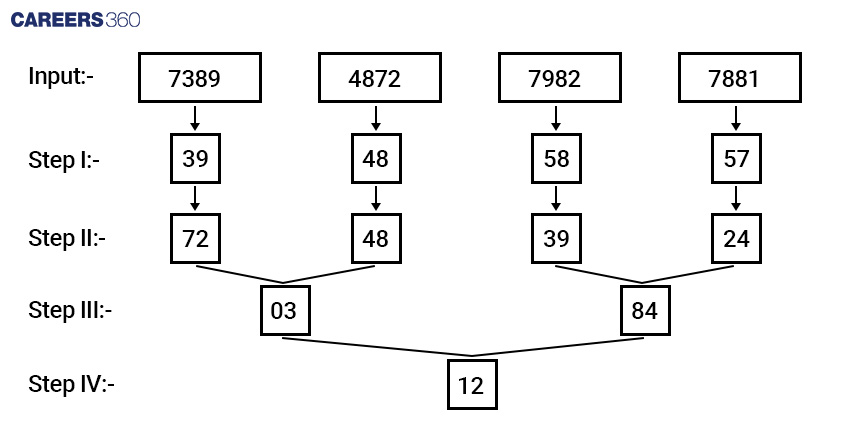
So, the result when the highest number is divided by the lowest number in Step III will be 28. Hence, the second option is correct.
Q4. What is the remainder when the highest number in Step I is divided by the lowest number in Step II?
9
3
13
15
None of these (Correct)
Solution:
Following the above pattern the steps of the required input are as follows-
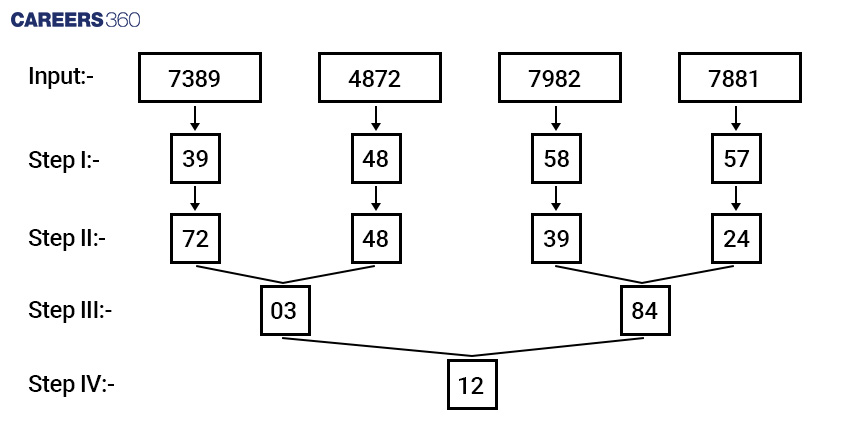
So, the remainder when the highest number in Step I is divided by the lowest number in Step II will be 10. Hence, the fifth option is correct.
Q5. What is the cube value of the final step?
2197
1331
9261
1728 (Correct)
None of these
Solution:
Following the above pattern the steps of the required input are as follows-
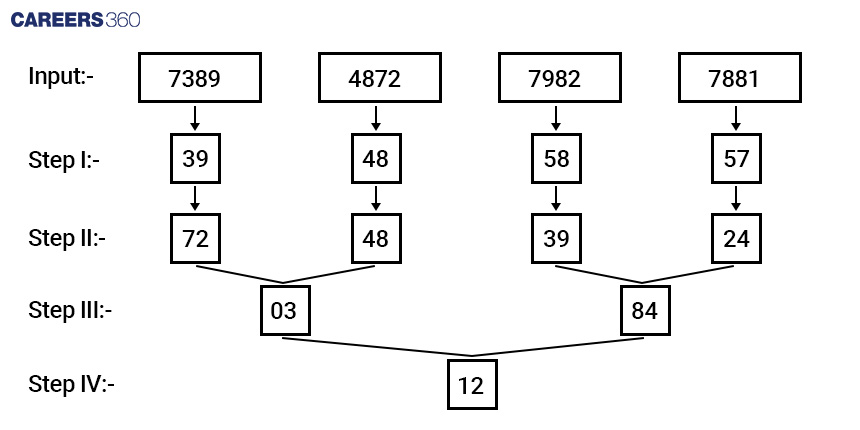
So, the cube of the final step will be 1728. Hence, the fourth option is correct.
Input Output Questions for CAT
Directions: (Q 1-4): A word and number arrangement machine when given an input line of words and numbers rearrange them following a particular rule in each step. The following is an illustration of input and rearrangement.
Input: chammy wonky 26 33 58 hardstem Bataan 65.
Step 1 : 65 C W 26 33 58 H B
Step 2 : 65 B C W 26 33 58 H
Step 3 : 65 B 58 C W 26 33 H
Step 4 : 65 B 58 C 33 W 26 H
Step 5 : 65 B 58 C 33 H 26 W
Step 6 : 65 B 58 C 33 H 26 W
As per the rule followed in the following questions the appropriate step for the given input:
Input : Determined Railway 16 38 47 Eenadu Apsrtc 55
Q-1) How many steps will be required to complete the rearrangement?
1) Three
2) Seven
3) Five
4) Six
5) Four
Solution
Write the first letters of the given problem.
Step 1 : 55 D R 16 38 47 E A
Step 2 : 55 A D R 16 38 47 E
Step 3 : 55 A 47 D R 16 38 E
Step 4 : 55 A 47 D 38 R 16 E
Step 5 : 55 A 47 D 38 E 16 R
Step 6 : 55 A 47 D 38 E 16 R
Therefore, six steps are required to complete the rearrangement. Hence, the fourth option is correct.
Q-2) Input : facebook snapdeal twitter 19 29 33 ezone 48 amazon 78
How many steps will be required to complete the re-arrangement?
1) Three
2) Four
3) Two
4) Six
5) Seven
Solution
Input : facebook snapdeal twitter 19 29 33 ezone 48 amazon 78
Write the first letters of the given problem.
Step 1 : 78 F S T 19 29 33 E 48 A
Step 2 : 78 A F S T 19 29 33 E 48
Step 3 : 78 A 48 F S T 19 29 33 E
Step 4 : 78 A 48 E F S T 19 29 33
Step 5 : 78 A 48 E 33 F S T 19 29
Step 6 : 78 A 48 E 33 F 29 S T 19
Step 7 : 78 A 48 E 33 F 29 S 19 T
So, seven steps are required to complete the rearrangement. Hence, the fourth option is correct.
Q-3) Input : whistle yahoo 21 speeder 32 17 48 torsion
Which of the following steps will be the last but one?
1) II
2) V
3) VI
4) VII
5) IV
Solution
Input : W Y 21 S 32 17 48 T
Step I : 48 W Y 21 S 32 17 T
Step II : 48 S W Y 21 32 17 T
Step III : 48 S 32 W Y 21 17 T
Step IV : 48 S 32 T W Y 21 17
Step V : 48 S 32 T 21 W Y 17
Step VI : 48 S 32 T 21 W 17 Y
Hence, the second option is correct.
Q-4) Step 4 of an input is : 77 addable 67 Cadiz 17 34 horni Denver
Which of the following is definitely the input?
1) addable Cadiz 17 77 67 34 horni Denver
2) 77 Cadiz addable 17 67 horni 34 Denver
3) Cadiz 77 addable 67 17 34 Denver horni
4) Cannot be Determined
5) addable Cadiz 77 67 17 34 horni Denver
Solution
Step I : addable Cadiz 77 67 17 34 horni Denver
Step II : 77 Cadiz addable 17 67 horni 34 Denver
Step III : Cadiz 77 addable 67 17 34 Denver horni
Step IV : Cannot be Determined
Hence, the fourth option is correct.
Input Output Questions for SBI PO/ IBPS PO/ IBPS RRB PO exams
Directions: Q (1-2): A word and number arrangement machine when given an input line of words and numbers rearrange them following a particular rule in each step. The following is an illustration of input and rearrangement.
Input: sequential 25 indigo at 83 whatsapp 52 tuner
Step 1: 25 sequential indigo at 83 whatsapp 52 tuner
Step 2: 25 whatsapp sequential indigo at 83 52 tuner
Step 3: 25 whatsapp 52 sequential indigo at 83 tuner
Step 4: 25 whatsapp 52 tuner sequential indigo at 83
Step 5: 25 whatsapp 52 tuner 83 sequential indigo at
As per the rule followed in the following questions the appropriate step for the given input.
Step III of an Input: apple 25 horse speed 86 52 trainer 68
Q-1) Which of the following will be Step VI?
1) apple speed 25 86 52 trainer 68 horse
2) apple 52 horse 25 speed 86 trainer 68
3) apple 25 horse 52 speed 86 trainer 68
4) apple 25 horse 52 speed 68 86 trainer
5) apple 25 horse 52 speed 68 trainer 86
Solution
Step I: apple speed 25 86 52 trainer 68 horse
Step II: apple 25 speed 86 52 trainer 68 horse
Step III: apple 25 horse speed 86 52 trainer 68
Step IV: apple 25 horse 52 speed 86 trainer 68
Step V: apple 25 horse 52 speed 68 86 trainer
Step VI: apple 25 horse 52 speed 68 trainer 86
Hence, the fifth option is correct.
Q-2) Input: someone headquarters 38 65 all margaret 85 58
How many steps will be required to complete the re-arrangement?
1) Three
2) Four
3) Five
4) Eight
5) Six
Solution
Input: someone headquarters 38 65 all margaret 85 58
Step I: 38 someone headquarters 65 all margaret 85 58
Step II: 38 someone 58 headquarters 65 all margaret 85
Step III: 38 someone 58 margaret headquarters 65 all 85
Step IV: 38 someone 58 margaret headquarters 65 85 all
Therefore, the four steps are required to complete the re-arrangement. Hence, the second option is correct.
Directions: (Q 3-5): A word and number arrangement machine when given an input line of words and numbers rearranges them following a particular rule in each step. The following is an illustration of input and rearrangement.
Input: some found 19 other 99 27 came 45
Step 1: came some found 19 other 99 27 45
Step 2: came 99 some found 19 other 27 45
Step 3: came 99 found some 19 other 27 45
Step 4: came 99 found 45 some 19 other 27
Step 5: came 99 found 45 other some 19 27
Step 6: came 99 found 45 other 27 some 19
Step 6 is the last step of the rearrangement of the above input.
As per the rules followed in the following questions the appropriate step for the given input:
Q-3) Input: mathematics hour for 18 against 89 21 47
Which of the following will be step 2?
1) against 89 hour mathematics for 18 21 47
2) against 18 mathematics 89 hour for 47 21
3) against 89 mathematics hour for 18 21 47
4) Can not be determined
5) against 89 mathematics 18 hour for 21 47
Solution
Step 1: against mathematics hour for 18 89 21 47
Step 2: against 89 mathematics hour for 18 21 47
Hence, the third option is correct.
Q-4) Input: 72 59 37 go for picnic 24 journey
How many steps will be required to complete the rearrangement?
1) Two
2) Four
3) Five
4) Six
5) Three
Solution
Step 1: 24 72 59 37 go for picnic journey
Step 2: 24 picnic 72 59 37 go for journey
Step 3: 24 picnic 37 72 59 go for journey
Step 4: 24 picnic 37 journey 72 59 go for
Step 5: 24 picnic 37 journey 59 72 go for
Step 6: 24 picnic 37 journey 59 go 72 for
Therefore, six steps are required to complete the rearrangement. Hence, the fourth option is correct.
Q-5) Input: nick flower 37 14 cost height 42 57
Which of the following will be step 3?
1) 37 nick 14 height flower cost 42 57
2) 14 nick 37 height 42 flower cost 57
3) 14 nick 37 flower cost height 42 57
4) 14 nick flower 37 cost height 42 57
5) 14 nick 37 height flower cost 42 57
Solution
Step 1: 14 nick flower 37 cost height 42 57
Step 2: 14 nick 37 flower cost height 42 57
Step 3: 14 nick 37 height flower cost 42 57
Hence, the fifth option is correct.
Best Books for Input-Output Reasoning Questions (SSC, Banking, RRB Exams)
This section lists the most recommended books to master input-output reasoning questions, including machine-based patterns, shortcut tricks, and practice sets to improve speed and accuracy in competitive exams.
| Book Name | Author | Best For | Key Features |
|---|---|---|---|
| A Modern Approach to Verbal & Non-Verbal Reasoning | R.S. Aggarwal | SSC, Banking, RRB | Covers a variety of input-output reasoning questions with clear concepts |
| Analytical Reasoning | M.K. Pandey | SSC CGL, CAT, Banking | Strong focus on logic building and advanced machine input-output questions |
| Magical Book on Puzzle & Reasoning | K. Kundan | SSC, Banking | Includes practice sets for input-output and puzzle reasoning questions |
| A New Approach to Reasoning | B.S. Sijwali & Indu Sijwali | SSC, Banking | Detailed explanations of input-output questions with answers |
| Logical Reasoning for CAT | Arun Sharma | CAT, Banking | Advanced level input-output reasoning questions for practice |
| Kiran SSC Reasoning Chapterwise | Kiran Publication | SSC CGL/CHSL | Previous year input-output questions PDF-style practice |
| Reasoning Ability for Bank PO & Clerk | Disha Experts | Banking Exams | Exam-focused practice with input-output tricks and shortcuts |
Non Verbal Reasoning Topics
For non-verbal reasoning read the topics below:
About the Faculty
Tanu Gupta, with over a decade of experience as a reasoning faculty, specializes in preparing students for various entrance examinations and career development. Her extensive work with multiple educational platforms and institutions has honed her expertise in logical and analytical thinking. Her dedication to innovative teaching methods ensures these articles provide practical insights and expert guidance.
Frequently Asked Questions (FAQs)
There are a total of three types of input-output i.e. Shifting-based, operation-based and box-based.
The level of the questions of input-output has been seen as moderate to difficult in the examinations.
In various Banking exams, such as SBI PO Mains, and IBPS PO Mains 5-10 questions on this topic are asked whereas in other competitive exams such as LIC, RRB, UPSC, State PSC exams, and CAT, 4-5 questions are asked from this topic.
Carefully analyze each step, identify the pattern, and apply input-output tricks to predict the next step or final output.
Focus on one element at a time, track changes step-by-step, and look for patterns like sorting, shifting, or grouping.
Input-output reasoning involves identifying patterns in a sequence where an input is transformed step by step into an output using a specific rule.
The output and input example is as follows:
Study the information given below and answer the following question:
Input: Treat Mouse Mobile Games Bag Box
Step I: Bag Treat Mouse Mobile Games Box
Step II: Bag Box Treat Mouse Mobile Games
Step III: Bag Box Games Treat Mouse Mobile
Step IV: Bag Box Games Mobile Treat Mouse
Step V: Bag Box Games Mobile Mouse Treat
And Step V is the final step.
Based on the pattern followed above, find the output for the given input:
Input: House Colony Yellow Bear Red White
Colony Yellow Bear Red White House
Red White House Colony Yellow Bear
Red White Yellow Bear House Colony
Bear Colony House Red White Yellow
House Red White Yellow Bear Colony
Here, the words given in the input are arranged in alphabetical order in the given steps from left to right. One word at a time is rearranged in the given steps.
Similarly, the step-by-step arrangement of the given input is as follows-
Step I: Bear House Colony Yellow Red White
Step II: Bear Colony House Yellow Red White
Step III: Bear Colony House Red Yellow White
Step IV: Bear Colony House Red White Yellow
So, the output for the given input is Bear Colony House Red White Yellow. Hence, the fourth option is correct.
The three methods of input-output are as follows:
1) Shifting-based
2) Operation-based
3) Box-based
In the main reasoning portion of the major competitive exams, including as the IBPS PO, IBPS Clerk, SBI PO, SBI Junior Associate, RRB Clerk, RRB Scale 1 Officer, NIACL AO, and others, sequential output tracing questions are commonly posed.
Almost not, is the response. The exam can only be passed in three months by a select few students who are exceptionally proficient in English and who also understand the fundamentals of reasoning and quants. They must also work very hard to pass the major tests. But it will be quite challenging for a typical candidate.
