


Arithmetical Problems: Meaning, Reasoning Questions, Examples
Have you ever solved a simple word problem involving ages, ratios, or numbers and realized it’s not just about calculation but also logic? That’s exactly what arithmetical problems in reasoning are all about. In competitive exams, arithmetical reasoning questions test your ability to understand numerical information, apply basic math concepts, and think logically at the same time. These questions may look straightforward, but they require careful interpretation and the right approach to solve quickly. In this article, we’ll cover the meaning of arithmetical problems, different types of arithmetical reasoning questions, and explain them with clear examples and tricks to help you improve speed and accuracy in exams. Arithmetic reasoning questions are generally seen in the SSC, Railways, Defence, CUET, JIPMAT, CLAT, MAH MBA CET, and Insurance exams.
This Story also Contains
- Arithmetical Problems in Reasoning: Meaning, Questions, Types, Tricks & Examples
- Types of Arithmetical Problems in Reasoning: Average, Percentage, Age & More
- Average Problems in Reasoning (Concept, Formula & Examples)
- Problems on Ages in Reasoning: Concepts, Formulas, Questions & Tricks
- Time and Work Problems in Reasoning: Concepts, Formulas, Questions & Tricks
- Simplification in Reasoning: Concepts, BODMAS Rule & Shortcut Methods
- 5. Time and Distance Problems in Reasoning
- 6. Percentage Problems in Reasoning
- 7. Ratio and Proportion Problems in Reasoning
- 8. Mensuration Problems in Reasoning
- 9. Profit and Loss Problems in Reasoning
- Arithmetic Questions with Answers
- Best Books for Arithmetical Reasoning & Arithmetic Problems Preparation (SSC, Banking, RRB Exams)
- Verbal Reasoning Topics
- Arithmetical Problems for SSC MTS/ SSC CHSL/ SSC Stenographer/ RRB exams
- Arithmetic Problems with Solutions PDF Download
- Arithmetical Problems for IBPS RRB Assistant/ IBPS CWE Clerical/ Insurance Assistant exams
- Non-verbal Reasoning Topics
Arithmetical Problems in Reasoning: Meaning, Questions, Types, Tricks & Examples
Arithmetical problems in reasoning combine basic mathematics with logical thinking to test how well you can interpret and solve number-based situations. In competitive exams, arithmetical reasoning questions often appear in the form of word problems, number relationships, and logical calculations. With regular practice of arithmetic problems reasoning questions with answers and the right arithmetic tricks, you can solve these questions quickly and accurately.
What are Arithmetical Problems in Reasoning? Definition and Basic Concept
Arithmetical problems in reasoning are questions where numerical data is given, and you need to apply basic arithmetic concepts along with logic to find the correct answer.
Understanding Arithmetical Reasoning with Easy Explanation
In arithmetical reasoning questions, you may encounter problems related to ages, ratios, percentages, averages, or number patterns. These questions are not just about calculation—they require proper understanding and logical interpretation of the given data.
Key Features of Arithmetic Problems in Reasoning
Combines mathematics and logical reasoning
Includes word problems and number-based questions
Requires concepts like ratio, percentage, average, and number system
Common in SSC, Banking, and other competitive exams
Importance of Arithmetical Reasoning Questions for SSC, Banking & Competitive Exams
Arithmetical reasoning is an important and scoring topic in the reasoning and aptitude sections of competitive exams.
Why Arithmetical Reasoning Questions are Important for Exams
Frequently asked in SSC CGL, CHSL, IBPS, SBI, and RRB exams
Tests both calculation skills and logical thinking
Helps improve speed in solving numerical problems
Why Arithmetic Problems are a Scoring Topic
Based on clear concepts and formulas
Can be solved quickly with proper arithmetic tricks and shortcuts
High accuracy possible with practice of arithmetical reasoning questions with answers
Role of Arithmetical Problems in Exam Strategy
Mastering arithmetical problems in reasoning helps you manage time efficiently and boosts your overall score. With consistent practice and application of arithmetic reasoning tricks, you can confidently solve questions in SSC, Banking, and other competitive exams.
Types of Arithmetical Problems in Reasoning: Average, Percentage, Age & More
In arithmetical reasoning questions, a variety of topics are asked to test your numerical and logical skills. Common areas include average problems, percentage, age-based questions, fractions, decimals, and mensuration. These topics frequently appear in SSC, Banking, and other competitive exams, making them essential for scoring well.
Overview of Common Arithmetic Topics in Reasoning Exams
Important Types of Arithmetic Problems Asked in Reasoning
Simplification (addition, subtraction, multiplication, division)
Average problems in reasoning
Age-based arithmetic problems
Percentage and ratio-based questions
Decimal and fraction problems
Basic mensuration questions
These topics form the core of arithmetical reasoning questions with answers in competitive exams.
Average Problems in Reasoning (Concept, Formula & Examples)
Average problems in reasoning are among the most frequently asked questions in exams like SSC, Banking, and RRB.
What is Average? Definition in Arithmetic Reasoning
The average is defined as the mean value obtained by dividing the total sum of observations by the number of observations.
Important Formulas for Average in Reasoning Questions
Basic Average Formula
$\text{Average} = \frac{\text{Sum of Observations}}{\text{Number of Observations}}$
Average Speed Formula
$\text{Average Speed} = \frac{2ab}{a + b}$
(Used when equal distances are covered at speeds $a$ and $b$)
Arithmetic Problems Examples (Average Questions with Solutions)
Example 1: Average of First Natural Numbers
Find the average of the first 50 natural numbers.
Solution:
Sum of first $n$ natural numbers = $\frac{n(n+1)}{2}$
So,
$\frac{50 \times 51}{2} = 1275$
Average = $\frac{1275}{50} = 25.5$
Example 2: Average Weight Problem in Reasoning
There are two sections C and D with 40 and 44 students. Their average weights are 44 kg and 55 kg respectively. Find the average weight of the whole class.
Solution:
Total weight = $(40 \times 44) + (44 \times 55) = 1760 + 2420 = 4180$
Total students = $40 + 44 = 84$
Average = $\frac{4180}{84} = 49.76 , \text{kg}$
Why Average Problems are Important for Competitive Exams
Frequently asked in arithmetical reasoning questions for SSC and Banking exams
Easy to solve with formulas and practice
Helps improve calculation speed and accuracy
Problems on Ages in Reasoning: Concepts, Formulas, Questions & Tricks
Age-based arithmetical reasoning questions are very common in SSC, Banking, and other competitive exams. These questions test your ability to form equations and apply logic to find unknown ages. Although age problems in reasoning may seem confusing at first, with proper understanding of concepts and regular practice, they become easy and scoring.
Basic Concept of Age Problems in Reasoning (Important Rules & Logic)
To solve problems on ages in reasoning, you need to understand how ages change with time and how they are represented mathematically.
Key Concepts Used in Age-Based Arithmetic Problems
If age is given in ratio (e.g., $a : b$), assume ages as $ax$ and $bx$
If present age = $x$, then age after $n$ years = $x + n$
If present age = $x$, then age $n$ years ago = $x - n$
These concepts are essential for solving arithmetical reasoning questions based on ages.
Techniques to Solve Age Problems in Reasoning Questions (Step-by-Step Method)
A structured approach helps in solving age-related reasoning questions quickly and accurately.
Step-by-Step Method to Solve Age-Based Questions
Step 1: Read the Question Carefully
Understand all given conditions, relationships, and time references in age problems in reasoning questions.
Step 2: Assume Variables for Unknown Ages
Let unknown ages be represented by variables like $x$ or $y$. This simplifies solving arithmetic problems in reasoning.
Step 3: Form Mathematical Equations
Convert the given information into equations based on age relationships. This is the most important step in solving age-based arithmetic reasoning questions.
Step 4: Solve the Equation and Verify
Find the value of the variable and check whether it satisfies all conditions given in the question.
Example of Age Problem in Reasoning (Solved Question)
Example:
The ratio of ages of A and B is $3 : 4$. After 5 years, their ratio becomes $4 : 5$. Find their present ages.
Solution:
Let present ages be $3x$ and $4x$
After 5 years:
$3x + 5$ and $4x + 5$
According to the question:
$\frac{3x + 5}{4x + 5} = \frac{4}{5}$
$5(3x + 5) = 4(4x + 5)$
$15x + 25 = 16x + 20$
$x = 5$
So, present ages:
A = $15$ years, B = $20$ years
Tips to Master Age Problems in Reasoning
Practice regularly with arithmetical reasoning questions with answers
Focus on forming correct equations
Avoid confusion between past and future age conditions
Start with simple problems and gradually move to complex ones
Example:
Directions: The sum of the present ages of Vishal and Aditi is 105 years. If Aditi is 25 years younger than Vishal, then what will be the present age of Pritam, who is 7 years older than Adit?
1) 40 years
2) 72 years
3) 32 years
4) 47 years
Solution:
Given:
(I) The sum of the present ages of Vishal and Aditi is 105 years.
(II) If Aditi is 25 years younger than Vishal
According to the statements –
(I) V's age + A's age = 105
(II) A's age = V's age – 25
⇒V's age = A's age + 25 (Put the value of V's age in equation I)
⇒A's age + 25 + A's age = 105
2 × A's age + 25 = 105
2 × A's age = 80
A's age = 40
Pritam's age = 7 + A's age; Pritam's age = 7 + 40 = 47
So, the present age of Pritam is 47 years. Hence, the fourth option is correct.
Time and Work Problems in Reasoning: Concepts, Formulas, Questions & Tricks
Time and work problems in reasoning are an important part of arithmetical reasoning questions asked in SSC, Banking, and other competitive exams. These questions focus on calculating the time taken by a person or group to complete a task and their efficiency. With proper understanding of time and work formulas and regular practice, these questions become easy and scoring.
Basic Concept of Time and Work in Arithmetic Reasoning
To solve time and work reasoning questions, you need to understand the relationship between work, time, and efficiency.
Key Concepts in Time and Work Problems
$\text{Work (W)} = \text{Time (T)} \times \text{Rate of Work (R)}$
Rate of work = work done per unit time
$\text{Rate (R)} = \frac{1}{\text{Time (T)}}$
Important Relationship in Time and Work
Time and efficiency are inversely proportional
More efficiency → less time
Less efficiency → more time
These concepts are essential for solving arithmetical reasoning questions based on time and work.
Important Formulas for Time and Work Problems in Reasoning
Basic Time and Work Formulas
If a person completes work in $n$ days → one day’s work = $\frac{1}{n}$
If one day’s work = $\frac{1}{n}$ → total time = $n$ days
Efficiency and Work Ratio Concepts
If X is twice as efficient as Y:
Work ratio = $2 : 1$
Time ratio = $1 : 2$
If ratio of workers = $A : B$
Time ratio = $B : A$
Combined Work Formula (Men, Days & Hours)
If:
$M_1$ people complete $W_1$ work in $D_1$ days working $T_1$ hours/day
$M_2$ people complete $W_2$ work in $D_2$ days working $T_2$ hours/day
Then:
$\frac{M_1 \times D_1 \times T_1}{W_1} = \frac{M_2 \times D_2 \times T_2}{W_2}$
This formula is useful in solving complex time and work reasoning questions.
Techniques to Solve Time and Work Questions in Reasoning (Step-by-Step)
Step-by-Step Method to Solve Time and Work Problems
Read the question carefully and identify given data
Convert work into unit form (usually 1 unit)
Calculate individual or combined efficiency
Use formulas to find required time or work
Verify the final answer
Example of Time and Work Problem in Reasoning (Solved)
Example:
A can complete a work in 10 days and B can complete it in 15 days. In how many days can they complete the work together?
Solution:
A’s one-day work = $\frac{1}{10}$
B’s one-day work = $\frac{1}{15}$
Combined work per day = $\frac{1}{10} + \frac{1}{15} = \frac{3 + 2}{30} = \frac{5}{30} = \frac{1}{6}$
Total time = $6$ days
Arithmetic problems examples:
Example: Raju and Ramu together can do a piece of work in 8 days, and Raju alone can do it in 12 days. In how many days can Ramu alone do it?
1) 18 days
2) 20 days
3) 22 days
4) 24 days
Solution:
If a man can do the work in n days, then 1 day's work of the man is 1/n.
Raju and Ramu together can do a piece of work in 8 days.
Their 1 day's work = 1/8
Raju alone can do it in 12 days.
Raju's 1 day's work = 1/12
So, Ramu's 1 day's work = 1/ 8 - 1/ 12 = 1/24
Therefore, Ramu can complete the work alone in 24 days. Hence, the correct answer is 24 days.
Example: A, B, and C are employed to do a piece of work for INR 5,290. A and B together are supposed to do 19/23 of the work and B and C together 8/23 of the work. Then A should be paid:
1) INR 4,250
2) INR 3,450
3) INR 1,950
4) INR 2,290
Solution:
Part of the work done by A and B together = 19/23 of the total work
Part of the work done by B and C together = 8/23 of the total work
Part of the work done by A alone
= Total work – Part of work done by B and C together
= (1 – 8/23) of total work
= 15/23 of total work
Total wages = INR 5,290
So, the wage of A = 15/23 × 5290 = INR 3,450
Hence, the correct answer is INR 3,450
Simplification in Reasoning: Concepts, BODMAS Rule & Shortcut Methods
Simplification in reasoning is an important part of arithmetical reasoning questions, where you are required to evaluate numerical expressions quickly and accurately. These questions are commonly asked in SSC, Banking, and other competitive exams and can be solved easily using the BODMAS rule and basic arithmetic concepts.
What is Simplification in Reasoning? (Definition & Concept)
Simplification refers to solving or evaluating a numerical expression by applying the correct order of operations.
Understanding Simplification in Arithmetic Reasoning
In simplification questions, you may be given expressions involving addition, subtraction, multiplication, division, and brackets. The goal is to find the correct value using logical steps and arithmetic rules.
Importance of Simplification Questions in Competitive Exams
Frequently asked in SSC, Banking, and entrance exams
Usually 1–2 questions appear in reasoning or aptitude sections
Easy to solve and highly scoring with proper practice
Methods to Simplify Numerical Expressions (BODMAS Rule Explained)
BODMAS Rule in Simplification (Core Concept)
The BODMAS rule defines the correct order of operations to solve numerical expressions.
BODMAS Stands For:
B – Brackets
O – Of
D – Division
M – Multiplication
A – Addition
S – Subtraction
Correct Order to Solve Simplification Questions
Solve brackets in the order:
$() \rightarrow {} \rightarrow []$Then apply operations in this sequence:
Of → Division → Multiplication → Addition → Subtraction
Example of Simplification in Reasoning (Solved)
Example:
$20 + 6 × (5 + 3)$
Solution:
First solve bracket:
$(5 + 3) = 8$
Now:
$20 + 6 × 8 = 20 + 48 = 68$
Arithmetic problem-solving examples :
Example:
Directions: On a farm, there are 48 ducks, 42 goats, and 10 cows with some attendants. If the total number of feet is 216 more than the number of heads, what is the number of attendants on the farm?
1) 10
2) 14
3) 8
4) 12
Solution:
Given:
Number of Ducks = 48, Goats = 42 goats, Cows = 10 cows
Let the number of attendants be a.
Total number of feet of 48 ducks = 48 × 2 = 96
Total number of feet of 42 goats = 42 × 4 = 168
Total number of feet of 10 cows = 10 × 4 = 40
Total number of feet of a attendants = 2 × a = 2a
Each one has one head.
Total Heads = 48 + 42 + 10 + a = 100 + a
Total feet = 96 + 168 + 40 + 2a = 304 + 2a
Now according to the given question,
Total number of feet = Total number of heads + 216
(304 + 2a) = (100 + a) + 216
304 + 2a = 100 + a + 216
304 + 2a = 316 + a
2a – a = 316 – 304
a = 12
So, the total number of attendants on the farm is 12. Hence, the fourth option is correct.
Example:
Question: What is the value of (1665 ÷ 37) + (42 × 5)?
1) 295
2) 270
3) 255
4) 285
Solution:
Given, (1665 ÷ 37) + (42 × 5)
= 45 + 210
= 255
Hence, the correct answer is 255.
5. Time and Distance Problems in Reasoning
Speed, Time and Distance is one of the most important chapters. It tells us the distance covered by an object in a certain time at a certain speed or vice versa. In reasoning mostly one question is seen in the competitive exams. The basic question from this chapter is asked in the logical reasoning section which is solved by putting the values in the formulae. The formulas are discussed below.
Understanding the Relationship Between Time, Speed, and Distance
1) Speed = Distance/ Time
The relation between the above terms tells us how slow or fast an object moves. It defines the distance travelled by the time taken to cover the distance.
2) Speed is directly proportional to the distance travelled and inversely proportional to the time.
Therefore, Distance = Speed x Time
Time = Distance/ Speed
3) The speed, distance and time can be expressed in different units such as:
Distance: meters (m), kilometers(km), miles, feet
Time: seconds (s), minutes (min), hours (hr)
Speed: m/s, km/hr
Note: If the units of distance and time are equal to km and hr, then Speed will be km/hr as Speed = Distance/ Time
Formulas to Solve Time and Distance Problems in Reasoning
1) Speed = Distance/ Time
2) Time = Distance/ Speed
3) Distance = Speed x Time
4) a km/ hr = a x 5/18 m/ sec
5) b m/ sec =b x 18/ 5 km/hr
6) If the ratio of the speeds of X : Y, then the ratio of the time taken by them to cover the same distance is equal to 1/X : 1/Y or Y : X
7) Suppose a person covers a certain distance at a km/hr and an equal distance at b km/ hr. Then the average speed during the whole journey is (2ab/ a + b) km/hr
Example:
Directions: A person covers a certain distance in 6 hours if he travels at 40 km/hr. If he has covered the same distance in 4 hours, then his speed must be:
1) 50 km/hr
2) 60 km/hr
3) 80 km/hr
4) 70 km/hr
Solution:
The person covers a certain distance in 6 hours if he travels at 40 km/hr.
Speed = Distance/ Time
Distance covered in 6 hours = 6 × 40 = 240 km
To cover the same distance in 4 hours, then his speed must be
240/ 4 = 60 km/hr
Hence, the correct answer is 60 km/hr.
6. Percentage Problems in Reasoning
Percentage is defined as the number, amount, rate, etc of something expressed as if it is part of a total which is a hundred or a part or share of a whole or a percentage is a number or ratio that can be expressed as a fraction of 100. In reasoning, easy percentage problem is asked in various competitive and entrance exams. Mostly, one question is asked in the reasoning section of this concept.
Percentage Concepts
The word Percentage is derived from the Latin word “per centum” which means by the hundred.
The sign of percentage is %. For example: If we say 7%, then it is equal to 7/100 = 0.07
By a certain percentage, we mean that many hundredths. Therefore, a per cent means a hundredths, which is denoted by a%
1) To express a % as a fraction: a % = a /100
Therefore, 30% = 30/ 100 = 0.3, 56% = 56/100 = 0.56
2) To express a/b as a percent: a/b = (a/b x 100)%
Therefore, ¼ = (¼ x 100)% = 25%
Methods to Solve Percentage-Related Problems in Reasoning
1) First of all, write the percentage as a decimal or a fraction. Then divide the fraction or decimal by the part. This method is implemented in any situation in which the percentage and its value are given.
2) The three components of a per cent problem are Base, Rate, and Part.
Here Base = whole, total number of parts, Rate = a per cent, Part = part of the base
Rate = Part/ Base
Percentage(%) = Number of Parts/ Total number of parts
Arithmetic problems examples:
Example:
Directions: A student has to obtain 40% of the maximum marks to pass. If she scored 80 marks and yet failed by 20 marks, then what were the maximum marks?
1) 220
2) 250
3) 300
4) 200
Solution:
Given:
Let maximum marks = x
Passing marks = 40% = 0.4 x → (i)
Marks scored = 80
Remaining marks to pass = 20
Passing marks = 80 + 20 = 100 → (ii)
Equation (i) and (ii),
0.4 x = 100
x = 100 ÷ 0.4
x = 1000 ÷ 4
x = 250
So, the maximum mark is 250. Hence, the second option is correct.
Example:
Directions: The value of a certain product depreciates at the rate of 20% every year. It was purchased 3 years ago. If its present value is INR 10,000, then what was the approximate purchase price of the product?
1) INR 15,237
2) INR 19,531
3) INR 18,145
4) INR 25,000
Solution:
Let the purchasing value of the product 3 years ago = P
Depreciation rate = 20% every year
Time = 3 years
Equivalent depreciation rate for 3 years –
Equivalent rate for 2 years = (20 + 20) - {(20 × 20) ÷ 100} = 40 – (400 ÷ 100) = 40 – 4 = 36%
Equivalent rate of 36% and 20% = (36 + 20) – {(36 × 20) ÷ 100} = 56 – (720 ÷ 100) = 56 – 7.2 = 48.8%. Thus, the product value has been depreciated by 48.8% in 3 years
Remaining value = 100 – 48.8 = 51.2%
Present value = Rs. 10,000
51.2% of P = (51.2 ÷ 100) × P
Similarly,
51.2% of 10,000 = 10,000 ÷ 0.512 P
= 19531.25 ~ 19531
Thus, the product's value 3 years ago was Rs. 19531. Hence, the second option is correct.
7. Ratio and Proportion Problems in Reasoning
A comparison of two quantities by division is called a ratio and the equality of two ratios is called proportion. A ratio can be represented in different forms such as a : b or a/b whereas the proportion is defined as an equation which says that two ratios are equal. In logical reasoning, one question is seen in various competitive and entrance exams. The basic concept-based questions are asked in the reasoning from this topic.
Definition and Properties of Ratio
Ratio defines the relationship between the quantities of two or more objects. The ratio of two quantities x and y in the same units is the fraction x/y and we write it as x : y.
In the ratio x : y. The first term x is called antecedent and the second term y is called consequent.
Example: The ratio 6 : 7 represents 6/7 with antecedent = 6; Consequent = 7
Note: The multiplication or division of each term of a ratio by the same non-zero number does not affect the ratio.
Proportion is defined as the equality of two ratios. If a : b = c : d, we write it as a : b :: c : d and we say that a, b, c, d are in proportion.
Here, a and d are called extremes, while b and c are called mean terms.
The product of the means = The product of the extremes
Therefore, a : b :: c : d and (b x c) = (a x d)
Techniques to solve ratio-related reasoning questions
1) First of all determine the known and the unknown ratio.
2) In the second step, set up the proportion or find the value of one part by dividing the comparison value by the number of parts given.
3) Cross-multiply the values and solve.
4) If you want to check the answer you can check by plugging the result into the unknown ratio.
Arithmetic problem-solving examples
Example:
Directions: One day, 90 students were travelling in a bus and the ratio of the number of boys to girls was 2: 1. The next day, the number of students remained the same, but the ratio of the number of boys to girls became 3: 2. What was the difference between the numbers of boys travelling in the bus on both the days?
1) 18
2) 6
3) 14
4)30
Solution:
90 students were travelling in a bus, and the ratio of the number of boys to that of girls was 2: 1
According to the question,
2x + x = 90
3x = 90
x = 90 ÷ 3
x = 30
Therefore, Number of Boys = 60, Number of Girls = 30;
The next day, the number of students remained the same, but the ratio of the number of boys to that of girls became 3: 2
3x + 2x = 90
5x = 90
x = 90 ÷ 5
x = 18
Therefore, the Number of Boys = 54, The Number of Girls = 36
So the difference between the numbers of boys travelling in the bus = 60 – 54 = 6
Therefore, the difference between the numbers of boys travelling on the bus on both days is 6. Hence, the second option is correct.
8. Mensuration Problems in Reasoning
Mensuration is defined as the branch of mathematics that studies the measurement of geometric figures and their other parameters, such as area, volume, length, breadth, surface area, etc. In reasoning, basic formula-based questions are asked about this topic. Mostly, 1 - 2 questions are asked in various competitive and entrance exams. You should learn formulae to solve mensuration questions in logical reasoning.
Formulas Related to Mensuration Problems
1) Area of Rectangle = Length x Breadth
2) Perimeter of Rectangle = 2 (Length + Breadth)
3) Area of a square = (side)2 = 1/2(diagonal)2
4) Area of walls of a room = 2 (Length + Breadth) x Height
5) Area of a triangle = ½ x Base x Height
6) Area of parallelogram = Base x Height
7) Area of rhombus = ½ x (Product of diagonals)
8) Area of trapezium = ½ x (sum of parallel sides) x distance between them
9) Volume of cuboid = (Length x Breadth x Height) cubic units
10) Surface area of cuboid = 2 (lb + bh + lh) sq.units
11) Volume of cube = a3 cubic units
12) Surface area of cube = 6a2 sq.units
(Note: In logical reasoning, formula-based questions are asked from this topic. So, you should learn the formulas to attempt the questions easily.)
Arithmetic problems example:
Question: If one side of a square is 6 cm, then what will be its area and perimeter?
Solution:
Given:
Length of side of square = 6 cm
Area = side2 = 62 = 36 cm2
Perimeter = Sum of all sides or 4 x side
= 6 + 6 + 6 + 6 = 24 cm
9. Profit and Loss Problems in Reasoning
Profit and Loss are used to identify the price of an article in the market and to determine the profit of a business. Each article has a cost price and a selling price. Based on these, you can calculate the profit or loss incurred for a particular article. Profit and Loss are asked in almost all competitive and entrance exams. In the reasoning section, formula-based questions are mostly seen in the exams.
Profit and Loss Concepts
1) Cost Price (C.P.) - The price at which the article is purchased is called its cost price
2) Selling Price (S.P.) - The price at which the article is sold is called its selling price.
3) Profit or Gain - If the selling price is greater than the cost price, the seller is said to have a profit or gain.
4) Loss - If the selling price is less than the cost price, the seller is said to have incurred a loss.
Formulae of Profit and Loss
1) Profit/ Gain = S.P - C.P.
2) Loss = C.P. - S.P.
3) Gain% / Profit % = (Gain x 100/ C.P.)
4) Loss % = (Loss x 100 / C.P.)
5) If an article is sold at a profit of 25%, then S.P. = 125% of C.P.
6) If an article is sold at a loss of 25%, then S.P. = 75% of C.P.
7) S.P. =(100+Gain%)100× C.P.
8) S.P. =(100− Loss %)100× C.P.
9) C.P. =100(100+Gain%)× S.P.
10) C.P. =100(100−Loss%)× S.P.
Example:
Directions: A man bought 30 defective machines for INR 1,000. He repaired and sold them at a rate of INR 300 per machine. He made a profit of INR 150 per machine. How much did he spend on repairs?
1) INR 5,500
2) INR 4,500
3) INR 3,500
4) INR 2,500
Solution:
Use the formula:
Repair cost = selling price – profit – cost price.
The cost price of 30 defective machines = INR 1,000
The selling price of 1 machine = INR 300
Total selling price = INR 300 × 30 = INR 9,000
Profit per machine = INR 150
Total profit = INR 150 × 30 = INR 4,500
Repair cost = selling price – profit – cost price.
= 9,000 – 4,500 – 1,000
= INR 3,500
Hence, the correct answer is INR 3,500.
Arithmetic Questions with Answers
1) Directions: A man was 32 years of age when he had his first son. His wife was 35 years of age when his son attained the age of 7 years. The difference in age between the man and his wife is?
1) 7 years
2) 3 years
3) 5 years
4) 4 years
Solution:
According to the question –
The age of the wife when her son was born was (35 – 7) = 28 years
But, the age of the man was 32 years old when his son was born.
Therefore, the difference in age between the man and his wife is (32 – 28) = 4 years.
So, the difference in age between the man and his wife is 4 years. Hence, the fourth option is correct.
2) Directions: Hari is twice as old as Johnny, who is three years older than Rahul. If Hari's age is five times Rahul's age, how old is Johnny?
1) 2 years
2) 4 years
3) 5 years
4) 8 years
Solution:
Let the ages of Hari, Johnny, and Rahul be H, J, and R, respectively.
Hari is twice as old as Johnny ⇒ H = 2 × J (1st equation)
Johnny is three years older than Rahul ⇒ R + 3 = J
⇒ R = J – 3 (2nd equation)
Hari's age is five times Rahul's age ⇒ H = 5 × R (3rd equation)
Putting the value of R from the second equation in the above equation, the equation becomes –
⇒ H = 5 × (J – 3)
But, H = 2 × J (1st equation)
So, 5 × (J – 3) = 2 × J
⇒ 5 × J – 15 = 2 × J
⇒ 3 × J = 15
⇒ J = 5
So, the age of Johnny is 5 years. Hence, the third option is correct.
3) Directions: A father's age is one more than 5 times his son's age. After 3 years, the father's age would be 2 less than four times the son's age. Find the present age of the father.
1) 30 years
2) 40 years
3) 31 years
4) 29 years
Solution:
Let the present age of the father and son be F and S years respectively.
The father's present age is 1 more than 5 times his son's age ⇒ F = (5 × S) + 1
Father's age after 3 years = (5 × S) + 4
Son's age after 3 years = S + 3
After 3 years, the father's age would be 2 less than four times the son's age.
⇒ (5 × S) + 4 = 4 × (S + 3) – 2
⇒ (5 × S) + 4 = (4 × S) + 12 – 2 = (4 × S) + 10
⇒ S = 6
⇒ F = (5 × S) + 1
= 5 × 6 + 1 = 30 + 1 = 31 years.
So, the present age of the father is 31 years. Hence, the third option is correct.
4) Directions: The average age of 19 boys in a class is 21 years. If the teacher's age is included, the average increases to 22 years. What is the teacher's age?
1) 39 years
2) 41 years
3) 40 years
4) 44 years
Solution:
The average age of the 19 boys in a class is 21 years.
Average⇒(Sum of ages of 19 boys) ÷ 19 = 21
So, the sum of the ages of 19 boys = 19 × 21 = 399
The average age of the 19 boys and the teacher is 22 years.
Average (including teacher's age)⇒(Sum of ages of 19 boys + Age of the teacher) ÷ 20 = 22
⇒(Sum of ages of 19 boys + Age of the teacher) = 22 × 20 = 440
Substitute the sum of the ages of 19 boys by 399 (calculated above)
⇒399 + (Age of the teacher) = 22 × 20 = 440
⇒Age of the teacher = 440 – 399 = 41 years
So, the age of the teacher is 41 years. Hence, the second option is correct.
5) Directions: In a family, Mr. Prakash has his wife and his two married brothers, of whom one has two children and another has no child. How many members are there in the family?
1) 12 members
2) 8 members
3) 6 members
4) 10 members
Solution:
Mr. Prakash and his wife constitute 2 members.
Mr. Prakash has two married brothers. These constitute 4 members (His 2 brothers and their wives).
Also, one of the two married brothers has two children. These constitute 2 members.
So, the total members in the family are 2 + 4 + 2 = 8
Hence, the second option is correct.
6) Directions: Two persons, A and B get the same salary. Their basic pay is different. The allowances are 65% and 80% of the basic pay, respectively. What is the ratio of the basic pay?
1) 17 : 15
2) 7 : 5
3) 11 : 10
4) 12 : 11
Solution:
Two persons A and B get the same salary.
Their basic pay is different.
The allowances are 65% and 80% of the basic pay, respectively.
Let's consider that A's basic pay is X and B's is Y.
As per the given details,
Allowances of A = 65% of basic pay
Salary of A = X + 65% of X
⇒ X + (65 ÷ 100) × X
⇒ X + (65X) ÷ 100
⇒ (100X + 65X) ÷ 100
⇒ 165X ÷ 100
Allowances of B = 80% of basic pay
Salary of B = Y + 80% of Y
⇒ Y + (80 ÷ 100) × Y
⇒ Y + (80Y) ÷ 100
⇒ (100 + 80Y) ÷ 100
⇒ 180Y ÷ 100
Again, it is given that both salaries are equal.
Therefore,
165X ÷ 100 = 180Y ÷ 100
⇒ 165X = 180Y (cancelling 100 on both sides denominators)
⇒ X ÷ Y = 180 ÷ 165
⇒ X : Y = 180 : 165
⇒ X : Y = 12 : 11
So, the ratio of the basic pay is 12 : 11. Hence, the fourth option is correct.
7) Directions: Six regular hexagons of side 5 cm are joined together to form the figure given below. What is the perimeter of the figure?
1) 210
2) 180
3) 120
4) 240
Solution:
Given:
The side of a regular hexagon is 5cm.
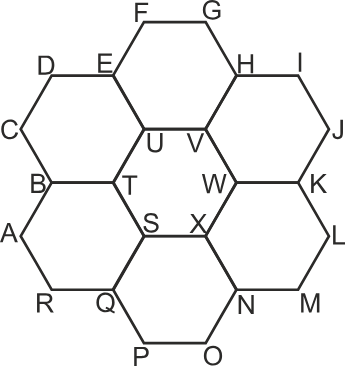
The perimeter of a given figure(P) = (Total length of the external boundary) + (Total length of the internal boundary)
P = (AB + BC + CD + DE + EF + FG + GH + HI + IJ + JK + KL + LM + MN + NO + OP + PQ + QR + RA) + (ST + TU + UV + VW + WX + XS)
P = (5 + 5 + 5 + 5 + 5 + 5 + 5 + 5 + 5 + 5 + 5 + 5 + 5 + 5 + 5 + 5 + 5 + 5) + (5 + 5 + 5 + 5 + 5 + 5)
P = 90 + 30
P = 120
Therefore, 120 is the perimeter of the given figure. Hence, the third option is correct.
8) Directions: If in a business, Alok gains 75% more profit than Akash, then by what percentage profit of Akash is less than the profit of Alok?
1) 25%
2) 12.63%
3) 30.8%
4) 42.85%
Solution:
Given:
In a business, Alok gains 75% more profit than Akash.
Let us assume that Akash makes a profit of ₹ 100
The profit of Alok is 75% more than Akash.
Hence, profit of Akash = 100 + (75/100 × 100) = 100 + 75 = 175
So, profit earned by Alok over Akash = 175 – 75 = 75
% Profit earned by Alok over Akash = {(more profit earned by Alok) / total profit earned by Alok } × 100
= [(75 ÷ 175) × 100] %
= 0.42857 × 100%
= 42.85 %
Therefore, Akash earns 42.85% less profit than Alok. Hence, the fourth option is correct.
9) Directions: A total of 60 students are travelling in a bus. The ratio of the number of boys to that of girls is 2 : 1. Then, 15 boys get down 5 girls get on the bus at the first stop, 5 boys get in and 10 girls get down from the bus at the second stop. What is the ratio of the number of boys to that of girls in the bus after the second stop?
1) 3 : 2
2) 2 : 1
3) 2 : 3
4) 3 : 1
Solution:
Given:
A total of 60 students are travelling in a bus. The ratio of the number of boys to that of girls is 2 : 1
2x + x = 60; 3x = 60; x = 60 ÷ 3; x = 20
Thus, Number of Boys = 2x = 40; Number of Girls = x = 20
Then, 15 boys get down and 5 girls get on the bus at the first stop
The remaining boys after the first stop; 40 – 15 = 25
The remaining girls after the first stop; 20 + 5 = 25
At the second stop, 5 boys get in and 10 girls get down from the bus.
The remaining boys after the second stop; 25 + 5 = 30
The remaining girls after the second stop; 25 – 10 = 15
So, the ratio of Boys: Girls = 30 : 15; 2 : 1. Hence, the second option is correct.
10) Directions: The sum of a number's square, its cube, and its next number's cube is 205. What is the number?
1) 3
2) 5
3) 4
4) 6
Solution:
Given:
x2 + x3 + (x + 1)3 = 205
By using the above equation let's check the option –
First option: 3; 32 + 33 + (3 + 1)3 = 9 + 27 + 64 = 100 ≠ 205
Second option: 5; 52 + 53 + (5 + 1)3 = 25 + 125 + 216 = 366 ≠ 205
Third option: 4; 42 + 43 + (4 + 1)3 = 16 + 64 + 125 = 205
Fourth option: 6; 62 + 63 + (6 + 1)3 = 36 + 216 + 343 = 595 ≠ 205
So, the sum of the 4's square, its cube, and its next number's cube is 205. Hence, the third option is correct;
11) Directions: When a number is added to its next number and another number that is four times its next number, the sum of these three numbers is 95. Find the number.
1) 16
2) 14
3) 17
4) 15
Solution:
Let, the number be x
According to the question –
x + (x + 1) + 4(x + 1) = 95
By solving the above equation –
6x + 5 = 95
6x = 95 – 5
6x = 90
x = 90 ÷ 6 = 15
So, the number is 15. Hence, the fourth option is correct.
12) Directions: A man bought 25 crates of oranges for INR 10,000. He lost five crates. In order to earn a total profit of 25% of the total cost, he would have to sell each of the remaining crates at:
1) INR 650
2) INR 625
3) INR 600
4) INR 575
Solution:
The cost price of 25 crates of oranges = INR 10,000
Total profit = 25% of total cost = 25% of INR 10,000 = INR 2,500
The selling price of 25 crates of oranges = cost price + total profit
= INR 10,000 + INR 2,500
= INR 12,500
Number of crates of oranges sold = 25 – 5 = 20
⇒ Selling price per crate = 12,500/20 = INR 625
Hence, the correct answer is INR 625.
13) Directions: A rides his bicycle at 15 km/hr, while B starts his ride after 6 hours to catch A at a speed of 25 km/hr. Time taken by B to catch A (in hours) is:
1) 9
2) 8
3) 10
4) 6
Solution:
Distance travelled by A = Speed × Time
So, Distance = 15 × 6 = 90 km
Relative speed of B to A = Speed of B – Speed of A
Relative speed = (25 – 15) km/hr = 10 km/hr
Time taken by B to catch A = Distance/ Relative Speed
= 90/10 = 9 hours
Hence, the correct answer is 9.
14) Directions: A thief steals a bike at 12:30 p.m. and drives it at 48 km/hr. But the theft is discovered after half an hour. The bike owner starts to chase him on another bike at 58 km/hr. The thief will be caught at ________.
1) 3:40 p.m.
2) 3:54 p.m.
3) 3:10 p.m.
4) 3:24 p.m.
Solution:
Speed of thief = 48 km/hr
Distance travelled by him in 30 mins = 48 x 30/60 = 24km
Owner speed = 58 km/hr
Their relative speed = 58 – 48 = 10 km/hr
Time = Distance/ Speed = 24/10 = 2 hours 24 minutes
The owner started after 30 minutes at 1:00 p.m.
The thief gets caught at 1:00 + 2:24 = 3:24 p.m.
Hence, the correct answer is 3:24 p.m.
15) Directions: What is the value of x?
If x = 0.05 × 0.36 ÷ 0.4 + 0.055 + 1.50 ÷ 0.03
1) 45.9
2) 50.1
3) 55.1
4) 49.9
Solution:
x = 0.05 × 0.36 ÷ 0.4 + 0.055 + 1.50 ÷ 0.03
⇒ x = 0.05 × 0.9 + 0.055 + 50
⇒ x = 0.045 + 0.055 + 50
⇒ x = 50.1
Hence, the correct answer is 50.1
16) Directions: What is the value of 2160 × 3 ÷ 144 + 13 - 2?
1) 56
2) 57
3) 59
4) 54
Solution:
Follow the BODMAS Rule
B = Brackets; O= Of; D= Division; M= Multiplications; A= Addition; S= Subtraction.
Using the BODMAS Rule,
2160 × 3 ÷ 144 + 13 - 2
= 2160 × 3/144 +13 - 2
= 15 × 3 + 11
= 45 + 11 = 56
Hence, the correct answer is 56.
17. Directions: Sonu and his friend Rahul went shopping. Sonu had Rs. 500 with him while Rahul had Rs. 240. Sonu spent twice as much as Rahul on shopping. Now Sonu has three times as much money as is left with Rahul. How much money did Sonu spend?
1) Rs. 60
2) Rs. 440
3) Rs. 120
4) Rs. 220
Solution:
Given:
Sonu had = Rs. 500
Rahul had = Rs. 240
Let the money spent by Rahul on shopping be x.
So, Sonu spent the money on shopping is 2x.
According to the question,
(500 – 2x) = 3(240 – x)
(500 – 2x) = (720 – 3x)
(3x – 2x) = (720 – 500)
x = 220
The money spent by Sonu on shopping is 2x, 2 × 220 = Rs. 440. Hence, the second option is correct.
18. Directions: If a train 150 m long crosses a pole in 12 seconds, then what is the speed of the train in km/h?
1) 45
2) 60
3) 50
4) 75
Solution:
Given:
Length of a train = 150m
Time taken to cross the pole = 12sec
So, Speed = Distance ÷ Time
= 150 ÷ 12 = 25/2 m/sec = 45 km/h
So, 45 km/h is the required answer. Hence, the first option is correct.
19. Directions: In a zoo, there are Rabbits and Pigeons. If heads are counted, there are 200 and if legs are counted, there are 580. How many pigeons are there?
1) 90
2) 100
3) 110
4) 120
Solution:
Given:
Total number of legs = 580
Total number of heads = 200
Let the number of pigeons is X and the number of rabbits is Y.
Total number of heads = 200
⇒ X + Y = 200→(1)
We know that a rabbit has 4 legs and a pigeon has 2 legs.
⇒ 2X + 4Y = 580 or X + 2Y = 290→(2)
By solving equations (1) and (2)
X = 290 – 2Y
(290 – 2Y) + Y = 200
⇒ Y = 90
Also X + Y = 200
⇒ 90 + X = 200
⇒ X = 110
So, the number of pigeons is 110. Hence, the third option is correct.
20. Directions: If 10 boys walk 10 km in 10 days, then how many days it will take for 3 boys to walk 10 km?
1) 33.33
2) 36
3) 66.66
4) 10
Solution:
Given:
M1 = 10; W1 = 10; D1 =10
M2 = 3; W2 = 10; D2 = ?
Here, M→boys; W→work done; D→days
Therefore, (M1 × D1) ÷ W1 = (M2 × D2) ÷ W2
⇒ (10 × 10) ÷ 10 = (3 × D2) ÷ 10
⇒ 100 = 3 × D2
⇒ D2 = 100/3
⇒ D2 = 33.33 days
So, the number of days is 33.33. Hence, the first option is correct.
Best Books for Arithmetical Reasoning & Arithmetic Problems Preparation (SSC, Banking, RRB Exams)
This section lists the most recommended books to master arithmetical reasoning questions, including topics like average, age, time and work, and simplification, along with shortcut tricks and practice sets to improve speed and accuracy.
| Book Name | Author | Best For | Key Features |
|---|---|---|---|
| Quantitative Aptitude for Competitive Examinations | R.S. Aggarwal | SSC, Banking, RRB | Covers all arithmetical problems in reasoning with formulas and practice questions |
| Fast Track Objective Arithmetic | Rajesh Verma | SSC, Banking | Focus on arithmetic tricks and shortcut techniques for quick solving |
| Arithmetic for General Competitions | Neetu Singh | SSC, Railway Exams | Concept clarity with arithmetical reasoning questions with answers |
| Magical Book on Quicker Maths | M. Tyra | SSC, Banking | Shortcut-based approach for simplification and arithmetic problems |
| Quantitative Aptitude for CAT | Arun Sharma | CAT, Banking | Advanced level arithmetic reasoning questions and practice sets |
| Kiran SSC Chapterwise Arithmetic | Kiran Publication | SSC CGL/CHSL | Previous year arithmetical reasoning questions PDF-style practice |
| Objective Arithmetic | S. Chand Experts | SSC, Banking | Covers basic to advanced arithmetic concepts and reasoning problems |
Verbal Reasoning Topics
The verbal reasoning topics are given below.
Arithmetical Problems for SSC MTS/ SSC CHSL/ SSC Stenographer/ RRB exams
1) Directions: Sumit wants to get his clothes washed. The laundry service charges in his city are such that for the first kg. of clothes, he is charged Rs 150, and after that, he is charged Rs 50 for every kg that follows. If he gets 10 kg of clothes washed, how much money does he pay for the laundry service?
1) Rs 250
2) Rs 450
3) Rs 650
4) Rs 600
Hint: Determine the total cost of washing by adding the cost of washing 1 kg and the remaining 9 kg of clothes at given rates.
Solution:
Given:
The weight of clothes that Sumit wants to get washed = 10kg
The cost of washing the first kg of clothes = Rs. 150
The cost of the remaining 9 kg of clothes = 50 × 9 = 450
The total cost of washing is 450 + 150 = 600
So, the total cost of washing is Rs. 600. Hence, the fourth option is correct.
2) Directions: The present ages of Ankur and his sister are in the ratio of 4:3. After 6 years, the ratio of Ankur's sister and brother will be 3:2. If the present age of his brother is 32 years, what will be the age (in years) of Ankur after 3 years?
1) 71
2) 68
3) 70
4) 65
Hint: First, assume Ankur's brother's current age is 2A and compare it to the given age to determine the unknown. Then, use ratios to calculate Ankur's age in 3 years from the present.
Solution:
Given:
The present age of Ankur's brother is 32 years.
⇒ His age 6 years later = 38 years
But, after 6 years the ratio of ages of Ankur's sister and brother will be 3:2.
After 6 years, Ankur's sister's age = 3A, Ankur's brother's age = 2A
⇒ 2A = 38
⇒ A = 38 ÷ 2 = 19
⇒ Ankur's sister's age 6 years later = 57 years
⇒ Ankur's sister's present age→57 – 6 = 51 years
But, the present ages of Ankur and his sister are in the ratio of 4:3.
Ankur's sister's present age = 3A, Ankur's present age = 4A
⇒ Ankur's sister's present age→57 – 6 = 51 years
⇒ 3A = 51
⇒ A = 51 ÷ 3 = 17
⇒ Ankur's present age = 4 × 17 = 68 years
Ankur's age after 3 years will be 71 years. Hence, the first option is correct.
Arithmetic Problems with Solutions PDF Download
For more practice, you must download the e-book of Arithmetic Problems with Solutions PDF below:
Download Now: Arithmetical Problems Questions with Solutions PDF
Arithmetical Problems for IBPS RRB Assistant/ IBPS CWE Clerical/ Insurance Assistant exams
1) Directions: Joel and Tom were travelling from town X to town Y which was 210 km apart. Joel set off 1 hour and 15 minutes later than Tom but arrived 15 minutes earlier. If the average speed of Tom was 42 km/h, find the average speed of Joel.
1) 50 km/h
2) 60 km/h
3) 65 km/h
4) 70 km/h
Hint: Solve, using the formulae of speed and time to get the required answer.
Solution:
Given:
Distance between town X and town Y = 210 km
Average speed of Tom = 42 km/h
Time taken by Tom = Distance ÷ Speed
= 210 ÷ 42
= 5 hours
Here, Joel started 1hr 15 mins late and arrived 15 mins earlier.
Thus, the time taken by Joel
= 5 hrs – 1hr 15mins – 15mins
= (5 × 60) – (1 × 60 + 15) – 15
= 300 – 75 – 15
= 300 – 90
= 210 mins
Now, convert minutes into hours –
= 210 ÷ 60
= 3.50 hrs
Average speed = Distance ÷ Time
= 210 ÷ 3.5
= 60 km/h
So, the average speed of Joel is 60 km/h. Hence, the second option is correct.
2) Directions: Ravi had five subjects in his final examination. The maximum marks in each subject are 100. If his percentage in four subjects is 80, and he scores 65 marks in the fifth subject, determine his overall percentage for the five subjects.
1) 0.78
2) 0.79
3) 0.77
4) 0.76
Hint: Determine the marks of five subjects scored by Ravi from the given information and calculate the percentage.
Solution:
Given:
Total number of Subjects→5
Maximum marks in each subject→100
% scored by Ravi in 4 subjects = 80%
Marks scored by Ravi in the 5th subject = 65
From the given information –
Maximum marks in all 5 subjects = 100 × 5 = 500
% scored by Ravi in 4 subjects = 80%
Total marks scored by Ravi in 4 subjects = 80/100 × (100 × 4)
= 80/100 x 400
= 320
Therefore, the total marks scored by Ravi in all 5 subjects = 320 + 65 = 385
⇒ Total % scored by Ravi = (385/500 × 100) % = 77% = 0.77
Hence, the third option is correct.
Non-verbal Reasoning Topics
The important non-verbal reasoning topics are given below:
About the Faculty
Tanu Gupta, with over a decade of experience as a reasoning faculty, specializes in preparing students for various entrance examinations and career development. Her extensive work with multiple educational platforms and institutions has honed her expertise in logical and analytical thinking. Her dedication to innovative teaching methods ensures these articles provide practical insights and expert guidance.
Frequently Asked Questions (FAQs)
There are various topics of quantitive aptitude which are covered in arithmetical reasoning such as simplification, ratio and proportion, problems on ages, time and distance, time and work, profit and loss etc.
The easy-level questions are asked in the logical reasoning section of this chapter.
Mostly one question is seen in various exams of this chapter. The weightage of the question is 1-2 marks.
Generally, formulae-based questions are asked in the exam. You should learn formulae from the above article.
You should learn the right approach to solve the question or you can practice several questions to ace the topic.
