


Excretion Definition: Systems, Examples, Importance & Facts
Excretion is the biological process of removing metabolic wastes like urea, CO₂, ammonia, and salts to maintain homeostasis. Different organisms—from protozoans and annelids to vertebrates—use specialized excretory organs adapted to their environment. This guide covers definition, types of excretory organs, excretory systems in various organisms, comparisons, NEET MCQs, and FAQs.
This Story also Contains
- What Is Excretion?
- Excretion in Different Organisms
- Excretion in Unicellular Organisms
- Excretion in Invertebrates
- Excretion in Vertebrates
- Excretion NEET MCQs (With Answers & Explanations)
- Recommended Video on Excretion Definition
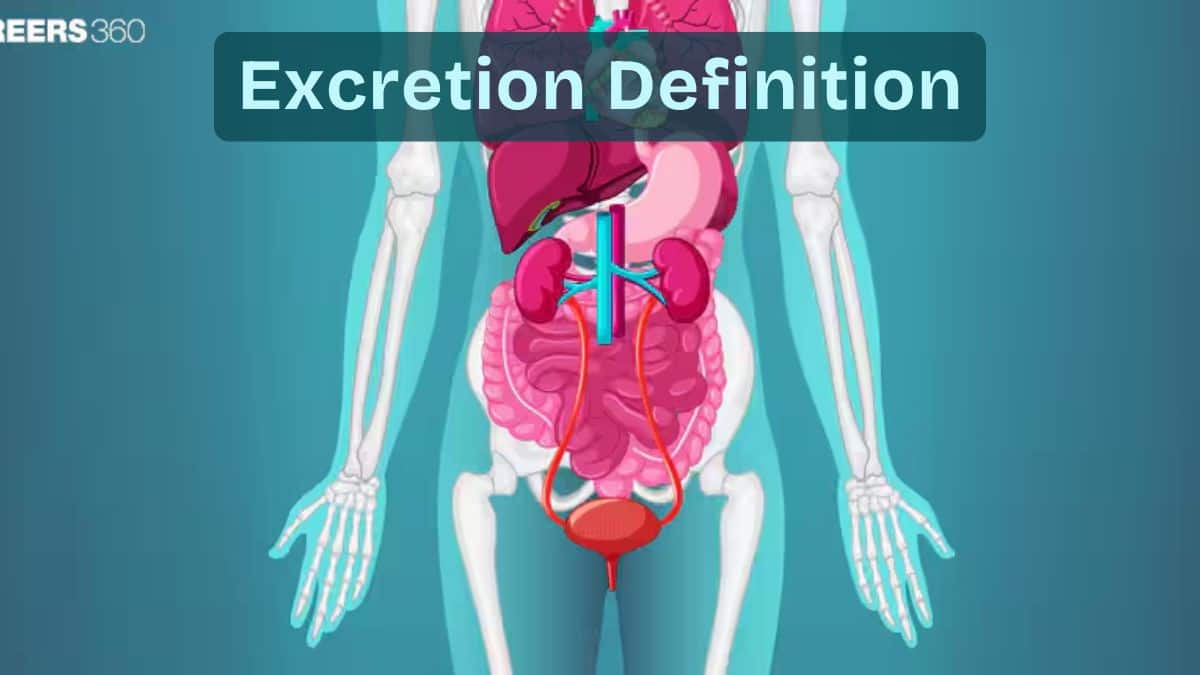
What Is Excretion?
Excretion is a process by which organisms eliminate from their bodies waste products of several chemical reactions that take place in cells, especially through the breakdown of nutrients to liberate energy. If such waste materials are not removed, they might accumulate within the organism and prove to be toxic to the very organism. Other wastes include carbon dioxide, water, ammonia, and salts which are expelled in varying methods by different organisms and different forms of waste.
Different organisms have evolved specialized organs or structures that facilitate excretion. For example, in humans and most animals, the kidneys filter out waste from the blood and produce urine, which is then excreted from the body; in plants, excess water and oxygen are excreted out through small pores in the leaves known as stomata. In simpler organisms, such as bacteria and amoebas, waste simply diffuses out of cells. This helps maintain balance in the body by maintaining the internal environment stable enough so that cells can function.
Why Excretion Is Essential
Excretion plays an important role in maintaining the chemical balance of the body by ridding it of substances which could be harmful if allowed to accumulate and thus disrupt normal physiological functions. It also plays a role in the regulation of water and electrolyte balance, which is very important for several cellular processes.
Excretion in Different Organisms
Excretory systems vary among organisms according to their needs and environments. Excretion of wastes presents a special problem in water conservation. The end product is ammonia, a highly toxic material. Fishes excrete ammonia, since there is an abundance of water to wash it away. Terrestrial insects, reptiles and birds convert it into uric acid, a nontoxic, almost insoluble compound. This conversion enables them to excrete a semisolid urine with little water loss. Uric acid as an end product has another important benefit.
Excretion in Unicellular Organisms
Excretion in unicellular organisms is by:
Diffusion (Bacteria, Amoeba)
Waste products are directly diffused across the cell membrane.
Contractile Vacuole (Protozoa)
Excess water with waste products is expelled by contractile vacuoles.
Excretion in Invertebrates
Many protozoan groups and some freshwater sponges have special excretory organelles called contractile vacuoles. More complex invertebrates have excretory organs that are basically tubular structures.
Annelids – Nephridia
Nephridia filters waste from the fluid of its body.
Arthropods – Malpighian Tubules
Excrete waste and maintain osmotic balance through Malpighian tubules.
Excretion in Vertebrates
The vertebrate kidney maintains homeostasis and it is the main organ that regulates volume and composition of the internal fluid environment. The organization of kidneys differs in different groups of vertebrates, but in all the basic functional unit is the nephron, and urine is formed by three well-defined physiological processes: filtration, reabsorption, and secretion.
Fish
Gills are the major excretory organs, eliminating ammonia directly into the water.
Amphibians
Kidneys and skin are excretory organs.
Reptiles
Kidneys excrete uric acid, which minimizes water loss.
Birds
Kidneys and cloaca excrete uric acid.
Mammals
Kidneys filter blood, and urine is produced.
Excretion NEET MCQs (With Answers & Explanations)
Important questions asked in NEET from this topic are:
Excretion in different organisms
Excretion in Vertebrates
Practice Questions for NEET
Q1. Which of the following statements is true regarding osmoconformers and osmoregulators?
Osmoconformers can maintain their internal osmolarity at a constant level regardless of the external environment.
Osmoregulators can adjust their internal osmolarity to match that of the external environment.
Osmoconformers and osmoregulators have the same ability to regulate their internal osmolarity.
Osmoconformers and osmoregulators have the same ability to regulate their internal osmolarity.
Correct answer: 2) Osmoregulators can adjust their internal osmolarity to match that of the external environment.
Explanation:
Osmoconformers and osmoregulators are two different strategies used by animals to maintain their internal osmolarity (concentration of solutes) in the external environment.
Osmoconformers, as the name suggests, conform to the osmolarity of their external environment. This means that their internal osmolarity changes in response to the osmolarity of the surrounding environment. They do not actively regulate their internal osmolarity but rather allow it to match the external environment. Osmoconformers are typically found in environments with stable or predictable osmotic conditions.
On the other hand, osmoregulators can actively regulate their internal osmolarity regardless of the osmolarity of the external environment. They can adjust the concentration of solutes and the balance of water and salts within their bodies to maintain a relatively constant internal osmolarity. Osmoregulators are capable of adapting to a wide range of osmotic conditions, including both freshwater and marine environments.
Hence, the correct answer is option 2) Osmoregulators can adjust their internal osmolarity to match that of the external environment.
Q2. Osmoregulators are
Animals whose internal osmolarity changes in relation to their external environment.
Animals that excrete urea
Animals can maintain their internal osmolarity at a particular level regardless of the external environment.
Animals whose osmolality is not fixed
Correct answer: 4) Animals can maintain their internal osmolarity at a particular level regardless of the external environment.
Explanation:
Osmoregulatory: Animals who can maintain their internal osmolarity at a particular level regardless of the external environment. This remarkable adaptation allows them to thrive in various external environments, whether exposed to freshwater, saline water, or fluctuating conditions. By efficiently controlling the movement of water and solutes, osmoregulatory animals can maintain homeostasis and ensure their physiological processes function optimally, regardless of external osmotic pressures.
Hence, the correct option is 3) Animals who can maintain their internal osmolarity at a particular level regardless of the external environment.
Q3. Select incorrect statement
Lungs remove large amounts of CO2
Approximately 200mL/minute CO2 is removed from the lungs.
Water is also removed as an excretory product.
Large amounts of O2 are also released from the lungs.
Correct answer: 4) Large amounts of O2 are also released from the lungs.
Explanation:
The lungs mostly produce carbon dioxide (CO2) during exhalation, not oxygen (O2), hence the statement "Large amounts of O2 is also expelled from the lungs" is untrue. Depending on the body's oxygen needs, just a tiny quantity of oxygen may be expelled as unneeded during inhalation.
Hence, the correct answer is option 4)Large amounts of O2 are also released from the lungs.
Also Read:
Recommended Video on Excretion Definition
Frequently Asked Questions (FAQs)
The excretory system maintains fluid balance, electrolyte levels, and thus the pH required for stable internal conditions.
Humans excrete primarily urea through kidneys, but some other animals excrete either ammonia or uric acid depending on the environment and evolutionary adaptation.
Excretion refers to the removal of metabolic waste from the body. It is essential to prevent the accumulation of substances which are either poisons or behave like poisons to maintain homeostasis.
Kidneys filter blood through nephrons. Waste gets separated from usable nutrients and water and forms urine
The common diseases are kidney stones, urinary tract infections, and chronic kidney diseases.
