KCC Institute of Legal and Higher Education, Greater Noida
Law Admissions 2026 Open | Avail Merit-Based Scholarships


Imagine describing the motion of a car as “10 km towards the east”, or the force applied to push an object in a certain direction. Such quantities cannot be represented by numbers alone because they involve both magnitude and direction. This is where Vector Algebra becomes essential in mathematics. In Class 12 Mathematics, Vector Algebra is the branch of mathematics that deals with vectors, quantities that have both magnitude and direction. Vectors are represented using directed line segments or in component form and are widely used to describe physical quantities such as displacement, velocity, force, and acceleration. Scalar quantities, on the other hand, have only magnitude. Vector algebra offers systematic methods for adding, subtracting, and multiplying vectors according to well-defined rules. A common real-life application of vector algebra can be seen in navigation, physics, engineering, and computer graphics.
This Story also Contains
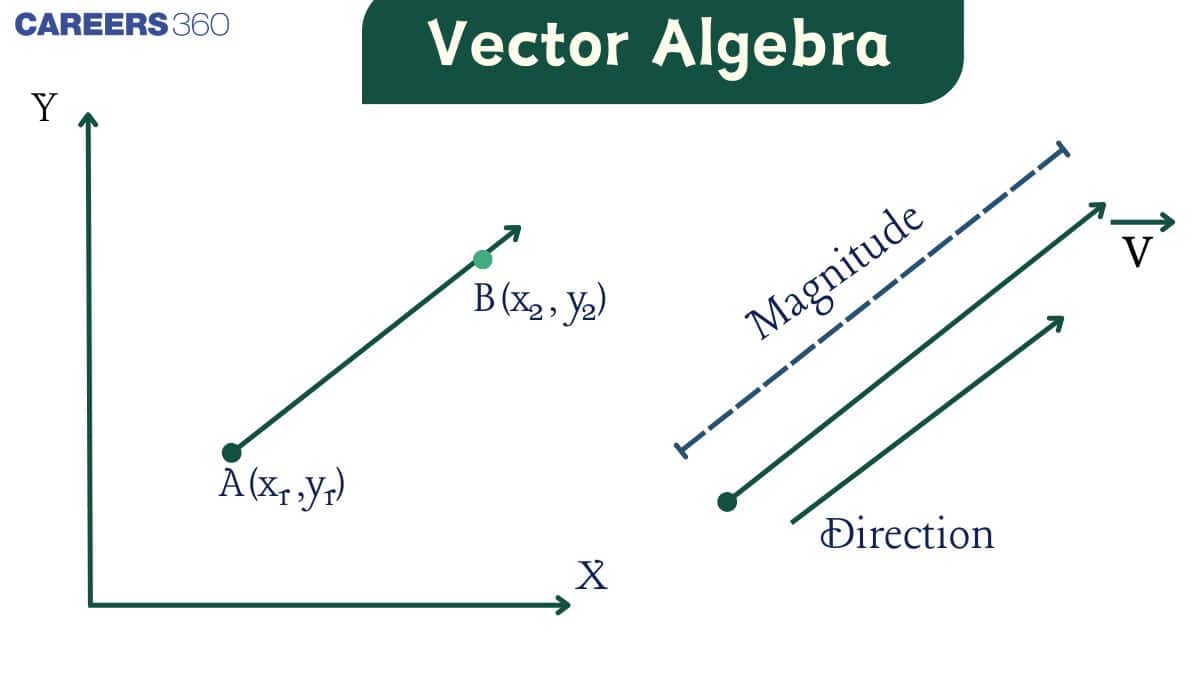
In the Vector Algebra Class 12 chapter, students learn important topics such as vector addition and subtraction, scalar (dot) product, vector (cross) product, and their geometric interpretations. The chapter also helps in understanding angles between vectors and areas of parallelograms and triangles using vector methods. Mastery of this chapter is essential for solving problems in calculus, three dimensional geometry, and physics. In this article, we cover Vector Algebra Class 12 definitions, important formulas, solved examples, and practice questions to help students build strong conceptual clarity and perform well in board examinations as well as competitive exams like JEE and NEET.
Vector Algebra plays a key role in representing and analysing quantities that have both magnitude and direction in mathematics. It provides powerful tools to solve problems related to geometry, motion, and force in a clear and systematic manner.
Vector- In general terms, a vector is defined as an object having both direction as well as magnitude.
Position vector- Consider a point $P$ in space, having coordinates $(x, y, z)$ with respect to the origin $\mathrm{O}(0,0,0)$. Then, the vector $\overrightarrow{O P}($ or $\vec{r})$ having $O$ and $P$ as its initial and terminal points, respectively, is called the position vector of the point $P$ with respect to $O$.
The types of vectors are,
Zero Vector: A vector whose initial and terminal points coincide is called a zero vector (or null vector). A zero vector can not be assigned a definite direction as it has zero magnitude. Alternatively, it may be regarded as having any direction. The vector $\overrightarrow{A A}$ or $\overrightarrow{B B}$ represents the zero vector.
Unit Vector: A vector whose magnitude is unity (i.e., $1$ unit) is called a unit vector. The unit vector in the direction of a given vector $\vec{a}$ is denoted by $\hat{a}$.
Coinitial Vectors: Two or more vectors having the same initial point are called coinitial Vectors.
Collinear Vectors: Two or more vectors are said to be collinear if they are parallel to the same line, irrespective of their magnitudes and directions.
Equal Vectors: Two vectors $\vec{a}$ and $\vec{b}$ are said to be equal if they have the same magnitude and direction, regardless of the positions of their initial points, and written as $\vec{a}=\vec{b}$.
Negative of a Vector: A vector whose magnitude is the same as that of a given vector (say, $\overrightarrow{A B}$ ), but whose direction is opposite to that of it, is called the negative of the given vector.
If a vector is represented as $x \hat{i}+y \hat{j}+z \hat{k}$, then it is called the component form of the vector. Here, $\hat{i}, \hat{j}$ and $\hat{k}$ representing the unit vectors along the
$x, y$, and $z$-axes, respectively and $(x, y, z)$ represent coordinates of the vector.
Some important points:
If $\vec{a}$ and $\vec{b}$ are any two vectors given in the component form $a_1 \hat{i}+a_2 \hat{j}+a_3 \hat{k}$ and $b_1 \hat{i}+b_2 \hat{j}+b_3 \hat{k}$, respectively, then,
The resultant of the vectors is
$
(\vec{a} \pm \vec{b})=\left(a_1 \pm b_1\right) \hat{i}+\left(a_2 \pm b_2\right) \hat{j}+\left(a_3 \pm b_3\right) \hat{k}
$
The vectors are equal if and only if
$
a_1=b_1, a_2=b_2 \text { and } a_3=b_3
$
The multiplication of vector $\vec{a}$ by any scalar $\lambda$ is given by
$
\lambda \vec{a}=\lambda a_1 \hat{i}+\lambda a_2 \hat{j}+\lambda a_3 \hat{k}
$
When point $R$ divides $\vec{PQ}$ internally in the ratio of $m:n$ such that $\frac{\overrightarrow{P R}}{\overrightarrow{R Q}}=\frac{m}{n} \quad \vec{r}=\frac{m \vec{b}+n \vec{a}}{m+n}$.
When point $R$ divides $\overrightarrow{P Q}$ externally in the ratio of $m:n$ such that $\frac{\overrightarrow{P R}}{\overrightarrow{Q R}}=\frac{m}{n} \vec{r}_{\text {then }}=\frac{m \vec{b}-n \vec{a}}{m-n}$.
Multiplication of two vectors is defined in two ways:
(i) Scalar (or dot) product and (ii) Vector (or cross) product.
In the scalar product, the resultant is a scalar quantity.
In the vector product, the resultant is a vector quantity.
Scalar product
Scalar product, also known as the dot product of two non-zero vectors $\vec{a}$ and $\vec{b}$, is denoted by $\vec{a} \cdot \vec{b}$. Scalar product is calculated as $\vec{a} \cdot \vec{b}=|\vec{a}||\vec{b}| \cos \theta$ where, $\theta$ is the angle between two non zero given vectors.
Vector product
Vector product of two non-zero vectors $\vec{a}$ and $\vec{b}$ is denoted by $\vec{a} \times \vec{b}$. Vector product also known as cross product can be calculated as $\vec{a} \times \vec{b}=|\vec{a}||\vec{b}| \sin \theta \hat{n} \quad$ where $\theta$ is the angle between two non zero vectors and $\hat{n}$ is a unit vector perpendicular to both.
In vector algebra class 12, vectors are combined and manipulated using various operations. These operations are essential in solving problems in class 12 vector algebra and are widely used in physics, engineering, and mathematics. The main operations include:
The sum of two vectors $\vec{A}$ and $\vec{B}$ is a vector $\vec{R}$ obtained by placing them tip-to-tail or using components:
$
\vec{R} = \vec{A} + \vec{B} = (A_x + B_x)\hat{i} + (A_y + B_y)\hat{j} + (A_z + B_z)\hat{k}
$
The difference between two vectors $\vec{A}$ and $\vec{B}$ is:
$
\vec{D} = \vec{A} - \vec{B} = (A_x - B_x)\hat{i} + (A_y - B_y)\hat{j} + (A_z - B_z)\hat{k}
$
A vector can be multiplied by a scalar $k$, which scales its magnitude without changing its direction:
$
\vec{R} = k \vec{A} = k A_x \hat{i} + k A_y \hat{j} + k A_z \hat{k}
$
The dot product of two vectors $\vec{A}$ and $\vec{B}$ gives a scalar and is defined as:
$
\vec{A} \cdot \vec{B} = |\vec{A}| |\vec{B}| \cos \theta
$
where $\theta$ is the angle between $\vec{A}$ and $\vec{B}$. Using components:
$
\vec{A} \cdot \vec{B} = A_x B_x + A_y B_y + A_z B_z
$
The cross product of two vectors $\vec{A}$ and $\vec{B}$ results in a vector perpendicular to both, with magnitude:
$
|\vec{A} \times \vec{B}| = |\vec{A}| |\vec{B}| \sin \theta
$
and direction given by the right-hand rule. In component form:
$
\vec{A} \times \vec{B} =
\begin{vmatrix}
\hat{i} & \hat{j} & \hat{k} \\
A_x & A_y & A_z \\
B_x & B_y & B_z
\end{vmatrix}
$
These operations form the foundation for vector algebra class 12 solutions and are used in calculating displacement, force, and motion problems in class 12 vector algebra.
In class 12 vector algebra, understanding key formulas is essential for solving problems effectively. Here are the main formulas with their definitions and applications:
The magnitude (or length) of a vector $\vec{A} = A_x \hat{i} + A_y \hat{j} + A_z \hat{k}$ is the distance from the origin to the point it represents:
$
|\vec{A}| = \sqrt{A_x^2 + A_y^2 + A_z^2}
$
A unit vector has a magnitude of 1 and points in the direction of a vector $\vec{A}$. It is given by:
$
\hat{A} = \frac{\vec{A}}{|\vec{A}|}
$
For a vector $\vec{A} = A_x \hat{i} + A_y \hat{j} + A_z \hat{k}$, the direction cosines $(\cos \alpha, \cos \beta, \cos \gamma)$ are:
$
\cos \alpha = \frac{A_x}{|\vec{A}|}, \quad \cos \beta = \frac{A_y}{|\vec{A}|}, \quad \cos \gamma = \frac{A_z}{|\vec{A}|}
$
The numbers proportional to $A_x, A_y, A_z$ are called direction ratios.
The dot product of $\vec{A}$ and $\vec{B}$ measures how much one vector extends in the direction of another:
$
\vec{A} \cdot \vec{B} = |\vec{A}| |\vec{B}| \cos \theta = A_x B_x + A_y B_y + A_z B_z
$
The cross product gives a vector perpendicular to both $\vec{A}$ and $\vec{B}$:
Magnitude:
$
|\vec{A} \times \vec{B}| = |\vec{A}| |\vec{B}| \sin \theta
$
Direction: Right-hand rule
Component form:
$
\vec{A} \times \vec{B} =
\begin{vmatrix}
\hat{i} & \hat{j} & \hat{k} \
A_x & A_y & A_z \
B_x & B_y & B_z
\end{vmatrix}
$
Applications: Area of a parallelogram = $|\vec{A} \times \vec{B}|$, volume of parallelepiped = $|\vec{A} \cdot (\vec{B} \times \vec{C})|$
The triple scalar product gives the volume of a parallelepiped formed by vectors $\vec{A}, \vec{B}, \vec{C}$:
$
V = \vec{A} \cdot (\vec{B} \times \vec{C})
$
If $V = 0$, the vectors are coplanar.
This section provides all essential vector algebra class 12 formulas needed to solve NCERT and board exam problems efficiently.
Given below is the list of important formulae related to vector algebra, which help in solving a variety of problems related to vectors:
| Concept | Formula |
|---|---|
| Magnitude of a Vector | For $\vec{A} = A_x \hat{i} + A_y \hat{j} + A_z \hat{k}$: $ |
| Unit Vector | A vector in the same direction as $\vec{A}$ with magnitude $1$: $\hat{A} = \dfrac{\vec{A}}{|\vec{A}|}$ |
| Direction Ratios | Numbers proportional to the components of a vector: $A_x : A_y : A_z$ |
| Direction Cosines | Cosines of angles made with coordinate axes:
$\cos \alpha = \dfrac{A_x}{|\vec{A}|}$ $\cos \beta = \dfrac{A_y}{|\vec{A}|}$ $\cos \gamma = \dfrac{A_z}{|\vec{A}|}$ |
| Vector Addition | $\vec{A} + \vec{B} = (A_x + B_x)\hat{i} + (A_y + B_y)\hat{j} + (A_z + B_z)\hat{k}$ |
| Vector Subtraction | $\vec{A} - \vec{B} = (A_x - B_x)\hat{i} + (A_y - B_y)\hat{j} + (A_z - B_z)\hat{k}$ |
| Scalar Multiplication | $k \vec{A} = k A_x \hat{i} + k A_y \hat{j} + k A_z \hat{k}$ |
| Dot Product | $\vec{A} \cdot \vec{B} = A_x B_x + A_y B_y + A_z B_z$ |
| Angle Between Two Vectors | $\cos \theta = \dfrac{\vec{A} \cdot \vec{B}}{|\vec{A}| \, |\vec{B}|}$ |
| Projection of $\vec{A}$ on $\vec{B}$ | Scalar projection: $\text{Proj}_{\vec{B}} \vec{A} = \dfrac{\vec{A} \cdot \vec{B}}{|\vec{B}|}$ Vector Projection: $\text{vec-proj}_{\vec{B}} \vec{A} = \dfrac{\vec{A} \cdot \vec{B}}{|\vec{B}|^2} \vec{B}$ |
| Cross Product | $\vec{A} \times \vec{B} = \begin{vmatrix} \hat{i} & \hat{j} & \hat{k} \ A_x & A_y & A_z \ B_x & B_y & B_z \end{vmatrix}$ Magnitude: $ |
| Area of a Parallelogram | $A = |\vec{A} \times \vec{B}|$ |
| Volume of Parallelepiped | $V = |\vec{A} \cdot (\vec{B} \times \vec{C})|$ |
| Triple Scalar Product | $[\vec{A}, \vec{B}, \vec{C}] = \vec{A} \cdot (\vec{B} \times \vec{C})$ (Vectors are coplanar if $[\vec{A}, \vec{B}, \vec{C}] = 0$) |
| Vector Between Two Points | $\vec{PQ} = (x_2 - x_1)\hat{i} + (y_2 - y_1)\hat{j} + (z_2 - z_1)\hat{k}$ |
| Angle Between a Line and a Plane | If line has direction ratios $(a,b,c)$ and plane equation $px+qy+rz+d=0$: $\sin \theta = \dfrac{|a p + b q + c r|}{\sqrt{a^2+b^2+c^2} \sqrt{p^2+q^2+r^2}}$ |
| Distance of a Point from a Plane | For $P(x_1, y_1, z_1)$ and plane $ax+by+cz+d=0$: $d = \dfrac{|a x_1 + b y_1 + c z_1 + d|}{\sqrt{a^2 + b^2 + c^2}}$ |
| Shortest Distance Between Two Skew Lines | For lines $\vec{r} = \vec{a_1} + \lambda \vec{b_1}$ and $\vec{r} = \vec{a_2} + \mu \vec{b_2}$: $d = \frac{|(\vec{a_2}-\vec{a_1}) \cdot (\vec{b_1} \times \vec{b_2})|}{|\vec{b_1} \times \vec{b_2}|}$ |
| Scalar Component of $\vec{A}$ along $\vec{B}$ | $\text{comp}_{\vec{B}} \vec{A} = \dfrac{\vec{A} \cdot \vec{B}}{|\vec{B}|}$ |
Law Admissions 2026 Open | Avail Merit-Based Scholarships
BBA/MBA/PGDM Early Bird Applications Deadline 06th Nov'26. Apply now using coupon code CAREER250 and get ₹250 off the application fee
Question 1:
If $\vec{a}=\alpha \hat{i}+\beta \hat{j}+3 \hat{k}, \vec{b}=-\beta \hat{i}-\alpha \hat{j}-\hat{k}$ and $\vec{c}=\hat{i}-2 \hat{j}-\hat{k}$ such that $\vec{a} \cdot \vec{b}=1$ and $\vec{b} . \vec{c}=-3$, then $\frac{1}{3}((\vec{a} \times \vec{b}) \cdot \vec{c})$ is equal to:
Solution:
$
\begin{aligned}
& \vec{a}=\alpha \hat{i}+\beta \hat{j}+3 \hat{k}, \\
& \vec{b}=-\beta \hat{i}-\alpha \hat{j}-\hat{k} \text { and } \\
& \vec{c}=\hat{i}-2 \hat{j}-\hat{k} \\
& \vec{a} \cdot \vec{b}=1 \\
& \Rightarrow \quad-\alpha \beta-\alpha \beta-3=1 \\
& \Rightarrow \quad-2 \alpha \beta=4 \Rightarrow \alpha \beta=-2 \\
& \vec{b} \cdot \vec{c}=-3 \\
& \Rightarrow-\beta+2 \alpha+1=-3 \\
& \beta-2 \alpha=4 \quad \ldots(2)
\end{aligned}
$
Solving (1) & (2)
$
\begin{aligned}
(\alpha, \beta) & =(-1,2) \\
\frac{1}{3}[\vec{a} \vec{b} \vec{c}] & =\frac{1}{3}\left|\begin{array}{ccc}
\alpha & \beta & 3 \\
-\beta & -\alpha & -1 \\
1 & -2 & -1
\end{array}\right| \\
& =\frac{1}{3}\left|\begin{array}{ccc}
-1 & 2 & 3 \\
-2 & 1 & -1 \\
1 & -2 & -1
\end{array}\right| \\
& =\frac{1}{3}\left|\begin{array}{ccc}
0 & 0 & 2 \\
-2 & 1 & -1 \\
1 & -2 & -1
\end{array}\right| \\
& =\frac{1}{3}[2(4-1)]=2
\end{aligned}
$
Hence, the correct answer is 2.
Question 2:
Let $\vec{a}=2 \hat{i}-3 \hat{j}+4 \hat{k}$ and $\vec{b}=7 \hat{i}+\hat{j}-6 \hat{k}$.
If $\vec{r} \times \vec{a}=\vec{r} \times \vec{b}, \vec{r} \cdot(\hat{i}+2 \hat{j}+\hat{k})=-3$, then $\vec{r} \cdot(2 \hat{i}-3 \hat{j}+\hat{k})$ is equal to:
Solution:
$\begin{aligned} & \vec{r} \times \vec{a}-\vec{r} \times \vec{b}=0 \\ & \Rightarrow \vec{r} \times(\vec{a}-\vec{b})=0 \\ & \Rightarrow \vec{r}=\lambda(\vec{a}-\vec{b}) \\ & \Rightarrow \vec{r}=\lambda(-5 \hat{i}-4 \hat{j}+10 \hat{k}) \\ & \text { Also } \vec{r} \cdot(\hat{i}+2 \hat{j}+\hat{k})=-3 \\ & \Rightarrow \lambda(-5-8+10)=-3 \\ & \lambda=1 \\ & \text { Now } \vec{r}=-5 \hat{i}-4 \hat{j}+10 \hat{k} \\ & =\vec{r} \cdot(2 \hat{i}-3 \hat{j}+\hat{k}) \\ & =-10+12+10=12\end{aligned}$
Hence, the correct answer is 12.
Question 3:
Let $\vec{a}=\widehat{i}+2 \widehat{j}-3 \widehat{k}$ and $\vec{b}=2 \widehat{i}-3 \widehat{j}+5 \widehat{k}$. If $\vec{r} \times \vec{a}=\vec{b} \times \vec{r}$, $\vec{r} \cdot(\alpha \widehat{i}+2 \widehat{j}+\widehat{k})=3$ and $\vec{r} \cdot(2 \widehat{i}+5 \widehat{j}-\alpha \widehat{k})=-1, \alpha \epsilon R$, then the value of $\alpha+[\vec{r}]^2$ is equal to:
Solution:
$
\begin{aligned}
& \vec{r} \times \vec{a}=\vec{b} \times \vec{r} \Rightarrow \vec{r} \times(\vec{a}+\vec{b})=0 \\
& \vec{r}=\vec{\lambda}(\vec{a}+\vec{b}) \Rightarrow \vec{r}=\vec{\lambda}(\hat{i}+2 \hat{j}-3 \hat{k}+2 \hat{i}-3 \hat{j}+5 \hat{k}) \\
& \vec{r}=\vec{\lambda}(3 \hat{i}-\hat{j}+2 \hat{k}) \quad \ldots(1) \\
& \vec{r} \cdot(\alpha \hat{i}+2 \hat{j}+\hat{k})=3 \quad \ldots(\text { Given }) \\
& \vec{\lambda}(3 \hat{i}-\hat{j}+2 \hat{k}) \cdot(\alpha \hat{i}+2 \hat{j}+\hat{k})=3 \\
& \Rightarrow \quad \alpha \lambda=1 \\
& \vec{r} \cdot(2 \hat{i}+5 \hat{j}-\alpha \hat{k})=-1 \quad \ldots(\text { Given }) \\
& \vec{\lambda}(3 \hat{i}-\hat{j}+2 \hat{k}) \cdot(2 \hat{i}+5 \hat{j}-\alpha \hat{k})=-1 \\
& \Rightarrow \quad 2 \lambda \alpha-\lambda=1
\end{aligned}
$
Solve (2) $\&(3)$
$
\begin{aligned}
& \alpha=1, \lambda=1 \\
& \Rightarrow \quad \vec{r}=3 \hat{i}-\hat{j}+2 \hat{k} \\
& |\vec{r}|^2=14 \quad \& \quad \alpha=1 \\
& \alpha+|\vec{r}|^2=15
\end{aligned}
$
Hence, the correct answer is 15.
Question 4:
If $\vec{b} \times \vec{d}=0, \vec{a}=\vec{b}+\vec{c}, \vec{c} \cdot \vec{d}=0$ then $\frac{\vec{d} \times(\vec{a} \times \vec{d})}{|\vec{d}|^2}$ equals:
Solution:
$
\begin{aligned}
& \frac{\vec{d} \times(\vec{a} \times \vec{d})}{|\vec{d}|^2}=\frac{(\vec{d} \cdot \vec{d}) \vec{a}-(\vec{d} \cdot \vec{a}) \vec{d}}{|\vec{d}|^2} \\
& =\frac{|\vec{d}|^2}{|\vec{d}|^2}-\frac{(\vec{d} \cdot \vec{a})}{|\vec{d}|^2} \vec{d}
\end{aligned}
$
Now $\vec{a}=\vec{b}+\vec{c}$
$
\begin{aligned}
& \Rightarrow \vec{a} \cdot \vec{d}=\vec{b} \cdot \vec{d}+\vec{c} \cdot \vec{d} \\
& \Rightarrow \quad \vec{a} \cdot \vec{d}=\vec{b} \cdot \vec{d} \quad(\text { As } \vec{c} \cdot \vec{d}=0)
\end{aligned}
$
$
\begin{aligned}
& \text { (i) } \Rightarrow \frac{\vec{d} \times(\vec{a} \times \vec{d})}{|\vec{d}|^2}=\vec{a}-\frac{\vec{b} \cdot \vec{d}}{|\vec{d}|^2} \vec{d} \\
& =\vec{a}-\frac{|\vec{b}||\vec{d}|}{|\vec{d}|^2} \vec{d} \quad\left(\begin{array}{c}
\text { As } \vec{b} \times \vec{d}=0 \\
\Rightarrow \vec{b} \text { and } \vec{d} \\
\text { are parallel }
\end{array}\right) \\
& =\vec{a}-\frac{|\vec{b}|}{|\vec{d}|} \cdot|\vec{d}| \hat{d} \\
& =\vec{a}-|\vec{b}| \hat{d} \\
& =\vec{a}-|\vec{b}| \hat{b} \quad(\text { as } \vec{b} \text { and } \vec{d} \text { are parallel) }
\end{aligned}
$
$
\begin{aligned}
& =\vec{a}-\vec{b} \\
& =\vec{c}(\mathrm{As} \vec{a}=\vec{b}+\vec{c})
\end{aligned}
$
Hence, the correct answer is $\vec{c}$.
Question 5:
If $\tilde{\mathrm{a}}=\mathrm{i}-\mathrm{j}-\mathrm{k}, \tilde{\mathrm{b}}=\mathrm{i}-\mathrm{j}+\mathrm{k}$ and $\tilde{\mathrm{c}}=\mathrm{i}+2 \mathrm{j}-\mathrm{k}$, then $\vec{a} \times(\vec{b} \times \vec{c})$ equals:
Solution:
$\begin{aligned} & \vec{a} \times(\vec{b} \times \vec{c}) \\ & =(\vec{a} \cdot \vec{c}) \vec{b}-(\vec{a} \cdot \vec{b}) \vec{c} \\ & =(1-2+1) \vec{b}-(1+1-1) \vec{c} \\ & =-\vec{c} \\ & =-i-2 j+k\end{aligned}$
Hence, the correct answer is ($-i-2 j+k$).
Vector Algebra is one of the basic topics. You can prepare this topic by understanding a few basic concepts
Start with the basic concept of a vector, and understand all the terms used in vector algebra.
Representation of a vector is an important part of this chapter. You need to read all the questions meditatively.
Vector is all about the direction with magnitude, so make sure that the direction given in the question and the direction obtained in the answer match properly.
Make sure that after studying a certain section/concept, you solve questions related to those concepts without looking at the solutions and practice MCQ from the above-mentioned books and solve all the previous year problems asked in JEE.
Don’t let any doubt remain in your mind, and clear all the doubts with your teachers or with your friends.
This section outlines all the key vector algebra topics as per the NCERT and JEE Main syllabus, helping you focus on important chapters and concepts for Class 12.
The chapter Vector Algebra introduces vectors as mathematical quantities that have both magnitude and direction. It is an important part of Class 12 Mathematics and is widely tested in board and competitive examinations. Questions from this chapter evaluate a student’s understanding of vector operations, scalar and vector products, and their geometrical interpretations. Regular practice of NCERT exercises and application-based questions helps students develop strong problem-solving skills and score well in examinations.
| Exam Name | Focus Area | Common Topics Asked | Preparation Tips |
|---|---|---|---|
| CBSE Board | Conceptual clarity & formula use | Vector addition, scalar and vector products, basic properties | Learn definitions and formulas thoroughly and practise NCERT problems |
| JEE Main | Accuracy & application | Dot product, cross product, vector equations | Practise MCQs and numerical-based questions regularly |
| JEE Advanced | Analytical and geometrical insight | Complex vector identities, mixed product applications | Solve advanced-level problems and previous years’ questions |
| NEET | Basics & formula application | Simple vector operations, angle between vectors | Focus on the quick application of standard formulas |
| State Board Exams (ICSE, UP Board, RBSE, etc) | Theory-oriented | Definitions, derivations, standard vector problems | Revise textbook theory and practice solved examples |
| Mathematics Olympiads | Conceptual depth | Challenging vector-based and geometric problems | Strengthen fundamentals and practise higher-level questions |
Here you will find recommended books, resources, and reference materials that cover vector algebra class 12 formulas, solutions, and practice problems for thorough preparation.
| Book Title | Author / Publisher | Description |
|---|---|---|
| NCERT Mathematics Class 12 | NCERT | Official textbook covering all key algebra topics with exercises. |
| Mathematics for Class 12 | R.D. Sharma | Comprehensive explanations and solved problems on algebra concepts. |
| Objective Mathematics | R.S. Aggarwal | Ample MCQs and practice problems on Class 12 algebra topics. |
| Arihant All-In-One Mathematics | Arihant | Detailed concepts with exam-centric problems and solutions. |
| Advanced Algebra | Hall & Knight | Classic text for a deeper understanding of algebra, including theory and advanced problems. |
This section highlights official NCERT resources like textbooks, solved examples, and exercises that explain vector algebra concepts clearly for Class 12 students.
Here, you get subject-specific NCERT resources, including worked-out problems, notes, and exemplar solutions for class 12, helping in detailed understanding and practice.
| Subject | NCERT Notes Link | NCERT Solutions Link | NCERT Exemplar Link |
|---|---|---|---|
| Mathematics | NCERT Notes Class 12 Maths | NCERT Solutions for Class 12 Mathematics | NCERT Exemplar Class 12 Maths |
| Physics | NCERT Notes Class 12 Physics | NCERT Solutions for Class 12 Physics | NCERT Exemplar Class 12 Physics |
| Chemistry | NCERT Notes Class 12 Chemistry | NCERT Solutions for Class 12 Chemistry | NCERT Exemplar Class 12 Chemistry |
This part provides practice questions and sample problems based on vector algebra formulas and methods, enabling students to strengthen problem-solving skills and exam readiness.
The chapter Vector Algebra builds a strong foundation for understanding quantities that involve both magnitude and direction, and their applications in mathematics and physics. By mastering vector operations, scalar and vector products, and their geometric interpretations, students develop effective problem-solving and analytical skills. This chapter is an important scoring area in Class 12 Mathematics and is essential for success in board examinations as well as competitive exams like JEE and NEET. Regular practice of NCERT problems and clear understanding of formulas ensure confidence and accuracy while solving vector-based questions.
Frequently Asked Questions (FAQs)
The dot product of two vectors $\vec{A}$ and $\vec{B}$ is given by $\vec{A} \cdot \vec{B} = |\vec{A}| |\vec{B}| \cos \theta$, where $\theta$ is the angle between them. In component form, it is $\vec{A} \cdot \vec{B} = A_x B_x + A_y B_y + A_z B_z$.
The angle $\theta$ between two vectors $\vec{A}$ and $\vec{B}$ is calculated using the formula $\cos \theta = \dfrac{\vec{A} \cdot \vec{B}}{|\vec{A}| |\vec{B}|}$.
The cross product of two vectors $\vec{A}$ and $\vec{B}$ is a vector perpendicular to both $\vec{A}$ and $\vec{B}$, given by $\vec{A} \times \vec{B} = \begin{vmatrix} \hat{i} & \hat{j} & \hat{k} \ A_x & A_y & A_z \ B_x & B_y & B_z \end{vmatrix}$. It is used to calculate the area of a parallelogram or volume of a parallelepiped.
A unit vector is a vector with magnitude 1 that points in the same direction as a given vector. It is used to indicate direction and is written as $\hat{A} = \dfrac{\vec{A}}{|\vec{A}|}$.
The main operations are vector addition, vector subtraction, scalar multiplication, dot product (or scalar product), and cross product (or vector product). Each operation follows specific rules and has geometric interpretations.
Vector algebra is a branch of mathematics that deals with vectors, which are quantities having both magnitude and direction. It involves operations like addition, subtraction, dot product, cross product, and scalar multiplication.

Law Admissions 2026 Open | Avail Merit-Based Scholarships
BBA/MBA/PGDM Early Bird Applications Deadline 06th Nov'26. Apply now using coupon code CAREER250 and get ₹250 off the application fee
Ranked #36 amongst institutions in Management by NIRF | 100% Placement
Globally Recognized by AACSB (US) & AMBA (UK) | 18 LPA Avg. CTC for PGPM 2026
NEET PG All India & State College Predictor with Admission Process Guide
Top B-School: Ranked #9 in NIRF Management Rankings 2025.