


Vector Triple Product
Imagine holding three ropes and pulling an object in different directions at the same time. To understand the combined effect of these directions and forces, mathematicians use vector operations. When two vectors are first combined using a cross product and the resulting vector is then crossed with a third vector, we obtain a vector triple product. This operation in vector algebra is much more than a simple calculation - it helps simplify complicated vector expressions and reveals important relationships between vectors in three-dimensional space. The vector triple product is widely used in maths, mechanics, electromagnetism, engineering, and computer graphics. In this article, we will explore the definition, formula, properties, geometric interpretation, proofs, and applications of the vector triple product in a simple and systematic manner.
This Story also Contains
- What is a Vector Triple Product?
- Basics of Vector Algebra
- Vector Triple Product Formula
- Derivation of the Vector Triple Product Formula
- Properties of Vector Triple Product
- Geometrical Interpretation of Vector Triple Product
- Types of Triple Products in Vector Algebra
- Vector Triple Product in Component Form
- Applications of Vector Triple Product
- Vector Triple Product and Vector Projections
- Vector Triple Product Identities
- Difference Between Cross Product and Vector Triple Product
- Common Mistakes in Vector Triple Product
- Important Results
- Best Books for Vector Triple Product
- Shortcut Tips and Tricks for Vector Triple Product
- Important Formula Table
- Solved Examples Based on Vector Triple Product
- List of Topics Related to Vector Algebra
- NCERT Resources
- Practice Questions based on Vector Triple Product
What is a Vector Triple Product?
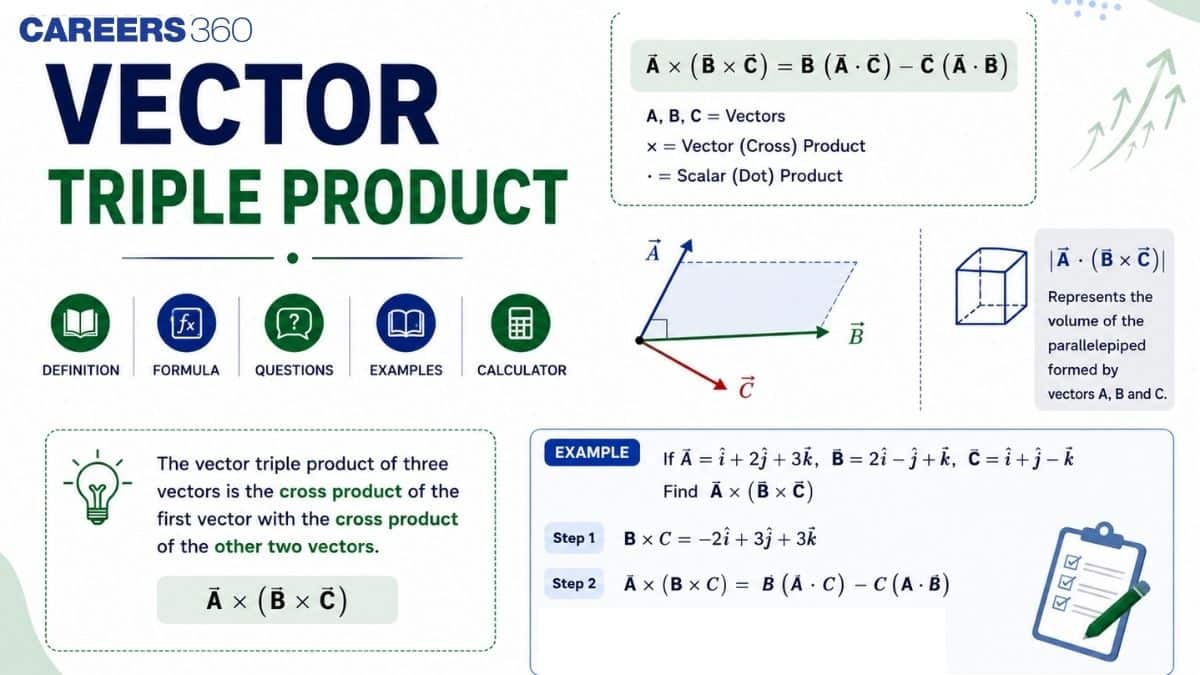
The vector triple product is an important operation in vector algebra that involves three vectors. It is obtained when the cross product of two vectors is again crossed with a third vector. Unlike the scalar triple product, the result of a vector triple product is a vector. This concept is widely used in mathematics, physics, engineering, and three-dimensional geometry to simplify complex vector expressions and analyze spatial relationships.
Vector Triple Product Meaning in Simple Words
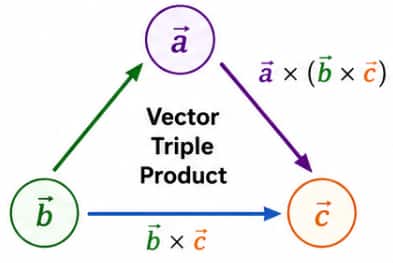
A vector triple product can be thought of as a two-step vector operation. First, two vectors are combined using a cross product, and then the resulting vector is crossed with another vector. This operation helps express complicated vector relationships in a simpler form.

Definition of Vector Triple Product
The vector triple product of three vectors $\vec{a}$, $\vec{b}$, and $\vec{c}$ is defined as
$\vec{a}\times(\vec{b}\times\vec{c})$ or
$(\vec{a}\times\vec{b})\times\vec{c}$
Both expressions involve three vectors but generally produce different results because the cross product is not associative.
Why the Vector Triple Product is Important
The vector triple product helps simplify lengthy vector calculations and provides important identities used in higher mathematics and physics. It is particularly useful when solving problems involving forces, moments, electromagnetic fields, and coordinate transformations.
Real-Life Applications of Vector Triple Product
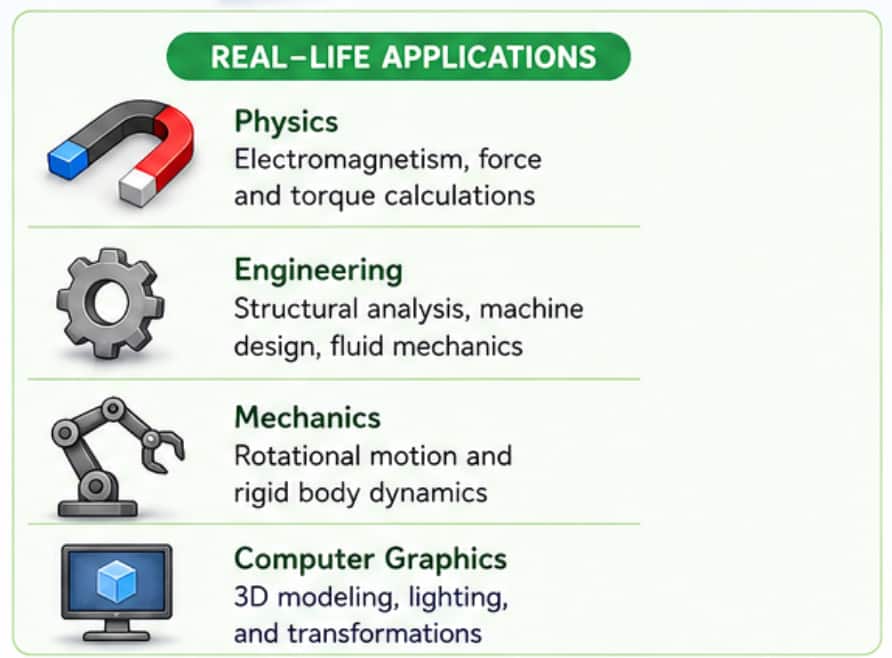
The vector triple product is used in:
Mechanics and force systems
Electromagnetism
Fluid dynamics
Robotics
Aerospace engineering
Computer graphics and animation
Three-dimensional modeling
Basics of Vector Algebra
Before studying vector triple products, it is important to understand the fundamental concepts of vector algebra.
What is a Vector?
A vector is a quantity that has both magnitude and direction.
Examples include:
Velocity
Force
Acceleration
Displacement
Vectors are usually represented by bold letters such as $\vec{a}$, $\vec{b}$, and $\vec{c}$.
Scalar and Vector Quantities
A scalar quantity has only magnitude.
Examples:
Mass
Temperature
Time
Distance
A vector quantity has both magnitude and direction.
Examples:
Velocity
Force
Momentum
Electric field
Dot Product of Two Vectors
The dot product of vectors $\vec{a}$ and $\vec{b}$ is given by $\vec{a}\cdot\vec{b}=|\vec{a}||\vec{b}|\cos\theta$
The result is a scalar quantity.
The dot product is commonly used to determine angles between vectors and projections.
Cross Product of Two Vectors
The cross product of vectors $\vec{a}$ and $\vec{b}$ is
$\vec{a}\times\vec{b}=|\vec{a}||\vec{b}|\sin\theta\ \hat{n}$
where $\hat{n}$ is a unit vector perpendicular to both vectors.
The result is a vector quantity.
Vector Triple Product Formula
The vector triple product can be simplified using a famous vector identity known as the BAC-CAB rule.
Standard Vector Triple Product Formula
The standard formula is
$\vec{a}\times(\vec{b}\times\vec{c})$
Using vector identities, it can be simplified considerably.
BAC-CAB Rule
The most important identity for vector triple products is
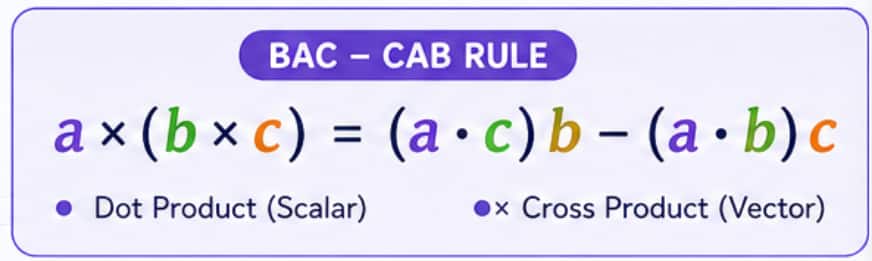
$\vec{a}\times(\vec{b}\times\vec{c})=(\vec{a}\cdot\vec{c})\vec{b}-(\vec{a}\cdot\vec{b})\vec{c}$
This identity is commonly called the BAC-CAB rule because the vectors appear in the order:
"BAC minus CAB."
Meaning of Terms in the Formula
In $\vec{a}\times(\vec{b}\times\vec{c})=(\vec{a}\cdot\vec{c})\vec{b}-(\vec{a}\cdot\vec{b})\vec{c}$
$\vec{a},\vec{b},\vec{c}$ are vectors.
$\vec{a}\cdot\vec{c}$ is a scalar.
$\vec{a}\cdot\vec{b}$ is a scalar.
The final result is a vector.
Mathematical Representation
The vector triple product can be represented as
$\vec{a}\times(\vec{b}\times\vec{c})$ or
$(\vec{a}\times\vec{b})\times\vec{c}$
These two expressions are generally not equal.
Derivation of the Vector Triple Product Formula
The vector triple product identity is one of the most important results in vector algebra. It helps convert a complicated cross product involving three vectors into a simpler linear combination of vectors.
We want to derive:
This identity is commonly known as the BAC-CAB Rule.
Step 1: Consider the Vector Triple Product
Let
$\vec{R}=\vec{a}\times(\vec{b}\times\vec{c})$
The vector $\vec{b}\times\vec{c}$ is perpendicular to both $\vec{b}$ and $\vec{c}$.
Since $\vec{R}$ is perpendicular to $(\vec{b}\times\vec{c})$, it must lie in the plane containing $\vec{b}$ and $\vec{c}$.
Therefore, $\vec{R}$ can be expressed as
$\vec{R}=m\vec{b}+n\vec{c}$
where $m$ and $n$ are scalars.
Step 2: Take Dot Product with $\vec{a}$
Taking the dot product of both sides with $\vec{a}$,
$\vec{a}\cdot\vec{R}=\vec{a}\cdot(m\vec{b}+n\vec{c})$
$\vec{a}\cdot\vec{R}=m(\vec{a}\cdot\vec{b})+n(\vec{a}\cdot\vec{c})$
Since
$\vec{R}=\vec{a}\times(\vec{b}\times\vec{c})$
and a vector is always perpendicular to its cross product,
$\vec{a}\cdot\vec{R}=0$
Hence,
$m(\vec{a}\cdot\vec{b})+n(\vec{a}\cdot\vec{c})=0$
Step 3: Take Dot Product with $\vec{b}$
Taking the dot product of
$\vec{R}=m\vec{b}+n\vec{c}$
with $\vec{b}$,
$\vec{R}\cdot\vec{b}=m(\vec{b}\cdot\vec{b})+n(\vec{b}\cdot\vec{c})$
Now,
$\vec{R}\cdot\vec{b}=[\vec{a}\times(\vec{b}\times\vec{c})]\cdot\vec{b}$
Using scalar triple product properties,
$\vec{R}\cdot\vec{b}=(\vec{b}\times\vec{c})\cdot(\vec{b}\times\vec{a})$
After simplification,
$\vec{R}\cdot\vec{b}=(\vec{a}\cdot\vec{c})|\vec{b}|^2-(\vec{a}\cdot\vec{b})(\vec{b}\cdot\vec{c})$
Thus,
$m|\vec{b}|^2+n(\vec{b}\cdot\vec{c})=(\vec{a}\cdot\vec{c})|\vec{b}|^2-(\vec{a}\cdot\vec{b})(\vec{b}\cdot\vec{c})$
Step 4: Compare Coefficients
The above relation is satisfied when
$m=(\vec{a}\cdot\vec{c})$ and
$n=-(\vec{a}\cdot\vec{b})$
Substituting these values into
$\vec{R}=m\vec{b}+n\vec{c}$
gives $\vec{R}=(\vec{a}\cdot\vec{c})\vec{b} = (\vec{a}\cdot\vec{b})\vec{c}$
Step 5: Final Result
Since
$\vec{R}=\vec{a}\times(\vec{b}\times\vec{c})$
we obtain $\boxed{\vec{a}\times(\vec{b}\times\vec{c})=(\vec{a}\cdot\vec{c})\vec{b}-(\vec{a}\cdot\vec{b})\vec{c}}$
This is the Vector Triple Product Formula or BAC-CAB Identity.
Why is it Called BAC-CAB?
Observe the final expression:
$(\vec{a}\cdot\vec{c})\vec{b}-(\vec{a}\cdot\vec{b})\vec{c}$
The vectors appear in the order:
BAC − CAB
which gives the famous memory trick:
BAC minus CAB
Important Observation
The result contains only $\vec{b}$ and $\vec{c}$.
This means that
$\vec{a}\times(\vec{b}\times\vec{c})$
always lies in the plane formed by $\vec{b}$ and $\vec{c}$, which is one of the most important geometric properties of the vector triple product.
Verification Using Cartesian Components
Let $\vec{a}=a_1\hat{i}+a_2\hat{j}+a_3\hat{k}$
$\vec{b}=b_1\hat{i}+b_2\hat{j}+b_3\hat{k}$
$\vec{c}=c_1\hat{i}+c_2\hat{j}+c_3\hat{k}$
Expanding both sides yields identical expressions, proving the identity.
Properties of Vector Triple Product
Several important properties make vector triple products useful in vector algebra.
Non-Associative Nature
Cross products are not associative.
Therefore,
$\vec{a}\times(\vec{b}\times\vec{c})\neq(\vec{a}\times\vec{b})\times\vec{c}$
This is one of the most important facts to remember.
Coplanarity Property
The vector
$\vec{a}\times(\vec{b}\times\vec{c})$
lies in the plane containing $\vec{b}$ and $\vec{c}$.
Linear Combination Property
The BAC-CAB identity shows that the result is a linear combination of $\vec{b}$ and $\vec{c}$.
Orthogonality Relationships
The resulting vector remains perpendicular to the vector generated by the inner cross product.
This property is useful in geometric proofs and mechanics.
Geometrical Interpretation of Vector Triple Product
The vector triple product has a meaningful geometric interpretation.
Understanding the Resultant Vector
The resulting vector is always confined to the plane formed by two of the participating vectors.
Vector Triple Product and Planes
The BAC-CAB identity demonstrates that the resultant vector belongs to the plane spanned by $\vec{b}$ and $\vec{c}$.
Direction of the Resultant Vector
The direction depends on the magnitudes and relative orientations of the vectors involved.
Geometric Visualization in Three Dimensions
In three-dimensional space, vector triple products help describe projections, rotations, and vector decompositions.
Types of Triple Products in Vector Algebra
Vector algebra contains two major types of triple products.
Vector Triple Product
The vector triple product is
$\vec{a}\times(\vec{b}\times\vec{c})$
and produces a vector.
Scalar Triple Product
The scalar triple product is
$\vec{a}\cdot(\vec{b}\times\vec{c})$
and produces a scalar.
Difference Between Scalar and Vector Triple Products
The scalar triple product gives volume information, while the vector triple product gives directional information.
Applications of Each Type
Scalar triple products are used in volume calculations.
Vector triple products are used in force systems, projections, and vector simplifications.
Vector Triple Product in Component Form
Component methods are often used to simplify calculations.
Using Cartesian Coordinates
Vectors are expressed using $\hat{i}$, $\hat{j}$, and $\hat{k}$ components.
Expansion in Terms of Unit Vectors
The vectors are written as
$\vec{a}=a_x\hat{i}+a_y\hat{j}+a_z\hat{k}$
and similarly for other vectors.
Simplifying Component Calculations
Component methods eliminate geometric ambiguity and make calculations systematic.
Common Computational Techniques
Common methods include:
Determinant expansion
BAC-CAB identity
Unit vector decomposition
Matrix methods
Applications of Vector Triple Product
Vector triple products appear in numerous scientific fields.
Vector Triple Product and Vector Projections
Vector triple products are closely related to projections.
Relationship with Projection of Vectors
The BAC-CAB rule expresses vectors using projections onto other vectors.
Resolving Vectors into Components
Vector decomposition is often simplified using triple product identities.
Projection Along a Given Direction
The identity helps determine vector components parallel to specified directions.
Geometric Significance
It provides a mathematical way to describe how vectors influence each other geometrically.
Vector Triple Product Identities
Several useful identities are associated with vector triple products.
First Vector Triple Product Identity
$\vec{a}\times(\vec{b}\times\vec{c})=(\vec{a}\cdot\vec{c})\vec{b}-(\vec{a}\cdot\vec{b})\vec{c}$
Second Vector Triple Product Identity
$(\vec{a}\times\vec{b})\times\vec{c}=(\vec{a}\cdot\vec{c})\vec{b}-(\vec{b}\cdot\vec{c})\vec{a}$
Related Vector Algebra Identities
Important identities include:
$\vec{a}\cdot(\vec{b}\times\vec{c})=\vec{b}\cdot(\vec{c}\times\vec{a})$ and $\vec{a}\times\vec{a}=0$
Important Results to Remember
Cross products are not associative.
BAC-CAB is the key identity.
The result is always a vector.
The resultant vector lies in a plane.
Difference Between Cross Product and Vector Triple Product
Although related, these operations are different.
Definition Comparison
Cross product involves two vectors.
Vector triple product involves three vectors.
Formula Comparison
Cross Product:
$\vec{a}\times\vec{b}$
Vector Triple Product:
$\vec{a}\times(\vec{b}\times\vec{c})$
Resultant Quantity Comparison
Both produce vectors, but vector triple products simplify into combinations of vectors.
Comparison Table
| Feature | Cross Product | Vector Triple Product |
|---|---|---|
| Number of Vectors | 2 | 3 |
| Formula | $\vec{a}\times\vec{b}$ | $\vec{a}\times(\vec{b}\times\vec{c})$ |
| Result | Vector | Vector |
| Main Use | Perpendicular vectors | Vector simplification |
| Key Identity | Cross Product Formula | BAC-CAB Rule |
Common Mistakes in Vector Triple Product
Students frequently make several avoidable errors.
Assuming Associative Property
The most common mistake is assuming
$\vec{a}\times(\vec{b}\times\vec{c})=(\vec{a}\times\vec{b})\times\vec{c}$
which is false.
Incorrect Order of Vectors
Changing the order changes the result.
Vector order must always be preserved.
Sign Errors in Expansion
Students often forget the negative sign in the BAC-CAB identity.
Confusing Scalar and Vector Triple Products
Always check whether the operation begins with a dot product or a cross product.
Important Results
The following formulas are the most important for revision.
BAC-CAB Formula Table
| Formula | Result |
|---|---|
| $\vec{a}\times(\vec{b}\times\vec{c})$ | $(\vec{a}\cdot\vec{c})\vec{b}-(\vec{a}\cdot\vec{b})\vec{c}$ |
| $(\vec{a}\times\vec{b})\times\vec{c}$ | $(\vec{a}\cdot\vec{c})\vec{b}-(\vec{b}\cdot\vec{c})\vec{a}$ |
Vector Product Identities Table
| Identity | Expression |
|---|---|
| Dot Product | $\vec{a}\cdot\vec{b}$ |
| Cross Product | $\vec{a}\times\vec{b}$ |
| Scalar Triple Product | $\vec{a}\cdot(\vec{b}\times\vec{c})$ |
| Vector Triple Product | $\vec{a}\times(\vec{b}\times\vec{c})$ |
Key Properties at a Glance
Result is always a vector.
BAC-CAB rule simplifies the expression.
Cross products are not associative.
Resultant vector lies in the plane of $\vec{b}$ and $\vec{c}$.
Widely used in physics, engineering, and three-dimensional geometry.
Best Books for Vector Triple Product
Vector triple products are an important part of vector algebra and three-dimensional geometry. The following books explain vector operations, vector identities, and applications in physics and engineering.
| Book Name | Best For | Why It Helps |
|---|---|---|
| NCERT Mathematics Class 12 | School Students | Covers vector algebra fundamentals |
| Higher Algebra - Hall & Knight | Concept Building | Strong mathematical foundation |
| Vector Algebra - Shanti Narayan | Detailed Learning | Comprehensive coverage of vector identities |
| Cengage Mathematics: Vector Algebra | JEE Preparation | Topic-wise theory and practice questions |
| Problems Plus in IIT Mathematics - A. Das Gupta | Advanced Practice | Challenging vector algebra problems |
Shortcut Tips and Tricks for Vector Triple Product
Vector triple product problems can often be simplified using standard identities and geometric interpretations.
| Trick | Explanation |
|---|---|
| Remember BAC-CAB Rule | Most important shortcut for vector triple products |
| Do Not Use Associative Property | Cross product is not associative |
| Expand Carefully | Use standard vector identities directly |
| Check Vector Order | Changing order changes the result |
| Look for Dot Products | Final answer usually contains scalar coefficients |
| Simplify Before Expanding | Reduces calculation errors |
| Use Geometric Meaning | Helps verify answers quickly |
Important Formula Table
The following formulas are frequently used in vector triple product problems.
| Concept | Formula |
|---|---|
| Vector Triple Product | $\vec{a}\times(\vec{b}\times\vec{c})$ |
| BAC-CAB Identity | $\vec{a}\times(\vec{b}\times\vec{c})=(\vec{a}\cdot\vec{c})\vec{b}-(\vec{a}\cdot\vec{b})\vec{c}$ |
| Alternative Form | $(\vec{a}\times\vec{b})\times\vec{c}=(\vec{a}\cdot\vec{c})\vec{b}-(\vec{b}\cdot\vec{c})\vec{a}$ |
| Coplanar Condition | $[\vec{a}\ \vec{b}\ \vec{c}]=0$ |
Solved Examples Based on Vector Triple Product
Example 1: If $\vec{a}, \vec{b}, \vec{c}$ are three non-zero vectors and $\hat{n}$ is a unit vector perpendicular to $\hat{c}$ such that $\vec{a}=\alpha \vec{b}-\hat{n}(a \neq 0)$ and $\vec{b} \cdot \vec{c}=12$, then $|\vec{c} \times(\vec{a} \times \vec{b})|_{\text {is equal to: }}$
[JEE MAINS 2023]
Solution:
$
\begin{aligned}
& \overrightarrow{\mathrm{a}}=\alpha \overrightarrow{\mathrm{b}}-\hat{\mathrm{n}}, \vec{b} \cdot \overrightarrow{\mathrm{c}}=12 \\
& \overrightarrow{\mathrm{c}} \times(\vec{a} \times \vec{b})=(\vec{c} \cdot \vec{b}) \vec{a}-(\vec{c} \cdot \vec{a}) \vec{b} \\
& \overrightarrow{\mathrm{c}} \times(\overrightarrow{\mathrm{a}} \times \overrightarrow{\mathrm{b}})=12 \vec{a}-(\overrightarrow{\mathrm{c}} \cdot \overrightarrow{\mathrm{b}}) \\
& \because \overrightarrow{\mathrm{a}}=\alpha \overrightarrow{\mathrm{b}}-\mathrm{n}
\end{aligned}
$
$
\vec{c} \cdot \vec{a}=\alpha \overrightarrow{\mathrm{c}} \cdot \vec{b}-\vec{c} \cdot \mathrm{n}
$
$
\vec{c} \cdot \vec{a}=12 \alpha
$
$
\begin{aligned}
& \vec{c} \times(\vec{a} \times \vec{b})=12 \vec{a}-12 \alpha \vec{b} \\
& |\vec{c} \times(\vec{a} \times \vec{b})|=12|\vec{a}-\alpha \vec{b}| \quad[\because \vec{a}-\alpha \vec{b}=-n \text { then }|\vec{a}-\alpha \vec{b}|=1] \\
& \Rightarrow|\vec{c} \times(\vec{a} \times \vec{b})|=12
\end{aligned}
$
$
|\overrightarrow{\mathrm{c}} \times(\overrightarrow{\mathrm{a}} \times \overrightarrow{\mathrm{b}})|=12
$
Hence, the answer is 12
Example 2: Let $\lambda \in \mathbb{R}, \vec{a}=\lambda \hat{\imath}+2 \hat{\jmath}-3 \hat{k}, \vec{b}=\hat{\imath}-\lambda \hat{\jmath}+2 \hat{k}{ }_{\operatorname{If}}((\vec{a}+\vec{b}) \times(\vec{a} \times \vec{b})) \times(\vec{a}-\vec{b})=8 \hat{\imath}-40 \hat{\jmath}-24 \hat{k}$, then $|\lambda(\vec{a}+\vec{b}) \times(\vec{a}-\vec{b})|^2$ is equal to
Solution:
$
\begin{aligned}
& ((\vec{a}+\vec{b}) \times(\vec{a} \times \vec{b}) \times(\vec{a}-\vec{b})-=8 \hat{i}-40 \hat{j}-24 \hat{k} \\
& \Rightarrow(\vec{a} \times(\vec{a} \times \vec{b})+\vec{b} \times(\vec{a} \times \vec{b})) \times(\vec{a}-\vec{b}) \\
& \Rightarrow((\vec{a} \cdot \vec{b}) \vec{a}-(\vec{a} \cdot \vec{a}) \vec{b}+(\vec{b} \cdot \vec{b}) \vec{a}-(\vec{b} \cdot \vec{a}) \vec{b}) \times(\vec{a}-\vec{b}) \\
& \Rightarrow 0-(\vec{a} \cdot \vec{b})(\vec{a} \times \vec{b})-a^2(\vec{b} \times \vec{a})+0-\mathrm{b}^2(\vec{a} \times \vec{b})-(\vec{a} \cdot \vec{b}) \vec{b} \times \vec{a}=8 \hat{\mathrm{i}}-40 \hat{\mathrm{j}}-24 \hat{\mathrm{k}} \\
& \Rightarrow\left(\mathrm{a}^2-\mathrm{b}^2\right)(\vec{a} \times \overrightarrow{\mathrm{b}})=8 \hat{\mathrm{i}}-40 \hat{\mathrm{j}}-24 \hat{\mathrm{k}} \\
& \left(\left(\lambda^2+4+9\right)-\left(1+\lambda^2+4\right)\right)(\overrightarrow{\mathrm{a}} \times \overrightarrow{\mathrm{b}}) \\
& 8(\vec{a} \times \vec{b})=8(\hat{\mathrm{i}}-5 \hat{j}-3 \hat{k}) \\
& \hat{\mathrm{i}}(4-3 \lambda)-\hat{\mathrm{j}}(2 \lambda+3)+\hat{\mathrm{k}}\left(-\lambda^2-2\right)=\hat{\mathrm{i}}-5 \hat{\mathrm{j}}-3 \hat{\mathrm{k}} \\
& \Rightarrow 4-3 \lambda=1 \quad 2 \lambda+3=5 \quad-\lambda^2-2=-3 \\
& 3 \lambda=3 \\
& \lambda=1 \\
& \lambda \\
& \begin{array}{l}
\lambda^2=1
\end{array} \\
& \begin{array}{ll}
\lambda(\vec{a}+\vec{b}) \times(\vec{a}-\vec{b})|=|(\vec{a}+\vec{b}) \times\left.(\vec{a}-\vec{b})\right|^2 \\
\Rightarrow|-\vec{a} \times \vec{b}+\vec{b} \times \vec{a}|^2=|2(\vec{a} \times \vec{b})|^2=4(1+25+9)=140
\end{array}
\end{aligned}
$
Hence, the answer is 140
Example 3: Let $\vec{a}, \vec{b}$ and $\vec{c}$ be three non-zero vectors such that $\vec{b} \cdot \vec{c}=0$ and $\vec{a} \times(\vec{b} \times \vec{c})=\frac{b-\vec{c}}{2}$. If $\vec{d}$ be a vector such that $\vec{b} \cdot \vec{d}=\vec{a} \cdot \vec{b}$, then $(\vec{a} \times \vec{b}) \cdot(\vec{c} \times \vec{d})_{\text {is equal to }}$.
[JEE MAINS 2023]
Solution:
We are given $\vec{b}\cdot\vec{c}=0$ and $\vec{a}\times(\vec{b}\times\vec{c})=\dfrac{\vec{b}-\vec{c}}{2}$
Use the vector triple product identity
$\vec{a}\times(\vec{b}\times\vec{c})=\vec{b}(\vec{a}\cdot\vec{c})-\vec{c}(\vec{a}\cdot\vec{b})$
So, $\vec{b}(\vec{a}\cdot\vec{c})-\vec{c}(\vec{a}\cdot\vec{b})=\dfrac{\vec{b}-\vec{c}}{2}$
Compare coefficients of $\vec{b}$ and $\vec{c}$ on both sides.
For $\vec{b}$: $\vec{a}\cdot\vec{c}=\dfrac{1}{2}$
For $\vec{c}$: $-(\vec{a}\cdot\vec{b})=-\dfrac{1}{2}$
So, $\vec{a}\cdot\vec{b}=\dfrac{1}{2}$
Now we are given $\vec{b}\cdot\vec{d}=\vec{a}\cdot\vec{b}=\dfrac{1}{2}$
We need to find $(\vec{a}\times\vec{b})\cdot(\vec{c}\times\vec{d})$
Use the identity
$(\vec{p}\times\vec{q})\cdot(\vec{r}\times\vec{s})=(\vec{p}\cdot\vec{r})(\vec{q}\cdot\vec{s})-(\vec{p}\cdot\vec{s})(\vec{q}\cdot\vec{r})$
So, $(\vec{a}\times\vec{b})\cdot(\vec{c}\times\vec{d})=(\vec{a}\cdot\vec{c})(\vec{b}\cdot\vec{d})-(\vec{a}\cdot\vec{d})(\vec{b}\cdot\vec{c})$
But $\vec{b}\cdot\vec{c}=0$, hence the second term vanishes.
So, $(\vec{a}\times\vec{b})\cdot(\vec{c}\times\vec{d})=(\vec{a}\cdot\vec{c})(\vec{b}\cdot\vec{d})$
Substitute known values:
$\vec{a}\cdot\vec{c}=\dfrac{1}{2}$
$\vec{b}\cdot\vec{d}=\dfrac{1}{2}$
Therefore, $(\vec{a}\times\vec{b})\cdot(\vec{c}\times\vec{d})=\dfrac{1}{2}\cdot\dfrac{1}{2}$
$=\dfrac{1}{4}$
Hence, the answer is $\frac{1}{4}$.
Example 4: Let $\vec{a}, \vec{b}, \vec{c}$ be three vectors mutually perpendicular to each other and have the same magnitude. If a vector $\vec{r}$ satisfies $\vec{a} \times\{(\vec{r}-b) \times \vec{a}\}+b \times\{(\vec{r}-\vec{c}) \times b\}+\vec{c} \times\{(\vec{r}-\vec{a}) \times \vec{c}\}=0$,then $\vec{r}$ is equal to:
Solution:
$|\vec{a}|=|\vec{b}|=|\vec{c}|$ and $\vec{a} \cdot \vec{b}=\vec{b} \cdot \vec{c}=\vec{c} \cdot \vec{a}=0$
Let $\vec{r}=x \vec{a}+y \vec{b}+z \vec{c}$
where $\vec{r} \cdot \vec{a}=x|\vec{a}|^2, \vec{r} \cdot \vec{b}=y|\vec{b}|^2, \vec{r} \cdot \vec{c}=z|\vec{c}|^2$
Give expression is
$
\begin{aligned}
& (\vec{a} \times(\vec{r} \times \vec{a}))-(\vec{a} \times(\vec{b} \times \vec{a}))+\vec{b} \times(\vec{r} \times \vec{b})-\vec{b} \times(\vec{c} \times \vec{b})+ \\
& \vec{c} \times(\vec{r} \times \vec{c})-(\vec{c} \times(\vec{a} \times c))=0 \\
& \Rightarrow(\vec{a} \cdot \vec{r}) \vec{a}-|\vec{a}|^2 \vec{r}-(\vec{a} \cdot \vec{b}) \vec{a}+|\vec{a}|^2 \vec{b}+(\vec{b} \cdot \vec{r}) \vec{b}-|\vec{b}|^2 \vec{r}- \\
& (\vec{b} \cdot \vec{c}) \vec{b}+|\vec{b}|^2 \vec{c}+(\vec{c} \cdot \vec{r}) \vec{c}-|\vec{c}|^2 \vec{r}-(\vec{c} \cdot \vec{a}) \vec{a}+|\vec{c}|^2 \vec{a}=0 \\
& \Rightarrow x|\vec{a}|^2 \vec{a}+y|\vec{b}|^2 \vec{b}+z|\vec{c}|^2 \vec{c}-\vec{r}\left(|\vec{a}|^2+|\vec{b}|^2+|\vec{c}|^2\right)+ \\
& |\vec{a}|^2 \vec{b}+|\vec{b}|^2 \vec{c}+|\vec{c}|^2 \vec{a}=0 \\
& \Rightarrow|\vec{a}|^2(x \vec{a}+y \vec{b}+z \vec{c})-3|\vec{a}|^2 \vec{r}+|\vec{a}|^2(\vec{a}+\vec{b}+\vec{c})=0 \\
& \Rightarrow 3 \vec{r}-\vec{r}=\vec{a}+\vec{b}+\vec{c} \\
& \Rightarrow \vec{r}=\frac{1}{2}(\vec{a}+\vec{b}+\vec{c})
\end{aligned}
$
Hence, the answer is $\frac{1}{2}(\vec{a}+\vec{b}+\vec{c})$
Example 5: Let three vector $\vec{a}, \vec{b}$ and $\vec{c}$ be such that $\vec{c}$ is coplanar with $\vec{a}$ and $\vec{b}, \vec{a} \cdot \vec{b}=7$ and $\vec{b}$ is perpendicular to $\vec{c}$, where $\vec{a}=-\hat{i}+\hat{j}+\hat{k}$ and $\vec{b}=2 \hat{i}+\hat{k}$. Then the value of $2|\vec{a}+\vec{b}+\vec{c}|_{\text {is }}^2$ $\qquad$
[JEE MAINS 2021]
Solution:
$
\begin{aligned}
\vec{c} & =\lambda(\vec{b} \times(\vec{a} \times \vec{b})) \\
& =\lambda((\vec{b} \cdot \vec{b}) \vec{b}-(\vec{b} \cdot \vec{a}) \vec{b}) \\
& =\lambda(5(-\hat{i}+\hat{j}+\hat{k})+2 \hat{i}+\hat{k}) \\
& =\lambda(-3 \hat{i}+5 \hat{j}+6 \hat{k}) \\
\vec{c} & \cdot \vec{a}=7 \Rightarrow 3 \lambda+5 \lambda+6 \lambda=7 \\
\Rightarrow & \lambda=\frac{1}{2} \\
\therefore & 2\left|\left(\frac{-3}{2}-1+2\right) \hat{i}+\left(\frac{5}{2}+1\right) \hat{j}+(3+1+1) \hat{k}\right|^2 \\
& =2\left(\frac{1}{4}+\frac{49}{4}+25\right)=25+50=75
\end{aligned}
$
Hence, the answer is 75
List of Topics Related to Vector Algebra
Provided below is the list of topics which are related to vector triple product in vector algebra, to boost your understanding and strengthen your concepts:
Addition of Vectors and Subtraction of Vectors
Multiplication Of Vectors by a Scalar Quantity
Components Of A Vector Along And Perpendicular To Another Vector
NCERT Resources
This section offers well-organized NCERT-based resources, including clear notes and step-by-step solutions, to help you study strictly according to the syllabus. It focuses on building strong conceptual clarity in Vector Algebra.
NCERT Maths Class 12th Notes for Chapter 10 - Vector Algebra
NCERT Maths Class 12th Solutions for Chapter 10 - Vector Algebra
NCERT Maths Class 12th Exemplar Solutions for Chapter 10 - Vector Algebra
Practice Questions based on Vector Triple Product
This section includes carefully selected practice questions based on the Vector Triple Product to help you apply formulas and identities with confidence. It is designed to strengthen your problem-solving skills and improve accuracy through regular practice.
Proof Of The Vector Triple Product- Practice Question MCQ
We have provided below the practice questions based on the topics related to Vector Triple Product:
Frequently Asked Questions (FAQs)
The Vector Triple Product is an expression of the form $\vec{a}\times(\vec{b}\times\vec{c})$, where one vector is crossed with the cross product of two other vectors, and the result is always a vector.
The standard formula is:
$\vec{a}\times(\vec{b}\times\vec{c}) = (\vec{a}\cdot\vec{c})\vec{b}-(\vec{a}\cdot\vec{b})\vec{c}$
The Vector Triple Product is always a vector quantity.
It always lies in the plane containing the vectors $\vec{b}$ and $\vec{c}$.
No, it is not associative.
$\vec{a}\times(\vec{b}\times\vec{c}) \neq (\vec{a}\times\vec{b})\times\vec{c}$