


Difference Between Small Intestine and Large Intestine
The small intestine and large intestine are vital parts of the human digestive system with distinct structures and functions. The small intestine is mainly responsible for digestion and absorption of nutrients, whereas the large intestine focuses on water absorption and waste formation. This guide explains their structure, functions, differences, diagrams, and NEET-oriented comparison questions.
This Story also Contains
- Overview of the Human Digestive System
- Small Intestine
- Large Intestine
- Difference Between Small Intestine And Large Intestine
- Functional Comparison
- Small vs Large Intestine NEET MCQs (With Answers & Explanations)
Overview of the Human Digestive System
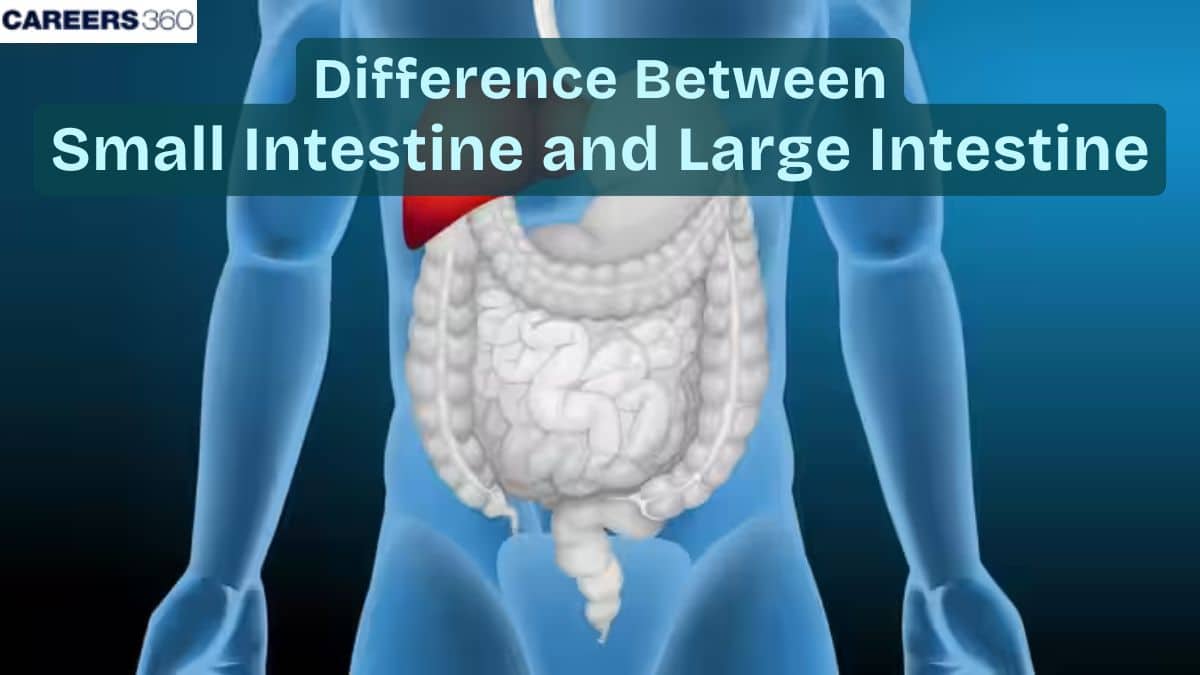
The digestive system is a system of organs, in which food is broken down to be absorbed and waste products excreted. It has two specific parts which are the small intestine and the large intestine. The main process of digestion and absorption occurs in the small intestine. However, the large intestine is mainly focused on absorbing water and forming waste products that need to be expelled from the body.
Small Intestine
Small intestine is discussed below:
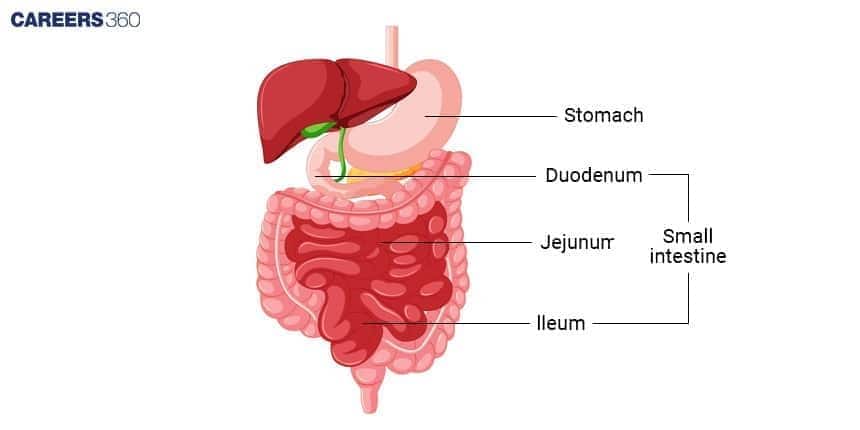
A long, coiled tube about 4-6 meters in length.
Divided into three portions: the duodenum, jejunum, and ileum.
The main function is to digest and absorb nutrients from the ingested food.
Its inner surface is lined by numerous villi and microvilli, progressing to enlarge the surface for effective absorption.
Enzymes and digestive juices from the pancreas, liver, and its own glands aid in breaking down carbohydrates, proteins, and fats, ensuring that vital nutrients are absorbed into the bloodstream.
Large Intestine
Large intestine is discussed below:
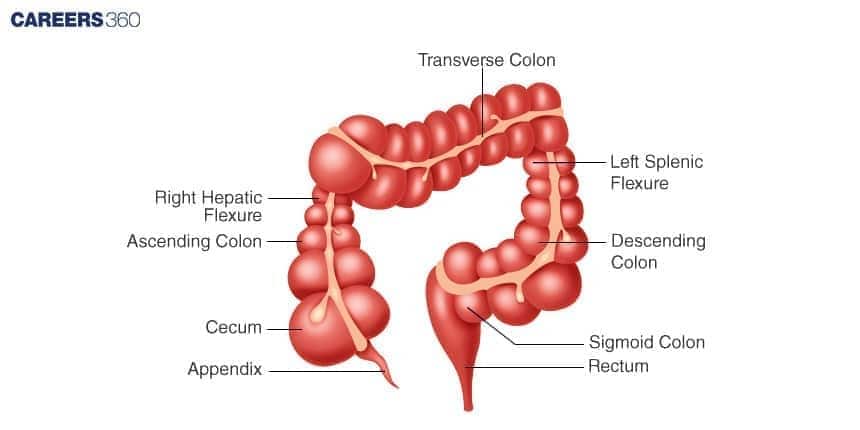
The large intestine is about 1.5 meters long and consists of the cecum, colon, rectum, and anal canal.
It absorbs significant amounts of water and electrolytes from indigestible food material and, hence, forms semi-solid stools.
Unlike the small intestine, it does not have villi but has haustra or pouches, which help with the segmentation movement and passage of waste
The large intestine also contains quite a respectable resident population of gut bacteria that can ferment undigested carbohydrates, producing valuable vitamins of the types of Vitamin K and some of the B complex
It stores faecal matter until it is excreted from the body.
Difference Between Small Intestine And Large Intestine
The difference between small and large intestine is discussed below:
| Feature | Small Intestine | Large Intestine |
|---|---|---|
Length | 4-6 meters | 1.5 meters |
Diameter | 2.5-3 cm | 6-7 cm |
Sections | Duodenum, jejunum, ileum | Cecum, colon, rectum, anal canal |
Surface Area | Villi and microvilli increase surface area | Smooth with haustra |
Primary Function | Digestion and absorption of nutrients | Absorption of water and electrolytes, formation of faeces |
Histological Layers | Mucosa, submucosa, muscularis, serosa | Mucosa, submucosa, muscularis, serosa |
Digestive Enzymes | Present (e.g., enterokinase, maltase) | None |
Motility | Segmentation and peristalsis | Haustral churning, mass movements |
Microbiota | Less abundant, mainly involved in nutrient digestion | Abundant, involved in fermentation and vitamin production |
Diseases | Crohn’s disease, celiac disease, intestinal obstruction | Colorectal cancer, ulcerative colitis, diverticulitis |
Functional Comparison
The small and large intestine differ in the functions:
Small Intestine
Digests carbohydrates, proteins, and fats
Absorbs nutrients into bloodstream
Essential for energy and growth
Large Intestine
Absorbs water and salts
Forms semi-solid faeces
Stores waste before egestion
Small vs Large Intestine NEET MCQs (With Answers & Explanations)
Important questions asked in NEET from this topic are:
Details of small and large intestine
Small vs Large Intestine
Practice Questions for NEET
Q1. Identify the precise nature and origin of the enzyme Enterogastrone
An enzyme secreted by the gastric mucosa
A hormone secreted by the small intestinal mucosa
A hormone secreted by the duodenal mucosa
A secretory product of an endocrine gland associated with digestion
Correct answer: 3) A hormone secreted by the duodenal mucosa
Explanation:
Enterogastrone is a collective term for various hormones produced by the mucosa of the small intestine, primarily the duodenum. These hormones, such as secretin and cholecystokinin are released in response to the presence of chyme in the small intestine and play a role in regulating digestive processes. The term "enterogastrone" specifically emphasizes its inhibitory effect on gastric motility and acid secretion, helping to slow down the emptying of the stomach and promote efficient digestion and absorption in the small intestine.
Hence, the correct answer is option 3. A hormone secreted by the duodenal mucosa.
Q2. Assertion: The serosa is a smooth membrane made up of a thin layer of cells that release serous fluid and a thin layer of connective tissue.
Reason: Serous fluid is a lubricating fluid that minimises friction caused by muscularis action
Assertion and reason are both true, and reason is an accurate account of assertion.
Both assertion and reason are accurate, but reason does not adequately explain assertion.
The assertion is correct, but the reasoning is incorrect.
Both the assertion and reason are incorrect.
Correct answer: 1) Assertion and reason are both true, and reason is an accurate account of assertion.
Explanation:
The serosa is the outermost layer of the small intestine and is composed of a thin layer of cells that secrete serous fluid and a layer of connective tissue. The serous fluid serves as a lubricant that reduces friction caused by the movement of the muscularis layer, which helps the small intestine mix and propel its contents along its length. Therefore, both the assertion and reason are true, and reason accurately explains the assertion.
Hence, the correct answer is option 1) Assertion and reason are both true, and reason is an accurate account of assertion.
Q3. Last section of large intestine is
Caecum
Colon
Rectum
Anus
Correct answer: 3) Rectum
Explanation:
The rectum is the final part of the large intestine, situated just before the anus. It plays a vital role in the elimination of waste from the body. The rectum stores formed faeces, which are the byproducts of digestion and absorption until they are ready to be expelled from the body during defecation.
Hence, the correct answer is option 3) Rectum
Also Read:
Frequently Asked Questions (FAQs)
The common diseases include Crohn's disease, celiac disease, and intestinal obstruction.
The absorption of nutrients in the small intestine happens with the help of its villi and microvilli, whereas the large intestine is mainly engaged in the absorption of water and electrolytes.
Water from undigestible material is absorbed in the large intestine and formed into faeces, which are excreted out of the body.
The main function of the small intestine is to break food into absorbable nutrients.
The large intestine is shorter, and wider, with Haustra and Teniae coli organs whereas the small intestine is longer, and narrower with villi and microvilli.
