
Search Colleges, Exams, Schools & more


Login
B.M.M. (Bachelor of Mass Media) - Courses, Fees, Admission, Exams, Salary, Colleges
#B.M.M.
Bachelor of Mass Media (B.M.M.) is a three-year undergraduate Mass Communications programme. B.M.M. covers various subjects related to communication and its mediums like newspaper, radio, television, and more in the three-year course spread over six semesters. The course imparts theoretical as well as practical knowledge to the candidates in the first two years and in the final year, candidates have to undergo internships or on-the-job training.
This Story also Contains
- What is the Full Form of B.M.M.?
- B.M.M. Course Details
- B.M.M. Fees Structure
- Why Choose B.M.M?
- B.M.M. Eligibility Criteria
- B.M.M. Course Duration
- Skills Required for B.M.M. Degree
- B.M.M. Application Process
- B.M.M. Cut off
- What after B.M.M.?
- Careers Opportunities after B.M.M.
- Salary After B.M.M. Degree
- Top Private B.M.M. Colleges in India with Fees
- Top Government B.M.M. Colleges in India with Fees
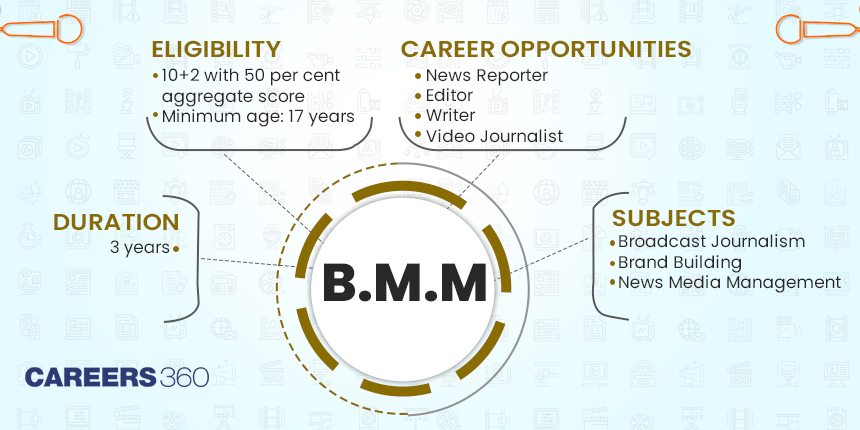
Institutes also allow candidates to choose specialisations of their choice such as journalism, advertising, and public relations after the second year but this varies from one institute to another. As media is one of society's strongest pillars, B.M.M. offers candidates various career opportunities. Those wishing to pursue a Bachelor of Mass Media should have skills such as communication, creativity, analytical, and problem-solving skills.
They should have an eye for detail. B.M.M. can open a plethora of career opportunities for candidates who are interested in the field of media. A B.M.M. graduate can get a job as a journalist in a top news channel or the individual can work as a writer. So, candidates have various areas open to them after completing the B.M.M. degree.
What is the Full Form of B.M.M.?
BMM's full form is Bachelor of Mass Media. Students who are interested in Mass Media, Communication, and Journalism can pursue BMM courses Anyone who wishes to develop their career in the field of Management can pursue BMS.
B.M.M. Course Details
| Particular | Values |
|---|---|
Name | Bachelor of Mass Media |
Abbreviation | B.M.M. |
Type | Degree |
Level | Undergraduate |
Duration | 3 years |
Field | Media |
Fee | Rs. 20,000 to Rs. 90,000 |
Job Opportunities | News Reporter, Editor, Writer, Video Journalist, Anchor, Correspondent, News Analyst |
Average Salary | Rs. 1.50 Lakhs to Rs. 3 Lakhs |
| Top Recruiters | Times of India, NDTV, News 18, Radio Mirchi, The Indian Express, Red FM |
B.M.M. Fees Structure
The B.M.M. course fees will differ based on the type of institution. The government colleges prescribe lesser fees for the course than the private ones. B.M.M fee in private colleges ranges from Rs. 57,000 to Rs. 1.36 Lakhs. The government colleges fee is between Rs. 53,000 - Rs. 83,000.
Why Choose B.M.M?
As media is one of society's strongest pillars, B.M.M. offers candidates various career opportunities. Those wishing to pursue a Bachelor of Mass Media should have skills such as communication, creativity, analytical, and problem-solving skills. They should have an eye for detail. B.M.M. can open a plethora of career opportunities for candidates who are interested in the field of media.
A B.M.M. graduate can get a job as a journalist in a top news channel or the individual can work as a writer. So, candidates have various areas open to them after completing the B.M.M. degree.
B.M.M. Eligibility Criteria
Candidates who wish to pursue a B.M.M. course must fulfill some minimum eligibility conditions to be considered for admission. However, the conditions may vary from one college to another. Following are the conditions that a candidate must satisfy to get admission to the B.M.M. course.
- Candidates must have passed 10+2 or equivalent examination with specialisation in any of the areas of Arts, Science, and Commerce.
- Candidates must have at least 50 percent marks in 10+2 or equivalent examination. This minimum percentage of marks may vary depending on the college. The minimum percentage can be between 50 percent and 60 percent.
- The minimum age limit to enroll for the course is 17 years.
B.M.M. Course Duration
The duration of B.M.M. is 3 years which is inclusive of the compulsory internship. Students need to complete a rotatory internship programme of one year or six months after the programme to become eligible for registration with the Veterinary Council.
Skills Required for B.M.M. Degree
Aspiring students must possess certain skills to get the most out of their B.V.Sc degree programme. Below, we have mentioned some of the skills that are required to pursue a BVSc degree programme.
- Patience
- Physical and Mental Strength
- Communication Skills
- Attention to Detail
- Critical Thinking
- Empathy
B.M.M. Application Process
The B.M.M. course admissions are based on marks secured by the candidates in 10+2 or equivalent examinations and entrance tests conducted by different institutes. Most of the colleges conduct their entrance test to shortlist the candidates for the course.
- Entrance: The entrance exam mainly has questions about English and communication skills, general knowledge, creative thinking, logical reasoning, data interpretation, and economics.
- Merit: Many colleges also conduct a personal interview or group discussion followed by the entrance test to shortlist the candidates. Candidates who qualify for the rounds involved in the admission process of an institute, get admission to the Institute.
B.M.M. Cut off
Bachelor of Veterinary Science cut-off is used to determine the student's merit for admission. For BVSc admission, NEET or other state or university level examination’s cut-off is the criteria for medical colleges. BVSc cutoff is based on the number of students appearing for the entrance examination, and the difficulty level of the question paper.
B.M.M. Syllabus
The B.M.M. syllabus covers all important media-related subjects and imparts knowledge about each aspect to the candidates. The first-year syllabus introduces the candidates to basic subjects like Communication Skills, Economics, Sociology, Psychology, Marketing and Management, Introduction to Literature, and more.
The second year has core subjects like Advertising, Journalism, Media Studies, Radio and Television, Culture Studies, Creative Writing, and more. In the last year, candidates are required to choose between electives Advertising and Journalism. The following tables can be referred to understand the detailed B.M.M. Syllabus.
B.M.M. First Year Syllabus
Semester 1 | Semester 2 |
|
|
B.M.M. Second Year Syllabus
Semester 3 | Semester 4 |
Introduction to Advertising Introduction to Journalism Introduction to Public Relations Introduction to Media Studies Culture Studies Creative Writing | Mass Media Research Organizational Behavior Understanding Cinema Radio and Television Advanced Computers Print Production and Photography |
B.M.M. Third Year Syllabus
Semester 5 | Semester 6 |
Electives: Journalism OR Advertising Journalism Journalism
Advertising
| Electives: Journalism OR Advertising Journalism Journalism
Advertising
|
B.M.M. Specialisations
- Business Journalism & Corporate Communication
- Communication and Media, and Psychology
- Communication and Media, English and Psychology
- Hindi Journalism and Mass Communication
- Journalism and Film Studies
- Journalism and Mass Communication
- Journalism and Mass Communication Hons
- Journalism, Economics, Psychology
- Mass Communication
- Mass Communication and Videography
What after B.M.M.?
B.M.M. graduates have a very wide scope in terms of job opportunities in the Mass communication sector. Careers in Mass Media are not only high paying but also bring job satisfaction. As every country has media houses, such candidates can also go abroad for jobs. However, it may require some additional skills.
Careers Opportunities after B.M.M.
As the media is a flourishing sector, it has various types of career opportunities for candidates. As the sector is considered a pillar of society, B.M.M. graduates can get different types of job roles. Candidates can be journalists, content writers, editors, and much more. Bachelor of Mass Media opens various areas for the graduates. Those with a B.M.M. Degree can get the following job roles:
Journalist - The job role of a journalist is to collect news or information from various sources and present it before the public. The role also involves working on articles and stories. The average annual salary of a journalist in India is Rs 3.50 Lakhs.
Columnist - A columnist is a person who writes or edits copies for a regular column in a newspaper. This column can be related to any field- entertainment, politics, sports, fashion, and many more. The average annual salary of a columnist in India is Rs. 3.60 Lakhs.
News Reporter - The job role of a news reporter involves gathering and writing news, reporting on-air, conducting interviews, generating stories, and more. The average annual salary of a news reporter in India is Rs. 2 Lakhs.
Editor - The job role of an editor involves planning, coordinating, and revising the content for publication. The main work is to check the copy of content that is going to be uploaded. Other than this, their job role involves setting publication standards, suggesting stories, complying with media laws, and more. The average annual salary of an editor in India is Rs. 4 Lakhs.
Sub-Editor - A sub-editor is responsible for editing copies, checking grammatical mistakes in the news reports, analysing whether the word count of the story is justified or not, checking facts, and much more. The average annual salary of a sub-editor in India is Rs. 3.60 Lakhs.
Anchor - The job role of an anchor involves informing the public about the latest stories through anchoring. They have to utilize their speaking skills to convey a story to the public. The average annual salary of an anchor in India is Rs. 4 Lakhs.
News Analyst - They have similar job roles as an anchor. Sometimes News Analysts and anchors are considered the same. News Analysts also have to interpret, analyse and broadcast the news coming from various sources. A news analyst with an experience of 6-7 years can get an average annual salary of Rs. 7.50 Lakhs.
Correspondent - The job role of a correspondent involves searching for new stories and topics, interviewing people, and much more. After searching for stories and gathering information, write stories for publication. The average annual salary of a correspondent in India is Rs. 3.80 Lakhs.
Photojournalist - As the name suggests, a photojournalist has to capture images of people, events, and incidents for a story to be published or broadcast. The average annual salary of a photojournalist in India is Rs. 4 Lakhs to Rs. 6 Lakhs.
Proofreader - The job role of a proofreader involves proofreading or checking for grammatical, syntax, and usage mistakes in a story material or copy. The basic role is to check for any mistakes in the copy. The average annual salary of a proofreader in India is Rs. 3.80 Lakhs.
Freelance Writer - Freelance writers are the writers that write stories for a news channel or publishing house remotely or without being a permanent part of the organisation. They take up particular work and complete it. The average annual salary of a proofreader in India is Rs. 2 lakhs to Rs. 2.40 Lakhs.
Director- As B.M.M. graduates know television, cinema, creative writing, and more, they can be directors also. The basic role of a director is to guide the actors and other staff. The average annual salary of a director in India is Rs. 13.50 Lakhs.
Content Writer- The work of content writers involves writing different types of content like stories for media and publication houses. They provide content for both digital and print media. The average annual salary of a content writer in India is Rs. 2.80 Lakhs.
Script Writer - The job role of a scriptwriter is also writing stories like a content writer but they are dedicated to writing scripts for movies, TV shows, and more. The average annual salary of a content writer in India is Rs. 6 Lakhs to Rs. 7 Lakhs.
Top Recruiters
- The Times of India
- Red FM
- Radio Mirchi
- News 18
- The Indian Express
- NDTV
Salary After B.M.M. Degree
The salary of B.M.M. graduates ranges from Rs. 2 Lakhs to Rs. 7 Lakhs per year. A fresher with a B.M.M. degree may get an average annual salary package of Rs. 2 Lakhs - Rs. 2.40 Lakhs but the salary is increased with experience. With an experience of five years, a graduate can earn Rs. 6 Lakhs - Rs. 7 Lakhs per annum. The salary is further increased with the years of experience.
B.M.M. Salary Graph
Experience | Average Annual Salary |
Freshers | Rs. 2 Lakhs to Rs. 2.40 Lakhs |
B.M.M. graduate with 4-5 years of experience | Rs. 4 Lakhs to Rs. 5 Lakhs |
B.M.M. graduate with 6-10 years of experience | Rs. 6 Lakhs to Rs 10 Lakhs |
Note: These salary figures may vary depending on various factors, such as designation, experience, skills, and job location.
Employment Areas
B.M.M. graduates can join private and government institutions. They can also practice individually. Some of the employment areas for these graduates are:
- Journalism
- Advertising
- Public Relations
- Digital communications
- Photography
Top Private B.M.M. Colleges in India with Fees
In India, there are several private B.M.M. colleges. Private universities are significantly more expensive than public universities. Some of the top private B.M.M. Colleges and B.M.M. fees are discussed below:
Colleges | Fees |
| Akbar Peerbhoy College of Commerce and Economics, Mumbai | Rs. 57,000 |
| AAFT University of Media and Arts | - |
| Bhavan's College, Mumbai | Rs. 71,600 |
| BK Birla College Kalyan | Rs. 63,000 |
| Chetana's Hazarimal Somani College of Commerce and Economics | Rs. 1.36 Lakhs |
Top Government B.M.M. Colleges in India with Fees
Attending a government-run B.M.M. college is less expensive than attending a private B.M.M. college. The following are some of the best government B.M.M colleges and their fees:
Colleges | Fees |
| AKU Patna | - |
| SNDT Women's University, Mumbai | Rs. 82,500 |
| Smt MMK College of Commerce and Economics, Mumbai | Rs. 52,000 |
| CHM Ulhasnagar | - |
| Langat Singh College, Muzaffarpur | - |
Bachelor in Mass Media is an undergraduate degree programme in mass media that provides candidates with knowledge and skills to build a career in the industry.
Frequently Asked Questions (FAQs)
Q: What is B.M.M.?
A:
B.M.M. i.e. Bachelor of Mass Media is a 3-year undergraduate degree in Mass Communication.
Q: Who can do a B.M.M. course?
A:
A candidate who has passed 10+2 or equivalent examination with specialization in any of the areas of Arts, Science and Commerce with minimum 50% (vary as per institute) marks is eligible for B.M.M. course.
Q: What are the career options after B.M.M.?
A:
B.M.M. graduates have various career options like Journalist, Columnist, News Reporter, Editor, Content Writer, Director, Business Consultant and more..
Q: What is the starting salary of B.M.M. Graduates?
A:
The starting salary of B.M.M. graduates can range from 2-2.4 lacs.
Articles
Certifications By Top Providers
Explore Top Universities Across Globe
Popular Courses and Specializations
Popular Branches
Popular Courses
- B.A. Photography: Course, Admission, Eligibility, Career, Subjects
- Diploma in Acting Course, Admissions, Eligibility, Syllabus, Fees, Career
- Diploma in Journalism Course, Admissions, Eligibility, Syllabus, Fees, Career Options
- B.Sc Visual Communication Course, Admissions, Eligibility, Syllabus, Fees
- Diploma in Photography Course, Admissions, Eligibility, Syllabus, Fees, Career
List of B.M.M. colleges

Questions related to B.M.M.
On Question asked by student community
Have a question related to B.M.M. ?
The official second-year exam schedule is generally released on the Mumbai University website or on the college notice board. Visit or contact your college office for the latest timetable.
Hello Archana,
Sure, here's a list list of colleges that you can check:
Government Colleges:
- Delhi University (DU)
- Delhi's Government Colleges : Delhi has several government-affiliated colleges offering BA-JMC and BMM programs. Research their admission criteria and specific programs (e.g., colleges like Hindu College) and admission processes separately.
- Haryana Government
Hello Aditya,
To teach at the TGT (Trained Graduate Teacher) and PGT (Post Graduate Teacher) levels, you need a relevant postgraduate degree and a B.Ed. Here’s what you should do next:
-
For TGT (teaching classes 6-10):
-
Pursue B.Ed. after your BMM.
- Choose subjects related to your graduation, like English, Social
-
Pursue B.Ed. after your BMM.
BMS full frame is Single man of Administration Thinks about which may be a 3-year UG degree planned to supply understudies with a comprehensive understanding of administration concepts, hones, and standards. BMS courses regularly emphasize commonsense learning through internships, case thinks about, and ventures, permitting understudies to apply hypothetical information
Bajaj finance ()- at us call now....

Applications for Admissions are open.
Ranked #45 Among Universities in India by NIRF | Get Upto 100% Scholarships | Spot Admissions via CUET
Karnavati University BAJMC Admissions 2024
Apply100% Placements Assistance | 200+ Recruiters