


Muscle Contraction and Mechanism of Muscle Contraction: Functions
Muscle contraction is the process of generating tension in muscle fibres through actin–myosin interaction, enabling voluntary and involuntary movements. The mechanism involves neuromuscular junction signalling, excitation–contraction coupling, calcium–troponin regulation, cross-bridge cycling, and ATP-dependent energy systems. This guide covers muscle anatomy, contraction steps, ATP sources, diagrams, FAQs, and NEET-style MCQs.
This Story also Contains
- What Is Muscle Contraction?
- Anatomy Of Muscles
- Mechanism Of Muscle Contraction
- Energy For Muscle Contraction
- Muscle Contraction NEET MCQs (With Answers & Explanations)
- Recommended video on "Mechanism of Muscle Contraction"
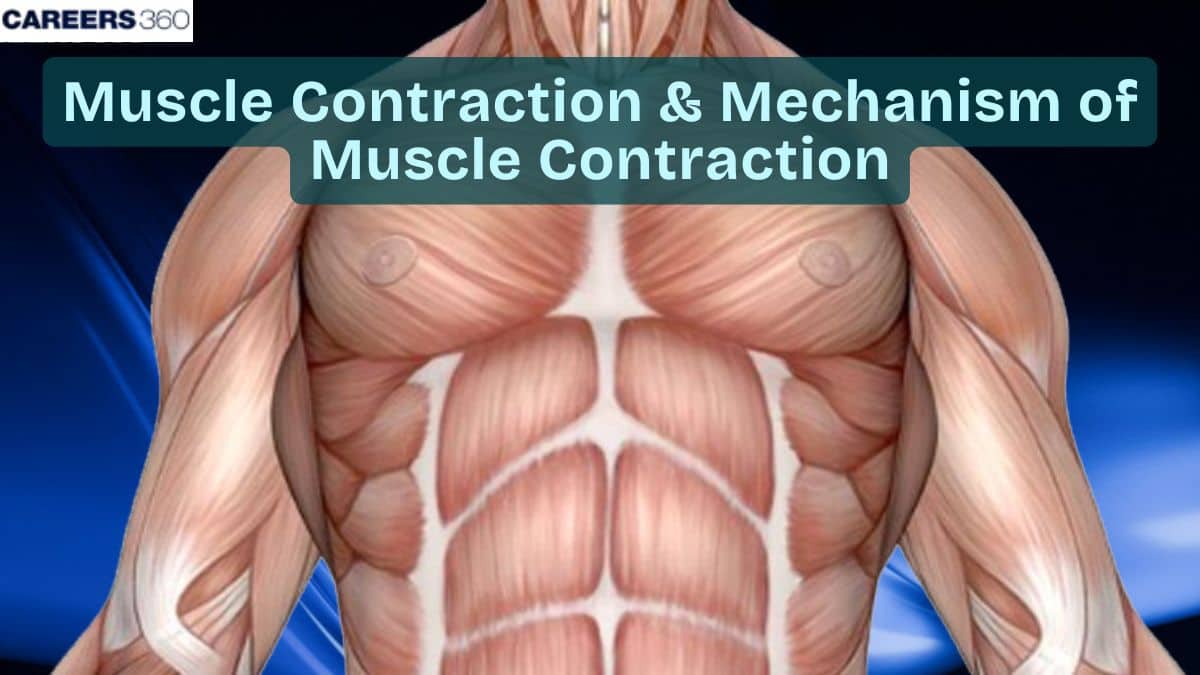
What Is Muscle Contraction?
Muscle contraction is the creation of tension in muscle fibre due to sliding of actin and myosin filament resulting in either shortening or lengthening of the muscle. The process has significant implications for many functions of physiology. It enables voluntary movements, such as posture and heat generation, and involuntary actions like the heart beating and interior organ functions, including digestion.
There are three types of muscles in the human body: skeletal muscles that provide for body movements, cardiac muscle found in the heart organ, which brings about rhythmic contractions to pump blood, and lastly, the smooth muscles found in the walls of internal organs that control such involuntary movements as peristalsis in the digestive tract.
Anatomy Of Muscles
The anatomy of muscles is discussed below-
Muscle Fibres
Skeletal muscle fibers are rather long, cylindrical cells that bear several nuclei at the periphery. They are covered with a plasma membrane called the sarcolemma. The sarcolemma envelops the sarcoplasm and within it, there are many myofibrils.
Myofibrils
These are rod-like structures lying parallel to each other in the muscle fibre and composed of repeated units known as sarcomeres. These consist of the contractile proteins, actin and myosin.
Sarcomeres
Sarcomere is rightly viewed as a portion of the muscle fibre existing between two successive and running Z-lines. Composing overlapping thin and thick filaments, their interaction with actin and myosin, respectively, gives rise to the contraction and subsequent relaxation of muscles.
Mechanism Of Muscle Contraction
The mechanism of muscle contraction is discussed below-
Neuromuscular Junction
The neuromuscular junction is a chemical synapse between the motor neuron and the skeletal muscle fibre. Derivation from the neuron axon ending, crossing the synaptic cleft, comes to rest at the motor end plate within the muscle fibre.
When the action potential reaches the axon terminal, acetylcholine (ACh) is released into the synaptic cleft. Later, ACh will bind to the receptors present on the motor end plate and finally depolarize it, which generates an action potential into the muscle fiber.
Excitation–Contraction Coupling
Role of calcium ions
The action potential travels down the sarcolemma and into the T-tubules, and then the Ca²⁺ is released from the sarcoplasmic reticulum into the sarcoplasm.
Role of troponin and tropomyosin
This Ca²⁺ now combines with troponin wherein, on a conformational change, the tropomyosin exposes the myosin-binding site on actin hence facilitating cross-bridge formation
Steps involved in excitation-contraction coupling:
Action Potential reaches the T-tubules
Release of Ca²⁺ from the sarcoplasmic reticulum.
Ca²⁺ binds with troponin; this use causes a change in the position of the tropomyosin.
Myosin-binding sites on the actin are exposed, and contraction is initiated.
Cross-Bridge Cycle
Step 1: Binding
When the myosin-binding sites on the actin filaments become available, energized myosin heads bind to these exposed sites, forming cross-bridges.
Step 2: Power Stroke
The myosin head pivots to return to its previous position, taking the attached actin filament towards the mid-sarcomere. It releases ADP and phosphate.
Step 3: Detachment
A newly bound ATP into the myosin head releases the myosin head from the actin filament.
Step 4: Re-cocking
Hydrolysis replenishes the energy of the myosin head so that it is cocked again and hence at the beginning of another cycle.
Energy For Muscle Contraction
The energy for muscle contraction is discussed below-
Role Of ATP
It provides energy for the cross-bridge cycle of muscle contraction. The binding of ATP to myosin heads allows the myosin heads to detach from actin after the completion of a power stroke. Hydrolysis re-energizes the myosin heads so that they are ready to go through another cycle of binding and pulling.
Sources Of ATP
Creatine Phosphate System
This high-energy compound gives its phosphate group directly back to ADP with great velocity, thereby regenerating a certain amount of ATP. This is an abbreviated form but instantaneous energy for contraction, sufficient activity to last about 10 seconds.
Glycolysis (Anaerobic)
Because this pathway is anaerobic, it degrades glucose to pyruvate directly by yielding 2 ATP molecules per glucose molecule. The energy yield from glycolysis caters to fleeting, very intense bursts of activities but results in the accumulation of lactic acid and thus muscle fatigue.
Aerobic Respiration
Aerobic respiration occurs inside the mitochondria. Oxygen is used in completely oxidizing glucose, fatty acids, and amino acids into carbon dioxide and water. In this process, a quite significant amount of ATP is generated. Aerobic Respiration is effective and, by continuously supplying ATP, can last for a longer period with moderate-intensity activities.
Muscle Contraction NEET MCQs (With Answers & Explanations)
Important questions asked in NEET from this topic are:
Anatomy of muscles
Mechanism of muscles contraction
Practice Questions for NEET
Q1. Name the ion responsible for unmasking active sites for myosin for cross-bridge activity during muscle contraction.
Calcium
Magnesium
Sodium
Potassium
Correct answer: 1) Calcium
Explanation:
The mechanism of muscle contraction is best explained by the sliding filament theory which states that the contraction of a muscle fibre takes place by the sliding of the thin filaments over the thick filaments. Calcium is the ion released into the sarcoplasm from the sarcoplasmic reticulum during the polarisation.
Ca++ attaches to the Troponin-C. This brings a conformational change in the tropomyosin. As a result, unmasking of active sites on actin for myosin takes place. Cross bridges are formed between actin and myosin. This results in muscle contraction. Magnesium is used in phosphorylation reactions involving ATP. Sodium and potassium help in maintaining the membrane potential.
Hence, the correct answer is option 1) Calcium.
Q2. Consider the following options related to ATP's role in providing energy for muscle contraction:
Facilitating the generation of an action potential in the muscle cell.
Enabling the attachment of Myosin cross-bridges to Actin.
Enabling the detachment of Myosin cross-bridges from Actin.
Triggering the release of Ca2+ from the sarcoplasmic reticulum.
Correct answer: 3) Enabling the detachment of Myosin cross-bridges from Actin.
Option 3 correctly states that ATP enables the detachment of Myosin cross-bridges from Actin during muscle contraction. ATP provides the energy required for Myosin to detach from Actin, allowing for the relaxation phase of the muscle. This process is crucial for the repeated contraction and relaxation cycles that occur during muscle activity.
Hence, the correct answer is option 3) Enabling the detachment of Myosin cross-bridges from Actin.
Q3. The muscle fibers that contract slowly are
Red muscle fibres
White muscle fibres
Both a and b
None of these
Correct answer: 1) Red muscle fibres
Explanation:
Red muscle fibers, also known as slow-twitch fibers, contract slowly but are highly resistant to fatigue. They are rich in myoglobin, mitochondria, and blood supply, which enable sustained aerobic energy production. These fibers are well-suited for endurance activities like walking, running long distances, or maintaining posture, as they rely on oxidative metabolism for energy.
Hence, the correct answer is option 1) Red muscle fibers.
Also Read:
Recommended video on "Mechanism of Muscle Contraction"
Frequently Asked Questions (FAQs)
Isotonic muscle contraction is one in which there is a change in the length of the muscle while developing force; hence, it can be further divided into two kinds: a concentric contraction, which results in muscle shortening, or an eccentric contraction, which results in muscle lengthening. Isometric contractions are muscle contractions that develop force without a change in the length of a muscle; this occurs due to holding a weight at some fixed position. Both are critical components of many forms of physical activity and muscle functions.
Common muscle contraction disruptions include muscular dystrophies, which is the progressive muscle weakening in the case of Duchenne muscular dystrophy; myasthenia gravis, an autoimmune disorder in which fatigability and generalised muscular weakness are factors; muscle cramps or spasms, in which involuntary contractions result; and finally, fibromyalgia, related aching and tenderness of the muscles.
The steps involved in muscle contraction are:
The neuromuscular junction releases acetylcholine as a consequence of a muscle fibre being excited by a nerve impulse. After this, an action potential is generated within the muscle fibre.
The impulse travels down the sarcolemma and into the T-tubules, triggering an increased release of calcium ions from the sarcoplasmic reticulum.
Calcium binds to troponin; tropomyosins, entrained with the former, get out of the way and thus expose the binding sites for myosin to bind and actin.
The myosin head binds the actins forming the cross-bridges and undergoes a "power stroke", pulling the actin toward the center of the sarcomere.
ATP binds myosin, releasing this protein from actin and recocking it for another cycle.
According to the sliding filament theory, sliding of thin filaments—actin—and thick filaments—myosin—past each other accounts for muscle contraction and hence shortens the sarcomere and, in consequence, the muscle Fiber. Thus, myosin heads will attach to actin, pulling it in—the actin filaments—toward the centre, thereby shortening the sarcomere to create tension. Because this event continually repeats in the presence of calcium ions and ATP, it leads to muscle contraction.
The entering into the activity of calcium ions during muscle contraction occurs by its binding to troponin on the actin filaments. This conformational change of the troponin causes a repositioning of tropomyosin, which moves off the myosin-binding sites on the actin filaments and opens these binding sites so that myosin heads can bind and institute the cross-bridge cycle that eventually results in muscle contraction.
