Great Lakes Institute of Management, Chennai
Globally Recognized by AACSB (US) & AMBA (UK) | 18 LPA Avg. CTC for PGPM 2026


Can you identify the correct answer without solving the entire question? That is the skill tested in Data Adequacy, while Data Interpretation checks how quickly you can read tables, charts and graphs to find the right result. The IBSAT 2026 exam is scheduled across December 5-6, 12-13, 19-20 and 26-27, 2026, according to published exam schedules. With 30 questions in the Data Adequacy and Data Interpretation section, knowing common question types and calculation shortcuts can help you save time and improve accuracy.
This Story also Contains
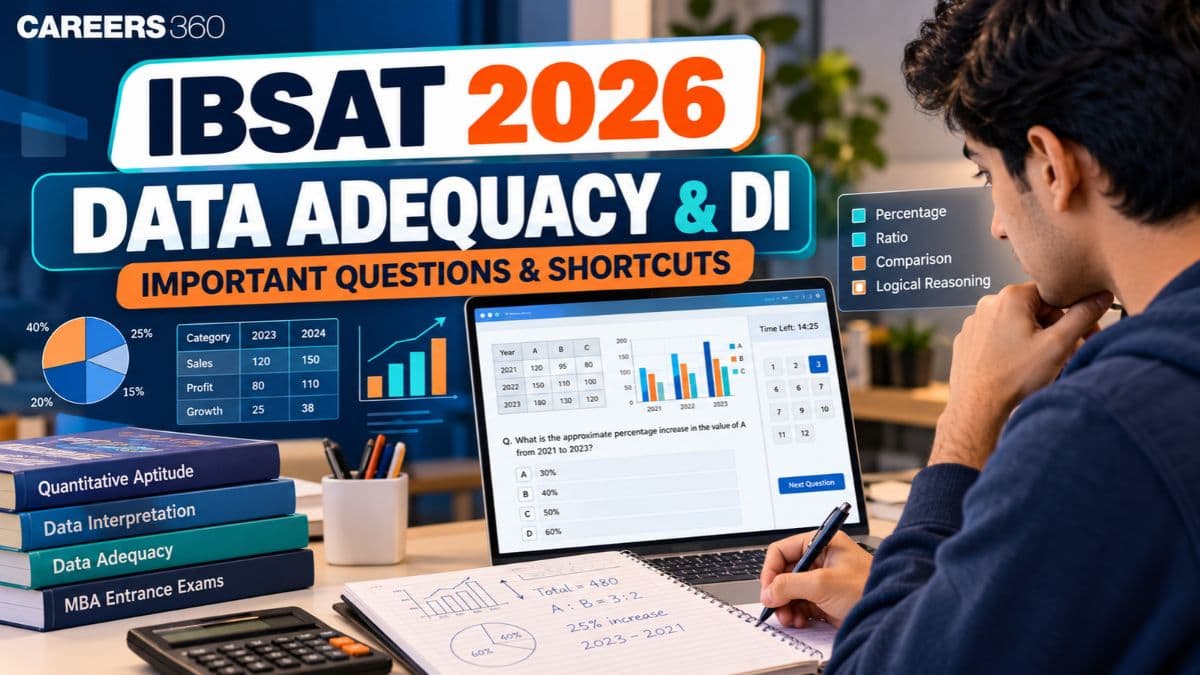
The Data Adequacy and Data Interpretation section tests two related skills: deciding whether given information is sufficient and using numerical data to solve questions. According to the IBSAT 2026 official mock test, the complete exam has 140 questions across four sections, to be attempted in 120 minutes.
Exam detail | Information |
Exam | IBSAT 2026 |
Exam dates | December 5-6, 12-13, 19-20 and 26-27, 2026, as per published schedules |
Section | Data Adequacy and Data Interpretation |
Number of questions | 30 |
Total exam questions | 140 |
Total duration | 120 minutes |
Question format | Multiple-choice questions |
IBS does not publish a detailed official topic-wise syllabus. Therefore, the topics covered below are based on commonly reported question formats and available model papers, rather than a guaranteed list for the 2026 exam.
Data Adequacy questions usually present a problem followed by two statements. Your task is to decide whether Statement 1, Statement 2, both statements together, or neither statement provides enough information to answer the question.
These questions involve percentages, ratios, averages, ages, time and work, or other numerical concepts. The main challenge is deciding whether the information leads to one definite answer.
Example: What is the value of (x)?
Statement 1: (x+y=12)
Statement 2: (y=5)
Globally Recognized by AACSB (US) & AMBA (UK) | 18 LPA Avg. CTC for PGPM 2026
Register for XAT 2027 by 28th Oct to become eligible to take the Mock Test | 75+ years of legacy | #1 Entrance Test | 100+ Test Cities | 250+ B-Schools accept XAT Score
Statement 1 alone is insufficient because both variables are unknown. Statement 2 alone is also insufficient. Together, they give (x=7), so both statements are required.
Questions may involve equations, integers, divisibility, factors or sequences. Check whether the given conditions allow more than one possible value.
Solving trick: If two different values satisfy the same information, the data is insufficient to determine a unique answer.
These questions may involve triangle properties, angles, circles, lengths or areas. Determine whether the statements provide enough measurements or relationships to calculate the requested value.
Solving trick: Draw a rough figure and mark the known measurements. Do not assume that a diagram is drawn to scale unless the question explicitly states so.
These questions use relationships between speed, distance, time, work, efficiency or proportions.
Solving trick: Identify the unknown quantity first, then check whether each statement provides enough information. Avoid combining statements before testing them separately.
The following table explains the common statement-sufficiency options used in IBSAT model papers. Always follow the exact answer codes printed in your question paper.
Situation | Meaning |
Statement 1 alone is sufficient | Statement 1 gives a definite answer independently. |
Statement 2 alone is sufficient | Statement 2 gives a definite answer independently. |
Both statements are required | Neither works alone, but together they provide a definite answer. |
Either statement alone is sufficient | Each statement independently provides enough information. |
Neither statement is sufficient | Even together, the statements do not provide a definite answer. |
Use these shortcuts while solving:
Test statements separately: Do not assume that both statements are needed.
Check for a unique answer: A range of possible values usually means the information is insufficient.
Avoid unnecessary calculations: You only need to establish whether the data is sufficient.
Watch for hidden assumptions: Do not assume a variable is positive, an integer or a particular value unless the question supports it.
Data Interpretation questions require you to extract information from tables, charts, graphs or written data and use it to answer numerical questions. The following formats are useful to practise based on available IBSAT model papers and preparation references.
Question type | What to practise | Useful solving trick |
Tables | Sales, production, revenue and totals | Read row and column headings before calculating. |
Bar graphs | Comparing values across categories | Find the required difference before calculating percentages. |
Pie charts | Shares, percentages and totals | Convert the given percentage into a value only when needed. |
Line graphs | Changes over time | Compare the correct years or periods before calculating growth. |
Caselet DI | Numerical information presented in paragraphs | Convert the data into a small table. |
Mixed graphs | Questions using two or more data formats | Identify which chart contains each required value. |
These questions present numerical information in rows and columns. You may need to find totals, differences, averages or percentage changes.
Example: A shop sells 120 units in January and 150 in February. The increase is 30 units, or (30/120\times100=25%).
Bar graphs help compare categories, while line graphs show changes over time. Questions may ask for the highest value, percentage growth or difference between two periods.
Solving trick: Before calculating, identify the exact categories or periods mentioned in the question. This prevents errors caused by comparing the wrong values.
Pie charts show how a total is divided among different categories. Questions may ask you to find a category's value, compare two shares or calculate a percentage difference.
Solving trick: If a sector represents 20% of a total of 500, its value is (500\times20/100=100). Calculate only the sectors needed for the question.
A caselet presents data in text rather than a ready-made chart. It may include information about people, companies, production or sales.
Solving trick: Make a quick table of the variables before calculating. This helps you organise the information and reduces the chance of mixing up values.
Use the following methods to reduce calculation time and avoid common mistakes.
Question type | Shortcut or formula | Example |
Percentage change | $\frac{\text{New}-\text{Old}}{\text{Old}}\times100$ | Increase from 200 to 250 = 25% |
Average | Total of values ÷ number of values | Average of 10, 20 and 30 = 20 |
Ratio | Divide both terms by their HCF | (24:36=2:3) |
Difference | Subtract the smaller value from the larger | 450 − 375 = 75 |
Pie chart value | Total × percentage ÷ 100 | 20% of 500 = 100 |
Approximation | Estimate values to eliminate clearly incorrect options | Use 198 as approximately 200 when suitable |
Remember that percentage change uses the original value as the denominator. Dividing by the new value instead can produce an incorrect answer.
Use a structured approach instead of solving random questions from different topics every day.
Practise Data Adequacy separately: Begin with arithmetic, algebra and number-based questions. Focus on identifying whether each statement is sufficient.
Build DI calculation speed: Practise tables, bar graphs, pie charts and line graphs before moving to mixed sets.
Review every mistake: Identify whether the error came from misreading data, choosing the wrong formula or making a calculation mistake.
Use model papers: Solve available IBSAT model papers to understand the statement-based format and common DI layouts.
Take the official mock test: The mock test on the official IBSAT website follows the exam's overall structure and can help you practise time management.
Highest Package 29.30 LPA | 12 LPA Median CTC | 230+ Recruiters | AACSB Accredited | Ranked 51 in Asia by QS International
Early Application Round Deadline: 27th Oct’26 | 400+ Recruiters | Highest CTC 17.2 LPA | Average CTC 8 LPA | 92% Avg. Placements | Awarded Best Business School of the Year
Prepare for IBSAT 2026 with mock tests designed to help you practise exam-level questions, improve speed and accuracy, and assess your preparation. Identify your weak areas and strengthen your test-taking strategy before the actual exam.
Attempt the IBSAT Mock Test Now
MBA Specialisation | What the eBook Covers | Download eBook |
|---|---|---|
Marketing Management | Top colleges, rankings, fees, placements and career options | |
Human Resource Management | Top HR colleges, rankings, fees, placements and careers | |
Financial Management & Services | Finance colleges, rankings, fees, placements and careers | |
Operations Management | Private colleges for operations, rankings, fees, placements and careers | |
Project Management | Colleges, rankings, fees, placements and careers | |
International Business | Top IB colleges, rankings, fees, placements and career opportunities |
Frequently Asked Questions (FAQs)
The commonly reported exam pattern includes 30 questions in the Data Adequacy and Data Interpretation section.
Data Adequacy tests whether the given information is sufficient to answer a question. Data Interpretation tests your ability to read and analyse numerical data to calculate or compare values.
Practise tables, bar graphs, pie charts, line graphs and caselet-based questions. These are common preparation areas, not a confirmed official topic-wise list.
Test each statement independently, check whether it gives a unique answer and combine the statements only when required. Avoid lengthy calculations when you only need to determine sufficiency.
Use available IBSAT model papers and the official mock test on the IBSAT website to practise the question formats and improve your speed.

On Question asked by student community
Hello student
Here are some preferred books for IBSAT exam preparation:
*Quantitative Aptitude:*
1. "Quantitative Aptitude for Competitive Examinations" by R.S. Aggarwal
2. "Quantum CAT" by Sarvesh K. Verma
*Data Interpretation and Logical Reasoning:*
1. "Data Interpretation and Logical Reasoning" by Arun Sharma
2. "Logical Reasoning and Data Interpretation" by
Hi,
IBS Aptitude Test is a test to find out your aptitude in the area of IBS. It helps you understand how well you handle stress and anxiety, how much you can cope with pain and discomfort, what are your strengths and weaknesses. The test is designed for people who
Hello,
IBSAT 2021 is scheduled on December 25, 2021 and December 26, 2021. The examination will be conducted in online mode. You do not have to book the slot to attend IBSAT 2021 examination. The examination center, date and time will be allotted to you and it will be given
IBSAT is a home proctored exam and it will held in the last week of December. You should check your admit card and email that whether you have received login credentials or not. In order to give this exam you must have username and password. At the test day they
Hello Aspirant.
Hope you are doing well.
NMAT = The National Medical Admission Test (NMAT) in Philippines is a national level examination pre-requisite by the applicant for entry to any medical school in the Philippines.
MAT = Management Aptitude Test, commonly known as MAT exam is conducted by the All

Globally Recognized by AACSB (US) & AMBA (UK) | 18 LPA Avg. CTC for PGPM 2026
Register for XAT 2027 by 28th Oct to become eligible to take the Mock Test | 75+ years of legacy | #1 Entrance Test | 100+ Test Cities | 250+ B-Schools accept XAT Score
Highest Package 29.30 LPA | 12 LPA Median CTC | 230+ Recruiters | AACSB Accredited | Ranked 51 in Asia by QS International
Early Application Round Deadline: 27th Oct’26 | 400+ Recruiters | Highest CTC 17.2 LPA | Average CTC 8 LPA | 92% Avg. Placements | Awarded Best Business School of the Year
Last Date to Apply - 19th December 2026 | Highest CTC 68.66 LPA | Average CTC 18.08 LPA | Top 25% Average CTC 24.66 LPA
Top B-School: Ranked #9 in NIRF Management Rankings 2025.