IBSAT 2026-ICFAI Business School MBA/PGPM 2027
AACSB Accredited | 40 LPA-Highest CTC | Scholarships worth 10 CR


An Executive MBA is a postgraduate degree programme in the field of business administration and management. The course duration ranges anywhere from one year to eighteen months. The course also helps the candidates dvelop various skills such as business insight. management, and leadership skills, which will be helpful for them in their careers. Some of the topics covered in EMBA are marketing management, human resource management, and business analytics. To be eligible for the EMBA degree, students must have completed a bachelor’s degree and have secured 60 per cent marks. Some colleges can also require candidates to have relevant work experience of two to three years.
This Story also Contains
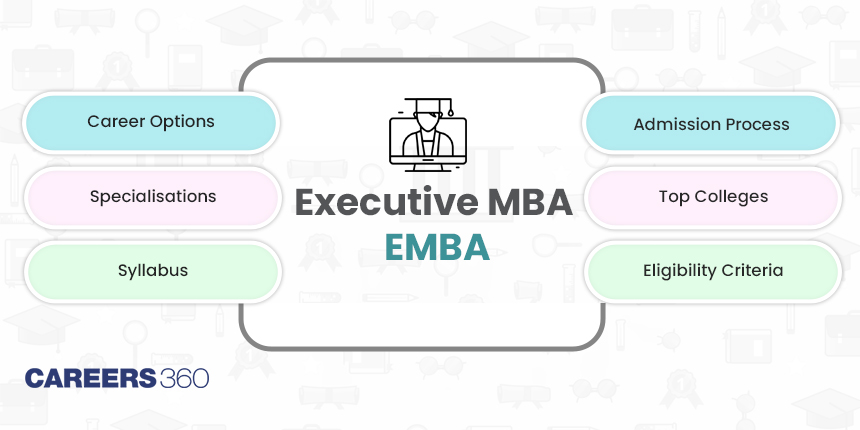
Key Attributes of the Executive MBA Course
Executive MBA is a postgraduate programme tailored for working professionals aiming to advance their careers. It offers flexible learning and industry-relevant skills over 12 to 18 months. Below are the highlights, including eligibility, duration, fees, job roles, top recruiters, entrance exams, and other essential details of the EMBA course.
The full form of an EMBA degree programme is Executive Master of Business Administration. It is a widely recognised management course among recent undergraduates and working professionals. The duration of an Executive MBA course is one year to eighteen months, and can also be pursued in distance modes instead of a regular MBA.
The duration of an Executive MBA course typically ranges from one year to eighteen months, depending on the institute. Students can check the duration of the Executive MBA course in the programme brochure of the college. They should also meet the eligibility requirements of the course before applying for admission.
Students can pursue an MBA in various formats depending on their convenience and interests. In the table below, we have provided the links to popular formats of MBA degrees:
An Executive MBA is a type of MBA that improves managerial skills and provides knowledge to professionals working in senior management positions in the corporate sector. The knowledge and skills gained in the executive master's degree will also help the candidates in getting a salary hike.
Graduates can apply for many career options, such as Company Secretary (CS), CEO, Marketing Manager, HR Manager, and Auditor. An Executive MBA also opens up new opportunities and possibilities for working professionals in business management.
The eligibility criteria for an executive MBA are more or less the same for every management college in India. In India, several private colleges are offering the Executive MBA courses. Below, we have listed the criteria for executive MBAs considered by most colleges in India.
| Particulars | Eligibility Parameters |
|---|---|
Educational Qualification | Bachelor's qualification in a relevant discipline |
Minimum aggregate score | 50-60 per cent aggregate score (for reserved category applicants, there may be some relaxation) |
Entrance Exam | CAT, MAT, CMAT, NMAT, GMAT, and SNAP are some popular exams |
GDPI (Group Discussion and Personal Interview) | Some colleges may conduct group discussions, personal interviews, and/or aptitude tests |
Work Experience | 1-2 years (important for Executive MBA) |
The Executive MBA admission process is quite simple, and almost every college in India follows the same process. Only after fulfilling the eligibility requirements can candidates apply for admission. Listed below is the admission procedure for the EMBA course.
Step 1- Research the Programme- Candidates should research the programme carefully before applying for admission. They should then check the availability of the course at their desired institute.
Step 2- Check the Eligibility details- Once candidates have decided on the institute, they should carefully study the eligibility details of the institute.
Step 3- Application Procedure- Eligible candidates can apply to their desired institute by filling out the application form, either on the official website of the institute or the programme brochure.
Step 4- Entrance Examination- Candidates interested in pursuing the course should appear for relevant entrance examinations. Once these exams are completed, candidates will advance to further steps.
Step 5- GDPI- Many management institutes also conduct group discussions and personal interviews, apart from these entrance examinations.
Step 6- Submit relevant documents- Submitting official documents is an important admission requirement. Candidates should carefully compile these documents before submission.
Step 7- Pay course fees- Finally, candidates should pay the course fee to reserve their seats.
For admissions to the Executive MBA degree programme, students should appear for relevant entrance examinations. Students can check the programme brochure or the official website to know which entrance examination is required by the institute. In this section, we have listed the popular entrance examinations for the EMBA degree programme:
| Exam Name | Conducting Body | Exam Pattern |
|---|---|---|
Indian Institute of Management Lucknow (IIM Lucknow) | ||
All India Management Association (AIMA) | ||
National Testing Agency | ||
Xavier School of Management | ||
Graduate Management Admission Council | ||
Graduate Management Admission Council | - |
Note: IIM Kozhikode administers EMAT to offer Executive Post-Graduate Programs in Management.
The cutoff score is released annually after the declaration of the entrance examination results. The Executive MBA cutoff is defined as the minimum marks that the candidates should score to be eligible for admission. The determining factors of a cutoff are the number of applicants, the difficulty level of the exam, the number of available seats, and students belonging to the reserved categories.
The cutoff is the final stage of the admission procedure and plays an important role in filtering the deserving candidates. Students can check the cutoff of popular management entrance examinations by checking the links below.
Executive MBA CAT 2024 Cutoff
| Top Colleges | Cutoff |
|---|---|
IIM Ahmedabad | 99-100 |
IIM Bangalore | 99-100 |
IIM Calcutta | 99 |
IIM Lucknow | 97+ |
IIM Indore | 97+ |
IIM Kozhikode | 97 to 98 |
IIM Amritsar | 95+ |
IIM Nagpur | 95+ |
Executive MBA XAT Cutoff
| Top Colleges | Cutoff |
|---|---|
XLRI Jamshedpur | 94-95 |
XIM University | 91-92 |
MICA Ahmedabad | 90-91 |
IMT Ghaziabad | 90-91 |
IMI Delhi | 90-91 |
The syllabus of the Executive MBA consists of subjects such as Human Resource Management, Project Finance, Mergers and Acquisitions, Supply Chain Management and Analytics. These subjects help students develop core managerial skills. Students can find the year-wise syllabus of the Executive MBA degree offered by SIBM Noida.
The first-year subjects provide a basic understanding of the management field. Some of the subjects included are Management of Operations, Organisational Behaviour, and Management Accounting. They will learn the fundamentals of the degree that will help them in their final year.
| Semester 1 | Semester 2 |
|---|---|
Economics for Managers | Fundamentals of Innovation |
Marketing Management | Supply Chain Management |
Human Resource Management | Organisational Behaviour |
Management of Operations | R Programming |
Management Accounting | Introduction to Financial Markets and Institutions |
Research Methodology | Management of Diverse Work Force |
Legal Aspects of Business | Project Management |
Introduction to Financial Management | Data-Driven Decision Making |
Management Information Systems | Basic Business Statistics for Data Analysis |
- | Business Analytics |
- | Project-I |
In the second and final year of the Executive MBA course, students are required to choose the specialisation of their specialisation. Apart from some common subjects, the core subjects will vary from one specialisation to another. Listed below is the Executive MBA syllabus for the final year.
| Semester 3 | Semester 4 |
|---|---|
Specialisation: Marketing Major | Generic Core Subjects |
International Marketing | International Marketing Communication |
Business-to-Business Marketing | Consumer Behaviour |
Sales Force and Channel Management | Services and Digital Marketing |
Customer Relationship Management | Leadership and Capacity Building |
Retail Marketing | Indian Ethos and Values for Management |
Sports and Entertainment Marketing | Research Project |
Brand Management | Strategic Management |
Marketing Strategy | - |
Students interested in pursuing the Executive MBA course should know the fees charged by some of the leading management institutes in India. The fees may vary depending on the type of college and facilities available for the comfort and convenience of the students.
Executive MBA in India fees generally range from Rs. 91,000 to Rs. 33 Lakhs for the entire course duration. Students with good merit scores and those belonging to lower socio-economic backgrounds can also receive private and government-funded scholarships.
Executive MBA degrees offer several specialisations that provide students with in-depth knowledge in that particular field. Students can choose the specialisation based on their future goals and interests. Listed below are the popular specialisations available for students with an Executive MBA degree.
Executive MBA Specialisation | Description |
|---|---|
The Executive MBA in Finance is probably one of the most famous specialisations. The finance industry offers various high-paying career opportunities. | |
Sales and Marketing is another popular specialisation offered in an EMBA degree. Sales involves converting a lead to a potential customer, and marketing revolves around understanding customer needs and attracting a wider audience. | |
The EMBA in International Business prepares students to establish a business unit abroad. It is a promising course for someone interested in understanding global business or establishing a business unit in foreign countries. | |
EMBA in Operations Management allows students to work on improving work efficiency and increasing the productivity of a business. It is another popular management specialisation. | |
Human Resource Management is an ideal course for someone interested in joining the HR department of a company, college, or any other unit. It is one of the most popular specialisations after Finance and Marketing. |
While both EMBA and MBA are popular amongst the aspirants, the latter is mostly preferred by the aspirants. However, there are some differences between Executive and Traditional MBAs that are worth considering. In the table below, we have compared the Executive MBA to the Traditional MBA.
| Particulars | Executive MBA | MBA |
|---|---|---|
Duration | 1 year | 2 years |
Eligibility | Bachelor's degree | Bachelor's degree |
Work Experience | 1-2 years (mandatory for most of the colleges) | 1-2 years (optional) |
Admission Process | Entrance exam/Merit-based | Entrance exam/Merit-based |
Fees (for the entire duration) | Rs. 8 Lakhs-Rs. 22 Lakhs | Rs. 50,000 to Rs. 25 Lakhs |
Job Profiles | Brand Manager, Management Consultant, Business Analyst, and Financial Analyst | Marketing Manager, Manager, Sales Manager |
Graduates with an Executive MBA degree can start working as senior managers or as secretaries at multinational companies and earn good salaries. The average annual executive MBA salary in India ranges from Rs. 12 Lakhs to Rs. 40 Lakhs, depending on the company and the candidate's skill and experience.
Students can also go for further studies in management and business by pursuing a PhD in related disciplines. They can also pursue entrepreneurship if they wish to start their business from scratch.
Read More: 7 Reasons to Pursue an Online MBA Degree
There can be numerous career options after EMBA. This degree will open new opportunities for the students and help them grow career-wise. In this section, we have mentioned all the career options available after Executive MBA courses:
| Job Profiles | Job Description |
|---|---|
| Business Development Manager | Business Development Managers are professionals who help develop new business opportunities and also focus on the company's profits and growth. They maintain strong relationships with their business partners. |
| Brand Manager | Brand managers are responsible for researching competition in the market, developing several marketing strategies, and looking after the design and new brand concepts. |
| Management Consultant | Management Consultants guide in identifying options for the organisation and suggest new ideas for change. In addition to this, they also help in solving problems and look after the overall growth of the company. |
| Finance Manager | Finance Managers deal with the financial health of an organisation. They work on direct investment activities, financial reports and also make plans for the long-term financial goals of the company. |
| Business Analyst | Business Analysts work on the business opportunities of the company and improve the efficiency of the same. They also identify and deal with the operational, technological, and financial concerns of the organisations. |
Also Read: What is the Scope of an Online MBA?
PGDM 2027 Early Bird Applications are open. Apply now using coupon code CAREER250 and get ₹250 off the application fee
Recognized as Category-1 Deemed to be University by UGC | 41,000 + Alumni Imprints Globally | Students from over 20+ countries
Executive MBA salary depends on the job role, the location of the company, and the experience of the applicant. Candidates can choose a career based on their interests and aptitude. The following table lists a few job roles and salary figures related to the Executive MBA degree programme.
| Job Profiles | Average Salary (LPA) |
|---|---|
Business Development Manager | Rs. 7.7 LPA |
Brand Manager | Rs. 19.2 LPA |
Management Consultant | Rs. 28.9 LPA |
Finance Manager | Rs. 17.4 LPA |
Business Analyst | Rs. 10.3 LPA |
Salary Source: AmbitionBox
Private executive MBA colleges are very popular among aspirants. However, the fee may be on the higher side compared to government colleges. In the table below, we have mentioned the popular private Executive MBA colleges, along with the respective fee details.
| Top Colleges | Fees |
|---|---|
Rs. 6 Lakhs | |
Rs. 91,000 | |
Rs. 30.26 Lakhs | |
Rs. 5.25 Lakhs | |
Rs. 6.93 Lakhs | |
Rs. 6.66 Lakhs | |
Rs. 2.80 Lakhs | |
Rs. 5.50 Lakhs | |
Rs. 2.53 Lakhs |
Government institutions are often the first choice of the aspirants due to affordable fees and quality education. Government colleges also offer scholarship facilities. In the table below, we have mentioned the popular government Executive MBA colleges, along with the respective fees.
| Top Colleges | Fees |
|---|---|
Rs. 33 Lakhs | |
- | |
Rs. 27 Lakhs | |
Rs. 12.60 Lakhs | |
Rs. 26,010 | |
Rs. 9.86 Lakhs | |
Rs. 3.52 Lakhs | |
Rs. 9.50 Lakhs | |
Rs. 12 Lakhs | |
Rs. 12.20 Lakhs |
Also Read: Is an Online MBA Valid in India?
Executive MBA degrees provide students with strong business and management expertise and strong networking opportunities, which will help them in their professions. Students can work in different sectors such as hospitality, healthcare, government sectors, and many multinational companies.
Frequently Asked Questions (FAQs)
MBA is a master's degree course offered by the University, to develop understanding of basics of business and management. Whereas, an executive MBA is a post-graduate programme for working people.
Candidates who hold a bachelor's degree with at least 60 per cent aggregate or equivalent from a recognised university are eligible for an executive MBA.
The scope for an executive MBA is decent as it provides a spectrum of opportunities to grow.
The salary for executive MBA candidates ranges from Rs. 12 lakh per annum to Rs. 40 lakh per annum.
Yes, executive MBA is equivalent to a master’s degree.
It is quite manageable, but candidates are required to put in some extra effort to score well.
Completing an executive MBA from IIM can cost a lot but it is worth it, as the ROI is also quite impressive.
Yes, a CAT score is required for an executive MBA, as it makes you eligible to get admission to IIMs and other prestigious colleges.
Working professionals with at least three to five years of experience can apply for executive MBA courses.
There are countless companies that offer jobs to executive MBAs. Some of the top recruiters are: TCS, Wipro, KPMG, Capgemini, and Amazon.

On Question asked by student community
Hello Aspirant,
That’s a great start! If you are preparing for the UGAT 2027 with the aim of getting admission to the Integrated MBA programme at the University of Kashmir, you should first make sure that UGAT is the correct entrance route for that programme, as admission rules can change
Hello Student, starting your preparation early for the 2027 admission cycle can give you enough time to build a strong foundation. You can focus on areas such as Quantitative Aptitude, Reasoning, English/Verbal Ability and General Awareness, while checking the official 2027 notification for the exact eligibility and exam pattern. If
Hey there,
IBMR accepts Karnataka PGCET along with CAT, XAT, MAT, ATMA and KMAT. The basic eligibility is a bachelor's degree with 50% marks (45% for SC/ST/Category-1 candidates).
For PGCET admission, the general process is:
PGCET → counselling/seat allotment → document verification → admission/fee payment.
IBMR's own admission process also
Hello Student,
If you're thinking about pursuing an MBA, IIT Delhi is definitely a solid choice! It's especially great for those looking into fields like technology, analytics, operations, finance, and consulting. Here are a few highlights:
Hey there,
For NIT Hamirpur MBA, the General-category CAT cutoff is not a fixed official percentile. NIT Hamirpur's 2026–27 admission process gives CAT a 10/10 weightage in the test component, followed by an interview; it accepts CAT, CMAT and MAT.
As a practical target, 80+ percentile is worth considering, while

Globally Recognized by AACSB (US) & AMBA (UK) | 18 LPA Avg. CTC for PGPM 2026
100% Placements with 260+ Recruiters
Test centres are available in 70+ cities across India | 75,000+ aspirants apply for the NMAT exam | Accepted by 58+ institutions like NMIMS, KJSIM, ISB, SPJIMR and Great Lakes.
Last Date to Apply: 17th August | QS I-Gauge Diamond Rated | NAAC A+ Accredited | 621 Recruitment Partners | INR 40 LPA Highest CTC | 4482 Job offers
Ranked No. 2 Business School in India and no. 26 in world by Financial Times MiM 2026 Ranking | Highest CTC: INR 75 LPA
1 Exam accepted by 17 Top Symbiosis Institutes for 29 MBA programmes.