KCC Institute of Legal and Higher Education, Greater Noida
Law Admissions 2026 Open | Avail Merit-Based Scholarships


Have you ever wondered how to quickly determine whether a number is divisible by 2, 3, 5, 9, or 11 without actually performing the division? Divisibility rules are simple mathematical shortcuts that help identify whether one number can be divided exactly by another. These rules are widely used in arithmetic, number systems, factorization, and mental calculations, making complex calculations faster and easier. Questions based on divisibility rules are frequently asked in school mathematics, SSC, Banking, CUET, CAT, Railways, Defence, and other competitive examinations and quantitative aptitude tests. In this article, we will explore the divisibility rules for different numbers, their formulas, tricks, examples, solved questions, and practical applications.
This Story also Contains
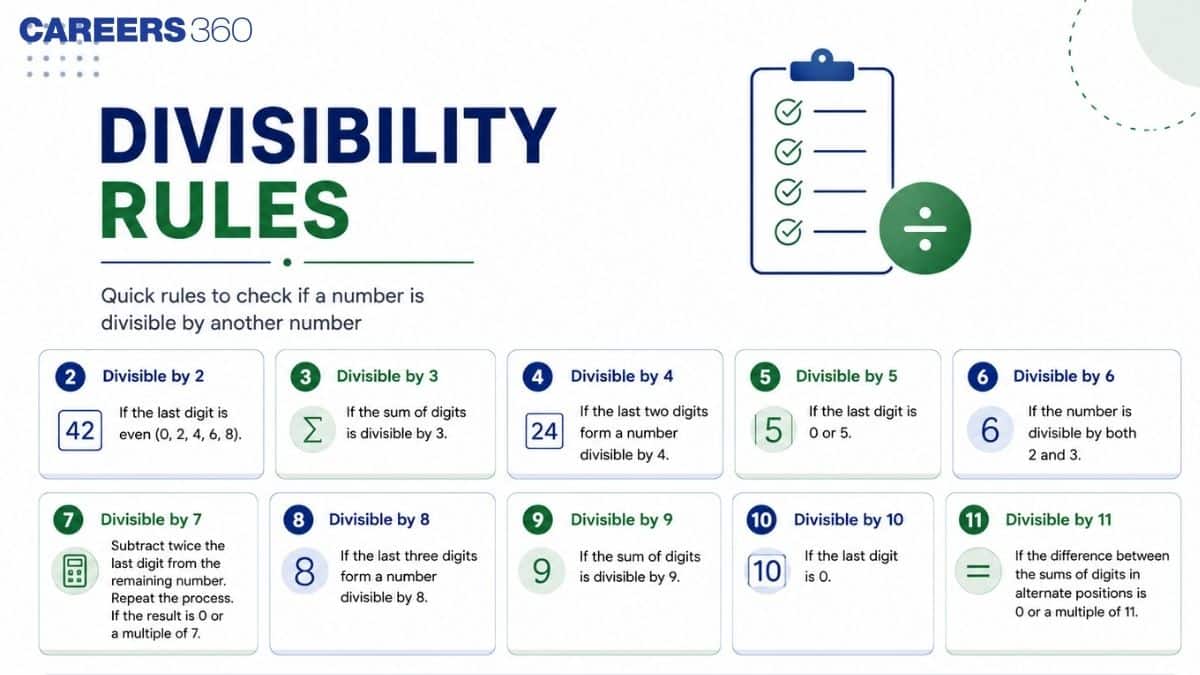
Divisibility rules are simple mathematical shortcuts that help determine whether a number can be divided exactly by another number without performing the actual division. These rules are widely used in arithmetic, number systems, factorization, HCF and LCM, and quantitative aptitude. Learning divisibility rules improves mental calculation speed and helps solve mathematical problems more efficiently.
Divisibility rules are quick tests that tell us whether a number is divisible by another number without carrying out long division.
For example:
Law Admissions 2026 Open | Avail Merit-Based Scholarships
BBA/MBA/PGDM Early Bird Applications Deadline 06th Nov'26. Apply now using coupon code CAREER250 and get ₹250 off the application fee
These simple checks save time and simplify calculations.
A divisibility rule is a mathematical condition used to determine whether a number can be divided by another number exactly, leaving no remainder.
If a number satisfies the required condition, then it is divisible by that divisor.
Consider the number:
$468$
Since:
$4+6+8=18$
and 18 is divisible by 3,
therefore 468 is divisible by 3.
Similarly,
the last digit of 468 is 8, which is even.
Therefore, 468 is also divisible by 2.
Divisibility rules are important because they simplify calculations and help solve number system questions quickly.
Questions based on divisibility rules frequently appear in:
Divisibility rules are not limited to classroom mathematics; they are also useful in everyday calculations.
| Situation | Application |
|---|---|
| Distributing items equally | Checking exact division |
| Packaging products | Determining equal group sizes |
| Inventory management | Counting and grouping objects |
| Data organization | Arranging values into categories |
| Financial calculations | Quick verification of numbers |
A divisibility rules chart provides a quick reference for checking whether a number is divisible by common divisors. Memorizing these rules can significantly improve speed in arithmetic and aptitude questions.
The following table summarizes the divisibility rules for numbers from 1 to 20.
| Number | Divisibility Rule |
|---|---|
| 1 | Every number is divisible by 1 |
| 2 | Last digit is 0, 2, 4, 6, or 8 |
| 3 | Sum of digits is divisible by 3 |
| 4 | Last two digits are divisible by 4 |
| 5 | Last digit is 0 or 5 |
| 6 | Divisible by both 2 and 3 |
| 7 | Double the last digit and subtract from the remaining number |
| 8 | Last three digits are divisible by 8 |
| 9 | Sum of digits is divisible by 9 |
| 10 | Last digit is 0 |
| 11 | Difference of alternate digit sums is divisible by 11 |
| 12 | Divisible by both 3 and 4 |
| 13 | Use repeated subtraction method |
| 14 | Divisible by both 2 and 7 |
| 15 | Divisible by both 3 and 5 |
| 16 | Last four digits divisible by 16 |
| 18 | Divisible by both 2 and 9 |
| 20 | Last digit is 0 and last two digits divisible by 20 |
The most frequently used divisibility tests are summarized below.
| Divisor | Quick Rule |
|---|---|
| 2 | Last digit is even |
| 3 | Sum of digits divisible by 3 |
| 4 | Last two digits divisible by 4 |
| 5 | Ends in 0 or 5 |
| 6 | Divisible by 2 and 3 |
| 8 | Last three digits divisible by 8 |
| 9 | Sum of digits divisible by 9 |
| 10 | Ends in 0 |
| 11 | Alternate digit difference divisible by 11 |
These rules are among the most commonly tested in quantitative aptitude and number system questions.
In divisibility rules(test) we find whether a given number is divisible by another number, we perform actual division and see whether the remainder is zero or not.
In mathematics, there are different rules of divisibility for every number. In this article, we will learn about them in detail.
Every number is divisible by 1. So there is no particular divisibility rule for 1.
Example: 2 is divisible by 1, 100 is divisible by 1, etc.
If the last digit of a number is even (i.e., 0, 2, 4, 6, 8), then the number is divisible by 2.
Example: 12 is divisible by 2, 24 is divisible by 2, 66 is divisible by 2, etc.
If the sum of its digits of a number is divisible by 3, then that number is divisible by 3.
Example: 123 is divisible by 3 as the sum of the digits 1 + 2 + 3 = 6 is divisible by 3.
768 is divisible by 3 as the sum of the digits 7 + 6 + 8 = 21 is divisible by 3.
If the last two digits of a number from left to right are divisible by 4, then that number is divisible by 4.
Example: 2064 is divisible by 4 as 64 is divisible by 4.
1532 is divisible by 4 as 32 is divisible by 4.
There is another way to check if a number is divisible by 4 or not. If the last two digits of a number are 0, then that number is divisible by 4.
Example: 600 is divisible by 4, 700 is divisible by 4, 1300 is divisible by 4, etc.
If the last digit of a number is 0 or 5, then that number is divisible by 5.
Example: 125 is divisible by 5, 50 is divisible by 5, 575 is divisible by 5, etc.
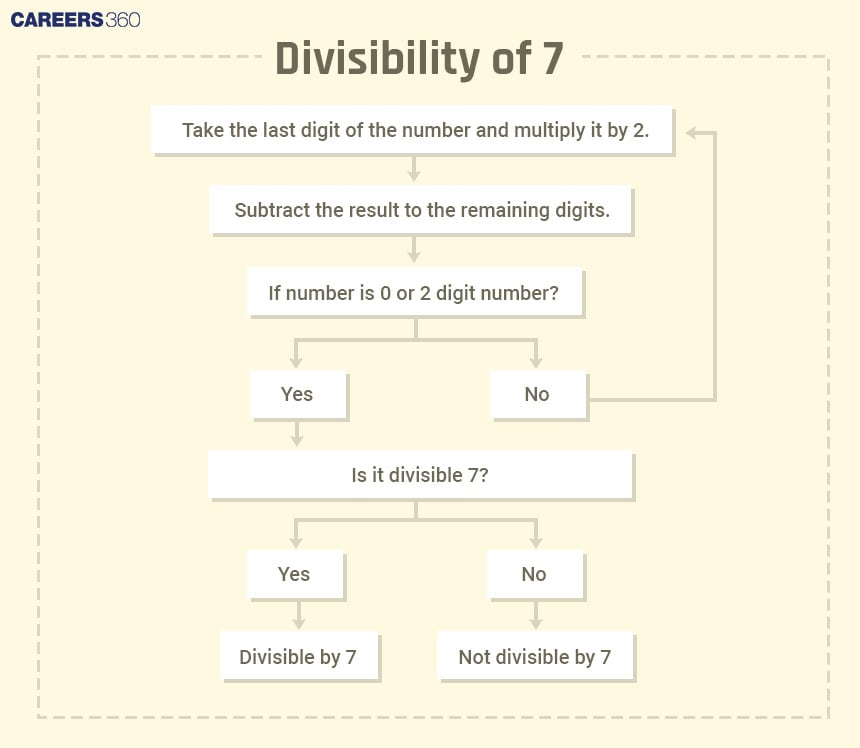
For 7 divisibility rule states that if a number is divisible by 7, then “the difference between twice the unit digit of the given number and the remaining part of the given number should be a multiple of 7 or it should be equal to 0”.
We have to take an example to understand it better.
Let's check if 2839155 is divisible by 7.
The unit digit of the number is 5.
So, 283915 – 5 × 2 = 283905
28390 – 5 × 2 = 28380
2838 – 0 = 2838
283 – 8 × 2 = 267
26 – 7 × 2 = 12, which is not divisible by 7.
So, the number is not divisible by 7.
If the last three digits of a number from left to right are divisible by 8, then that number is divisible by 8.
Example: 151629664 is divisible by 8 as 664 is divisible by 8.
For 9 divisibility rule states that if the sum of the digits of a number is divisible by 9, then that number is divisible by 9.
Example: 7363927 is divisible by 9 as the sum of the digits 7 + 3 + 6 + 3 + 9 + 2 + 6 = 36 is divisible by 9.
If the last digit of a number is 0, then that number is divisible by 10.
Example: 100, 520, 630, 1000, etc.
A number is divisible by 11 if the difference between the sum of the digits at even places and the sum of the digits at odd places of a number is either 0 or divisible by 11.
Example: 1726628 is not divisible by 11 as (1 + 2 + 6 + 8) - (7 + 6 + 2) = 2 is not divisible by 11.
3460831 is divisible by 11 as (3 + 6 + 8 + 1) - (4 + 0 + 3) = 11 is divisible by 11.
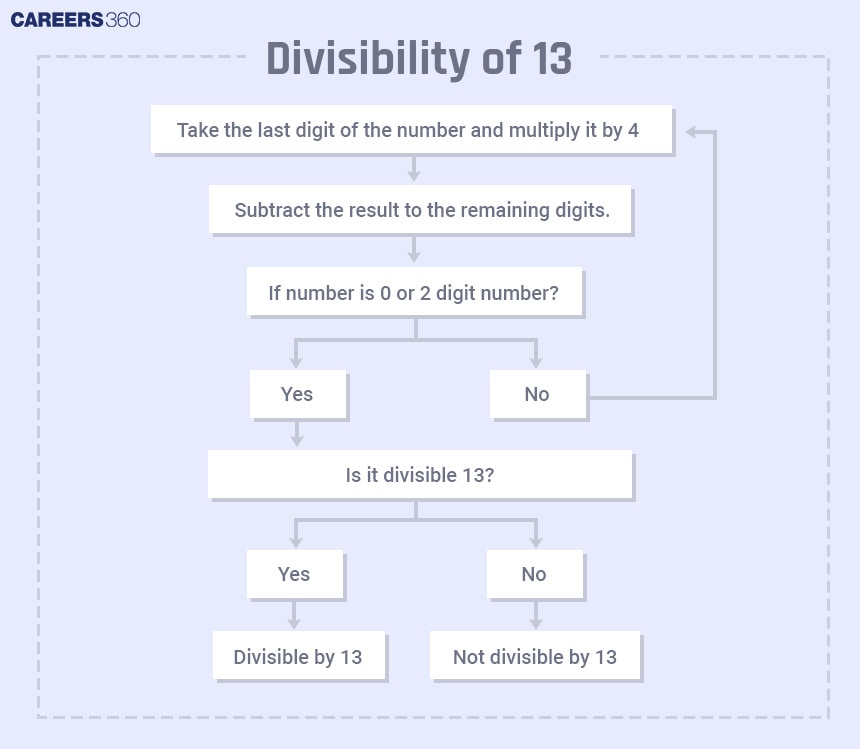
The 13 divisibility rule states that to check if a number is divisible by 13, first, multiply the last digit/unit digit of the number by 4 and subtract it from the remaining number. Then check if it is divisible by 13. For larger numbers, use this process until you get a smaller number to check if it is divisible by 13 or not.
Let's check if 2639155 is divisible by 13.
The unit digit of the number is 5.
So, 263915 – 5 × 4 = 263895
26389 – 5 × 4 = 26369
2636 – 9 × 4 = 2600
260 – 0 × 4 = 260
26 – 0 × 4 = 26, which is divisible by 13.
So, the number is divisible by 13.
If the last 4 digits of a number from left to right are divisible by 16, then the whole number is divisible by 16.
Example: 162652432 is divisible by 16 as 2432 is divisible by 16.
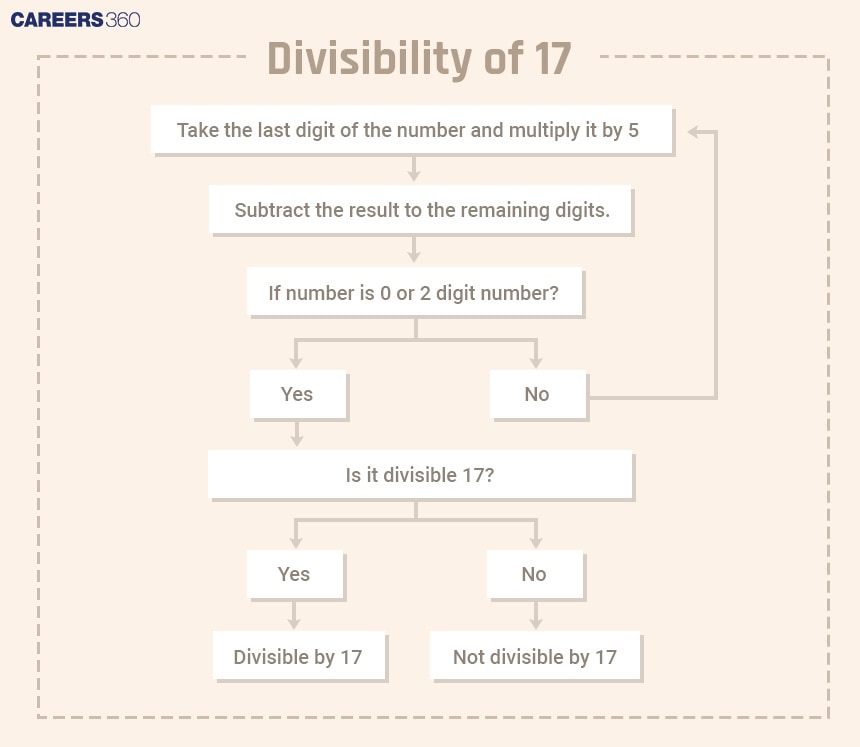
First, multiply the last digit/unit digit of the number by 5 and subtract it from the remaining number. Check if it is divisible by 17. For larger numbers, use this process until you get a smaller number to check if it is divisible by 17 or not.
Let's check if 109718 is divisible by 17.
The unit digit of the number is 8.
So, 10971 – 5 × 8 = 10931
1093 – 5 × 1 = 1088
108 – 5 × 8 = 68, which is divisible by 17.
So, the number is divisible by 17.
First, double the last digit of the number and add it to the remaining number. Check if it is divisible by 19. For larger numbers, use this process until you get a smaller number to check if it is divisible by 19 or not.
Let's check if 2639155 is divisible by 7.
The unit digit of the number is 5.
So, 263915 + 5 × 2 = 263925
26392 + 5 × 2 = 26402
2640 + 2 × 2 = 2644
264 + 6 × 2 = 266
26 + 6 × 2 = 38, which is divisible by 19.
So, the number is divisible by 19.
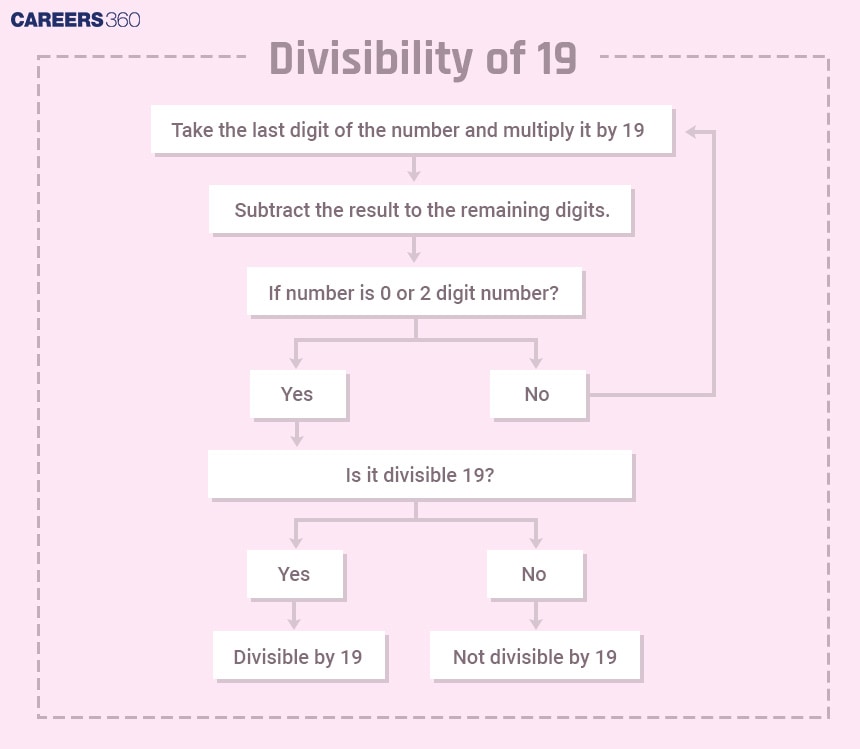
Some divisibility rules are used more frequently than others because they appear regularly in arithmetic calculations and competitive examinations.
A number is divisible by 2 if its last digit is:
$0,\ 2,\ 4,\ 6,\ 8$
Examples:
$248,\ 356,\ 1240$
A number is divisible by 3 if the sum of its digits is divisible by 3.
Example:
$531$
$5+3+1=9$
Since 9 is divisible by 3,
531 is divisible by 3.
A number is divisible by 5 if it ends in:
$0 \text{ or } 5$
Examples:
$250,\ 485,\ 1200$
A number is divisible by 9 if the sum of its digits is divisible by 9.
Example:
$729$
$7+2+9=18$
Since 18 is divisible by 9,
729 is divisible by 9.
A number is divisible by 10 if its last digit is 0.
Examples:
$120,\ 540,\ 2500$
Memorizing divisibility rules becomes easier when similar rules are grouped together and practiced regularly.
| Type | Divisors |
|---|---|
| Last Digit Rules | 2, 5, 10 |
| Digit Sum Rules | 3, 9 |
| Last Digits Rules | 4, 8 |
| Combined Rules | 6, 12, 15, 18 |
By learning these patterns instead of memorizing every rule separately, students can quickly master divisibility rules and solve number system questions with greater speed and accuracy.
The divisibility rule of 13, 17, and 19 is a bit complicated to remember. So we will take an example and check the same number is divisible by 13, 17, and 19.
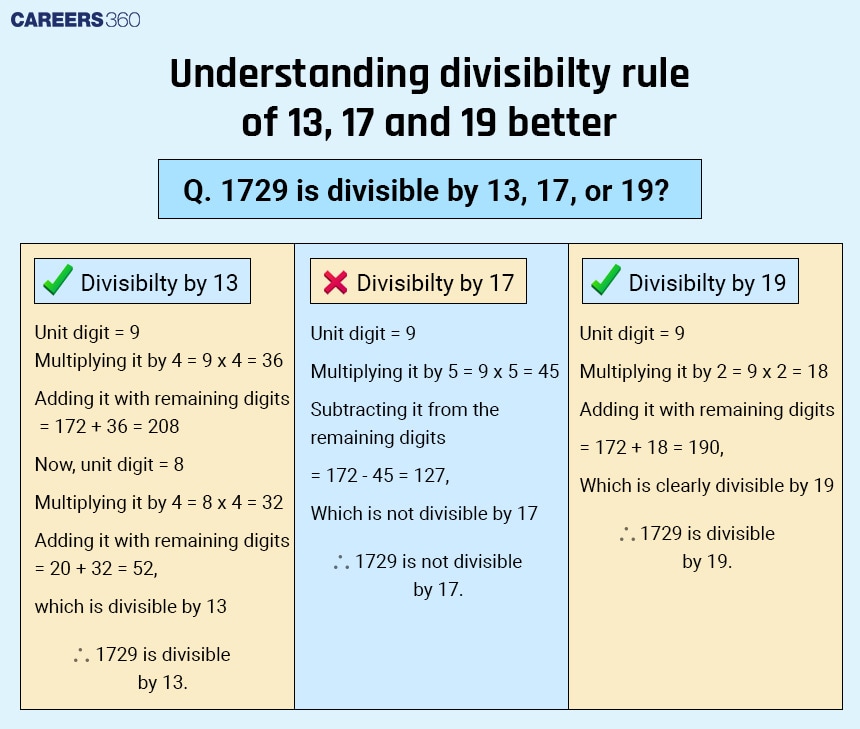
Many divisibility rules can be derived from simpler rules. If a number is the product of two or more prime factors, we can check whether the given number satisfies the divisibility rules of all those factors. This method makes divisibility testing faster and more systematic.
A number is divisible by 6 if it is divisible by both 2 and 3.
Check whether 36 is divisible by 6.
Therefore, 36 is divisible by 6.
A number is divisible by 12 if it is divisible by both 3 and 4.
Check whether 36 is divisible by 12.
Therefore, 36 is divisible by 12.
A number is divisible by 14 if it is divisible by both 2 and 7.
Check whether 56 is divisible by 14.
Therefore, 56 is divisible by 14.
A number is divisible by 15 if it is divisible by both 3 and 5.
Check whether 45 is divisible by 15.
Therefore, 45 is divisible by 15.
A number is divisible by 18 if it is divisible by both 2 and 9.
Check whether 36 is divisible by 18.
Therefore, 36 is divisible by 18.
Divisibility rules are an important part of mathematics because they simplify calculations, improve mental arithmetic, and help solve number system problems efficiently.
Divisibility rules allow us to determine whether a number is divisible by another number without performing lengthy division.
Consider the number:
$1756847577585$
Since the last digit is 5, the number is divisible by 5.
Using long division would take considerably more time.
Divisibility rules help in finding factors of numbers and are useful for calculating HCF and LCM.
To factorize 180:
$180=2\times2\times3\times3\times5$
Divisibility rules quickly help identify these factors.
Many mathematical puzzles, aptitude questions, and competitive examination problems use divisibility concepts to reach answers quickly.
In computer science, divisibility rules are used in:
Divisibility rules provide a quick method for verifying calculations.
Check whether 1536 is divisible by 6.
Therefore, 1536 is divisible by 6.
A composite number is a number that has more than two factors.
Divisibility rules help identify whether a number has additional factors and therefore determine whether it is composite.
24 is divisible by:
$2,\ 3,\ 4,\ 6,\ 8,\ 12$
Since it has more than two factors, 24 is a composite number.
Learning a few simple tricks can make divisibility questions much easier and faster to solve.
Start by learning the divisibility rules for:
These form the foundation for understanding more advanced divisibility tests.
For composite numbers, combine simpler divisibility rules.
If a number is divisible by two coprime numbers, then it is divisible by their product.
A number divisible by both 3 and 5 is divisible by:
$3\times5=15$
If:
$a$ is divisible by $b$
and
$b$ is divisible by $c$
then
$a$ is divisible by $c$
Therefore, 120 is divisible by 3.
If a number is divisible by two numbers, it is automatically divisible by their greatest common divisor (GCD).
If a number is divisible by 12 and 18, then it is also divisible by:
$\text{GCD}(12,18)=6$
Every leap year is divisible by 4, but not every year divisible by 4 is a leap year.
A year is a leap year if:
A strong understanding of divisibility rules helps improve mental calculations, factorization, number systems, and quantitative aptitude problem-solving. These books provide concept clarity and extensive practice.
| Book Name | Best For | Why It Helps |
|---|---|---|
| Quantitative Aptitude for Competitive Examinations – R.S. Aggarwal | SSC, Banking, Railways | Covers number system and divisibility concepts in detail |
| Fast Track Objective Arithmetic – Rajesh Verma | Competitive Exams | Includes shortcut methods and divisibility tricks |
| Magical Book on Quicker Maths – M. Tyra | Speed Mathematics | Useful for mental calculations and divisibility shortcuts |
| NCERT Mathematics Textbooks | School Students | Strong foundation in number properties |
| Objective Arithmetic – Arihant Publications | Aptitude Preparation | Topic-wise practice questions |
Learning divisibility shortcuts can significantly improve calculation speed and help solve number system questions without lengthy division. These tricks are especially useful in aptitude and competitive examinations.
| Number | Shortcut Rule |
|---|---|
| 2 | Last digit should be 0, 2, 4, 6, or 8 |
| 3 | Sum of digits should be divisible by 3 |
| 4 | Last two digits should be divisible by 4 |
| 5 | Last digit should be 0 or 5 |
| 6 | Number should be divisible by both 2 and 3 |
| 8 | Last three digits should be divisible by 8 |
| 9 | Sum of digits should be divisible by 9 |
| 10 | Last digit should be 0 |
| 11 | Difference of alternate digit sums should be divisible by 11 |
| 12 | Number should be divisible by both 3 and 4 |
This table provides a quick reference to the most commonly used divisibility tests. Memorizing these rules can save time and improve accuracy while solving arithmetic and number system problems.
| Divisor | Rule |
|---|---|
| 2 | Unit digit is even |
| 3 | Sum of digits divisible by 3 |
| 4 | Last two digits divisible by 4 |
| 5 | Ends in 0 or 5 |
| 6 | Divisible by both 2 and 3 |
| 7 | Double the last digit and subtract from remaining number |
| 8 | Last three digits divisible by 8 |
| 9 | Sum of digits divisible by 9 |
| 10 | Ends in 0 |
| 11 | Alternate digit difference divisible by 11 |
Q1. What is the smallest number that can be added to 9454351626 so that it becomes divisible by 11?
1
6
5
4
Hint: A number is divisible by 11 if the difference between the sum of the digits at even places and the sum of the digits at odd places of a number is either 0 or divisible by 11.
Answer:
A number is divisible by 11 if the difference between the sum of the digits at even places and the sum of the digits at odd places of a number is either 0 or divisible by 11.
Now, the difference between the sums = (9 + 5 + 3 + 1 + 2 − 4 − 4 − 5 − 6 − 6) = − 5
⇒ So, the difference is 5.
So, either we have to subtract 5 or add (11 – 5) = 6 to make 9454351626 divisible by 11.
Therefore, the smallest number that can be added to 9454351626 to make it divisible by 11 is 6.
Hence, the correct answer is 6.
Q2. Find the value of 'a' to make 6234a6 divisible by 9.
8
7
10
6
Hint: A number is divisible by 9 only when the sum of the digits of the number is divisible by 9.
Answer:
Given: The number is 6234a6.
A number is divisible by 9 when the sum of its digits is divisible by 9.
The sum of the digits of 6234a6 = 6 + 2 + 3 + 4 + a + 6 = 21 + a
The nearest value greater than 21 and divisible by 9 is 27.
So, 21 + a = 27
⇒ a = 6
Hence, the correct answer is 6.
Q3. Which of the following numbers is divisible by 8?
18718
18716
18712
18714
Hint: If the last three digits of a number are divisible by 8, then the number is divisible by 8.
Answer:
If the last three digits of a number are divisible by 8, then the number is divisible by 8.
Option 1: 18718. 718 cannot be divided by 8.
Option 2: 18716. 716 cannot be divided by 8.
Option 3: 18712. 712 is divisible by 8. Therefore, 18712 is also divisible by 8.
Option 4: 18714. 714 cannot be divided by 8.
Hence, the correct answer is 18712.
Q4. $4^{11}+4^{12}+4^{13}+4^{14}$ is divisible by:
7
14
17
9
Hint: Take $4^{11}$ common from the given expression.
Answer:
Given:
$4^{11}+4^{12}+4^{13}+4^{14}$
= $4^{11}(1+4+4^2+4^3)$
= $4^{11}(85)$
Since 85 is divisible by 17,
Therefore, the above expression is also divisible by 17.
Hence, the correct answer is 17.
Q5. Which of the following numbers is divisible by 99?
31548
60687
44775
84456
Hint: You have to check if the number is divisible by 9 and 11 to solve it.
Answer:
If a number is divisible by 99, then it must be divisible by 11 and 9, because 99 = 11 × 9
To check the divisibility by 11 we have to check the difference of the sum of odd place digits and the sum of even place digits.
If the result is 0 or a multiple of 11, then the number is divisible by 11.
To check the divisibility by 9, the sum of digits must be multiple of 9.
60687: Sum of odd place digits – Sum of even place digits = (6 + 6 + 7) – (0 + 8) = 11, which is divisible by 11.
Also, the sum of all digits = 6 + 0 + 6 + 8 + 7 = 27, which is divisible by 9.
So, 60687 will be divisible by 99.
Hence, the correct answer is 60687.
Q6. XY7B is a 4-digit number divisible by 4. What is the largest value of B?
6
2
0
8
Hint: For a number to be divisible by 4, the last 2 digits should be divisible by 4.
Answer:
For a number to be divisible by 4, the last 2 digits should be divisible by 4.
So, 7B should be divisible by 4.
76 is the largest number of the form 7B, which is divisible by 4.
Hence, the correct answer is 6.
Q7. The number 2918245 is divisible by which of the following numbers?
3
11
12
9
Hint: Divisibility rule for 3: A number is completely divisible by 3 if the sum of its digits is divisible by 3.
Divisibility rule for 11: The difference between the sum of digits at the odd position and the sum of digits at the even position in a number is 0 or 11.
Answer:
Given number: 2918245
Divisibility rule for 3: A number is completely divisible by 3 if the sum of its digits is divisible by 3.
Here, 2 + 9 + 1 + 8 + 2 + 4 + 5 = 31, which is not divisible by 3
⇒ The given number will not be divisible by 12 and 9 either.
Divisibility rule for 11: The difference between the sum of digits at the odd position and the sum of digits at the even position in a number is 0 or 11.
⇒ (2 + 1 + 2 + 5) – (9 + 8 + 4)
= 10 – 21
= –11, which is divisible by 11.
Hence, the correct answer is 11.
Q8. If the four-digit number 463y is divisible by 7, then what is the value of y?
4
6
3
5
Hint: First, divide the number by 7 and find the remainder. Then equate the remainder with 7 to find y.
Answer:
463y is divisible by 7.
463y = (7 × 661) + 3 + y
7 = 3 + y
⇒ y = 7 – 3 = 4
Hence, the correct answer is 4.
Q9. If the number 647592 is divisible by 88 and if the digits are rearranged in increasing order, then the new number thus formed will be divisible by:
22
66
44
3
Hint: If the sum of all digits of a number is divisible by 3 then the number will be divisible by 3.
Answer:
Given: The number 647592 is divisible by 88.
Rearranging the number in increasing order ⇒ 245679
Now, the sum of the digits = 2 + 4 + 5 + 6 + 7 + 9 = 33, which is divisible by 3.
So, the new number will be divisible by 3.
Hence, the correct answer is 3.
Q10. How many of the following numbers are divisible by 156?
312, 620, 936, 1402, 1872, 3216, 7176, 8108.
5
3
4
2
Hint: When we divide a number if we get the remainder as 0 then we can say that the given number is divisible by the divisor.
Answer:
Given numbers: 312, 620, 936, 1402, 1872, 3216, 7176, 8108.
312 = 156 × 2 + 0
620 = 156 × 3 + 152
936 = 156 × 6 + 0
1402 = 156 × 8 + 154
1872 = 156 × 12 + 0
3216 = 156 × 20 + 96
7176 = 156 × 46 + 0
8108 = 156 × 51 + 152
$\therefore$ A total of 4 numbers are divisible by 156.
Hence, the correct answer is 4.
Q11. If the 9-digit number $72 x 8431y 4$ is divisible by 36, what is the value of $(\frac{x}{y}-\frac{y}{x})$ for the smallest possible value of $y$, given that $x$ and $y$ are natural numbers?
$1 \frac{5}{7}$
$2 \frac{1}{10}$
$1 \frac{2}{5}$
$2 \frac{9}{10}$
Hint: First, check the divisibility of 4 and 9 and solve for $x$ and $y$. Then solve the required expression using it.
Answer:
If $72 x 8431y 4$ is divisible by 36,
Then, $72 x 8431y 4$ is divisible by 4 and 9.
Since it is divisible by 4, $y4$ is divisible by 4.
On putting $y=2, y4 = 24$ which is divisible by 4.
$\therefore$ The smallest possible value of $y$ is 2.
Now $72 x 8431y 4$ becomes $72 x 84312 4$
As it is divisible by 9,
$7+2+x+8+4+3+1+2+4=31+x$ is divisible by 9
⇒ $x=5$
$\therefore x=5, y=2$
$(\frac{x}{y}-\frac{y}{x})=(\frac{5}{2}-\frac{2}{5})=\frac{25-4}{10}=\frac{21}{10}=2\frac{1}{10}$
Hence, the correct answer is $2\frac{1}{10}$.
Q12. The number 150328 is divisible by 23. If the digits are rearranged in descending order and five times 13 is subtracted from the new number thus formed, then the resultant number will be divisible by:
3
5
11
2
Hint: The number 150328 is divisible by 23. When rearranged in descending order we get 853210. Now subtract 65 and then find out the number it can be divided by.
Answer:
Here, the number 150328 is divisible by 23.
When rearranged in descending order we get = 853210
When 5 times 13 i.e., 65 is subtracted from the new number, we get = 853210 – 65 = 853145
$\therefore$ The resultant number is divisible by 5 since the last digit is 5.
Hence, the correct answer is 5.
Q13. What are the values of R and M, respectively, if the given number is perfectly divisible by 16 and 11?
34R05030M6
4 and 6
7 and 5
5 and 5
5 and 7
Hint: A number is divisible by 16 if and only if the last 4 digits of the number are divisible by 16. A number is divisible by 11 if the difference of the sum of odd and even places is divisible by 11.
Answer:
Any number that has 4 or greater than 4 digits is divisible by 16 if and only if the last 4 digits of the number are divisible by 16.
Last 4 digits = 30M6
$\frac{30M6}{16}$ should be a whole number.
So M = 5 because $\frac{3056}{16}$ = 191
Now the number is 34R0503056
A number is divisible by 11 if the difference of the sum of odd and even places is divisible by 11.
To be divisible by 11,
$\frac{[(3 + R + 5 + 3 + 5) - (4 + 0 + 0 + 0 + 6)]}{11}$ should be a whole number
$=\frac{16+R-10}{11}$
$=\frac{6+R}{11}$
Hence, R must be 5 so that (6 + R) is divisible by 11.
Hence, the correct answer is 5 and 5.
Q14. If a 4-digit number x58y is exactly divisible by 9, then the least value of (x + y) is:
4
5
3
2
Hint: Divisibility rule of 9, which states that a number is divisible by 9 if the sum of its digits is divisible by 9.
Answer:
A number is divisible by 9 if the sum of its digits is divisible by 9.
Given a 4-digit number x58y, the sum of its digits is x + 5 + 8 + y = (x + y) + 13.
For the number to be divisible by 9, (x + y) + 13 must be divisible by 9.
The smallest possible value for (x + y) that makes (x + y) + 13 divisible by 9 is 5 (since 5 + 13 = 18, and 18 is the multiple of 9).
Hence, the correct answer is 5.
Q15. If the number 476xy0 is divisible by both 3 and 11, then in the hundredth and tenth places, the non-zero digits are, respectively:
2 and 3
3 and 2
5 and 8
8 and 5
Hint: A number is divisible by 3 if the sum of its digits is divisible by 3.
A number is divisible by 11 if the difference between the sum of digits at odd places and the sum of digits at even places is either 0 or divisible by 11.
Answer:
Let the given number be 476xy0.
Then (4 + 7 + 6 + x + y + 0) = (17 + x + y) must be divisible by 3.
And, (0 + x + 7) − (y + 6 + 4) = (x − y − 3) must be either 0 or 11.
From these conditions, we get x = 8 and y = 5.
Hence, the correct answer is 8 and 5.
Strengthen your quantitative aptitude preparation by exploring related mathematics topics that build numerical ability, logical thinking, and problem-solving skills. These concepts are frequently asked in competitive exams and help develop a strong foundation in arithmetic, algebra, and number systems.
Frequently Asked Questions (FAQs)
Divisibility rules are an important part of mathematics that helps us to determine whether a given number can be divided by another number without performing the actual division method. These rules simplify the process of checking divisibility and can be used to quickly identify factors of numbers.
In the actual division method, if a non-zero integer ‘a’ divides an integer ‘b’ and as a result, we get a number c, then we can say that b = ac. Here a is the divisor, b is the dividend, and c is the quotient.
If the number is not completely divisible, then there will be a remainder.
Example: 7 divisibility rule, 9 divisibility rule, 13 divisibility rule, etc.
The 7 divisibility rule is a bit complex. It states that if a number is divisible by 7, then “the difference between twice the unit digit of the given number and the remaining part of the given number should be a multiple of 7 or it should be equal to 0”.
We have to take an example to understand it better.
Checking if 2044 is divisible by 7.
Here unit digit is 4.
204 – 4 × 2 = 196
19 – 6 × 2 = 7, which is divisible by 7
Hence, 2044 is divisible by 7.
Some of the easiest divisibility rules are:
Divisibility rule of 2, which states that if the last digit of a number is even, then the number is divisible by 2.
The divisibility rule of 5, states that if the last digit of a number is 0 or 5, then the number is divisible by 5.
The divisibility rule of 4, states that if the last two digits of a number are divisible by 4, then the number is divisible by 4.
The divisibility rule of 9, states that if the sum of the digits is completely divisible by 9, then the number is divisible by 9.
In general, there are divisibility rules for the numbers 1-20. But if we can understand the pattern we can make more divisibility rules for other numbers.
Example: The divisibility rule for 21 should be the number divisible by 3 and 7 as 3 and 7 are prime numbers and factors of 21.
Divisibility rules help determine common factors and multiples, which are essential for calculating HCF (Highest Common Factor) and LCM (Least Common Multiple).

Law Admissions 2026 Open | Avail Merit-Based Scholarships
BBA/MBA/PGDM Early Bird Applications Deadline 06th Nov'26. Apply now using coupon code CAREER250 and get ₹250 off the application fee
Ranked #36 amongst institutions in Management by NIRF | 100% Placement
Globally Recognized by AACSB (US) & AMBA (UK) | 18 LPA Avg. CTC for PGPM 2026
NEET PG All India & State College Predictor with Admission Process Guide
Top B-School: Ranked #9 in NIRF Management Rankings 2025.