


Proportions and Variations: Definition, Formula, Questions, Examples
Have you ever noticed how recipes change automatically when you cook for more or fewer people? If a recipe for 2 people needs 1 cup of rice, then for 4 people you would need 2 cups. This simple relationship is an example of proportion and variation in real life. From adjusting ingredients in cooking to calculating speed, distance, profit, and even mobile data usage, the concepts of ratios, proportions, and variations are used everywhere in daily life. In mathematics, these concepts help us understand how one quantity changes with another and how different values are connected through a fixed relationship. In this article on Proportions and Variations: Definition, Formula, Questions, Examples, you will learn the meaning of proportion and variation, important formulas, direct and inverse variation concepts, solved examples, shortcut methods, and practice questions. We will also explore the real-life applications of proportions and variations, along with exam-focused concepts frequently asked in CBSE exams, CUET, IPMAT, SSC, CAT, and other quantitative aptitude exams where speed, logic, and calculation accuracy are essential.
This Story also Contains
- What are Proportions and Variations in Mathematics?
- Types of Proportion and Variation
- Important Proportion and Variation Formulas
- Properties of Proportion in Quantitative Aptitude
- Properties of Direct and Inverse Variation
- Practice Questions/Solved Examples on Proportion and Variation
- Best Books for Ratio, Proportion, and Variation
- Related Quantitative Aptitude Topics
What are Proportions and Variations in Mathematics?
Proportions and variations are important concepts in mathematics that explain the relationship between quantities. These concepts help us understand how values compare with each other and how one quantity changes when another quantity changes. Topics like ratio, direct proportion, inverse variation, and proportional relationships are widely used in arithmetic, algebra, and quantitative aptitude.
In daily life, proportions and variations appear in situations such as calculating speed and distance, dividing expenses, scaling recipes, managing time and work, and comparing prices. In competitive exams, these concepts are important because they test logical thinking, calculation skills, and problem-solving ability.
Proportion and Variation Definition with Simple Explanation
What is proportion in maths?
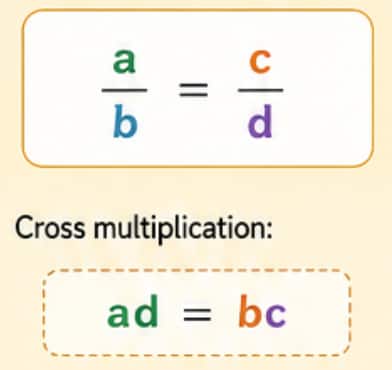
A proportion is a statement that shows two ratios are equal. It represents equality between two comparisons.
Example:
$\frac{2}{5} = \frac{4}{10}$
Both ratios are equal because they represent the same relationship.
Important points about proportion:
- It compares two equal ratios
- Usually written in fractional form
- Solved using cross multiplication
- Commonly used in ratio and proportion questions
Basic proportion formula:
What is variation in mathematics?
A variation explains how one quantity changes with another quantity. In simple words, it studies the dependency between variables.
For example:
- If speed increases, distance covered in fixed time increases
- If the number of workers increases, the time required to complete work decreases
Types of variation:
- Direct variation
- Inverse variation
In direct variation:
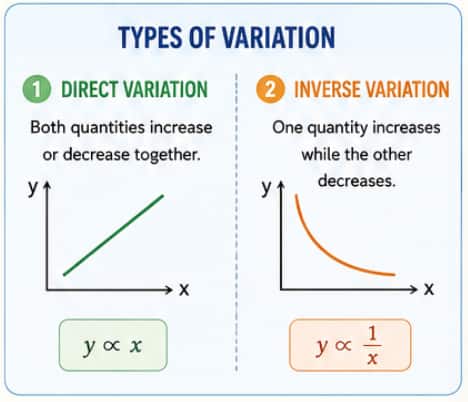
- Both quantities increase or decrease together
Example:
- More items purchased → higher total cost
In inverse variation:
- One quantity increases while the other decreases
Example:
- More workers → less time required
Why proportion and variation are important:
- Used in quantitative aptitude and arithmetic problems
- Helps solve time, speed, work, and percentage questions
- Frequently asked in exams like CUET, SSC, CAT, IPMAT, and banking exams
- Builds the foundation for algebra and advanced mathematics
Difference Between Ratio, Proportion, and Variation
Ratio, proportion, and variation are related concepts, but they are not the same. Understanding the difference between them is important for solving aptitude and maths questions correctly.
| Concept | Meaning | Example | Purpose |
|---|---|---|---|
| Ratio | Comparison of two quantities | $2:3$ | Shows comparison |
| Proportion | Equality of two ratios | $\frac{2}{3} = \frac{4}{6}$ | Shows equivalent relationships |
| Variation | Relationship between changing quantities | Speed and distance | Shows dependency between variables |
Understanding ratio:
- Ratio compares two quantities using division
- Written as $a:b$ or $\frac{a}{b}$
- Used to compare sizes or values
Example:
- Ratio of boys to girls = $3:2$
Understanding proportion:
- Proportion states that two ratios are equal
- Solved using cross multiplication
Example:
$\frac{3}{4} = \frac{6}{8}$
Cross multiplication:
$3 \times 8 = 4 \times 6$
$24 = 24$
Understanding variation:
- Variation studies how quantities change together
- Used in direct variation and inverse variation problems
Examples:
- Higher speed → more distance covered
- More workers → less time required
Quick comparison table:
| Feature | Ratio | Proportion | Variation |
|---|---|---|---|
| Based On | Comparison | Equality | Change |
| Form | $a:b$ | $\frac{a}{b} = \frac{c}{d}$ | $y \propto x$ |
| Main Use | Comparing quantities | Finding unknown values | Understanding relationships |
| Common Topics | Arithmetic | Ratio and proportion | Quantitative aptitude |
Types of Proportion and Variation
In mathematics, proportions and variations are classified into different types based on how quantities are related to each other. Understanding these types is important for solving quantitative aptitude questions, arithmetic problems, and real-life mathematical situations. Topics like direct proportion, inverse proportion, and compound proportion are frequently asked in exams such as CUET, SSC, IPMAT, CAT, and banking exams.
Learning the different types of variation helps students quickly identify the relationship between quantities and apply the correct formula without confusion.
Direct Proportion - Definition, Formula, and Examples
In direct proportion, two quantities increase or decrease together in the same ratio. If one quantity increases, the other also increases. Similarly, if one decreases, the other also decreases.
Definition:
Two quantities are said to be in direct proportion if their ratio remains constant.
Direct proportion formula:
$\frac{x_1}{y_1} = \frac{x_2}{y_2}$
or
$y \propto x$
which means
$y = kx$
where:
$k$ = constant of proportionality
Example:
If 2 notebooks cost ₹40, then 4 notebooks will cost ₹80.
| Number of Notebooks | Total Cost |
|---|---|
| 2 | ₹40 |
| 4 | ₹80 |
| 6 | ₹120 |
As the number of notebooks increases, the total cost also increases.
Real-life examples of direct proportion:
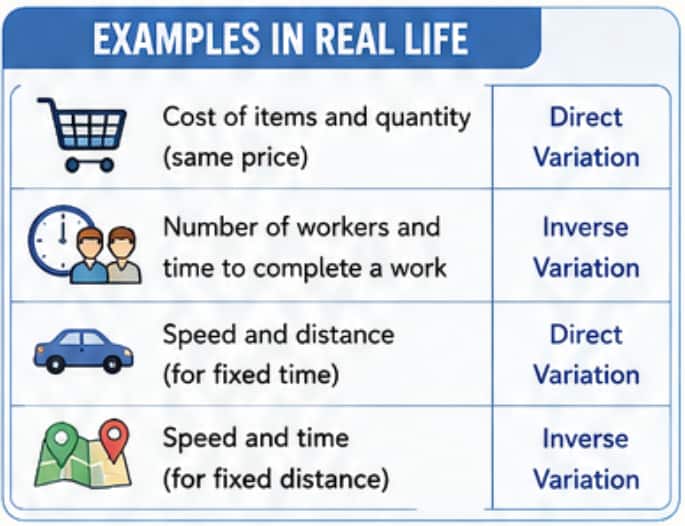
More items purchased → higher total cost
Higher speed → more distance covered in fixed time
More hours worked → higher wages
Important characteristics of direct variation:
Both quantities move in the same direction
Ratio remains constant
Graph forms a straight line through origin
Inverse Proportion - Meaning, Formula, and Questions
In inverse proportion, one quantity increases while the other decreases. The product of the two quantities remains constant.
Definition:
Two quantities are said to be in inverse proportion if increasing one quantity causes the other quantity to decrease proportionally.
Inverse proportion formula:
$x_1y_1 = x_2y_2$
or
$y \propto \frac{1}{x}$
which means
$y = \frac{k}{x}$
where:
$k$ = constant
Example:
If 4 workers complete a task in 12 days, then 8 workers will complete it in fewer days.
Using inverse proportion:
$4 \times 12 = 8 \times x$
$48 = 8x$
$x = 6$
So, 8 workers complete the work in 6 days.
| Workers | Days Required |
|---|---|
| 4 | 12 |
| 8 | 6 |
| 12 | 4 |
Real-life examples of inverse variation:
More workers → less time required
Higher speed → less travel time
More machines → less production time
Important characteristics of inverse proportion:
Quantities move in opposite directions
Product remains constant
Commonly used in time and work problems
Direct Variation vs Inverse Variation - Key Differences
Direct variation and inverse variation are often confused by students. Understanding the difference between them is essential for solving quantitative aptitude questions correctly.
| Basis | Direct Variation | Inverse Variation |
|---|---|---|
| Relationship | Both quantities increase or decrease together | One increases while the other decreases |
| Formula | $\frac{x_1}{y_1} = \frac{x_2}{y_2}$ | $x_1y_1 = x_2y_2$ |
| Constant | Ratio remains constant | Product remains constant |
| Graph Shape | Straight line | Curved graph |
| Example | More quantity → more cost | More workers → less time |
Example of direct variation:
If petrol consumption increases, total cost also increases.
Example of inverse variation:
If the number of workers increases, the time taken decreases.
Common mistake students make:
Applying direct proportion formula in inverse variation problems.
Quick identification trick:
Same direction movement → direct variation
Opposite direction movement → inverse variation
Compound Proportion with Solved Examples
Compound proportion involves more than two quantities and combines multiple proportional relationships in a single problem.
Definition:
Compound proportion is used when one quantity depends on two or more other quantities.
These problems are commonly asked in quantitative aptitude and competitive exams.
Example:
If 5 workers can build 20 walls in 8 days, how many walls can 10 workers build in 4 days?
Step 1:
More workers → more walls
Direct proportion
Step 2:
Fewer days → fewer walls
Direct proportion
Step 3:
Set up equation:
$\frac{10 \times 4 \times x}{5 \times 8 \times 20}$
Simplify:
$\frac{10 \times 4}{5 \times 8} \times 20$
$= \frac{40}{40} \times 20$
$= 20$
So, 10 workers can build 20 walls in 4 days.
Applications of compound proportion:
Time and work problems
Speed and distance questions
Production and efficiency calculations
Important Proportion and Variation Formulas
Formulas play a crucial role in solving proportion and variation questions quickly. A clear understanding of these formulas improves speed, accuracy, and problem-solving ability in competitive exams.
Direct Proportion Formula
In direct proportion, the ratio between two quantities remains constant.
Formula:
$\frac{x_1}{y_1} = \frac{x_2}{y_2}$
or
$y = kx$
where:
$k$ = constant of proportionality
Example:
If 3 pens cost ₹30, then 6 pens cost:
$\frac{3}{30} = \frac{6}{x}$
$3x = 180$
$x = 60$
Inverse Proportion Formula
In inverse proportion, the product of two quantities remains constant.
Formula:
$x_1y_1 = x_2y_2$
or
$y = \frac{k}{x}$
Example:
If 6 workers complete a task in 10 days, then 12 workers complete it in:
$6 \times 10 = 12 \times x$
$60 = 12x$
$x = 5$
Continued Proportion Formula
Three quantities are said to be in continued proportion if the ratio of the first and second equals the ratio of the second and third.
Formula:
$a:b = b:c$
or
$\frac{a}{b} = \frac{b}{c}$
which gives
$b^2 = ac$
Example:
If $a = 4$ and $c = 16$
$b^2 = 4 \times 16 = 64$
$b = 8$
Mean Proportion Formula
The mean proportional between two numbers is the square root of their product.
Formula:
$\text{Mean Proportion} = \sqrt{ab}$
Example:
Find mean proportion between 9 and 25:
$\sqrt{9 \times 25}$
$= \sqrt{225}$
$= 15$
Variation Formula Cheat Sheet for Quick Revision
| Concept | Formula |
|---|---|
| Direct Proportion | $\frac{x_1}{y_1} = \frac{x_2}{y_2}$ |
| Direct Variation | $y = kx$ |
| Inverse Proportion | $x_1y_1 = x_2y_2$ |
| Inverse Variation | $y = \frac{k}{x}$ |
| Continued Proportion | $b^2 = ac$ |
| Mean Proportion | $\sqrt{ab}$ |
Quick revision tips:
Use ratio method for direct proportion
Use product method for inverse proportion
Identify relationship type before applying formula
Practice real-life word problems regularly
Mastering these proportion and variation formulas helps solve quantitative aptitude questions faster and improves exam performance significantly.
Properties of Proportion in Quantitative Aptitude
Properties of proportion help simplify calculations and solve aptitude questions faster.
Addendo Property
If $a:b = c:d$, then:
$(a+c):(b+d)$
Subtrahendo Property
If $a:b = c:d$, then:
$(a-c):(b-d)$
Dividendo Property
If $a:b = c:d$, then:
$(a-b):b = (c-d):d$
Componendo Property
If $a:b = c:d$, then:
$(a+b):b = (c+d):d$
Alternendo Property
If $a:b = c:d$, then:
$a:c = b:d$
Invertendo Property
If $a:b = c:d$, then:
$b:a = d:c$
Componendo and Dividendo Property
If $a:b = c:d$, then:
$(a+b):(a-b) = (c+d):(c-d)$
Importance of Properties of Proportion
Reduce lengthy calculations
Useful in ratio and proportion shortcut methods
Important for quantitative aptitude exams
Improve problem-solving speed and accuracy
Properties of Direct and Inverse Variation
Understanding the properties of direct and inverse variation helps identify the correct relationship between quantities.
| Direct Variation | Inverse Variation |
|---|---|
| Ratio remains constant | Product remains constant |
| Variables move together | Variables move oppositely |
| Formula: $y=kx$ | Formula: $xy=k$ |
| Straight line graph | Hyperbola graph |
Quick Identification Trick
Same direction movement → direct variation
Opposite direction movement → inverse variation
Common Mistakes Students Make
Applying direct proportion formula in inverse variation questions
Ignoring units while comparing quantities
Using incorrect proportional relationships
A strong understanding of proportion and variation concepts improves speed, logical thinking, and accuracy in quantitative aptitude and competitive exam mathematics.
Practice Questions/Solved Examples on Proportion and Variation
Practising solved examples on proportion and variation helps students understand how formulas and concepts are applied in real mathematical problems. These quantitative aptitude questions improve calculation speed, logical thinking, and accuracy for exams like CUET, SSC, IPMAT, CAT, Banking, and other competitive exams.
Q.1. If $(2x-y)^{2}+(3y-2z)^{2}=0$, then the ratio $x:y:z$ is:
A. $1:3:2$
B. $1:2:3$
C. $3:1:2$
D. $3:2:1$
Hint: If the sum of squares of two terms is equal to zero, then each individual term is also equal to zero.
Solution:
Given:
$(2x-y)^2+(3y-2z)^2=0$
Since the sum of two squares is zero, each squared term must be zero.
Therefore:
$2x-y=0$
and
$3y-2z=0$
From $2x-y=0$:
$2x=y$
Divide both sides by 2:
$x=\frac{y}{2}$
Therefore:
$x:y=1:2$
Now, from $3y-2z=0$:
$3y=2z$
Divide both sides by 2:
$y:z=2:3$
Combining both ratios:
$x:y:z=1:2:3$
Correct Answer: Option B
Q.2. The speeds of three cars are in the ratio $1:3:5$. The ratio of the time taken by these cars to travel the same distance is:
A. $3:5:15$
B. $15:3:5$
C. $15:5:3$
D. $5:3:1$
Hint: Time is inversely proportional to speed.
$\text{Time} \propto \frac{1}{\text{Speed}}$
Solution:
Given speed ratio:
$1:3:5$
Since time varies inversely with speed:
Required time ratio:
$\frac{1}{1}:\frac{1}{3}:\frac{1}{5}$
Take LCM of 1, 3, and 5.
LCM $=15$
Multiply each term by 15:
$1\times15:\frac{1}{3}\times15:\frac{1}{5}\times15$
$=15:5:3$
Correct Answer: Option C
Q.3. If a 7-storey building has a 28 m long shadow, then the number of storeys of a building whose shadow is 48 m long is:
A. $14$
B. $24$
C. $16$
D. $12$
Hint: The length of the shadow is directly proportional to the number of storeys.
Solution:
Given:
7-storey building $\rightarrow$ 28 m shadow
Let the number of storeys of the second building be $x$.
Then:
$\frac{7}{28}=\frac{x}{48}$
Cross multiply:
$28x=7\times48$
$28x=336$
Divide both sides by 28:
$x=\frac{336}{28}$
$x=12$
Therefore, the building has 12 storeys.
Correct Answer: Option D
Q.4. The force (in pound-force) needed to keep a car from skidding on a curve varies directly with the weight of the car and the square of its speed, and inversely with the radius of the curve. Suppose 6125 pound-force is required to keep a 2750-pound car travelling at 35 mph from skidding on a curve of radius 550 feet. How much pound-force is required to keep a 3600-pound car travelling at 50 mph from skidding on a curve of radius 750 feet?
A. $11960$
B. $12150$
C. $12240$
D. $12000$
Hint:
$F=k\left(\frac{ws^2}{r}\right)$
where:
$F$ = force
$w$ = weight
$s$ = speed
$r$ = radius
Solution:
Given formula:
$F=k\left(\frac{ws^2}{r}\right)$
Substitute the first set of values:
$6125=k\left(\frac{2750\times35^2}{550}\right)$
First calculate $35^2$:
$35^2=1225$
Substitute:
$6125=k\left(\frac{2750\times1225}{550}\right)$
Simplify:
$\frac{2750}{550}=5$
So:
$6125=k(5\times1225)$
$6125=k(6125)$
Divide both sides by 6125:
$k=1$
Now use the formula again:
$F=\frac{3600\times50^2}{750}$
Calculate $50^2$:
$50^2=2500$
Substitute:
$F=\frac{3600\times2500}{750}$
Simplify:
$\frac{3600}{750}=4.8$
So:
$F=4.8\times2500$
$F=12000$
Correct Answer: Option D
Q.5. If the cost of 120 m of cloth is INR 9600, then what will be the cost of 147 m of cloth?
A. INR 16170
B. INR 11670
C. INR 11760
D. INR 17160
Hint: Cost varies directly as the length of the cloth.
Solution:
Given:
120 m cloth costs INR 9600
First find cost per metre:
$\frac{9600}{120}=80$
So, cost of 1 m cloth = INR 80
Now find cost of 147 m cloth:
$147\times80$
$=11760$
Therefore, the required cost is INR 11760.
Correct Answer: Option C
Q.6. $A$ varies directly as $(B+18)$ and $A=108$ when $B=36$. Find the value of $A$ when $B=68$.
A. $75$
B. $86$
C. $127$
D. $172$
Hint:
If $A$ varies directly as $(B+18)$, then:
$\frac{A_1}{A_2}=\frac{B_1+18}{B_2+18}$
Solution:
Given:
$A_1=108$
$B_1=36$
$B_2=68$
Using the formula:
$\frac{108}{A_2}=\frac{36+18}{68+18}$
Simplify numerator and denominator:
$\frac{108}{A_2}=\frac{54}{86}$
Cross multiply:
$108\times86=54\times A_2$
$9288=54A_2$
Divide both sides by 54:
$A_2=\frac{9288}{54}$
$A_2=172$
Correct Answer: Option D
Q.7. The third proportional of the numbers $(x-y)^2$ and $(x^2-y^2)^2$ is:
A. $(x+y)^3(x-y)^2$
B. $(x+y)^4(x-y)^2$
C. $(x+y)^2(x-y)^2$
D. $(x+y)^2(x-y)^3$
Hint:
Third proportional $=\frac{b^2}{a}$
Solution:
Let:
$a=(x-y)^2$
$b=(x^2-y^2)^2$
We know:
$x^2-y^2=(x-y)(x+y)$
Therefore:
$b=[(x-y)(x+y)]^2$
$b=(x-y)^2(x+y)^2$
Now find third proportional:
$c=\frac{b^2}{a}$
Substitute values:
$c=\frac{[(x-y)^2(x+y)^2]^2}{(x-y)^2}$
Expand numerator:
$c=\frac{(x-y)^4(x+y)^4}{(x-y)^2}$
Subtract powers:
$c=(x-y)^2(x+y)^4$
Therefore:
$c=(x+y)^4(x-y)^2$
Correct Answer: Option B
Q.8. What is the third proportional to 10 and 20?
A. $30$
B. $25$
C. $50$
D. $40$
Hint:
If $x$ is the third proportional of $a$ and $b$, then:
$a:b::b:x$
Solution:
Let the third proportional be $x$.
Then:
$10:20::20:x$
Convert into fraction form:
$\frac{10}{20}=\frac{20}{x}$
Cross multiply:
$10x=20\times20$
$10x=400$
Divide by 10:
$x=40$
Correct Answer: Option D
Q.9. What is the fourth proportional to 189, 273, and 153?
A. $117$
B. $299$
C. $221$
D. $187$
Hint:
In $a:b::c:d$, $d$ is called the fourth proportional.
Solution:
Let the fourth proportional be $x$.
Then:
$189:273::153:x$
Convert into fraction form:
$\frac{189}{273}=\frac{153}{x}$
Cross multiply:
$189x=273\times153$
$189x=41769$
Divide both sides by 189:
$x=\frac{41769}{189}$
$x=221$
Correct Answer: Option C
Q.10. Find two numbers such that their mean proportion is 16 and the third proportion is 1024.
A. $4$ and $32$
B. $4$ and $64$
C. $8$ and $64$
D. $8$ and $32$
Hint:
Mean proportion of $a$ and $b$:
$\sqrt{ab}$
Third proportional:
$\frac{b^2}{a}$
Solution:
Let the numbers be $a$ and $b$.
Mean proportion is 16:
$\sqrt{ab}=16$
Square both sides:
$ab=256 \quad ...(1)$
Third proportional is 1024:
$\frac{b^2}{a}=1024$
Cross multiply:
$b^2=1024a \quad ...(2)$
From equation (1):
$a=\frac{256}{b}$
Substitute into equation (2):
$b^2=1024\left(\frac{256}{b}\right)$
Multiply both sides by $b$:
$b^3=1024\times256$
$b^3=262144$
Take cube root:
$b=64$
Substitute into equation (1):
$64a=256$
Divide by 64:
$a=4$
Therefore, the two numbers are 4 and 64.
Correct Answer: Option B
Best Books for Ratio, Proportion, and Variation
Choosing the right book for ratio, proportion, and variation helps build strong quantitative aptitude and arithmetic problem-solving skills. A good book should include concept explanations, formulas, solved examples, shortcut tricks, and practice questions for competitive exams like CUET, SSC, CAT, Banking, and other aptitude tests.
| Book Name | Best For | Difficulty Level | Key Features | Suitable Exams |
|---|---|---|---|---|
| R.S. Aggarwal Quantitative Aptitude | Complete aptitude preparation | Beginner to Advanced | Large question bank, detailed solutions, arithmetic concepts | SSC, Banking, CUET, Railways |
| Fast Track Objective Arithmetic by Rajesh Verma | Shortcut methods and speed improvement | Intermediate | Fast calculation tricks, exam-oriented approach | SSC, Banking, Government Exams |
| Quantitative Aptitude for CAT by Arun Sharma | Advanced aptitude preparation | Advanced | High-level aptitude questions, logical approach | CAT, IPMAT, XAT |
| Magical Book on Quicker Maths by M. Tyra | Mental maths and calculation speed | Intermediate | Shortcut techniques, fast-solving methods | SSC, Banking, Aptitude Tests |
| NCERT Mathematics (Class 8-10) | Basic concept clarity | Beginner | Simple explanations, foundational understanding | School Exams, Olympiads |
| Pearson Quantitative Aptitude | Practice and concept building | Intermediate | Mixed difficulty questions, topic-wise exercises | MBA Entrance Exams |
| Objective Arithmetic by S. Chand | Arithmetic fundamentals | Beginner to Intermediate | Ratio, proportion, variation practice sets | SSC, Railway, Defence Exams |
Related Quantitative Aptitude Topics
To strengthen your understanding of proportion and variation, it is important to study related quantitative aptitude topics that use similar formulas, logical relationships, and arithmetic concepts. These topics help improve problem-solving speed and accuracy in exams like CUET, SSC, CAT, IPMAT, Banking, and other competitive aptitude exams.
Frequently Asked Questions (FAQs)
Ratios are comparisons between two quantities, variations describe how one quantity changes in relation to another, and proportions are equations that state the equality of two ratios.
To solve a proportion, we can use cross-multiplication. For example, if $\frac{a}{b}=\frac{c}{d}$, then using cross multiplication we get $ad = bc$.
Proportion refers to the equality of two ratios, while variation describes how one quantity changes in relation to another.
A proportion is an equation that shows two ratios are equal. It is written in the form $\frac{a}{b}=\frac{c}{d}$ or $a:b::c:d$.
The proportion formula is given as:
If $a:b::c:d$, then $\frac{a}{b}=\frac{c}{d}$.
The mean proportion between two numbers $a$ and $b$ is:
$\sqrt{ab}$
Example:
Mean proportion between 4 and 25:
$\sqrt{4\times25}=10$
