Careers360 Logo
ask-icon
share

    WBJEE Exam 2026: Registration (Started), Date, Syllabus, Eligibility, Pattern, Cutoff

    author
    Team Careers360Updated on Mar 13, 2026 02:18 PM

    About WBJEE 2026

    WBJEE 2026: WBJEE Board commenced the WBJEE 2026 applications on March 10, 2026. The WBJEE 2026 registration link is updated on the official website, wjeeb.nic.in. Candidates are advised to check the WBJEE 2026 eligibility criteria before applying. The last date to submit the WBJEE 2026 application form is April 5, 2026. The WBJEE 2026 information brochure was published on the official website. Along with the brochure, the WBJEE 2026 syllabus, exam pattern, and eligibility criteria, have also been released.  Candidates can check the complete details of the WBJEE 2026 exam schedule on the official portal. The WBJEE 2026 application form correction window is from April 7 to 9, 2026. Registered candidates can download the WBJEE 2026 admit card from May 15, 2026. The authority will conduct the WBJEE 2026 exam on May 24, 2026.

    All the information related to the exam will be included in the WBJEE 2026 information brochure, such as the WBJEE 2026 exam date.  Read the whole page for details on WBJEE 2026.

    WBJEE 2026 Latest News and Updates

    • WBJEE 2026 registration commenced.
    • WBJEE Information Brochure has been released.
    • WBJEE 2026 application form release date out.
    • WBJEE 2026 exam date announced.
    • WBJEE 2026 notification has been released online.

    WBJEE Previous Year’s Statistics 

    Candidates can check the previous year's WBJEE exam statistics from the table below.

    How many candidates appeared for WBJEE 2025?

    CategoryNumber of candidates
    Total Candidates Appeared
    1,01,643
    Total Qualified
    1,00,502
    From West Bengal
    77,793
    From Outside West Bengal
    23,850

    How many candidates appeared for WBJEE 2024?

    Total students appeared in WBJEE 2024

    1,13,492

    Total candidates appeared in WBJEE 2024 gender-wise

    Boys: 79,025

    Girls: 34,467

    Percentage increase in the number of WBJEE candidates from last year14.22%

    WBJEE 2023 - Statistics

    WBJEE 2023 total candidates

    1,24,919

    Gender-wise WBJEE total candidates 2023

    Male - 91,974

    Female - 52,944

    Transgender - 1

    Pass percentage

    99.4%

    WBJEE 2022 - Statistics

    WBJEE 2022 total candidates

    81,393

    Pass percentage

    98.85%

    WBJEE Result 2021 - Statistics

    Particular

    Details

    Number of students registered for WBJEE 2021

    92,695

    Students appeared in the exam

    65,170 (71%)

    Students passed the WBJEE exam

    64,850 (99.5 %)

    Male candidates appeared

    74%

    Female candidates appeared

    26%

    Students appeared from West Bengal

    77%

    Students appeared from outside

    23 %

    What is WBJEE?

    West Bengal Joint Entrance Examinations (WBJEE) is a state-level exam held for admission to professional degree courses like Bachelor of Technology and Bachelor of Pharmacy offered by the participating institutes. WBJEEB conducts the West Bengal JEE in 2 languages, Bengali and English. Being an offline exam, the WBJEE is conducted as a pen-and-paper-based test for 4 hours. 

    After the conclusion of the exam, the exam authority releases the WBJEE answer key on the official website. Applicants can calculate their expected score with the help of the WBJEE answer key 2026. Candidates are allowed to raise objections to the answer for a specified time. After reviewing all the objections, the exam-conducting authority will release the WBJEE final answer key along with the result. Shortlisted candidates based on results will be called for the counselling process later.

    Read More
    WBJEE Exam 2026: Registration (Started), Date, Syllabus, Eligibility, Pattern, Cutoff
    WBJEE Exam 2026: Registration (Started), Date, Syllabus, Eligibility, Pattern, Cutoff

    WBJEE 2026 Highlights

    Full Exam Name
    West Bengal Joint Entrance Exam
    Short Exam Name
    WBJEE
    Conducting Body
    West Bengal Joint Entrance Examinations Board
    Frequency Of Conduct
    Once a year
    Exam Level
    State Level Exam
    Languages
    Bengali +1 more
    Mode Of Application
    online
    Application Fee
    Online : 500
    Mode Of Exam
    offline
    Mode Of Counselling
    online
    Participating Colleges
    144
    Exam Duration
    4 Hours

    WBJEE Important Dates

    WBJEE West Bengal Joint Entrance Exam (session 2026)

    The WBJEE 2026 application form has been released on March 10. The last date for registration is April 5, 2026. Candidates who fulfil the minimum eligibility criteria will be able to apply for WBJEE 2026. The application process comprises registration, filling out the form, uploading the photo & signature, and payment of the application fee. Candidates can check the steps below for reference purposes only.

    WBJEE 2026 Application Form Process

    Registration: Students have to register by providing their basic details like name, father's name, date of birth, mobile number, and other basic details. Candidates have to be very careful while filling in the information during registration because the information entered at this stage i.e. applicant's name, father's name, date of birth, etc., could not be modified at later stages.

    Entering the details in WBJEE 2026 Application Form: Candidates have to enter the details related to eligibility, course, city, communication, etc. 

    Document Uploading: After entering the required details, the candidates have to upload the required documents in the prescribed format. 

    Particular
    Size
    Dimension & Format 
    Photo
    3kb - 100kb 
    4cm x 3cm & JPEG/JPG
    Sign
    3kb - 30kb
    4cm x 1.5cm & JPEG/JPG


    WBJEE 2026 application fee payment: To complete the online application process candidates have to pay the application fee in online mode using credit/ debit card/ net banking or offline mode.
    Application Fee: Rs. 500 (General candidates) Rs. 400 (SC/ST/OBC-A/OBC-B Candidates)

    Printing WBJEE Confirmation Page: After payment of the application fee, candidates have to review and submit the application form. Once the form is submitted, candidates are advised to take a printout of the confirmation page and keep it safe for future reference. The confirmation page is important for e-counselling too. Hence candidates have to safely keep the same till their admissions are completed. 

    Fee Concession for PwD Students in WBJEE
    PwD candidates will be eligible for a 40% reduction on WBJEE 2026 application fees. To avail of this, all PwD candidates have to formally apply in writing to the Chairman, WBJEEB and send/submit the application to the Board office. They have to enclose a copy of their WBJEE confirmation page and PwD certificate as proof. They are given a refund after the receipt of the application form.

    WBJEE application form 2026 Correction

    The WBJEEB will conduct the correction facility for the WBJEE application form 2026 from April 7 to 9, 2026. The candidate can correct mistakes in the application form.

    • All details except the name, father’s name, mother’s name, and date of birth would be edited or corrected.
    • Candidates need to ensure the accuracy of the corrections as there would not be another chance to correct these details.

    How to correct the WBJEE 2026 application form?

    Candidates can check the steps below for reference purposes.

    • Candidates have to log in using their WBJEE application number and password.
    • They must edit all details as required
    • They must submit the corrected details after verifying
    • The confirmation page of the corrected application must be downloaded and saved.

    Steps to take in case of photo discrepancy

    • Candidates who have a discrepancy in their photograph or signature can send an email or SMS in this regard.
    • They have to immediately upload the corrected image within 24 hours of receiving the email or SMS.
    • If they fail to do so, their application of WBJEE 2026 is liable to be rejected.

    Forgot WBJEE 2026 Application No?

    • Click on the Forgot Application No button on the login window.
    • Enter the following details: Candidate Name, Father Name, Mother Name, Date of Birth, and Security PIN. 
    • After successful submission, you will get your Application Number.

    Forgot Password of WBJEE 2026?

    • Go to the login window on the official website.
    • Click on the "Forgot Password" Button there.
    • Three options are given below.
      • Using a Security Question & its Answers are chosen during Form filling.
      • Using a verification code sent via text message (SMS) to Registered Mobile No.
      • Using a reset link sent via Email to the Registered Email address.
    • Use one of the given options and retrieve the password.

    How to get a duplicate WBJEE 2026 Confirmation Page?

    Candidates who have misplaced their WBJEE confirmation page can apply for a duplicate till 60 days after the declaration of the WBJEE 2026 result. Thereafter, they are not able to get it from any source. To avail of the duplicate confirmation page of WBJEE, candidates have to apply to WBJEEB with a DD for Rs 500 in favour of the “West Bengal Joint Entrance Examinations Board” payable in Kolkata.

    WBJEE PYQ's with Solutions

    Boost your WBJEE 2026 prep with real previous year papers! Practice PYQs with detailed step-by-step solutions. Learn exam pattern, difficulty & improve accuracy!

    Download Now

    B.Tech

    The exam authorities will release the WBJEE eligibility criteria along with the official notification. Applicants appearing for the exam must check the WBJEE eligibility criteria before filling the application form. WBJEE 2026 eligibility criteria will be released separately for all the courses. The eligibility criteria of WBJEE 2026 comprises citizenship, age limit, qualifying exam and others. In case any candidate fails to prove the eligibility conditions at the time of admission his/her candidature will be canceled. For more details candidates can refer to the information below.

    WBJEE B.Tech Eligibility Criteria

    West Bengal Joint Entrance Examinations Board has set a few eligibility parameters for the aspirants of WBJEE 2026. There are two papers in WBJEE 2026: Paper 1 (Mathematics) and Paper 2 (Physics and Chemistry Combined). Applicants taking both papers and getting ranked will be eligible for admission in BTech/Pharmacy/Architecture courses. In order to take part in that exam, aspirants need to fulfill the eligibility criteria prescribed for the WBJEE 2026. For taking admission in the WBJEE 2026 B.Tech course:

    • Candidates must be citizen of India.

    • His/her age should not be less than 17 years on December 31, 2026. There is no upper age limit for WBJEE but for Marine Engineering Degree Course, the upper age limit is 25 years as on December 31, 2026.

    • Candidates should have passed Class 12 as regular students from a recognized board with Mathematics, Physics and Chemistry/Biology/Computer Science/ Biotechnology/Computer Application as compulsory subjects.

    • The aggregate marks in these three subjects taken together should not be less than 45% (for SC/ST/OBC /PwD 40%).

    B.Arch

    WBJEEB incubates some eligibility factors for the candidates of WBJEE 2025. There will be two papers in WBJEE 2025: Paper 1 (Mathematics) and Paper 2 (Physics and Chemistry). In order to take part in that exam, aspirants need to fulfill the eligibility criteria prescribed for the WBJEE 2025. For taking admission in the WBJEE 2025 B.Arch course:

    • Candidates must be citizen of India.

    • His/her age should not be less than 17 years on December 31, 2025. There is no upper age limit for WBJEE.

    • Candidates should have passed Class 12 as regular students from a recognized board with Mathematics, Physics and Chemistry/Biology/Computer Science/ Biotechnology/Computer Application as compulsory subjects.

    • The aggregate marks should not be less than 50% in Class 12.

    • Candidates should have cleared the National Aptitude Test in Architecture (NATA) conducted by Council of Architecture (COA).

    B.Pharma

    Candidates who appear for Paper 2 (Physics and Chemistry) can apply for only pharmacy courses while candidates who appear for both Paper 1 & 2 can apply for engineering courses as well. The eligibility criteria for WBJEE 2024 for the B.Pharm courses are:

    • Only citizens of India are eligible to apply.

    • Age should not be less than 17 years on Dec. 31, 2024. However, there is no upper age limit for WBJEE 2024.

    • Candidates should have passed Class 12 as regular students from a recognized board.

    • They must have studied Physics, Chemistry, and Mathematics/Biology/Computer Science/ Biotechnology/Computer Application as compulsory subjects with pass marks in both Practical and Theory sections individually.

    • The aggregate marks in these three subjects taken together should not be less than 45% (for SC/ST/OBC /PwD 40%).

    • Candidates should have passed the English subject of Class 12 with at least 30% marks.

    Background wave

    Documents Required at Exam WBJEE 2026

    West Bengal Joint Entrance Exam 2026

    WBJEE 2026 admit card
    1 copy of colour photograph
    Original copy of photo id card such as pan card/ Aadhar card/ passport/ 10th admit card/ school-id/ voter card etc.

    WBJEE 2026 Exam Centers

    StateCity
    Tripura
    Agartala
    Assam
    Silchar
    West Bengal
    Alipurduar
    Bankura
    Bishnupur
    Bolpur
    Suri
    Asansol
    Durgapur
    Burdwan
    Cooch Behar
    Siliguri
    Balurghat
    Raiganj
    Jalpaiguri
    Jhargram
    Kolkata
    Malda
    Kharagpur
    Medinipur
    Contai
    Haldia
    Tamluk
    Jiaganj
    Kalyani
    Krishnanagar
    Nabadwip
    Purulia
    Berhampore
    Barrackpore
    Basirhat
    Baruipur
    Kurseong
    Arambagh
    Chinsurah
    Bandel
    Serampore
    Shibpur
    Salkia
    Bally
    Uttarpara
    Domjur
    Uluberia
    Kalimpong
    Beliaghata
    Salt Lake City
    New Town
    Rajarhat
    Ballygunge
    Bhawanipur
    Joka
    Behala
    Khidirpur
    Raghunathganj
    Ashoknagar
    Barasat
    Garia
    Sonarpur
    GNA University B.Tech Admissions 2026

    100% Placement Assistance | Avail Merit Scholarships | Highest CTC 43 LPA

    Amity University-Noida B.Tech Admissions 2026

    Among top 100 Universities Globally in the Times Higher Education (THE) Interdisciplinary Science Rankings 2026

    WBJEEB has released the exam pattern of WBJEE 2026 in the official notification. Applicants appearing for the exam must refer to the WBJEE exam pattern for their preparation. WBJEE 2026 exam pattern comprises the marking scheme, duration of exam, number of questions and others. Applicants can also refer to the WBJEE syllabus to check the important topics to be asked in the exam. WBJEE 2026 will be conducted in offline mode, comprising multiple-choice questions. There will be two papers in WBJEE 2026: Paper 1 (Mathematics/Biology) and Paper 2 (Physics and Chemistry combined).

    Candidates seeking admission in Pharmacy courses have to appear for Biology instead of Mathematics in Paper 1. Students have to qualify in both papers in order to be considered for WBJEE admissions. Candidates will get 120 minutes for each paper i.e. Paper 1 and Paper 2. There are three categories of questions in both paper 1 and 2 as described below.

    Particulars

    Details

    Mode of Exam

    Offline Mode (OMR Based Examination)

    Examination Duration

    2 Hours for each paper (Total 4 hours)

    Papers

    Paper I - Mathematics

    Paper II - Physics and Chemistry

    Type of Questions

    Multiple Choice Questions (Objective)

    Number of Questions

    • Physics - 40 questions

    • Chemistry - 40 questions

    • Mathematics - 75 questions

    Category-wise Division of Questions

    • Mathematics - 50 Questions in Category 1, 15 Questions in Category 2, and 10 Questions in Category 3.

    • Physics and Chemistry - 30 Questions in Category 1, 5 Questions each in Category 2 and 3.

    Mode of Answering

    There will be four alternative answers for each question. The correct response has to be selected by the candidates by darkening the appropriate circle completely with blue/black ballpoint pen.

    Total Marks

    200 Marks

    Marking Scheme

    Category 1 - Each correct answer will be awarded one mark.

    Category 2 - For every correct response, two marks will be given by the candidates.

    Category 3 - For every correct response, two marks will be given by the candidates.

    Negative Marking

    Category 1 - Incorrect response will yield a loss of ¼ mark

    Category 2 - For each incorrect answer, ½ mark will be deducted.

    Category 3 - There is no negative marking.

    There will be three categories of questions in both paper 1 and 2 as described below.

    For category 1 questions there is just one correct option, 1 mark is given for a correct answer while an incorrect answer would fetch -0.25 marks.

    For category 2 questions there is just one correct option and 2 marks are given for a correct answer while an incorrect answer would fetch -0.5 marks.

    For category 3 questions there are one or more options correct and 2 marks are given for correct answer while incorrect answer would fetch 0 marks while for partially correct answers candidates will get marks as per this formula: 2 x (no. of correct options marked/total no. of correct options).

    Scheme of WBJEE 2026

    Subject

    Category 1 (1 mark)

    Category 2 (2 marks)

    Category 3 (2 marks)

    Total Questions

    Aggregate Marks

    Questions

    Questions

    Questions

    Mathematics

    50

    15

    10

    75

    100

    Physics

    30

    5

    5

    40

    50

    Chemistry

    30

    5

    5

    40

    50

    Recommended Exams

    Other Exams

    Manav Rachna National Aptitude Test
    NAAC A++ Grade | Recognized as Category-1 Deemed to be University by UGC | 41,000 + Alumni Imprints Globally
    University of Petroleum & Energy Studies Engineering Aptitude Test
    Last Date to Apply: 29th April | Ranked #43 among Engineering colleges in India by NIRF | Highest Package 1.3 CR , 100% Placements
    Manipal Entrance Test
    NAAC A++ Accredited | Accorded institution of Eminence by Govt. of India | NIRF Rank #3

    WBJEE 2026 Syllabus

    WBJEE B.Tech Syllabus

    Mathematics: Unit 01


    Algebra
    • A.P., G.P., H.P.: Definition A.P. and G.P.; general term; summation of first n-terms of series ∑n, ∑n², ∑n³; arithmetic/ geometric series, A.M., G.M., and their relation; infinite G.P. series and its sum
    • Logarithms: Definition; general properties; change of base
    • Complex numbers: Definition in terms of ordered pair of real numbers and properties of complex numbers; complex conjugate; triangle inequality; amplitude of complex numbers and its properties; square root of complex numbers; cube roots of unity
    • Complex numbers: De Moivre's theorem (statement only) and its elementary applications. Solution of quadratic equation in complex number system
    • Polynomial equation: Nth degree equation has exactly n roots (statement only); quadratic equations: Quadratic equations with real coefficients; relations between roots and coefficients; nature of roots; formation of a quadratic equation
    • Polynomial equation: Sign and magnitude of the quadratic expression ax²+bx+c (where a, b, c are rational numbers and a ≠ 0)
    • Permutation and combination: Permutation of n different things taken r at a time (r ≤ n). Permutation of n things not all different. Permutation with repetitions (circular permutation excluded). Combinations of n different things taken r at a time (r ≤ n)
    • Permutation and combination: Combination of n things not all different. Basic properties. Problems involving both permutations and combinations
    • Principle of mathematical induction: Statement of the principle, proof by induction for the sum of squares, sum of cubes of first n natural numbers, divisibility properties like 2²ⁿ-1 is divisible by 3 (n ≥ 1), 7 divides 3²ⁿ⁺¹+2ⁿ⁺² (n ≥ 1)
    • Binomial theorem (positive integral index): Statement of the theorem, general term, middle term, equidistant terms, properties of binomial coefficients
    • Matrices: Concepts of m x n (m ≤ 3, n ≤ 3) real matrices, operations of addition, scalar multiplication and multiplication of matrices. Transpose of a matrix. Determinant of a square matrix. Properties of determinants (statement only)
    • Matrices: Minor, cofactor, and adjoint of a matrix. Non singular matrix. Inverse of a matrix. Finding area of a triangle. Solutions of system of linear equations. (not more than 3 variables)
    • Sets, relations, and mappings: Idea of sets, subsets, power set, complement, union, intersection and difference of sets, Venn diagram, De Morgan's laws, inclusion/ exclusion formula for two or three finite sets, Cartesian product of sets
    • Sets, relations, and mappings: Relation and its properties. Equivalence relation-definition and elementary examples, mappings, range and domain, injective, surjective, and bijective mappings, composition of mappings, inverse of a mapping
    • Statistics and probability: Measure of dispersion, mean, variance and standard deviation, frequency distribution. Addition and multiplication rules of probability, conditional probability and Bayes’ theorem, independence of events
    • Statistics and probability: Repeated independent trials and binomial distribution

    Mathematics: Unit 02


    Trigonometry
    • Trigonometric functions, addition, and subtraction formulae, formulae involving multiple and submultiple angles, general solution of trigonometric equations
    • Properties of triangles, inverse trigonometric functions, and their properties

    Mathematics: Unit 03


    Coordinate geometry of two dimensions
    • Distance formula, Section formula, Area of a triangle, Condition of collinearity of three points in a plane
    • Polar coordinates, transformation from Cartesian to polar coordinates, and vice versa
    • Parallel transformation of axes
    • Concept of locus, locus problems involving all geometrical configurations, slope of a line
    • Equation of lines in different forms, Angle between two lines
    • Condition of perpendicularity and parallelism of two lines
    • Distance of a point from a line
    • Distance between two parallel lines
    • Lines through the point of intersection of two lines
    • Angle bisector
    • Equation of a circle with a given center and radius
    • Condition that a general equation of second degree in x, y may represent a circle
    • Equation of a circle in terms of endpoints of a diameter
    • Equation of tangent, normal, and chord
    • Parametric equation of a circle
    • Intersection of a line with a circle
    • Equation of common chord of two intersecting circles
    • Definition of conic section, directrix, focus, and eccentricity, classification based on eccentricity
    • Equation of parabola, ellipse, and hyperbola in standard form, their foci, directrices, eccentricities, and parametric equations

    Mathematics: Unit 04


    Coordinate geometry of three dimensions
    • Direction cosines and direction ratios, Distance between two points and section formula, Equation of a straight line, Equation of a plane, Distance of a point from a plane

    Mathematics: Unit 05


    Calculus
    • Differential calculus: Functions, domain, and range set of functions, composition of two functions and inverse of a function, limit, continuity, derivative, chain rule and derivative of functions in various forms. Concept of differential
    • Differential calculus: Rolle's theorem and Lagrange's mean value theorem (statement only). Their geometric interpretation and elementary application. L'hospital's rule (statement only) and applications. Second order derivative
    • Integral calculus: Integration as a reverse process of differentiation, indefinite integral of standard functions. Integration by parts. Integration by substitution and partial fraction. Definite integral as a limit of a sum with equal subdivisions
    • Integral calculus: Fundamental theorem of integral calculus and its applications. Properties of definite integrals
    • Differential equations: Formation of ordinary differential equations, solution of homogeneous differential equations, separation of variables method, linear first order differential equations
    • Application of calculus: Tangents and normals, conditions of tangency. Determination of monotonicity, maxima and minima. Differential coefficient as a measure of rate. Motion in a straight line with constant acceleration
    • Application of calculus: Geometric interpretation of definite integral as area, calculation of area bounded by elementary curves and straight lines. Area of the region included between two elementary curves
    • Vectors: Addition of vectors, scalar multiplication, dot and cross products, scalar triple product

    Physics: Unit 01


    Physical world, measurements, units, and dimensions
    • Physical world, measurements, units, and dimensions of physical quantities, dimensional analysis and its applications, error in measurements, significant figures

    Physics: Unit 02


    Kinematics
    • Scalars and vectors, representation of vectors in 3D, dot and cross product, and their applications, elementary differential and integral calculus, time-velocity and relevant graphs, equations of motion with uniform acceleration

    Physics: Unit 03


    Laws of motion
    • Newton’s laws of motion, using algebra and calculus, inertial and non inertial frames, conservation of linear momentum with applications, elastic and inelastic collisions, impulse centripetal force, banking of roads, relative velocity
    • Projectile motion and uniform circular motion work, power, energy: Work, power, energy Work, work-energy theorem, power, energy, work done by constant and variable forces, PE and KE, conservation of mechanical energy
    • Conservative and non conservative forces, PE of a spring, motion of centre of mass, connected systems, friction: Centre of mass of two-particle system, motion of connected system, torque, equilibrium of rigid bodies
    • Moments of inertia of simple geometric bodies (2D) [without derivation] conservation of angular momentum, friction and laws of friction

    Physics: Unit 04


    Gravitation
    • Kepler’s laws, (only statement) universal law of gravitation, acceleration due to gravity (g), variation of g, gravitational potential and PE, escape velocity, orbital velocity of satellites, geostationary orbits

    Physics: Unit 05


    Bulk properties of matter
    • Elasticity, Hooke’s law, Young’s modulus, bulk modulus, shear, rigidity modulus, Poisson’s ratio elastic potential energy
    • Fluid pressure: Pressure due to a fluid column, buoyancy, Pascal’s law, effect of gravity on fluid pressure
    • Surface tension: Surface energy, phenomena involving surface tension, angle of contact, capillary rise

    Physics: Unit 06


    Viscosity
    • Coefficient of viscosity, streamline and turbulent motion, Reynold’s number, Stoke’s law, terminal velocity, Bernoulli’s theorem
    • Heat and thermal physics: Heat and temperature, thermal expansion of solids, liquids and gases, ideal gas laws, isothermal and adiabatic processes; anomalous expansion of water and its effects, sp
    • Heat and thermal physics: Heat capacity, Cp, Cv, calorimetry
    • Change of state, specific latent heat capacity
    • Heat transfer; conduction, thermal and thermometric conductivity, convection and radiation, Newton's law of cooling, Stefan's law

    Physics: Unit 07


    Thermodynamics
    • Thermal equilibrium (zeroth law of thermodynamics), heat, work, and internal energy
    • 1st law of thermodynamics, isothermal and adiabatic processes, 2nd law of thermodynamics, reversible, and irreversible processes

    Physics: Unit 08


    Kinetic theory of gases
    • Equation of state of a perfect gas, kinetic theory of gases, assumptions in kinetic theory of gases, concept of pressure, and temperature; RMS speed of gas molecules; degrees of freedom
    • Law of equipartition of energy (introductory ideas) and application to specific heats of gases; mean free path, Avogadro number

    Physics: Unit 09


    Oscillations and waves
    • Periodic motion-time period, frequency, time-displacement equation, simple harmonic motion (S.H.M.) and its equation; phase; S.H.M. in different systems, restoring force and force const, energy in S.H.M.-KE and PE, free
    • Forced and damped oscillations (introductory ideas), resonance wave motion, equation for progressive wave, longitudinal and transverse waves, sound waves, Newton’s formula and Laplace’s correction, factors affecting the velocity of sound in air
    • Principles of superposition of waves, reflection of waves, standing waves in strings and organ pipes, fundamental mode, harmonics and overtones, beats, Doppler effect

    Physics: Unit 10


    Electrostatics
    • Conservation of electric charges, Coulomb's law-force between two-point charges, forces between multiple charges; superposition principle and continuous charge distribution
    • Electric field and potential due to a point charge and distribution of charges, electric field lines electric field due to a dipole; torque on a dipole in uniform electric field; electric flux, Gauss' theorem and its simple applications
    • Conductors and insulators, free charges and bound charges inside a conductor; dielectrics and electric polarisation, capacitors and capacitance, combination of capacitors in series and in parallel
    • Capacitance of a parallel plate capacitor with and without dielectric medium between the plates, energy stored in a capacitor

    Physics: Unit 11


    Current electricity
    • Electric current and conductor, drift velocity mobility and their relation with electric current; Ohm's law, electrical resistance, Ohmic and non-Ohmic conductors, electrical energy and power, carbon resistors, colour codes, combination of resistances
    • Temperature dependence of resistances, electric cell, EMF and internal resistance of an electric cell, pd, combination of cells, secondary cells, (introductory) Kirchhoff’s laws of electrical network, simple applications, principle of Wheatstone bridge
    • Metre bridge and potentiometer and their uses, thermoelectricity; Seebeck effect; Peltier effect, thermo EMF

    Physics: Unit 12


    Magnetic effect of current
    • Concept of magnetic field, Oersted's experiment, Biot-Savart law and its application to current carrying circular loop; Ampere's law and its applications to infinitely long straight wire, straight and toroidal solenoids
    • Force on a moving charge in uniform magnetic and electric fields, cyclotron frequency; force on a current-carrying conductor in a uniform magnetic field, force between two parallel current-carrying conductors-definition of ampere
    • Torque experienced by a current loop in a uniform magnetic field; moving coil galvanometer-its current sensitivity and conversion to ammeter, and voltmeter, Inter-conversion of voltmeter and ammeter, and change of their ranges

    Physics: Unit 13


    Magnetics
    • Current loop as a magnetic dipole and its magnetic dipole moment, magnetic dipole moment of a revolving electron, magnetic field intensity due to a magnetic dipole bar magnet along its axis and perpendicular to its axis
    • Torque on a magnetic dipole (bar magnet) in a uniform magnetic field; magnet as an equivalent solenoid, magnetic field lines; earth's magnetic field and its magnetic elements
    • Para-, dia-, and ferro- magnetic substances, with examples
    • Electromagnets and the factors affecting their strengths, permanent magnets

    Physics: Unit 14


    Electromagnetic induction and alternating current
    • Electromagnetic induction; Faraday's laws, induced EMF and current; Lenz's Law, eddy currents, self and mutual induction, alternating currents, peak and RMS value of alternating current and voltage; reactance and impedance; LR and CR circuits
    • Phase lag and lead, LCR series circuit, resonance; power in AC circuits, wattless current

    Physics: Unit 15


    Electromagnetic waves
    • Electromagnetic waves and their characteristics (qualitative ideas only), transverse nature of electromagnetic waves, electromagnetic spectrum, applications of the waves from the different parts of the spectrum

    Physics: Unit 16


    Optics-I (ray optics)
    • Reflection of light, spherical mirrors, mirror formula
    • Refraction of light, total internal reflection, and its applications, optical fibres, refraction at spherical surfaces, lenses, thin lens formula, lensmaker's formula
    • Newton's relation: Displacement method to find position of images (conjugate points) magnification, power of a lens, combination of thin lenses in contact, combination of a lens and a mirror refraction, and dispersion of light through a prism
    • Optical instruments, human eye, image formation and accommodation, correction of eye defects (myopia, hypermetropia) using lenses, microscopes and astronomical telescopes (reflecting and refracting), and their magnifying powers

    Physics: Unit 17


    Optics-II (wave optics)
    • Scattering of light-blue colour of the sky, elementary idea of Raman effect; wave optics: Wave front and Huygens principle, reflection and refraction of plane wave at a plane surface using wave fronts
    • Proof of laws of reflection and refraction using Huygens principle interference, Young's double slit experiment and expression for fringe width, coherent sources, Fraunhofer diffraction due to a single slit

    Physics: Unit 18


    Particle nature of light and wave particle dualism
    • Photoelectric effect, Hertz and Lenard’s observations; Einstein’s photoelectric equation-particle nature of light, matter waves; wave nature of particles, De Broglie relation

    Physics: Unit 19


    Atomic physics
    • Alpha-particle scattering experiment Rutherford's nuclear atom model of atom; Bohr model of hydrogen atom, energy levels in a hydrogen atom, hydrogen spectrum, continuous, and characteristic X-rays

    Physics: Unit 20


    Nuclear physics
    • Composition and size of nucleus, atomic masses, isotopes, isobars; isotones, radioactivity-alpha, beta, and gamma particles/ rays and their properties; radioactive decay law; mass energy relation, mass defect
    • Binding energy per nucleon and its variation with mass number; nuclear fission, and fusion

    Physics: Unit 21


    Solid state electronics
    • Energy bands in solids (qualitative ideas only), conductors, insulators, and semiconductors; semiconductor diode-I-V characteristics in forward and reverse bias, diode as a rectifier; I-V characteristics of LED, photodiode, solar cell, and zener diode
    • Zener diode as a voltage regulator, junction transistor (BJT), transistor action, characteristics of a BJT, BJT as an amplifier (CE configuration) and oscillator; logic gates (OR, AND, NOT, NAND, and NOR)

    Chemistry: Unit 01


    Atoms, molecules, and chemical arithmetic
    • Dalton’s atomic theory; Gay Lussac’s law of gaseous volume; Avogadro’s hypothesis and its applications
    • Atomic mass; molecular mass; equivalent weight; valency; gram atomic weight; gram molecular weight; gram equivalent weight and mole concept; chemical formulae; balanced chemical equations
    • Calculations (based on mole concept) involving common oxidation-reduction, neutralization, and displacement reactions; concentration in terms of mole fraction, molarity, molality, and normality
    • Percentage composition, empirical formula, and molecular formula; numerical problems

    Chemistry: Unit 02


    Atomic structure
    • Concept of nuclear atom-electron, proton, and neutron (charge and mass), atomic number
    • Rutherford's model and its limitations; extra nuclear structure; line spectra of hydrogen atom
    • Quantization of energy (Planck’s equation E = hν); Bohr’s model of hydrogen atom and its limitations, Sommerfeld’s modifications (elementary idea); the four quantum numbers
    • Ground state electronic configurations of many electron atoms and monatomic ions; the Aufbau principle; Pauli’s exclusion principle and Hund’s rule
    • Dual nature of matter and light, De Broglie's relationship, uncertainty principle; the concept of atomic orbitals, shapes of s, p, and d orbitals (pictorial approach)

    Chemistry: Unit 03


    Radioactivity and nuclear chemistry
    • Radioactivity α-, β-, γ rays, and their properties; artificial transmutation; rate of radioactive decay, decay constant, half-life and average age life period of radio-elements; units of radioactivity; numerical problems
    • Stability of the atomic nucleus-effect of neutron-proton (n/ p) ratio on the modes of decay, group displacement law, radioisotopes and their uses (C, P, Co, and I as examples) isobars and isotones (definition and examples)
    • Elementary idea of nuclear fission and fusion reactions

    Chemistry: Unit 04


    The periodic table and chemical families
    • Modern periodic law (based on atomic number); modern periodic table based on electronic configurations, groups (Gr. 1-18) and periods
    • Types of elements-representative (s-block and p-block), transition (d-block) elements and inner transition (f-block/ lanthanides and actinides), and their general characteristics
    • Periodic trends in physical and chemical properties-atomic radii, valency, ionization energy, electron affinity, electronegativity, metallic character, acidic, and basic characters of oxides and hydrides of the representative elements (up to Z = 36)
    • Position of hydrogen and the noble gases in the periodic table; diagonal relationships

    Chemistry: Unit 05


    Chemical bonding and molecular structure
    • Valence electrons, the octet rule, electrovalent, covalent, and coordinate covalent bonds with examples; properties of electrovalent and covalent compounds
    • Limitations of octet rule (examples); Fajans rule
    • Directionality of covalent bonds, shapes of polyatomic molecules (examples); concept of hybridization of atomic orbitals (qualitative pictorial approach): sp, sp2 , sp3, and dsp2
    • Molecular orbital energy diagrams for homonuclear diatomic species-bond order and magnetic properties
    • Valence shell electron pair repulsion (VSEPR) concept (elementary idea)-shapes of molecules
    • Concept of resonance (elementary idea), resonance structures (examples)
    • Elementary idea about electronegativity, bond polarity and dipole moment, inter-and intra-molecular hydrogen bonding, and its effects on physical properties (mp, bp, and solubility); hydrogen bridge bonds in diborane

    Chemistry: Unit 06


    Coordination compounds
    • Introduction, double salts and complex salts, coordination compounds (examples only), Werner's theory, coordination number (examples of coordination number 4 and 6 only), colour, magnetic properties, and shapes
    • IUPAC Nomenclature of mononuclear coordination compounds

    Chemistry: Unit 07


    Solid state
    • Classification of solids based on different binding forces: Molecular, ionic, covalent, and metallic solids, amorphous, and crystalline solids (elementary idea)
    • Unit cell in two dimensional and three dimensional lattices, calculation of density of unit cell, packing in solids, packing efficiency, voids, number of atoms per unit cell in a cubic unit cell, point defects, electrical, and magnetic properties
    • Band theory of metals, conductors, semiconductors, and insulators and n and p type semiconductors

    Chemistry: Unit 08


    Liquid state
    • Vapour pressure, viscosity, and surface tension (qualitative idea only, no mathematical derivations)

    Chemistry: Unit 09


    Gaseous state
    • Measurable properties of gases
    • Boyle’s law and Charles law, absolute scale of temperature, kinetic theory of gases, ideal gas equation-average, root mean square and most probable velocities, and their relationship with temperature
    • Dalton's law of partial pressure, Graham's law of gaseous diffusion
    • Deviations from ideal behaviour
    • Liquefaction of gases, real gases, Van Der Waals equation; numerical problems

    Chemistry: Unit 10


    Chemical energetics and chemical dynamics
    • Chemical energetics-conservation of energy principle, energy changes in physical and chemical transformations
    • First law of thermodynamics; internal energy, work, and heat, pressure-volume work; enthalpy
    • Internal energy change (ΔE) and enthalpy change (ΔH) in a chemical reaction
    • Hess's law and its applications (numerical problems)
    • Heat of reaction, fusion, and vaporization; second law of thermodynamics; entropy; free energy; criterion of spontaneity
    • Third law of thermodynamics (brief introduction)
    • Chemical equilibrium-the law of mass action, dynamic nature of chemical equilibrium
    • Equilibrium constants, Le Chatelier's principle
    • Equilibrium constants of gaseous reactions (Kp and Kc) and relation between them (examples)
    • Significance of ΔG and ΔGº
    • Chemical dynamics-factors affecting the rate of chemical reactions (concentration, pressure, temperature, catalyst), concept of collision theory
    • Arrhenius equation and concept of activation energy
    • Order and molecularity (determination excluded); first order reactions, rate constant, half-life (numerical problems), examples of first order and second order reactions

    Chemistry: Unit 11


    Physical chemistry of solutions
    • Colloidal solutions: Differences from true solutions; hydrophobic and hydrophilic colloids (examples and uses); coagulation and peptization of colloids; dialysis and its applications; Brownian motion; Tyndall effect and its applications
    • Colloidal solutions: Elementary idea of emulsion, surfactant, and micelle
    • Electrolytic solutions: Specific conductance, equivalent conductance, ionic conductance, Kohlrausch’s law, Faraday’s laws of electrolysis, applications. Numerical problems
    • Non-electrolytic solutions: Types of solution, vapour pressure of solutions; Raoult’s law; colligative properties-lowering of vapour pressure, elevation of boiling point, depression of freezing point
    • Non-electrolytic solutions: Osmotic pressure and their relationships with molecular mass (without derivations); numerical problems

    Chemistry: Unit 12


    Ionic and redox equilibrium
    • Ionic equilibria: Ionization of weak electrolytes, Ostwald’s dilution law; ionization constants of weak acids and bases, ionic product of water, the pH-scale, pH of aqueous solutions of acids and bases; buffer solutions
    • Ionic equilibria: Buffer action and Henderson equation
    • Ionization constants of weak acids and bases, ionic product of water, the pH-scale, pH of aqueous solutions of acids and bases; buffer solutions, buffer action and Henderson equation
    • Acid-base titrations, acid-base indicators (structures not required)
    • Hydrolysis of salts (elementary idea), solubility product, common ion effect (no numerical problems)

    Chemistry: Unit 13


    Redox equilibrium
    • Oxidation-reduction reactions as electron transfer processes, oxidation numbers, balancing of redox reactions by oxidation number and ion-electron methods
    • Standard electrode potentials (E°), electrochemical series, feasibility of a redox reaction
    • Significance of Gibb’s equation: ΔG° = – nFΔE° (without derivation), no numerical problems
    • Redox titrations with (examples); Nernst equations (numerical problems)

    Chemistry: Unit 14


    Hydrogen
    • Position of hydrogen in periodic table, occurrence, isotopes, preparation, properties, and uses of hydrogen, hydrides-ionic covalent and interstitial; physical and chemical properties of water, heavy water, hydrogen peroxide-preparation
    • Reactions and structure and use; hydrogen as a fuel

    Chemistry: Unit 15


    Chemistry of non-metallic elements and their compounds
    • Carbon: Occurrence, isotopes, allotropes (graphite, diamond, fullerene); CO and CO₂ production, properties and uses
    • Nitrogen and phosphorus: Occurrence, isotopes, allotropes, isolation from natural sources and purification, reactivity of the free elements. Preparation, properties, reactions of NH₃, PH₃, NO, NO₂, HNO₂, HNO₃, P₄O₁₀, H₃PO₃, and H₃PO₄
    • Oxygen and sulphur: Occurrence, isotopes, allotropic forms, isolation from natural sources and purification, properties and reactions of the free elements. Water, unusual properties of water, heavy water (production and uses)
    • Oxygen and sulphur: Hydrogen peroxide and ozone (production, purification, properties, and uses)
    • Halogens: Comparative study, occurrence, physical states, and chemical reactivities of the free elements, peculiarities of fluorine and iodine; hydracids of halogens (preparation, properties, reactions, and uses), interhalogen compounds (examples)
    • Halogens: Oxyacids of chlorine

    Chemistry: Unit 16


    Chemistry of metals
    • General principles of metallurgy-occurrence, concentration of ores, production and purification of metals, mineral wealth of India
    • Typical metals (Na, Ca, Al, Fe, Cu, and Zn)-occurrence, extraction, purification (where applicable), properties and reactions with air, water, acids, and nonmetals
    • Manufacture of steels and alloy steel (Bessemer, open-hearth, and LD process)
    • Principles of chemistry involved in electroplating, anodizing, and galvanizing
    • Preparation and Properties of K2Cr2O7 and KMnO4
    • Lanthanoids-electronic configuration, oxidation states, chemical reactivity, and lanthanoid contraction and its consequences
    • Actinoids-electronic configuration, oxidation states and comparison with lanthanides

    Chemistry: Unit 17


    Chemistry in industry
    • Large scale production (including physicochemical principles where applicable, omitting technical details) and uses of sulphuric acid (contact process), ammonia (Haber’s process), nitric acid (Ostwald’s process)
    • Sodium bicarbonate, and sodium carbonate (solvay process)

    Chemistry: Unit 18


    Polymers
    • Natural and synthetic polymers, methods of polymerization (addition and condensation), copolymerization, some important polymers-natural and synthetic like polythene, nylon polyesters, bakelite, rubber
    • Biodegradable and non-Biodegradable polymers

    Chemistry: Unit 19


    Surface chemistry
    • Adsorption-physisorption and chemisorption, factors affecting adsorption of gases on solids, catalysis, homogenous and heterogenous activity, and selectivity; enzyme catalysis colloidal state distinction between true solutions, colloids and suspension
    • Lyophilic, lyophobic multimolecular and macromolecular colloids; properties of colloids; Tyndall effect, Brownian movement, electrophoresis, coagulation, emulsion-types of emulsions

    Chemistry: Unit 20


    Environmental chemistry
    • Common modes of pollution of air, water, and soil
    • Ozone layer, ozone hole-important chemical reactions in the atmosphere, smog; major atmospheric pollutants; greenhouse effect; global warming pollution due to industrial wastes, green chemistry as an alternative tool for reducing pollution
    • Strategies for control of environment pollution

    Chemistry: Unit 21


    Chemistry of carbon compounds
    • Hybridization of carbon: σ-and π-bonds
    • Isomerism-constitutional and stereoisomerism; geometrical and optical isomerism of compounds containing up to two asymmetric carbon atoms
    • IUPAC nomenclature of simple organic compounds-hydrocarbons, mono and bifunctional molecules only (alicyclic and heterocyclic compounds excluded)
    • Conformations of ethane and n-butane (Newman projection only)
    • Electronic effects: Inductive, resonance, and hyper conjugation
    • Stability of carbocation, carbanion, and free radicals; rearrangement of carbocation; electrophiles and nucleophiles, tautomerism in β-dicarbonyl compounds, acidity and basicity of simple organic compounds

    Chemistry: Unit 22


    Compounds
    • Alkanes: Preparation from alkyl halides and carboxylic acids; reactions-halogenation and combustion
    • Alkenes and alkynes: Preparation from alcohols; formation of Grignard reagents and their synthetic applications for the preparation of alkanes, alcohols, aldehydes, ketones, and acids; SNl and SN2 reactions (preliminary concept)
    • Alkenes and alkynes: Markownikoff’s and anti-Markownikoff’s additions; hydroboration; oxymercuration-demercuration, reduction of alkenes and alkynes (H₂/ lindlar catalyst and Na in liquid NH₃), metal acetylides

    Chemistry: Unit 23


    Haloalkanes and Haloarenes
    • Haloalkanes-preparation from alcohols; nomenclature, nature of C-X bond, physical and chemical properties, mechanism of substitution reactions, optical rotation
    • Formation of Grignard reagents and their synthetic applications for the preparation of alkanes, alcohols, aldehydes, ketones, and acids; SN1 and SN2 reactions (preliminary concept)
    • Uses and environmental effects of-dichloromethane, trichloromethane, tetrachloromethane, iodoform, freons, DDT

    Chemistry: Unit 24


    Alcohols
    • Preparation of alcohols from carbonyl compounds and esters
    • Reaction-dehydration, oxidation, esterification, reaction with sodium, ZnCl₂/ HCl, phosphorus halides
    • Ethers: Preparation by Williamson’s synthesis; cleavage with HCl and HI
    • Aldehydes and ketones: Preparation from esters, acid chlorides, gem-dihalides, Ca-salt of carboxylic acids
    • Reaction: Nucleophilic addition with HCN, hydrazine, hydroxyl amines, semi carbazides, alcohols; aldol condensation, Clemmensen and Wolff-Kishner reduction, haloform, Cannizzaro, and Wittig reactions
    • Carboxylic acids: Hydrolysis of esters (mechanism excluded) and cyanides; Hunsdiecker and HVZ reactions
    • Aliphatic amines: Preparation from nitro, cyano, and amido compounds. Distinction of 1º, 2º, and 3º amines (Hinsberg method); reaction with HNO2; carbylamine reaction

    Chemistry: Unit 25


    Aromatic compounds
    • Benzene-Kekule structure, aromaticity, and Hückel rule
    • Electrophilic substitution-halogenation, sulfonation, nitration, Friedel Crafts reaction, ozonolysis
    • Directive influence of substituents in monosubstituted benzenes
    • Carcinogenicity and toxicity
    • Amines-preparation from reduction of nitro compounds; formation of diazonium salts and their stability; replacement of diazonium group with H, OH, X (halogen), CN and NO2, diazo coupling and reduction
    • Haloarenes-nature of C-X bond, substitution reactions; nucleophilic substitution, cine substitution (excluding mechanism, directive influence of halogen in monosubstituted compounds only)
    • Phenols-halogenation, sulfonation, nitration, Reimer-Tiemann, and Kolbe reactions
    • Aromatic aldehydes-preparation by Gattermann, Gattermann-Koch, Rosenmund, and Stephen’s method
    • Reactions-Perkin, benzoin, and Cannizzaro

    Chemistry: Unit 26


    Application oriented chemistry
    • Main ingredients, their chemical natures (structures excluded) and their side effects, if any, of common antiseptics, analgesics, antacids, vitamin-C

    Chemistry: Unit 27


    Introduction to biomolecules
    • Carbohydrates-pentoses and hexoses
    • Distinctive chemical reactions of glucose
    • Aminoacids-glycine, alanine, aspartic acid, cysteine (structures)
    • Zwitterion structures of amino acids, peptide bond
    • ADP and ATP-structures and role in bioenergetics; nucleic acids-DNA and RNA skeleton structures
    • Names of essential elements in biological system

    Chemistry: Unit 28


    Principles of qualitative analysis
    • Detection of water soluble non-interfering acid and basic radicals by dry and wet tests from among: (i) Acid radicals-Cl¯, S₂¯, SO₄²¯, NO₃¯, CO₃²¯. (b) Basic radicals: Cu²⁺, Al³⁺, Fe³⁺, Fe²⁺, Zn²⁺, Ca²⁺, Mg²⁺, Na⁺ , NH₄⁺
    • Detection of special elements (N, Cl, Br, I, and S) in organic compounds by chemical tests
    • Identification of functional groups in: Phenols, aromatic amines, aldehydes, ketones, and carboxylic acids
    WBJEE B.Pharma Syllabus

    Physics: Unit 01


    Physical world, measurements, units, and dimensions
    • Physical world, measurements, units, and dimensions of physical quantities, dimensional analysis and its applications, error in measurements, significant figures

    Physics: Unit 02


    Kinematics
    • Scalars and vectors, representation of vectors in 3D, dot and cross product, and their applications, elementary differential and integral calculus, time-velocity and relevant graphs, equations of motion with uniform acceleration

    Physics: Unit 03


    Laws of motion
    • Newton’s laws of motion, using algebra and calculus, inertial and non inertial frames, conservation of linear momentum with applications, elastic and inelastic collisions, impulse centripetal force, banking of roads, relative velocity
    • Projectile motion and uniform circular motion work, power, energy: Work, power, energy Work, work-energy theorem, power, energy, work done by constant and variable forces, PE and KE, conservation of mechanical energy
    • Conservative and non conservative forces, PE of a spring, motion of centre of mass, connected systems, friction: Centre of mass of two-particle system, motion of connected system, torque, equilibrium of rigid bodies
    • Moments of inertia of simple geometric bodies (2D) [without derivation] conservation of angular momentum, friction and laws of friction

    Physics: Unit 04


    Gravitation
    • Kepler’s laws, (only statement) universal law of gravitation, acceleration due to gravity (g), variation of g, gravitational potential and PE, escape velocity, orbital velocity of satellites, geostationary orbits

    Physics: Unit 05


    Bulk properties of matter
    • Elasticity, Hooke’s law, Young’s modulus, bulk modulus, shear, rigidity modulus, Poisson’s ratio elastic potential energy
    • Fluid pressure: Pressure due to a fluid column, buoyancy, Pascal’s law, effect of gravity on fluid pressure
    • Surface tension: Surface energy, phenomena involving surface tension, angle of contact, capillary rise

    Physics: Unit 06


    Viscosity
    • Coefficient of viscosity, streamline and turbulent motion, Reynold’s number, Stoke’s law, terminal velocity, Bernoulli’s theorem
    • Heat and thermal physics: Heat and temperature, thermal expansion of solids, liquids and gases, ideal gas laws, isothermal and adiabatic processes; anomalous expansion of water and its effects, sp
    • Heat and thermal physics: Heat capacity, Cp, Cv, calorimetry
    • Change of state, specific latent heat capacity
    • Heat transfer; conduction, thermal and thermometric conductivity, convection and radiation, Newton's law of cooling, Stefan's law

    Physics: Unit 07


    Thermodynamics
    • Thermal equilibrium (zeroth law of thermodynamics), heat, work, and internal energy
    • 1st law of thermodynamics, isothermal and adiabatic processes, 2nd law of thermodynamics, reversible, and irreversible processes

    Physics: Unit 08


    Kinetic theory of gases
    • Equation of state of a perfect gas, kinetic theory of gases, assumptions in kinetic theory of gases, concept of pressure, and temperature; RMS speed of gas molecules; degrees of freedom
    • Law of equipartition of energy (introductory ideas) and application to specific heats of gases; mean free path, Avogadro number

    Physics: Unit 09


    Oscillations and waves
    • Periodic motion-time period, frequency, time-displacement equation, simple harmonic motion (S.H.M.) and its equation; phase; S.H.M. in different systems, restoring force and force const, energy in S.H.M.-KE and PE, free
    • Forced and damped oscillations (introductory ideas), resonance wave motion, equation for progressive wave, longitudinal and transverse waves, sound waves, Newton’s formula and Laplace’s correction, factors affecting the velocity of sound in air
    • Principles of superposition of waves, reflection of waves, standing waves in strings and organ pipes, fundamental mode, harmonics and overtones, beats, Doppler effect

    Physics: Unit 10


    Electrostatics
    • Conservation of electric charges, Coulomb's law-force between two-point charges, forces between multiple charges; superposition principle and continuous charge distribution
    • Electric field and potential due to a point charge and distribution of charges, electric field lines electric field due to a dipole; torque on a dipole in uniform electric field; electric flux, Gauss' theorem and its simple applications
    • Conductors and insulators, free charges and bound charges inside a conductor; dielectrics and electric polarisation, capacitors and capacitance, combination of capacitors in series and in parallel
    • Capacitance of a parallel plate capacitor with and without dielectric medium between the plates, energy stored in a capacitor

    Physics: Unit 11


    Current electricity
    • Electric current and conductor, drift velocity mobility and their relation with electric current; Ohm's law, electrical resistance, Ohmic and non-Ohmic conductors, electrical energy and power, carbon resistors, colour codes, combination of resistances
    • Temperature dependence of resistances, electric cell, EMF and internal resistance of an electric cell, pd, combination of cells, secondary cells, (introductory) Kirchhoff’s laws of electrical network, simple applications, principle of Wheatstone bridge
    • Metre bridge and potentiometer and their uses, thermoelectricity; Seebeck effect; Peltier effect, thermo EMF

    Physics: Unit 12


    Magnetic effect of current
    • Concept of magnetic field, Oersted's experiment, Biot-Savart law and its application to current carrying circular loop; Ampere's law and its applications to infinitely long straight wire, straight and toroidal solenoids
    • Force on a moving charge in uniform magnetic and electric fields, cyclotron frequency; force on a current-carrying conductor in a uniform magnetic field, force between two parallel current-carrying conductors-definition of ampere
    • Torque experienced by a current loop in a uniform magnetic field; moving coil galvanometer-its current sensitivity and conversion to ammeter, and voltmeter, Inter-conversion of voltmeter and ammeter, and change of their ranges

    Physics: Unit 13


    Magnetics
    • Current loop as a magnetic dipole and its magnetic dipole moment, magnetic dipole moment of a revolving electron, magnetic field intensity due to a magnetic dipole bar magnet along its axis and perpendicular to its axis
    • Torque on a magnetic dipole (bar magnet) in a uniform magnetic field; magnet as an equivalent solenoid, magnetic field lines; earth's magnetic field and its magnetic elements
    • Para-, dia-, and ferro- magnetic substances, with examples
    • Electromagnets and the factors affecting their strengths, permanent magnets

    Physics: Unit 14


    Electromagnetic induction and alternating current
    • Electromagnetic induction; Faraday's laws, induced EMF and current; Lenz's Law, eddy currents, self and mutual induction, alternating currents, peak and RMS value of alternating current and voltage; reactance and impedance; LR and CR circuits
    • Phase lag and lead, LCR series circuit, resonance; power in AC circuits, wattless current

    Physics: Unit 15


    Electromagnetic waves
    • Electromagnetic waves and their characteristics (qualitative ideas only), transverse nature of electromagnetic waves, electromagnetic spectrum, applications of the waves from the different parts of the spectrum

    Physics: Unit 16


    Optics-I (ray optics)
    • Reflection of light, spherical mirrors, mirror formula
    • Refraction of light, total internal reflection, and its applications, optical fibres, refraction at spherical surfaces, lenses, thin lens formula, lensmaker's formula
    • Newton's relation: Displacement method to find position of images (conjugate points) magnification, power of a lens, combination of thin lenses in contact, combination of a lens and a mirror refraction, and dispersion of light through a prism
    • Optical instruments, human eye, image formation and accommodation, correction of eye defects (myopia, hypermetropia) using lenses, microscopes and astronomical telescopes (reflecting and refracting), and their magnifying powers

    Physics: Unit 17


    Optics-II (wave optics)
    • Scattering of light-blue colour of the sky, elementary idea of Raman effect; wave optics: Wave front and Huygens principle, reflection and refraction of plane wave at a plane surface using wave fronts
    • Proof of laws of reflection and refraction using Huygens principle interference, Young's double slit experiment and expression for fringe width, coherent sources, Fraunhofer diffraction due to a single slit

    Physics: Unit 18


    Particle nature of light and wave particle dualism
    • Photoelectric effect, Hertz and Lenard’s observations; Einstein’s photoelectric equation-particle nature of light, matter waves; wave nature of particles, De Broglie relation

    Physics: Unit 19


    Atomic physics
    • Alpha-particle scattering experiment Rutherford's nuclear atom model of atom; Bohr model of hydrogen atom, energy levels in a hydrogen atom, hydrogen spectrum, continuous, and characteristic X-rays

    Physics: Unit 20


    Nuclear physics
    • Composition and size of nucleus, atomic masses, isotopes, isobars; isotones, radioactivity-alpha, beta, and gamma particles/ rays and their properties; radioactive decay law; mass energy relation, mass defect
    • Binding energy per nucleon and its variation with mass number; nuclear fission, and fusion

    Physics: Unit 21


    Solid state electronics
    • Energy bands in solids (qualitative ideas only), conductors, insulators, and semiconductors; semiconductor diode-I-V characteristics in forward and reverse bias, diode as a rectifier; I-V characteristics of LED, photodiode, solar cell, and zener diode
    • Zener diode as a voltage regulator, junction transistor (BJT), transistor action, characteristics of a BJT, BJT as an amplifier (CE configuration) and oscillator; logic gates (OR, AND, NOT, NAND, and NOR)

    Chemistry: Unit 01


    Atoms, molecules, and chemical arithmetic
    • Dalton’s atomic theory; Gay Lussac’s law of gaseous volume; Avogadro’s hypothesis and its applications
    • Atomic mass; molecular mass; equivalent weight; valency; gram atomic weight; gram molecular weight; gram equivalent weight and mole concept; chemical formulae; balanced chemical equations
    • Calculations (based on mole concept) involving common oxidation-reduction, neutralization, and displacement reactions; concentration in terms of mole fraction, molarity, molality, and normality
    • Percentage composition, empirical formula, and molecular formula; numerical problems

    Chemistry: Unit 02


    Atomic structure
    • Concept of nuclear atom-electron, proton, and neutron (charge and mass), atomic number
    • Rutherford's model and its limitations; extra nuclear structure; line spectra of hydrogen atom
    • Quantization of energy (Planck’s equation E = hν); Bohr’s model of hydrogen atom and its limitations, Sommerfeld’s modifications (elementary idea); the four quantum numbers
    • Ground state electronic configurations of many electron atoms and monatomic ions; the Aufbau principle; Pauli’s exclusion principle and Hund’s rule
    • Dual nature of matter and light, De Broglie's relationship, uncertainty principle; the concept of atomic orbitals, shapes of s, p, and d orbitals (pictorial approach)

    Chemistry: Unit 03


    Radioactivity and nuclear chemistry
    • Radioactivity α-, β-, γ rays, and their properties; artificial transmutation; rate of radioactive decay, decay constant, half-life and average age life period of radio-elements; units of radioactivity; numerical problems
    • Stability of the atomic nucleus-effect of neutron-proton (n/ p) ratio on the modes of decay, group displacement law, radioisotopes and their uses (C, P, Co, and I as examples) isobars and isotones (definition and examples)
    • Elementary idea of nuclear fission and fusion reactions

    Chemistry: Unit 04


    The periodic table and chemical families
    • Modern periodic law (based on atomic number); modern periodic table based on electronic configurations, groups (Gr. 1-18) and periods
    • Types of elements-representative (s-block and p-block), transition (d-block) elements and inner transition (f-block/ lanthanides and actinides), and their general characteristics
    • Periodic trends in physical and chemical properties-atomic radii, valency, ionization energy, electron affinity, electronegativity, metallic character, acidic, and basic characters of oxides and hydrides of the representative elements (up to Z = 36)
    • Position of hydrogen and the noble gases in the periodic table; diagonal relationships

    Chemistry: Unit 05


    Chemical bonding and molecular structure
    • Valence electrons, the octet rule, electrovalent, covalent, and coordinate covalent bonds with examples; properties of electrovalent and covalent compounds
    • Limitations of octet rule (examples); Fajans rule
    • Directionality of covalent bonds, shapes of polyatomic molecules (examples); concept of hybridization of atomic orbitals (qualitative pictorial approach): sp, sp2 , sp3, and dsp2
    • Molecular orbital energy diagrams for homonuclear diatomic species-bond order and magnetic properties
    • Valence shell electron pair repulsion (VSEPR) concept (elementary idea)-shapes of molecules
    • Concept of resonance (elementary idea), resonance structures (examples)
    • Elementary idea about electronegativity, bond polarity and dipole moment, inter-and intra-molecular hydrogen bonding, and its effects on physical properties (mp, bp, and solubility); hydrogen bridge bonds in diborane

    Chemistry: Unit 06


    Coordination compounds
    • Introduction, double salts and complex salts, coordination compounds (examples only), Werner's theory, coordination number (examples of coordination number 4 and 6 only), colour, magnetic properties, and shapes
    • IUPAC Nomenclature of mononuclear coordination compounds

    Chemistry: Unit 07


    Solid state
    • Classification of solids based on different binding forces: Molecular, ionic, covalent, and metallic solids, amorphous, and crystalline solids (elementary idea)
    • Unit cell in two dimensional and three dimensional lattices, calculation of density of unit cell, packing in solids, packing efficiency, voids, number of atoms per unit cell in a cubic unit cell, point defects, electrical, and magnetic properties
    • Band theory of metals, conductors, semiconductors, and insulators and n and p type semiconductors

    Chemistry: Unit 08


    Liquid state
    • Vapour pressure, viscosity, and surface tension (qualitative idea only, no mathematical derivations)

    Chemistry: Unit 09


    Gaseous state
    • Measurable properties of gases
    • Boyle’s law and Charles law, absolute scale of temperature, kinetic theory of gases, ideal gas equation-average, root mean square and most probable velocities, and their relationship with temperature
    • Dalton's law of partial pressure, Graham's law of gaseous diffusion
    • Deviations from ideal behaviour
    • Liquefaction of gases, real gases, Van Der Waals equation; numerical problems

    Chemistry: Unit 10


    Chemical energetics and chemical dynamics
    • Chemical energetics-conservation of energy principle, energy changes in physical and chemical transformations
    • First law of thermodynamics; internal energy, work, and heat, pressure-volume work; enthalpy
    • Internal energy change (ΔE) and enthalpy change (ΔH) in a chemical reaction
    • Hess's law and its applications (numerical problems)
    • Heat of reaction, fusion, and vaporization; second law of thermodynamics; entropy; free energy; criterion of spontaneity
    • Third law of thermodynamics (brief introduction)
    • Chemical equilibrium-the law of mass action, dynamic nature of chemical equilibrium
    • Equilibrium constants, Le Chatelier's principle
    • Equilibrium constants of gaseous reactions (Kp and Kc) and relation between them (examples)
    • Significance of ΔG and ΔGº
    • Chemical dynamics-factors affecting the rate of chemical reactions (concentration, pressure, temperature, catalyst), concept of collision theory
    • Arrhenius equation and concept of activation energy
    • Order and molecularity (determination excluded); first order reactions, rate constant, half-life (numerical problems), examples of first order and second order reactions

    Chemistry: Unit 11


    Physical chemistry of solutions
    • Colloidal solutions: Differences from true solutions; hydrophobic and hydrophilic colloids (examples and uses); coagulation and peptization of colloids; dialysis and its applications; Brownian motion; Tyndall effect and its applications
    • Colloidal solutions: Elementary idea of emulsion, surfactant, and micelle
    • Electrolytic solutions: Specific conductance, equivalent conductance, ionic conductance, Kohlrausch’s law, Faraday’s laws of electrolysis, applications. Numerical problems
    • Non-electrolytic solutions: Types of solution, vapour pressure of solutions; Raoult’s law; colligative properties-lowering of vapour pressure, elevation of boiling point, depression of freezing point
    • Non-electrolytic solutions: Osmotic pressure and their relationships with molecular mass (without derivations); numerical problems

    Chemistry: Unit 12


    Ionic and redox equilibrium
    • Ionic equilibria: Ionization of weak electrolytes, Ostwald’s dilution law; ionization constants of weak acids and bases, ionic product of water, the pH-scale, pH of aqueous solutions of acids and bases; buffer solutions
    • Ionic equilibria: Buffer action and Henderson equation
    • Ionization constants of weak acids and bases, ionic product of water, the pH-scale, pH of aqueous solutions of acids and bases; buffer solutions, buffer action and Henderson equation
    • Acid-base titrations, acid-base indicators (structures not required)
    • Hydrolysis of salts (elementary idea), solubility product, common ion effect (no numerical problems)

    Chemistry: Unit 13


    Redox equilibrium
    • Oxidation-reduction reactions as electron transfer processes, oxidation numbers, balancing of redox reactions by oxidation number and ion-electron methods
    • Standard electrode potentials (E°), electrochemical series, feasibility of a redox reaction
    • Significance of Gibb’s equation: ΔG° = – nFΔE° (without derivation), no numerical problems
    • Redox titrations with (examples); Nernst equations (numerical problems)

    Chemistry: Unit 14


    Hydrogen
    • Position of hydrogen in periodic table, occurrence, isotopes, preparation, properties, and uses of hydrogen, hydrides-ionic covalent and interstitial; physical and chemical properties of water, heavy water, hydrogen peroxide-preparation
    • Reactions and structure and use; hydrogen as a fuel

    Chemistry: Unit 15


    Chemistry of non-metallic elements and their compounds
    • Carbon: Occurrence, isotopes, allotropes (graphite, diamond, fullerene); CO and CO₂ production, properties and uses
    • Nitrogen and phosphorus: Occurrence, isotopes, allotropes, isolation from natural sources and purification, reactivity of the free elements. Preparation, properties, reactions of NH₃, PH₃, NO, NO₂, HNO₂, HNO₃, P₄O₁₀, H₃PO₃, and H₃PO₄
    • Oxygen and sulphur: Occurrence, isotopes, allotropic forms, isolation from natural sources and purification, properties and reactions of the free elements. Water, unusual properties of water, heavy water (production and uses)
    • Oxygen and sulphur: Hydrogen peroxide and ozone (production, purification, properties, and uses)
    • Halogens: Comparative study, occurrence, physical states, and chemical reactivities of the free elements, peculiarities of fluorine and iodine; hydracids of halogens (preparation, properties, reactions, and uses), interhalogen compounds (examples)
    • Halogens: Oxyacids of chlorine

    Chemistry: Unit 16


    Chemistry of metals
    • General principles of metallurgy-occurrence, concentration of ores, production and purification of metals, mineral wealth of India
    • Typical metals (Na, Ca, Al, Fe, Cu, and Zn)-occurrence, extraction, purification (where applicable), properties and reactions with air, water, acids, and nonmetals
    • Manufacture of steels and alloy steel (Bessemer, open-hearth, and LD process)
    • Principles of chemistry involved in electroplating, anodizing, and galvanizing
    • Preparation and Properties of K2Cr2O7 and KMnO4
    • Lanthanoids-electronic configuration, oxidation states, chemical reactivity, and lanthanoid contraction and its consequences
    • Actinoids-electronic configuration, oxidation states and comparison with lanthanides

    Chemistry: Unit 17


    Chemistry in industry
    • Large scale production (including physicochemical principles where applicable, omitting technical details) and uses of sulphuric acid (contact process), ammonia (Haber’s process), nitric acid (Ostwald’s process)
    • Sodium bicarbonate, and sodium carbonate (solvay process)

    Chemistry: Unit 18


    Polymers
    • Natural and synthetic polymers, methods of polymerization (addition and condensation), copolymerization, some important polymers-natural and synthetic like polythene, nylon polyesters, bakelite, rubber
    • Biodegradable and non-Biodegradable polymers

    Chemistry: Unit 19


    Surface chemistry
    • Adsorption-physisorption and chemisorption, factors affecting adsorption of gases on solids, catalysis, homogenous and heterogenous activity, and selectivity; enzyme catalysis colloidal state distinction between true solutions, colloids and suspension
    • Lyophilic, lyophobic multimolecular and macromolecular colloids; properties of colloids; Tyndall effect, Brownian movement, electrophoresis, coagulation, emulsion-types of emulsions

    Chemistry: Unit 20


    Environmental chemistry
    • Common modes of pollution of air, water, and soil
    • Ozone layer, ozone hole-important chemical reactions in the atmosphere, smog; major atmospheric pollutants; greenhouse effect; global warming pollution due to industrial wastes, green chemistry as an alternative tool for reducing pollution
    • Strategies for control of environment pollution

    Chemistry: Unit 21


    Chemistry of carbon compounds
    • Hybridization of carbon: σ-and π-bonds
    • Isomerism-constitutional and stereoisomerism; geometrical and optical isomerism of compounds containing up to two asymmetric carbon atoms
    • IUPAC nomenclature of simple organic compounds-hydrocarbons, mono and bifunctional molecules only (alicyclic and heterocyclic compounds excluded)
    • Conformations of ethane and n-butane (Newman projection only)
    • Electronic effects: Inductive, resonance, and hyper conjugation
    • Stability of carbocation, carbanion, and free radicals; rearrangement of carbocation; electrophiles and nucleophiles, tautomerism in β-dicarbonyl compounds, acidity and basicity of simple organic compounds

    Chemistry: Unit 22


    Compounds
    • Alkanes: Preparation from alkyl halides and carboxylic acids; reactions-halogenation and combustion
    • Alkenes and alkynes: Preparation from alcohols; formation of Grignard reagents and their synthetic applications for the preparation of alkanes, alcohols, aldehydes, ketones, and acids; SNl and SN2 reactions (preliminary concept)
    • Alkenes and alkynes: Markownikoff’s and anti-Markownikoff’s additions; hydroboration; oxymercuration-demercuration, reduction of alkenes and alkynes (H₂/ lindlar catalyst and Na in liquid NH₃), metal acetylides

    Chemistry: Unit 23


    Haloalkanes and Haloarenes
    • Haloalkanes-preparation from alcohols; nomenclature, nature of C-X bond, physical and chemical properties, mechanism of substitution reactions, optical rotation
    • Formation of Grignard reagents and their synthetic applications for the preparation of alkanes, alcohols, aldehydes, ketones, and acids; SN1 and SN2 reactions (preliminary concept)
    • Uses and environmental effects of-dichloromethane, trichloromethane, tetrachloromethane, iodoform, freons, DDT

    Chemistry: Unit 24


    Alcohols
    • Preparation of alcohols from carbonyl compounds and esters
    • Reaction-dehydration, oxidation, esterification, reaction with sodium, ZnCl₂/ HCl, phosphorus halides
    • Ethers: Preparation by Williamson’s synthesis; cleavage with HCl and HI
    • Aldehydes and ketones: Preparation from esters, acid chlorides, gem-dihalides, Ca-salt of carboxylic acids
    • Reaction: Nucleophilic addition with HCN, hydrazine, hydroxyl amines, semi carbazides, alcohols; aldol condensation, Clemmensen and Wolff-Kishner reduction, haloform, Cannizzaro, and Wittig reactions
    • Carboxylic acids: Hydrolysis of esters (mechanism excluded) and cyanides; Hunsdiecker and HVZ reactions
    • Aliphatic amines: Preparation from nitro, cyano, and amido compounds. Distinction of 1º, 2º, and 3º amines (Hinsberg method); reaction with HNO2; carbylamine reaction

    Chemistry: Unit 25


    Aromatic compounds
    • Benzene-Kekule structure, aromaticity, and Hückel rule
    • Electrophilic substitution-halogenation, sulfonation, nitration, Friedel Crafts reaction, ozonolysis
    • Directive influence of substituents in monosubstituted benzenes
    • Carcinogenicity and toxicity
    • Amines-preparation from reduction of nitro compounds; formation of diazonium salts and their stability; replacement of diazonium group with H, OH, X (halogen), CN and NO2, diazo coupling and reduction
    • Haloarenes-nature of C-X bond, substitution reactions; nucleophilic substitution, cine substitution (excluding mechanism, directive influence of halogen in monosubstituted compounds only)
    • Phenols-halogenation, sulfonation, nitration, Reimer-Tiemann, and Kolbe reactions
    • Aromatic aldehydes-preparation by Gattermann, Gattermann-Koch, Rosenmund, and Stephen’s method
    • Reactions-Perkin, benzoin, and Cannizzaro

    Chemistry: Unit 26


    Application oriented chemistry
    • Main ingredients, their chemical natures (structures excluded) and their side effects, if any, of common antiseptics, analgesics, antacids, vitamin-C

    Chemistry: Unit 27


    Introduction to biomolecules
    • Carbohydrates-pentoses and hexoses
    • Distinctive chemical reactions of glucose
    • Aminoacids-glycine, alanine, aspartic acid, cysteine (structures)
    • Zwitterion structures of amino acids, peptide bond
    • ADP and ATP-structures and role in bioenergetics; nucleic acids-DNA and RNA skeleton structures
    • Names of essential elements in biological system

    Chemistry: Unit 28


    Principles of qualitative analysis
    • Detection of water soluble non-interfering acid and basic radicals by dry and wet tests from among: (i) Acid radicals-Cl¯, S₂¯, SO₄²¯, NO₃¯, CO₃²¯. (b) Basic radicals: Cu²⁺, Al³⁺, Fe³⁺, Fe²⁺, Zn²⁺, Ca²⁺, Mg²⁺, Na⁺ , NH₄⁺
    • Detection of special elements (N, Cl, Br, I, and S) in organic compounds by chemical tests
    • Identification of functional groups in: Phenols, aromatic amines, aldehydes, ketones, and carboxylic acids

    Applicants preparing for the exam must practice WBJEE 2026 mock test for their preparations. Practicing mock test of WBJEE 2026 helps candidates to evaluate their preparations. It also helps candidates to understand the scheme of examination and paper pattern. It is ideal to use the previous WBJEE question papers as that would allow candidates to understand the question paper, determine the weightage of the topics that are asked, and in general get an idea on how best to crack the exam. Constant practice with the question papers of WBJEE will also aid students to improve their speed in the exam.

    WBJEE Question Papers of Past Years

    WBJEE 2024 Question Paper for Physics & Chemistry
    WBJEE 2024 Question Paper for Mathematics
    WBJEE 2023 Physics & Chemistry Question Paper
    WBJEE 2023 Mathematics Question Paper
    WBJEE 2022 Physics Question Paper  
    WBJEE 2022 Mathematics Question Paper  
    WBJEE 2021 Mathematics Question Paper 
    WBJEE 2021 Physics & Chemistry Question Paper
    WBJEE 2020 Mathematics Question Paper
    WBJEE 2020 Physics & Chemistry Question Paper
    WBJEE 2019 Mathematics Question Paper
    WBJEE 2019 Physics & Chemistry Question Paper
    WBJEE 2018 Mathematics Question Paper
    WBJEE 2018 Physics & Chemistry Question Paper
    WBJEE 2017 Mathematics Question Paper
    WBJEE 2017 Physics & Chemistry Question Paper
    WBJEE 2016 Mathematics Question Paper
    WBJEE 2016 Physics & Chemistry Question Paper
    WBJEE 2015 Mathematics Question Paper
    WBJEE 2015 Physics & Chemistry Question Paper
    WBJEE 2014 Mathematics Question Paper
    WBJEE 2014 Physics Question Paper
    WBJEE 2014 Chemistry Question Paper

    Applicants preparing for the exam must prepare a study plan to complete the WBJEE syllabus on time. The first step is to go through the WBJEE 2026 syllabus thoroughly. It helps candidates to figure out high and low weightage. Applicants must also refer to the WBJEE exam pattern check marking scheme, duration of exam, number of questions and others. Practising a lot with the help of papers of previous years and sample papers will help a lot in improving an aspirant's performance. Students should analyze their performance after solving every sample paper and then try to work on the topics which need more attention in order to crack the WBJEE 2026. 

    The following are tips to follow to prepare for WBJEE 2026

    • Know the WBJEE Syllabus thoroughly. Check topics to study in Physics, Chemistry and Mathematics

    • Understand the exam pattern of WBJEE 2026 to know the type of questions asked, duration so that you prepare accordingly.

    • Segregate topics of WBJEE such that you know your strong points, improvement points and need to learn topics.

    • Start with a daily schedule and adhere to it. 

    • Once you complete a topic, do the exercises in the textbook and then from the past question papers

    • Once you complete a subject, start with mock tests and sample papers in addition to past WBJEE question papers

    • Stick to the exam paper timetable as this will allow you to prepare by the WBJEE 2026 exam guidelines

    • Prepare short notes for quick revision.

    Advantages of Appearing in WBJEE 2026

    • The authorities conduct WBJEE as a state level exam and thus, holds importance in West Bengal.

    • Among all the state level entrance exams for engineering, WBJEE 2026 is rated higher.

    • Various top-ranking institutes and universities offer engineering admissions on the basis of WBJEE in the state and is considered outside as well

    • Candidates who have all hopes on JEE Main but not prepared well, they should opt for state level exams as well. In that case, WBJEE 2026 is one of the better choices.

    WBJEEB will issue the WBJEE 2026 admit card online on May 15, 2026. Applicants who fill the application form before the last date issued the WBJEE admit card 2026. Candidates can download the admit card of WBJEE through their application number and date of birth. Applicants appearing for the exam must carry their WBJEE 2026 admit card along with one valid photo ID proof at the exam centre. In case of any discrepancy in the admit card of WBJEE, applicants must contact the exam authorities at least one week before the exam. Steps to download the WBJEE admit card are given below.

    How to download WBJEE admit card 2026?

    • Visit the WBJEE official website.

    • Click on the direct link to download the admit card.

    • Enter the application number and date of birth in the required fields.

    • Check all the details mentioned in the WBJEE admit card.

    • Download the admit card for future reference.
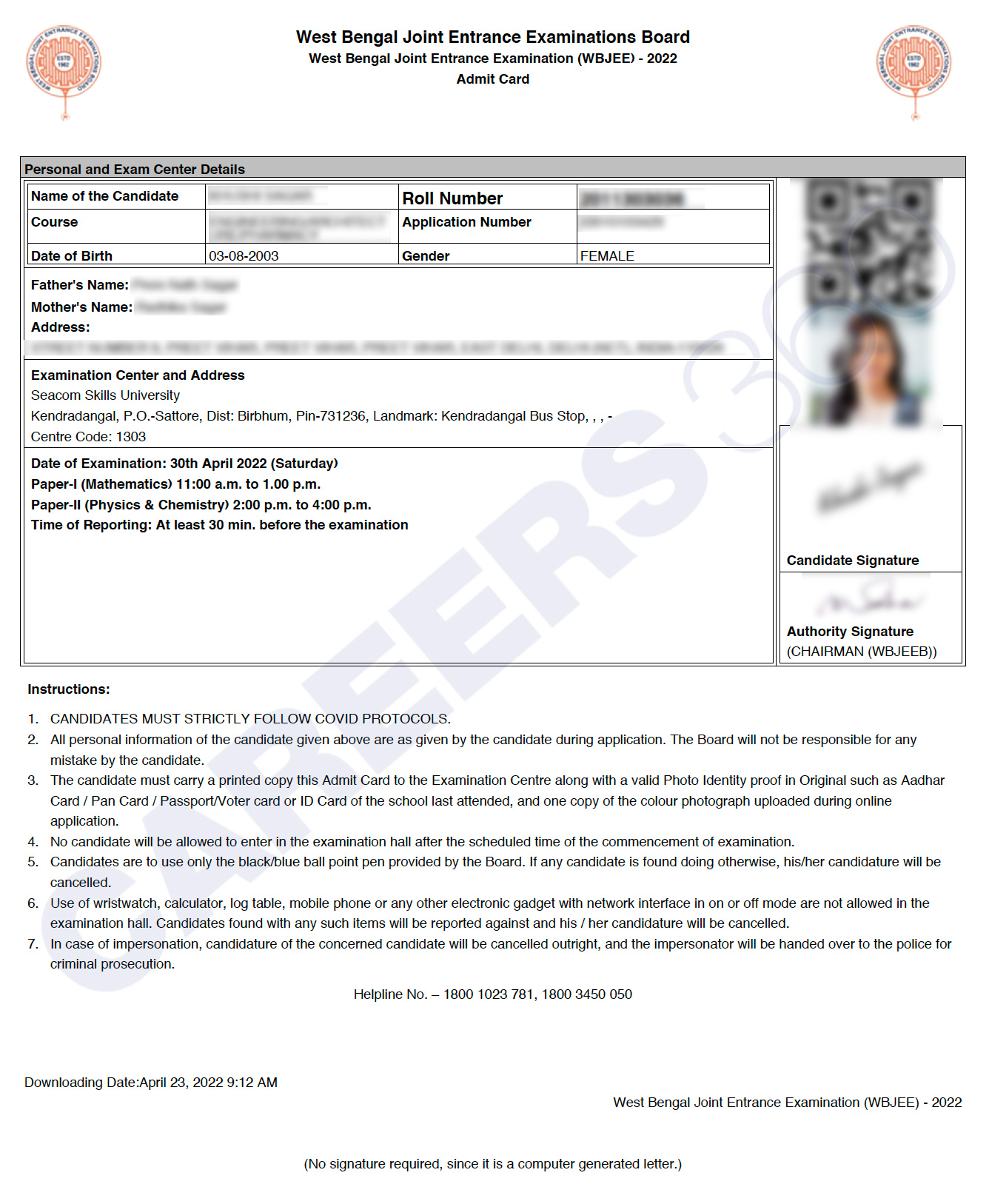
    WBJEE_admit_card

    What to carry with WBJEE admit card 2026?

    • A copy of Colour Photo (same as uploaded in the application form).

    • Any Photo ID in original - Aadhaar Card/ Pan Card/ Passport/ Voter Card/ Class 10 Admit Card/ School ID Card.

    How to apply for a duplicate WBJEE admit card 2026?

    If any candidate lost or misplaced the admit card and does not have a copy saved, they can apply for a duplicate one. The Board will issue a duplicate within 60 days from the date of WBJEE admit card declaration. Beyond that, candidates will not apply for a duplicate admit card. The process to apply for the duplicate WBJEE admit card is as follows

    Steps to apply for duplicate admit card of WBJEE 2026

    • Send an application to WBJEE Board along with mentioning the WBJEE Application No, Name, address and other details like email, mobile number etc.

    • Attach a DD for Rs. 500/- via a  DD in the name of “West Bengal Joint Entrance Examinations Board” payable in Kolkata.

    • After checking, the board will send the WBJEE 2026 admit card duplicate copy to the candidate.


    The exam authority will release the WBJEE 2026 answer key online. Candidates can download the answer key from the official website using the application number and password. Students can verify their answers using the WBJEE answer key and response sheet. 

    The authorities will also release the OMR Sheets along with the answer key to help candidates calculate their expected score. The OMR Sheet objection window can be utilised, by paying a fee of Rs 500 per question. 

    To check the official WBJEE answer key 2026

    • Click on the "View/ Challenge Answer Key" link given on the official website - wbjeeb.nic.in (link has been updated after the official release)
    • The WBJEE login window will open and candidates have to enter the application number and password.
    • WBJEE 2026 answer key will be displayed. Candidates may download the same.

    WBJEE OMR Images and Machine Read Responses

    WBJEEB will release the OMR images and machine-read responses of the candidates. Candidates can check the responses through the WBJEE 2026 portal. The responses are shown as 'A', 'B', 'C' and 'D' in case of Category I and Category II questions, while the unattempted questions are shown as "-". In the case of multiple answers, the response is shown as '*'. 

    Steps to download Responses

    • Visit WBJEE 2026 official portal (wbjeeb.nic.in)
    • Click on the OMR sheets link (link will be updated after release)
    • Login using the application number and password
    • OMR sheets will be displayed on the screen
    • Download and take a print of the OMR sheet

    How to Challenge Response Sheet?

    Candidates who are not satisfied with the responses can raise objections. It must be noted that objections can be raised in only one session. Candidates are required to pay Rs 500 per challenge. The payment of the fee can be done only in online mode through a debit/credit card or Internet banking.

    The WBJEEB will announce the WBJEE 2026 result on the official website. Applicants who appear for the examination can check the WBJEE 2026 result through their application number and password. The result of WBJEE 2026 mentions the score of Papers 1 and 2, the total score and the rank of the candidate. To participate in the counselling process, applicants must keep the WBJEE scorecard safe. The steps to download the WBJEE are given below.

    How to check the WBJEE result 2026?

    • Visit the WBJEE official website.
    • Click on the direct link to check the WBJEE result.
    • Enter the required login credentials. 
    • Check all the details mentioned in the WBJEE scorecard.
    • Download the WBJEE result and scorecard for future reference.

    Issue of Duplicate Rank Card of WBJEE 2026

    • In case the result is misplaced, a duplicate rank card will be issued within 60 days of the declaration of the result of WBJEE 2026.
    • Candidates must write to the WBJEE Board quoting their application number, and personal details including email and mobile, and attach a copy of the confirmation page
    • They must also attach a DD for Rs 500 in favour of “West Bengal Joint Entrance Examinations Board” payable in Kolkata

    Rank Cards are issued to all candidates who appear for the exam. Seat allotment will only be as per the merit of the candidates who meet the eligibility criteria and score more than the WBJEE Cutoff marks.

    In case two candidates score the same marks in the WBJEE 2026 result then authorities will opt for the tie-breaking rule. The criteria for tie-breaking will be applied while calculating the WBJEE results as per the points given below.

    • Less negative marks in Mathematics, Physics and Chemistry taken together.
    • More positive marks in Mathematics and Physics taken together.
    • More positive marks in Mathematics and Chemistry taken together.
    • Less negative marks in Mathematics and Physics taken together.
    • Less negative marks in Mathematics and Chemistry taken together.
    • More positive marks in Mathematics for only the 2 marks questions
    • More positive marks in Physics for only the 2 marks questions
    • More positive marks in Chemistry for only the 2 marks questions
    • Less negative marks in Mathematics for only the 2 marks questions
    • Less negative marks in Physics for only the 2 marks questions.

    WBJEE 2025 Toppers

    RANK

    NAME

    SCHOOL

    Board

    1

    Aniruddha Chakrabarti

    Don Bosco School, Park Circus

    CISCE

    2

    Samyajyoti Biswas

    Kalyani Central Model School, Kalyani

    CBSE

    3

    Dishaanth Basu

    Delhi Public School, Ruby Park, Kolkata


    CBSE

    4

    Aritro Ray

    Delhi Public School, Ruby Park, Kolkata


    CBSE

    5

    Trishanjit Doloi

    PURV International School, Durgapur


    CBSE

    6

    Sagnik Patra

    Midnapore Collegiate School, Midnapore

    WBCHSE

    7

    Sambit Mukhopadhyay

    Burdwan Model School, Purba Bardhaman

    CBSE

    8

    Archisman Nandy

    DAV, Model School, Kharagpur

    CBSE

    9

    Pratik Dhanuka

    Delhi Public School, Rajarhat, Kolkata

    CISCE

    10

    Arka Banerjee

    Burdwan Municipal High School, Purba Bardhaman

    CISCE

    WBJEE 2024 Toppers

    RankName of the Candidates
    1Kingshuk Patra
    2Shubrodeep Pal
    3Bhibashon Biswas
    4Iradri Basu Siliguri
    5Mayukh Choudhury
    6Ritam Banerjee Hooghly
    7Abhik Das
    8Atharva Singhania
    9Sounak Kar
    10Bijit Moish

    WBJEE 2023 Toppers

    RankTopper NameSchool/Institute
    1

    Md Sahil Akhter

    DPS Ruby Park
    2Soham DasDPS Ruby Park School
    3

    Sara Mukhopadhyay

    Bankura Banga Vidyalaya
    4Souharda DatMidnipur Collegiate School
    5Ayan GoswamiHemshila Model School, Durgapur
    6Aritra Davao Dutta

    Narayan School, Sodpura
    7Kintan Saha

    Ma Bharati Senior Secondary School, Kota, Rajasthan
    8Sagrik Nandi

    Bakura District School
    9

    Raktim Kundu,

    Disha Delphi Public School, Kota, Rajasthan
    10Siraj ChandraHoly Angels School, Katwa

    WBJEE Topper 2022

    Rank
    Name of the candidate
    School
    1
    Himanshu Sekhar
    Barrackpore Central Model School
    2
    Himanshu Sekhar
    Siliguri
    3
    Saptarshi Mukherjee
    The Future Foundation School, Kolkata
    4
    Jahnavi Shaw
    South Point High School, Kolkata
    5
    Kaustav Chowdhury
    Jenkins School, Kochbihar
    6
    Saumyaprabha Dey
    Kolaghat Thermal Power Plant High School, East Midnapore
    7
    Debraj Karmakar
    DBMS Kadma High School, Jamshedpur
    8
    Agnidhra Dey
    South Point High School
    9
    Ayon Adhikari
    Calcutta Boys High School
    10
    Shubhankar Bandyopadhyay
    Central Model School, Barrackpore

    WBJEE 2026 cutoff will be released along with the seat allotment. The cut-off will consist of the opening and closing ranks within which the participating institutes offer admission. The WBJEE cutoff score for taking admission in Technology/ Engineering/ Architecture and Pharmacy will differ from the cutoff rank. WBJEE cutoff score is the minimum score in Papers 1 and 2 which candidates have to secure to take part in the counselling and admission process. The board will declare the cutoff score for both papers. 

    If candidates have appeared for only Paper 2 and scored above the cutoff only then he/ she will be allotted Pharmacy Merit Rank (PMR). Candidates who have appeared in the exams of Paper 1 and Paper 2 and scored above the cutoff mark will get General Merit Rank (GMR) and PMR both. Those candidates will not get any rank and will take part in only Paper 1. Depending upon the category of candidate, the selected course and Institute cutoff mark will be different.

    WBJEE Cutoff 2026 - Determining Factors

    The following are the factors considered by the exam authorities for the determination of the cutoff of WBJEE 2026.

    • The number of applicants in the exam.

    • Number of candidates who appeared for WBJEE 2026

    • Availability of seats

    • The difficulty level of WBJEE 2026

    • Previous year cutoff trends

    WBJEEB will announce the complete schedule for the WBJEE 2026 counselling on the official website.  For admission to the institute and the course of their choice, candidates have to participate in the counselling process. 

    Verification of documents will be done during the counselling and admission process and registration with the university. No candidate will be given admission without taking part in counselling of WBJEE 2026. Before counselling and allotment, the seat matrix comprising information about the institute and course-wise availability of seats will be published on the board's site. Participants can make use of this to select an appropriate option for themselves.

    WBJEE Counselling Process 2026

    Registration and payment of counselling fee: Eligible candidates need to register online to take part in the counselling process by submitting the required information. To register for counselling, process candidates are supposed to pay Rs. 300 and applicable charge towards the counselling fee of WBJEE 2026 through Credit/ Debit Card/ Net Banking. Participants' Identity codes and passwords will be created. WBJEE 2026 rank holders will not be required to pay the counselling fee.

    Online choice filling and locking: As per their choice, the participant can select a course and institute and lock them before the last date fixed in this regard. Participants should keep a copy of the locked options with them for future reference.

    Allotment of seats and verification: Candidates are allotted a seat in an institute as per the availability in the order of merit. Those candidates who got allocated a seat in the first round should pay the required provisional admission fee online and then upload documents for verification. The document verification will be done online by virtual counselling centres.

    The second round of WBJEE 2026 seat allotment will be conducted for the seats remaining vacant after the first round of reporting. The third round of WBJEE 2026 seat allotment results will be published for the seats remaining vacant after the second round. 

    WBJEE Fee Structure - Previous Year

    Year

    Fees (Rs)

    First Year

    80, 000

    Second Year

    82,000

    Third Year

    84,000

    Fourth Year

    86,000

    Top 10 Participating Institutes of WBJEE (in alphabetical order)

    Institute

    Academy of Technology, Adisaptagram, Hooghly

    Bidhan Chandra Krishi Viswavidyalaya

    Government College of Engineering & Ceramic Technology, Kolkata

    Government College of Engineering and Leather Technology, Kolkata

    Government College of Engineering and Textile Technology, Berhampore

    Haldia Institute of Technology

    Heritage Institute of Technology, Kolkata

    Jadavpur University, Kolkata

    Kalyani Government Engineering College, Nadia

    Maulana Abul Kalam Azad University of Technology, Kolkata

    To view the complete list of WBJEE participating institutes (previous year data).

    Documents Required at WBJEE 2026 counselling

    West Bengal Joint Entrance Exam 2026

    WBJEE 2026 rank card
    Provisional allotment letter's print out
    Confirmation page of WBJEE 2026
    Yes or no up-gradation option form
    Marks sheet of class 10 and self-attested copy
    Marks sheet of class 12 and self-attested copy
    For architecture course, certificate or marks sheet of NATA or JEE Main 2026's paper 2
    Domicile certificate and self-attested copy (only for West Bengal candidates)
    Caste certificate and self-attested copy (C/ ST/ OBC candidates of West Bengal)
    Income certificate and self-attested copy for tuition fee waiver verification (only for West Bengal candidates)
    Physically challenged certificate and self-attested copy for PwD category verification (only for West Bengal candidates)
    10th class admit car/birth certificate for verification of date of birth

    General Information

    Contact Number:

    18001023781 , 033-71564345

    Relevant Links:

    Official Website Link Click Here, + 1 more
    UPES B.Tech Admissions 2026

    Last Date to Apply: 29th April | Ranked #43 among Engineering colleges in India by NIRF | Highest Package 1.3 CR , 100% Placements

    Amrita University B.Tech 2026

    Application Deadline: 15th April | Recognized as Institute of Eminence by Govt. of India | NAAC ‘A++’ Grade | Upto 75% Scholarships

    Frequently Asked Questions (FAQs)

    Q: How many subjects are there in WBJEE 2026?
    A:

    The syllabus of WBJEE 2026 will be based on Physics, Chemistry, and Mathematics.

    Q: When will the WBJEE 2026 application form release?
    A:

    The WBJEE 2026 application form will be released on March 10, 2026.

    Q: How can I download the admit card of WBJEE 2026?
    A:

    Students had to download their admit card from the official website of WBJEE using their application number and password.  

    Q: Is the WBJEE answer key out?
    A:

    WBJEE model answer key 2026 will be released online.

    Q: Is WBJEE Cutoff 2026 released?
    A:

    No, WBJEE 2026 cutoff will be released for BP Poddar Institute of Management and Technology, Kolkata. The WBJEE/JEE Main cutoff is required for getting admission to B. Tech courses. 

    Q: Where will the authorities release the WBJEE 2026 result?
    A:

    The authority will announce the WBJEE result 2026 on the official website - wbjeeb.nic.in.

    Q: How can I download the answer key of WBJEE 2026?
    A:

    Candidates can download the official WBJEE 2026 answer key online through the official website.

    Q: What to do if I forget my WBJEE application number 2026?
    A:

    You can use the “Forgot Application Number” link in the WBJEE login window to know the application number.

    Q: Whom should I contact in case my details in WBJEE admit card are incorrect?
    A:

    Candidates had to contact the WBJEE 2026 exam conducting authority to rectify the incorrect details on the admit card.  The contact detail is West Bengal Joint Entrance Examinations Board, AQ 13/1, Salt Lake City, Sector - V, Kolkata - 700091.

    Q: Is there any age limit for WBJEE 2026?
    A:

    There is no upper age limit. However, if you want to get admission into Marine Engineering, then you need to be a maximum of 25 years of age as of December 31, 2026.

    Articles
    |

    Questions related to WBJEE

    On Question asked by student community

    Have a question related to WBJEE ?

    The WBJEE 2026 exam will not be held in Maharashtra, as per the details mentioned in the brochure. The exam centres will be available in West Bengal, Assam and Tripura. If you are from any other state, then your options will be limited to WB.
    For a complete list of

    Hello,
    A non-local student does not get full fee reimbursement through MHT-CET or WBJEE. Full fee reimbursement is usually given only to students who belong to the home state and satisfy the state-specific eligibility rules. In MHT-CET, only Maharashtra domicile candidates under valid categories are eligible for government fee reimbursement.

    Hi dear candidate,

    WBJEE, NIPER, JEE and GATE all are entrance exams for higher studies.

    WBJEE is engineering entrance exam for West Bengal colleges.

    NIPER is a PG program for admission in pharmacy masters or PhD programs.

    JEE is all over India entrance exam for engineering.

    GATE is all over

    Student Community: Where Questions Find Answers

    Ask and get expert answers on exams, counselling, admissions, careers, and study options.