Symbiosis Institute of Business Management, Noida
1 Exam accepted by 17 Top Symbiosis Institutes for 32 MBA programmes.


With SNAP 2026 approaching, candidates need to give proper attention to the Ethics, Morality and Values section along with the other topics. SNAP is conducted by Symbiosis International (Deemed University) for admission to MBA programmes at its institutes. The exam will be held on December 13, 19 and 26, 2026, and candidates can take it up to three times, which gives them more than one chance to improve their score. Unlike the aptitude sections, this section tests how candidates think and judge in real-life situations through ethical dilemmas, workplace scenarios and decision-making questions.

This article provides SNAP ethics questions with answers and explanations, along with sample papers and preparation tips to help candidates practise effectively.
The new EMV section forms part of the 60-question, 60-minute SNAP 2026 exam pattern.
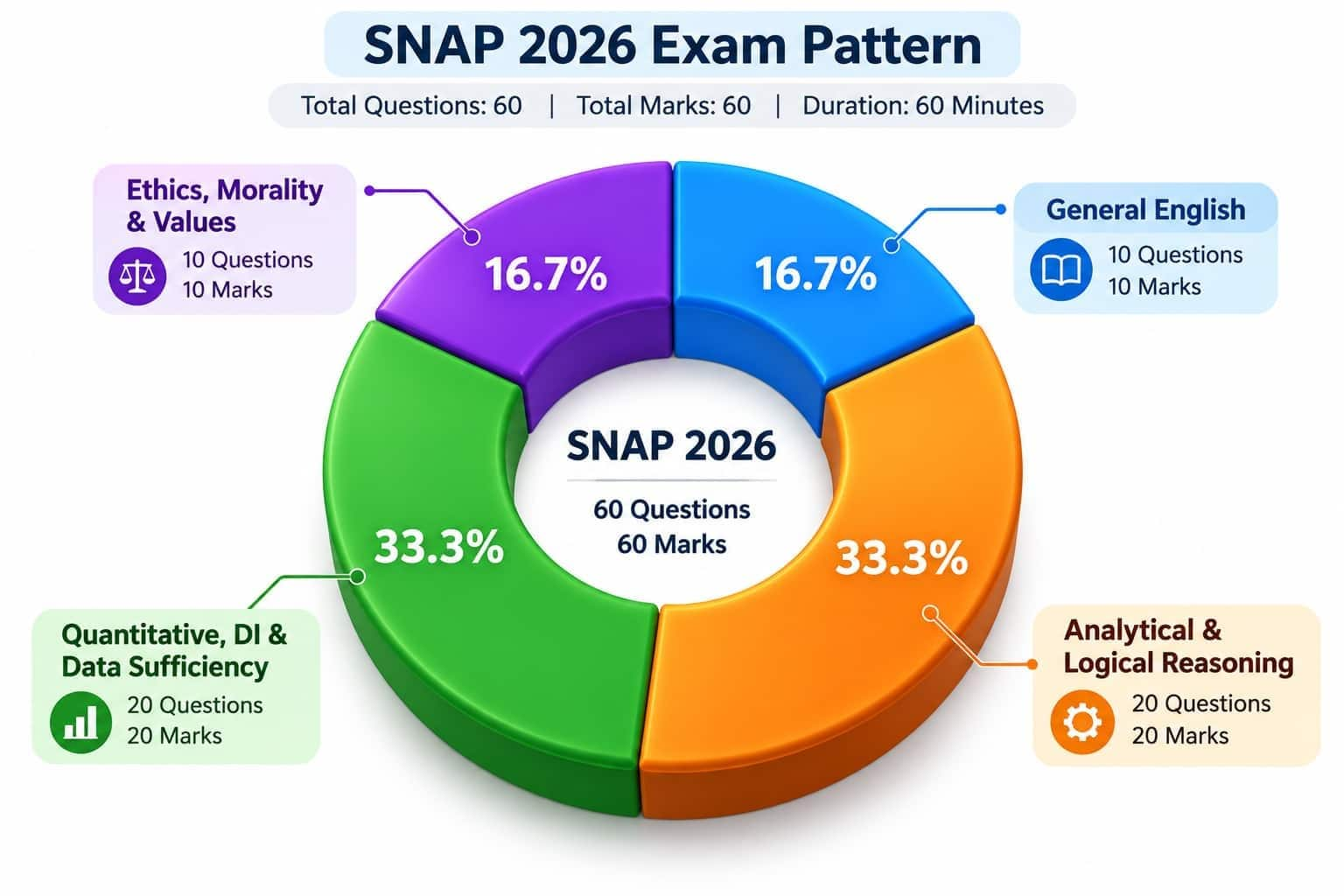
Each correct answer earns 1 mark, each incorrect answer incurs 25% negative marking, and candidates can attempt sections in any order; with 10 questions, EMV accounts for one-sixth of SNAP and offers 10 additional scoring opportunities.
SNAP 2026 will be conducted on three dates, and a candidate can appear for up to three tests. When multiple tests are taken, the higher score is considered for the final percentile calculation. Below are the SNAP exam dates:
The exam dates are 13,19 and 26 December, 2026 for the test 1,2 and 3 respectively.
SNAP 2026 registration is currently open and closes on November 25, 2026. The official registration information states that the test registration fee is ₹2,550 per test, plus applicable taxes, while programme registration is separate.
Candidates who have not completed the application can use the registration page before the deadline.
Register for SNAP 2026: SNAP 2026 Registration
SNAP EMV questions are expected to be scenario-based, requiring candidates to evaluate the available choices and select the most responsible and balanced course of action rather than rely on memorised definitions.
Common areas include:
Integrity and honesty
Fairness and impartiality
Accountability
Conflict of interest
Confidentiality
Professional responsibility
Responsible use of authority
Transparency
Respect for others
Ethical decision-making
A useful approach is to consider both the immediate outcome and the broader impact of a decision.
Strengthen preparation for the newly introduced Ethics, Morality & Values section with focused notes covering key concepts and value-based decision-making.
The following SNAP ethics practice questions provide a short introduction to scenario-based EMV preparation.
An employee accidentally receives a confidential document intended for another department. What is the most appropriate action?
Read the document because it was received accidentally.
Share it with trusted colleagues.
Report the error and avoid using the information.
Keep it for possible future use.
Ignore the matter completely.
Answer: 3
Explanation: Confidential information should not be used simply because it has been received accidentally. Reporting the incident and avoiding its use demonstrates responsibility and protects confidentiality.
A student notices that an examination system has accidentally displayed the answer to a question. What should the student do?
Use the answer without informing anyone.
Inform the examination authority.
Share the answer with other students.
Record the answer and report it after the examination.
Ignore the issue.
Answer: 2
Explanation: Reporting the error prevents an unfair advantage and protects the integrity of the examination.
A manager discovers that a team member has made an honest mistake in an important report. What is the most appropriate response?
Hide the mistake.
Publicly blame the employee.
Discuss the mistake and help correct it.
Wait for senior management to discover it.
Ignore it if there is no immediate loss.
Answer: 3
Explanation: A constructive response addresses the error while maintaining accountability and allowing the problem to be corrected.
A supplier offers an expensive gift to an employee shortly before a contract decision. What should the employee do?
Accept the gift because the contract has not been awarded.
Accept it and disclose it later.
Decline or report it according to organisational policy.
Accept it if the supplier offers a competitive price.
Give the gift to another employee.
Answer: 3
Explanation: A valuable gift during a procurement decision can create a conflict of interest or the appearance of undue influence. Organisational policy should guide the response.
Question 5
A team member completes most of a project, but the team leader receives all the recognition. What would be the most ethical response?
Keep the recognition because the leader manages the team.
Acknowledge the team member's contribution.
Wait until the employee raises the issue.
Share credit only if management asks.
Ignore the contribution.
Answer: 2
Explanation: Giving appropriate recognition supports fairness, transparency and trust within a team.
A counsellor at an educational institution learns that a student has disclosed highly personal information during a confidential session. A faculty member requests the details, claiming that knowing the student’s circumstances would help improve academic performance. The student has not consented to disclosure, and there is no indication of an immediate safety risk or other overriding obligation to disclose.
What should the counsellor do?
A. Share the information because the faculty member’s educational responsibilities justify access to relevant student records.
B. Provide the complete session notes but request that the faculty member maintain confidentiality.
C. Decline to disclose the confidential details without valid authorisation and, if appropriate, offer general support recommendations that do not reveal the student’s private information.
D. Inform the student that confidentiality cannot be maintained whenever institutional staff request information for educational purposes.
Answer: 3
A hospital has one remaining treatment unit available. Two patients need it urgently. Based on the available clinical evidence, both patients have comparable chances of benefiting, and delaying treatment for either could result in serious harm. One patient is a prominent public figure whose family offers to fund a new hospital wing if the patient receives priority. The hospital’s established allocation policy requires priority to be determined by clinical need and relevant medical criteria.
What is the most ethically appropriate decision?
A. Prioritise the public figure because the prospective donation could benefit a larger number of future patients.
B. Apply the established clinical allocation criteria and use the prescribed impartial tie-breaking procedure if the patients remain equally eligible.
C. Prioritise the patient whose treatment is expected to generate greater public attention, thereby increasing awareness of the hospital’s services.
D. Allow the treating physicians to select whichever patient they personally believe would make the greatest contribution to society.
Answer: 2
An employee preparing an annual sustainability report discovers that the organisation’s environmental targets were achieved only because a significant category of emissions was excluded from the calculations. The reporting method is permitted under an internal guideline, but the published report does not clearly explain the exclusion. The employee’s manager insists that the report should remain unchanged to protect the organisation’s reputation.
What is the most ethically appropriate response?
A. Accept the report because compliance with an internal guideline makes further disclosure unnecessary.
B. Publicly release the underlying documents immediately, regardless of confidentiality obligations or the availability of internal reporting channels.
C. Remove the emissions category from the report entirely because including disputed information could confuse readers.
D. Seek a transparent correction or clarification through appropriate reporting channels so that readers can understand the scope and limitations of the reported results.
Answer: 4
During a professional conference, an attendee notices that another participant is being subjected to repeated humiliating remarks by a senior speaker. Several colleagues appear uncomfortable but remain silent. The attendee fears that objecting publicly could damage professional relationships and believes someone more senior should intervene.
Which response best reflects moral responsibility?
A. Take a proportionate step to address the conduct, such as respectfully challenging the remarks or seeking appropriate assistance, while considering the affected person’s safety and dignity.
B. Remain silent because intervening without formal authority could be interpreted as an inappropriate challenge to the speaker.
C. Wait until several other attendees object, since collective action is ethically preferable to individual intervention in every situation.
D. Publicly condemn the speaker in the strongest possible terms, regardless of the circumstances, because the seriousness of the conduct removes the need for proportionality.
Answer: 1
A company introduces an automated recruitment system that consistently ranks candidates from certain educational institutions lower than candidates from others. An internal review finds that the system learned this pattern from historical hiring data, which reflected past recruitment preferences rather than validated differences in job performance. The company argues that the system should continue to be used because it produces results faster than human recruiters.
What is the most ethically defensible course of action?
A. Continue using the system because historical hiring decisions provide an objective basis for predicting future employee performance.
B. Remove the names of educational institutions from the final reports while leaving the underlying ranking process unchanged.
C. Suspend or restrict reliance on the affected rankings until the company investigates the bias, validates job-related criteria and implements appropriate safeguards.
D. Allow the system to make all final decisions because automated processes are less susceptible to personal prejudice than human recruiters.
Answer: 3
A project manager discovers that a colleague has made a genuine mistake in a report submitted to an important client. The error is not yet known to the client and does not appear to have caused any immediate harm. The colleague asks the manager to remain silent, explaining that disclosure could jeopardise the colleague’s employment. The report is still being used by the client to make decisions.
What is the most ethically appropriate response?
A. Conceal the error because protecting a colleague from disproportionate personal consequences is more important than correcting a mistake that has caused no immediate harm.
B. Ensure that the error is corrected and communicated to the client through appropriate channels, while treating the colleague fairly and avoiding unnecessary personal blame.
C. Immediately report the colleague to senior management for disciplinary action before taking any steps to correct the report.
D. Wait until the client independently identifies the error, since voluntary disclosure could create unnecessary reputational damage for the organisation.
Answer: 2
SNAP mock test 2 was conducted on 23 October, 2026, in online format. Here is the list of new concepts introduced in the EMV section:
Moral Courage and Professional Responsibility
Conflict of Interest and Impartial Judgement
Equality, Equity and Fair Selection
Ethical Leadership and Accountability
Privacy, Consent and Professional Ethics
Ethical Allocation of Scarce Resources
Honesty, Loyalty and Public Interest
Moral Responsibility and Bystander Effect
Ethical Implications of Emerging Technology
Integrity Under Conflicting Obligation
The sample questions above offer a quick look at Ethics, Morality & Values preparation. For more practice, candidates can download the dedicated SNAP 2026 EMV Sample Questions PDF:
SNAP 2026 EMV Sample Questions PDF
For complete SNAP preparation, the latest sample paper can be used alongside the EMV material to practise all sections under the updated exam pattern.
A simple framework can make scenario-based questions easier to approach during timed practice.
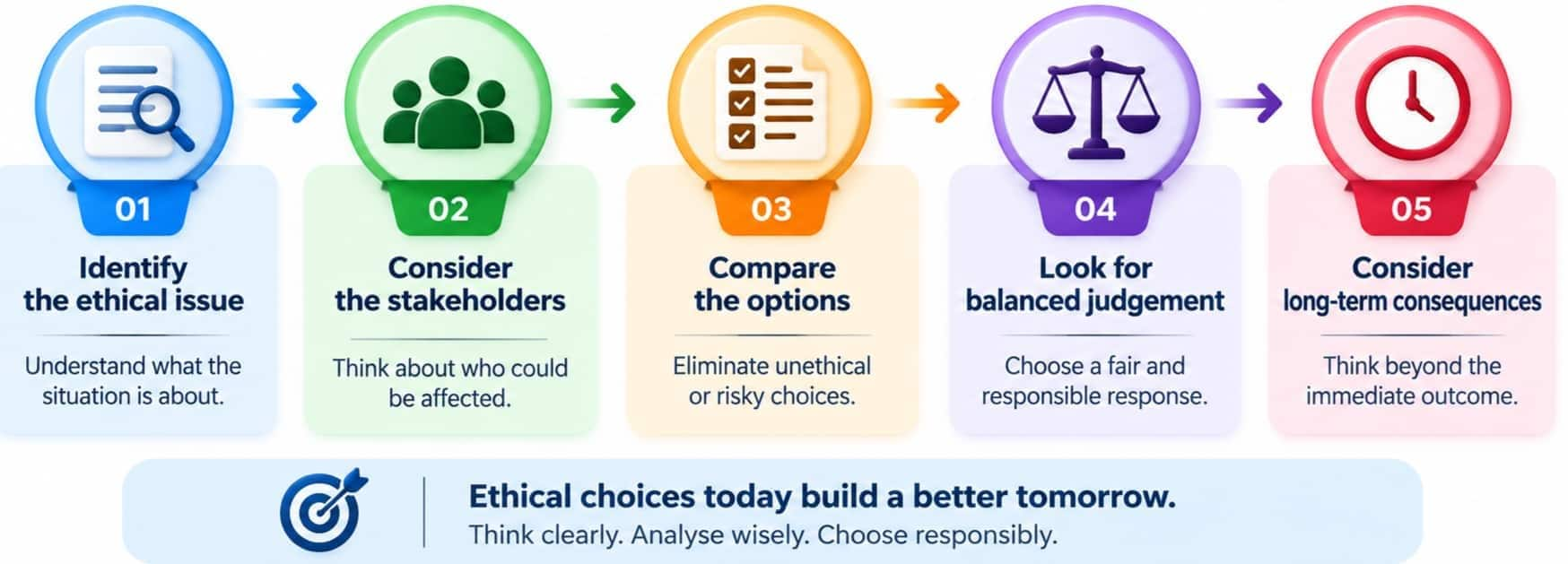
EMV SNAP preparation should progress from understanding basic principles to solving mixed, timed scenarios.
Concepts → Individual scenarios → Mixed EMV sets → Timed practice → Full SNAP mocks
After each SNAP ethics practice test, record:
Questions answered incorrectly
Ethical principle misunderstood
Distracting options selected
Questions taking excessive time
Similar scenarios requiring revision
This type of analysis can help develop consistency rather than relying on intuition alone.
A few preparation habits can reduce the effectiveness of EMV practice.
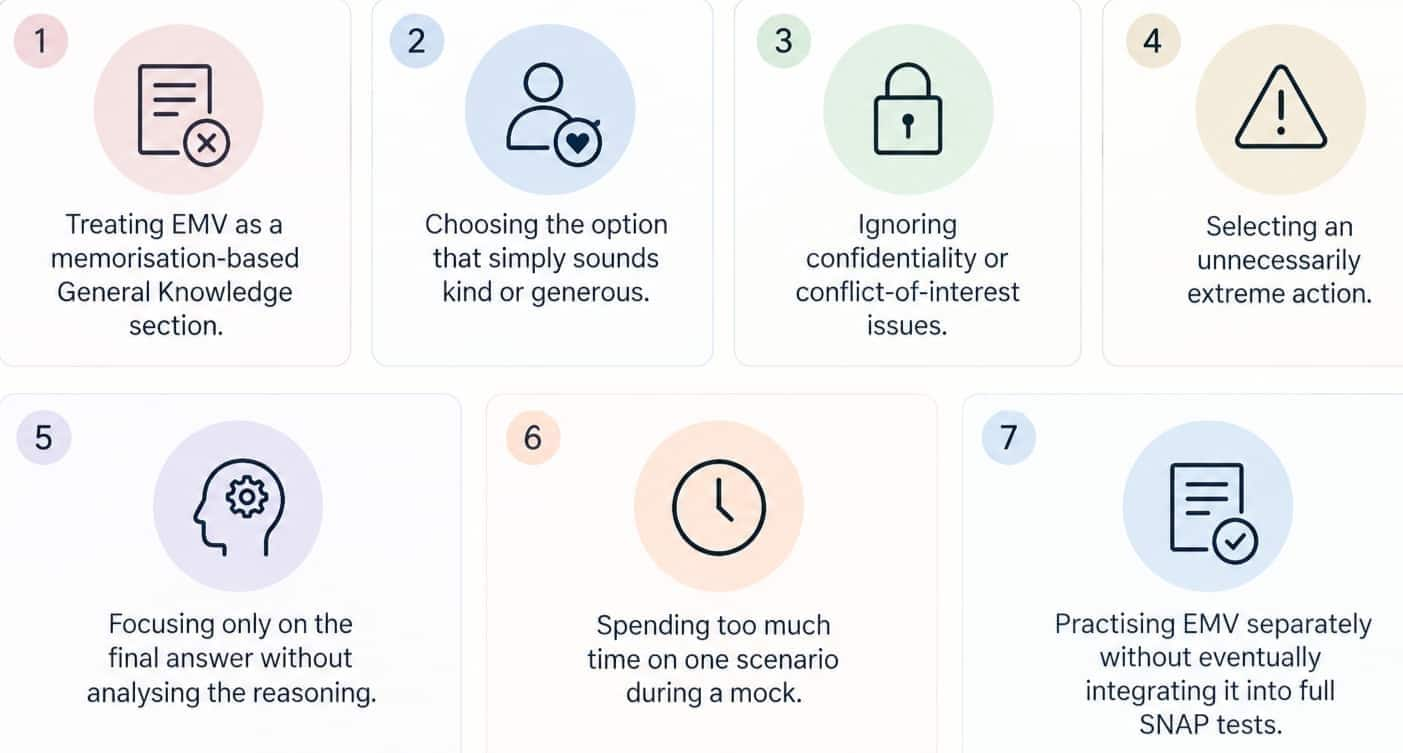
A short but consistent practice routine can be more useful than a single intensive revision session.
Preparation stage | Focus |
Foundation | Ethics, morality, values, and common principles |
Practice | Scenario-based EMV questions |
Analysis | Compare correct and incorrect options |
Timed sets | Build decision-making speed |
Apply EMV skills within the complete SNAP structure | |
Evaluate accuracy, timing, and question selection |
With only 10 EMV questions, preparation should stay balanced with the larger 20-question LR and Quantitative, DI & Data Sufficiency sections.
The SNAP mock test helps candidates understand the new four-section format, practise EMV questions within the 60-minute test, and assess section-wise speed and accuracy.
Attempt Now: SNAP 2026 Free Mock Test
Not only is attempting important, but a thorough analysis is also equally helpful.
A useful analysis format is:
Attempted → Correct → Wrong → Time Taken → Reason for Error
This makes it easier to determine whether mistakes arise from misunderstanding the ethical situation, choosing between two close options, or spending excessive time on a question.
Get the download links of top ebooks to ace the SNAP 2026 exam with high marks below:
SNAP 2026: Ethics, Morality & Values Notes | |
SNAP 2026: Best 50 Questions Quantitative, Data Interpretation & Data Sufficiency | |
SNAP 2026 Mock Test Analysis PDF | |
SNAP 2025 Question Paper with Solutions |

On Question asked by student community
You can find all the information here:
CAT- https://www.careers360.com/mba/articles/cat-exam-dates
SNAP- https://www.careers360.com/mba/articles/snap-exam-dates
Hi Student
Getting 70 percentile in the SNAP examination is well within the range of SSBF Pune. You can register and apply for admission to the college. Click on the link below to learn more about the admission process, dates, fees, etc.
Hello candidate,
SIBM Pune over the years has been known for its holistic development of students . SIBM Pune courses include MBA, MBA Executive and MBA Innovation and Entrepreneurship programmes in various specialisations.
Symbiosis Centre for Management and Human Resource Development, Pune was established in 1993. Admission to SCMHRD Pune
Yes, you can definitely prepare better for the SNAP Quantitative Ability section by keeping a complete formula list with you. Instead of memorising everything randomly, it helps to organise formulas chapter-wise so you can revise faster.
Here is a useful formula list for the SNAP Quant section:
1. Arithmetic
•
Hi there,
You have to apply separately for each symbiosis college, like SIBM Pune, as they as not automatically included. The CAT form automatically includes many IIMs, but the SNAP exam is a separate test that is given for admission to Symbiosis Institute, which requires its own separate application and

Globally Recognized by AACSB (US) & AMBA (UK) | 18 LPA Avg. CTC for PGPM 2026
Register for XAT 2027 by 28th Oct to become eligible to take the Mock Test | 75+ years of legacy | #1 Entrance Test | 100+ Test Cities | 250+ B-Schools accept XAT Score
Gateway to IBS Hyderabad & 8 other IBS campuses | Scholarships worth 10 CR
Highest Package 29.30 LPA | 230+ Recruiters | AACSB Accredited | Ranked 51 in Asia by QS International
Among top 6% B-Schools globally to be accredited by AACSB | Highest Package-35 LPA
Application Deadline: 1st Dec'26 | 400+ Recruiters | Highest CTC 17.2 LPA | Average CTC 8 LPA | 92% Avg. Placements | Awarded Best Business School of the Year