IBSAT 2026-ICFAI Business School MBA/PGPM 2027
AACSB Accredited | 40 LPA-Highest CTC | Scholarships worth 10 CR


SNAP 2026 preparation becomes easier to manage when the 100 days are divided into clear phases instead of treating every day the same. This SNAP 100-day study plan takes you from concept building and sectional practice to full-length mocks, error analysis and final revision. It covers Quantitative, Data Interpretation & Data Sufficiency, Analytical & Logical Reasoning, General English, and Ethics, Morality & Values (EMV), with a gradual shift from learning to timed practice.

SNAP 2026 registration opened on August 21 and is currently open. The registration and payment deadline is November 25, 2026. The exam will be conducted on December 13, 19 and 26, and candidates can appear for up to three tests. Below are the SNAP exam dates:
Event | Date |
Registration and payment closes | November 25, 2026 |
December 7, 2026 | |
SNAP 01 | December 13, 2026 |
SNAP 02 admit card | December 11, 2026 |
SNAP 02 | December 19, 2026 |
SNAP 03 admit card | December 18, 2026 |
SNAP 03 | December 26, 2026 |
Result | January 12, 2027 |
Register before the deadline: SNAP 2026 Registration Portal
Candidates should complete the application well before the deadline, particularly if test-date or test-city preferences are important.
The SNAP registration fee is ₹2550 per test, excluding applicable taxes. Candidates also need to pay a separate programme registration fee for each Symbiosis MBA programme selected.
The 100-day SNAP preparation plan can be divided into five phases. The first phase focuses on understanding your starting level and building fundamentals, while the later phases progressively increase timed practice and mock-test frequency.
Preparation Phase | Days | Main Focus |
Foundation | Days 1–21 | Diagnostic test, Quant basics, LR fundamentals, English and EMV |
Concept Building | Days 22–42 | Advanced Quant, analytical reasoning, DI and Data Sufficiency |
Timed Practice | Days 43–63 | Sectional tests, previous-year questions and speed improvement |
Mock-Test Phase | Days 64–90 | Full-length mocks, analysis and score-gap correction |
Final Revision | Days 91–100 | Mocks, formulas, error log, EMV, English and exam strategy |
The SNAP 2026 exam pattern outlines the section-wise distribution of questions and marks. Since the test has 60 questions in 60 minutes and allows sections to be attempted in any order, preparation should focus on speed, accuracy and question selection as well as concepts.
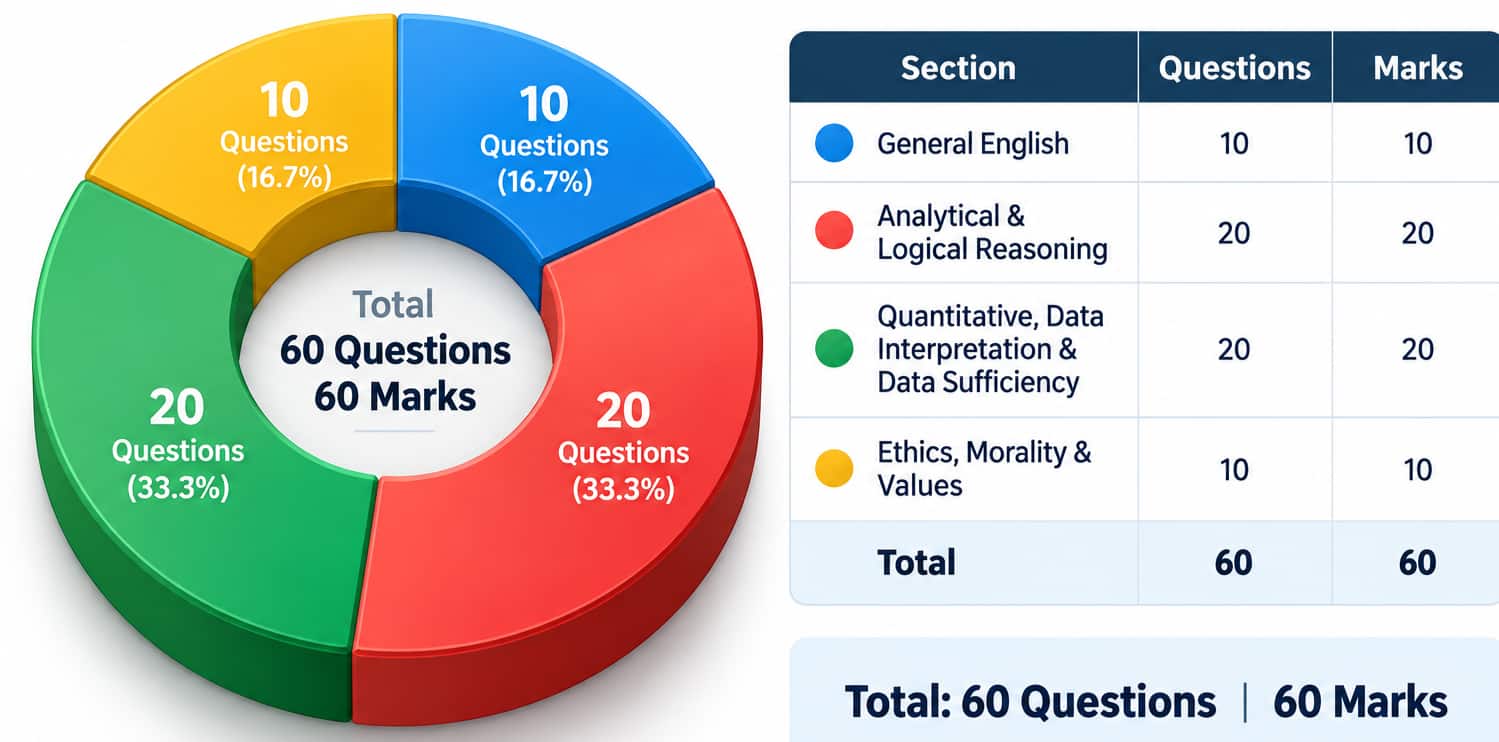
Each correct answer carries 1 mark and an incorrect answer attracts a 25% negative-marking penalty. Sections can be attempted in any order.
The SNAP 100-day study plan is divided into phases that gradually move from SNAP syllabus coverage and concept building to timed practice, mock tests, analysis and final revision.
The first week should establish a realistic starting point instead of immediately trying to cover the entire syllabus.
Focus areas:
Quant: Percentages, ratios, averages and basic arithmetic
LR: Series, coding-decoding, directions and blood relations
English: Grammar fundamentals and vocabulary
EMV: Basic concepts of ethics, morality and values
Take one diagnostic SNAP-style mock
After the diagnostic test, classify each section as strong, moderate or weak and maintain an error log recording the question type, reason for the mistake and correct approach.
Quant preparation should begin with topics that can generate questions across different difficulty levels.
Cover:
Percentages and ratios
Start with accuracy and gradually introduce timed 10-15 question sets.
Logical Reasoning needs consistent practice because it accounts for 20 questions.
Focus on:
Coding-decoding
Blood relations
Logical sequences
The goal is to recognise familiar patterns quickly rather than spending several minutes trying to decode every question.
English preparation should become a short daily activity.
English: vocabulary, grammar, sentence correction and reading comprehension.
EMV: ethical principles, integrity, fairness, responsibility, professional ethics and common moral dilemmas.
For SNAP EMV, understanding the reasoning behind an answer is more useful than memorising isolated definitions.
Once arithmetic fundamentals are reasonably comfortable, move to:
Linear equations
Algebraic expressions
Progressions
Geometry
Mensuration
Advanced arithmetic
Introduce 20-question timed Quant sets by the end of the week.
Shift LR from individual questions to mixed sets and analytical problems.
A useful practice cycle is:
Solve the set without a time limit.
Repeat a similar set under time pressure.
Compare the two attempts.
Record whether the issue was speed, interpretation or question selection.
This helps identify whether your main LR weakness is speed, interpretation, accuracy or question selection rather than relying on accuracy alone.
Add SNAP-style numerical sets involving tables, charts, percentages and data sufficiency.
EMV should receive two dedicated sessions this week. Practise situation-based questions, identify the ethical principle being tested and maintain focused revision notes for recurring concepts.
Prepare for the EMV section with focused notes on Ethics, Morality and Values, including concepts useful for tackling situation-based questions.
Download now: SNAP 2026: Ethics, Morality & Values Notes
The preparation should now move from primarily learning concepts to applying them under SNAP's 60-minute constraint.
A suitable weekly routine is:
Activity | Frequency |
Full-length mock | 2 |
Quant practice | 3 sessions |
LR practice | 3 sessions |
English | 4 short sessions |
EMV | 2 sessions |
Error-log revision | 3 sessions |
Analyse every mock beyond the score. Identify incorrect attempts, missed questions that could have been solved, time-consuming questions and recurring errors. Use these patterns to adjust the next week's preparation.
Previous-year questions are useful for understanding SNAP's question language, structure and recurring patterns. Solve them under timed conditions and classify questions into three categories:
Quick attempts: solve immediately
Second-pass questions: require some calculation or thought
Skip questions: which may consume too much time
Use the first few mocks to identify the two areas costing the most marks.
For example:
Problem | Action |
Low Quantitative Aptitude accuracy | Revise concepts and practise targeted questions |
Slow LR | Use shorter timed sets and improve question selection |
Weak English | Revise grammar, vocabulary and RC |
Poor EMV accuracy | Analyse situation-based questions and ethical principles |
This is the stage where preparation should become increasingly personalised.
Move to 2-3 full-length mocks per week, provided you have enough time to analyse each mock and correct recurring mistakes.
Track:
Metric | What to Evaluate |
Accuracy | Avoidable mistakes |
Attempts | Number of questions completed |
Time | Sections consuming excessive time |
Selection | Difficult questions left at the right stage |
Score | Overall trend across mocks |
Candidates should also test different section orders. Since SNAP permits candidates to attempt sections in any order, the best sequence is the one that produces the strongest combination of accuracy and speed.
The smaller sections should not disappear during the mock-heavy phase.
English revision:
Vocabulary
Grammar rules
Reading comprehension
Verbal ability
EMV revision:
Ethics and morality
Professional conduct
Social responsibility
Integrity
Fairness
Ethical decision-making
Situation-based questions
The final two weeks should closely resemble actual SNAP conditions.
A practical schedule is:
3-4 full mocks per week
Daily calculation drills
Daily short LR set
Alternate-day English revision
2-3 EMV sessions per week
Full analysis of every mock
The objective is no longer to complete new topics. It is to improve selection, reduce negative marking and make the 60-minute attempt strategy predictable.
The last five days should focus on consolidation, error-log revision and exam strategy rather than heavy new-topic learning.
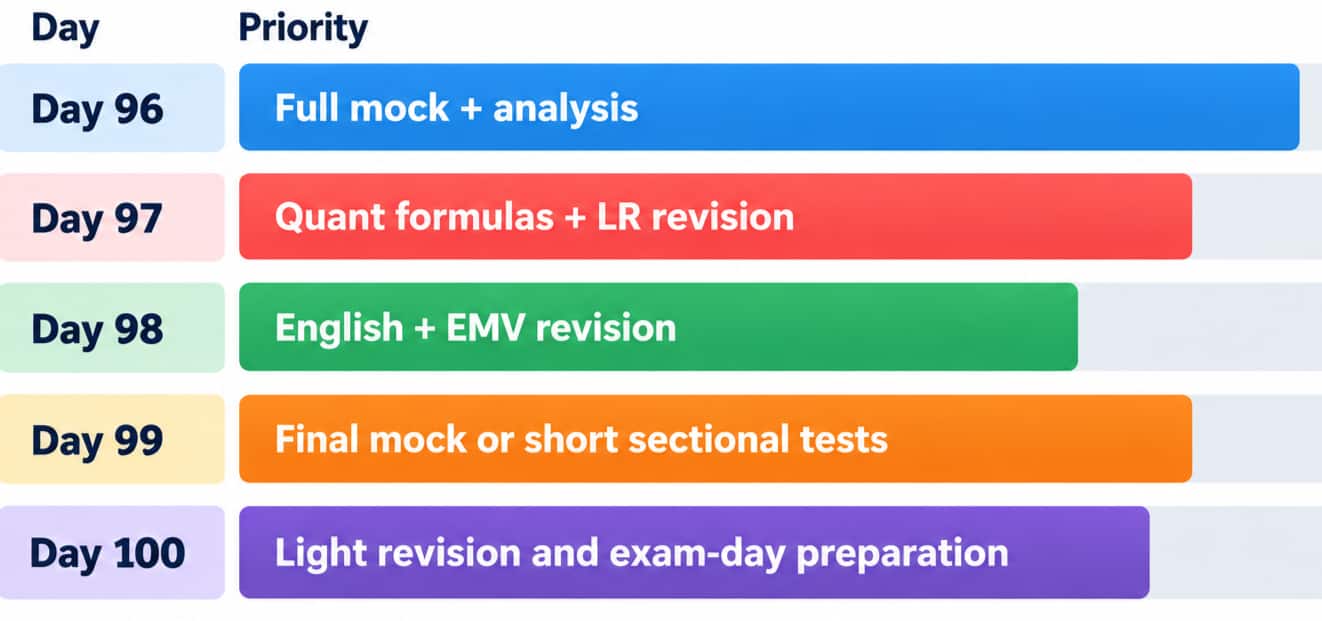
Avoid multiple exhausting mocks on the final day. The priority should be a clear attempt strategy, adequate rest and familiarity with the test process.
SNAP mock tests are particularly important because the paper allows only 60 minutes for 60 questions. The purpose of taking mocks should extend beyond score improvement: they should help determine the right attempt order, identify time traps and reduce avoidable negative marking.
Practise SNAP in a timed environment and use mock analysis to improve speed, accuracy and question selection.
Attempt now: SNAP 2026 Free Mock Test
While the SNAP 2026 Official mock test is released, practise with a SNAP 2025 official mock and solutions to evaluate speed, accuracy, question selection and overall exam strategy.
Practise now: SNAP 2025 Official Mock Test with Solutions
A 3-4 hour daily routine can be structured as follows:
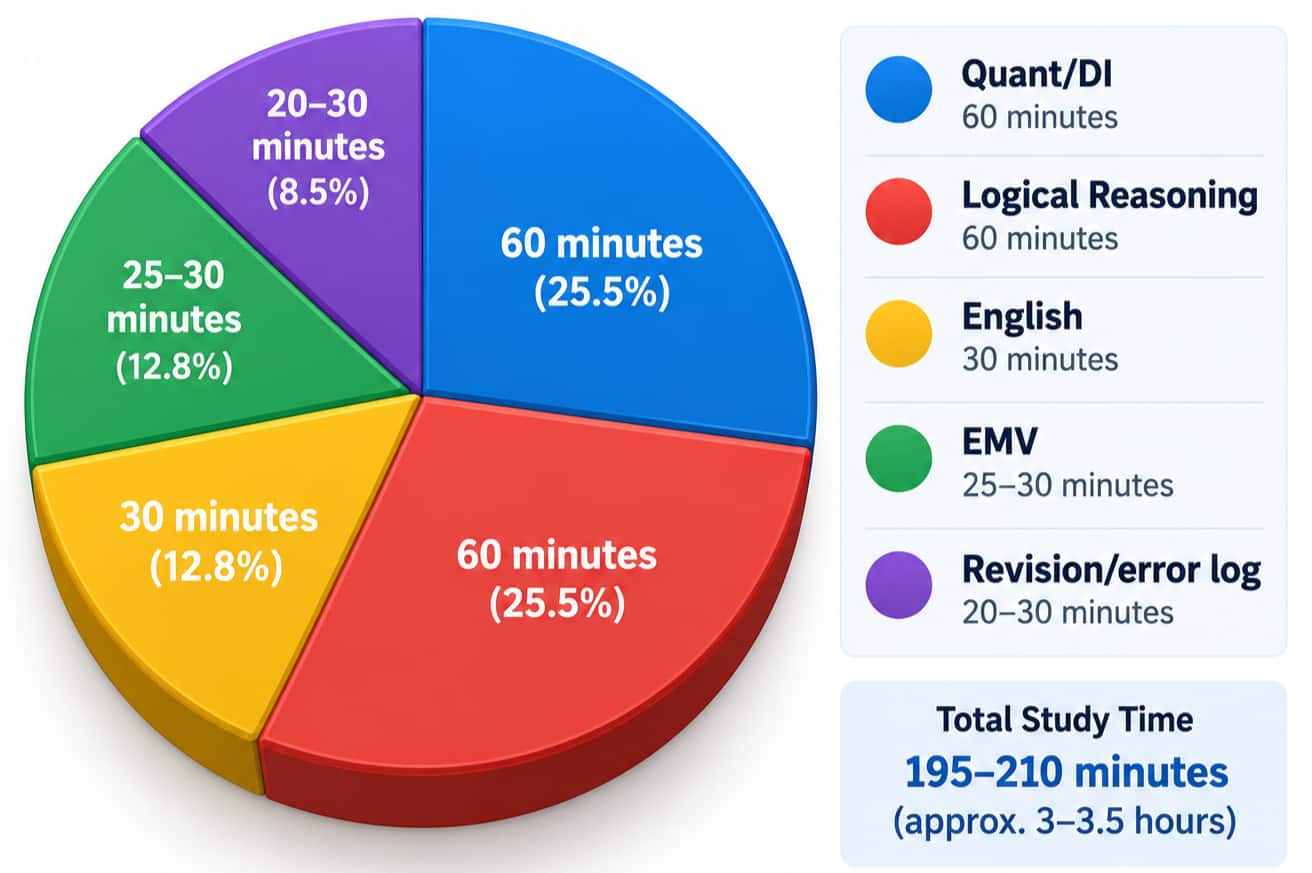
On mock days, the full 60-minute test can replace the regular section-wise practice, followed by dedicated analysis.
The section-wise strategy below highlights the concepts, question types and practice approach to prioritise during the 100-day preparation period.
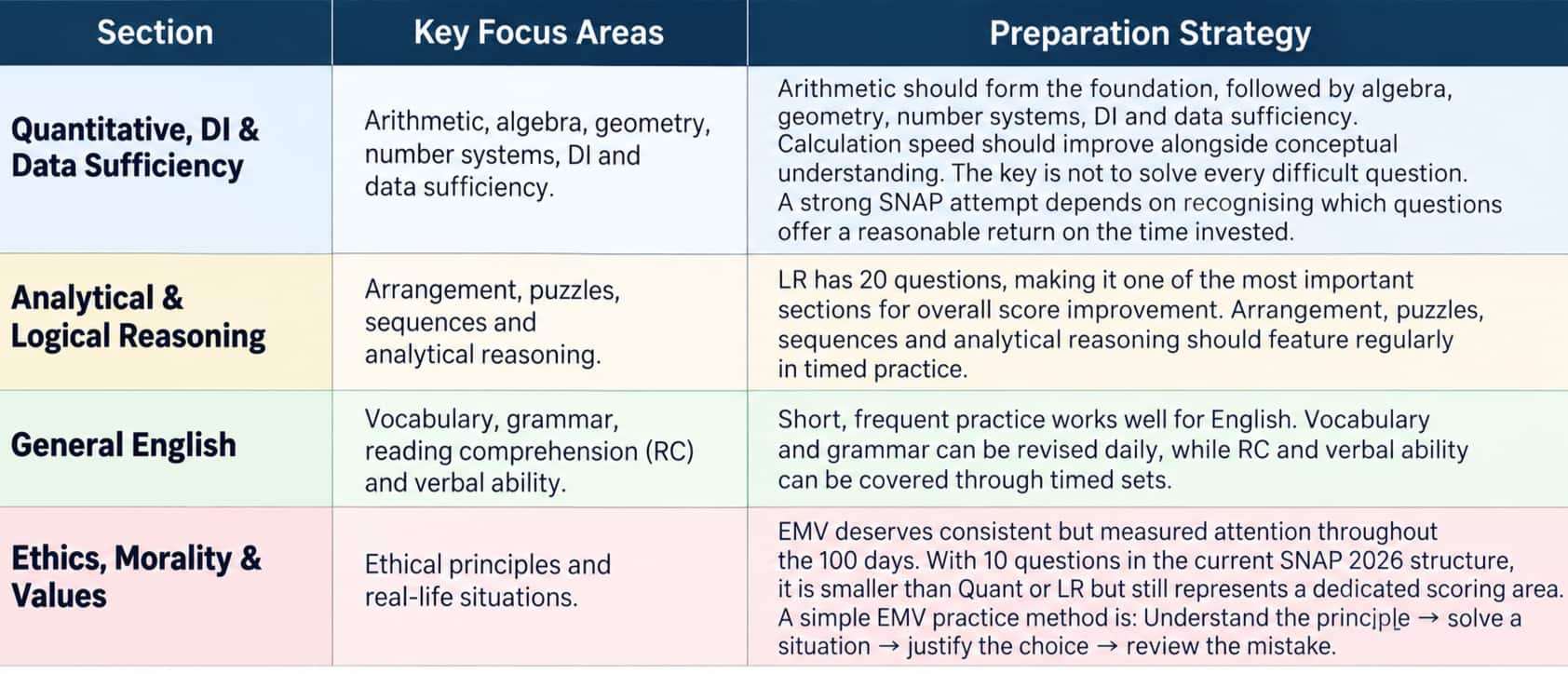
A successful 100-day SNAP preparation plan should gradually shift from concept building to timed practice, mock analysis and final revision. Quant and LR need sustained practice, while English and EMV should remain part of the weekly routine. Aim to be fully prepared for SNAP Test 1 on December 13 and use later tests as additional opportunities if required.
Frequently Asked Questions (FAQs)
Yes. A structured 100-day schedule gives enough time for concept building, timed practice, mock tests, error analysis and final revision. The key is to gradually shift from learning concepts to applying them under SNAP's time constraint.
SNAP 2026 registration and payment close on November 25, 2026.
SNAP 2026 has 60 questions, to be attempted in 60 minutes. The paper covers General English, Analytical & Logical Reasoning, Quantitative/DI/Data Sufficiency, and Ethics, Morality & Values.
Yes. EMV is a separate section with 10 questions in the current SNAP 2026 structure. Regular practice is preferable to leaving the section for the final few days.
Yes. Candidates can appear for up to three SNAP tests. When more than one test is taken, the higher score is considered for the final percentile calculation.
The official schedule lists January 12, 2027 as the SNAP 2026 result date.

On Question asked by student community
You can find all the information here:
CAT- https://www.careers360.com/mba/articles/cat-exam-dates
SNAP- https://www.careers360.com/mba/articles/snap-exam-dates
Dear Student,
SIBM Nagpur SNAP 2025 Cutoff is expected to be on higher side this year, around 93+ percentile if we look at the trends of the previous years. As per the SNAP 2025 score vs percentile, to match the SIBM Nagpur SNAP 2025 cutoff one need to score around
Hi Student
Getting 70 percentile in the SNAP examination is well within the range of SSBF Pune. You can register and apply for admission to the college. Click on the link below to learn more about the admission process, dates, fees, etc.
Hello candidate,
SIBM Pune over the years has been known for its holistic development of students . SIBM Pune courses include MBA, MBA Executive and MBA Innovation and Entrepreneurship programmes in various specialisations.
Symbiosis Centre for Management and Human Resource Development, Pune was established in 1993. Admission to SCMHRD Pune
Yes, you can definitely prepare better for the SNAP Quantitative Ability section by keeping a complete formula list with you. Instead of memorising everything randomly, it helps to organise formulas chapter-wise so you can revise faster.
Here is a useful formula list for the SNAP Quant section:
1. Arithmetic
•

Globally Recognized by AACSB (US) & AMBA (UK) | 18 LPA Avg. CTC for PGPM 2026
75+ years of legacy | #1 Entrance Exam | Score accepted by 250+ BSchools
Test centres are available in 70+ cities across India | 75,000+ aspirants apply for the NMAT exam | Accepted by 58+ institutions like NMIMS, KJSIM, ISB, SPJIMR and Great Lakes.
AACSB Accredited | 40 LPA-Highest CTC | Scholarships worth 10 CR
6-Hour Masterclass to help you score 99+ percentile in CAT 2026
Among top 6% B-Schools globally to be accredited by AACSB | Highest Package-35 LPA