IBSAT 2026-ICFAI Business School MBA/PGPM 2027
Gateway to IBS Hyderabad & 8 other IBS campuses | Scholarships worth 10 CR


The SNAP 2026 official mock test gives aspirants a practical look at the revised examination structure, including the newly introduced Ethics, Morality and Values (EMV) section. With 60 questions to be attempted in 60 minutes across four sections, the mock can help candidates understand the new pattern, test their section order and identify where their time and accuracy are being lost. This SNAP 2026 mock analysis focuses on what the official SIU mock reveals and how to use the results for SNAP 2026 preparation.
This Story also Contains
SNAP 2026 Official Mock Test: Quick Highlights
Feature | Details |
Total questions | 60 |
Duration | 60 minutes |
Sections | 4 |
New section | Ethics, Morality and Values (EMV) |
Correct answer | +1 |
Incorrect answer | -0.25 |
Section navigation | Allowed |
Average time/question | 1 minute |
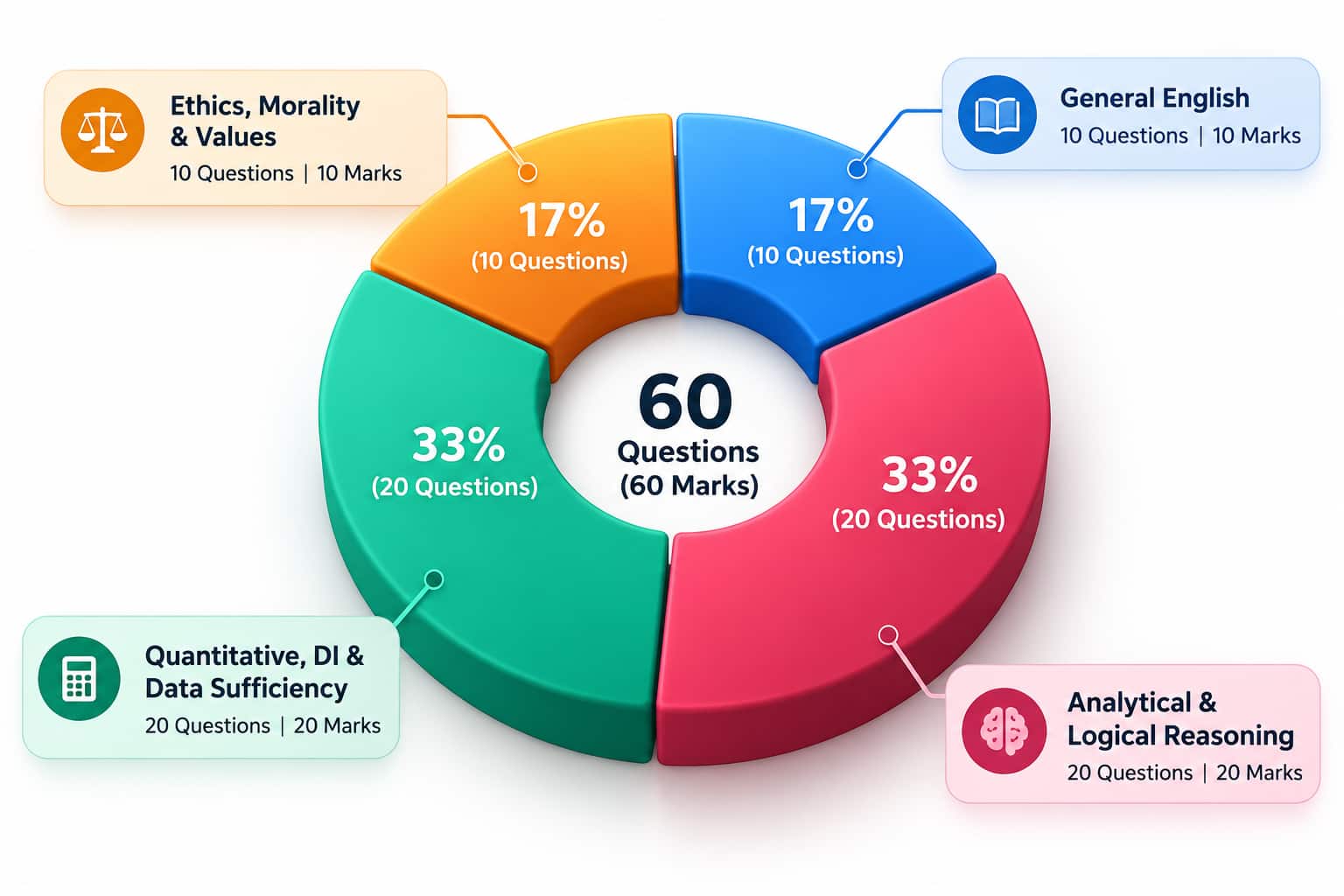
The revised SNAP 2026 structure divides the paper into four sections.
Exam Feature | Details |
Exam Duration | 60 minutes |
Total Questions | 60 |
Total Marks | 60 |
Marks per Correct Answer | +1 |
Negative Marking | -0.25 for each incorrect answer |
Section Navigation | Candidates can move between sections |
Average Time per Question | 1 minute |
The key takeaway from the SNAP 2026 new pattern is that candidates now need to manage four different question types within the same 60-minute window.
The official mock allows candidates to experience the revised structure and familiarise themselves with the test interface before taking the actual examination.
Attempt Now: SNAP 2026 Official Mock Test
Use the mock as a baseline test. Record your attempts, accuracy, section-wise performance and time spent before making changes to your SNAP preparation strategy.
The mock is particularly useful because the revised pattern changes how candidates have to distribute their time.
The introduction of 10 SNAP EMV questions means that Ethics, Morality and Values now accounts for one-sixth of the paper.
Candidates should therefore evaluate more than whether they got an EMV question right or wrong. During analysis, ask:
Did I understand the situation correctly?
Did I identify the central ethical issue?
Did I eliminate unsuitable options quickly?
Did I spend too much time between two close choices?
Did I answer based on reasoning or intuition?
This makes EMV analysis different from reviewing a Quant or LR question.
The 60-question, 60-minute structure gives an average of:
6060=1 minute per question.
However, candidates should not try to force every question into exactly one minute. A direct English question may take much less time, while a difficult LR or Quantitative Ability question may require more.
The objective is to recover time from easy questions and avoid spending excessive time on low-probability questions.
A final score alone does not explain your performance. Record the following after every mock:
Metric | What to Analyse |
Attempts | How aggressively did you attempt the paper? |
Correct | How many attempts converted into marks? |
Incorrect | How much negative marking did you incur? |
Accuracy | Quality of your attempts |
Unattempted | Potential marks left unexplored |
Time used | Where did your time go? |
For example, if you attempt 52 questions with 44 correct and 8 incorrect:
Your accuracy is:
This tells you considerably more than simply knowing that you attempted 52 questions.
Since candidates can move between sections, the official mock is a useful place to test different sequences.
Possible Order | What You Can Evaluate |
English → LR → Quant → EMV | Whether starting with a short section helps |
LR → Quant → English → EMV | Whether tackling larger sections first works |
EMV → English → LR → Quant | Whether two 10-question sections provide a quick start |
Personal order | Whether your own performance supports another sequence |
Do not select an order simply because it is recommended by someone else. Compare your score, accuracy, attempts and time left across mocks.
If one sequence consistently produces better accuracy without causing a time crunch, it deserves further testing.
Analyse your SNAP 2026 mock performance section-wise to identify strengths, weaknesses, time-management gaps, and areas that need more practice.
With 10 questions, English should be analysed mainly for speed and accuracy.
After the mock, identify:
Questions that took unusually long
Vocabulary mistakes
Grammar errors
Questions where you changed a correct answer
Easy questions missed because of rushing
If English is taking substantially longer than expected, identify the exact question type responsible rather than simply writing “English is slow”.
LR contains 20 questions, making it one of the largest sections.
Focus your review on question selection.
Look for:
Direct questions solved quickly
Long puzzles
Questions abandoned too late
Easy questions left unattempted
Questions where the effort did not justify the marks
For example, if one puzzle takes six minutes and produces only one correct answer while several direct questions remain, the issue may be selection rather than LR ability.
Quant also has 20 questions, so small improvements in selection and calculation speed can affect the overall score.
Classify mistakes into:
Area | Review Point |
Arithmetic | Concept or calculation |
Algebra | Equation formation |
Number System | Properties and shortcuts |
Geometry | Formula/application |
DI | Calculation and interpretation |
Data Sufficiency | Information sufficiency |
This allows you to distinguish a genuine topic weakness from a time-management problem.
For EMV, review why an answer was correct rather than simply memorising the option.
For every mistake, identify whether you:
Misread the situation
Missed an important consequence
Ignored a stakeholder
Selected an attractive but weaker option
Spent too long comparing choices
This creates a much more useful EMV error log.
Learn how to use the three SNAP 2026 attempts strategically, choose the right slots, and maximise your chances of improving your overall score.
Negative marking makes question selection particularly important.
After the mock, divide your attempts into four groups:
Correct and fast: Keep the approach.
Correct but slow: Find a quicker method.
Incorrect but solvable: Identify the exact mistake.
Incorrect and uncertain: Reconsider whether the question should have been attempted.
You should also review unattempted questions.
Suppose you leave 10 questions but discover during analysis that 4 were actually easy. Your problem may not be lack of preparation. It could be that you did not identify those questions quickly enough during the test.
Your SNAP mock test should result in specific changes.
If you spend too much time in Quant and rush EMV, test a different section sequence in your next mock.
Instead of writing “time management issue”, record the exact cause:
One lengthy LR set
Slow Quant calculations
Overthinking EMV
Excessive time on an RC
Repeatedly returning to marked questions
Use a simple format:
Question | Error | Correction |
Quant | Calculation error | Recheck arithmetic |
LR | Poor selection | Set a time limit |
EMV | Misread situation | Identify central issue first |
English | Vocabulary gap | Revise recurring words |
This makes your next mock more targeted than simply taking another test.
Treat the first official mock as your performance baseline.
Record your:
Total score
Attempts
Accuracy
Section-wise score
Section order
Time spent
EMV accuracy
Number of questions changed after review
Easy questions missed
Then compare these metrics across subsequent mocks.
A higher attempt count is not automatically an improvement. If attempts increase but accuracy falls sharply, the strategy may be becoming too aggressive. Similarly, fewer attempts with significantly better accuracy can indicate stronger question selection.
The aim of SNAP mock test 2026 practice should therefore be to develop a repeatable strategy for the 60-minute paper, rather than chasing a single high mock score.
Frequently Asked Questions (FAQs)
Ethics, Morality and Values (EMV) has been introduced as a separate 10-question section.
The revised SNAP 2026 paper has 60 questions across four sections.
Candidates get 60 minutes to complete the entire paper.
Yes, candidates can navigate between sections, making section order and time allocation important strategic decisions.
Track score, attempts, accuracy, section-wise performance, time usage and unattempted questions, then use these metrics to adjust your strategy.

On Question asked by student community
You can find all the information here:
CAT- https://www.careers360.com/mba/articles/cat-exam-dates
SNAP- https://www.careers360.com/mba/articles/snap-exam-dates
Dear Student,
SIBM Nagpur SNAP 2025 Cutoff is expected to be on higher side this year, around 93+ percentile if we look at the trends of the previous years. As per the SNAP 2025 score vs percentile, to match the SIBM Nagpur SNAP 2025 cutoff one need to score around
Hi Student
Getting 70 percentile in the SNAP examination is well within the range of SSBF Pune. You can register and apply for admission to the college. Click on the link below to learn more about the admission process, dates, fees, etc.
Hello candidate,
SIBM Pune over the years has been known for its holistic development of students . SIBM Pune courses include MBA, MBA Executive and MBA Innovation and Entrepreneurship programmes in various specialisations.
Symbiosis Centre for Management and Human Resource Development, Pune was established in 1993. Admission to SCMHRD Pune
Yes, you can definitely prepare better for the SNAP Quantitative Ability section by keeping a complete formula list with you. Instead of memorising everything randomly, it helps to organise formulas chapter-wise so you can revise faster.
Here is a useful formula list for the SNAP Quant section:
1. Arithmetic
•

Globally Recognized by AACSB (US) & AMBA (UK) | 18 LPA Avg. CTC for PGPM 2026
Gateway to IBS Hyderabad & 8 other IBS campuses | Scholarships worth 10 CR
Among top 6% B-Schools globally to be accredited by AACSB | Highest Package-35 LPA
1 Exam accepted by 17 Top Symbiosis Institutes for 32 MBA programmes.
Test centres are available in 70+ cities across India | 75,000+ aspirants apply for the NMAT exam | Accepted by 58+ institutions like NMIMS, KJSIM, ISB, SPJIMR and Great Lakes.
Highest CTC- 21 LPA | Average CTC- 10.38 LPA Scholarships Available | MBA in Forestry Management MBA in Sustainability Management MBA in Sustainable Development MBA in Development and Sustainable Finance