Birla Institute of Management Technology, Greater Noida
AACSB Accredited | Highest CTC: 22 LPA


For CAT 2026, Time and Work is less about direct formula application and more about recognising how efficiency changes when workers join, leave, switch schedules or work against an outlet. The CAT Time and Work topic also extends naturally to Pipes and Cisterns, making it important for CAT Arithmetic preparation. This guide covers the CAT Time and Work formulas, efficiency method, shortcuts, PYQs and advanced practice questions designed around the multi-step calculations that can make this topic challenging in CAT Quant.
This Story also Contains

Time and Work questions are based on the relationship between the amount of work completed, the time taken and the efficiency of the worker.
The fundamental relationship is:
$Work = Efficiency \times Time$
If A completes a task in 10 days, A's one-day work is: 110
If B completes the same task in 15 days, B's one-day work is: 115
When they work together: 110+115=16
Therefore, A and B together complete the task in 6 days.
For CAT 2026, the major Time and Work question types include:
Individual and combined work
Efficiency-based questions
Workers joining or leaving
Work and wages
Men and days
Alternate-day work
Partial completion of work
Changes in efficiency
*CAT 2025 had 2 questions from time and work across 3 slots.
The efficiency method is one of the fastest ways to solve CAT Time and Work questions. Instead of repeatedly working with fractions, the total work can be assumed to be the LCM of the individual completion times.
Suppose A completes a task in 12 days and B completes it in 18 days.
Take total work as: $LCM(12,18)=36$ units.
Therefore:
A's efficiency = 36/12=3 units/day
B's efficiency = 36/18=2 units/day
Combined efficiency = 3+2=5 units/day
Hence, the time taken together is: 365=7.2 days
This approach is especially useful when a question involves three or more workers.
If A completes a task in $x$ days and B completes it in $y$ days, their combined completion time is: xyx+y
For example, if A takes 12 days and B takes 18 days:
121812+18=7.2 days
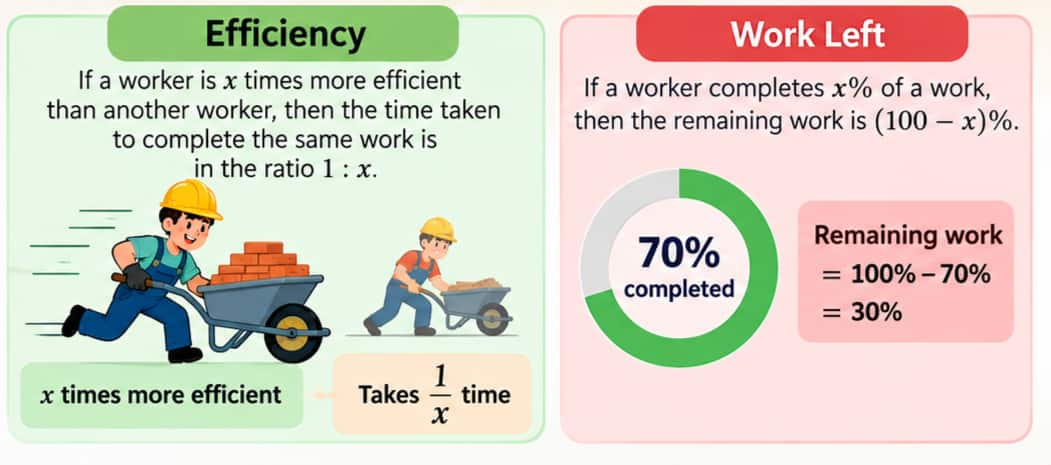
Efficiency and time are inversely proportional. Therefore, if A takes 10 days and B takes 20 days:
Efficiency A: Efficiency B=20:10=2:1$
So, A is twice as efficient as B.
For work and wages: $Wages \propto Efficiency \times Time$
Thus, wages depend on both how efficiently and how long a person works.

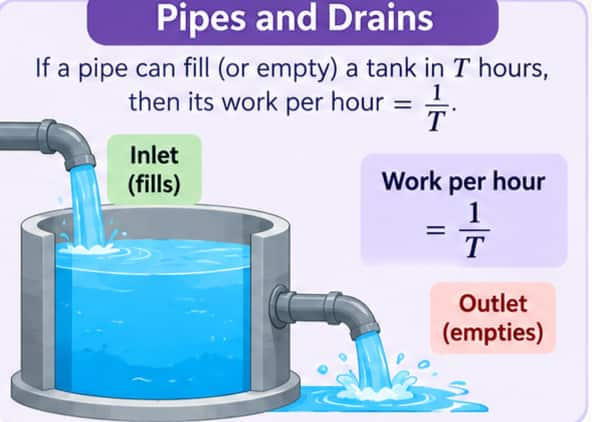
Pipes and Cisterns follow exactly the same work-rate principle as Time and Work. The difference is that a filling pipe adds water, while an outlet removes it.
A pipe that fills a tank in $x$ hours has a rate of: 1x
A pipe that empties a tank in $y$ hours has a rate of: -1y
Therefore, when both operate together: $Net\ Rate=\frac{1}{x}-\frac{1}{y}$
For example, a pipe fills a tank in 8 hours and an outlet empties it in 12 hours.
The net rate is: 18-112=124
Hence, the tank will take 24 hours to fill.
The quickest way to handle these questions is to assign positive rates to inlet pipes and negative rates to outlets.
If a tank has three pipes with rates: 110,115,-130
the net rate becomes: 110+115-130=215
Therefore, the tank takes: 152=7.5 hours.
The key is to focus on the rate rather than the amount of water mentioned in the question.
Get a slot-wise CAT 2025 weightage analysis to understand how questions were distributed across sections and topics. Use the data to identify important CAT topics and make a more targeted CAT 2026 preparation strategy.
CAT Time and Work questions can appear straightforward but often combine two concepts. A worker may start alone, another may join later, or the efficiency of a worker may change midway.
The most important patterns to practise are shown below.
Question Type | Concept Tested | Recommended Method |
Two workers together | Combined efficiency | LCM/rate method |
Worker joins midway | Remaining work | Stage-wise calculation |
Worker leaves midway | Remaining work | Work completed first |
Efficiency changes | Efficiency ratio | Percentage conversion |
Pipes and outlets | Net rate | Positive/negative rates |
Alternate-day work | Daily contribution | Day-wise calculation |
Work and wages | Work done | Efficiency × Time |
Men and days | Constant total work | Men × Days |
These patterns should form the core of CAT 2026 Time and Work practice.
The following 15 questions provide a focused practice set covering workers, efficiency, Pipes and Cisterns, wages, alternate-day work and changing work conditions.
Question 1: A and B together can complete a piece of work in 12 days, while B and C together can complete it in 15 days. A works alone for 6 days, after which B joins A. After another 4 days, C replaces A. If the entire work is completed in 18 days, in how many days can C alone complete the work?
24 days
30 days
36 days
45 days
Question 2: A, B and C can independently complete a task in 24, 36 and 48 days respectively. They start working together, but after every 4 days, the efficiency of A increases by 25%, while the efficiencies of B and C remain unchanged.
If the task is completed exactly at the end of the 12th day, what fraction of the total work was completed by A during the last 4 days?
18
524
14
724
Question 3: A and B work on alternate days, starting with A. A can complete the work alone in 20 days, while B can complete it alone in 30 days. However, after every second day of work, A's efficiency increases by 20% compared with its efficiency during the previous working day, while B's efficiency remains unchanged.
If the work is completed during A's $n$th working day, find the smallest possible value of $n$.
5
6
7
8
Question 4: Pipe A can fill a tank in 12 hours, Pipe B can fill it in 18 hours, and Pipe C can empty it in 24 hours. A and B are opened together for 3 hours. C is then opened while B is closed. After another 4 hours, B is reopened and C is closed.
How many more hours are required to fill the remaining tank?
115
135
3
165
Question 5: A group of men can complete a project in 24 days. If 8 additional men join the group, the project is completed 6 days earlier. However, if the efficiency of every original worker decreases by 20%, the original group requires 30 days to complete the project.
How many men were originally in the group?
24
28
32
36
Question 6: A takes 40% more time than B to complete a task. B and C together can complete the task in 12 days, while A and C together can complete it in 15 days.
If A works alone for 6 days and then B and C work together until the task is completed, how many days in total are required?
14 days
15 days
16 days
18 days
Question 7: A, B and C undertake a project. A works for 12 days, B for 15 days and C for 20 days. Their daily efficiencies are in the ratio 5:4:3, respectively.
However, A receives 20% more wage per unit of work than B, while C receives 10% less wage per unit of work than B.
If the total amount paid for the project is ₹1,20,000, what is the amount received by B?
₹36,000
₹40,000
₹42,000
₹45,000
Question 8: 8 men and 12 women can complete a piece of work in 15 days. The efficiency of a man is twice that of a woman.
After 5 days, 4 men and 6 women leave the project. The remaining work is completed by the workers left behind in another 15 days.
If the same work had instead been completed by only women, how many women would have been required to finish it in 20 days?
24
27
30
32
Question 9: Pipe A fills a tank in 16 hours and Pipe B fills it in 24 hours. When both are opened simultaneously, a leak causes the tank to fill 4 hours later than it would have without the leak.
If the tank is initially empty and A, B and the leak are opened together, how long will it take to fill the tank?
16 hours
18 hours
20 hours
22 hours
Question 10: A, B and C can complete a task individually in 18, 24 and 36 days respectively.
A and B start the work together. After 3 days, A leaves and C joins B. After another 4 days, B leaves and A rejoins C. The work is completed 5 days later.
If A's efficiency is increased by 50% from the day A rejoins C, what was the original ratio of the work completed by A during the first 3 days to the work completed by C during the final 5 days?
3:5
4:7
5:8
7:10
Strengthen your CAT Time and Work preparation with 30 carefully selected CAT-level practice questions covering workers, efficiency, pipes and drains, and changing work rates. The ebook includes step-by-step solutions to improve calculation speed, accuracy and problem-solving skills.
Practice with CAT Time and Work PYQs to strengthen your understanding of one of the important Arithmetic topics in CAT Quantitative Aptitude. The resource provides previous-year questions to help you identify recurring question patterns, improve calculation speed, and develop an exam-oriented approach to solving Time and Work problems.
Time and Work questions often become difficult because of incorrect interpretation rather than difficult mathematics.
If A takes 10 days and B takes 20 days, their combined time is not 30 days. Their rates must be added.
If one worker takes half the time taken by another, the first worker is twice as efficient.
A filling pipe contributes positively, while an outlet contributes negatively.
If a worker leaves midway, first calculate how much work has already been completed.
If A is 50% more efficient than B, the efficiency ratio is: A: B=150:100=3:2$
Converting percentages into ratios often makes CAT calculations faster.
Time and Work should be prepared as part of the broader Arithmetic block rather than as an isolated chapter. The concepts overlap strongly with Ratio and Proportion, Percentages and Pipes and Cisterns.
A focused preparation sequence is:
Learn work-rate and efficiency basics.
Practise LCM-based Time and Work questions.
Move to workers joining and leaving.
Practise efficiency and work-wage questions.
Add alternate-day problems.
Learn Pipes and Cisterns using positive and negative rates.
Solve CAT PYQs under a time limit.
Maintain an error log for conceptual and calculation mistakes.
Reattempt incorrect questions without checking the solution first.
The objective should be to identify the correct rate relationship within a few seconds and then perform only the necessary calculation.
Test your preparation with a CAT 2026 Free Mock Test and experience a structured CAT practice environment. Use your mock performance to evaluate speed, accuracy, time management and section-wise preparation before the CAT exam.
A quick CAT formula revision sheet can help consolidate the formulas before a mock test or CAT Quant revision session.
Concept | Formula |
One-day work | 1/x |
Combined work | Sum of individual work rates |
Two-worker time | xyx+y |
Efficiency ratio | Inverse ratio of completion times |
Filling pipe rate | 1/x |
Emptying pipe rate | -1/x |
Net pipe rate | Filling rate − Emptying rate |
Total work | Efficiency × Time |
Wages | Proportional to work done |
Men-days | Men × Days, when efficiency is equal |
Practise CAT Quantitative Aptitude PYQs from 2021 to 2025 with this comprehensive question bank designed to help aspirants understand recurring question patterns and strengthen CAT Quant preparation.
Download CAT Quant PYQs: 2021-2025
Practise with the CAT 2026 Sample Paper for quant to familiarise yourself with CAT-level Quantitative Aptitude questions and assess your preparation. It can help improve question selection, calculation speed, accuracy and exam readiness.
Time and Work becomes much easier when every question is converted into an efficiency or work-rate problem. For CAT 2026, candidates should prioritise combined work, changing efficiency, workers joining or leaving, Pipes and Cisterns, alternate-day work and PYQs. Regular timed practice can turn lengthy-looking Arithmetic questions into short calculations based on a few core relationships.

On Question asked by student community
Hi Khushdeep
Several apps and online platforms are available for CAT (Common Admission Test) preparation. Students can choose a platform based on their preparation needs, such as video lectures, practice questions, mock tests, and performance analysis.
Hello, for AP NEET PG Category C seats, NRI documents are generally required if you are applying under the NRI quota, and eligibility depends on the applicable counselling rules. The fee payment currency and procedure should be confirmed from the current Dr. NTRUHS notification at its official website drntr.uhsap.in.
Hello, CAT aur B-school entrance exams ke baare mein aap exam dates, eligibility, registration, exam pattern, syllabus, colleges ya admission process ki information dekh sakte hain. Aapki requirement ke according relevant details yahan mil sakti hain: https://bschool.careers360.com/exams
You can download the latest CAT syllabus from here:
Hey there,
For a B.Sc. with Chemistry, Botany and Zoology (CBZ), if the CAT application asks separately for:
If the Discipline dropdown has a more specific option such as “Biological Sciences,” “Life Sciences,” or “Zoology/Botany,”
Directions for question:
The bar-graph given below shows the foreign exchange reserves of Nepal (in million Rupees) from 2014 to 2021. Answer the following questions based on the graph :

Question:
What was the percentage increase (rounded to the nearest integer, if deemed necessary) in the foreign exchange reserves in

Globally Recognized by AACSB (US) & AMBA (UK) | 18 LPA Avg. CTC for PGPM 2026
Register for XAT 2027 by 28th Oct to become eligible to take the Mock Test | 75+ years of legacy | #1 Entrance Test | 100+ Test Cities | 250+ B-Schools accept XAT Score
Highest Package 29.30 LPA | 12 LPA Median CTC | 230+ Recruiters | AACSB Accredited | Ranked 51 in Asia by QS International
Application Deadline: 1st Dec'26 | 400+ Recruiters | Highest CTC 17.2 LPA | Average CTC 8 LPA | 92% Avg. Placements | Awarded Best Business School of the Year
Last Date to Apply - 19th December 2026 | Highest CTC 68.66 LPA | Average CTC 18.08 LPA | Top 25% Average CTC 24.66 LPA
MICAT-I Registrations Closing on 21st Nov'26 | Ranked #33 by NIRF | NBA Accredited | AICTE Approved | Highest CTC 45.67 LPA & Average CTC 20.46 LPA