IBSAT 2026-ICFAI Business School MBA/PGPM 2027
Gateway to IBS Hyderabad & 8 other IBS campuses | Scholarships worth 10 CR


A SNAP mock test is useful only when the analysis reveals what went wrong, where time was lost and which questions should have been skipped. SNAP 2026 will be conducted on December 13, December 19 and December 26, 2026, giving candidates multiple opportunities to apply lessons from mock performance. But how should a 60-question, 60-minute paper actually be reviewed? Read the complete article for a practical SNAP mock analysis method covering attempts, accuracy, time management, section-wise performance and score improvement.

A mock score shows the outcome; detailed analysis explains the reasons behind it. Reviewing every attempted, unattempted and incorrect question helps identify patterns that are difficult to notice while simply taking more mocks.
A useful SNAP mock test analysis should answer five questions:
Which questions consumed too much time?
Which incorrect answers were caused by conceptual gaps?
Which questions could have been solved faster?
Which easy questions were missed?
Which section affected the overall score most?
The purpose is not to take a large number of mocks but to convert each mock into specific preparation actions.
The official SNAP 2026 exam pattern contains 60 questions to be attempted within 60 minutes, with four sections. Each correct answer carries one mark and each incorrect answer attracts a 25% penalty. Candidates can move between sections during the test.
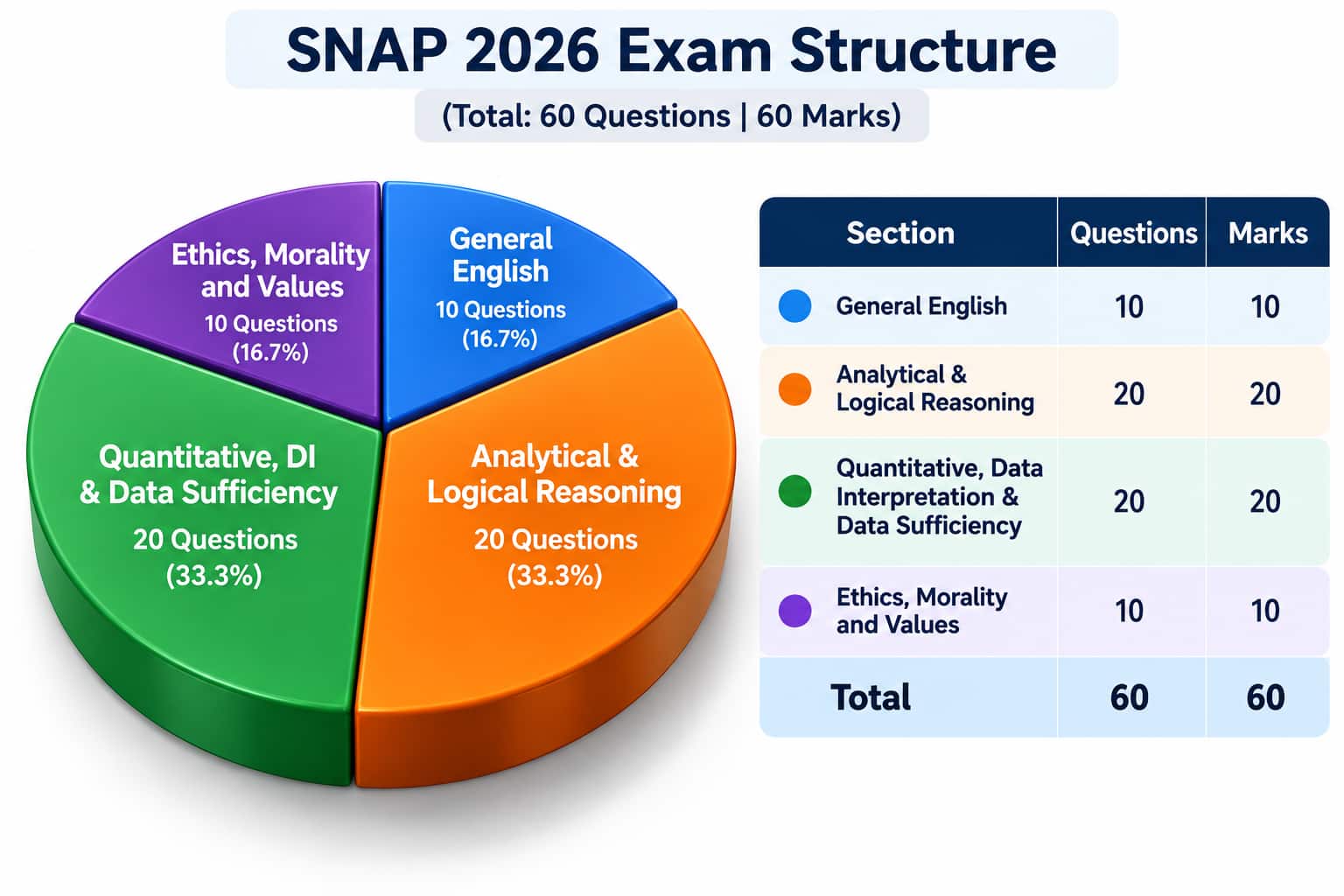
This structure makes question selection particularly important because the average available time is approximately one minute per question.
A systematic review can be divided into four stages: score analysis, question analysis, time analysis and action planning.
Before checking solutions, record the basic numbers from the mock.
Metric | What to Record |
Total score | Final marks after negative marking |
Questions attempted | Total attempted |
Correct answers | Number correct |
Incorrect answers | Number wrong |
Unattempted | Questions left unanswered |
Accuracy | Correct answers ÷ attempted questions |
Time used | Total time taken |
Section-wise score | Marks from each section |
This creates a baseline for future comparison.
Do not analyse only incorrect questions. Every question should be classified.
Category | Meaning | Action |
Correct + Fast | Strong question selection and execution | Maintain |
Correct + Slow | Correct approach but inefficient | Improve speed |
Incorrect + Attempted | Error or conceptual weakness | Identify cause |
Unattempted + Solvable | Missed scoring opportunity | Revisit |
This classification makes the SNAP mock test analysis much more useful than simply checking the answer key.
Accuracy is particularly important because SNAP has negative marking. The official structure awards one mark for a correct answer and deducts 0.25 marks for an incorrect answer.
Instead of looking only at the final score, compare attempts and accuracy.
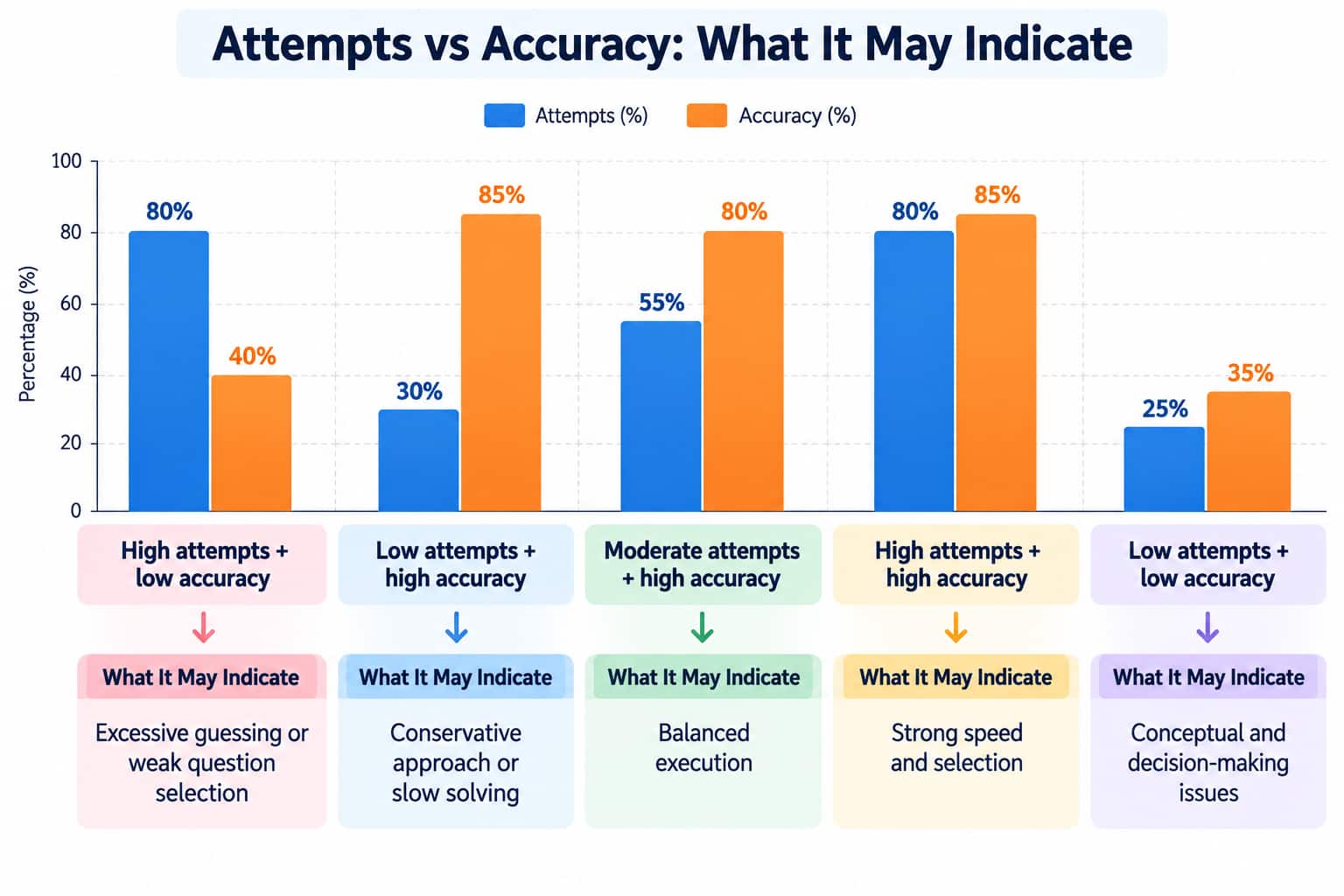
The analysis should then identify whether the problem is knowledge, calculation, comprehension, speed or selection.
Incorrect answers should be divided according to the reason for the error.
The underlying concept was not understood or a formula/rule was forgotten.
Action: Revise the topic and solve additional questions of the same type.
The approach was correct but the final answer was wrong because of arithmetic or calculation mistakes.
Action: Practise calculations and slow down at critical steps.
The question or option was misread.
Action: Highlight keywords mentally and avoid rushing through short questions.
The question looked manageable but consumed too much time or became unnecessarily complicated.
Action: Identify similar questions earlier and learn when to leave them.
The answer was selected without sufficient confidence.
Action: Track unnecessary guesses separately because negative marking can turn marginal attempts into score loss.
Unattempted questions can reveal missed opportunities.
Take every unattempted question and classify it as:
Too difficult
Too time-consuming
Concept not known
Could have been solved with more time
Easy but overlooked
The fourth and fifth categories deserve special attention. If several manageable questions were left because too much time was spent elsewhere, the issue is not necessarily knowledge; it is question selection.
The Quantitative Ability, Data Interpretation & Data Sufficiency section contains 20 questions.
For this section, analysis should go beyond the total score.
Area to Check | Questions to Identify |
Arithmetic | Percentage, ratio, averages, profit and loss, Time, Speed, Distance , time and work |
Algebra | Equations, identities and related concepts |
Number System | Divisibility, remainders and number properties |
Geometry | Basic geometry and measurement |
Tables, graphs and calculation-based sets | |
DS | Statement sufficiency and logical evaluation |
For each wrong or slow question, record the topic and error type. After three or four mocks, repeated weaknesses become much easier to identify.
Logical Reasoning contains 20 questions, making it the largest individual section in the SNAP structure.
Analyse:
Time spent on individual puzzles
Questions solved through direct logic
Questions requiring lengthy arrangements
Incorrect assumptions
Missed easy reasoning questions
Sets that should have been abandoned earlier
If one puzzle consumes several minutes without meaningful progress, the SNAP 2026 Analytical & Logical Reasoning analysis should flag question selection rather than simply marking it as a difficult topic.
General English contains 10 questions, so individual mistakes can have a noticeable effect on section performance.
Review errors under:
Vocabulary
Grammar
Sentence usage
Verbal reasoning
Reading-based questions
Test centres are available in 70+ cities across India | 75,000+ aspirants apply for the NMAT exam | Accepted by 58+ institutions like NMIMS, KJSIM, ISB, SPJIMR and Great Lakes.
Among top 6% B-Schools globally to be accredited by AACSB | Highest Package-35 LPA
Maintain a small error log containing the question type, reason for the mistake and the correct rule or interpretation.
The Ethics, Morality and Values section contains 10 questions in the revised SNAP 2026 structure.
SNAP EMV analysis should focus on the reasoning behind the selected answer rather than memorising an answer pattern.
For each incorrect question, note whether the issue involved:
Ethical principles
Conflict of interest
Integrity
Fairness
Responsibility
Transparency
Professional conduct
Ethical decision-making
Scenario-based questions should be reviewed carefully because two options may appear reasonable while differing in the underlying ethical principle.
Time analysis is one of the most important parts of a SNAP mock test strategy.
Create a simple time log:
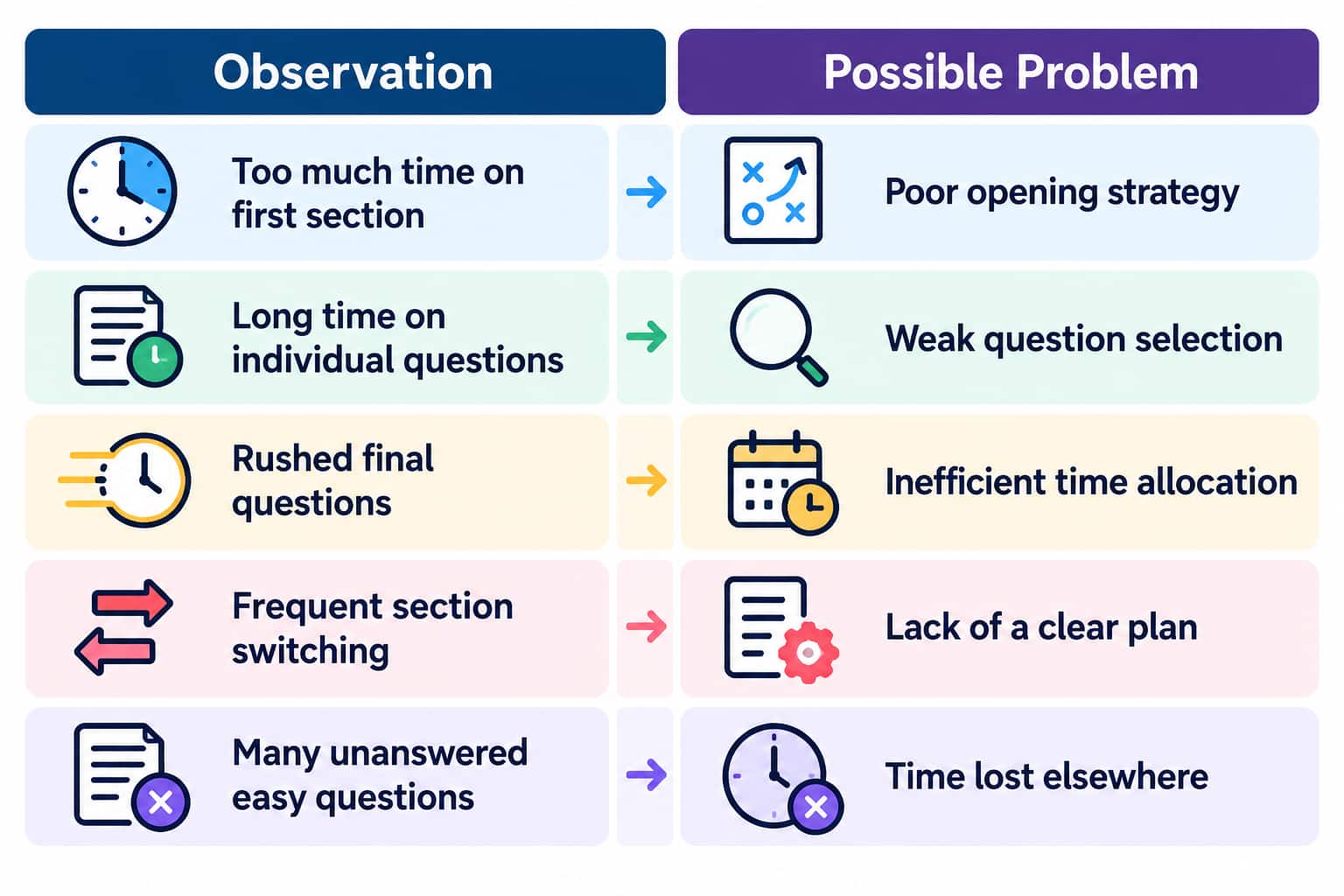
Since candidates can attempt sections in any order, the analysis should determine which sequence produced better performance rather than assuming one fixed order is universally suitable.
Every mock should result in a short action list.
Identify the biggest weaknesses and establish a baseline.
Check whether the first set of corrections actually improved performance.
Compare accuracy, attempts and time allocation rather than only the score.
Track recurring errors and reduce repeated mistakes.
A useful tracker can look like this:
Mock | Score | Attempts | Accuracy | Main Issue | Next Action |
1 | - | - | - | Time management | Practise timed sets |
2 | - | - | - | Arithmetic errors | Calculation practice |
3 | - | - | - | LR selection | Set-selection practice |
4 | - | - | - | EMV accuracy | Revise ethical concepts |
Several common approaches make mock analysis less useful.
Checking only the final score
Reviewing only incorrect answers
Ignoring questions that took too long
Immediately taking another mock without fixing weaknesses
Memorising solutions without understanding the approach
Comparing scores without comparing accuracy and attempts
Repeating the same time-management strategy despite poor results
A mock should function as a diagnostic exercise, not just another test.
A simple review cycle can make analysis easier.
Within 30 minutes: Record score, attempts, accuracy and section-wise performance.
Within 2 hours: Review incorrect and doubtful questions.
Same day: Identify conceptual and calculation gaps.
Next study session: Practise the weak topics through targeted sets.
Before the next mock: Review the previous error log and consciously apply the corrections.
This creates a feedback loop between testing and preparation.
Score improvement should be measured across multiple indicators.
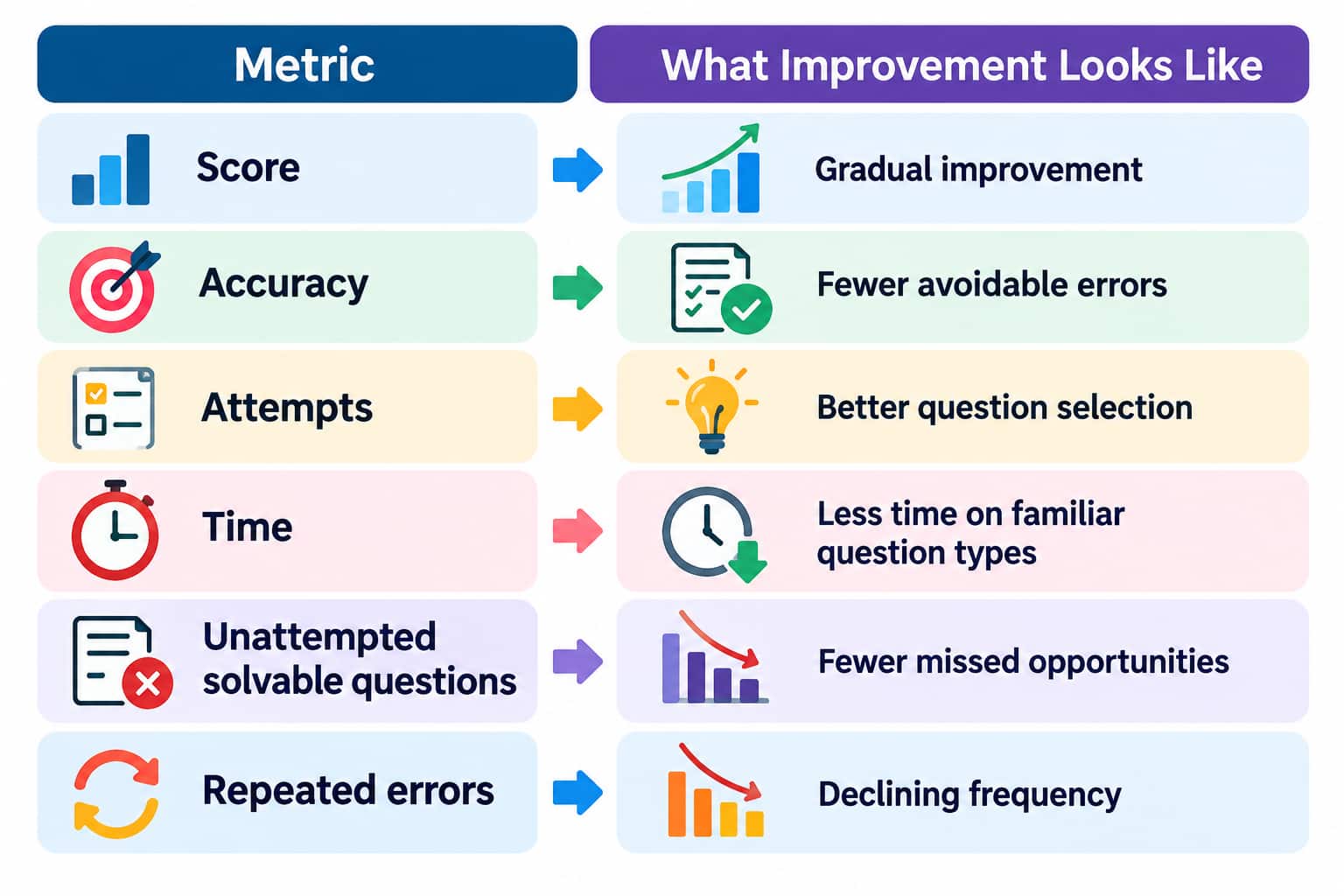
The aim is not necessarily to increase attempts after every mock. A smaller number of better-selected attempts can be more useful than increasing attempts while accuracy falls.
Practise SNAP-style questions in a timed environment and analyse performance to improve speed, accuracy and question selection.
Attempt now: SNAP 2026 Free Mock Test
Before moving to the next mock, check:
Were all incorrect questions categorised?
Were slow questions identified?
Were easy unattempted questions reviewed?
Was section-wise accuracy calculated?
Were repeated topics identified?
Was unnecessary guessing recorded?
Was a specific action plan created?
Were previous errors revised?
Effective SNAP mock analysis goes beyond checking the final score. Tracking accuracy, time management, question selection and recurring errors helps turn every mock into a targeted preparation exercise. With SNAP 2026 scheduled for December 13, 19 and 26, each mock can become an opportunity to refine the strategy before the exam.

On Question asked by student community
You can find all the information here:
CAT- https://www.careers360.com/mba/articles/cat-exam-dates
SNAP- https://www.careers360.com/mba/articles/snap-exam-dates
Dear Student,
SIBM Nagpur SNAP 2025 Cutoff is expected to be on higher side this year, around 93+ percentile if we look at the trends of the previous years. As per the SNAP 2025 score vs percentile, to match the SIBM Nagpur SNAP 2025 cutoff one need to score around
Hi Student
Getting 70 percentile in the SNAP examination is well within the range of SSBF Pune. You can register and apply for admission to the college. Click on the link below to learn more about the admission process, dates, fees, etc.
Hello candidate,
SIBM Pune over the years has been known for its holistic development of students . SIBM Pune courses include MBA, MBA Executive and MBA Innovation and Entrepreneurship programmes in various specialisations.
Symbiosis Centre for Management and Human Resource Development, Pune was established in 1993. Admission to SCMHRD Pune
Yes, you can definitely prepare better for the SNAP Quantitative Ability section by keeping a complete formula list with you. Instead of memorising everything randomly, it helps to organise formulas chapter-wise so you can revise faster.
Here is a useful formula list for the SNAP Quant section:
1. Arithmetic
•

Globally Recognized by AACSB (US) & AMBA (UK) | 18 LPA Avg. CTC for PGPM 2026
Gateway to IBS Hyderabad & 8 other IBS campuses | Scholarships worth 10 CR
Among top 6% B-Schools globally to be accredited by AACSB | Highest Package-35 LPA
Test centres are available in 70+ cities across India | 75,000+ aspirants apply for the NMAT exam | Accepted by 58+ institutions like NMIMS, KJSIM, ISB, SPJIMR and Great Lakes.
400+ Recruiters | Highest CTC 17.2 LPA | Average CTC 8 LPA | 92% Avg. Placements | Ranked as Platinum Institute | Awarded Best Business School of the Year
Application Open | Scholars’ Round Deadline: 14th Nov’26 | Earn upto 50% merit Scholarship + 10% for top performers | EFMD Accredited | AACSB & Business Graduates Association Member | Highest CTC 28 LPA