


Classification of numbers
Classification of numbers is one of the fundamental concepts in mathematics that helps us understand how different types of numbers are organized based on their properties and characteristics. From natural numbers used for counting objects to integers, rational numbers, irrational numbers, and real numbers, number classification forms the foundation of arithmetic, algebra, and higher mathematics. This topic is frequently tested in school examinations as well as competitive exams such as SSC, Banking, CUET, CAT, Railways, Defence, and other quantitative aptitude tests. In this article, we will explore the classification of numbers, different types of number systems, their definitions, properties, examples, formulas, solved questions, and practical applications.
This Story also Contains
- What is Classification of Numbers?
- Number System Overview
- Types of numbers and their classifications
- Prime and Composite Numbers
- Even and Odd Numbers
- Best Books for the Classification of Numbers
- Shortcut Tips and Tricks for Classification of Numbers
- Tips to Identify Number Types Quickly
- Important Formula and Number System Table
- Practice Questions on the Classification of Numbers
- Related Quantitative Aptitude Topics
What is Classification of Numbers?
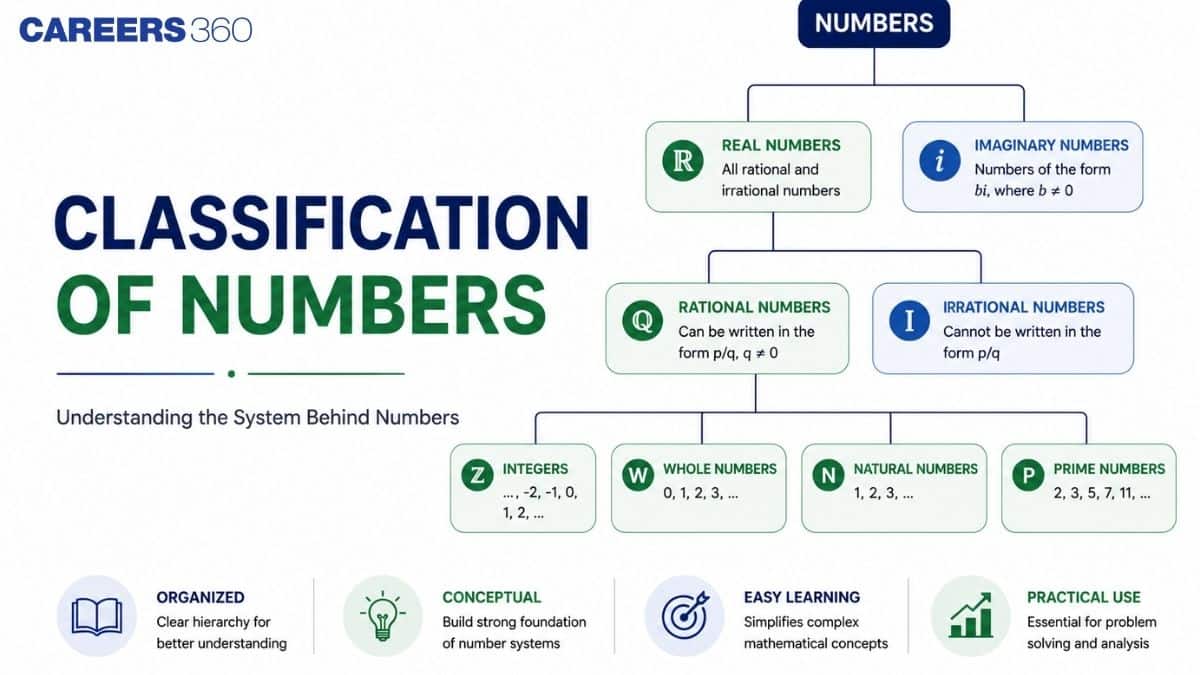
Classification of numbers is the process of grouping numbers into different categories based on their properties, characteristics, and mathematical behavior. The number system includes natural numbers, whole numbers, integers, rational numbers, irrational numbers, real numbers, and complex numbers. Understanding the classification of numbers helps students solve arithmetic, algebra, number system, and quantitative aptitude questions more effectively.
Classification of Numbers Meaning in Simple Words
In simple words, classification of numbers means organizing numbers into different groups according to their characteristics.
For example:
- $1, 2, 3, 4, 5$ are natural numbers.
- $0, 1, 2, 3, 4$ are whole numbers.
- $-3, -2, -1, 0, 1, 2$ are integers.
- $\frac{3}{5}$ and $\frac{7}{2}$ are rational numbers.
- $\sqrt{2}$ and $\pi$ are irrational numbers.
Grouping numbers in this way makes mathematical concepts easier to understand and apply.
Definition of Classification of Numbers
Classification of numbers refers to the systematic arrangement of numbers into various categories based on common mathematical properties.
Each category has its own set of rules and characteristics. For instance:
- Natural numbers are used for counting.
- Integers include positive and negative numbers.
- Rational numbers can be expressed as fractions.
- Irrational numbers cannot be expressed as fractions.
- Real numbers include both rational and irrational numbers.
This classification forms the foundation of the number system in mathematics.
Why Number Classification is Important
Number classification plays a crucial role in mathematics because different types of numbers are used for different purposes.
Importance of Number Classification
- Helps understand the structure of the number system.
- Makes mathematical operations easier to perform.
- Improves problem-solving skills in algebra and arithmetic.
- Forms the basis of higher mathematical concepts.
- Helps identify the properties of different numbers quickly.
- Frequently tested in school exams and competitive examinations.
- Essential for topics such as fractions, surds, percentages, and number theory.
Competitive Exam Relevance
Questions on number classification are commonly asked in:
- SSC CGL
- SSC CHSL
- Banking Exams
- CUET
- CAT
- Railways
- NDA
- CDS
- State PSC Exams
Real-Life Examples of Number Classification
Different categories of numbers are used in everyday life.
| Situation | Type of Number |
|---|---|
| Counting students in a classroom | Natural Numbers |
| Numbering floors in a building | Whole Numbers |
| Temperature below zero | Integers |
| Sharing a pizza into fractions | Rational Numbers |
| Measuring the diagonal of a square | Irrational Numbers |
| Engineering and scientific calculations | Real Numbers |
Examples
- 25 students in a classroom → Natural Number ($25$)
- Ground floor numbered as 0 → Whole Number ($0$)
- Temperature of $-5^\circ C$ → Integer ($-5$)
- Half a cake → Rational Number ($\frac{1}{2}$)
- Diagonal of a unit square → Irrational Number ($\sqrt{2}$)
These examples show how different types of numbers are used in real-world situations.
Number System Overview
A number system is a structured way of representing and classifying numbers. It provides the framework for performing mathematical operations and understanding relationships between different types of numbers.
What is a Number System?
A number system is a collection of numbers organized according to specific rules and properties.
It helps represent quantities, measurements, positions, and mathematical relationships.
The major categories in the number system are:
- Natural Numbers
- Whole Numbers
- Integers
- Rational Numbers
- Irrational Numbers
- Real Numbers
- Complex Numbers
Together, these categories form the complete classification of numbers.
Hierarchy of Numbers
The different types of numbers are related to one another in a hierarchical manner.
The hierarchy is:
Natural Numbers ⊂ Whole Numbers ⊂ Integers ⊂ Rational Numbers ⊂ Real Numbers ⊂ Complex Numbers
This means that every natural number is also a whole number, every whole number is also an integer, and so on.
Example
Consider the number:
$5$
It belongs to:
- Natural Numbers
- Whole Numbers
- Integers
- Rational Numbers
- Real Numbers
Thus, one number can belong to multiple categories simultaneously.
Classification Chart of Numbers
The following table summarises the major classifications within the number system.
| Number Type | Examples |
|---|---|
| Natural Numbers | $1, 2, 3, 4, 5$ |
| Whole Numbers | $0, 1, 2, 3, 4, 5$ |
| Integers | $-3, -2, -1, 0, 1, 2, 3$ |
| Rational Numbers | $\frac{1}{2}, \frac{3}{4}, 5$ |
| Irrational Numbers | $\sqrt{2}, \sqrt{3}, \pi$ |
| Real Numbers | All rational and irrational numbers |
| Complex Numbers | $2+3i,\ 4-5i$ |
This classification chart helps visualize the complete structure of the number system.
Relationship Between Different Types of Numbers
Each category of numbers is connected to other categories through subset relationships.
| Number Category | Relationship |
|---|---|
| Natural Numbers | Subset of Whole Numbers |
| Whole Numbers | Subset of Integers |
| Integers | Subset of Rational Numbers |
| Rational Numbers | Subset of Real Numbers |
| Irrational Numbers | Subset of Real Numbers |
| Real Numbers | Subset of Complex Numbers |
Key Relationships
- Every natural number is a whole number.
- Every whole number is an integer.
- Every integer is a rational number because $n=\frac{n}{1}$.
- Every rational number is a real number.
- Every irrational number is also a real number.
- Real numbers consist of both rational and irrational numbers.
Mathematically,
$\text{Real Numbers}=\text{Rational Numbers}+\text{Irrational Numbers}$
Understanding these relationships is essential for mastering number systems, classification of numbers, and quantitative aptitude concepts.
Types of numbers and their classifications
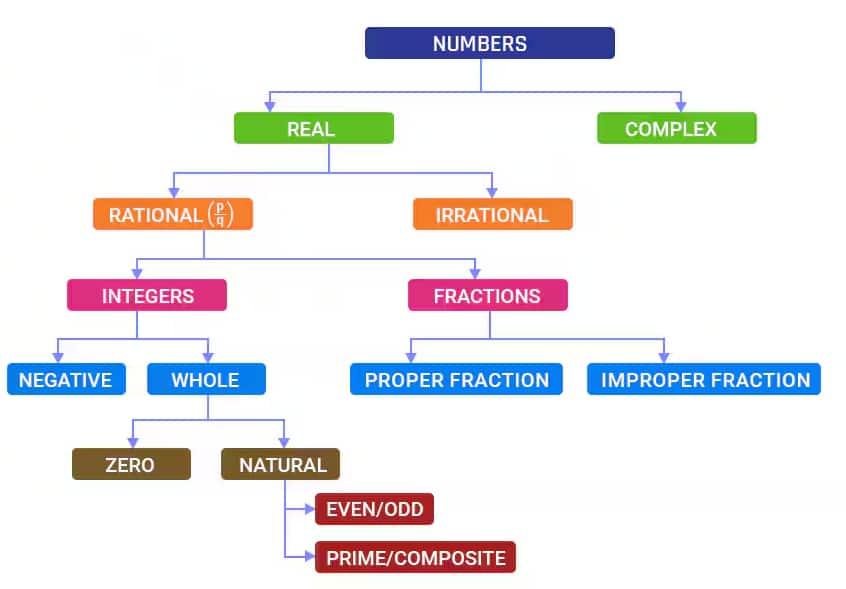
Classification of numbers can be visually represented on a number line, a straight line where each point corresponds to a number. The numbers that are placed on the right side of zero are called positive numbers, while negative numbers are placed on the left side of zero.
Real numbers
Numbers that can be placed on the number line, positive or negative, are called real numbers.
Real numbers are used to solve various problems in our day-to-day lives.
Real numbers can be further classified as
Rational numbers
Irrational numbers
Example:- $1, -1, \pi = 3.14159….,-\frac{1}{2}, \sqrt{3}$
Rational Numbers
A number is called a rational number if it can be expressed as a fraction where the numerator and denominator are integers, and the denominator is not zero.
It is written like $\frac{p}{q}$, where p and q are integers and $q \neq 0$
Rational numbers can be negative or positive.
The sum or product of two rational numbers is rational.
Example: $\frac12,-\frac32,\frac43$, etc.
Irrational Numbers
If a number can not be written as a fraction or ratio, then it is called an Irrational number.
Irrational numbers can be negative or positive.
The sum or product of two irrational numbers is sometimes irrational.
Example: $\pi, \sqrt{3}, \sqrt{\frac{8}{25}},\sqrt{17}$, etc.
Integers
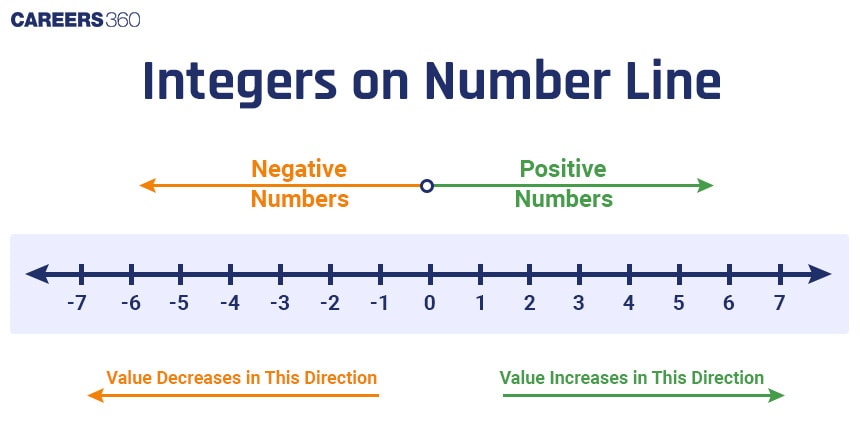
Integers are numbers that have no fractional parts or decimals. It can be negative, positive, or zero.
We can use integers for arithmetic operations like addition, subtraction, multiplication, and division.
All whole numbers are integers.
Example: 0, 7, 9, -3, -55, etc.
Properties of Integers:
Some properties of integers are written below.
Commutative property: Order does not matter if we add or multiply two integers.
- Example: a + b = b + a, where a and b are integers
Closure property: The sum or product of any two integers is always an integer.
- Example: 5 × 6 = 30, which is an integer
Associative property: When we add or multiply three or more integers, how the numbers are grouped does not change the result.
- Example: a + (b + c) = (a + b) + c, where a, b, and c are integers
Distributive Property: Multiplying a sum of two integers by a third integer gives the same result as multiplying each integer separately by the third integer and then adding the products.
- Example: a × (b + c) = (a × b) + (a × c), where a, b, and c are integers
Zero property: If we multiply any integer with zero, the result will be zero.
- Example: 0 × a = 0, where a is an integer
Identity property: If we multiply any integer with 1, we will get the same number back.
- Example: 1 × a = a, where a is an integer
Fractions
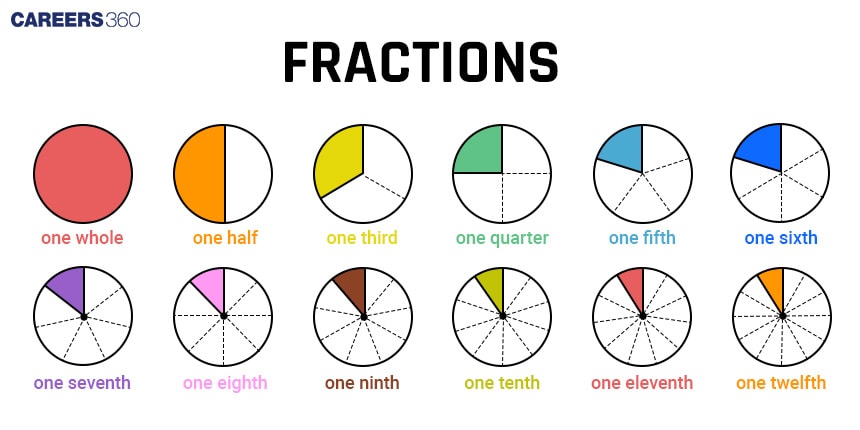
Fractions are numbers that can be written as a ratio or $\frac{p}{q}$ form, $q \neq 0$, and not a whole number.
We can say that every rational number is a fraction. But not every fraction is a rational number.
Because Fractions can be negative.
Example: $\frac{1}{2}, -\frac{3}{2},-\frac{5}{7},$ etc.
Mainly fractions are of 3 types:
Proper fractions: Here, the numerator will be smaller than the denominator.
Example- $\frac{1}{2},\frac{5}{6},\frac{9}{10},$ etc.Improper fractions: Here, the numerator will be greater than the denominator.
Example- $\frac{3}{2},\frac{7}{6},\frac{11}{10},$ etc.
Whole Numbers
Numbers starting from 0 to infinity are called Whole Numbers. So, we can say that including 0, every natural number is a whole number. Whole numbers do not consist of fractions, decimals, or negative numbers.
Example: 0, 10, 11, 20, etc.
Properties of whole numbers:
Some properties of whole numbers are written below.
Commutative property: Order does not matter if we add or multiply two whole numbers.
Example: a + b = b + a, where a and b are whole numbers
Closure property: The sum or product of any two whole numbers is always a whole number.
Example: 5 × 6 = 30, which is a whole number
Associative property: When we add or multiply three or more whole numbers, how the numbers are grouped does not change the result.
Example: a + (b + c) = (a + b) + c, where a, b, and c are whole numbers
Distributive Property: Multiplying a sum of two whole numbers by a third whole number gives the same result as multiplying each whole number separately by the third whole number and then adding the products.
Example: a × (b + c) = (a × b) + (a × c), where a, b, and c are whole numbers
Zero property: If we multiply any whole number with zero, the result will be zero.
Example: 0 × a = 0, where a is a whole number
Identity property: If we multiply any whole number by 1, we will get the same number back.
Example: 1 × a = a, where a is a whole number
Natural Numbers
Numbers starting from 1 to infinity are called natural numbers. These numbers are used for counting purposes and are always positive, greater than zero.
0 is not considered a natural number.
Example: 1, 2, 3, 10, etc.
Properties of natural numbers:
Some properties of natural numbers are written below.
Commutative property: Order does not matter if we add or multiply two natural numbers.
Example: a + b = b + a, where a and b are natural numbers
Closure property: The sum or product of two natural numbers or integers is always a natural number.
Example: 5 × 6 = 30, which is a natural number
Associative property: When we add or multiply three or more natural numbers, how the numbers are grouped does not change the result.
Example: a + (b + c) = (a + b) + c, where a, b, and c are natural numbers
Distributive Property: Multiplying a sum of two natural numbers by a third natural number gives the same result as multiplying each natural number separately by the third natural number and then adding the products.
Example: a × (b + c) = (a × b) + (a × c), where a, b, and c are natural numbers
Zero property: If we multiply any natural number with zero, the result will be zero.
Example: 0 × a = 0, where a is a natural number
Identity property: If we multiply any natural number by 1, we will get the same number back.
Example: 1 × a = a, where a is a natural number
Imaginary Numbers
As the name suggests, Imaginary numbers are not real numbers. If we square a number and get a negative result, then that number is called an Imaginary number.
We define imaginary numbers as i and the value of i2 = -1
Example: Suppose 2i is an imaginary number. Because if we square the number, we will get 4i2, which is equal to -4 as the value of i2 is -1.
Some more examples of imaginary numbers are $\sqrt{-2}, 3 + \sqrt{-25}, \sqrt{-36}$, etc.
Complex Numbers
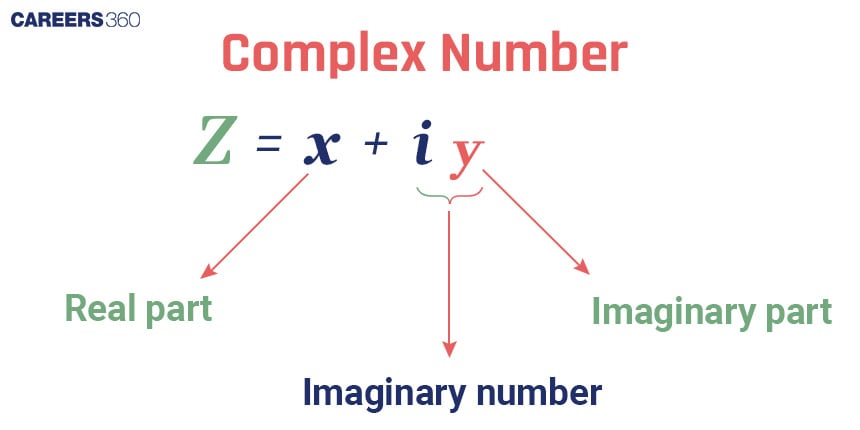
Complex numbers are those non-real numbers that are made by combining real numbers and imaginary numbers.
It can be written as (a + ib), where a and b are real numbers and i is the imaginary number
As we know the value of i2 = -1, so i = $\sqrt{-1}$
Example: $3+6i=3+6 \sqrt{-1}$
The Conjugate of a complex number a + ib is a - ib, where a is the real part, and ib is the imaginary part.
The modulus of a complex number a + ib is given by $\left | a+ib \right |$ which is equal to $\sqrt{a^2 +b^2}$.
Two complex numbers a + ib and c + id can be called equal if a = c and b = d.
The sum of two complex numbers a + ib and c + id is (a + c) + i(b + d).
Similarly, the subtraction of two complex numbers a + ib and c + id is (a - c) + i(b - d).
The product of two complex numbers a + ib and c + id is (ac - bd) + i(ad + bc) as i2 = -1.
Division of two complex numbers a + ib and c + id = $\frac{\left | a+ib \right |}{\left | c+id \right |}=\frac{\left | a+ib \right |\left | c-id \right |}{\left | c+id \right |\left | c-id \right |}=\frac{(ac+bd)+i(bc-ad)}{c^2+d^2}$
Prime and Composite Numbers
A natural number greater than 1 that has no positive divisors other than 1 and itself is called a Prime number. So, we can say that if a number cannot be formed by multiplying two smaller natural numbers, it can be called a Prime number.
Example: 7 is a prime number because it has no divisors other than 1 and itself.
Other examples of odd numbers are 3, 5, 11, 47, etc.
If a natural number greater than 1 has more than two positive divisors is called a Composite number.
Example: 10 is a composite number because it has divisors other than 1 and itself, specifically 2 and 5.
Other examples of composite numbers are 15, 20, 22, 25, etc.
Even and Odd Numbers
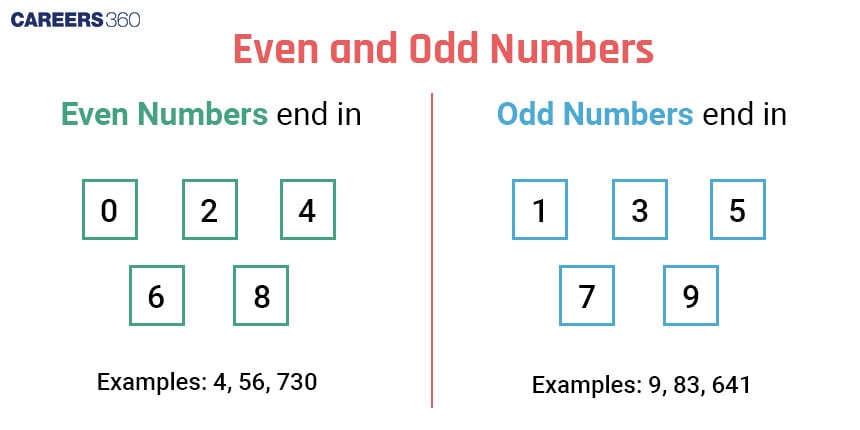
If we divide a number by 2 and get no remainder, then that number is called an Even number.
Even numbers can be negative or positive. But the even numbers can not be decimals or fractions.
Example: 12, 16, 18, -28, -50, etc.
If we divide a number by 2 and there is a remainder equal to 1, then that number is called an Odd number.
Odd numbers are in the form of 2k + 1, where k is an integer
Like even numbers, Odd numbers can be negative or positive but can not be decimals or fractions.
Example: 1, 7, 11, -3, -51, etc.
Best Books for the Classification of Numbers
A strong understanding of the classification of numbers is essential for mastering number systems, arithmetic, algebra, and quantitative aptitude. The following books are highly recommended for learning concepts and solving exam-level questions.
| Book Name | Best For | Why It Helps |
|---|---|---|
| Quantitative Aptitude for Competitive Examinations – R.S. Aggarwal | SSC, Banking, Railways, CUET | Covers number systems and classification concepts with practice questions |
| Fast Track Objective Arithmetic – Rajesh Verma | Competitive Exams | Includes shortcut methods and number system tricks |
| Magical Book on Quicker Maths – M. Tyra | Speed Mathematics | Useful for learning quick calculation techniques |
| NCERT Mathematics Textbooks | School Students | Builds a strong foundation in number systems |
| Objective Arithmetic – Arihant Publications | Exam Preparation | Contains topic-wise questions and detailed explanations |
Shortcut Tips and Tricks for Classification of Numbers
Understanding the relationships between different types of numbers can help classify numbers quickly in examinations.
| Trick | Explanation |
|---|---|
| Every natural number is a whole number | Natural Numbers ⊂ Whole Numbers |
| Every whole number is an integer | Whole Numbers ⊂ Integers |
| Every integer is a rational number | Any integer $n=\frac{n}{1}$ |
| Every rational number is a real number | Rational Numbers ⊂ Real Numbers |
| Irrational numbers are also real numbers | Real Numbers = Rational + Irrational |
| Numbers with terminating decimals are rational | Example: $0.25=\frac{1}{4}$ |
| Numbers with repeating decimals are rational | Example: $0.333...=\frac{1}{3}$ |
| Non-terminating, non-repeating decimals are irrational | Example: $\sqrt{2}$, $\pi$ |
| Perfect square roots are rational | Example: $\sqrt{64}=8$ |
| Non-perfect square roots are irrational | Example: $\sqrt{5}$ |
Tips to Identify Number Types Quickly
These quick rules can help solve number classification questions faster.
| Tip | Example |
|---|---|
| Counting numbers start from 1 | $1,2,3,\ldots$ |
| Whole numbers include 0 | $0,1,2,3,\ldots$ |
| Integers include negative numbers | $-3,-2,-1,0,1,2$ |
| Fractions are rational numbers | $\frac{3}{5}$ |
| Surds are generally irrational numbers | $\sqrt{2},\sqrt{7}$ |
| $\pi$ is always irrational | $\pi=3.14159\ldots$ |
| Rational + Rational = Rational | $\frac{1}{2}+\frac{1}{3}$ |
| Rational × Rational = Rational | $\frac{2}{3}\times\frac{3}{4}$ |
Important Formula and Number System Table
The following formulas and relationships are frequently used in number system and classification of numbers questions.
| Concept | Formula |
|---|---|
| Rational Number | $\frac{p}{q},\ q\ne0$ |
| Integer as Rational Number | $n=\frac{n}{1}$ |
| Square Root Form | $\sqrt{a}=a^{1/2}$ |
| Cube Root Form | $\sqrt[3]{a}=a^{1/3}$ |
| Real Numbers | Rational Numbers + Irrational Numbers |
| Complex Numbers | $a+ib$ |
| Imaginary Unit | $i=\sqrt{-1}$ |
Classification of Numbers Hierarchy
| Number Type | Examples |
|---|---|
| Natural Numbers | $1,2,3,4,5$ |
| Whole Numbers | $0,1,2,3,4,5$ |
| Integers | $-3,-2,-1,0,1,2,3$ |
| Rational Numbers | $\frac{1}{2},\frac{3}{4},5$ |
| Irrational Numbers | $\sqrt{2},\sqrt{3},\pi$ |
| Real Numbers | All rational and irrational numbers |
| Complex Numbers | $2+3i,\ 5-i$ |
Quick Classification Reference Table
| Number | Classification |
|---|---|
| $7$ | Natural, Whole, Integer, Rational, Real |
| $0$ | Whole, Integer, Rational, Real |
| $-8$ | Integer, Rational, Real |
| $\frac{5}{7}$ | Rational, Real |
| $\sqrt{2}$ | Irrational, Real |
| $\pi$ | Irrational, Real |
| $3+2i$ | Complex Number |
These tables provide a quick revision guide for classification of numbers, number systems, natural numbers, whole numbers, integers, rational numbers, irrational numbers, real numbers, and competitive exam preparation.
Practice Questions on the Classification of Numbers
Q1. Use the distributive property to get the value: 24 × 48 + 24 × 50
Answer: Using distributive property, we get,
24 × (48 + 50)
= 24 × 98
= 2352
Hence, the correct answer is 2352.
Q2. Add the given numbers using the associative property: 87 + 113 + 387
Answer: Using associative property, we get,
87 + (113 + 387)
= 87 + 500
= 587
Hence, the correct answer is 587.
Q3. Which is the smallest whole number?
2
B. 1
C. 3
D. 0
Answer: Zero is the smallest whole number.
Hence, the correct answer is option (D).
Q4. Which number is an even number as well as a prime number?
4
2
1
6
Answer: 2 is an even number as well as a prime number.
Hence, the correct answer is option (B).
Q5. Which of the following statements is true?
0 is an odd number.
0 is an even number.
Both statements are true.
None of the above.
Answer: 0 is not an odd number.
If we divide 0 by 2, then we get 0. So no remainder.
Therefore, 0 is an even number.
Hence, the correct answer is option (B).
Q6. Determine if 0.25 is a rational number.
Answer: We can write 0.25 as $\frac{25}{100}=\frac{1}{4}$, which is a fraction.
Hence, 0.25 is a rational number.
Q7. Choose which one is not an irrational number.
$\sqrt{15}$
$\sqrt{36}$
$\sqrt{5}$
$\sqrt{50}$
Answer: Here $\sqrt{36}=6$ which can be written as $\frac{6}{1}$.
So, it is a rational number. The rest of the options can not be written in a fraction form.
So, those are irrational numbers.
Hence, the correct answer is option (B).
Q8. If a = 10 and b = 4, then the value of a × b is even or odd.
Answer: a × b = 10 × 4 = 40, which is an even number,
because if we divide 40 by 2, there is no remainder. Hence, the correct answer is “even”.
Q9. Determine whether 1 is a prime number or a composite number.
Answer: The definition of a prime number says a prime number should only have two divisors, 1 and itself. Also, the definition of a composite number says a composite number should have at least 1 divisor other than 1 and itself.
However, 1 is neither a prime nor a composite number since it has exactly one factor.
Q10. If we subtract 199 from 217, is the result prime or composite?
Answer: 217 - 199 = 18, which is a composite number, as it has divisors 2, 3, and 6, other than 1 and itself. So, 18 has more than 2 factors and hence, it is a composite number. Hence, the correct answer is “Composite”.
Q11. If a = 5 + 8i and b = 3 – i, then find $\frac{a}{b}$.
A. $\frac{23+19i}{10}$
B. $\frac{19+19i}{10}$
C. $\frac{23+19i}{11}$
D. $\frac{23+29i}{10}$
Answer:
We know, $i^2=-1$
Given: a = 5 + 8i and b = 3 – i
$\frac{a}{b}=\frac{5+8i}{3-i}=\frac{(5+8i)(3-i)}{(3-i)(3-i)}=\frac{15+24i-5i-8i^2}{9-i^2}=\frac{23+19i}{10}$
Hence, the correct answer is $\frac{23+19i}{10}$.
Q12. Find the conjugate of x – y if x = 10 + 3i and y = 3 + 2i.
Answer: x – y = 10 + 3i – 3 – 2i = 7 + i
As we know, the conjugate of a complex number a + ib is a - ib.
So, the conjugate of 7 + i is 7 – i.
Hence, the correct answer is 7 – i.
Q13. What is the sum of the following fractions?
$\frac{3}{5},\frac{7}{15},\frac{6}{45}$
A. $\frac{6}{5}$
B. $\frac{5}{6}$
C. $\frac{3}{2}$
D. $\frac{2}{3}$
Answer:
$\frac{3}{5}+\frac{7}{15}+\frac{6}{45}=\frac{27+21+6}{45}=\frac{54}{45}=\frac{6}{5}$
Hence, the correct answer is $\frac{6}{5}$.
Q14. Kushal has a budget of Rs. 200 and wants to buy pens that cost Rs. 3 each and notebooks that cost Rs. 7 each. What are the number of sets of pens and notebooks Kushal can buy within his budget?
A. 20
B. 15
C. 25
D. 10
Answer:
The cost of 1 set of pens and notebooks = Rs. 3 + Rs. 7 = Rs. 10
Therefore in Rs. 200, Kushal can buy $\frac{200}{10}=20$ sets of pens and notebooks.
Hence, the correct answer is 20.
Q15. Simplify the expression $\sqrt3(\sqrt{16}+\sqrt{25})$. Is the result rational or irrational?
Answer:
$\sqrt3(\sqrt{16}+\sqrt{25})=\sqrt{48}+\sqrt{75}=4\sqrt3+5\sqrt3=9\sqrt3$
$9\sqrt3$ is an irrational number.
Hence, the result will be an irrational number.
Related Quantitative Aptitude Topics
Exploring related quantitative aptitude topics can help strengthen your mathematical foundation and improve problem-solving skills. These concepts are commonly asked in competitive exams and are closely connected to number systems, arithmetic, algebra, and logical reasoning.
Frequently Asked Questions (FAQs)
Classification of numbers is the process of grouping numbers into different categories based on their mathematical properties. The major categories include natural numbers, whole numbers, integers, rational numbers, irrational numbers, real numbers, and complex numbers.
A number system is a structured framework used to represent and classify different types of numbers. It helps in performing mathematical operations and understanding relationships between various number categories.
0 is the whole number which is not a natural number. So, all whole numbers are not natural numbers but all the natural numbers are whole numbers.
Imaginary numbers are used in various fields of Mathematics, Physics, computer science, and Engineering.
1. Imaginary numbers are used in quadratic quotations and polynomials.
2. In electrical engineering, complex numbers including imaginary numbers are used in AC circuit analysis to represent voltage and current.
3. Imaginary numbers are also used analysis and processing of signals.
4. In the field of Quantum mechanics imaginary numbers are used.
5. Complex numbers including imaginary numbers are used in computer graphics to rotate and transform objects.
Rational numbers | Irrational numbers |
|
|
| 2. We cannot terminate the decimal expansion. |
| 3. The sum and product of two irrational numbers is sometimes an irrational number. |
| 4. Example: $\pi,0.24444….,\sqrt{2},\sqrt{5}$ |
Yes. Zero can be expressed as:
$\frac{0}{1}$
Therefore, 0 is a rational number.
