


Algebraic Identities: Definition, Questions, Formula, Examples
Ever noticed how quickly you can estimate the cost of something like ₹49 × ₹49 without actually multiplying it the long way? This is where the practical use of (a+b)² and other algebraic identities comes into play in real life. For example, instead of calculating 49² directly, you can think of it as $(50 - 1)^2$ and apply a simple identity to get the answer faster. These small mental shortcuts are not just tricks - they are based on powerful algebraic concepts that help simplify calculations, solve equations, and save time in exams. In mathematics, algebraic identities formulas and examples form the foundation of faster problem-solving, especially in topics like factorisation, expansion, and quadratic equations. In this article on Algebraic Identities: Definition, Questions, Formula, Examples, you will learn what algebraic identities are, understand key formulas like $(a+b)^2$, $(a-b)^2$, and $(a^2-b^2)$, explore solved examples and practice questions, and discover the real-life applications of algebraic identities in maths. We will also cover how this topic is frequently asked in competitive exams such as CBSE Class 9 & 10 exams, CUET, JEE Main, IPMAT, and other aptitude-based tests, where speed and accuracy are crucial.
This Story also Contains
- What are Algebraic Identities in Mathematics? (Definition & Meaning)
- List of Important Algebraic Identities Formulas
- Algebraic Identities of Two Variables (a, b) – Formulas, Examples, and Applications
- Algebraic Identities of Three Variables (a, b, c) – Complete Formula List
- Algebraic Identities Used for Factorisation (Shortcut Methods)
- Proof of Standard Algebraic Identities (Conceptual Understanding)
- Important Algebraic Identities Table (Formulas)
- Application of Algebraic Identities
- How to Solve Questions Using Algebraic Identities Quickly
- Algebraic Identities Tricks, Shortcuts, and Memory Techniques
- Practice Questions/Solved Examples for Algebraic Identities
- Related Quantitative Aptitude Topics
What are Algebraic Identities in Mathematics? (Definition & Meaning)
Algebraic identities are one of the most important building blocks in mathematics, especially when it comes to simplifying expressions and solving problems quickly. Whether you are working on basic algebra or preparing for competitive exams, understanding algebraic identities formulas and examples helps you reduce complex calculations into simple steps. These identities act as powerful shortcuts that improve speed, accuracy, and problem-solving efficiency.
From the practical use of (a+b)² in quick calculations to solving factorisation and expansion questions, algebraic identities are used everywhere in maths. They are not just theoretical formulas but essential tools for mastering topics like polynomials, quadratic equations, and algebraic simplification.
Algebraic Identities Definition with Simple Explanation
Algebraic identities are standard mathematical formulas that are always true for all values of the variables involved. These identities help simplify complex calculations and are widely used in solving algebraic expressions, factorisation, and equations.
In simple terms, an algebraic identity is a rule or shortcut that allows you to expand or simplify expressions quickly without doing lengthy calculations. For example, instead of multiplying $(a+b)(a+b)$ step-by-step, you can directly use the identity $(a+b)^2 = a^2 + 2ab + b^2$.
Key points to understand algebraic identities easily:
- Always true for any value of variables (unlike equations which may have specific solutions)
- Used to simplify algebraic expressions and calculations
- Commonly applied in expansion and factorisation problems
- Form the base of higher-level topics like quadratic equations and polynomials
- Extremely useful in mental maths and quick calculations
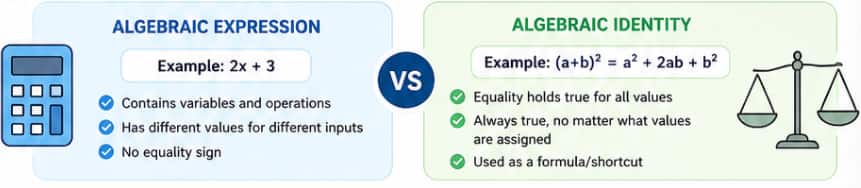
Difference Between Algebraic Expressions and Identities
Many students confuse algebraic expressions with algebraic identities, but they are fundamentally different concepts in mathematics.
Why Algebraic Identities are Important in Maths
Understanding algebraic identities is essential for building a strong foundation in mathematics, especially for exams and real-life problem solving.
Importance of algebraic identities in maths:
- Helps in faster calculations using formulas like $(a+b)^2$ and $(a-b)^2$
- Reduces lengthy multiplication steps through shortcut methods
- Essential for solving algebraic equations and factorisation problems
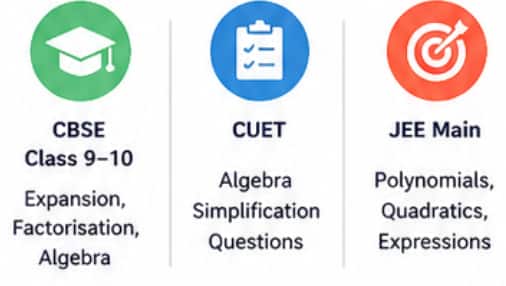
- Improves speed and accuracy in competitive exams like CBSE, CUET, JEE, CAT
- Widely used in simplifying complex expressions in higher mathematics
- Plays a key role in topics like polynomials, quadratic equations, and coordinate geometry
Real-life and exam relevance:
- Useful in mental maths and quick estimations
- Frequently asked in board exams and entrance tests
- Helps in solving questions under time pressure efficiently
This makes algebraic identities not just a theoretical concept, but a practical tool for both academic success and everyday calculations.
List of Important Algebraic Identities Formulas
Algebraic identities formulas are the backbone of algebra. They allow you to simplify expressions, expand brackets, and solve problems much faster than traditional methods. Instead of performing long multiplications repeatedly, these identities give you a direct and reliable shortcut.
A clear understanding of algebraic identities is essential for topics like factorisation, polynomials, quadratic equations, and algebraic simplification. They are also heavily tested in school exams and competitive exams where speed matters.
Basic Algebraic Identities Formula List (a+b)², (a-b)², a²-b²
These are the most fundamental identities that every student must master before moving to advanced algebra.
Key formulas:
- $(a+b)^2 = a^2 + 2ab + b^2$
- $(a-b)^2 = a^2 - 2ab + b^2$
- $a^2 - b^2 = (a-b)(a+b)$
Understanding these identities:
- $(a+b)^2$ represents the square of a sum and includes three terms: square of first term, twice the product, and square of second term
- $(a-b)^2$ is similar but the middle term becomes negative
- $a^2 - b^2$ is called the difference of squares and is used for factorisation
Where they are used:
- Expanding expressions quickly
- Factorising algebraic expressions
- Solving equations efficiently
- Performing fast mental calculations
Why these are important:
- They are the most frequently used identities in mathematics
- Almost every algebra problem depends on them
- They form the base for higher-level identities
Standard Algebraic Identities for Class 8, 9, 10
These identities are part of the school curriculum and are essential for CBSE and other board exams. They extend the basic identities and are used in more complex expressions.
Important formulas:
- $(a+b+c)^2 = a^2 + b^2 + c^2 + 2ab + 2bc + 2ca$
- $(a+b)^3 = a^3 + 3a^2b + 3ab^2 + b^3$
- $(a-b)^3 = a^3 - 3a^2b + 3ab^2 - b^3$
Conceptual understanding:
- These identities deal with three terms or higher powers
- They require careful handling of multiple terms
- Sign management becomes important, especially in $(a-b)^3$
Applications in exams:
- Frequently asked in expansion-based questions
- Used in simplifying long algebraic expressions
- Helpful in solving application-based and word problems
Why students struggle:
- Forgetting coefficients like 3 in cube identities
- Missing terms such as $2bc$ or $2ca$
- Sign errors in subtraction-based identities
Advanced Algebraic Identities Formulas for Competitive Exams
For competitive exams like CUET, JEE Main, and IPMAT, students must apply algebraic identities in more complex and indirect ways. These identities are often used in tricky questions that test conceptual clarity and speed.
Important advanced identities:
- $a^3 + b^3 = (a+b)(a^2 - ab + b^2)$
- $a^3 - b^3 = (a-b)(a^2 + ab + b^2)$
- $(x+a)(x+b) = x^2 + (a+b)x + ab$
Key applications:
- Factorisation of cubic expressions
- Solving higher-degree polynomial equations
- Simplifying algebraic fractions
- Identifying patterns in complex questions
Exam relevance:
- Common in aptitude-based exams
- Used in shortcut methods for faster solving
- Helps reduce lengthy calculations under time pressure
Critical observation:
- These identities are rarely used directly; they are often hidden in question
Algebraic Identities of Two Variables (a, b) – Formulas, Examples, and Applications
Algebraic identities involving two variables are the most commonly used formulas in mathematics. These identities form the foundation of algebra and are widely used in simplification, expansion, factorisation, and solving equations. Understanding these algebraic identities formulas is essential for both school exams and competitive exams.
Important Algebraic Identities of Two Variables
The key algebraic identities involving variables $a$ and $b$ are:
- $(a+b)^2 = a^2 + 2ab + b^2$
- $(a-b)^2 = a^2 - 2ab + b^2$
- $a^2 + b^2 = (a+b)^2 - 2ab = (a-b)^2 + 2ab$
- $a^2 - b^2 = (a+b)(a-b)$
- $(x+a)(x+b) = x^2 + (a+b)x + ab$
- $(a+b)^3 = a^3 + 3a^2b + 3ab^2 + b^3 = a^3 + b^3 + 3ab(a+b)$
- $(a-b)^3 = a^3 - 3a^2b + 3ab^2 - b^3 = a^3 - b^3 - 3ab(a-b)$
- $a^3 + b^3 = (a+b)(a^2 - ab + b^2)$
- $a^3 - b^3 = (a-b)(a^2 + ab + b^2)$
Key insights:
- These identities help in quick expansion and factorisation
- They are heavily used in polynomial and quadratic expressions
- Frequently asked in CBSE, CUET, JEE, and aptitude exams
Algebraic Identities of Three Variables (a, b, c) – Complete Formula List
Algebraic identities with three variables are slightly more advanced and are commonly used in higher-level algebra problems.
Important Identities of Three Variables
- $(a+b+c)^2 = a^2 + b^2 + c^2 + 2ab + 2bc + 2ca$
- $a^2 + b^2 + c^2 = (a+b+c)^2 - 2ab - 2bc - 2ca$
- $a^3 + b^3 + c^3 - 3abc = (a+b+c)(a^2 + b^2 + c^2 - ab - bc - ca)$
- If $a+b+c = 0$, then $a^3 + b^3 + c^3 = 3abc$
Where these are used:
- Simplifying multi-variable algebraic expressions
- Solving higher-order algebra problems
- Frequently used in Olympiad and competitive exams
Algebraic Identities Used for Factorisation (Shortcut Methods)
Algebraic identities play a major role in factorisation, which is essential for solving equations quickly.
Important Factorisation Identities
- $a^2 - b^2 = (a+b)(a-b)$
- $x^2 + (a+b)x + ab = (x+a)(x+b)$
- $a^3 + b^3 = (a+b)(a^2 - ab + b^2)$
- $a^3 - b^3 = (a-b)(a^2 + ab + b^2)$
Why these identities matter:
- Help break complex expressions into simpler factors
- Reduce calculation time significantly
- Essential for solving quadratic and cubic equations
- Widely used in board exams and entrance tests
Proof of Standard Algebraic Identities (Conceptual Understanding)
Understanding the proof of algebraic identities helps build strong conceptual clarity. Instead of memorising formulas blindly, learning their derivation ensures better application in exams.
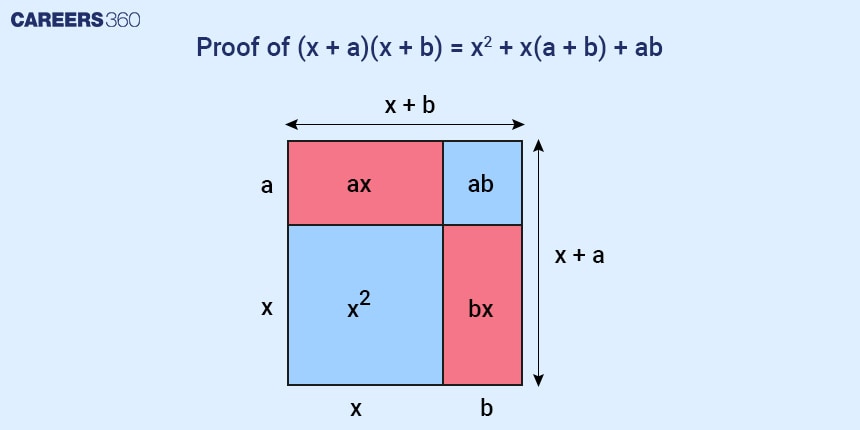
Proof of $(x + a)(x + b) = x^2 + x(a + b) + ab$
This identity can be understood using multiplication:
- Multiply each term:
$x(x+b) + a(x+b)$ - Expand:
$x^2 + xb + ax + ab$ - Combine like terms:
$x^2 + x(a+b) + ab$
Conclusion:
- This identity shows how two linear expressions multiply into a quadratic expression
- Widely used in factorisation and quadratic equations
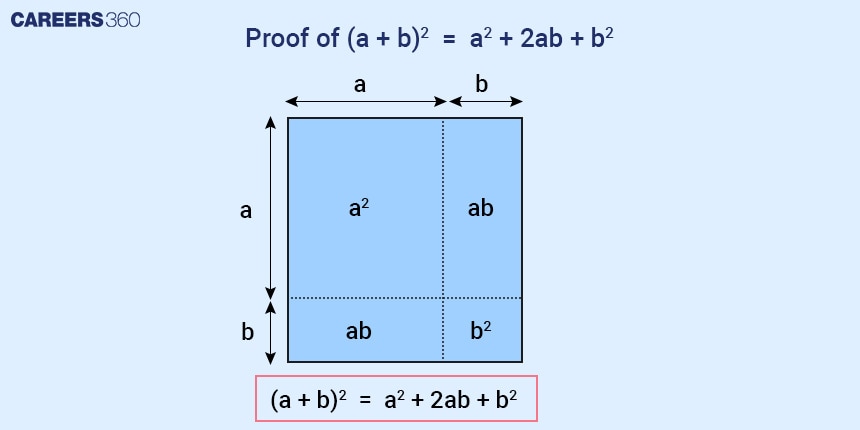
Proof of $(a + b)^2 = a^2 + 2ab + b^2$
Step-by-step expansion:
- $(a+b)(a+b)$
- Multiply each term:
$a(a+b) + b(a+b)$ - Expand:
$a^2 + ab + ab + b^2$ - Combine like terms:
$a^2 + 2ab + b^2$
Key idea:
- The middle term $2ab$ comes from adding $ab + ab$
- This identity is one of the most frequently used in algebra
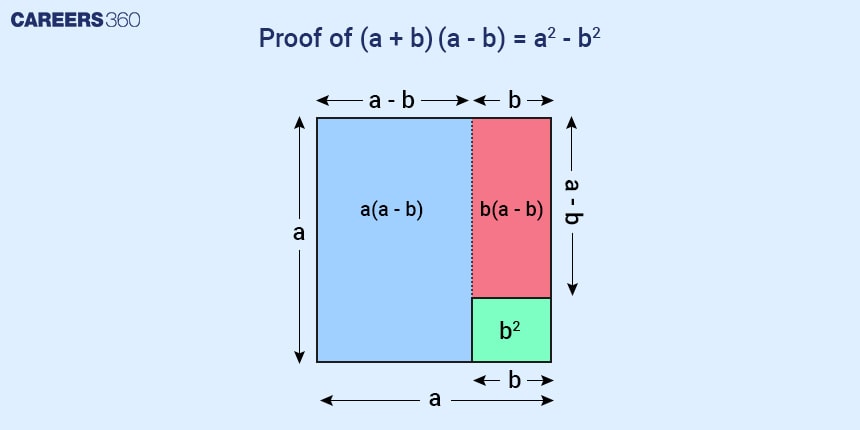
Proof of $(a + b)(a - b) = a^2 - b^2$
Step-by-step expansion:
- $(a+b)(a-b)$
- Multiply:
$a(a-b) + b(a-b)$ - Expand:
$a^2 - ab + ab - b^2$ - Simplify:
$a^2 - b^2$
Key observation:
- The middle terms cancel out
- This is why it is called the difference of squares
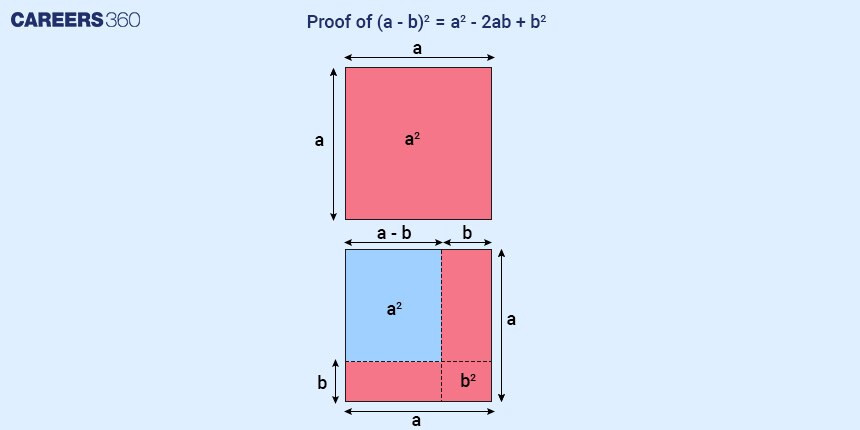
Proof of $(a - b)^2 = a^2 - 2ab + b^2$
Step-by-step expansion:
- $(a-b)(a-b)$
- Multiply:
$a(a-b) - b(a-b)$ - Expand:
$a^2 - ab - ab + b^2$ - Simplify:
$a^2 - 2ab + b^2$
Important point:
- The negative sign affects the middle term
- This is a common area where students make mistakes
Important Algebraic Identities Table (Formulas)
These formulas are essential for exams like CBSE Class 9 and 10, CUET, JEE Main, and IPMAT. Whether you are a beginner or preparing for competitive exams, mastering these identities is crucial. The table below presents all the important algebraic identities formulas in a simple, organised, and exam-focused format.
| Identity Type | Formula | Use Case |
|---|---|---|
| Square of Sum | $(a+b)^2 = a^2 + 2ab + b^2$ | Fast expansion of binomials |
| Square of Difference | $(a-b)^2 = a^2 - 2ab + b^2$ | Handling subtraction expressions |
| Difference of Squares | $a^2 - b^2 = (a+b)(a-b)$ | Quick factorisation |
| Product of Binomials | $(x+a)(x+b) = x^2 + (a+b)x + ab$ | Quadratic formation |
| Cube of Sum | $(a+b)^3 = a^3 + 3a^2b + 3ab^2 + b^3$ | Higher power expansion |
| Cube of Difference | $(a-b)^3 = a^3 - 3a^2b + 3ab^2 - b^3$ | Polynomial simplification |
| Sum of Cubes | $a^3 + b^3 = (a+b)(a^2 - ab + b^2)$ | Factorisation of cubic expressions |
| Difference of Cubes | $a^3 - b^3 = (a-b)(a^2 + ab + b^2)$ | Advanced algebra problems |
| Three Variable Square | $(a+b+c)^2 = a^2 + b^2 + c^2 + 2ab + 2bc + 2ca$ | Multi-variable expressions |
Application of Algebraic Identities
Simplifying Expressions: We can reduce the complexity of algebraic expressions and factorise large polynomials with the help of algebraic identities.
Solving Equations: We can solve quadratic and higher-degree equations by using the identities.
Geometric Calculations: These identities also help us calculate the areas and volumes of geometric shapes easily.
Probability and Statistics: We can derive formulas for variance and standard deviation and also simplify complex expressions using the identities.
Trigonometry: Using these identities we can also simplify trigonometric expressions and prove trigonometric formulas.
Computer Science: We can optimize algorithms and design error-detecting or correcting codes with the help of these identities.
Economics and Finance: We can also derive and simplify formulas for compound interest and solve optimization problems using algebraic identities.
These applications demonstrate the versatility and importance of algebraic identities across various fields.
How to Solve Questions Using Algebraic Identities Quickly
This section focuses on how to solve algebraic identities questions quickly, using structured steps, avoiding common errors, and applying exam-oriented strategies.
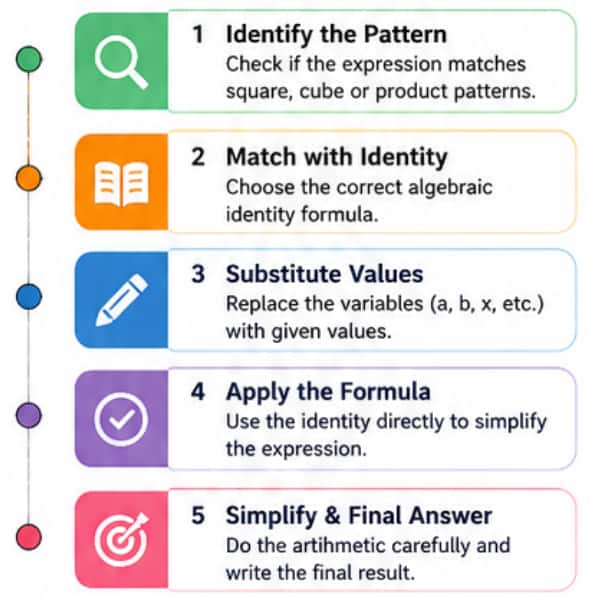
Step-by-Step Method to Apply Algebraic Identities
A systematic approach helps you identify the correct identity and apply it without confusion.
Follow this method:
Practical example: Expand $(2x+7)^2$
- Identify: $(a+b)^2$
- Apply: $(2x)^2 + 2(2x)(7) + 7^2$
- Result: $4x^2 + 28x + 49$
Key takeaway:
- Always recognise the pattern first, then apply the formula
Common Mistakes to Avoid in Algebraic Identities Questions
Even if you know the formulas, small mistakes can lead to wrong answers. These errors are very common in exams.
Most frequent mistakes:
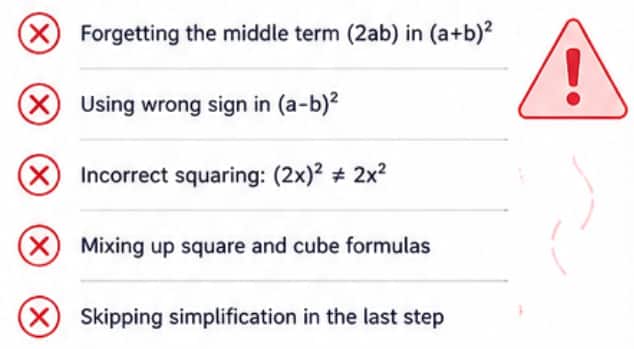
How to avoid these mistakes:
- Revise formulas regularly
- Practice step-by-step solving
- Double-check signs and coefficients
- Verify the final expression
Algebraic Identities Tricks, Shortcuts, and Memory Techniques
Learning algebraic identities is not just about memorisation. Smart tricks and shortcuts can help you remember formulas easily and apply them quickly in exams.
Easy Tricks to Remember Algebraic Identities Formulas
Memorising identities becomes easier when you understand patterns instead of rote learning.
Simple memory techniques:
- Use pattern logic
- $(a+b)^2$ → first square + twice product + second square
- $(a-b)^2$ → same pattern but middle term negative
- Visualise structure
- First term squared
- Middle term as $2ab$
- Last term squared
- Learn in groups
- Square identities together
- Cube identities together
- Factorisation identities together
- Repeat through practice
- Write formulas daily
- Apply them in questions
Quick recall trick:
- Think: square → 3 terms
- Cube → 4 terms
- Difference of squares → 2 terms
Shortcut Methods for Expansion and Factorisation
Shortcuts help reduce calculation time and are extremely useful in exams.
Expansion shortcuts:
- $(a+b)^2$ → directly write $a^2 + 2ab + b^2$
- $(a-b)^2$ → write $a^2 - 2ab + b^2$
- $(a+b)(a-b)$ → write $a^2 - b^2$
Factorisation shortcuts:
- Identify difference of squares
- $x^2 - 16$ → $(x+4)(x-4)$
- Identify quadratic patterns
- $x^2 + 5x + 6$ → $(x+2)(x+3)$
- Recognise cube identities
- $a^3 + b^3$ → factor using standard identity
Key idea:
- Do not expand unnecessarily
- Always check if factorisation is faster
Exam-Oriented Tricks for Faster Problem Solving
In competitive exams, time is limited, so applying algebraic identities efficiently is crucial.
Exam-focused strategies:
- Convert numbers into identity form
- $99^2 = (100-1)^2$
- $101 \times 99 = (100+1)(100-1)$
- Look for hidden identities in questions
- Many questions are designed to test recognition
- Avoid long multiplication
- Always check if an identity can be applied
- Practice high-frequency questions
- Focus on previous year exam patterns
- Use approximation where applicable
- Helps in quick elimination in MCQs
Final takeaway:
- Speed comes from recognising patterns, not from calculation
- Algebraic identities tricks and shortcuts are essential for scoring high in exams like CBSE, CUET, JEE, and IPMAT
Mastering these strategies ensures that you can solve algebraic identities questions quickly, accurately, and with confidence under exam pressure.
Practice Questions/Solved Examples for Algebraic Identities
Q.1 If $x + y = \sqrt{3}$ and $x - y = \sqrt{2}$, the value of $8xy(x^2 + y^2)$ is:
A. $6$
B. $\sqrt{6}$
C. $5$
D. $\sqrt{5}$
Solution:
$x + y = \sqrt{3}$
Square both sides:
$(x+y)^2 = (\sqrt{3})^2$
$x^2 + y^2 + 2xy = 3 \quad ...(i)$
$x - y = \sqrt{2}$
Square both sides:
$(x-y)^2 = (\sqrt{2})^2$
$x^2 + y^2 - 2xy = 2 \quad ...(ii)$
Add (i) and (ii):
$(x^2 + y^2 + 2xy) + (x^2 + y^2 - 2xy) = 3 + 2$
$2x^2 + 2y^2 = 5$
Divide both sides by 2:
$x^2 + y^2 = \frac{5}{2} \quad ...(iii)$
Substitute (iii) into (i):
$\frac{5}{2} + 2xy = 3$
Subtract $\frac{5}{2}$ from both sides:
$2xy = 3 - \frac{5}{2}$
Convert to common denominator:
$3 = \frac{6}{2}$
$2xy = \frac{6}{2} - \frac{5}{2} = \frac{1}{2}$
Divide both sides by 2:
$xy = \frac{1}{4}$
Now evaluate:
$8xy(x^2 + y^2)$
Substitute values:
$= 8 \times \frac{1}{4} \times \frac{5}{2}$
First simplify:
$8 \times \frac{1}{4} = 2$
Now:
$2 \times \frac{5}{2} = 5$
Correct Option: C
Q.2 If $(a+b-6)^2 + a^2 + b^2 + 1 + 2b = 2ab + 2a$, the value of $a$ is:
A. $7$
B. $6$
C. $3.5$
D. $2.5$
Solution:
Given:
$(a+b-6)^2 + a^2 + b^2 + 1 + 2b = 2ab + 2a$
Bring all terms to LHS:
$(a+b-6)^2 + a^2 + b^2 + 1 + 2b - 2ab - 2a = 0$
Now rewrite:
$a^2 + b^2 - 2ab = (a-b)^2$
Group terms:
$(a+b-6)^2 + (a-b-1)^2 = 0$
If sum of squares = 0 → each = 0
$a+b-6 = 0 \Rightarrow a+b=6 \quad ...(i)$
$a-b-1 = 0 \Rightarrow a-b=1 \quad ...(ii)$
Add (i) and (ii):
$a+b + a-b = 6 + 1$
$2a = 7$
$a = \frac{7}{2} = 3.5$
Correct Option: C
Q.3 If $a^2 + 13b^2 + c^2 - 4ab - 6bc = 0$, then $a:b:c$ is:
A. $1:2:3$
B. $2:1:3$
C. $2:3:1$
D. $3:2:1$
Solution:
$a^2 + 13b^2 + c^2 - 4ab - 6bc = 0$
Split $13b^2$:
$a^2 - 4ab + 4b^2 + 9b^2 + c^2 - 6bc = 0$
Group:
$(a^2 - 4ab + 4b^2) + (c^2 - 6bc + 9b^2) = 0$
Write as squares:
$(a-2b)^2 + (c-3b)^2 = 0$
So,
$a-2b=0 \Rightarrow a=2b$
$c-3b=0 \Rightarrow c=3b$
Thus: $a:b:c = 2:1:3$
Correct Option: B
Q.4 If $(a + \frac{1}{a})^2 = 3$, find $a^2 + \frac{1}{a^2}$
Options:
A. $0$
B. $1$
C. $2$
D. $3$
Solution:
Expand: $a^2 + 2 + \frac{1}{a^2} = 3$
$a^2 + \frac{1}{a^2} = 3 - 2 = 1$
Correct Option: B
Q.5 If $(a - 2) + \frac{1}{a + 2} = -1$, find $(a+2)^2 + \frac{1}{(a+2)^2}$
Options:
A. $7$
B. $11$
C. $23$
D. $27$
Solution:
Given equation:
$(a - 2) + \frac{1}{a + 2} = -1$
Add $4$ to both sides:
Left side:
$(a - 2) + 4 = a + 2$
So equation becomes:
$(a + 2) + \frac{1}{a + 2} = -1 + 4$
Right side:
$-1 + 4 = 3$
Thus, $(a + 2) + \frac{1}{a + 2} = 3$
Let $x = a + 2$
Then equation becomes:
$x + \frac{1}{x} = 3$
Square both sides:
$\left(x + \frac{1}{x}\right)^2 = 3^2$
Apply identity:
$(x + \frac{1}{x})^2 = x^2 + \frac{1}{x^2} + 2$
So, $x^2 + \frac{1}{x^2} + 2 = 9$
Subtract 2 from both sides:
$x^2 + \frac{1}{x^2} = 9 - 2$
$x^2 + \frac{1}{x^2} = 7$
Substitute back $x = a + 2$:
$(a+2)^2 + \frac{1}{(a+2)^2} = 7$
Correct Option: A
Q.6 If $a + b = 5$ and $a - b = 3$, find $a^2 + b^2$
Options:
A. $17$
B. $18$
C. $19$
D. $20$
Solution:
Given:
$a + b = 5 \quad ...(i)$
$a - b = 3 \quad ...(ii)$
Add (i) and (ii):
$(a+b) + (a-b) = 5 + 3$
$a + b + a - b = 8$
$2a = 8$
Divide by 2:
$a = 4$
Substitute into (i):
$4 + b = 5$
$b = 5 - 4 = 1$
Find required value:
$a^2 + b^2 = 4^2 + 1^2$
$= 16 + 1 = 17$
Correct Option: A
Q.7 If $a + b + c = 0$, find $a^3 + b^3 + c^3$
Options:
A. $abc$
B. $2abc$
C. $3abc$
D. $0$
Solution:
Use identity:
$a^3 + b^3 + c^3 - 3abc = (a+b+c)(a^2 + b^2 + c^2 - ab - bc - ca)$
Substitute $a + b + c = 0$:
$a^3 + b^3 + c^3 - 3abc = 0 \cdot (a^2 + b^2 + c^2 - ab - bc - ca)$
Right side becomes: $0$
So, $a^3 + b^3 + c^3 - 3abc = 0$
Add $3abc$ to both sides:
$a^3 + b^3 + c^3 = 3abc$
Correct Option: C
Q.8 If $\frac{1}{p} + \frac{1}{q} = \frac{1}{p+q}$, find $p^3 - q^3$
Options:
A. $p-q$
B. $pq$
C. $1$
D. $0$
Solution:
Given:
$\frac{1}{p} + \frac{1}{q} = \frac{1}{p+q}$
Take LHS common denominator:
$\frac{q + p}{pq} = \frac{1}{p+q}$
Cross multiply: $(p+q)^2 = pq$
Expand LHS: $p^2 + q^2 + 2pq = pq$
Bring all terms to one side:
$p^2 + q^2 + 2pq - pq = 0$
$p^2 + q^2 + pq = 0 \quad ...(i)$
Use identity: $p^3 - q^3 = (p-q)(p^2 + q^2 + pq)$
Substitute from (i):
$p^3 - q^3 = (p-q)(0)$
$p^3 - q^3 = 0$
Correct Option: D
Q.9 If the square of the sum of three consecutive natural numbers exceeds the sum of their squares by 292, find the largest number
Options:
A. $5$
B. $6$
C. $3$
D. $8$
Solution:
Let numbers be:
$a = x-1$, $b = x$, $c = x+1$
Given:
$(a+b+c)^2 - (a^2 + b^2 + c^2) = 292$
Use identity:
$(a+b+c)^2 = a^2 + b^2 + c^2 + 2ab + 2bc + 2ca$
Substitute:
$a^2 + b^2 + c^2 + 2ab + 2bc + 2ca - (a^2 + b^2 + c^2) = 292$
Cancel terms:
$2ab + 2bc + 2ca = 292$
Divide by 2:
$ab + bc + ca = 146$
Substitute values:
$x(x-1) + x(x+1) + (x+1)(x-1) = 146$
Expand each term:
$x^2 - x + x^2 + x + x^2 - 1 = 146$
Simplify:
$3x^2 - 1 = 146$
Add 1 both sides:
$3x^2 = 147$
Divide by 3:
$x^2 = 49$
$x = 7$
Largest number = $x + 1 = 8$
Correct Option: D
Q.10 If $x + \frac{1}{x} = \sqrt{3}$, find $x^3 + \frac{1}{x^3}$
Options:
A. $\sqrt{3}$
B. $\frac{1}{\sqrt{3}}$
C. $0$
D. $1$
Solution:
Given:
$x + \frac{1}{x} = \sqrt{3}$
Cube both sides:
$\left(x + \frac{1}{x}\right)^3 = (\sqrt{3})^3$
Apply identity:
$(a+b)^3 = a^3 + b^3 + 3ab(a+b)$
So, $x^3 + \frac{1}{x^3} + 3(x \cdot \frac{1}{x})(x + \frac{1}{x}) = 3\sqrt{3}$
Simplify:
$x \cdot \frac{1}{x} = 1$
So,$x^3 + \frac{1}{x^3} + 3(x + \frac{1}{x}) = 3\sqrt{3}$
Substitute given value:
$x^3 + \frac{1}{x^3} + 3\sqrt{3} = 3\sqrt{3}$
Subtract $3\sqrt{3}$ from both sides:
$x^3 + \frac{1}{x^3} = 0$
Correct Option: C
Related Quantitative Aptitude Topics
To strengthen your understanding of algebraic identities, it is important to explore closely related quantitative aptitude topics that build on the same concepts. These topics help improve problem-solving speed and accuracy in exams like CUET, JEE, IPMAT, and other aptitude-based tests.
Frequently Asked Questions (FAQs)
The 12 algebraic identities are:
$(a+b)^2=a^2+2ab+b^2$
$(a-b)^2=a^2-2ab+b^2$
$a^2+b^2=(a+b)^2-2ab=(a-b)^2+2ab$
$a^2-b^2=(a+b)(a-b)$
$(x+a)(x+b)=x^2+(a+b)x+ab$
$(a+b)^3=a^3+3a^2b+3ab^2+b^3=a^3+b^3+3ab(a+b)$
$(a-b)^3=a^3-3a^2b+3ab^2-b^3=a^3-b^3-3ab(a-b)$
$a^3+b^3=(a+b)(a^2-ab+b^2)$
$a^3-b^3=(a-b)(a^2+ab+b^2)$
$(a+b+c)^2=a^2+b^2+c^2+2ab+2bc+2ca$
$a^2+b^2+c^2=(a+b+c)^2-2ab-2bc-2ca$
$a^3+b^3+c^3-3abc=(a+b+c)(a^2+b^2+c^2-ab-bc-ca)$
An algebraic expression is a combination of variables, constants, and operations (addition, subtraction, multiplication, division). Examples include $2x + 3, a^2+5b, m-\frac{n}{2}$ etc.
An algebraic identity is an equation that is true for all values of the variables involved.
For example, $(a+b)^2=a^2+2ab+b^2$, is true for all values of ‘a’ and ‘b’.
The main difference is that algebraic expressions vary with variable inputs, while algebraic identities are universally true.
To learn algebraic identities easily, start by understanding the fundamental principles behind each identity and practice them regularly. Visual aids, such as geometric interpretations, can help in grasping concepts. Break down complex identities into simpler parts and use examples to see how they apply.
No, not every equation is an identity. An identity is an equation that holds true for all values of the variables involved, while a general equation may only be true for specific values.
For example, $x^2-y^2=(x+y)(x-y)$ is an identity but $x^2-16=0$ is not an identity as it only holds true for $x=4$ and $x=-4$
Forgetting the middle term ($2ab$)
Sign errors in $(a-b)^2$
Incorrect squaring of terms
Mixing different identities
