KCC Institute of Legal and Higher Education, Greater Noida
Law Admissions 2026 Open | Avail Merit-Based Scholarships


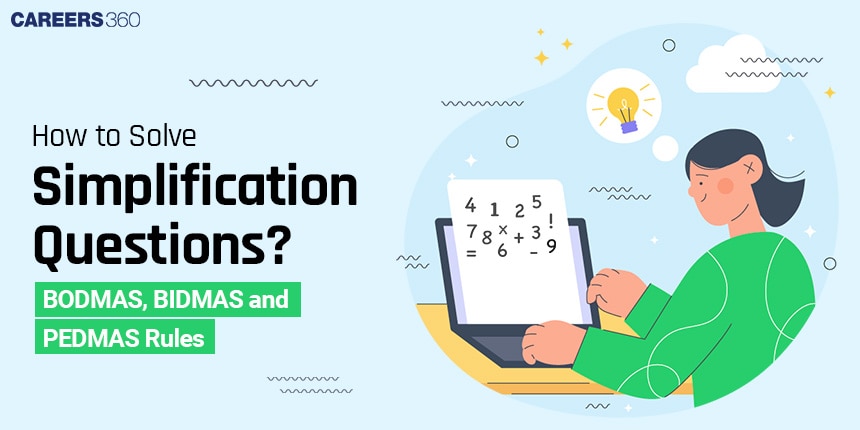
Imagine calculating your shopping bill where you first apply a discount, then multiply by the quantity, and finally add delivery charges. If the steps are done in the wrong order, the final amount becomes incorrect. Mathematics works in the same way, and that is where the BODMAS Rule becomes important. BODMAS stands for Brackets, Orders, Division, Multiplication, Addition, and Subtraction. It is a standard rule used to solve mathematical expressions in the correct sequence. The BODMAS Rule helps students avoid mistakes in simplification questions and is widely used in arithmetic, algebra, and quantitative aptitude. It is an important topic for school mathematics as well as competitive exams like SSC, Banking, NDA, CAT, and other aptitude tests where fast and accurate calculations are required.
This Story also Contains
BODMAS stands for Brackets, Of, Division, Multiplication, Addition, and Subtraction.
BIDMAS stands for Brackets, Indices (which is another term for powers and roots), Division, Multiplication, Addition, and Subtraction.
PEDMAS stands for Parentheses, Exponents(Which are powers or indices), Division, Multiplication, Addition, and Subtraction.
The BODMAS Rule is one of the most important concepts in mathematics and quantitative aptitude. It helps students solve mathematical expressions in the correct order and avoids mistakes in simplification questions. Whether you are preparing for school exams or competitive exams like SSC, Banking, NDA, CAT, or Railways, understanding the BODMAS Rule is essential for fast and accurate problem-solving.
BODMAS is a standard mathematical rule used to decide the correct sequence of operations while solving an expression that contains multiple operators like addition, subtraction, multiplication, division, powers, and brackets.
Without BODMAS, the same expression can give different answers depending on how it is solved. This rule ensures that everyone gets the same correct answer.
The BODMAS Rule states that mathematical operations must be solved in a fixed order:
Solve:
$8 + 2 \times (6 - 3)$
Step 1: Solve bracket first
$(6 - 3) = 3$
Now expression becomes:
$8 + 2 \times 3$
Step 2: Perform multiplication
$2 \times 3 = 6$
Now expression becomes:
$8 + 6$
Step 3: Perform addition
$8 + 6 = 14$
Final Answer = 14
This is a basic example of simplification using the BODMAS Rule.
BODMAS stands for:
| Letter | Meaning |
|---|---|
| B | Brackets |
| O | Orders (powers, roots, exponents) |
| D | Division |
| M | Multiplication |
| A | Addition |
| S | Subtraction |
This order must always be followed while solving arithmetic expressions.
Many students confuse multiplication and division or addition and subtraction, but both should be solved from left to right when they appear together.
The BODMAS Rule is important because it removes confusion in calculations and ensures accuracy.
It helps in:
Law Admissions 2026 Open | Avail Merit-Based Scholarships
BBA/MBA/PGDM Early Bird Applications Deadline 06th Nov'26. Apply now using coupon code CAREER250 and get ₹250 off the application fee
Most simplification questions in exams are directly based on BODMAS.
Learning BODMAS improves both speed and accuracy.
BODMAS is not limited to textbooks—it is used in daily life calculations too.
Suppose you buy 3 items worth ₹200 each and then get a ₹100 discount.
Correct calculation:
$(3 \times 200) - 100 = 500$
Wrong order can give a completely incorrect answer.
Interest calculations, EMI calculations, and discount percentages follow BODMAS.
In aptitude problems involving rates and time, correct order of operations is necessary.
Competitive exam questions on percentages and profit-loss depend heavily on proper simplification.
This makes BODMAS a practical and scoring topic.
To solve simplification questions correctly, students must understand the exact order of operations used in the BODMAS Rule.
Brackets are solved first because they contain the most immediate operations.
Types of brackets include:
$12 - (4 + 2)$
First solve:
$(4 + 2) = 6$
Then:
$12 - 6 = 6$
Orders include:
$3 + 2^3$
First solve power:
$2^3 = 8$
Then:
$3 + 8 = 11$
Division is solved before multiplication if it appears first from left to right.
$20 \div 5 \times 2$
First division:
$20 \div 5 = 4$
Then multiplication:
$4 \times 2 = 8$
Multiplication is performed after division or from left to right if both exist together.
$4 \times 3 + 2$
First multiplication:
$4 \times 3 = 12$
Then addition:
$12 + 2 = 14$
Addition is done after multiplication and division.
$10 + 6 - 2$
Addition and subtraction are solved from left to right.
$10 + 6 = 16$
Subtraction is the final step in most expressions.
$16 - 2 = 14$
Understanding this full order is the key to solving simplification questions correctly.
Following a proper step-by-step method helps avoid mistakes and improves exam performance.
Always begin with the innermost bracket.
Example
$15 - (3 + 2)$
First: $(3 + 2) = 5$
Then: $15 - 5 = 10$
After brackets, solve powers and roots.
Example
$5 + \sqrt{16}$
$\sqrt{16} = 4$
So: $5 + 4 = 9$
Solve division and multiplication from left to right.
Example
$24 \div 6 \times 3$
$24 \div 6 = 4$
$4 \times 3 = 12$
Finally solve addition and subtraction from left to right.
Example
$12 + 8 - 5$
$12 + 8 = 20$
$20 - 5 = 15$
Always recheck:
This step improves accuracy and reduces silly mistakes.
Learning shortcut methods makes simplification much faster in competitive exams.
The standard order is:
$\text{B} \rightarrow \text{O} \rightarrow \text{D} \rightarrow \text{M} \rightarrow \text{A} \rightarrow \text{S}$
This is the most important simplification rule.
Some useful tricks include:
These tricks save time in MCQ-based exams.
Students often make these mistakes:
Avoiding these mistakes can significantly improve scores in aptitude exams.
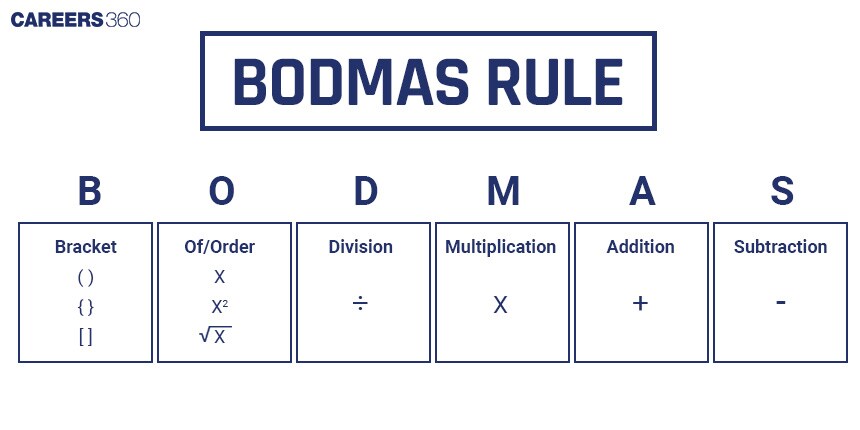
In mathematics, if a symbol is used to group parts of an expression or equation, it is called Brackets.
It indicates that the operations within the brackets should be performed first according to the order of operations.
There are three main types of brackets.
First brackets or parentheses, ()
Second brackets or curly braces, {}
Third brackets or square brackets, []
If an expression has all three brackets in it, then the order of operations should be
first brackets > second brackets > third brackets.
In mathematical expressions, the term "of" means multiplication. So, after completing the operations within brackets, the next step is multiplying the numbers wherever the term "of" appears.
The division is one of the four basic arithmetic operations. It is the process of determining how many times one number is contained within another. It will be done from left to right in the expression.
Multiplication is one of the four basic arithmetic operations. It is the process of repeatedly adding the same number. It will be done from left to right in the expression.
Addition is a fundamental operation of the four basic arithmetic operations. It is the process of getting a total sum by combining two or more numbers. It will be done from left to right in the expression.
Subtraction is a fundamental operation of the four basic arithmetic operations. It is the process of finding the difference between two numbers by removing the value of one number from another. It will be done from left to right in the expression.
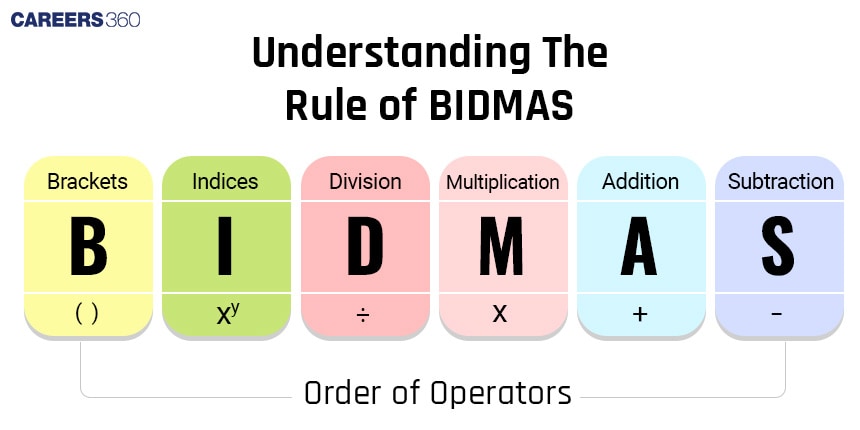
The BIDMAS rule is used to simplify and get the value of an expression if it has brackets, indices, and arithmetic operations like addition, subtraction, multiplication, and division. It helps us to remember which operations to do first.
When faced with a mathematical expression involving multiple types of brackets, indices, and arithmetic operations, knowing which operation to perform first can be challenging. This confusion can lead to incorrect results and wasted time without a clear method.
The BIDMAS rule provides a straightforward approach to handle these expressions systematically.
First, the operations of brackets are done, and then the exponents or roots are evaluated. After that, we will divide and multiply from left to right in that order. Addition comes next and Subtraction at the end. Both these operations should be done from left to right.
In mathematics, if a symbol is used to group parts of an expression or equation, it is called Brackets.
It indicates that the operations within the brackets should be performed first according to the order of operations.
There are three main types of brackets.
First brackets or parentheses, ()
Second brackets or curly braces, {}
Third brackets or square bracket, []
If an expression has all three brackets in it, then the order of operations should be
first brackets > second brackets > third brackets.
Indices or exponents represent the power or roots of numbers and need to be simplified to their standard form.
For example, 22 simplifies to 4, and 52 simplifies to 25.
The division is one of the four basic arithmetic operations. It is the process of determining how many times one number is contained within another. It will be done from left to right in the expression.
Multiplication is one of the four basic arithmetic operations. It is the process of repeatedly adding the same number. It will be done from left to right in the expression.
Addition is a fundamental operation of the four basic arithmetic operations. It is the process of getting a total sum by combining two or more numbers. It will be done from left to right in the expression.
Subtraction is a fundamental operation of the four basic arithmetic operations. It is the process of finding the difference between two numbers by removing the value of one number from another. It will be done from left to right in the expression.
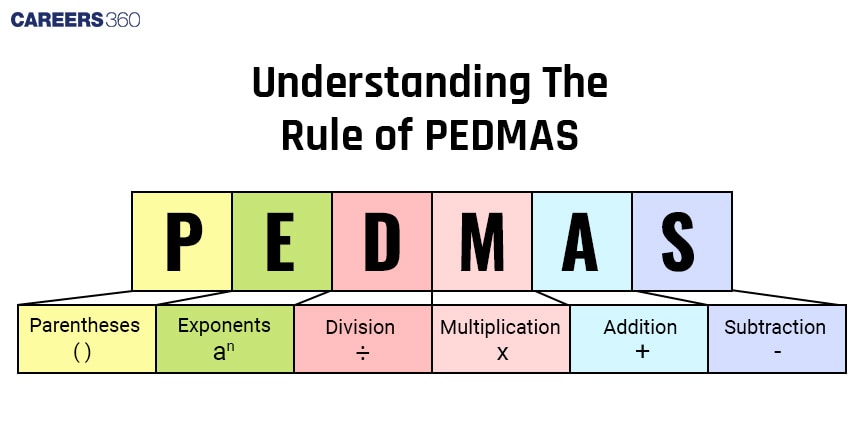
The PEDMAS rule is used to simplify and get the value of an expression if it has parentheses, exponents, and arithmetic operations like addition, subtraction, multiplication, and division. It helps us to remember which operations to do first.
When faced with a mathematical expression involving multiple types of parentheses, exponents, and arithmetic operations, knowing which operation to perform first can be challenging. This confusion can lead to incorrect results and wasted time without a clear method.
The PEDMAS rule provides a straightforward approach to handle these expressions systematically.
First, do the operations of parentheses, and then evaluate the exponents or roots. After that, we will divide and multiply from left to right in that order. Addition comes next and Subtraction at the end. Both these operations should be done from left to right.
Parentheses generally mean the Brackets “()”. But in mathematical expressions, we also have to evaluate other grouping symbols like square brackets “[]” and curly braces “{}”.
Exponents represent the power or roots of numbers and need to be simplified to their standard form.
For example, 22 simplifies to 4, and 52 simplifies to 25.
The division is one of the four basic arithmetic operations. It is the process of determining how many times one number is contained within another. It will be done from left to right in the expression.
Multiplication is one of the four basic arithmetic operations. It is the process of repeatedly adding the same number. It will be done from left to right in the expression.
Addition is a fundamental operation of the four basic arithmetic operations. It is the process of getting a total sum by combining two or more numbers. It will be done from left to right in the expression.
Subtraction is a fundamental operation of the four basic arithmetic operations. It is the process of finding the difference between two numbers by removing the value of one number from another. It will be done from left to right in the expression.
Many students get confused between BODMAS and PEMDAS because both are used to solve mathematical expressions in the correct order. The good news is that both rules follow the same basic principle—the correct sequence of operations in simplification. The only difference lies in the terminology used in different countries.
Understanding the difference between BODMAS and PEMDAS is important for school mathematics, quantitative aptitude, and competitive exam preparation.
BODMAS and PEMDAS are both rules of order of operations used to solve arithmetic and algebraic expressions correctly.
BODMAS stands for:
PEMDAS stands for:
Although the names are slightly different, both rules are based on the same logic.
In BODMAS, the word “Brackets” is used, while PEMDAS uses “Parentheses.”
Similarly, BODMAS uses “Orders” for powers and roots, while PEMDAS uses “Exponents.”
The mathematical process remains the same.
Example
Solve:
$12 - 2 \times (3 + 1)$
Using BODMAS:
Step 1: Bracket first
$(3 + 1) = 4$
Step 2: Multiplication
$2 \times 4 = 8$
Step 3: Subtraction
$12 - 8 = 4$
Using PEMDAS, the answer will also be exactly the same.
This proves that both systems give the same final result.
In India, the BODMAS Rule is the standard method taught in schools and used in competitive exams.
Most textbooks, school exams, CBSE, ICSE, and government exam preparation materials follow BODMAS.
Exams like:
mainly use the BODMAS Rule for simplification questions.
PEMDAS is more commonly used in countries like the United States.
Students preparing for Indian exams should focus mainly on BODMAS.
Both BODMAS and PEMDAS help in solving expressions correctly by following operator priority.
The main similarities are:
This means there is no mathematical conflict between them.
The differences are mainly in naming conventions.
| BODMAS | PEMDAS |
|---|---|
| Brackets | Parentheses |
| Orders | Exponents |
| Division before Multiplication (same priority, left to right) | Multiplication before Division (same priority, left to right) |
| Common in India and UK | Common in USA |
Many students wrongly think PEMDAS means multiplication must always be done before division. This is incorrect.
Multiplication and division have equal priority and must be solved from left to right.
The same rule applies to addition and subtraction.
Example
Solve:
$20 \div 5 \times 2$
Correct method:
$20 \div 5 = 4$
Then:
$4 \times 2 = 8$
Not:
$5 \times 2 = 10$ first
This is a very common mistake in competitive exams.
Understanding these similarities and differences helps students solve simplification questions more accurately and avoid confusion between BODMAS and PEMDAS.
What is the value of 2160 × 3 ÷ 144 + 13 - 2?
Simplification questions are very common in quantitative aptitude and are asked in exams like SSC, Banking, NDA, Railways, CAT, and other competitive exams. The key to solving these questions quickly is not just knowing formulas, but also applying smart tricks and shortcut methods.
The first and most important rule in simplification is understanding operator priority.
Always remember the BODMAS order:
$\text{Brackets} \rightarrow \text{Orders} \rightarrow \text{Division} \rightarrow \text{Multiplication} \rightarrow \text{Addition} \rightarrow \text{Subtraction}$
If this order is ignored, the final answer becomes incorrect.
Example
$12 + 6 \times 2$
Correct method:
$6 \times 2 = 12$
Then:
$12 + 12 = 24$
Wrong method:
$(12 + 6) \times 2 = 36$
This is why operator priority is extremely important.
Fast simplification depends heavily on mental maths.
Students should practice:
This reduces dependency on rough work and improves speed.
Example
Instead of writing:
$25%$ of $400$
Quickly think:
$\frac{25}{100} \times 400 = 100$
Mental calculation saves valuable exam time.
Brackets should always be solved from inner to outer order.
When removing brackets, sign changes must be handled carefully.
Example
$10 - (3 - 2)$
First solve inside bracket:
$(3 - 2) = 1$
Then:
$10 - 1 = 9$
If signs are handled incorrectly, the answer becomes wrong.
This is one of the most common mistakes in simplification questions.
Using shortcut methods helps solve aptitude questions faster.
Useful shortcuts include:
Example
$\frac{48}{12} \times 5$
Quick method:
$48 \div 12 = 4$
Then:
$4 \times 5 = 20$
Shortcuts improve both speed and confidence.
Apart from BODMAS, several additional rules are important for solving simplification questions in aptitude exams.
Fractions and decimals are common in SSC and Banking exams.
Important rules:
Example
$\frac{3}{4} + \frac{1}{2}$
Convert:
$\frac{1}{2} = \frac{2}{4}$
Then:
$\frac{3}{4} + \frac{2}{4} = \frac{5}{4}$
This method reduces confusion.
Many simplification problems involve percentages and ratios.
Important rules:
$50% = \frac{1}{2}$
$25% = \frac{1}{4}$
$20% = \frac{1}{5}$
$12.5% = \frac{1}{8}$
Example
Find $20%$ of $250$
$= \frac{1}{5} \times 250$
$= 50$
Using direct fraction conversion is much faster than percentage formulas.
Algebraic expressions must also follow BODMAS.
Example
$2x + 3(x + 4)$
First solve bracket multiplication:
$= 2x + 3x + 12$
$= 5x + 12$
Ignoring operator order leads to incorrect answers.
This is very important for algebra-based aptitude questions.
Quick identification of squares and cubes improves exam speed.
Important values to remember:
Squares:
$11^2 = 121$
$12^2 = 144$
$15^2 = 225$
$20^2 = 400$
Cubes:
$2^3 = 8$
$3^3 = 27$
$5^3 = 125$
$10^3 = 1000$
Example
$\sqrt{625} = 25$
$\sqrt[3]{216} = 6$
Memorizing these saves time in competitive exams.
Choosing the right book helps students build strong basics and improve problem-solving speed for simplification questions.
| Book Name | Author / Publisher | Key Features | Best For |
|---|---|---|---|
| Quantitative Aptitude for Competitive Examinations | R.S. Aggarwal | Covers simplification, arithmetic, percentages, fractions, and aptitude basics | SSC, Banking, NDA beginners |
| Fast Track Objective Arithmetic | Rajesh Verma | Shortcut tricks, speed methods, and exam-level simplification practice | SSC CGL, CHSL, Banking |
| Magical Book on Quicker Maths | M. Tyra | Strong focus on mental maths and fast-solving techniques | Speed improvement |
| Objective Arithmetic | S.P. Bakshi | Good for arithmetic concepts and competitive aptitude practice | Banking and government exams |
| How to Prepare for Quantitative Aptitude for CAT | Arun Sharma | Advanced-level aptitude practice including arithmetic simplification | CAT and MBA entrance exams |
| NCERT Mathematics | NCERT | Strong foundation in arithmetic and operator rules | School + basics |
These books are highly useful for mastering BODMAS Rule and simplification techniques.
This quick revision table helps students revise the most important formulas used in simplification and BODMAS-based aptitude questions.
| Concept | Formula | Use Case |
|---|---|---|
| BODMAS Rule | $\text{B} \rightarrow \text{O} \rightarrow \text{D} \rightarrow \text{M} \rightarrow \text{A} \rightarrow \text{S}$ | Correct order of operations |
| Percentage | $x% = \frac{x}{100}$ | Percentage calculations |
| Profit Percentage | $\frac{\text{Profit}}{\text{CP}} \times 100$ | Profit and loss |
| Loss Percentage | $\frac{\text{Loss}}{\text{CP}} \times 100$ | Loss calculation |
| Fraction to Percentage | $\frac{a}{b} \times 100$ | Quick conversion |
| Average | $\frac{\text{Sum of terms}}{\text{Number of terms}}$ | Mean value |
| Square Formula | $(a+b)^2 = a^2 + b^2 + 2ab$ | Algebraic simplification |
| Cube Formula | $(a+b)^3 = a^3 + b^3 + 3ab(a+b)$ | Higher algebra simplification |
| Speed Formula | $\text{Speed} = \frac{\text{Distance}}{\text{Time}}$ | Speed-based simplification |
| Ratio Formula | $\frac{a}{b}$ | Ratio comparison |
These formulas are frequently used in simplification questions for competitive exams and help in fast problem-solving.
Q1. Simplify the following using BODMAS rule:
(16 + 14) ÷ 2 – 12 + 16 × 4 – 28 + 13 (–16 + 13)
6
0
-3
3
Answer:
Given: (16 + 14) ÷ 2 – 12 + 16 × 4 – 28 + 13 (–16 + 13)
Using the BODMAS rule, we get,
= 30 ÷ 2 – 12 + 16 × 4 – 28 + 13 (–3)
= 15 – 12 + 64 – 28 – 39
= 3 + 64 – 67
= 0
Hence, the correct answer is option(B).
Q2. What is the value of $\frac{3}{2} \div \frac{1}{7} \times[(\frac{1}{2} - \frac{1}{3}) \div \frac{1}{42}]?$
$72 \frac{1}{3}$
$73 \frac{1}{2}$
$72 \frac{1}{2}$
$71 \frac{2}{3}$
Answer:
Given: $\frac{3}{2} \div \frac{1}{7} \times[(\frac{1}{2} - \frac{1}{3}) \div \frac{1}{42}]$
Applying the BODMAS rule, we get,
$=\frac{3}{2} \div \frac{1}{7} \times[(\frac{3-2}{6}) \div \frac{1}{42}]$
$=\frac{3}{2} \div \frac{1}{7} \times[\frac{1}{6} \div \frac{1}{42}]$
$=\frac{3}{2} \div \frac{1}{7} \times[\frac{1}{6} \times{42}]$
$=\frac{3}{2} \div \frac{1}{7} \times7$
$=\frac{21}{2}\times 7$
$=\frac{147}{2}$
$=73\frac{1}{2}$
Hence, the correct answer is $73\frac{1}{2}$.
Q3. If $M =\left ( \frac{3}{7} \right ) ÷ \left ( \frac{6}{5} \right ) ×\left ( \frac{2}{3} \right ) + \left ( \frac{1}{5} \right ) ×\left ( \frac{3}{2} \right )$ and $N = \left ( \frac{2}{5} \right ) × \left ( \frac{5}{6} \right ) ÷ \left ( \frac{1}{3} \right ) + \left ( \frac{3}{5} \right ) × \left ( \frac{2}{3} \right ) ÷ \left ( \frac{3}{5} \right )$, then what is the value of $\frac{M}{N}$?
$\frac{207}{560}$
$\frac{339}{1120}$
$\frac{113}{350}$
$\frac{69}{175}$
Answer:
$M =\left (\frac{3}{7}\right) ÷ \left (\frac{6}{5} \right) ×\left (\frac{2}{3} \right) + \left (\frac{1}{5} \right) ×\left (\frac{3}{2}\right)$
$M =\left (\frac{3}{7} \right) × \left (\frac{5}{6} \right) ×\left (\frac{2}{3} \right) + \left (\frac{1}{5} \right) ×\left (\frac{3}{2} \right)$
$M = \frac{5}{21}+\frac{3}{10}$
$M = \frac{113}{210}$
$N = \left (\frac{2}{5} \right) × \left (\frac{5}{6} \right) ÷ \left (\frac{1}{3} \right) + \left (\frac{3}{5} \right) × \left (\frac{2}{3} \right) ÷ \left (\frac{3}{5} \right)$
$N = \left (\frac{2}{5} \right) × \left (\frac{5}{6} \right) ×3+ \left (\frac{3}{5} \right) × \left (\frac{2}{3} \right) × \left (\frac{5}{3} \right)$
$N =1 + \left (\frac{2}{3} \right)$
$N = \left (\frac{5}{3} \right)$
$\frac{M}{N} = \frac{113}{210}×\frac{3}{5} = \frac{113}{350}$
Hence, the correct answer is $\frac{113}{350}$.
Q4. Simplify the following using BODMAS rule:
$\{[(x-5)(x-1)]-[(9 x-5)(9x-1)]\} \div 16x$
$2x(5x-3)$
$-(5x-3)$
$x(5x-3)$
$-6x(5x-3)$
Answer:
Given: $\{[(x-5)(x-1)]-[(9 x-5)(9x-1)]\} \div 16x$
$= [(x^{2}-x-5x+5)-[(81x^{2}-9x-45x+5)]\div 16x$
$= [(x^{2}-6x+5)-[(81x^{2}-54x+5)]\div 16x$
$= [(x^{2}-6x+5-81x^{2}+54x-5)]\div 16x$
$= [-80x^{2}+48x]\div 16x$
$=[-5x+3]$
$=-(5x-3)$
Hence, the correct answer is $-(5x-3)$.
Q5. If $\left(2^2+4\right)^2 \times(3-5)+20 \%$ of $400+x \%$ of $30=30 \%$ of $30$, find the value of $x$.
150
120
190
160
Answer:
$\left(2^2+4\right)^2 \times(3-5)+20 \%$ of $400+x \%$ of $30=30 \%$ of $30$
⇒ $(4+4)^2 \times (-2) + \frac{20\times 400}{100} + \frac{30x}{100} = \frac{30\times 30}{100}$
⇒ $8^2 \times (-2) + 80 + 0.3x = 9$
⇒ $-128 + 80 + 0.3 x = 9$
⇒ $-48 + 0.3x = 9$
⇒ $0.3x = 57$
$\therefore x = \frac{570}{3} = 190$
Hence, the correct answer is 190.
Q6. Simplify the following expression.
$\frac{7}{10} \div \frac{3}{7}$ of $\left(2 \frac{3}{10}+2 \frac{3}{5}\right)+\frac{1}{5} \div 1 \frac{2}{5}-\frac{2}{7}$
$-\frac{4}{21}$
$\frac{5}{21}$
$\frac{4}{21}$
$-\frac{5}{21}$
Answer:
$\frac{7}{10} \div \frac{3}{7}$ of $\left(2 \frac{3}{10}+2 \frac{3}{5}\right)+\frac{1}{5} \div 1 \frac{2}{5}-\frac{2}{7}$
Converting mixed fractions to fractions,
= $\frac{7}{10} \div \frac{3}{7}$ of $\left(\frac{23}{10}+\frac{13}{5}\right)+\frac{1}{5} \div \frac{7}{5}-\frac{2}{7}$
Applying BODMAS, we get,
= $\frac{7}{10} \div \frac{3}{7}\ $ of $ (\frac{49}{10})+\frac{1}{5} \div \frac{7}{5}-\frac{2}{7}$
= $\frac{7}{10} \div (\frac{21}{10})+\frac{1}{7}-\frac{2}{7}$
= $\frac{1}{3}-\frac{1}{7}$
= $\frac{4}{21}$
Hence, the correct answer is $\frac{4}{21}$.
Q7. The value of
$51 \div\left\{25+(25\right.$ of $12 \div 30)-\left(5^4 \div 5\right.$ of 125$\left.)\right\}$ is:
$\frac{2}{3}$
$\frac{3}{2}$
$-\frac{2}{3}$
$-\frac{3}{2}$
Answer:
Given: $51\div\left\{25+(25\right.$ of $12 \div 30)-\left(5^4 \div 5\right.$ of 125$\left.)\right\}$
$= 51\div\left\{25+(300\right.$ $ \div 30)-\left(5^4 \div 5^4\right.$$\left.)\right\}$
$= 51÷[25+10-1]$
$= \frac{51}{34}$
$= \frac{3}{2}$
Hence, the correct answer is $\frac{3}{2}$.
Q8. The value of $3\frac{1}{2} - [2\frac{1}{4}+ 1\frac{1}{4} - \frac{1}{2}(1\frac{1}{2}-\frac{1}{3} -\frac{1}{6})]$ is:
$\frac{1}{2}$
$2\frac{1}{2}$
$3\frac{1}{2}$
$9\frac{1}{2}$
Answer:
Given: $3\frac{1}{2} - [2\frac{1}{4}+ 1\frac{1}{4} -\frac{1}{2}(1\frac{1}{2}-\frac{1}{3} -\frac{1}{6})]$
$=3\frac{1}{2} -[2\frac{1}{4}+ 1\frac{1}{4} - \frac{1}{2}(\frac{3}{2}-\frac{1}{2})]$
$=3\frac{1}{2} -[2\frac{1}{4}+ 1\frac{1}{4} - \frac{1}{2}\times 1]$
$=3\frac{1}{2} -[\frac{9}{4}+\frac{5}{4} - \frac{1}{2}]$
$=3\frac{1}{2} -[\frac{14}{4} - \frac{1}{2}]$
$=3\frac{1}{2} -[\frac{12}{4}]$
$=\frac{7}{2} -3$
$=\frac{1}{2}$
Hence, the correct answer is $\frac{1}{2}$.
Q9. Simplify: $\sqrt{\frac{4\frac{1}{7}-2\frac{1}{4}}{3\frac{1}{2}+1\frac{1}{7}}+\frac{2}{2+\frac{1}{2+\frac{1}{5-\frac{1}{5}}}}}$
1
$\sqrt{\frac{265}{130}}$
2
$\sqrt{\frac{159}{130}}$
Answer:
Given: $\sqrt{\frac{4\frac{1}{7}-2\frac{1}{4}}{3\frac{1}{2}+1\frac{1}{7}}+\frac{2}{2+\frac{1}{2+\frac{1}{5-\frac{1}{5}}}}}$
= $\sqrt{\frac{\frac{29}{7}-\frac{9}{4}}{\frac{7}{2}+\frac{8}{7}}+\frac{2}{2+\frac{1}{2+\frac{5}{24}}}}$
= $\sqrt{\frac{\frac{53}{28}}{\frac{65}{14}}+\frac{2}{2+\frac{24}{53}}}$
= $\sqrt{\frac{53}{130}+\frac{106}{130}}$
= $\sqrt{\frac{159}{130}}$
Hence, the correct answer is $\sqrt{\frac{159}{130}}$.
Q10. Simplify the following expression.
2 + (30 – 26)2 ÷ 8{3 – 2} × 0.5
2
1
3
0
Answer:
Given: 2 + (30 – 26)2 ÷ 8{3 – 2} × 0.5
= 2 + 42 ÷ 81 × 0.5
= 2 + 16 ÷ 8 × 0.5
= 2 + 2 × 0.5
= 2 + 1
= 3
Hence, the correct answer is Option (C), 3.
This section covers other important Quantitative Aptitude topics related to simplification and BODMAS Rule, helping students strengthen their overall problem-solving skills. It includes key concepts from arithmetic, algebra, percentages, ratios, and number systems that are frequently asked in competitive exams.
Quantitative Aptitude Topics | |||
Frequently Asked Questions (FAQs)
BODMAS | PEDMAS |
“B” stands for Brackets. | “P” stands for Parentheses, which broadly means Brackets. |
“O” stands for Of/Orders. Of means Multiplication. | “E” stands for Exponents which means powers or roots of the numbers. |
“D” stands for Division. | “D” stands for Division. |
“M” stands for Multiplication. | “M” stands for Multiplication. |
“A” stands for Addition. | “A” stands for Addition. |
“S” stands for Subtraction. | “S” stands for Subtraction. |
The BODMAS Rule is a standard mathematical rule used to solve expressions in the correct order of operations. It stands for Brackets, Orders, Division, Multiplication, Addition, and Subtraction.
We will start proceeding from the innermost bracket, then gradually move to the outer brackets.
If there are first brackets, curly braces, and square brackets, then the order of the brackets will be, first brackets, () > second brackets, {} > third brackets, []
BODMAS stands for:
B = Brackets
O = Orders
D = Division
M = Multiplication
A = Addition
S = Subtraction
This order helps in solving simplification questions correctly.
Yes, multiplication and division have equal priority. They are solved from left to right depending on which comes first in the expression.

Law Admissions 2026 Open | Avail Merit-Based Scholarships
BBA/MBA/PGDM Early Bird Applications Deadline 06th Nov'26. Apply now using coupon code CAREER250 and get ₹250 off the application fee
Ranked #36 amongst institutions in Management by NIRF | 100% Placement
Globally Recognized by AACSB (US) & AMBA (UK) | 18 LPA Avg. CTC for PGPM 2026
NEET PG All India & State College Predictor with Admission Process Guide
Top B-School: Ranked #9 in NIRF Management Rankings 2025.