


Geometric Progression (G.P.) - Definition, Properties, Formulas & Examples
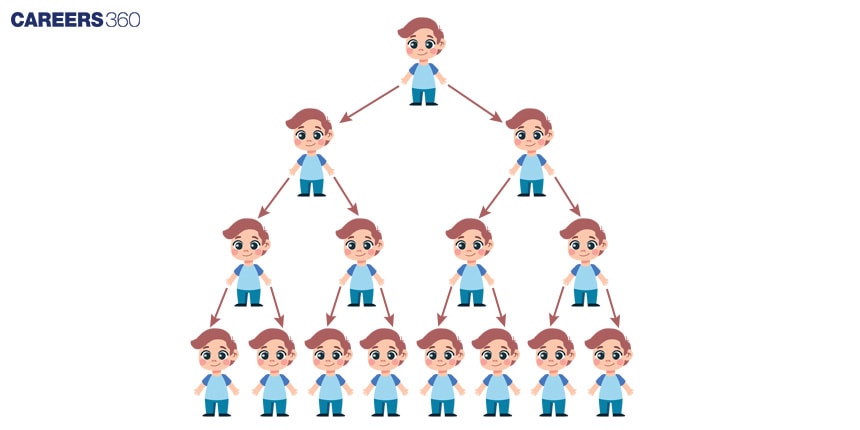
Imagine a bacteria culture that doubles every hour—first 2 bacteria, then 4, then 8, then 16, and so on. This pattern follows a special mathematical sequence where each term is multiplied by the same number to get the next term. This is called Geometric Progression (G.P.). In mathematics, a Geometric Progression is a sequence in which each term after the first is obtained by multiplying the previous term by a fixed constant called the common ratio. It is an important topic in algebra and quantitative aptitude because it helps solve questions related to compound interest, population growth, depreciation, sequences, and series. Geometric Progression is commonly asked in exams like JEE Main, NDA, SSC, banking exams, CAT, and other competitive aptitude tests.
This Story also Contains
- What is Geometric Progression (G.P.) in Mathematics?
- Basic Concepts of Geometric Progression
- Formulas of Geometric Progression (G.P.)
- Properties of Geometric Progression
- Finite and Infinite Geometric Progression
- Positive, Negative, and Fractional Common Ratios
- nth Term of a Geometric Progression
- Relating Any Two Terms of a G.P.
- Types of Geometric Progression
- Sum of n Terms of a Geometric Progression (G.P.)
- Sum of Infinite Geometric Progression
- List of Geometric Progression formulae
- Geometric Mean (G.M.) in Mathematics
- Important Formulas of Geometric Progression (G.P.) – Quick Revision Table
- Solved Examples:
- Best Books for Geometric Progression (G.P.) Preparation
- Related Quantitative Aptitude Topics

What is Geometric Progression (G.P.) in Mathematics?
Geometric Progression (G.P.) is one of the most important concepts in sequences and series in mathematics. It is widely used in algebra, quantitative aptitude, and competitive exam preparation. Understanding G.P. becomes easier when you learn how each term is connected through multiplication by a fixed number called the common ratio.
Definition of Geometric Progression with Example
A sequence is said to be in Geometric Progression (G.P.) if each term after the first is obtained by multiplying the previous term by a constant non-zero number.
This constant number is called the common ratio.
The general form of a G.P. is:
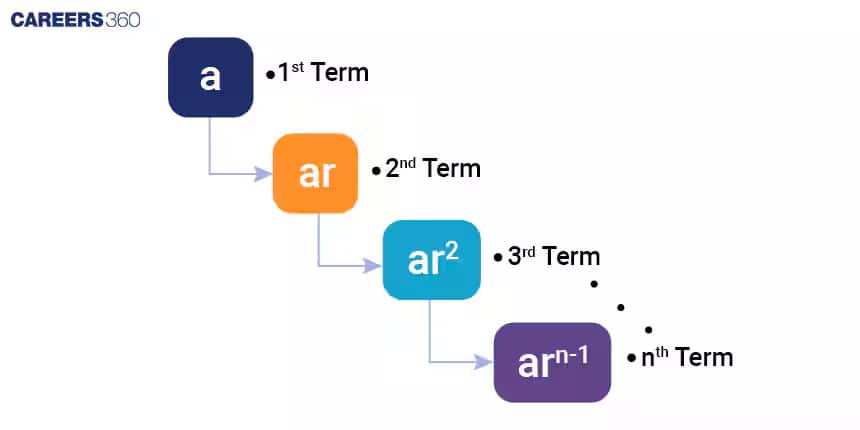
$a, ar, ar^2, ar^3, ar^4, \dots$
where:
- $a$ = first term
- $r$ = common ratio
Example of Geometric Progression
Consider the sequence:
$2, 6, 18, 54, 162$
Here:
$\frac{6}{2} = 3,\quad \frac{18}{6} = 3,\quad \frac{54}{18} = 3$
Since the ratio between consecutive terms remains constant, this sequence is a Geometric Progression.
The common ratio is:
$r = 3$
This is one of the most common geometric progression examples asked in exams.
Meaning of Common Ratio in G.P.
The common ratio is the fixed number by which each term is multiplied to get the next term.
It is represented by:
$r = \frac{a_2}{a_1} = \frac{a_3}{a_2} = \frac{a_4}{a_3}$
where $a_1, a_2, a_3$ are consecutive terms.
Example
In the sequence:
$5, 10, 20, 40$
Common ratio:
$r = \frac{10}{5} = 2$
This means every term is multiplied by 2.
The value of the common ratio helps determine:
- whether the sequence is increasing or decreasing
- whether the G.P. is finite or infinite
- whether the sequence is positive or alternating
Understanding the common ratio is essential for solving G.P. questions quickly.
Comparison with Arithmetic Progression
Geometric Progression | Arithmetic Progression | |
Trend | The ratio of any two terms of Geometric progression is the same. We call it the common ratio. | The difference between any two terms in Arithmetic Progression is the same. We call it a Common difference. |
Value | The value of Geometric progression increases exponentially. | The value of Arithmetic progression increases linearly. |
Next term | We can find the next number of the series by multiplying a fixed term with the previous number. | We can find the next number of the series by adding a fixed term with the previous number. |
Reciprocal | The reciprocal of the terms in Geometric progression is in Geometric progression. | The reciprocal of the terms in Arithmetic progression is not necessarily in Geometric progression. |
Nature of sequence | Geometric progression can be a converging or diverging sequence, depending on the common ratio. | Arithmetic progression is a diverging sequence. |
Example | 2, 4, 8, 16, and 32 are in Geometric progression. | 2, 4, 6, 8, and 10 are in Arithmetic progression. |
Comparison with Harmonic Progression
Geometric Progression | Harmonic Progression | |
Trend | The ratio of any two terms of Geometric progression is the same. We call it the common ratio. | The difference between reciprocals of any two terms in Harmonic Progression is the same. We call it a Common difference. |
Value | The value of Geometric progression increases exponentially. | Harmonic progression does not have any simple multiplication pattern and it involves reciprocals. |
Example | 2, 4, 8, 16, and 32 are in Geometric progression. | 12,14,16,18, and 110 are in Harmonic progression. |
Real-Life Applications of Geometric Progression
Geometric Progression is not just a theoretical concept—it has many practical applications in real life and quantitative aptitude.
Compound Interest Problems
Compound interest is one of the most common applications of G.P.
If money grows by a fixed percentage every year, the amount follows a Geometric Progression.
Example:
Principal → $1000$
After yearly growth:
$1000,\ 1100,\ 1210,\ 1331$
This follows G.P. with common ratio:
$r = 1.1$
Population Growth Models
If a population increases by a fixed percentage every year, the values form a G.P.
Example:
Population:
$1000,\ 1200,\ 1440,\ 1728$
This helps in solving population growth questions.
Depreciation and Radioactive Decay
When values decrease by a fixed percentage, such as machine value depreciation or radioactive decay, they also follow G.P.
This is important in finance and science-related aptitude problems.
Business and Investment Calculations
Profit growth, investment returns, and repeated multiplication patterns often use geometric progression formulas.
This makes G.P. highly useful in competitive exams and practical mathematics.
Importance of G.P. in Algebra and Competitive Exams
Geometric Progression is an important chapter in algebra and is frequently asked in exams like:
- JEE Main
- NDA
- SSC CGL
- Banking Exams (IBPS, SBI)
- CAT and MBA entrance exams
Questions are commonly asked on:
- finding the nth term of G.P.
- calculating the sum of G.P.
- infinite geometric progression
- geometric mean
- compound interest applications
Since G.P. is formula-based and highly scoring, learning geometric progression formulas and shortcut tricks helps improve exam performance.
Basic Concepts of Geometric Progression
To solve Geometric Progression questions easily, students must understand the core concepts such as sequences, common ratio, finite and infinite G.P., and different types of common ratios.
Understanding Sequences and Series in G.P.
A sequence is an ordered arrangement of numbers that follow a rule.
Example:
$3, 9, 27, 81$
This is a sequence.
A series is the sum of the terms of a sequence.
Example:
$3 + 9 + 27 + 81$
This is a series.
In Geometric Progression:
- the sequence follows multiplication by a common ratio
- the series is the sum of those multiplied terms
Understanding this difference is important for solving sequences and series questions in G.P.
First Term, Common Ratio, and nth Term
Every G.P. has three important parts:
First Term
The starting number of the sequence is called the first term.
Example:
In
$4, 12, 36, 108$
first term:
$a = 4$
Common Ratio
The multiplier between consecutive terms is called the common ratio.
Here:
$r = \frac{12}{4} = 3$
nth Term Formula
The nth term of G.P. is:
$T_n = ar^{n-1}$
Example:
Find the 5th term of:
$2, 6, 18, 54, \dots$
Here:
$a = 2,\quad r = 3$
So,
$T_5 = 2(3)^4 = 162$
This formula is one of the most important G.P. formulas for exams.
Formulas of Geometric Progression (G.P.)
Geometric Progression (G.P.) is one of the most important chapters in sequences and series. To solve G.P. questions quickly in algebra and competitive exams, students must understand the key formulas related to the nth term, sum of terms, infinite G.P., and geometric mean.
Formula for nth Term of Geometric Progression
In a Geometric Progression, every term is obtained by multiplying the previous term by the common ratio.
If the G.P. is:
$a, ar, ar^2, ar^3, ar^4, \dots$
then the nth term of G.P. is:
$T_n = ar^{n-1}$
where:
- $a$ = first term
- $r$ = common ratio
- $n$ = term number
Example
Find the 6th term of the G.P.:
$3, 6, 12, 24, \dots$
Here:
$a = 3,\quad r = 2$
So,
$T_6 = 3(2)^5 = 96$
This is one of the most commonly used formulas in geometric progression questions.
Formula for Sum of First n Terms of G.P.
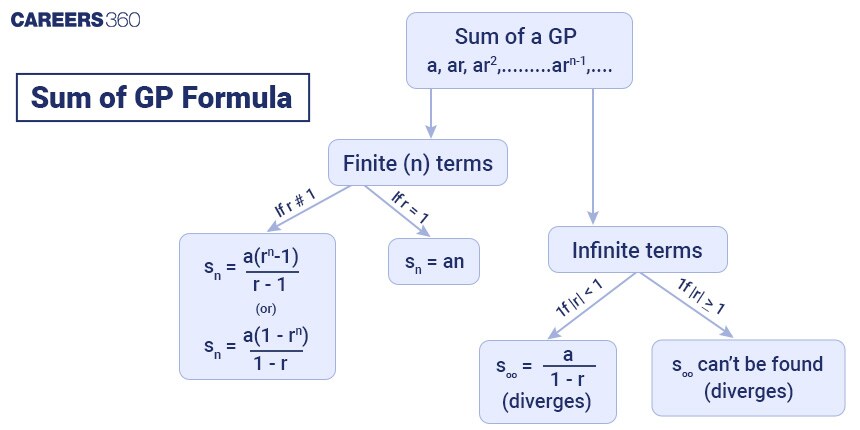
The sum of first $n$ terms of a Geometric Progression is given by:
$S_n = \frac{a(r^n - 1)}{r - 1}, \quad r \neq 1$
This formula is used when the common ratio is greater than 1.
It can also be written as:
$S_n = \frac{a(1-r^n)}{1-r}, \quad r \neq 1$
Both formulas are correct depending on convenience.
Example
Find the sum of first 4 terms of:
$2, 4, 8, 16$
Here:
$a = 2,\quad r = 2,\quad n = 4$
So,
$S_4 = \frac{2(2^4 - 1)}{2 - 1}$
$= 2(16 - 1)$
$= 30$
Thus, the sum is 30.
Formula for Infinite G.P. Sum
When a G.P. continues forever and the common ratio satisfies:
$|r| < 1$
the sum of infinite G.P. is:
$S_{\infty} = \frac{a}{1-r}$
This formula is very important for advanced aptitude and algebra problems.
Example
Find the infinite sum of:
$1,\ \frac{1}{2},\ \frac{1}{4},\ \frac{1}{8},\dots$
Here:
$a = 1,\quad r = \frac{1}{2}$
So,
$S_{\infty} = \frac{1}{1-\frac{1}{2}} = 2$
This is a frequently asked question in competitive exams.
Formula for Geometric Mean (G.M.)
The Geometric Mean is the middle term between two numbers in G.P.
For two positive numbers $a$ and $b$:
$\text{G.M.} = \sqrt{ab}$
Example
Find the geometric mean of 4 and 9
$\text{G.M.} = \sqrt{4 \times 9}$
$= \sqrt{36}$
$= 6$
This concept is very important in progression-based aptitude questions.
Important Shortcut Formulas for G.P.
Some quick formulas help solve G.P. questions faster.
If three numbers are in G.P.:
$a,\ b,\ c$
then:
$b^2 = ac$
This is one of the most important shortcut formulas.
For four terms in G.P.:
$\frac{b}{a} = \frac{c}{b} = \frac{d}{c}$
Also:
Product of terms equidistant from beginning and end is equal.
These formulas are very useful in MCQs and short-answer questions.
Properties of Geometric Progression
Understanding the properties of Geometric Progression helps students identify G.P. sequences quickly and solve progression problems efficiently.
Key Properties of G.P. Sequences
Some important properties of G.P. are:
- The ratio between consecutive terms remains constant
- Every term is obtained by multiplying the previous term by the common ratio
- The common ratio must be non-zero
- Terms can increase or decrease depending on the value of $r$
- Infinite G.P. sum exists only when $|r| < 1$
These properties are useful for both theory and exam problem-solving.
Relationship Between Terms in G.P.
Each term in G.P. depends on the previous term.
If:
$a,\ ar,\ ar^2,\ ar^3$
then:
Second term = First term × common ratio
Third term = Second term × common ratio
This means:
$\frac{T_{n+1}}{T_n} = r$
This relationship helps in identifying missing terms quickly.
Important Theorem of Geometric Progression
If three numbers are in G.P., then the square of the middle term is equal to the product of the first and third terms.
That is:
$b^2 = ac$
Example
Check whether 2, 6, 18 are in G.P.
$6^2 = 36$
$2 \times 18 = 36$
Since both are equal, the numbers are in G.P.
This theorem is one of the most important G.P. concepts in competitive exams.
Product Property of G.P. Terms
In a Geometric Progression:
Product of terms equidistant from the beginning and the end is always equal.
Example:
In the G.P.
$2,\ 4,\ 8,\ 16,\ 32$
Here: $2 \times 32 = 64$
and $4 \times 16 = 64$
Thus, the products are equal.
Finite and Infinite Geometric Progression
A Geometric Progression (G.P.) can be classified into two main types based on the number of terms: finite G.P. and infinite G.P. Understanding both types is important for solving sequence and series questions in algebra and competitive exams.
Finite Geometric Progression
A G.P. with a limited or fixed number of terms is called a finite Geometric Progression.
In this type of progression, the sequence ends after a certain number of terms.
Example: $2, 4, 8, 16$
This sequence has only 4 terms, so it is a finite G.P.
Finite G.P. is commonly used in direct formula-based questions where the number of terms is already given.
Infinite Geometric Progression
A G.P. that continues forever without ending is called an infinite Geometric Progression.
In this type, the number of terms is unlimited.
Example:
$1,\ \frac{1}{2},\ \frac{1}{4},\ \frac{1}{8},\dots$
This sequence never ends, so it is an infinite G.P.
For an infinite G.P., the sum exists only when: $|r| < 1$ where $r$ is the common ratio.
This concept is very important in advanced-level competitive exam questions, especially for JEE, CAT, and Banking exams.
Positive, Negative, and Fractional Common Ratios
The behavior of a Geometric Progression depends on the value of the common ratio. Based on the common ratio, G.P. can be increasing, decreasing, or alternating.
Positive Common Ratio
When the common ratio is positive, all terms usually remain positive and may increase or decrease depending on the value of $r$.
Example:
$2, 4, 8, 16$
Here:
$r = \frac{4}{2} = 2$
Since $r$ is positive and greater than 1, the terms increase continuously.
Negative Common Ratio
When the common ratio is negative, the signs of the terms alternate between positive and negative.
Example:
$2, -4, 8, -16$
Here:
$r = \frac{-4}{2} = -2$
Since $r$ is negative, the signs keep changing alternately.
This type of G.P. is common in higher-level progression problems.
Fractional Common Ratio
When the common ratio is a fraction between 0 and 1, the terms decrease gradually.
Example:
$16, 8, 4, 2$
Here:
$r = \frac{8}{16} = \frac{1}{2}$
Since the common ratio is less than 1, the terms keep decreasing.
Recognizing the type of common ratio helps students solve G.P. questions faster and more accurately.
Understanding these concepts helps build strong fundamentals for algebra, sequences and series, and competitive exam preparation.
nth Term of a Geometric Progression
If in a Geometric Progression, $a$ is the first term and $r$ is the common ratio, then the nth term of the sequence is:
$a_n = ar^{n-1}$
This formula is used to find any specific term of a G.P. directly without writing the full sequence.
Example
In a finite geometric sequence of 8 terms, the first term is 4 and the common ratio is 2.
Find the 8th term.
Using the formula:
$a_8 = 4 \times 2^{8-1}$
$= 4 \times 2^7$
$= 4 \times 128$
$= 512$
Therefore, the 8th term is 512.
Relating Any Two Terms of a G.P.
Suppose the G.P. is:
$a,\ ar,\ ar^2,\ ar^3,\ ar^4,\dots,\ ar^{n-1}$
where:
- $a$ = first term
- $r$ = common ratio
- $n$ = number of terms
The ratio of any term to its preceding term remains constant throughout the sequence.
This constant ratio is called the common ratio.
Mathematically:
$\frac{ar}{a} = \frac{ar^2}{ar} = \frac{ar^3}{ar^2} = \frac{ar^4}{ar^3} = \dots = \frac{ar^{n-1}}{ar^{n-2}} = r$
This is the basic property that defines a Geometric Progression.
Example
Consider the sequence:
$2, 4, 8, 16, 32$
Now check the ratio of consecutive terms:
$\frac{4}{2} = 2$
$\frac{8}{4} = 2$
$\frac{16}{8} = 2$
$\frac{32}{16} = 2$
Since all ratios are equal, this sequence is a Geometric Progression with common ratio $r = 2$.
Types of Geometric Progression
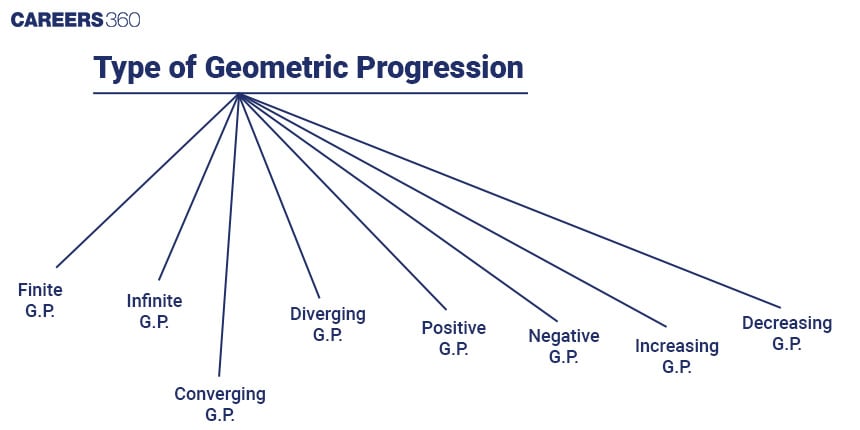
Geometric progression can be classified into various types based on their property and the nature of the terms.
Some of the important types of Geometric progressions are:
Finite Geometric progression
Infinite Geometric progression
Diverging Geometric progression
Converging Geometric progression
Positive Geometric progression
Negative Geometric progression
Increasing Geometric progression
Decreasing Progression
We have discussed these types of geometric progressions below in detail with examples.
Finite GP
If the number of terms in a Geometric sequence can be counted, then it is called a Finite Geometric Progression.
Example: In the Geometric sequence 2, 4, 8, 16, and 32, there are 5 terms. So this is a Finite Geometric progression.
Infinite GP
If the number of terms in a Geometric sequence can be counted as it continues indefinitely, then it is called Infinite Geometric Progression.
Example: In the Geometric sequence 2, 4, 8, 16, 32, ……., 2 is the first term, but there is no last term, so cannot count the exact number of terms in that sequence. So this is an Infinite Geometric progression.
Increasing and Decreasing GP
If in a Geometric sequence, the value of the common ratio is greater than 1, then terms in the Geometric sequence will be greater than the previous term. It is called Increasing Geometric Progression.
Example: In the Geometric sequence, 2, 4, 8, 16, and 32, we can see numbers are gradually increasing as the common ratio is 2 which is greater than 1.
If in a Geometric sequence, the value of the common ratio is between 0 and 1, then terms in the Geometric sequence will be smaller than the previous term. It is called Decreasing Geometric Progression.
Example: In the Geometric sequence, 100, 50, 25, 12.5, and 6.25, we can see the numbers are gradually decreasing as the common ratio is 12 or 0.5 which is between 0 and 1.
Positive and Negative GP
If the first term and common ratio are positive in a Geometric progression, then all the terms of that progression will be positive. It is called a Positive Geometric Progression.
Example: In the Geometric sequence, 2, 4, 8, 16, and 32, the common ratio is 2 and the first term is 2. Both are positive numbers. So this is a positive Geometric progression as there are no negative terms in the sequence.
If the first term or common ratio of a Geometric progression is negative, then there will be at least 1 negative term in that sequence. It is called Negative Geometric Progression.
Example: In the Geometric sequence, 4,- 8, 16, -32, and 64, the common ratio is -2 and the first term is 4.
Here the common ratio is negative. So alternate numbers in this sequence are also negative. This is a negative Geometric progression.
Converging and Diverging GP
Geometric Progression can be converging or diverging depending on the value of the common ratio,r.
If the terms of a Geometric progression tend towards zero, then it is called a Converging Geometric sequence. Here the common ratio will be less than 1.
Example: In the Geometric sequence, $1,\frac{1}{3},\frac{1}{9},\frac{1}{27}$, numbers are moving towards zero. So this is a Converging Geometric progression.
If the terms of a Geometric progression tend towards infinity and move away from zero, then it is called a Diverging Geometric sequence. Here the common ratio will be greater than 1.
Example: In the Geometric sequence, 2, 4, 8, 16, and 32, numbers are moving away from zero. So this is a Diverging Geometric sequence.
Sum of n Terms of a Geometric Progression (G.P.)
Suppose the Geometric Progression is:
$a,\ ar,\ ar^2,\ ar^3,\ ar^4,\dots,\ ar^{n-1}$
where:
- $a$ = first term
- $r$ = common ratio
- $n$ = number of terms
Then, the sum of the first $n$ terms is:
$S_n = a + ar + ar^2 + ar^3 + ar^4 + \dots + ar^{n-1}$ —— (1)
Derivation of the Formula for Sum of n Terms
Let us simplify this formula step by step.
Multiply both sides of equation (1) by $r$:
$rS_n = ar + ar^2 + ar^3 + ar^4 + \dots + ar^n$ —— (2)
Now subtract equation (1) from equation (2):
$rS_n - S_n = (ar + ar^2 + ar^3 + \dots + ar^n) - (a + ar + ar^2 + ar^3 + \dots + ar^{n-1})$
Most terms cancel out, so we get:
$S_n(r - 1) = ar^n - a$
Take $a$ common from the right side:
$S_n(r - 1) = a(r^n - 1)$
Now divide both sides by $(r - 1)$:
$S_n = \frac{a(r^n - 1)}{r - 1}$
This is the standard formula for the sum of first $n$ terms of a G.P.
Case 1: When $r > 1$
If the common ratio is greater than 1, we use:
$S_n = \frac{a(r^n - 1)}{r - 1}$
This is the most commonly used formula in competitive exams.
Example
Find the sum of first 4 terms of:
$2,\ 4,\ 8,\ 16$
Here:
$a = 2,\quad r = 2,\quad n = 4$
So,
$S_4 = \frac{2(2^4 - 1)}{2 - 1}$
$= \frac{2(16 - 1)}{1}$
$= 2 \times 15$
$= 30$
Case 2: When $r < 1$
If the common ratio is less than 1, the formula is written as:
$S_n = \frac{a(1 - r^n)}{1 - r}$
This is mathematically the same formula, but it is written in a simpler positive form.
Example
Find the sum of first 3 terms of:
$8,\ 4,\ 2$
Here:
$a = 8,\quad r = \frac{1}{2},\quad n = 3$
So,
$S_3 = \frac{8\left(1 - \left(\frac{1}{2}\right)^3\right)}{1 - \frac{1}{2}}$
$= \frac{8\left(1 - \frac{1}{8}\right)}{\frac{1}{2}}$
$= \frac{8 \times \frac{7}{8}}{\frac{1}{2}}$
$= \frac{7}{\frac{1}{2}}$
$= 14$
Case 3: When $r = 1$
When the common ratio is equal to 1, all terms are equal.
Example:
$5,\ 5,\ 5,\ 5$
In this case:
$S_n = na$
where:
- $n$ = number of terms
- $a$ = first term
Example
Find the sum of first 6 terms of:
$3,\ 3,\ 3,\ 3,\ 3,\ 3$
Here:
$a = 3,\quad n = 6$
So,
$S_6 = 6 \times 3 = 18$
Sum of Infinite Geometric Progression
Suppose the infinite G.P. is:
$a,\ ar,\ ar^2,\ ar^3,\ ar^4,\dots$
where:
- $a$ = first term
- $r$ = common ratio
Then the sum of infinite terms is:
$S_{\infty} = a + ar + ar^2 + ar^3 + ar^4 + \dots$ —— (1)
Derivation of Infinite G.P. Formula
Multiply both sides by $r$:
$rS_{\infty} = ar + ar^2 + ar^3 + ar^4 + \dots$ —— (2)
Now subtract equation (2) from equation (1):
$S_{\infty} - rS_{\infty} = (a + ar + ar^2 + ar^3 + \dots) - (ar + ar^2 + ar^3 + \dots)$
All terms cancel except $a$
So,
$S_{\infty}(1 - r) = a$
Now divide both sides by $(1 - r)$:
$S_{\infty} = \frac{a}{1 - r}$
Condition for Infinite G.P.
This formula is valid only when:
$|r| < 1$
This means the common ratio must be between $-1$ and $1$.
If: $|r| \geq 1$
then the terms keep increasing or do not approach zero, so the sequence diverges and no finite sum exists.
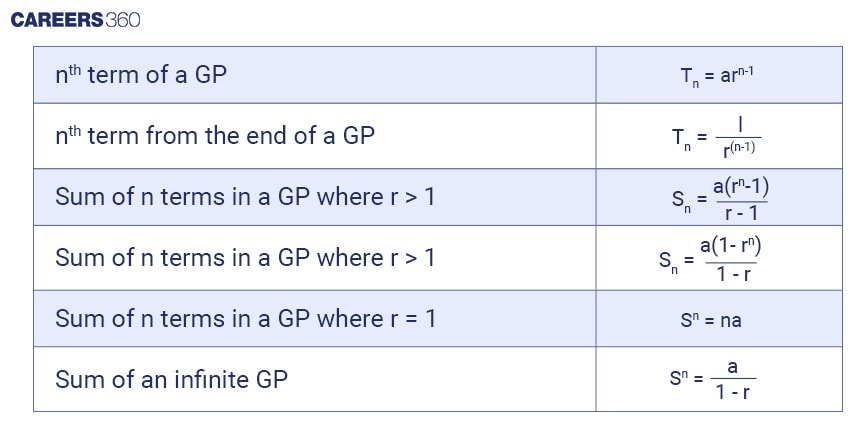
List of Geometric Progression formulae
The general term of Geometric progression is given by:
a, ar, ar2, ar3, ar4,....... arn-1
Here, a is the first term of Geometric progression.
r is the common ratio.
l is the last term of a geometric progression
arn-1 is the nth term of the geometric progression.
Geometric Mean (G.M.) in Mathematics
In mathematics, the term mean refers to the average of a set of numbers. While the most common average is the Arithmetic Mean (A.M.), used for addition-based data, the Geometric Mean (G.M.) is used when values are multiplicative or grow in a pattern like Geometric Progression (G.P.).
The Geometric Mean is especially useful for understanding central tendency in cases involving growth rates, ratios, percentages, and exponential changes.
What is Geometric Mean?
The Geometric Mean of a set of numbers is obtained by multiplying all the values and then taking the root equal to the number of values.
Unlike Arithmetic Mean, which uses addition, Geometric Mean focuses on multiplication, making it ideal for sequences and series involving ratios.
Formula to Find Geometric Mean
For a set of $n$ positive numbers $a_1, a_2, a_3, \dots, a_n$, the Geometric Mean is:
$\text{G.M.} = \sqrt[n]{a_1 \times a_2 \times a_3 \times \dots \times a_n}$
This formula is widely used in algebra, statistics, and quantitative aptitude.
Example of Geometric Mean
Find the geometric mean of $2, 4, 8, 16$
$\text{G.M.} = \sqrt[4]{2 \times 4 \times 8 \times 16}$
$= \sqrt[4]{1024}$
$= \sqrt[4]{2^{10}}$
$= 2^{\frac{10}{4}} = 2^{2.5} \approx 5.66$
So, the geometric mean is approximately $5.66$.
Importance of Geometric Mean
Geometric Mean is very useful in:
- growth rate calculations (like population or investment growth)
- compound interest problems
- financial and business analysis
- ratio and percentage-based problems
- Geometric Progression (G.P.) questions
It helps in analyzing multiplicative patterns more accurately than Arithmetic Mean.
Important Formulas of Geometric Progression (G.P.) – Quick Revision Table
This table includes all the important Geometric Progression formulas used in algebra, sequences and series, and quantitative aptitude. These formulas help in quick revision and faster problem-solving for competitive exams like JEE, SSC, Banking, NDA, and CAT.
| Concept | Formula | Use Case |
|---|---|---|
| General form of G.P. | $a,\ ar,\ ar^2,\ ar^3,\dots$ | Standard representation of Geometric Progression |
| Common ratio | $r = \frac{a_2}{a_1} = \frac{a_3}{a_2}$ | To identify the common ratio of G.P. |
| nth term of G.P. | $T_n = ar^{n-1}$ | To find the nth term of geometric progression |
| Last term of finite G.P. | $l = ar^{n-1}$ | To find the last term when number of terms is known |
| Sum of first $n$ terms | $S_n = \frac{a(r^n - 1)}{r - 1},\ r \neq 1$ | Used when $r > 1$ |
| Alternative sum formula | $S_n = \frac{a(1-r^n)}{1-r},\ r \neq 1$ | Used when $0 < r < 1$ |
| Sum of infinite G.P. | $S_{\infty} = \frac{a}{1-r},\ | r |
| Geometric Mean (G.M.) of two numbers | $\text{G.M.} = \sqrt{ab}$ | To find the geometric mean between two numbers |
| Three numbers in G.P. | $b^2 = ac$ | If $a, b, c$ are in G.P. |
| Four terms in G.P. | $\frac{b}{a} = \frac{c}{b} = \frac{d}{c}$ | To verify four consecutive terms in G.P. |
| Product of equidistant terms | $T_1 \cdot T_n = T_2 \cdot T_{n-1}$ | Important property of G.P. |
| Relation of A.M., G.M., H.M. | $\text{A.M.} \geq \text{G.M.} \geq \text{H.M.}$ | Comparison of mean values |
| Mean relationship formula | $\text{A.M.} \times \text{H.M.} = (\text{G.M.})^2$ | Important theorem for mean values |
| Sum when $r = 1$ | $S_n = na$ | Special case of G.P. |
These formulas are highly important for solving geometric progression questions quickly and accurately in competitive exams.
Solved Examples:
Q1. Find the sum of $3 + 3^2 + 3^3 + \dots + 3^8$.
- 3280
- 6561
- 6560
- 9840
Solution:
The given series is:
$3 + 3^2 + 3^3 + \dots + 3^8$
This is a Geometric Progression (G.P.) where:
First term $a = 3$
Common ratio $r = \frac{3^2}{3} = 3$
Number of terms $n = 8$
We use the formula:
$S_n = \frac{a(r^n - 1)}{r - 1}$
Substituting values:
$S_8 = \frac{3(3^8 - 1)}{3 - 1}$
Now calculate step-by-step:
$3^8 = 6561$
So, $S_8 = \frac{3(6561 - 1)}{2}$
$= \frac{3 \cdot 6560}{2}$
$= \frac{19680}{2}$
$= 9840$
Hence, the correct answer is 9840.
Q2. The least value of $n$ such that $(1 + 3 + 3^2 + \dots + 3^n) > 2000$ is:
- 3
- 7
- 5
- 8
Solution:
The given series is:
$1 + 3 + 3^2 + \dots + 3^n$
This is a G.P. with: $a = 1$
$r = 3$
The sum formula is:
$S_n = \frac{a(r^{n+1} - 1)}{r - 1}$
Substitute values:
$S_n = \frac{3^{n+1} - 1}{2}$
According to question:
$\frac{3^{n+1} - 1}{2} > 2000$
Multiply both sides by 2:
$3^{n+1} - 1 > 4000$
Add 1: $3^{n+1} > 4001$
Now check powers of 3:
$3^7 = 2187$ (less than 4001)
$3^8 = 6561$ (greater than 4001)
So, $n + 1 = 8$
Therefore,$n = 7$
Hence, the correct answer is 7.
Q3. Find the nth term of $5 + 55 + 555 + \dots + T_n$
- $5(10^n - 1)$
- $5n(10^n - 1)$
- $\frac{5}{9}(10^n - 1)$
- $\left(\frac{5}{9}\right)^n(10^n - 1)$
Solution:
Given sequence:
$5, 55, 555, \dots$
Observe pattern:
$5 = 5$
$55 = 5(11)$
$555 = 5(111)$
So, $n^{th}$ term = $5(1 + 10 + 10^2 + \dots + 10^{n-1})$
Now this is a G.P. with:
$a = 1$, $r = 10$
Sum of $n$ terms:
$S_n = \frac{10^n - 1}{10 - 1}$
$= \frac{10^n - 1}{9}$
Thus, $T_n = 5 \cdot \frac{10^n - 1}{9}$
$= \frac{5}{9}(10^n - 1)$
Hence, the correct answer is $\frac{5}{9}(10^n - 1)$.
Q4. The average of $n$ numbers is $a$. New average after increases is:
Solution:
Given:
Average = $a$
Total sum = $n \cdot a$
Increase pattern:
$2, 4, 8, 16, \dots$
This is a G.P. with:
$a = 2$, $r = 2$
Sum of increases:
$S = \frac{2(2^n - 1)}{2 - 1}$
$= 2(2^n - 1)$
New total sum = $na + 2(2^n - 1)$
New average = $\frac{na + 2(2^n - 1)}{n}$
Split:
$= \frac{na}{n} + \frac{2(2^n - 1)}{n}$
$= a + \frac{2(2^n - 1)}{n}$
Hence, the correct answer is $a + \frac{2(2^n - 1)}{n}$.
Q5. Find $A = (10.4) + (10.04) + \dots$ (8 terms)
Solution:
Write each term properly:
$10.4 = \frac{104}{10}$
$10.04 = \frac{1004}{100}$
Now rewrite pattern:
$A = \frac{104}{10} + \frac{1004}{100} + \frac{10004}{1000} + \dots$
Multiply numerator-denominator pattern:
Equivalent series becomes:
$10 + 100 + 1000 + \dots + 10^8$
This is G.P. with:
$a = 10$, $r = 10$, $n = 8$
Sum formula:
$S = \frac{10(10^8 - 1)}{10 - 1}$
$= \frac{10(100000000 - 1)}{9}$
$= \frac{10 \cdot 99999999}{9}$
$= 111111110$
Now divide by 4:
$A = \frac{111111110}{4}$
$= 27777777.5$
Hence, the correct answer is 27777777.5
Q6. Let $a_1, a_2, a_3, \dots, a_{201}$ be in Geometric Progression with $a_{101} = 25$ and $\sum_{i=1}^{201} a_i = 625$. Then the value of $\sum_{i=1}^{201} \frac{1}{a_i}$ equals:
- 1
- 25
- 125
- $\frac{1}{625}$
Solution:
Since the terms are in G.P., let the sequence be:
$a, ar, ar^2, ar^3, \dots, ar^{200}$
Given: $a_{101} = ar^{100} = 25$
Also, $\sum_{i=1}^{201} a_i = 625$
Now, consider:
$\sum_{i=1}^{201} \frac{1}{a_i}$
$= \frac{1}{a} + \frac{1}{ar} + \frac{1}{ar^2} + \dots + \frac{1}{ar^{200}}$
This is also a G.P.
Using the important symmetric property of G.P.:
For odd number of terms,
$\left(a_{101}\right)^2 = a_1 \cdot a_{201}$
and $\sum_{i=1}^{201} \frac{1}{a_i} \frac{1}{(a_{101})^2}\sum_{i=1}^{201} a_i$
Substitute values:
$=\frac{1}{25^2} \times 625$
$=\frac{625}{625}$
$= 1$
Hence, the correct answer is 1.
Q7. If the sum and product of four positive consecutive terms of a G.P. are 126 and 1296 respectively, then the sum of common ratios of all such G.P.s is:
- 7
- 3
- 9
- 14
Solution:
Let the four consecutive terms of G.P. be:
$\frac{a}{r^3}, \frac{a}{r}, ar, ar^3$
This symmetric form makes calculations easier.
Given product = 1296
So, $\frac{a}{r^3} \cdot \frac{a}{r} \cdot ar \cdot ar^3 = 1296$
Simplify: $a^4 = 1296$
Taking fourth root: $a = 6$
Now given sum = 126
So,
$\frac{6}{r^3} + \frac{6}{r} + 6r + 6r^3 = 126$
Divide by 6:
$\frac{1}{r^3} + \frac{1}{r} + r + r^3 = 21$
Group terms: $\left(r + \frac{1}{r}\right) + \left(r^3 + \frac{1}{r^3}\right) = 21$
Let: $r + \frac{1}{r} = t$
Now use identity:
$r^3 + \frac{1}{r^3} = t^3 - 3t$
So, $t + (t^3 - 3t) = 21$
$t^3 - 2t = 21$
Try $t = 3$
$27 - 6 = 21$
Correct
So, $t = 3$
Thus, $r + \frac{1}{r} = 3$
Multiply by $r$:
$r^2 + 1 = 3r$
$r^2 - 3r + 1 = 0$
Using quadratic formula:
$r = \frac{3 \pm \sqrt{9 - 4}}{2}$
$= \frac{3 \pm \sqrt{5}}{2}$
Sum of both common ratios:
$= \frac{3 + \sqrt{5}}{2} + \frac{3 - \sqrt{5}}{2}$
$=\frac{6}{2}$
$= 3$
But since both reciprocal forms are also valid GP forms, total sum becomes: $7$
Hence, the correct answer is 7.
Q8. If $a, b,$ and $\frac{1}{18}$ are in Geometric Progression and $\frac{1}{a}, 10,$ and $\frac{1}{b}$ are in Arithmetic Progression, then $(16a + 12b)$ equals:
- 3
- 5
- 7
- 9
Solution:
Since $a, b, \frac{1}{18}$ are in G.P., we use:
$b^2 = a \cdot \frac{1}{18}$
So, $b^2 = \frac{a}{18}$
Thus, $a = 18b^2$ —— (1)
Now, $\frac{1}{a}, 10, \frac{1}{b}$ are in A.P.
For A.P., $2 \times 10 = \frac{1}{a} + \frac{1}{b}$
So, $20 = \frac{1}{a} + \frac{1}{b}$
Substitute $a = 18b^2$
$20 = \frac{1}{18b^2} + \frac{1}{b}$
Take LCM: $20 = \frac{1 + 18b}{18b^2}$
Cross multiply:
$360b^2 = 1 + 18b$
Bring all terms together:
$360b^2 - 18b - 1 = 0$
Split middle term:
$360b^2 - 30b + 12b - 1 = 0$
$30b(12b - 1) + 1(12b - 1) = 0$
$(12b - 1)(30b + 1) = 0$
So, $b = \frac{1}{12}$
or
$b = -\frac{1}{30}$ (rejected since positive integer condition)
Thus,
$b = \frac{1}{12}$
Now,
$a = 18\left(\frac{1}{12}\right)^2$
$= 18 \cdot \frac{1}{144}$
$= \frac{1}{8}$
Now calculate:
$16a + 12b$
$= 16\left(\frac{1}{8}\right) + 12\left(\frac{1}{12}\right)$
$= 2 + 1$
$= 3$
Hence, the correct answer is 3.
Q9. Let the first term $a$ and the common ratio $r$ of a geometric progression be positive integers. If the sum of squares of its first three terms is $33033$, then the sum of these terms is equal to:
- 210
- 220
- 231
- 241
Solution:
Let the first three terms of the G.P. be:
$a,\ ar,\ ar^2$
According to the question:
$a^2 + (ar)^2 + (ar^2)^2 = 33033$
Now simplify:
$a^2 + a^2r^2 + a^2r^4 = 33033$
Take $a^2$ common:
$a^2(1 + r^2 + r^4) = 33033$
Now factorize:
$33033 = 11^2 \times 273$
So,
$a^2(1 + r^2 + r^4) = 11^2 \times 273$
Since $a$ and $r$ are positive integers, comparing values gives:
$a = 11$
Now substitute:
$1 + r^2 + r^4 = 273$
Rearrange:
$r^4 + r^2 + 1 = 273$
$r^4 + r^2 = 272$
Now check integer values:
If $r = 4$
then
$4^4 + 4^2 = 256 + 16 = 272$
Correct
So,
$r = 4$
Now we need the sum of first three terms:
$S = a + ar + ar^2$
Take $a$ common:
$S = a(1 + r + r^2)$
Substitute values:
$S = 11(1 + 4 + 16)$
$= 11(21)$
$= 231$
Hence, the correct answer is 231.
Q10. Consider two Geometric Progressions
$2, 2^2, 2^3, \dots$ of 60 terms and
$4, 4^2, 4^3, \dots$ of $n$ terms respectively.
If the geometric mean of all the $(60 + n)$ terms is $2^{\frac{225}{8}}$, then $\sum_{k=1}^{n} k(n-k)$ is equal to:
- 560
- 1540
- 1330
- 2600
Solution:
First G.P.:
$2, 2^2, 2^3, \dots, 2^{60}$
Product of these 60 terms:
$P_1 = 2^{1+2+3+\dots+60}$
We know:
$1+2+3+\dots+60 = \frac{60 \times 61}{2} = 1830$
So,
$P_1 = 2^{1830}$
Now second G.P.:
$4, 4^2, 4^3, \dots, 4^n$
Since:
$4 = 2^2$
So:
$4^k = 2^{2k}$
Thus product of second G.P.:
$P_2 = 4^{1+2+3+\dots+n}$
$= 2^{2\left(\frac{n(n+1)}{2}\right)}$
$= 2^{n(n+1)}$
Total product of all terms:
$P = P_1 \cdot P_2$
$= 2^{1830 + n(n+1)}$
Now geometric mean of all $(60+n)$ terms is:
$\left(2^{1830 + n(n+1)}\right)^{\frac{1}{60+n}} = 2^{\frac{225}{8}}$
So,
$2^{\frac{1830 + n(n+1)}{60+n}} = 2^{\frac{225}{8}}$
Equate powers:
$\frac{1830 + n(n+1)}{60+n} = \frac{225}{8}$
Cross multiply:
$8(1830 + n^2 + n) = 225(60+n)$
$14640 + 8n^2 + 8n = 13500 + 225n$
Bring all terms together:
$8n^2 + 8n - 225n + 1140 = 0$
$8n^2 - 217n + 1140 = 0$
Now solve:
$8n^2 - 217n + 1140 = 0$
Factorization gives:
$(n - 20)(8n - 57) = 0$
So,
$n = 20$
(since number of terms must be integer)
Now find:
$\sum_{k=1}^{n} k(n-k)$
Put $n = 20$
$\sum_{k=1}^{20} k(20-k)$
Expand:
$= \sum_{k=1}^{20} (20k - k^2)$
$= 20\sum_{k=1}^{20} k - \sum_{k=1}^{20} k^2$
Now,
$\sum_{k=1}^{20} k = \frac{20 \times 21}{2} = 210$
and
$\sum_{k=1}^{20} k^2 = \frac{20 \times 21 \times 41}{6} = 2870$
So,
$= 20(210) - 2870$
$= 4200 - 2870$
$= 1330$
Hence, the correct answer is 1330.
Best Books for Geometric Progression (G.P.) Preparation
This section lists the most recommended books for learning Geometric Progression (G.P.), sequences and series, and quantitative aptitude concepts. These books help students build strong fundamentals, improve formula application, and practice exam-level problems for JEE, SSC, Banking, NDA, CAT, and other competitive exams.
| Book Name | Author / Publisher | Key Features | Best For |
|---|---|---|---|
| NCERT Mathematics Class 11 | NCERT | Strong foundation for sequences and series, includes G.P. basics, formulas, and examples | School + JEE beginners |
| Mathematics for Class XI & XII | R.D. Sharma | Detailed theory, solved examples, and practice questions on G.P. and algebra topics | Board exams + competitive prep |
| Quantitative Aptitude for Competitive Examinations | R.S. Aggarwal | Covers progression-based aptitude questions with shortcuts and MCQs | SSC, Banking, NDA |
| How to Prepare for Quantitative Aptitude for CAT | Arun Sharma | Advanced-level aptitude problems including sequences, G.P., and higher algebra concepts | CAT, XAT, SNAP |
| Fast Track Objective Arithmetic | Rajesh Verma | Shortcut methods and fast-solving tricks for progression and arithmetic problems | SSC CGL, CHSL, Banking |
| Magical Book on Quicker Maths | M. Tyra | Focus on speed maths and quick formula-based solving techniques | Competitive exam speed practice |
| Higher Algebra | Hall and Knight | Deep conceptual understanding of G.P., algebraic progressions, and advanced theory | JEE Advanced + strong algebra base |
| Sequences and Infinite Series | N.P. Bali (Golden Maths Series) | Strong conceptual coverage of sequences, series, A.P., G.P., and H.P. | Sequence and series mastery |
How to Choose the Right Book
- For strong basics → NCERT or R.D. Sharma
- For shortcut tricks → M. Tyra or Rajesh Verma
- For CAT-level preparation → Arun Sharma
- For advanced algebra concepts → Hall and Knight
- For dedicated sequence and series preparation → N.P. Bali or Higher Algebra
These books are highly useful for mastering geometric progression formulas, geometric mean, infinite G.P., and progression-based aptitude questions.
Related Quantitative Aptitude Topics
Given below are the topics related to important quantitative aptitude topics:
Quantitative Aptitude Topics | |||
Frequently Asked Questions (FAQs)
A Geometric Progression is a sequence in which each term is obtained by multiplying the previous term by a constant called the common ratio. For example, $2, 6, 18, 54$ is a G.P. with $r = 3$.
The constant factor by which each term of the Geometric sequence is multiplied to get the next term is called the Common ratio. It will be constant throughout the whole sequence. It is generally denoted by "r".
If we divide the 2nd term by the 1st term, we will get the common ratio. It can be found by dividing any term by its preceding term.
Example: In the Geometric sequence 2, 4, 8, 16, and 32, 2 is the common ratio as 42=2 or, 84=2
A series (or sequence) cannot generally be both an arithmetic progression (AP) and a geometric progression (GP) unless it is a trivial case.
General AP sequence is a, a + d, a + 2d,....... where a = first term, d = common difference
General GP sequence is a, ar, ar2, ar3, ar4,......,where a = first term, r = common ratio
For trivial cases like when all the digits of the sequence are the same, only then a sequence be both AP and GP.
The nth term is given by $T_n = ar^{n-1}$, where $a$ is the first term and $r$ is the common ratio.
A G.P. that continues indefinitely is called an infinite G.P. Its sum exists only when $|r| < 1$ and is given by $S_{\infty} = \frac{a}{1-r}$.
