KCC Institute of Legal and Higher Education, Greater Noida
Law Admissions 2026 Open | Avail Merit-Based Scholarships


Imagine checking the last digit of a very large number like $7^{103}$ without actually calculating the full value. In daily life too, we often focus only on the final digit—like checking the last digit of a bill amount, a phone number, or a transaction value. In mathematics, this concept is called the Unit Digit. The unit digit is the digit in the one’s place of any number and plays a very important role in quantitative aptitude, number system, and simplification questions. Unit digit problems are frequently asked in competitive exams like SSC, Banking, NDA, CAT, Railways, and other aptitude tests because they test speed, logic, and pattern recognition rather than lengthy calculations.
This Story also Contains
Unit Digit is one of the most important topics in quantitative aptitude and number system. It helps students solve large-number problems quickly without performing lengthy calculations. Questions based on unit digit are commonly asked in competitive exams like SSC, Banking, NDA, Railways, CAT, and other aptitude tests because they test logical thinking, pattern recognition, and speed.
Instead of calculating the full value of large powers like $7^{103}$ or large multiplications, we only focus on the digit in the one’s place. This makes unit digit questions easy to solve with the right rules and tricks.
Understanding the concept of unit digit is extremely useful for simplification, exponents, cyclicity, and number system-based aptitude questions.
The unit digit is the digit present at the one’s place of any number.
In simple words, it is the last digit of a number.
For example:
Unit digit of $257$ is $7$
Unit digit of $1349$ is $9$
Unit digit of $58240$ is $0$
Law Admissions 2026 Open | Avail Merit-Based Scholarships
BBA/MBA/PGDM Early Bird Applications Deadline 06th Nov'26. Apply now using coupon code CAREER250 and get ₹250 off the application fee
Even if the number is very large, we only focus on its last digit.
This concept becomes very important when solving powers, multiplication, and remainder questions.
The unit digit of a number is the digit occupying the one’s place in the decimal number system.
It is the digit that remains after ignoring all the digits to its left.
Example
Find the unit digit of $45678$.
The last digit is $8$.
Therefore, the unit digit is $8$.
Another example:
Find the unit digit of $3^4$.
We know that $3^4 = 81$.
The last digit is $1$.
Therefore, the unit digit is $1$.
This shows that unit digit questions can involve both simple numbers and powers.
Unit digit plays a major role in number system and simplification because it helps solve large calculations quickly.
Instead of finding the complete value of a number, we only find the last digit.
This saves both time and effort in competitive exams.
It is especially useful in:
powers and exponents
multiplication of large numbers
factorial problems
remainder questions
square and cube questions
cyclicity-based aptitude problems
For example, finding the unit digit of $9^{99}$ is much faster than calculating the full value.
This is why unit digit is considered a high-scoring topic in aptitude exams.
Although unit digit is a mathematical topic, it also appears in daily life situations.
When checking the final digit of a total bill amount, we often look only at the unit digit.
For example, in ₹$2487$, the unit digit is $7$.
The last digit of mobile numbers is often remembered first.
In banking and finance, quick estimation sometimes depends on checking the last digit.
Many identification systems use the final digit for quick recognition.
These examples show that the unit digit concept is not limited to textbooks.
Unit digit questions are frequently asked in exams like:
SSC CGL
Banking Exams
NDA
Railways
CAT
UPSC foundation mathematics
School Olympiads
These questions are important because:
they are fast to solve
they require less calculation
they improve accuracy
they test logical thinking
they help save exam time
Most unit digit questions are based on powers, multiplication, and cyclic patterns.
Students who master unit digit tricks can solve these questions in seconds.
This makes unit digit one of the most scoring chapters in quantitative aptitude.
Before solving advanced unit digit questions, students must understand the basic concepts clearly.
Strong fundamentals help in solving powers, cyclicity, and simplification problems much faster.
The most important concepts include:
one’s place value
positive numbers
negative numbers
multiplication and powers
These concepts form the foundation of all unit digit questions.
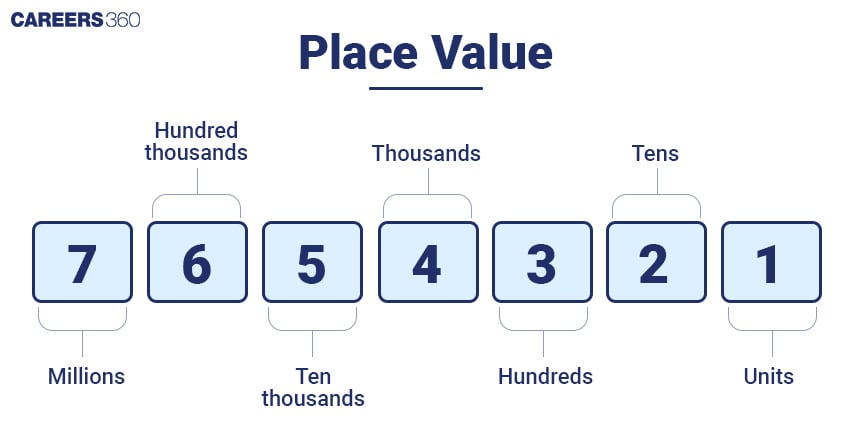
In the decimal number system, every digit has a place value.
For example, in $5487$:
$7$ is in the one’s place
$8$ is in the ten’s place
$4$ is in the hundred’s place
$5$ is in the thousand’s place
The digit at the one’s place is called the unit digit.
This is the only digit we focus on in unit digit problems.
Example
Find the unit digit of $9321$.
The digit at the one’s place is $1$.
Therefore, the unit digit is $1$.
This basic idea is the starting point for all higher-level problems.
For positive numbers, the unit digit is simply the last digit of the number.
No special rule is needed.
Example
Find the unit digit of $78654$.
The last digit is $4$.
Therefore, the unit digit is $4$.
Another example:
For $1250$, the unit digit is $0$.
This concept is very straightforward.
For negative numbers, the unit digit is still determined by the last digit of the number, ignoring the negative sign.
The sign does not affect the unit digit itself.
Example
Find the unit digit of $-347$.
Ignore the negative sign.
The last digit is $7$.
Therefore, the unit digit is $7$.
Another example:
For $-8920$, the unit digit is $0$.
This rule helps avoid confusion in simplification questions.
This is the most important concept in unit digit problems.
When numbers are multiplied, only the unit digits are needed to find the final unit digit.
Similarly, in powers, unit digits follow repeating patterns called cycles.
To find the unit digit of multiplication:
Multiply only the unit digits of the numbers.
Then take the unit digit of the result.
Example
Find the unit digit of $27 \times 34$.
Unit digit of $27 = 7$
Unit digit of $34 = 4$
Now multiply:
$7 \times 4 = 28$
Unit digit of $28 = 8$
Therefore, the unit digit of $27 \times 34$ is $8$.
This saves a lot of time.
In powers, the unit digit depends on the repeating cycle of the last digit.
Example
Find the unit digit of $2^5$.
Let us observe the pattern:
$2^1 = 2$
$2^2 = 4$
$2^3 = 8$
$2^4 = 16$
$2^5 = 32$
The unit digits are $2, 4, 8, 6$.
Then the pattern repeats.
So the unit digit of $2^5$ is $2$.
This repeating pattern is called cyclicity and is the key to solving unit digit questions quickly.
Mastering multiplication and powers makes solving advanced unit digit problems much easier in competitive exams.
The concept of unit digit is one of the most important topics in number system and quantitative aptitude. Questions based on unit digit are very common in competitive examinations like SSC, Banking, NDA, Railways, CAT, and other aptitude tests. These questions help test logical thinking, pattern recognition, and calculation speed.
By finding the unit digit of a number, we can often determine useful properties such as whether the number is even or odd, whether it can be divisible by certain numbers, and how powers of large numbers behave. This makes the unit digit concept a very scoring topic in aptitude preparation.
For example, if the unit digit of a number is $0, 2, 4, 6,$ or $8$, the number is even. If the unit digit is $1, 3, 5, 7,$ or $9$, the number is odd.
This simple idea becomes extremely powerful when solving powers, exponents, and simplification questions.
It is very easy to identify the unit digit of a small number by direct observation. However, when a number is raised to a very large power such as $7^{103}$ or $9^{245}$, finding the unit digit becomes difficult using normal calculation.
This is where the concept of cyclicity becomes important.
Cyclicity is one of the most important shortcut methods used to solve unit digit questions quickly in competitive exams.
The concept of cyclicity is based on the fact that every digit has its own repeating pattern of unit digits when raised to different powers.
This repeating sequence is called the cycle of that digit.
Instead of calculating the complete value of a large power, we only study the repeating pattern of the last digit.
This saves a lot of time in aptitude exams.
Let us observe the powers of $2$:
$2^1 = 2$ → unit digit = $2$
$2^2 = 4$ → unit digit = $4$
$2^3 = 8$ → unit digit = $8$
$2^4 = 16$ → unit digit = $6$
$2^5 = 32$ → unit digit = $2$
$2^6 = 64$ → unit digit = $4$
Here, the unit digits follow the sequence:
$2,\ 4,\ 8,\ 6$
After this, the same pattern repeats again.
This means the cyclicity of digit $2$ is $4$.
In simple words, after every $4$ powers, the unit digit repeats.
This is why finding the unit digit of large powers becomes easy.
Most unit digit questions in aptitude exams involve very large exponents.
For example:
Find the unit digit of $3^{57}$
Without cyclicity, solving this would take a long time.
With cyclicity, we simply identify the repeating pattern and use the remainder method.
This makes the question very fast and easy.
That is why cyclicity is one of the most important concepts in quantitative aptitude and number system.
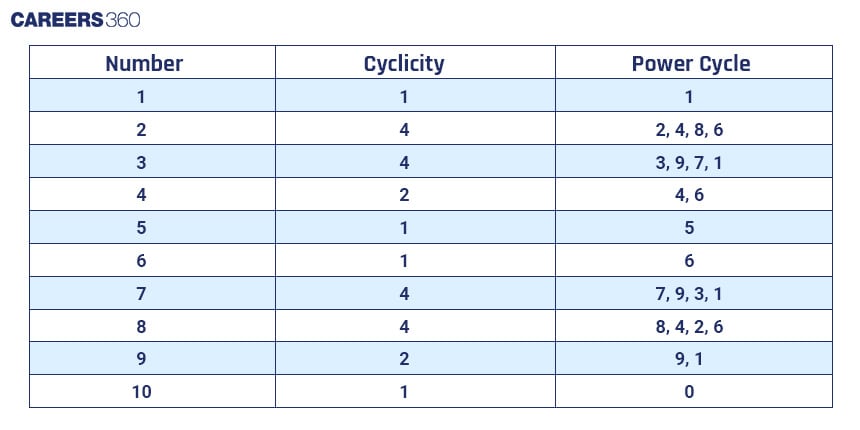
Every digit from $0$ to $9$ has its own cyclic pattern.
Some digits repeat after $4$ steps, some after $2$, and some remain the same always.
For example:
digit $0$ always gives unit digit $0$
digit $1$ always gives unit digit $1$
digit $5$ always gives unit digit $5$
digit $6$ always gives unit digit $6$
These digits have cyclicity of $1$
Digits like $2, 3, 7,$ and $8$ usually have cyclicity of $4$
Digits like $4$ and $9$ usually have cyclicity of $2$
Understanding these patterns helps solve unit digit questions much faster.
The cyclicity table is one of the most useful tools for solving unit digit questions quickly. It shows the repeating pattern of unit digits for all single-digit numbers.
Finding the unit digit of a number is one of the most important concepts in number system and quantitative aptitude. Unit digit questions are very common in competitive exams like SSC, Banking, NDA, Railways, CAT, and other aptitude tests because they can be solved quickly using logic instead of lengthy calculations.
There are mainly two types of problems when finding the unit digit of a number:
Finding the unit digit of a number formed by multiplying several numbers
Finding the unit digit of a number in the form of $x^n$
Both types follow different methods, so we need to understand them separately.
To find the unit digit of a number formed by multiplying many numbers, we only need to multiply the unit digits of those numbers.
There is no need to multiply the complete numbers.
This shortcut saves a lot of time in aptitude exams.
Step 1: Identify the unit digit of each number
Step 2: Multiply only the unit digits
Step 3: Take the unit digit of the final product
This gives the required answer.
Example
Find the unit digit of the number formed by:
$81 \times 82 \times 83 \times 84 \times 85 \times 86 \times 87 \times 88 \times 89$
Solution
Take only the unit digits:
$1 \times 2 \times 3 \times 4 \times 5 \times 6 \times 7 \times 8 \times 9$
Now simplify step by step:
$1 \times 2 = 2$
$2 \times 3 = 6$
$6 \times 4 = 24$
Unit digit = $4$
Now:
$4 \times 5 = 20$
Unit digit = $0$
Once the unit digit becomes $0$, the final unit digit will always remain $0$
Therefore, the required unit digit is:
$0$
This is one of the fastest unit digit shortcut methods.
To find the unit digit of a number in the form of $x^n$, we classify numbers based on their last digit.
Different ending digits follow different cyclic patterns.
These are divided into three important groups:
Numbers ending with $0, 1, 5, 6$
Numbers ending with $2, 3, 7, 8$
Numbers ending with $4, 9$
This classification makes unit digit questions much easier.
If a number ends with $0, 1, 5,$ or $6$, the unit digit remains the same even after raising it to any power.
This means:
$0^n \Rightarrow 0$
$1^n \Rightarrow 1$
$5^n \Rightarrow 5$
$6^n \Rightarrow 6$
for any positive integer value of $n$
The unit digit of a number ending with $0$ is always $0$
The unit digit of a number ending with $1$ is always $1$
The unit digit of a number ending with $5$ is always $5$
The unit digit of a number ending with $6$ is always $6$
This is the easiest case in unit digit problems.
Example
Find the unit digit of:
$30^{24},\ 41^{36},\ 75^{44},\ 86^{38}$
Solution
$30^{24}$ ends with $0$
So, the unit digit is $0$
$41^{36}$ ends with $1$
So, the unit digit is $1$
$75^{44}$ ends with $5$
So, the unit digit is $5$
$86^{38}$ ends with $6$
So, the unit digit is $6$
These questions can be solved instantly without calculation.
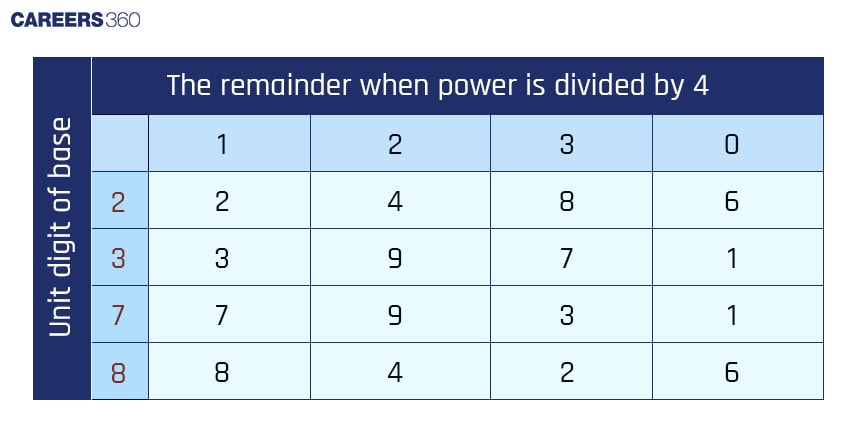
These digits follow a cyclicity of $4$
This means their unit digits repeat after every $4$ powers.
To solve such questions, we use the remainder method.
Step 1: Identify the unit digit of the base number
Step 2: Divide the power $n$ by $4$
Step 3: Find the remainder
Possible remainders are:
$0,\ 1,\ 2,\ 3$
Step 4: Use the remainder to determine the final unit digit
This method is used for digits ending in $2, 3, 7,$ and $8$
Pattern of powers of $2$:
$2^1 = 2$
$2^2 = 4$
$2^3 = 8$
$2^4 = 16$
Unit digit pattern:
$2,\ 4,\ 8,\ 6$
If remainder is $1$ → unit digit = $2$
If remainder is $2$ → unit digit = $4$
If remainder is $3$ → unit digit = $8$
If remainder is $0$ → unit digit = $6$
Example
Find the unit digit of $4562^{75}$
Solution
The unit digit of $4562$ is $2$
Now divide:
$75 \div 4$
Remainder = $3$
For digit $2$, remainder $3$ means:
Unit digit = $8$
Therefore, the required unit digit is $8$
Pattern of powers of $3$:
$3^1 = 3$
$3^2 = 9$
$3^3 = 27$
$3^4 = 81$
Unit digit pattern:
$3,\ 9,\ 7,\ 1$
If remainder is $1$ → unit digit = $3$
If remainder is $2$ → unit digit = $9$
If remainder is $3$ → unit digit = $7$
If remainder is $0$ → unit digit = $1$
Example
Find the unit digit of $563^{26}$
Solution
The unit digit of $563$ is $3$
Now divide:
$26 \div 4$
Remainder = $2$
For digit $3$, remainder $2$ means:
Unit digit = $9$
Therefore, the required unit digit is $9$
Pattern of powers of $7$:
$7^1 = 7$
$7^2 = 49$
$7^3 = 343$
$7^4 = 2401$
Unit digit pattern:
$7,\ 9,\ 3,\ 1$
If remainder is $1$ → unit digit = $7$
If remainder is $2$ → unit digit = $9$
If remainder is $3$ → unit digit = $3$
If remainder is $0$ → unit digit = $1$
Example
Find the unit digit of $2587^{113}$
Solution
The unit digit of $2587$ is $7$
Now divide:
$113 \div 4$
Remainder = $1$
For digit $7$, remainder $1$ means:
Unit digit = $7$
Therefore, the required unit digit is $7$
Pattern of powers of $8$:
$8^1 = 8$
$8^2 = 64$
$8^3 = 512$
$8^4 = 4096$
Unit digit pattern:
$8,\ 4,\ 2,\ 6$
If remainder is $1$ → unit digit = $8$
If remainder is $2$ → unit digit = $4$
If remainder is $3$ → unit digit = $2$
If remainder is $0$ → unit digit = $6$
Example
Find the unit digit of $6368^{84}$
Solution
The unit digit of $6368$ is $8$
Now divide:
$84 \div 4$
Remainder = $0$
For digit $8$, remainder $0$ means:
Unit digit = $6$
Therefore, the required unit digit is $6$
Both digits $4$ and $9$ have a cyclicity of $2$
This means only two cases exist:
even power
odd power
This makes these questions much easier.
If power is even → unit digit = $6$
If power is odd → unit digit = $4$
Example
Find the unit digit of $564^{48}$
Solution
The unit digit of $564$ is $4$
Power $48$ is even
So, the unit digit is $6$
Therefore, the required unit digit is $6$
If power is even → unit digit = $1$
If power is odd → unit digit = $9$
Example
Find the unit digit of $8759^{83}$
Solution
The unit digit of $8759$ is $9$
Power $83$ is odd
So, the unit digit is $9$
Therefore, the required unit digit is $9$
These shortcut rules make unit digit questions extremely fast and scoring in competitive exams.
Q.1. What is the unit digit of ( 217 ) 413 × ( 819 ) 547 × ( 414 ) 624 × ( 342 ) 812 ?
2
4
6
8
Hint: Use the concept of cyclicity to get the desired unit digit.
Solution:
Given:
(217)413 × (819)547 × (414)624 × (342)812
Solution:
The cyclicity of 7 is 4.
The cyclicity of 9 is 2.
The cyclicity of 4 is 2.
The cyclicity of 2 is 4.
According to the cyclicity theorem, divide the powers by 4 and take reminders. Otherwise, take 4.
The unit digit of (217)413 = 7413 = 7(4 × 10³) + 1 = 71 = 7
The unit digit of (819)547 = 9547 = 9(2 × 273) + 1 = 91 = 9
The unit digit of (414)624 = 4624 = 4(2 × 312) = 44 = 6
The unit digit of (342)812 = 2812 = 2(4 × 203) = 24 = 6
The unit digit of the given expression will be the same as the unit digit of 7413 × 9547 × 4624 × 2812
⇒ 71 × 93 × 44 × 24
For unit digit ⇒ 7 × 9 × 6 × 6
∴ The required unit digit = 8
Hence, the correct answer is option (4).
Q.2. What is the digit in the unit's place in the number 15 ! 100 ?
5
7
3
0
Hint: Number of trailing zeroes in n ! = [ n 5 ] + [ n 25 ] + [ n 125 ] + ....... where [ ] denotes greatest integer function.
Solution:
Number of trailing zeroes in n ! = [ n 5 ] + [ n 25 ] + [ n 125 ] + ....... where [ ] denotes greatest integer function.
So, the number of trailing zeroes in 15! = [ 15 5 ] + [ 15 25 ] + [ 15 125 ] + ....... = 3 + 0 + 0 + ..... = 3
⇒ Number of zeroes in the product = 3
⇒ Unit's digit in 15 ! 100 = 0
Hence, the correct answer is option (4).
Q.3. What will be the remainder when 252 126 + 244 152 is divided by 10?
4
6
0
8
Hint: When any number is divided by 10, the unit digit will be the remainder.
Solution:
To find the remainder when 252 126 + 244 152 is divided by 10, we only need to consider the unit digit of each term in the sum.
The unit digit of 252 126 is the same as the unit digit of 2126.
Divide 126 by 4 and get remainder = 2
So, the unit digit of 252 126 is 2 2 = 4
The unit digit of 244 152 is the same as the unit digit of 4152.
If the power of 4 is even, the unit digit is 6.
So, the unit digit of 244 152 is 6.
The sum of the unit digits = 4 + 6 = 10
The remainder when 252 126 + 244 152 is divided by 10 = Remainder when 10 is divided by 10 = 0
So, the remainder is 0.
Hence, the correct answer is option (3).
Q.4. Let x = (433)24 – (377)38 + (166)54. What is the unit digit of x ?
8
9
7
6
Hint: The unit digit of the power of a number repeats itself every 4th time for the base having the last digit as 3 or 7. But the last digit for the(166)54 will always be 6 as the unit digit of a power of a number having the last digit 6 will always be 6.
Solution:
Given: x = (433)24 – (377)38 + (166)54
We can write 43324 = 433(4 × 5) + 4, 37738 = 377(4 × 9) + 2
So, the unit digit of 4334 = 1 and the unit digit of 3772 = 9
The last digit for the(166)54 will always be 6 as the unit digit of a power of a number having the last digit 6 will always be 6.
∴ x = 1 – 9 + 6 = 7 – 9 → Unit digit = 17 – 9 = 8
Hence, the correct answer is option (1).
Q.5. Find the Unit digit of 287 5 62581 .
1
2
7
4
Hint: Use the cyclicity of 7.
Solution:
The unit digit of 2587 is 7.
So, we divide the power 562581 by 4 and get the remainder of 1.
Therefore, the required unit digit is 7 1 = 7 .
Hence, the correct answer is option (3).
Q.6. The unit digit in the sum of ( 124 ) 3 72 + ( 124 ) 3 73 is:
5
4
20
0
Hint: If the power of a number ending with 4 is even, then the unit digit will be 6 and if it is odd then, the unit digit will be 4.
Solution:
Both of the numbers have a unit digit of 4 and it has a repeating cycle of 2 with unit digits 4 and 6
So in the first number power is 372 which is an even number, the unit digit of the first number will be 6.
Also in the second number power is 373 which is an odd number, the unit digit of the second number will be 4.
Therefore, the unit digit of the sum will be 6 + 4 → 0.
Hence, the correct answer is option (4).
Q.7. The digit in the unit digit in the square of 66049 is:
1
2
3
4
Hint: The square of numbers ending with 9 has the unit digit of 1.
Solution:
We know, the square of numbers ending with 9 has the unit digit of 1.
So, the unit digit in the square of 66049 is 1.
Hence, the correct answer is option (1).
Q.8. Find the unit digit in 71 × 72 × 73 × 74 × 76 × 77 × 78 × 79.
1
4
6
3
Hint: We need to multiply only the unit digits.
Solution:
The unit digit of 71 × 72 × 73 × 74 × 76 × 77 × 78 × 79
→ 2 × 2 × 2 × 2 → 6.
Hence, the correct answer is option (3).
Q.9. Find the unit digit of the sum of the first 110 natural numbers.
2
3
5
4
Hint: The sum of the first n natural numbers = n ( n + 1 ) 2 .
Solution:
The sum of the first 110 natural numbers
= 110 × ( 110 + 1 ) 2 = 110 × 111 2 = 55 × 111
So, the unit digit of the sum of the first 110 natural numbers = 5 × 1 = 5.
Hence, the correct answer is option (3).
Q.10. Find the unit digit of 432 4 12 × 499 4 31 .
4
3
2
1
Hint: Use the cyclicity of numbers to solve this.
Solution:
For the first number,
We divide 412 by 4 to get the remainder of 0.
So, the unit digit of 432 4 12 is 2 4 → 6.
Also, for the second number,
The unit digit of the number 499 is 9 and the power 431 is odd.
So, the unit digit of 499 4 31 is 9.
Therefore, the unit digit of 432 4 12 × 499 4 31 is 6 × 9 → 4.
Hence, the correct answer is option (1).
Unit digit questions are one of the fastest-scoring topics in quantitative aptitude because they depend on logic, cyclicity, and observation rather than lengthy calculations. In exams like SSC, Banking, NDA, CAT, and Railways, unit digit questions are frequently asked to test speed and pattern recognition.
By learning the right shortcut tricks, students can solve even large exponent problems like $7^{103}$ or $8^{245}$ within a few seconds. The most important part is understanding cyclicity and knowing which shortcut to apply.
The most important trick for solving unit digit questions is memorizing the cyclicity patterns of digits from $0$ to $9$.
Every digit has a repeating pattern when raised to powers. Some digits repeat after $4$ powers, some after $2$, and some remain constant forever.
This repeating sequence is called cyclicity.
| Last Digit | Unit Digit Pattern | Cyclicity |
|---|---|---|
| 0 | 0 | 1 |
| 1 | 1 | 1 |
| 2 | 2, 4, 8, 6 | 4 |
| 3 | 3, 9, 7, 1 | 4 |
| 4 | 4, 6 | 2 |
| 5 | 5 | 1 |
| 6 | 6 | 1 |
| 7 | 7, 9, 3, 1 | 4 |
| 8 | 8, 4, 2, 6 | 4 |
| 9 | 9, 1 | 2 |
Instead of calculating the full value of large powers, we simply use the cycle.
Example
Find the unit digit of $7^{22}$
Pattern of $7$:
$7,\ 9,\ 3,\ 1$
Now divide:
$22 \div 4$
Remainder = $2$
The second number in the cycle is $9$
Therefore, the unit digit is $9$
This method saves a huge amount of time.
Digits ending in $4$ and $9$ are the easiest because they have cyclicity of only $2$.
This means we only need to check whether the power is even or odd.
| Power Type | Unit Digit |
|---|---|
| Even Power | 6 |
| Odd Power | 4 |
Example
Find the unit digit of $24^{18}$
The last digit is $4$
Power $18$ is even
Therefore, the unit digit is $6$
| Power Type | Unit Digit |
|---|---|
| Even Power | 1 |
| Odd Power | 9 |
Example
Find the unit digit of $39^{15}$
The last digit is $9$
Power $15$ is odd
Therefore, the unit digit is $9$
This shortcut is extremely useful in competitive exams.
Large powers like $3^{127}$ or $8^{245}$ may look difficult, but they become easy using the remainder method.
Step 1: Identify the last digit of the base number
Step 2: Find the cyclicity of that digit
Step 3: Divide the exponent by the cycle length
Step 4: Use the remainder to locate the correct position in the cycle
Step 5: If remainder is $0$, use the last digit of the cycle
This is the most important method for unit digit questions.
Example
Find the unit digit of $8^{245}$
Pattern of $8$:
$8,\ 4,\ 2,\ 6$
Cycle length = $4$
Now divide:
$245 \div 4$
Remainder = $1$
The first number in the cycle is $8$
Therefore, the unit digit is $8$
Many students lose marks because of small mistakes, not because the concept is difficult.
Avoiding these common errors improves accuracy immediately.
| Mistake | Correct Approach |
|---|---|
| Using the full number instead of the last digit | Only use the unit digit |
| Forgetting cyclicity pattern | Memorize the cyclicity table |
| Ignoring remainder $0$ case | Use the last digit of the cycle |
| Confusing even and odd powers | Check parity carefully |
| Mixing unit digit with last two digits | Solve both differently |
If remainder becomes $0$, do not use the first number of the cycle.
Always use the last number of the cycle.
Example
Find the unit digit of $2^8$
$8 \div 4$
Remainder = $0$
Cycle of $2$:
$2,\ 4,\ 8,\ 6$
Use the fourth number
Therefore, the unit digit is $6$
Not $2$
This is one of the most common exam mistakes.
Some unit digit questions follow special fixed rules and do not require the full cyclicity method.
These include:
factorial numbers
perfect squares
perfect cubes
expressions involving brackets
Understanding these cases makes solving faster.
Factorial means multiplication of all natural numbers from $1$ to that number.
For example:
$5! = 5 \times 4 \times 3 \times 2 \times 1$
For any factorial greater than or equal to $5!$, the unit digit is always $0$
This happens because factorial contains both $2$ and $5$, which create $10$
And once a number ends in $0$, the unit digit remains $0$
| Number | Unit Digit |
|---|---|
| $1!$ | 1 |
| $2!$ | 2 |
| $3!$ | 6 |
| $4!$ | 4 |
| $n!$, where $n \geq 5$ | 0 |
Example
Find the unit digit of $8!$
Since $8! \geq 5!$
Therefore, the unit digit is $0$
Perfect squares can only end with certain digits.
They can have unit digits:
$0,\ 1,\ 4,\ 5,\ 6,\ 9$
They can never end with:
$2,\ 3,\ 7,\ 8$
| Possible | Not Possible |
|---|---|
| 0 | 2 |
| 1 | 3 |
| 4 | 7 |
| 5 | 8 |
| 6 | |
| 9 |
Example
Can a perfect square end with $8$?
No, because $8$ is not a possible unit digit of a perfect square.
Perfect cubes can end with any digit from $0$ to $9$
Unlike perfect squares, there is no restriction.
$2^3 = 8$
$3^3 = 27$
$4^3 = 64$
Perfect cubes can have unit digits like $8,\ 7,\ 4$, etc.
This is an important exam concept.
Sometimes questions come in the form:
$(23 + 17)^5$
In such cases:
First solve the bracket
Then apply the unit digit rule
Example
Find the unit digit of $(18 + 12)^3$
First solve the bracket:
$18 + 12 = 30$
Now:
$30^3$
Any number ending with $0$ always gives unit digit $0$
Therefore, the answer is $0$
Many students confuse unit digit with last two digits.
Although both are pattern-based questions, their solving methods are different.
Understanding this difference is very important.
Unit digit means the digit in the one’s place only.
Last two digits means the number formed by the tens and one’s place together.
| Number | Unit Digit | Last Two Digits |
|---|---|---|
| 3487 | 7 | 87 |
| 1254 | 4 | 54 |
| 9801 | 1 | 01 |
These are not the same.
For last two digit questions, we often use modulus $100$
For unit digit questions, we only use cyclicity of the last digit
This makes last two digit problems slightly more advanced.
Example
Find the last two digits of $11^2$
$11^2 = 121$
Last two digits = $21$
This is different from unit digit logic.
Students often apply unit digit rules directly to last two digit questions.
This gives wrong answers.
Always remember:
unit digit → focus on one digit
last two digits → focus on modulus $100$
This distinction is very important for competitive exams.
Unit digit is one of the most frequently asked topics in number system and quantitative aptitude.
It appears in multiple chapters and helps save exam time.
Most unit digit problems belong to the number system chapter.
These include:
powers and exponents
cyclicity
factorials
perfect squares
perfect cubes
This makes it a core topic in aptitude exams.
Many simplification questions involve multiplication and powers.
Using unit digit tricks helps solve them quickly without full calculation.
This improves speed significantly.
Expressions like:
$a^n + b^n$
or
$(x + y)^n$
often use unit digit concepts.
This makes unit digit useful beyond arithmetic.
Unit digit questions are commonly asked in:
SSC CGL
Banking Exams
NDA
Railways
CAT
UPSC foundation mathematics
These exams prefer logic-based fast-solving questions.
That is why unit digit is considered a very high-scoring topic.
Choosing the right book helps students improve both concept clarity and speed.
| Book Name | Author | Best For |
|---|---|---|
| Quantitative Aptitude for Competitive Examinations | R.S. Aggarwal | SSC, Banking, NDA |
| Fast Track Objective Arithmetic | Rajesh Verma | Speed solving |
| Magical Book on Quicker Maths | M. Tyra | Shortcut tricks |
| Objective Arithmetic | S.P. Bakshi | Banking exams |
| How to Prepare for Quantitative Aptitude for CAT | Arun Sharma | CAT-level aptitude |
These books are highly useful for mastering unit digit and number system concepts.
This quick revision table helps students revise the most important unit digit rules before exams.
| Concept | Formula / Rule |
|---|---|
| Unit digit of multiplication | Multiply only the unit digits of the given numbers |
| Unit digit of numbers ending with $0$ | $0^n \Rightarrow 0$ |
| Unit digit of numbers ending with $1$ | $1^n \Rightarrow 1$ |
| Unit digit of numbers ending with $5$ | $5^n \Rightarrow 5$ |
| Unit digit of numbers ending with $6$ | $6^n \Rightarrow 6$ |
| Numbers ending with $2, 3, 7, 8$ | Divide power by $4$ and use remainder method |
| Numbers ending with $4, 9$ | Divide power by $2$ or check even/odd power |
| For digit $2$ cycle | $2,\ 4,\ 8,\ 6$ |
| For digit $3$ cycle | $3,\ 9,\ 7,\ 1$ |
| For digit $7$ cycle | $7,\ 9,\ 3,\ 1$ |
| For digit $8$ cycle | $8,\ 4,\ 2,\ 6$ |
| For digit $4$ cycle | $4,\ 6$ |
| For digit $9$ cycle | $9,\ 1$ |
| If remainder is $0$ (cycle of 4) | Use the 4th term of the cycle |
| If remainder is $0$ (cycle of 2) | Use the 2nd term of the cycle |
| Unit digit of factorial for $n \geq 5$ | Unit digit = $0$ |
| Unit digit of perfect square | Can only be $0,\ 1,\ 4,\ 5,\ 6,\ 9$ |
| Unit digit of perfect cube | Can be any digit from $0$ to $9$ |
| Unit digit of bracket expressions | Solve brackets first, then apply unit digit rule |
| Last two digits concept | Use modulus $100$ instead of only cyclicity |
Memorizing this table makes unit digit questions extremely fast and easy in competitive exams.
This section covers other important Quantitative Aptitude topics related to Unit Digit and Number System concepts, helping students strengthen their problem-solving speed and accuracy. It includes frequently asked topics like remainders, divisibility rules, simplification, surds and indices, and other high-scoring aptitude chapters for competitive exams.
Quantitative Aptitude Topics | |||
Frequently Asked Questions (FAQs)
The unit digit is the digit present at the one’s place of a number. It is simply the last digit of the number. For example, the unit digit of $4578$ is $8$.
To find the unit digit of a product of numbers, identify the unit digits of each number and multiply them together, then repeat this process until you obtain the unit digit of the final result.
For example: Find the unit digit of the number 81 × 82 × 83 × 84 × 85 × 86 × 87 × 88 × 89.
Sol: Multiplying only the unit digits we get,
1 × 2 × 3 × 4 × 5 × 6 × 7 × 8 × 9 ⇒ 2 × 2 × 0 × 6 × 9 ⇒ 0
So, the unit digit of the number is 0.
First, identify the cyclicity pattern of the last digit. For $7$, the pattern is $7, 9, 3, 1$. Then divide the exponent by $4$, find the remainder, and use the corresponding term in the cycle to get the unit digit.
The cyclicity concept is based on the fact that every digit in the number has its own repetitive pattern when raised to any specific power.
For example, the number 2 has a cyclicity of 4 i.e. 2, 4, 8, and 6.
These numbers always keep the same unit digit for any positive power.
$0^n \Rightarrow 0$
$1^n \Rightarrow 1$
$5^n \Rightarrow 5$
$6^n \Rightarrow 6$

Law Admissions 2026 Open | Avail Merit-Based Scholarships
BBA/MBA/PGDM Early Bird Applications Deadline 06th Nov'26. Apply now using coupon code CAREER250 and get ₹250 off the application fee
Ranked #36 amongst institutions in Management by NIRF | 100% Placement
Globally Recognized by AACSB (US) & AMBA (UK) | 18 LPA Avg. CTC for PGPM 2026
NEET PG All India & State College Predictor with Admission Process Guide
Top B-School: Ranked #9 in NIRF Management Rankings 2025.