


Harmonic Progression (H.P.) - Definition, Properties, Formulas, Examples
Imagine you are dividing your travel time for the same distance - first at 60 km/h, then 40 km/h, and then 30 km/h. Here, the speeds are changing in a special mathematical pattern where their reciprocals form an arithmetic progression. This is where the concept of Harmonic Progression (H.P.) comes in. In mathematics, a Harmonic Progression is a sequence in which the reciprocals of the terms are in Arithmetic Progression (A.P.). It is an important topic in algebra and quantitative aptitude because it helps in solving questions related to averages, ratios, speed-time-distance, and sequence-based problems. Harmonic Progression is commonly asked in exams like JEE Main, NDA, SSC, banking exams, and other competitive aptitude tests.
This Story also Contains
- What is Harmonic Progression (H.P.) in Mathematics?
- Basic Concepts of Harmonic Progression (H.P.)
- Formulas of Harmonic Progression (H.P.)
- Properties of Harmonic Progression
- Important Formulas of Harmonic Progression (H.P.) – Quick Revision Table
- Solved Examples
- Best Books for Harmonic Progression (H.P.) Preparation
- Step-by-Step Method to Solve Harmonic Progression (H.P.) Questions
- Tips and Tricks to Solve Harmonic Progression Questions Quickly
- Applications of Harmonic Progression in Real Life
- Related Quantitative Aptitude Topics
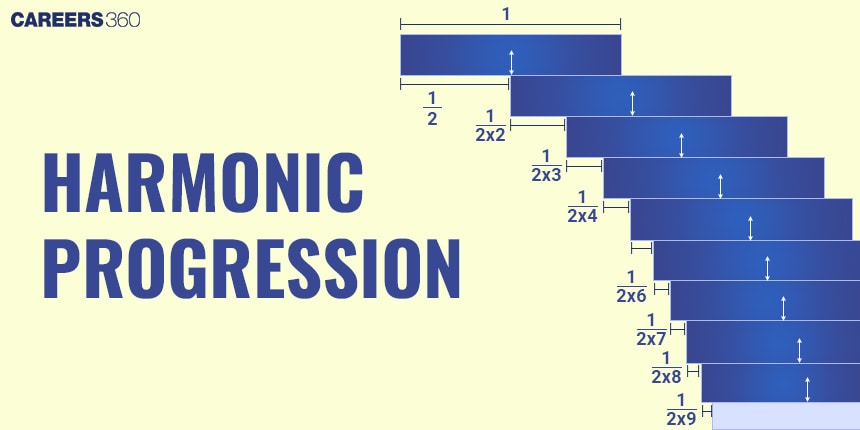
What is Harmonic Progression (H.P.) in Mathematics?
Harmonic Progression (H.P.) is one of the most important concepts in sequences and series in mathematics. It is widely used in algebra, quantitative aptitude, and competitive exam preparation. Understanding H.P. becomes much easier when you first understand Arithmetic Progression (A.P.) and the concept of reciprocals.
Definition of Harmonic Progression with Example
A sequence is said to be in Harmonic Progression (H.P.) if the reciprocals of its terms form an Arithmetic Progression (A.P.).
In simple words, if for a sequence:
$a_1, a_2, a_3, a_4, \dots$ the reciprocals $\frac{1}{a_1}, \frac{1}{a_2}, \frac{1}{a_3}, \frac{1}{a_4}, \dots$ are in A.P., then the original sequence is called a Harmonic Progression.
Example of Harmonic Progression
Consider the sequence: $\frac{1}{2}, \frac{1}{4}, \frac{1}{6}, \frac{1}{8}$
Now take reciprocals: $2, 4, 6, 8$
This forms an Arithmetic Progression with common difference $2$.
Therefore, $\frac{1}{2}, \frac{1}{4}, \frac{1}{6}, \frac{1}{8}$ is a Harmonic Progression.
This is one of the most common harmonic progression examples asked in exams.
Real-Life Applications of Harmonic Progression
Harmonic Progression is not just a theoretical topic—it has many practical applications in daily life and real-world mathematical problems.
Speed and Average Problems
Suppose you travel the same distance at different speeds like 60 km/h, 40 km/h, and 30 km/h.
The average speed in such cases often uses the concept of Harmonic Mean, which comes directly from H.P.
Work and Time Problems
In problems involving efficiency and rates of work, H.P. helps in understanding inverse relationships.
Example:
If two workers complete the same task at different rates, harmonic concepts are often used.
Finance and Ratio-Based Problems
H.P. is useful in ratio calculations, investment analysis, and data interpretation problems involving inverse values.
This makes H.P. highly relevant in quantitative aptitude topics.
Importance of H.P. in Algebra and Competitive Exams
Harmonic Progression is an important chapter in algebra and is frequently asked in exams like:
- JEE Main
- NDA
- SSC CGL
- Banking Exams (IBPS, SBI)
- CAT and other MBA entrance exams
Questions are usually asked on:
- identifying H.P. sequences
- finding Harmonic Mean (H.M.)
- converting H.P. into A.P.
- solving progression-based aptitude problems
Since H.P. questions are formula-based and logical, they are considered scoring if concepts are clear.
Learning harmonic progression formulas, properties, and shortcut tricks can help students solve these questions quickly and improve overall exam performance.
Comparison with Arithmetic Progression and Geometric Progression
Arithmetic Progression | Geometric Progression | Harmonic Progression | |
Definition | A sequence with a constant difference between consecutive terms. | A sequence with a constant ratio between consecutive terms. | A sequence where each term is the reciprocal of an arithmetic sequence. |
Example | 2, 5, 8, 11, 14, ….. It is an Arithmetic Progression. | 2, 6, 18, 54, 162,...... It is a Geometric Progression. | $\frac{1}{2}, \frac{1}{3}, \frac{1}{4},......$ It is a Harmonic Progression |
Common difference/ ratio | A fixed amount is added or subtracted between consecutive terms, which is called the common difference. | A fixed number is multiplied or divided between consecutive terms, which is called the common ratio. | Not applicable |
Application | The financial calculation is a time-based progression. | Growth models, compound interest, exponential decay. | Problems involving reciprocals, harmonic mean. |
Basic Concepts of Harmonic Progression (H.P.)
To understand Harmonic Progression (H.P.) properly, it is important to first learn its basic concepts. Since H.P. is directly connected to Arithmetic Progression (A.P.) through reciprocals, a clear understanding of these fundamentals makes solving questions much easier in algebra and competitive exams.
What is the Reciprocal Relationship in Harmonic Progression?
The most important concept in Harmonic Progression is the reciprocal relationship.
A sequence is called a Harmonic Progression when the reciprocals of its terms form an Arithmetic Progression.
If the sequence is $a_1, a_2, a_3, a_4, \dots$, then the reciprocals are $\frac{1}{a_1}, \frac{1}{a_2}, \frac{1}{a_2}, \frac{1}{a_4}, \dots$.
If these reciprocal terms are in A.P., then the original sequence is said to be in H.P.
Example of Reciprocal Relationship
Consider the sequence $\frac{1}{3}, \frac{1}{5}, \frac{1}{7}, \frac{1}{9}$.
Taking reciprocals gives $3, 5, 7, 9$.
This forms an Arithmetic Progression with common difference $2$.
Hence, $\frac{1}{3}, \frac{1}{5}, \frac{1}{7}, \frac{1}{9}$ is a Harmonic Progression.
This reciprocal rule is the foundation of all harmonic progression questions and formulas.
Understanding Sequences and Series in H.P.
In mathematics, a sequence is an ordered list of numbers arranged according to a rule.
For example, $2, 4, 6, 8$ is a sequence.
A series is the sum of the terms of a sequence.
For example, $2 + 4 + 6 + 8$ is a series.
In Harmonic Progression:
- the terms form a sequence based on reciprocal A.P.
- the sum of these terms forms the H.P. series
Example of H.P. sequence: $\frac{1}{2}, \frac{1}{4}, \frac{1}{6}, \frac{1}{8}$
Example of H.P. series: $\frac{1}{2} + \frac{1}{4} + \frac{1}{6} + \frac{1}{8}$
Understanding this difference is important for solving sequence and series questions in H.P.
How Harmonic Progression is Derived from Arithmetic Progression
Harmonic Progression is not formed directly—it is derived from Arithmetic Progression.
Step-by-Step Derivation of H.P. from A.P.
Suppose an Arithmetic Progression is $a, a+d, a+2d, a+3d, \dots$, where:
- $a$ = first term
- $d$ = common difference
Now take reciprocals of all terms:
$\frac{1}{a}, \frac{1}{a+d}, \frac{1}{a+2d}, \frac{1}{a+3d}, \dots$
This new sequence becomes a Harmonic Progression.
Example
A.P.: $4, 8, 12, 16$
Take reciprocals: $\frac{1}{4}, \frac{1}{8}, \frac{1}{12}, \frac{1}{16}$
This becomes H.P.
This method is the easiest way to identify and solve harmonic progression examples.
Key Terminology Used in Harmonic Progression
To solve H.P. problems confidently, students must understand the important terms used in this chapter.
First Term
The first value of the H.P. sequence is called the first term.
Example: In $\frac{1}{2}, \frac{1}{4}, \frac{1}{6}$, the first term is $\frac{1}{2}$.
Common Difference of Reciprocal A.P.
H.P. itself does not have a common difference.
The common difference belongs to the reciprocal A.P.
Example:
For H.P. $\frac{1}{2}, \frac{1}{4}, \frac{1}{6}$, the reciprocal A.P. is $2, 4, 6$.
So, the common difference is $2$.
Harmonic Mean (H.M.)
The average of numbers in H.P. is called the Harmonic Mean.
For two numbers $a$ and $b$:
$\text{H.M.} = \frac{2ab}{a+b}$
This is one of the most important formulas in harmonic progression aptitude questions.
nth Term of H.P.
The nth term is found by first identifying the reciprocal A.P. and then taking the reciprocal of its nth term.
This concept is widely used in exam questions.
Understanding these basic concepts of Harmonic Progression (H.P.), reciprocal relationships, and sequence formation helps students solve progression problems quickly and accurately in competitive exams.
The sum of n terms of an HP
The sum of n terms an HP is $S_n = \frac{1}{d}\log{\frac{2a + (2n-1)d}{2a - d}}$, where $a$ is the reciprocal of the first term and $d$ is the common difference of the reciprocal of the terms.
Formulas of Harmonic Progression (H.P.)
Harmonic Progression (H.P.) is an important topic in sequences and series, especially for algebra and competitive exams. To solve H.P. questions quickly, students must understand the important formulas related to the nth term, harmonic mean, and the relationship between A.P. and H.P.
Formula for nth Term of Harmonic Progression
A Harmonic Progression is formed when the reciprocals of its terms are in Arithmetic Progression.
If the corresponding A.P. is:
$a, a+d, a+2d, a+3d, \dots$
then the H.P. becomes:
$\frac{1}{a}, \frac{1}{a+d}, \frac{1}{a+2d}, \frac{1}{a+3d}, \dots$
Therefore, the nth term of H.P. is:
$T_n = \frac{1}{a+(n-1)d}$
where:
$a$ = first term of the reciprocal A.P.
$d$ = common difference of the reciprocal A.P.
$n$ = number of terms
This is the most important formula for solving harmonic progression questions.
Formula for Sum of Harmonic Progression
Unlike A.P. and G.P., there is no direct simple formula for the sum of H.P.
The sum is written as:
$S_n = \frac{1}{a} + \frac{1}{a+d} + \frac{1}{a+2d} + \dots + \frac{1}{a+(n-1)d}$
Since the sum depends on reciprocal values, it is usually simplified manually instead of using a direct shortcut formula.
This concept is commonly used in higher-level harmonic progression problems.
Relation Between A.P. and H.P. Formulas
The strongest connection in Harmonic Progression is with Arithmetic Progression.
If a sequence is in H.P., then its reciprocal sequence must be in A.P.
If H.P. is:
$\frac{1}{x_1}, \frac{1}{x_2}, \frac{1}{x_3}, \dots$
then:
$x_1, x_2, x_3, \dots$
must be in Arithmetic Progression.
This means:
Solve H.P. problems by converting them into A.P.
Apply A.P. formulas first
Then take reciprocals if needed
This shortcut makes H.P. questions much easier in competitive exams.
Important Shortcut Formulas for Harmonic Progression
Some quick formulas help in solving H.P. problems faster.
For three numbers in H.P.:
If $a, b, c$ are in H.P., then:
$\frac{1}{a}, \frac{1}{b}, \frac{1}{c}$ are in A.P.
So,
$\frac{2}{b} = \frac{1}{a} + \frac{1}{c}$
This is one of the most frequently used formulas in H.P.
For Harmonic Mean of two numbers:
$\text{H.M.} = \frac{2ab}{a+b}$
This is extremely important for objective questions.
These shortcut formulas improve speed and accuracy.
Properties of Harmonic Progression
Understanding the properties of Harmonic Progression helps students identify H.P. sequences quickly and solve questions more efficiently.
Key Properties of H.P. Sequences
Some important properties of Harmonic Progression are:
The reciprocals of H.P. terms always form an Arithmetic Progression
H.P. does not have a common difference directly
The reciprocal A.P. has a constant common difference
H.P. terms are generally non-zero
H.P. is useful in inverse relationships such as speed and efficiency
These properties are useful in both theory and problem-solving.
Relationship Between Mean Values in H.P.
There is a strong relationship between Arithmetic Mean (A.M.), Geometric Mean (G.M.), and Harmonic Mean (H.M.).
For two positive numbers:
$\text{A.M.} \geq \text{G.M.} \geq \text{H.M.}$
This means:
Arithmetic Mean is always greater than or equal to Geometric Mean, and Geometric Mean is always greater than or equal to Harmonic Mean.
This theorem is frequently asked in aptitude exams.
Harmonic Mean (H.M.) Concept and Formula
The Harmonic Mean is the average used when values are related inversely.
It is especially useful in:
speed and distance problems
work and time problems
ratio-based aptitude questions
For two numbers $a$ and $b$:
$\text{H.M.} = \frac{2ab}{a+b}$
Example
Find the H.M. of 4 and 6
$\text{H.M.} = \frac{2 \times 4 \times 6}{4+6}$
$= \frac{48}{10}$
$= 4.8$
Thus, the Harmonic Mean is 4.8.
Important Theorems Related to Harmonic Progression
Several useful theorems help in solving Harmonic Progression questions faster.
Theorem 1: Three Numbers in H.P.
If three numbers $a, b, c$ are in H.P., then: $b = \frac{2ac}{a+c}$
This means the middle term is the Harmonic Mean of the first and third terms.
Theorem 2: A.P. of Reciprocals
If: $a, b, c$ are in H.P. then:
$\frac{1}{a}, \frac{1}{b}, \frac{1}{c}$ are in A.P.
This helps in quickly identifying H.P. sequences.
Theorem 3: Mean Relationship
For two positive numbers:
$\text{A.M.} \times \text{H.M.} = (\text{G.M.})^2$
This is one of the most important formulas in sequences and series.
Learning these formulas and properties of Harmonic Progression helps students solve questions quickly in exams like JEE, NDA, SSC, Banking, and CAT.
Important Formulas of Harmonic Progression (H.P.) – Quick Revision Table
This table includes all the important Harmonic Progression formulas used in algebra, sequences and series, and quantitative aptitude. These formulas help in quick revision and faster problem-solving for competitive exams like JEE, SSC, Banking, NDA, and CAT.
| Concept | Formula | Use Case |
|---|---|---|
| nth term of H.P. | $T_n = \frac{1}{a + (n-1)d}$ | To find the nth term of harmonic progression |
| General form of H.P. | $\frac{1}{a}, \frac{1}{a+d}, \frac{1}{a+2d}, \dots$ | Standard representation of H.P. |
| Sum of H.P. | $S_n = \frac{1}{a} + \frac{1}{a+d} + \frac{1}{a+2d} + \dots$ | To calculate sum of terms in H.P. |
| Harmonic Mean of two numbers | $\text{H.M.} = \frac{2ab}{a+b}$ | To find harmonic mean between two values |
| Three numbers in H.P. | $\frac{2}{b} = \frac{1}{a} + \frac{1}{c}$ | If $a, b, c$ are in H.P. |
| Middle term in H.P. | $b = \frac{2ac}{a+c}$ | To find the middle term of three numbers in H.P. |
| Relation of A.P. and H.P. | If $\frac{1}{a}, \frac{1}{b}, \frac{1}{c}$ are in A.P., then $a, b, c$ are in H.P. | To identify H.P. |
| A.M., G.M., H.M. relation | $\text{A.M.} \geq \text{G.M.} \geq \text{H.M.}$ | Comparison of mean values |
| Mean relationship formula | $\text{A.M.} \times \text{H.M.} = (\text{G.M.})^2$ | Important theorem for mean values |
| Reciprocal rule | Reciprocal of H.P. forms A.P. | Basic concept of harmonic progression |
These formulas are highly important for solving harmonic progression questions quickly and accurately in competitive exams.
Solved Examples
Q.1. Find the 5th term of the HP 6, 3, 2, …..
$\frac{5}{6}$
$\frac{6}{5}$
$\frac{7}{5}$
$1$
Hint: Convert the given HP into an AP, then find the 5th term of that AP.
Solution:
Given: HP = 6, 3, 2, …..
The corresponding AP is $\frac{1}{6}, \frac{1}{3}, \frac{1}{2}, …...$
The first term ($a$) = $\frac{1}{6}$, common difference ($d$) = $\frac{1}{3} - \frac{1}{6} = \frac{1}{6}$.
Now, the 5th term of AP is $t_5 = a + (5 -1)d$ = $\frac{1}{6} + \frac{4}{6}$ = $\frac{5}{6}$
So, the corresponding 5th term of the HP is $\frac{6}{5}$.
Hence, the correct answer is option (2).
Q.2. Which of the following progression is helpful in deriving harmonic progression?
Algebraic progression
Geometric progression
Logarithm progression
Arithmetic progression
Hint: Harmonic progression is obtained by taking the reciprocal of the terms of an arithmetic progression.
Solution:
We know that a Harmonic Progression (HP) is defined as a sequence of real numbers that are determined by taking the reciprocals of the arithmetic progression.
So, the arithmetic progression is helpful in deriving harmonic progressions.
Hence, the correct answer is option (4).
Q.3. Find the 12th term of the harmonic progression, if the 5th term is $\frac{1}{16}$, and the 8th term is $\frac{1}{25}$.
$\frac{1}{32}$
$\frac{1}{34}$
$\frac{1}{37}$
$\frac{1}{35}$
Hint: The nth term of an HP is $t_n = \frac{1}{a + (n-1)d}$, where $a$ is the reciprocal of the first term, $d$ is the common difference of the reciprocal of the terms.
Solution:
Given: $t_5 = \frac{1}{16}$ and $t_8 = \frac{1}{25}$
Let the first term and the common difference of the corresponding AP be $a$ and $d$
⇒ $\frac{1}{a+(5-1)d}=\frac{1}{16}$ and $\frac{1}{a+(8-1)d}=\frac{1}{25}$
⇒ $\frac{1}{a+4d}=\frac{1}{16}$ and $\frac{1}{a+7d}=\frac{1}{25}$
⇒ $a+4d=16$ and $a+7d=25$
Subtracting the first equation from the second we get,
⇒ $3d = 9$ ⇒ $d = 3$
From this, we can get, $a = 16 -12$ ⇒ $a = 4$
So, the 12th term of the HP is $t_{12} = \frac{1}{4 + (12-1)3} = \frac{1}{37}$
Hence, the correct answer is option (3).
Q.4. Find the harmonic mean of 60 and 40.
48
24
36
50
Hint: Harmonic mean of two terms $a$ and $b$ is $\frac{2ab}{a+b}$
Solution:
The harmonic mean of 60 and 40 = $\frac{2×60×40}{60+40} = \frac{4800}{100} = 48$
Hence, the correct answer is option (1).
Q.5. Three numbers 5, p and 10 are in harmonic progression if p =?
7
8
$\frac{20}{3}$
$\frac{10}{3}$
Hint: In a harmonic progression, any term of the series is the harmonic mean of its neighbouring terms.
Solution:
If 5, p, and 10 are in HP then p is the harmonic mean of 5 and 10.
So, p = $\frac{2×5×10}{5+10} = \frac{100}{15} = \frac{20}{3}$
Hence, the correct answer is option (3).
Best Books for Harmonic Progression (H.P.) Preparation
This section lists the most recommended books for learning Harmonic Progression (H.P.), sequences and series, and quantitative aptitude concepts. These books help in building strong fundamentals, shortcut techniques, and exam-level practice for competitive exams like JEE, SSC, Banking, NDA, and CAT.
| Book Name | Author / Publisher | Key Features | Best For |
|---|---|---|---|
| Quantitative Aptitude for Competitive Examinations | R.S. Aggarwal | Covers arithmetic, algebra, sequences, series, and harmonic progression with detailed solved examples | SSC, Banking, NDA beginners |
| How to Prepare for Quantitative Aptitude for CAT | Arun Sharma | Strong conceptual explanations with advanced-level progression questions including A.P., G.P., and H.P. | CAT, MBA entrance exams |
| Fast Track Objective Arithmetic | Rajesh Verma | Shortcut methods, objective questions, and fast-solving techniques for progression problems | SSC CGL, CHSL, Banking |
| Magical Book on Quicker Maths | M. Tyra | Focus on speed maths, shortcut tricks, and quick aptitude solving methods | Speed improvement for competitive exams |
| Quantitative Aptitude Quantum CAT | Sarvesh Kumar Verma | High-level aptitude practice with progression-based problem solving | CAT, XAT, SNAP |
| Objective Mathematics | R.D. Sharma | Strong algebra foundation with detailed sequence and progression concepts | School + competitive exams |
| Higher Algebra | Hall and Knight | Deep conceptual understanding of algebraic progressions and harmonic progression theory | Advanced algebra preparation |
How to Choose the Right Book
For strong basics → R.S. Aggarwal or R.D. Sharma
For shortcut tricks → M. Tyra or Rajesh Verma
For CAT-level preparation → Arun Sharma or Sarvesh Kumar Verma
For advanced algebra concepts → Hall and Knight
These books are widely used for mastering harmonic progression formulas, harmonic mean, and progression-based aptitude questions.
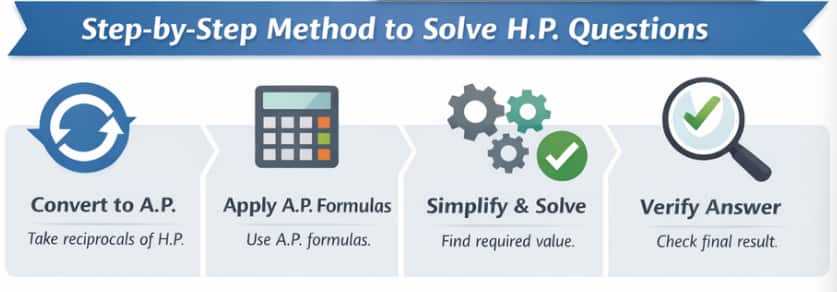
Step-by-Step Method to Solve Harmonic Progression (H.P.) Questions
This section explains a simple and effective method to solve Harmonic Progression questions in competitive exams. Since H.P. is directly related to Arithmetic Progression (A.P.), following these steps helps students solve problems faster and with better accuracy.
Convert Harmonic Progression into A.P. Using Reciprocals
The first and most important step in solving H.P. questions is converting the Harmonic Progression into Arithmetic Progression.
If the given H.P. is:
$\frac{1}{2}, \frac{1}{4}, \frac{1}{6}, \frac{1}{8}$
Take reciprocals:
$2, 4, 6, 8$
Now this becomes an Arithmetic Progression.
This step makes the problem much easier because A.P. formulas are simpler to apply.
Apply Arithmetic Progression (A.P.) Formulas
After converting H.P. into A.P., use standard A.P. formulas.
The nth term formula of A.P. is:
$T_n = a + (n-1)d$
where:
- $a$ = first term
- $d$ = common difference
- $n$ = term number
Use this formula to find the required term, common difference, or missing values.
This is the most common method used in harmonic progression problems.
Simplify and Find the Required Value
Once the A.P. calculation is complete, convert the result back if needed.
For example, if the A.P. nth term is:
$T_n = 10$
then the corresponding H.P. term will be:
$\frac{1}{10}$
Similarly, for Harmonic Mean questions, apply:
$\text{H.M.} = \frac{2ab}{a+b}$
Careful simplification helps avoid mistakes in competitive exams.
Verify the Final Answer
The final step is checking whether your answer satisfies the H.P. condition.
- Take reciprocals again
- Confirm that they form an A.P.
- Check if the common difference remains constant
This helps ensure the answer is correct and prevents calculation errors.
Following this step-by-step approach makes solving harmonic progression questions much easier for exams like JEE, SSC, Banking, NDA, and CAT.
Tips and Tricks to Solve Harmonic Progression Questions Quickly
This section covers important shortcut methods and smart tricks to solve H.P. questions faster. These techniques are especially useful in objective exams where speed and accuracy matter the most.
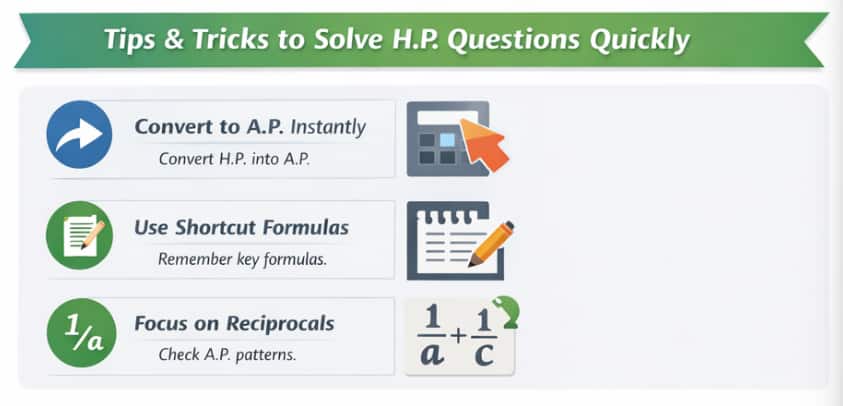
Convert to A.P. Instantly for Faster Solving
Always remember:
H.P. → Take reciprocals → Convert into A.P.
This is the golden rule of Harmonic Progression.
Instead of solving directly in H.P., convert it into A.P. first because A.P. formulas are easier and faster to apply.
This shortcut saves both time and effort.
Use Important Shortcut Formulas
Some formulas are frequently used in H.P. questions.
For three numbers in H.P.:
$\frac{2}{b} = \frac{1}{a} + \frac{1}{c}$
For Harmonic Mean of two numbers:
$\text{H.M.} = \frac{2ab}{a+b}$
For nth term:
$T_n = \frac{1}{a+(n-1)d}$
Memorizing these formulas helps solve MCQs quickly without lengthy calculations.
Focus on Reciprocals and Number Patterns
Many students make mistakes by ignoring reciprocal patterns.
Always check:
- whether reciprocals form an A.P.
- whether the common difference is constant
- whether the sequence satisfies H.P. conditions
Pattern recognition improves speed in progression-based aptitude questions.
These small observations help solve questions much faster.
Applications of Harmonic Progression in Real Life
Harmonic Progression is not just a theoretical algebra topic. It has many practical uses in daily life and real-world quantitative problems, especially where inverse relationships are involved.
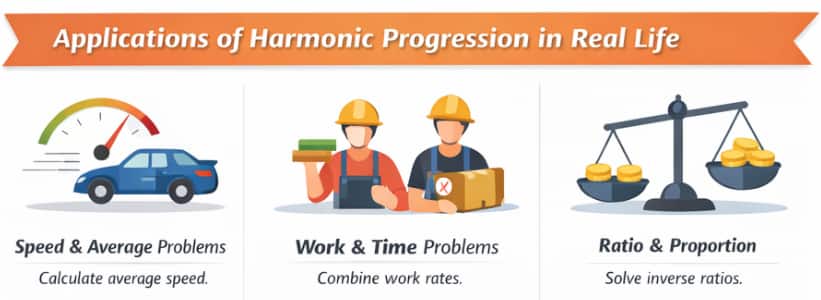
Speed and Average Problems
H.P. is commonly used in average speed calculations.
Suppose a person travels the same distance at speeds of 60 km/h and 40 km/h.
The average speed is found using Harmonic Mean, not simple average.
Formula:
$\text{H.M.} = \frac{2ab}{a+b}$
This concept is very important in speed, time, and distance questions.
Work and Time Problems
In work and time problems, rates of work are inversely related to time taken.
Example:
If one worker completes a task in 4 hours and another in 6 hours, harmonic concepts help in analyzing efficiency and combined work rates.
This makes H.P. useful in aptitude exams and real-life productivity calculations.
Ratio and Proportion Applications
H.P. is also useful in ratio-based problems where inverse proportionality exists.
It is used in:
- efficiency comparisons
- resource distribution
- financial ratios
- investment analysis
These applications make Harmonic Progression highly relevant in both mathematics and competitive exam preparation.
Understanding these real-life uses helps students connect H.P. formulas with practical problem-solving situations.
Related Quantitative Aptitude Topics
Given below are the topics related to quantitative aptitude that will help you boost your performance and score:
Quantitative Aptitude Topics | |||
Frequently Asked Questions (FAQs)
A sequence is in H.P. if the reciprocals of its terms form an Arithmetic Progression (A.P.). For example, $\frac{1}{2}, \frac{1}{4}, \frac{1}{6}$ is in H.P. because $2, 4, 6$ is an A.P.
Take reciprocals of the terms. If $\frac{1}{a_1}, \frac{1}{a_2}, \frac{1}{a_3}, \dots$ form an A.P., then the original sequence is in H.P.
If the corresponding A.P. is $a, a+d, a+2d, \dots$, then the nth term of H.P. is $T_n = \frac{1}{a + (n-1)d}$.
Harmonic Mean is the average of numbers in inverse form. For two numbers $a$ and $b$, $\text{H.M.} = \frac{2ab}{a+b}$.
For positive numbers, $\text{A.M.} \geq \text{G.M.} \geq \text{H.M.}$ and also $\text{A.M.} \times \text{H.M.} = (\text{G.M.})^2$.
