


Square Root and Cube Root of Surds: Definition, Calculator, Questions, Formula
Have you ever wondered how to find the square root of $\sqrt{50}$ or the cube root of $\sqrt[3]{54}$ when the number is not a perfect square or a perfect cube? Such expressions are called surds, and they are used to represent irrational numbers in an exact mathematical form. Square roots and cube roots of surds are important concepts in algebra, number systems, and higher mathematics because they help simplify complex expressions and solve equations involving irrational numbers. These concepts are frequently used in school mathematics, JEE, CUET, SSC, Banking, CAT, Railways, Defence, and other competitive examinations. In this article, we will explore the meaning of square roots and cube roots of surds, their structure, properties, simplification methods, formulas, solved examples, applications, shortcut tricks, and quantitative aptitude practice questions.
This Story also Contains
- What are Surds?
- Structure of Surds
- Types of Surds
- Square Roots of Surds
- Cube Roots of Surds
- Square roots and Cube roots: An Overview
- How to find the Square root of a number
- The square root of a Surd
- How to find the Cube root of a number
- Cube root of a Surd
- Best Books for Square Roots, Cube Roots, and Surds
- Shortcut Tips and Tricks for Square Roots and Cube Roots of Surds
- Tips to Solve Surds Questions Quickly
- Important Formula Table for Square Roots and Cube Roots of Surds
- Practice Questions/Solved Examples based on square and cube roots of surds
- Related Quantitative Aptitude Topics
What are Surds?
Surds are irrational numbers represented in root form. They cannot be simplified further into rational numbers and are commonly encountered in algebra, geometry, trigonometry, and higher mathematics. Understanding surds is essential for solving square root and cube root problems in school mathematics and competitive examinations.
Surds Meaning in Simple Words
A surd is a root expression whose value is irrational.
In simple words, if the square root, cube root, or higher root of a number cannot be expressed as an exact rational number, it is called a surd.
Examples
$\sqrt{2}$
$\sqrt{3}$
$\sqrt{5}$
$\sqrt[3]{7}$
These numbers cannot be written as simple fractions and have non-terminating, non-repeating decimal values.
Definition of Surds
A surd is an irrational root expression that cannot be simplified into a rational number.
Mathematically:
$\sqrt[n]{a}$
is a surd if $a$ is not a perfect $n^{th}$ power.
Examples
$\sqrt{2}$
$\sqrt{11}$
$\sqrt[3]{5}$
Non-Examples
$\sqrt{25}=5$
$\sqrt{81}=9$
$\sqrt[3]{64}=4$
Since these simplify to rational numbers, they are not surds.
Real-Life Examples of Surds
Surds frequently appear in practical situations involving measurements and geometry.
Examples
| Situation | Surd Expression |
|---|---|
| Diagonal of a square of side 1 unit | $\sqrt{2}$ |
| Distance between two points | $\sqrt{x^2+y^2}$ |
| Geometry and mensuration | $\sqrt{3}$, $\sqrt{5}$ |
| Engineering calculations | Root-based measurements |
| Physics formulas | Irrational quantities |
Example
For a square of side 1 unit:
$\text{Diagonal}=\sqrt{1^2+1^2}$
$=\sqrt{2}$
Thus, the diagonal length is a surd.
Why Surds are Important in Mathematics
Surds are important because they:
help represent irrational numbers exactly
simplify algebraic calculations
are used in coordinate geometry
appear in trigonometry and mensuration
help solve quadratic equations
are frequently asked in aptitude and entrance examinations
Applications of Surds
| Field | Application |
|---|---|
| Algebra | Simplification and factorization |
| Geometry | Lengths and diagonals |
| Trigonometry | Exact values of angles |
| Engineering | Measurement calculations |
| Competitive Exams | Number system and algebra questions |
Structure of Surds
Every surd consists of specific components that determine its value and form.
Understanding the structure of surds helps in simplification and arithmetic operations.
Components of a Surd
A surd generally contains:
Radical sign
Radicand
Index (in some cases)
Example
$\sqrt[3]{54}$
Here:
Radical sign = $\sqrt{\phantom{x}}$
Radicand = 54
Index = 3
Radical Sign, Radicand, and Index
The different parts of a surd are defined below.
| Component | Meaning |
|---|---|
| Radical Sign | Symbol representing the root |
| Radicand | Number inside the root |
| Index | Degree of the root |
Example
In:
$\sqrt[4]{81}$
Radical sign = $\sqrt{\phantom{x}}$
Radicand = 81
Index = 4
For square roots, the index is generally omitted.
Example:
$\sqrt{16}$
Here, the index is 2.
Standard Form of a Surd
A surd is said to be in standard form when:
The radicand contains no perfect square factors (for square roots).
The radicand contains no perfect cube factors (for cube roots).
Examples
$\sqrt{12}=2\sqrt{3}$
$\sqrt{50}=5\sqrt{2}$
$\sqrt[3]{54}=3\sqrt[3]{2}$
These are standard forms because the surd part cannot be simplified further.
Rational and Irrational Parts of a Surd
A surd may contain both rational and irrational components.
Example
$5\sqrt{2}$
Here:
Rational part = 5
Irrational part = $\sqrt{2}$
Similarly,
$3\sqrt[3]{7}$
contains:
Rational part = 3
Irrational part = $\sqrt[3]{7}$
Types of Surds
Surds are classified into different categories based on their structure and characteristics.
Simple Surds
A simple surd contains only one irrational root.
Examples
$\sqrt{2}$
$\sqrt{7}$
$\sqrt[3]{5}$
These surds contain a single radical expression.
Compound Surds
A compound surd contains two or more surds combined through addition or subtraction.
Examples
$\sqrt{2}+\sqrt{3}$
$\sqrt{5}-\sqrt{2}$
$\sqrt{7}+\sqrt{11}$
Compound surds are commonly encountered in algebraic simplification problems.
Pure Surds
A pure surd has no rational factor outside the radical sign.
Examples
$\sqrt{2}$
$\sqrt{11}$
$\sqrt[3]{7}$
Only the irrational root is present.
Mixed Surds
A mixed surd contains both a rational coefficient and an irrational root.
Examples
$2\sqrt{3}$
$5\sqrt{2}$
$7\sqrt[3]{4}$
These are obtained after simplifying surds.
Similar and Dissimilar Surds
Similar Surds
Surds having the same irrational part are called similar surds.
Examples:
$2\sqrt{5}$
$7\sqrt{5}$
$10\sqrt{5}$
All contain the same surd part $\sqrt{5}$.
Dissimilar Surds
Surds having different irrational parts are called dissimilar surds.
Examples:
$\sqrt{2}$
$\sqrt{3}$
$\sqrt{5}$
These cannot be directly combined through addition or subtraction.
Square Roots of Surds
Square roots of surds are obtained by finding the square root of an irrational root expression.
They are commonly used in algebra and advanced simplification problems.
Meaning of Square Root of a Surd
The square root of a surd is another surd whose square equals the original surd.
Example
$\sqrt{\sqrt{16}}$
$=\sqrt{4}$
$=2$
For irrational surds:
$\sqrt{\sqrt{2}}$
$=2^{1/4}$
which is also a surd.
How to Find the Square Root of a Surd
The easiest method is to express the surd using exponents.
Formula
$\sqrt{\sqrt[n]{a}}=a^{\frac{1}{2n}}$
Example
$\sqrt{\sqrt{3}}$
$=(3^{1/2})^{1/2}$
$=3^{1/4}$
Simplifying Square Roots of Surds
Use exponent rules and prime factorization.
Example 1
$\sqrt{12}$
$=\sqrt{4\times3}$
$=2\sqrt{3}$
Example 2
$\sqrt{75}$
$=\sqrt{25\times3}$
$=5\sqrt{3}$
Solved Examples of Square Roots of Surds
Example 1
Find:
$\sqrt{50}$
Solution:
$\sqrt{50}$
$=\sqrt{25\times2}$
$=5\sqrt{2}$
Example 2
Find:
$\sqrt{108}$
Solution:
$\sqrt{108}$
$=\sqrt{36\times3}$
$=6\sqrt{3}$
Cube Roots of Surds
Cube roots of surds involve irrational root expressions whose cube roots cannot be expressed as rational numbers.
These concepts are important in algebra, indices, and higher mathematics.
Meaning of Cube Root of a Surd
The cube root of a surd is a number which, when cubed, gives the original surd.
Example
$\sqrt[3]{\sqrt{2}}$
$=(2^{1/2})^{1/3}$
$=2^{1/6}$
which is also a surd.
How to Find the Cube Root of a Surd
Convert the radical expression into fractional exponent form.
Formula
$\sqrt[3]{\sqrt[n]{a}}=a^{\frac{1}{3n}}$
Example
$\sqrt[3]{\sqrt{5}}$
$=(5^{1/2})^{1/3}$
$=5^{1/6}$
Simplifying Cube Roots of Surds
Extract perfect cube factors from the radicand.
Example 1
$\sqrt[3]{54}$
$=\sqrt[3]{27\times2}$
$=3\sqrt[3]{2}$
Example 2
$\sqrt[3]{128}$
$=\sqrt[3]{64\times2}$
$=4\sqrt[3]{2}$
Solved Examples of Cube Roots of Surds
Example 1
Find:
$\sqrt[3]{250}$
Solution:
$\sqrt[3]{250}$
$=\sqrt[3]{125\times2}$
$=5\sqrt[3]{2}$
Example 2
Find:
$\sqrt[3]{686}$
Solution:
$\sqrt[3]{686}$
$=\sqrt[3]{343\times2}$
$=7\sqrt[3]{2}$
These square roots and cube roots of surds form the foundation for advanced topics such as rationalization, indices, algebraic simplification, and higher mathematics.
Square roots and Cube roots: An Overview
Square roots and cube roots are fundamental operations in mathematics. The square root of a number $x$ is a value $y$ such that $y^2 = x$, and the cube root of $x$ is a value $y$ such that $y^3 = x$. These operations are crucial for solving equations, simplifying expressions, and understanding various mathematical concepts.
How to find the Square root of a number
Finding the square root of a number is a fundamental mathematical operation that involves determining a number that, when multiplied by itself, yields the original number. Various methods such as long division, factorisation, and approximation are used to compute square roots accurately.
Long Division Method
The long division method for finding the square root of a number involves a step-by-step process of division and estimation. Here’s how it works:
Step 1: Group the number into pairs of digits starting from right to left.
Step 2: Starting with the leftmost pair, find the largest integer whose square is less than or equal to the first pair of digits. This forms the first part of the square root.
Step 3: Subtract the square of this integer from the original pair and bring down the next pair of digits to form a new dividend.
Step 4: Double the current part of the square root found so far and find the next digit that, when multiplied by itself, gives a number close to the new dividend.
Step 5: Repeat steps 3 and 4 until all pairs of digits have been used, forming the complete square root.
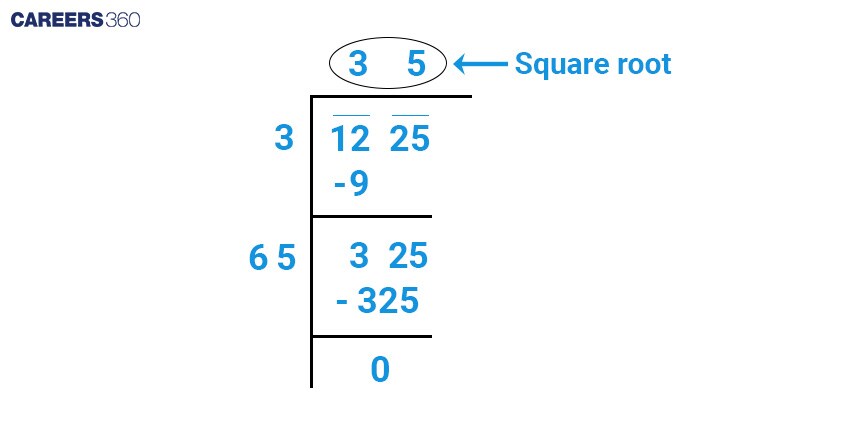
Example: Find the square root of 1225 using the long division method.
Method of factor
The factorisation method for finding the square root of a number involves the following steps:
Step 1: Factorize the number into its prime factors.
Step 2: Take one factor from each pair of these prime factors.
Step 3: Multiply these to obtain the square root.
Example: Find the square root of 324 using the factorisation method.
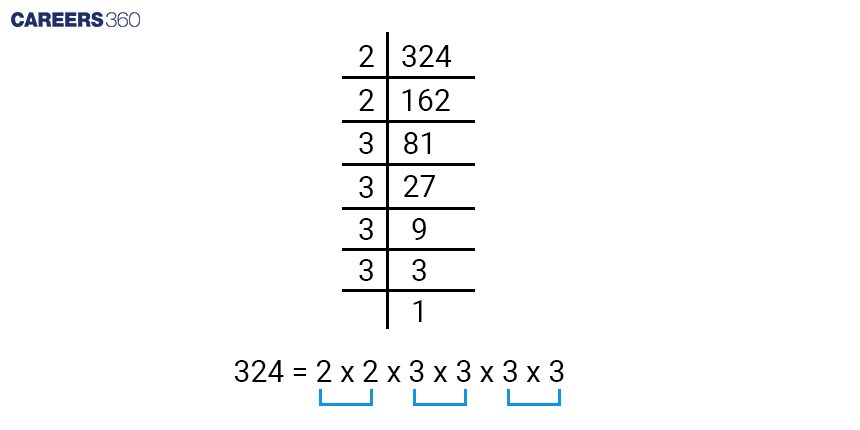
So, the square root of 324 is (2 × 3 × 3) = 18.
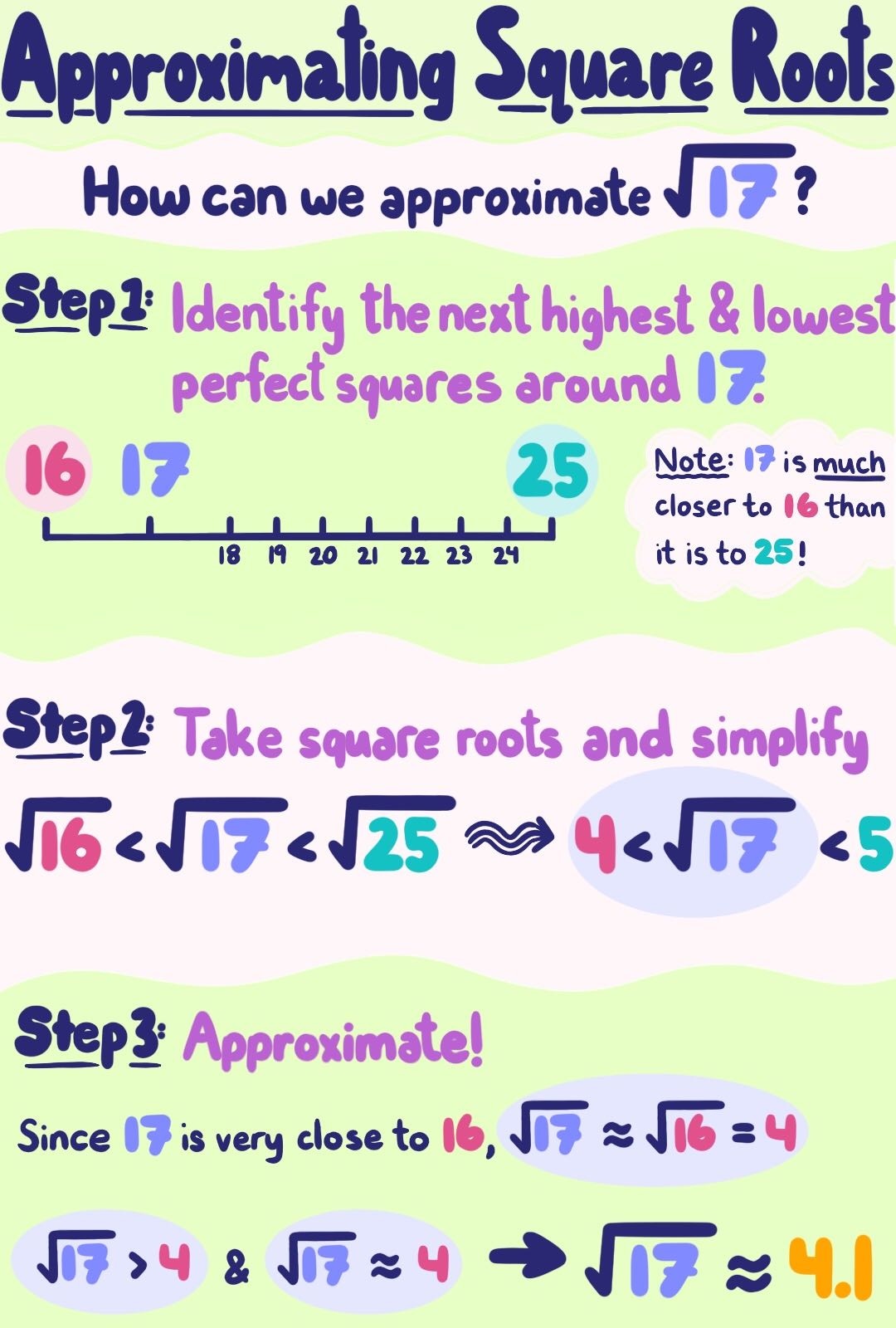
Method of Approximation
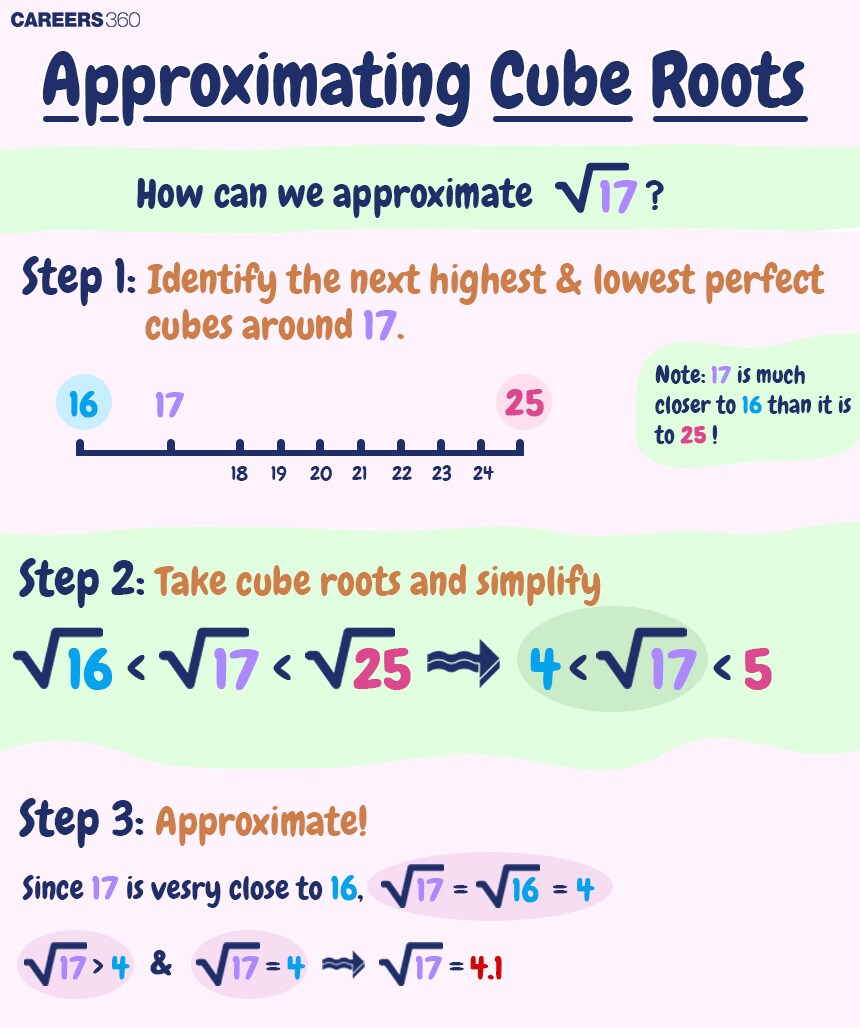
This method involves estimating the square root by identifying two close perfect squares and interpolating them.
The square root of a Surd
The square root of a surd refers to simplifying an expression that contains a square root of a number that is not a perfect square. Surds often involve radicals (square roots) of numbers that cannot be simplified further into rational numbers. Finding the square root of a surd typically involves using algebraic techniques to express it in a simplified form.
Steps to find the square root of a surd
Let’s find the square root of the surd ($a+\sqrt{b}$) following these general steps:
Use the formula, $(a + b)^2 = a^2 + 2ab + b^2$, to simplify the expression of $\sqrt{a + \sqrt{b}}$.
Identify $x$ and $y$ such that $\sqrt{a + \sqrt{b}} = (\sqrt{x} + \sqrt{y})^2$.
The square root of ($a+\sqrt{b}$) will be $(\sqrt{x} + \sqrt{y})$.
Example: Find the square root of $(9+4\sqrt{5})$.
Here, $9+4\sqrt{5}$ = $4+5+4\sqrt{5}$ = $(2)^2+2×2×\sqrt{5}+(\sqrt{5})^2$ = $(2+\sqrt{5})^2$
Hence, the square root of $(9+4\sqrt{5})$ is $(2+\sqrt{5})$ or $-(2+\sqrt{5})$.
How to find the Cube root of a number
Finding the cube root of a number involves determining a value which, when multiplied by itself three times, equals the original number. There are various ways to find the cube root of a number, let's discuss them with proper examples.
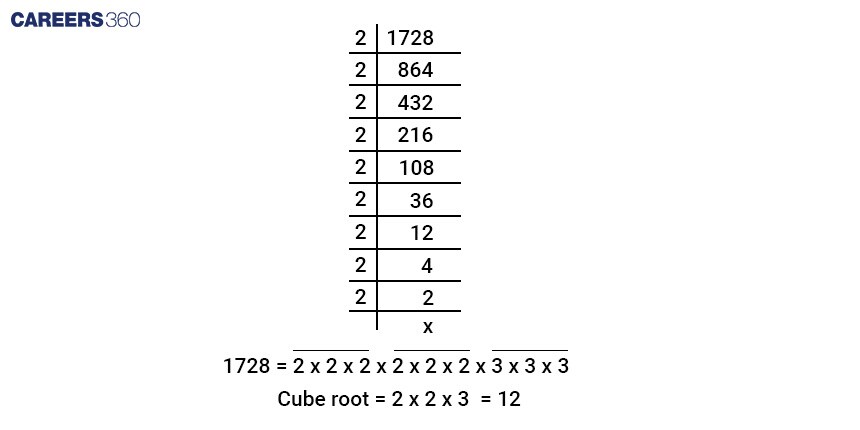
Method of factor
This method is similar to finding the square root by factorisation but involves triplets of factors. Finding the cube root of a number using the factorization method involves the following steps:
Break down the number into its prime factors.
Group the prime factors into sets of three identical factors.
For each group of three identical factors, take one factor out of the group.
Multiply these factors together to get the cube root of the original number.
Example: Find the cube root of 1728 using the factorisation method.
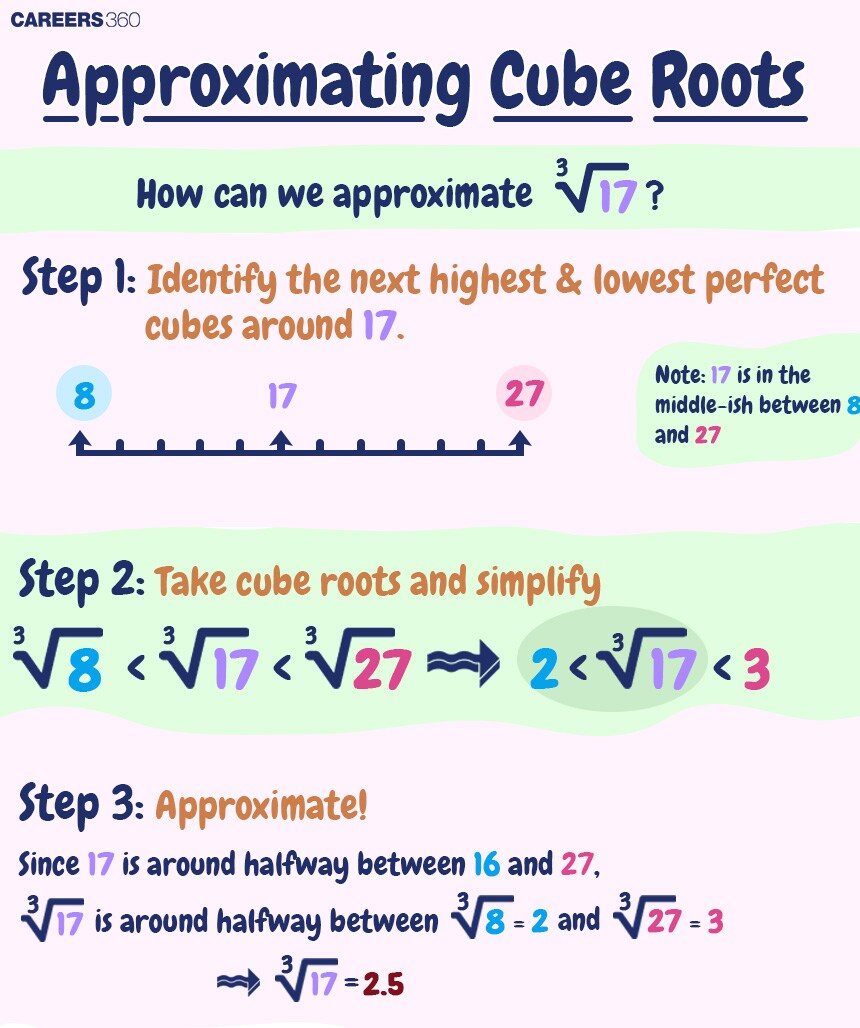
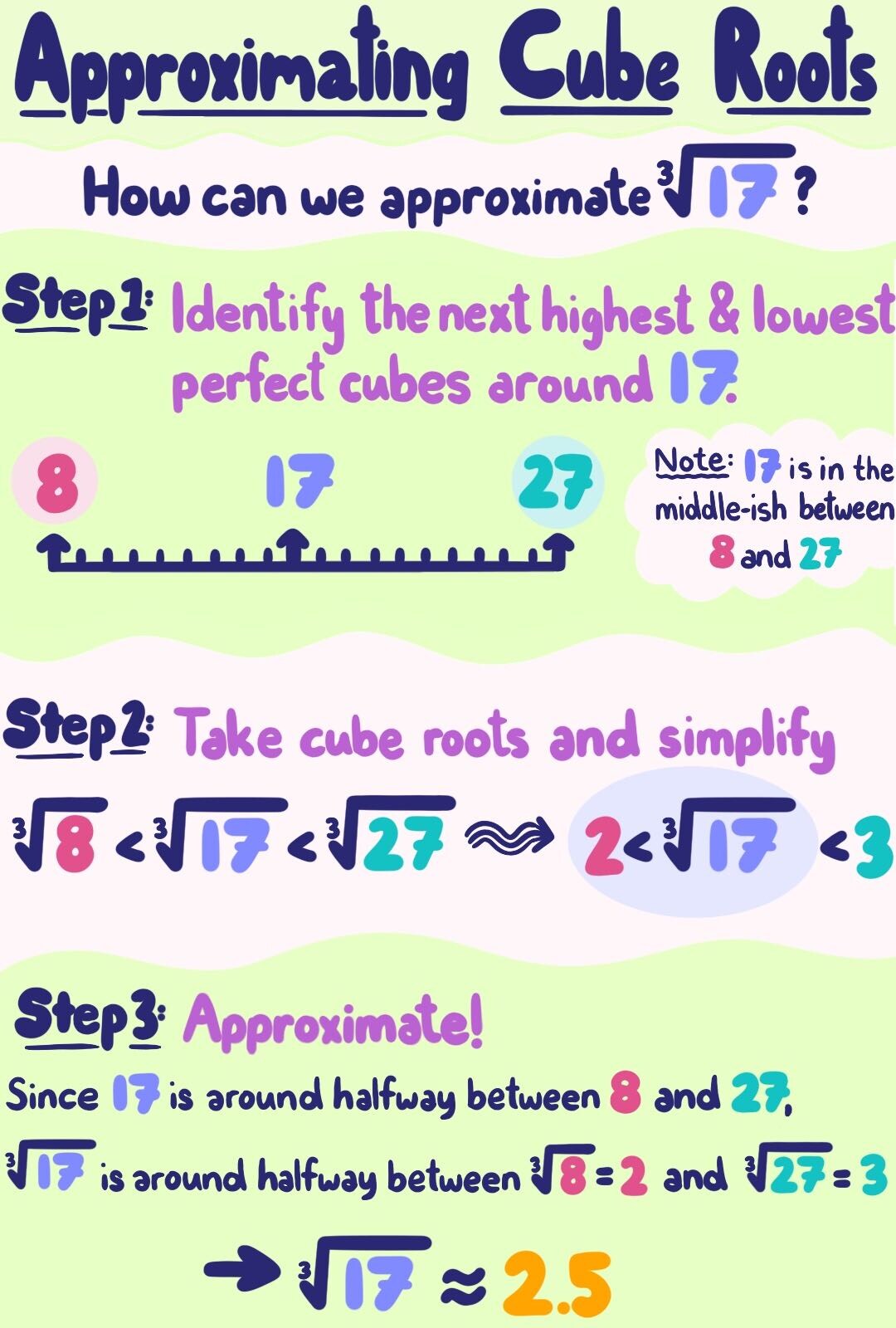
Method of Approximation
Estimate the cube root by identifying two close perfect cubes.
Example: Find the cube root of 17 using the approximation method.
Cube root of a Surd
The cube root of a surd involves simplifying an expression that includes a cube root of a number that is not a perfect cube. Finding the cube root of a surd generally requires using algebraic methods such as using specific formulas to simplify and express the cube root in its simplest form.
Steps to find the cube root of a surd
Let’s find the cube root of the surd ($a+\sqrt{b}$) following these general steps:
Use the formula, $(a + b)^3 = a^3 + 3a^2b + 3ab^2 + b^3$, to simplify expression of $\sqrt{a + \sqrt{b}}$.
Identify $x$ and $y$ such that $\sqrt{a + \sqrt{b}} = (\sqrt{x} + \sqrt{y})^3$.
The cube root of ($a+\sqrt{b}$) will be $(\sqrt{x} + \sqrt{y})$.
Example: Find the cube root of $10 + 6\sqrt{3}$.
Here, $10 + 6\sqrt{3}$
= $1 + 9 + 3\sqrt{3} + 3\sqrt{3}$
= $(1)^3 + 3×(1)^2×(\sqrt{3}) + 3×(1)×(\sqrt{3})^2 + (\sqrt{3})^3$
= $(1+\sqrt{3})^3$
So, the cube root of $10 + 6\sqrt{3}$ is $(1+\sqrt{3})$.
Best Books for Square Roots, Cube Roots, and Surds
A strong understanding of surds, square roots, and cube roots is essential for mastering number systems, algebra, simplification, and quantitative aptitude. The following books are highly recommended for both concept building and exam preparation.
| Book Name | Best For | Why It Helps |
|---|---|---|
| Quantitative Aptitude for Competitive Examinations | SSC, Banking, CUET, Railways | Covers surds, indices, square roots, cube roots, and aptitude questions |
| Fast Track Objective Arithmetic | Competitive exams | Provides shortcut techniques and practice questions |
| Magical Book on Quicker Maths | Mental calculations | Useful for learning square root and cube root tricks |
| NCERT Mathematics Textbook | School students | Builds strong fundamentals of surds and irrational numbers |
| Objective Arithmetic | Exam preparation | Includes topic-wise questions and shortcuts |
Shortcut Tips and Tricks for Square Roots and Cube Roots of Surds
Surd questions can often be solved quickly by identifying perfect square and perfect cube factors. These shortcuts are particularly useful in competitive examinations.
| Trick | Shortcut |
|---|---|
| Extract perfect squares | $\sqrt{72}=\sqrt{36\times2}=6\sqrt{2}$ |
| Extract perfect cubes | $\sqrt[3]{54}=\sqrt[3]{27\times2}=3\sqrt[3]{2}$ |
| Use prime factorization | Simplifies complex surds quickly |
| Convert roots into indices | $\sqrt{a}=a^{1/2}$ and $\sqrt[3]{a}=a^{1/3}$ |
| Identify similar surds | Only similar surds can be added or subtracted directly |
| Rationalize denominators | Remove surds from denominators for simpler calculations |
| Memorize common squares and cubes | Speeds up simplification and root calculations |
Tips to Solve Surds Questions Quickly
These practical tips can improve speed and accuracy in school and competitive examinations.
| Tip | Explanation |
|---|---|
| Look for perfect square factors first | Simplifies square root surds quickly |
| Look for perfect cube factors first | Simplifies cube root surds quickly |
| Use exponent rules | Makes root operations easier |
| Combine only similar surds | Dissimilar surds cannot be directly added |
| Simplify before calculating | Reduces chances of errors |
| Learn common square values | Helps identify simplifications faster |
| Learn common cube values | Useful in cube root questions |
Important Formula Table for Square Roots and Cube Roots of Surds
The formulas below are frequently used in surds, indices, algebra, and quantitative aptitude.
| Concept | Formula |
|---|---|
| Square Root | $\sqrt{a}=a^{1/2}$ |
| Cube Root | $\sqrt[3]{a}=a^{1/3}$ |
| Product Rule | $\sqrt{ab}=\sqrt{a}\times\sqrt{b}$ |
| Quotient Rule | $\sqrt{\frac{a}{b}}=\frac{\sqrt{a}}{\sqrt{b}}$ |
| Square Root of a Surd | $\sqrt{\sqrt[n]{a}}=a^{\frac{1}{2n}}$ |
| Cube Root of a Surd | $\sqrt[3]{\sqrt[n]{a}}=a^{\frac{1}{3n}}$ |
| Power of a Surd | $(\sqrt[n]{a})^m=a^{m/n}$ |
| Rationalization | $\frac{1}{\sqrt{a}}=\frac{\sqrt{a}}{a}$ |
| Conjugate Identity | $(a+b)(a-b)=a^2-b^2$ |
Important Perfect Squares for Surds
| Number | Square |
|---|---|
| 1 | 1 |
| 2 | 4 |
| 3 | 9 |
| 4 | 16 |
| 5 | 25 |
| 6 | 36 |
| 7 | 49 |
| 8 | 64 |
| 9 | 81 |
| 10 | 100 |
| 11 | 121 |
| 12 | 144 |
| 13 | 169 |
| 14 | 196 |
| 15 | 225 |
Important Perfect Cubes for Surds
| Number | Cube |
|---|---|
| 1 | 1 |
| 2 | 8 |
| 3 | 27 |
| 4 | 64 |
| 5 | 125 |
| 6 | 216 |
| 7 | 343 |
| 8 | 512 |
| 9 | 729 |
| 10 | 1000 |
These tables provide a quick revision sheet for surds and indices, square roots of surds, cube roots of surds, irrational numbers, algebraic simplification, and quantitative aptitude preparation.
Practice Questions/Solved Examples based on square and cube roots of surds
Q1. If $9\sqrt{x}=\sqrt{12}+\sqrt{147}$, then $x=$ ?
- 5
- 3
- 2
- 4
Hint: Simplify the square roots and compare both sides.
Solution:
Given,
$9\sqrt{x}=\sqrt{12}+\sqrt{147}$
Simplifying the surds,
$\sqrt{12}=\sqrt{4\times3}$
$=2\sqrt{3}$
and
$\sqrt{147}=\sqrt{49\times3}$
$=7\sqrt{3}$
Substituting these values,
$9\sqrt{x}=2\sqrt{3}+7\sqrt{3}$
$9\sqrt{x}=9\sqrt{3}$
Dividing both sides by 9,
$\sqrt{x}=\sqrt{3}$
Squaring both sides,
$x=3$
Correct Answer: 3
Q2. $2\sqrt{54}-6\sqrt{\frac{2}{3}}-\sqrt{96}$ is equal to:
- $\sqrt{6}$
- $0$
- $1$
- $2$
Hint: Simplify all the surds and then combine like terms.
Solution:
Given,
$2\sqrt{54}-6\sqrt{\frac{2}{3}}-\sqrt{96}$
Simplifying,
$\sqrt{54}=\sqrt{9\times6}$
$=3\sqrt{6}$
Therefore,
$2\sqrt{54}=6\sqrt{6}$
Also,
$\sqrt{96}=\sqrt{16\times6}$
$=4\sqrt{6}$
Substituting,
$=6\sqrt{6}-6\sqrt{\frac{2}{3}}-4\sqrt{6}$
$=2\sqrt{6}-6\sqrt{\frac{2}{3}}$
Writing $\sqrt{6}$ as $\sqrt{2}\sqrt{3}$,
$=2\sqrt{2}\sqrt{3}-6\frac{\sqrt{2}}{\sqrt{3}}$
Taking LCM,
$=\frac{2\sqrt{2}\sqrt{3}\times\sqrt{3}-6\sqrt{2}}{\sqrt{3}}$
$=\frac{6\sqrt{2}-6\sqrt{2}}{\sqrt{3}}$
$=\frac{0}{\sqrt{3}}$
$=0$
Correct Answer: 0
Q3. $\frac{\sqrt{24}+\sqrt{216}}{\sqrt{96}}$ is equal to:
- 1
- 6
- 8
- 2
Hint: Simplify each square root first.
Solution:
Given,
$\frac{\sqrt{24}+\sqrt{216}}{\sqrt{96}}$
Simplifying the numerator,
$\sqrt{24}=\sqrt{4\times6}$
$=2\sqrt{6}$
and
$\sqrt{216}=\sqrt{36\times6}$
$=6\sqrt{6}$
Therefore,
$\frac{\sqrt{24}+\sqrt{216}}{\sqrt{96}}$
$=\frac{2\sqrt{6}+6\sqrt{6}}{\sqrt{96}}$
$=\frac{8\sqrt{6}}{\sqrt{96}}$
Now,
$\sqrt{96}=\sqrt{16\times6}$
$=4\sqrt{6}$
Substituting,
$=\frac{8\sqrt{6}}{4\sqrt{6}}$
$=\frac{8}{4}$
$=2$
Correct Answer: 2
Q4. What is the value of $\sqrt{1509+\sqrt{144}}$ ?
- 39
- 37
- 41
- 49
Hint: First evaluate the inner square root.
Solution:
Given,
$\sqrt{1509+\sqrt{144}}$
We know,
$\sqrt{144}=12$
Substituting,
$=\sqrt{1509+12}$
$=\sqrt{1521}$
Now,
$39^2=1521$
Therefore,
$\sqrt{1521}=39$
Correct Answer: 39
Q5. What is the simplified value of $\frac{33}{(6-\sqrt3)}$ ?
- $6+\sqrt3$
- $6-\sqrt3$
- $12+\sqrt3$
- $12-\sqrt3$
Hint: Rationalize the denominator using the conjugate $(6+\sqrt3)$.
Solution:
Given,
$\frac{33}{(6-\sqrt3)}$
Multiplying numerator and denominator by $(6+\sqrt3)$,
$=\frac{33}{(6-\sqrt3)}\times\frac{(6+\sqrt3)}{(6+\sqrt3)}$
$=\frac{33(6+\sqrt3)}{(6-\sqrt3)(6+\sqrt3)}$
Using the identity,
$(a-b)(a+b)=a^2-b^2$
$=\frac{33(6+\sqrt3)}{6^2-(\sqrt3)^2}$
$=\frac{33(6+\sqrt3)}{36-3}$
$=\frac{33(6+\sqrt3)}{33}$
$=6+\sqrt3$
Correct Answer: $6+\sqrt3$
Q6. If $a = 64$ and $b = 289$, then the value of $\sqrt{\sqrt{\sqrt{a}+\sqrt{b}}-\sqrt{\sqrt{b}-\sqrt{a}}}$ is:
$2^{\frac{1}{2}}$
$2$
$4$
$-1$
Hint: Substitute the values of $a$ and $b$ into the expression and simplify step by step.
Solution:
Given,
$a=64$
$b=289$
The given expression is:
$\sqrt{\sqrt{\sqrt{a}+\sqrt{b}}-\sqrt{\sqrt{b}-\sqrt{a}}}$
Substituting the values of $a$ and $b$,
$=\sqrt{\sqrt{\sqrt{64}+\sqrt{289}}-\sqrt{\sqrt{289}-\sqrt{64}}}$
$=\sqrt{\sqrt{8+17}-\sqrt{17-8}}$
$=\sqrt{\sqrt{25}-\sqrt{9}}$
$=\sqrt{5-3}$
$=\sqrt{2}$
$=2^{\frac{1}{2}}$
Correct Answer: $2^{\frac{1}{2}}$
Q7. The square root of $\frac{2+\sqrt{3}}{2}$ is:
$\pm \frac{1}{\sqrt{2}}(\sqrt{3}+1)$
$\pm \frac{1}{2}(\sqrt{3}-2)$
None of these
$\pm \frac{1}{2}(\sqrt{3}+1)$
Hint: Express $\frac{2+\sqrt{3}}{2}$ as a perfect square.
Solution:
Given,
$\frac{2+\sqrt{3}}{2}$
Writing it as:
$=\frac{1}{4}(4+2\sqrt{3})$
Now,
$=\frac{1}{4}\left(1^2+(\sqrt{3})^2+2\times1\times\sqrt{3}\right)$
Using the identity,
$(a+b)^2=a^2+b^2+2ab$
$=\frac{1}{4}(1+\sqrt{3})^2$
Taking square root on both sides,
$\sqrt{\frac{2+\sqrt{3}}{2}}$
$=\sqrt{\frac{1}{4}(1+\sqrt{3})^2}$
$=\pm\frac{1}{2}(1+\sqrt{3})$
$=\pm\frac{1}{2}(\sqrt{3}+1)$
Correct Answer: $\pm \frac{1}{2}(\sqrt{3}+1)$
Q8. If $(2+\sqrt{3})a=(2-\sqrt{3})b=1$, then the value of $\frac{1}{a}+\frac{1}{b}$ is:
$1$
$2$
$2\sqrt{3}$
$4$
Hint: Find the values of $\frac{1}{a}$ and $\frac{1}{b}$ separately.
Solution:
Given,
$(2+\sqrt{3})a=(2-\sqrt{3})b=1$
From,
$(2+\sqrt{3})a=1$
Dividing both sides by $a$,
$2+\sqrt{3}=\frac{1}{a}$
Therefore,
$\frac{1}{a}=2+\sqrt{3}$
Similarly,
$(2-\sqrt{3})b=1$
Dividing both sides by $b$,
$2-\sqrt{3}=\frac{1}{b}$
Therefore,
$\frac{1}{b}=2-\sqrt{3}$
Now,
$\frac{1}{a}+\frac{1}{b}$
$=(2+\sqrt{3})+(2-\sqrt{3})$
$=2+\sqrt{3}+2-\sqrt{3}$
$=4$
Correct Answer: $4$
Q9. If $2x=\sqrt{a}+\frac{1}{\sqrt{a}},\ a>0$, then the value of $\frac{\sqrt{x^2-1}}{x-\sqrt{x^2-1}}$ is:
$a+1$
$\frac{1}{2}(a+1)$
$\frac{1}{2}(a-1)$
$a-1$
Hint: First find the values of $x$ and $\sqrt{x^2-1}$.
Solution:
Given,
$2x=\sqrt{a}+\frac{1}{\sqrt{a}}$
Therefore,
$x=\frac{1}{2}\left(\sqrt{a}+\frac{1}{\sqrt{a}}\right)$
Squaring both sides,
$x^2=\frac{1}{4}\left(\sqrt{a}+\frac{1}{\sqrt{a}}\right)^2$
$=\frac{1}{4}\left(a+\frac{1}{a}+2\right)$
Hence,
$x^2-1=\frac{1}{4}\left(a+\frac{1}{a}+2-4\right)$
$=\frac{1}{4}\left(a+\frac{1}{a}-2\right)$
$=\frac{1}{4}\left(\sqrt{a}-\frac{1}{\sqrt{a}}\right)^2$
Taking square root,
$\sqrt{x^2-1}=\frac{1}{2}\left(\sqrt{a}-\frac{1}{\sqrt{a}}\right)$
Now,
$x-\sqrt{x^2-1}$
$=\frac{1}{2}\left(\sqrt{a}+\frac{1}{\sqrt{a}}\right)-\frac{1}{2}\left(\sqrt{a}-\frac{1}{\sqrt{a}}\right)$
$=\frac{1}{2}\left(\frac{2}{\sqrt{a}}\right)$
$=\frac{1}{\sqrt{a}}$
Therefore,
$\frac{\sqrt{x^2-1}}{x-\sqrt{x^2-1}}$
$=\frac{\frac{1}{2}\left(\sqrt{a}-\frac{1}{\sqrt{a}}\right)}{\frac{1}{\sqrt{a}}}$
$=\frac{1}{2}\left(\sqrt{a}-\frac{1}{\sqrt{a}}\right)\sqrt{a}$
$=\frac{1}{2}(a-1)$
Correct Answer: $\frac{1}{2}(a-1)$
Q10. Which of the following statement(s) is/are true?
I. $\sqrt{144}\times\sqrt{36}<\sqrt[3]{125}\times\sqrt{121}$
II. $\sqrt{324}+\sqrt{49}<\sqrt[3]{216}\times\sqrt{9}$
Only I
Only II
Neither I nor II
Both I and II
Hint: Evaluate both sides of each inequality separately.
Solution:
For Statement I:
$\sqrt{144}\times\sqrt{36}$
$=12\times6$
$=72$
And,
$\sqrt[3]{125}\times\sqrt{121}$
$=5\times11$
$=55$
Therefore,
$72<55$
This statement is false.
For Statement II:
$\sqrt{324}+\sqrt{49}$
$=18+7$
$=25$
And,
$\sqrt[3]{216}\times\sqrt{9}$
$=6\times3$
$=18$
Therefore,
$25<18$
This statement is also false.
Hence, neither statement I nor statement II is true.
Correct Answer: Neither I nor II
Related Quantitative Aptitude Topics
To strengthen your quantitative aptitude preparation, it is important to study related topics that build problem-solving skills and improve numerical ability. These concepts are frequently asked in competitive exams and help develop a strong foundation in mathematics and logical reasoning.
Frequently Asked Questions (FAQs)
Surds are square roots (√) of numbers that cannot be simplified to give a rational number, meaning they have an irrational value. Example: $\sqrt{2}, \sqrt{5}, \sqrt[3]{4}$ etc.
Yes, the cube root of 7 is considered a surd. As 7 is not a perfect cube (a number that can be expressed as the cube of an integer), its cube root cannot be simplified into a rational number or whole number.
Surds find applications in various real-life scenarios, particularly in fields requiring precise measurements and calculations involving irrational numbers. Examples include engineering, where surds are used in calculations for structural stability and material strength, and physics, where they appear in formulas for wave frequencies and electromagnetic fields. Surds also play a role in financial calculations involving interest rates and complex investment calculations.
The square root of a surd refers to simplifying an expression that contains a square root of a number that is not a perfect square. Surds often involve radicals (square roots) of numbers that cannot be simplified further into rational numbers.
Some common properties of square roots and cube roots are:
The square root or the cube root of an even number is even.
The square root or the cube root of an odd number is odd.
Negative numbers have no square root in a set of real numbers.
The cube root of a negative number is also negative.
