


Rational Numbers
Rational numbers are one of the fundamental concepts in mathematics and form the foundation for fractions, decimals, percentages, and algebra. For example, if a pizza is divided equally among 4 friends and each friend gets $\frac{1}{4}$ of the pizza, then $\frac{1}{4}$ is a rational number because it can be expressed as a ratio of two integers. Rational numbers are widely used in everyday calculations involving money, measurements, discounts, and data analysis. They play an important role in number systems and are frequently tested in school mathematics, SSC, Banking, CUET, CAT, Railways, Defence, and other competitive examinations. In this article, we will understand the meaning of rational numbers, their properties, formulas, types, operations, solved examples, shortcut tricks, practice questions, and a mock test to strengthen your quantitative aptitude concepts.
This Story also Contains
- What are Rational Numbers?
- Rational Number Formula
- Types of Rational Numbers
- Properties of Rational Numbers
- Rational Numbers vs Irrational Numbers
- Arithmetic Operations on Rational Numbers
- Properties of Rational Numbers
- Conversion of Decimal Numbers to Fractions
- Best Books for Rational Numbers
- Shortcut Tips and Tricks for Rational Numbers
- Tips to Solve Rational Numbers Questions Quickly
- Important Rational Numbers Formula Table
- Practice Questions based on Rational Numbers
- Related Quantitative Aptitude Topics
What are Rational Numbers?
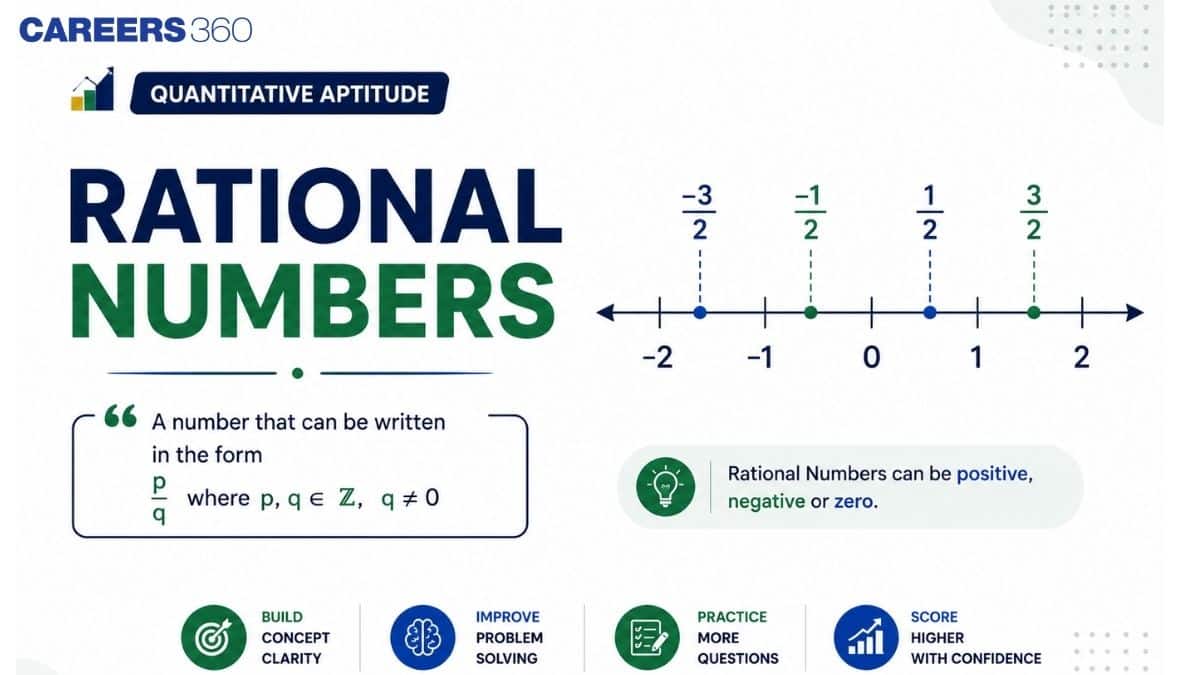
Rational numbers are numbers that can be expressed in the form of a fraction. They form an important part of the number system and are widely used in arithmetic, algebra, percentages, measurements, and everyday calculations.
Every rational number can be represented as a ratio of two integers, making them one of the most commonly used types of numbers in mathematics.
Rational Numbers Meaning in Simple Words
A rational number is any number that can be written as a fraction of two integers.
For example: $\frac{1}{2}$ , $\frac{3}{4}$ , $\frac{-5}{7}$
All these numbers are rational because they can be expressed in fractional form.
Examples of Rational Numbers
| Rational Number | Fraction Form |
|---|---|
| 0.5 | $\frac{1}{2}$ |
| 2 | $\frac{2}{1}$ |
| -3 | $\frac{-3}{1}$ |
| 0 | $\frac{0}{1}$ |
| 0.75 | $\frac{3}{4}$ |
Definition of Rational Numbers
A rational number is defined as any number that can be written in the form: $\frac{p}{q}$ where:
$p$ is an integer
$q$ is an integer
$q \ne 0$
Since division by zero is undefined, the denominator can never be zero.
Examples
$\frac{2}{5}$ , $\frac{-7}{9}$, $\frac{12}{1}$
All these are rational numbers.
Real-Life Examples of Rational Numbers
Rational numbers are used regularly in daily life.
Common Examples
| Situation | Rational Number Example |
|---|---|
| Pizza slices | $\frac{1}{4}$ pizza |
| Money | ₹12.50 |
| Measurements | $\frac{3}{5}$ metre |
| Discounts | $\frac{25}{100}$ or 25% |
| Time | $\frac{1}{2}$ hour |
Example
If a chocolate bar is divided equally among 4 children, each child gets: $\frac{1}{4}$ of the chocolate.
Since $\frac{1}{4}$ is a ratio of two integers, it is a rational number.
Why Rational Numbers are Important in Mathematics
Rational numbers are important because they:
form the foundation of fractions and decimals
are used in algebra and arithmetic
help solve measurement problems
are widely used in percentages and ratios
appear frequently in competitive exams
connect integers and fractions within the number system
Applications of Rational Numbers
| Field | Application |
|---|---|
| Mathematics | Fractions and algebra |
| Finance | Interest and discounts |
| Science | Measurements and calculations |
| Statistics | Data representation |
| Daily Life | Sharing, pricing, and time calculations |
Rational Number Formula
The mathematical representation of a rational number is based on a simple fraction form.
Understanding this formula helps identify whether a number is rational or not.
Standard Formula of Rational Numbers
The standard form of a rational number is: $\frac{p}{q}$ where:
$p$ = numerator
$q$ = denominator
$q \ne 0$
Examples
$\frac{3}{5}$, $\frac{-4}{7}$, $\frac{8}{1}$
All these satisfy the rational number formula.
Meaning of Numerator and Denominator
Every rational number consists of two parts.
| Part | Meaning |
|---|---|
| Numerator ($p$) | Number written above the fraction bar |
| Denominator ($q$) | Number written below the fraction bar |
Example
In: $\frac{7}{9}$
Numerator = 7
Denominator = 9
Conditions for a Rational Number
For a number to be rational:
It must be expressible as $\frac{p}{q}$
Both $p$ and $q$ must be integers
The denominator cannot be zero
Valid Rational Numbers
$\frac{5}{8}$, $\frac{-11}{3}$, $\frac{0}{7}$
Invalid Example
$\frac{5}{0}$
This is not a rational number because division by zero is undefined.
Types of Rational Numbers
Rational numbers can be classified into different categories based on their sign and value.
Positive Rational Numbers
Rational numbers greater than zero are called positive rational numbers.
Examples
$\frac{2}{3}$ , $\frac{5}{7}$, $\frac{9}{2}$
All these values are positive.
Negative Rational Numbers
Rational numbers less than zero are called negative rational numbers.
Examples
$\frac{-2}{5}$, $\frac{-7}{8}$, $\frac{-11}{4}$
All these values are negative.
Zero as a Rational Number
Zero is also a rational number because it can be expressed as:
$\frac{0}{1}$, $\frac{0}{5}$, $\frac{0}{100}$
Since the denominator is non-zero, zero satisfies the definition of a rational number.
Integers as Rational Numbers
Every integer is a rational number because it can be written as a fraction with denominator 1.
Examples
$5=\frac{5}{1}$, $-8=\frac{-8}{1}$, $12=\frac{12}{1}$
Therefore, all integers are rational numbers.
Properties of Rational Numbers
Rational numbers follow several mathematical properties that make calculations easier and more predictable.
Closure Property
The sum, difference, product, and quotient (except division by zero) of two rational numbers are always rational numbers.
Example
$\frac{1}{2}+\frac{3}{4}=\frac{5}{4}$
Since $\frac{5}{4}$ is rational, closure property holds.
Commutative Property
Changing the order of rational numbers does not affect the result in addition and multiplication.
Addition
$\frac{2}{3}+\frac{1}{4}=\frac{1}{4}+\frac{2}{3}$
Multiplication
$\frac{3}{5}\times\frac{2}{7}=\frac{2}{7}\times\frac{3}{5}$
Associative Property
Grouping of rational numbers does not affect the result in addition and multiplication.
Addition
$(\frac{1}{2}+\frac{1}{3})+\frac{1}{4}$
$=\frac{1}{2}+(\frac{1}{3}+\frac{1}{4})$
Multiplication
$(\frac{2}{3}\times\frac{3}{4})\times\frac{5}{2}$
$=\frac{2}{3}\times(\frac{3}{4}\times\frac{5}{2})$
Distributive Property
Multiplication distributes over addition and subtraction.
Example
$\frac{1}{2}\times(\frac{2}{3}+\frac{1}{3})$
$=\frac{1}{2}\times\frac{2}{3}+\frac{1}{2}\times\frac{1}{3}$
Identity Property
There are special rational numbers that leave other numbers unchanged.
| Operation | Identity Element |
|---|---|
| Addition | 0 |
| Multiplication | 1 |
Examples
$\frac{3}{5}+0=\frac{3}{5}$
$\frac{3}{5}\times1=\frac{3}{5}$
Inverse Property
Every non-zero rational number has:
an additive inverse
a multiplicative inverse
Additive Inverse
For: $\frac{3}{4}$
Additive inverse: $-\frac{3}{4}$
because: $\frac{3}{4}+(-\frac{3}{4})=0$
Multiplicative Inverse
For: $\frac{3}{4}$
Multiplicative inverse: $\frac{4}{3}$ because: $\frac{3}{4}\times\frac{4}{3}=1$
These properties of rational numbers are widely used in arithmetic, algebra, number systems, and competitive examination questions.
Rational Numbers vs Irrational Numbers
Understanding the difference between rational and irrational numbers is essential in the number system. While rational numbers can be expressed as fractions of integers, irrational numbers cannot be represented in fractional form.
Differentiating Rational Numbers from Irrational Numbers
A rational number can be expressed as:
$\frac{p}{q}$
where:
- $p$ and $q$ are integers
- $q \ne 0$
Examples of Rational Numbers
$\frac{1}{2}$, $\frac{3}{4}$, $\frac{-5}{7}$
$2=\frac{2}{1}$
On the other hand, irrational numbers cannot be expressed as a simple fraction of two integers.
Examples of Irrational Numbers
$\pi$, $\sqrt{2}$, $\sqrt{3}$, $\sqrt{5}$
These numbers have decimal expansions that are:
- Non-terminating
- Non-repeating
Note:
- Terminating decimals have a finite number of digits after the decimal point.
- Non-terminating decimals have infinitely many digits after the decimal point.
How to Identify Rational Numbers and Irrational Numbers
A number is rational if its decimal expansion is either terminating or repeating.
Examples of Rational Numbers
$\frac{1}{5}=0.2$
$\frac{3}{4}=0.75$
$0.3333\ldots=\frac{1}{3}$
Since these decimals either terminate or repeat, they are rational numbers.
Examples of Irrational Numbers
$0.15734582\ldots$, $3.575775777\ldots$, $\pi$, $\sqrt{3}$
Since these decimals neither terminate nor repeat, they are irrational numbers.
Rational Numbers vs Irrational Numbers
| Rational Numbers | Irrational Numbers |
|---|---|
| Can be written as $\frac{p}{q}$ | Cannot be written as $\frac{p}{q}$ |
| Decimal expansion terminates or repeats | Decimal expansion neither terminates nor repeats |
| Includes fractions and integers | Includes surds and special constants |
| Examples: $\frac{2}{3},\ 5,\ 0.75$ | Examples: $\sqrt{2},\ \pi,\ \sqrt{3}$ |
Arithmetic Operations on Rational Numbers
Arithmetic operations on rational numbers follow specific rules for addition, subtraction, multiplication, and division.
Let the two rational numbers be:
$\frac{a}{b}$ and $\frac{c}{d}$
where $b \ne 0$ and $d \ne 0$.
Addition of Rational Numbers
To add two rational numbers, first make the denominators the same.
Formula
$\frac{a}{b}+\frac{c}{d}=\frac{ad+bc}{bd}$
Example
$\frac{2}{3}+\frac{3}{4}$
$=\frac{(2\times4)+(3\times3)}{12}$
$=\frac{8+9}{12}$
$=\frac{17}{12}$
Subtraction of Rational Numbers
To subtract two rational numbers, first make the denominators the same.
Formula
$\frac{a}{b}-\frac{c}{d}=\frac{ad-bc}{bd}$
Example
$\frac{2}{3}-\frac{1}{2}$
$=\frac{(2\times2)-(1\times3)}{6}$
$=\frac{4-3}{6}$
$=\frac{1}{6}$
Multiplication of Rational Numbers
While multiplying rational numbers, multiply the numerators together and the denominators together.
Formula
$\frac{a}{b}\times\frac{c}{d}=\frac{ac}{bd}$
Example
$\frac{4}{5}\times\frac{3}{7}$
$=\frac{4\times3}{5\times7}$
$=\frac{12}{35}$
Division of Rational Numbers
Division of rational numbers is performed by multiplying the first fraction by the reciprocal of the second fraction.
Formula
$\frac{a}{b}\div\frac{c}{d}$
$=\frac{a}{b}\times\frac{d}{c}$
$=\frac{ad}{bc}$
Example
$\frac{2}{5}\div\frac{5}{6}$
$=\frac{2}{5}\times\frac{6}{5}$
$=\frac{12}{25}$
Properties of Rational Numbers
Rational numbers satisfy several important mathematical properties that make calculations easier and more systematic.
Closure Property
When two rational numbers are added, subtracted, or multiplied, the result is always a rational number.
Example
$\frac{1}{2}+\frac{1}{3}=\frac{5}{6}$
Since $\frac{5}{6}$ is rational, the closure property holds.
Note: Division by zero is undefined, so division does not always satisfy the closure property.
Commutative Property
The result remains unchanged when the order of rational numbers is changed in addition and multiplication.
Formula
$a+b=b+a$
$a\times b=b\times a$
Example
$\frac{2}{3}+\frac{1}{4}=\frac{1}{4}+\frac{2}{3}$
Not Applicable For
$a-b\ne b-a$
$a\div b\ne b\div a$
Associative Property
The result remains unchanged regardless of how rational numbers are grouped during addition and multiplication.
Formula
$x+(y+z)=(x+y)+z$
$x\times(y\times z)=(x\times y)\times z$
Example
$\frac{1}{2}+\left(\frac{1}{3}+\frac{1}{6}\right)$
$=\left(\frac{1}{2}+\frac{1}{3}\right)+\frac{1}{6}$
Not Applicable For
$x-(y-z)\ne(x-y)-z$
$x\div(y\div z)\ne(x\div y)\div z$
Distributive Property
Multiplication distributes over addition and subtraction.
Formula
$a\times(b+c)=a\times b+a\times c$
$a\times(b-c)=a\times b-a\times c$
Example
$2\times(3+4)$
$=(2\times3)+(2\times4)$
$=14$
Additive Identity and Additive Inverse Property
The additive identity of rational numbers is 0.
Additive Identity
$\frac{a}{b}+0=\frac{a}{b}$
Thus, 0 is called the additive identity.
Additive Inverse
For every rational number $\frac{a}{b}$, there exists:
$-\frac{a}{b}$
such that:
$\frac{a}{b}+\left(-\frac{a}{b}\right)=0$
Thus, $-\frac{a}{b}$ is called the additive inverse.
Multiplicative Identity and Multiplicative Inverse Property
The multiplicative identity of rational numbers is 1.
Multiplicative Identity
$\frac{a}{b}\times1=\frac{a}{b}$
Thus, 1 is called the multiplicative identity.
Multiplicative Inverse
For every non-zero rational number $\frac{a}{b}$, there exists:
$\frac{b}{a}$
such that:
$\frac{a}{b}\times\frac{b}{a}=1$
Thus, $\frac{b}{a}$ is called the multiplicative inverse of $\frac{a}{b}$.
Conversion of Decimal Numbers to Fractions
Decimals can be converted into fractions, which helps determine whether a number is rational. There are two main types of decimals:
- Terminating decimals
- Non-terminating repeating decimals
Converting Terminating Decimals to Fractions
A terminating decimal has a finite number of digits after the decimal point.
Examples
$0.5$ , $2.41$, $57.385$
Example: Convert 0.57 into a Fraction
The last digit 7 is in the hundredths place.
Therefore,
$0.57=\frac{57}{100}$
Similarly,
$0.9=\frac{9}{10}$
$1.35=\frac{135}{100}$
$25.382=\frac{25382}{1000}$
Converting Repeating Decimals to Fractions
A repeating decimal contains one or more digits that repeat indefinitely.
Example 1: Convert $0.4444\ldots$ into a Fraction
Let:
$x=0.4444\ldots$
Multiplying by 10:
$10x=4.4444\ldots$
Subtracting:
$10x-x=4.4444\ldots-0.4444\ldots$
$9x=4$
$x=\frac{4}{9}$
Therefore,
$0.4444\ldots=\frac{4}{9}$
Example 2: Convert $1.3454545\ldots$ into a Fraction
Let:
$y=1.3454545\ldots$
Multiplying by 10:
$10y=13.454545\ldots$ .......... (1)
Multiplying by 1000:
$1000y=1345.454545\ldots$ .......... (2)
Subtracting (1) from (2):
$1000y-10y=1345.454545\ldots-13.454545\ldots$
$990y=1332$
$y=\frac{1332}{990}$
Therefore,
$1.3454545\ldots=\frac{1332}{990}$
Shortcut Trick for Repeating Decimals
For decimals of the form:
$0.\overline{abc}$
Formula:
$\frac{\text{Repeated Digits}}{\text{Number of 9's Equal to the Number of Repeating Digits}}$
Example
$0.232323\ldots$
$=\frac{23}{99}$
For decimals of the form:
$p.a\overline{bc}$
Formula:
$\frac{abc-pa}{\text{Number of 9's Equal to Repeating Digits Followed by Number of 0's Equal to Non-Repeating Digits}}$
Examples
$0.7444\ldots$
$=\frac{74-7}{90}$
$=\frac{67}{90}$
$6.95454\ldots$
$=\frac{6954-69}{990}$
$=\frac{6885}{990}$
These conversion techniques are frequently used in number systems, rational numbers, and competitive aptitude examinations.
Best Books for Rational Numbers
A strong understanding of rational numbers helps students build a solid foundation in fractions, decimals, algebra, and number systems. The books below are useful for concept building as well as competitive exam preparation.
| Book Name | Best For | Why It Helps |
|---|---|---|
| NCERT Mathematics Textbook | School students | Covers rational numbers with clear explanations and examples |
| Quantitative Aptitude for Competitive Examinations | SSC, Banking, CUET, Railways | Includes number system concepts and aptitude-based questions |
| Fast Track Objective Arithmetic | Competitive exams | Useful for mastering arithmetic and number system topics |
| Objective Arithmetic | Exam preparation | Contains topic-wise practice questions and shortcuts |
| Magical Book on Quicker Maths | Speed mathematics | Helps improve calculation speed and number handling skills |
Shortcut Tips and Tricks for Rational Numbers
Rational number questions can often be solved quickly by understanding fraction rules, sign conventions, and simplification techniques.
| Trick | Shortcut |
|---|---|
| Check denominator first | Denominator can never be zero |
| Integer trick | Every integer can be written as a rational number by placing 1 in the denominator |
| Decimal conversion | Terminating and repeating decimals can be converted into rational numbers |
| Sign rule | Negative sign may be placed in numerator, denominator, or before the fraction |
| Simplify fractions | Always reduce fractions to lowest terms |
| Cross multiplication | Useful for comparing rational numbers quickly |
| Common denominator method | Helps perform addition and subtraction easily |
Tips to Solve Rational Numbers Questions Quickly
These practical tips can improve speed and accuracy in school and competitive examinations.
| Tip | Explanation |
|---|---|
| Simplify before calculating | Reduces computation time |
| Learn sign rules | Prevents mistakes in negative fractions |
| Use LCM for denominators | Makes addition and subtraction easier |
| Convert mixed fractions first | Simplifies operations |
| Check denominator carefully | Avoid division by zero errors |
| Practice fraction comparison | Frequently asked in aptitude exams |
| Memorize basic fraction-decimal conversions | Improves calculation speed |
Important Rational Numbers Formula Table
The formulas and concepts below are frequently used while solving rational number problems.
| Concept | Formula |
|---|---|
| Rational Number Form | $\frac{p}{q},\ q \ne 0$ |
| Addition | $\frac{a}{b}+\frac{c}{d}=\frac{ad+bc}{bd}$ |
| Subtraction | $\frac{a}{b}-\frac{c}{d}=\frac{ad-bc}{bd}$ |
| Multiplication | $\frac{a}{b}\times\frac{c}{d}=\frac{ac}{bd}$ |
| Division | $\frac{a}{b}\div\frac{c}{d}=\frac{a}{b}\times\frac{d}{c}$ |
| Reciprocal | Reciprocal of $\frac{a}{b}$ is $\frac{b}{a}$ |
| Additive Inverse | Additive inverse of $\frac{a}{b}$ is $-\frac{a}{b}$ |
| Multiplicative Inverse | Multiplicative inverse of $\frac{a}{b}$ is $\frac{b}{a}$ |
Important Fraction to Decimal Conversions
| Fraction | Decimal |
|---|---|
| $\frac{1}{2}$ | 0.5 |
| $\frac{1}{4}$ | 0.25 |
| $\frac{3}{4}$ | 0.75 |
| $\frac{1}{5}$ | 0.2 |
| $\frac{2}{5}$ | 0.4 |
| $\frac{3}{5}$ | 0.6 |
| $\frac{4}{5}$ | 0.8 |
| $\frac{1}{10}$ | 0.1 |
Important Rational Number Properties Table
| Property | Formula |
|---|---|
| Closure Property | $\frac{a}{b}\pm\frac{c}{d}$ is rational |
| Commutative Property | $a+b=b+a$ |
| Associative Property | $(a+b)+c=a+(b+c)$ |
| Distributive Property | $a(b+c)=ab+ac$ |
| Additive Identity | $a+0=a$ |
| Multiplicative Identity | $a\times1=a$ |
These tables provide a quick revision sheet for rational numbers and are especially useful for school mathematics, SSC, Banking, CUET, CAT, Railways, Defence, and other quantitative aptitude examinations.
Practice Questions based on Rational Numbers
Q.1. Find out which of the following is a rational number
7
$\pi$
$\sqrt{5}$
1.232232223….
Solution:
7 can be written as $\frac{7}{1}$, so it is a rational number.
$\pi$, $\sqrt{5}$, and 1.232232223…. These numbers can not be expressed as fractions, where the numerator and the denominator are both integers, and the denominator is not equal to zero, so these are not rational numbers.
Hence, the answer is the option (1).
Q.2. $\frac{1}{0}$ is a rational number. (True/False)
True
False
Solution:
A rational number can be defined as a fraction, where the numerator and the denominator are both integers, and the denominator is not equal to zero.
$\frac{1}{0}$ is not a rational number as the denominator of this fraction is zero.
Hence, the answer is the option (2).
Q.3. What is the additive inverse of $-\frac{5}{7}$?
0
1
$\frac{-6}{7}$
$\frac{5}{7}$
Solution:
We know that the sum of the number and its additive inverse is equal to 0.
So, the additive inverse of $-\frac{5}{7}$ is $\frac{5}{7}$, as $-\frac{5}{7}$ + $\frac{5}{7}$ = 0
Hence, the answer is the option (4).
Q.4. Find the number that should be added to $\frac{3}{5}$ to get the number $\frac{8}{9}$.
$\frac{12}{45}$
$\frac{14}{45}$
$\frac{13}{45}$
0
Solution:
The number that should be added to $\frac{3}{5}$ to get the number $\frac{8}{9}$ is
$\frac{8}{9} - \frac{3}{5} = \frac{40-27}{45} = \frac{13}{45}$
Hence, the answer is the option (3).
Q.5. Find the value of $2.34\overline{5}$ in fraction.
0
$\frac{2111}{900}$
$\frac{2111}{990}$
None of these
Solution:
$2.34\overline{5}$ = $\frac{2345-234}{900}$ = $\frac{2111}{900}$
Hence, the answer is the option (2).
Q.6. The addition and multiplication of rational numbers follow
Commutative property
Associative property
Both
None of these
Solution:
The addition and multiplication of rational numbers follow both the commutative property and the associative property.
Hence, the answer is the option (3).
Q.7. For any two rational numbers x and y we can say that x + y = y + x. (True/False)
True
False
Solution:
The addition of rational numbers is commutative, so for any two rational numbers x and y, we can say that x + y = y + x.
Hence, the answer is the option (1).
Q.8. What is the sum of the multiplicative inverse and the additive inverse of 5?
$-\frac{23}{5}$
$-\frac{24}{5}$
$\frac{24}{5}$
$-\frac{25}{5}$
Solution:
The multiplicative inverse of 5 is $\frac{1}{5}$.
The additive inverse of 5 is (-5).
So, the required sum = $\frac{1}{5}$ - 5 = $-\frac{24}{5}$
Hence, the answer is the option (2).
Q.9. The division of rational numbers is commutative. (True/False)
True
False
Solution:
The division of rational numbers is not commutative as 10 $\div$ 5 $\neq$ 5 $\div$ 10.
Hence, the answer is the option (2).
Q.10. Reciprocal of (-2) is:
2
$\frac{1}{2}$
$-\frac{1}{2}$
$\frac{1}{3}$
Solution:
The reciprocal of a number is the inverse of that number.
So, the reciprocal of (-2) is ($-\frac{1}{2}$).
Hence, the answer is the option (3).
Q.11. The product of a nonzero rational number with an irrational number is always an irrational number. (True/False)
True
False
Solution:
The product of a non-zero rational number with an irrational number is always irrational.
For example, $\frac{2}{3}$ is a rational number and $\sqrt{3}$ is an irrational number
Now, $\frac{2}{3} \times \sqrt{3} = \frac{2}{\sqrt{3}}$ is an irrational number.
Hence, the answer is the option (1).
Q.12. Find the value of $0.\overline{2} + 0.\overline{7}$.
$\frac{3}{4}$
0
2
1
Solution:
$0.\overline{2} + 0.\overline{7}$
= $\frac{2}{9} + \frac{7}{9}$
= $\frac{9}{9}$
= 1
Hence, the answer is the option (3).
Related Quantitative Aptitude Topics
The following are some commonly studied quantitative aptitude topics that are useful for building a strong base in mathematics. These topics are frequently asked in aptitude tests, school exams, and entrance examinations.
Frequently Asked Questions (FAQs)
$\sqrt{4}$ = 2 = $\frac{2}{1}$ also $\sqrt{9}$ = 3 = $\frac{3}{1}$
So, both $\sqrt{4}$ and $\sqrt{9}$ can be expressed as the ratio of two integers such as $\frac{p}{q}$ where p and q are integers and q $\neq$ 0.
Therefore, $\sqrt{4}$ and $\sqrt{9}$ are rational numbers.
Yes, 0 is a rational number as o can be written as $\frac{0}{1}$.
The Pythagoreans, followers of Pythagoras, were among the first to explore the properties of numbers, including rational numbers. They believed that all numbers could be expressed as ratios of whole numbers, which are essentially rational numbers.
Yes. Rational numbers can be positive, negative, or zero.
Examples of negative rational numbers:
$\frac{-2}{5}$
$\frac{-7}{8}$
$\frac{-11}{3}$
The word 'rational' originated from the word 'ratio', which implies that rational numbers can be written as a ratio of two integers.
