KCC Institute of Legal and Higher Education, Greater Noida
Law Admissions 2026 Open | Avail Merit-Based Scholarships


Mixture and Alligation is an important topic in quantitative aptitude that helps us determine the ratio in which two or more ingredients, substances, or quantities should be mixed to obtain a desired value. For example, if a shopkeeper wants to mix rice costing ₹40 per kg with rice costing ₹60 per kg to create a mixture worth ₹50 per kg, the concept of alligation can quickly determine the required mixing ratio. This topic is widely used in problems involving mixtures of milk and water, different varieties of rice, alloys, solutions, and profit-based mixing questions. Mixture and alligation is frequently asked in SSC, Bank, CUET, CAT, Railways, Defence, and other competitive examinations due to its practical applications and shortcut-solving techniques in quantitative aptitude. In this article, we will understand the concepts of mixture and alligation, important formulas, shortcut methods, solved examples, practice questions, and a mock test to strengthen your preparation.
This Story also Contains
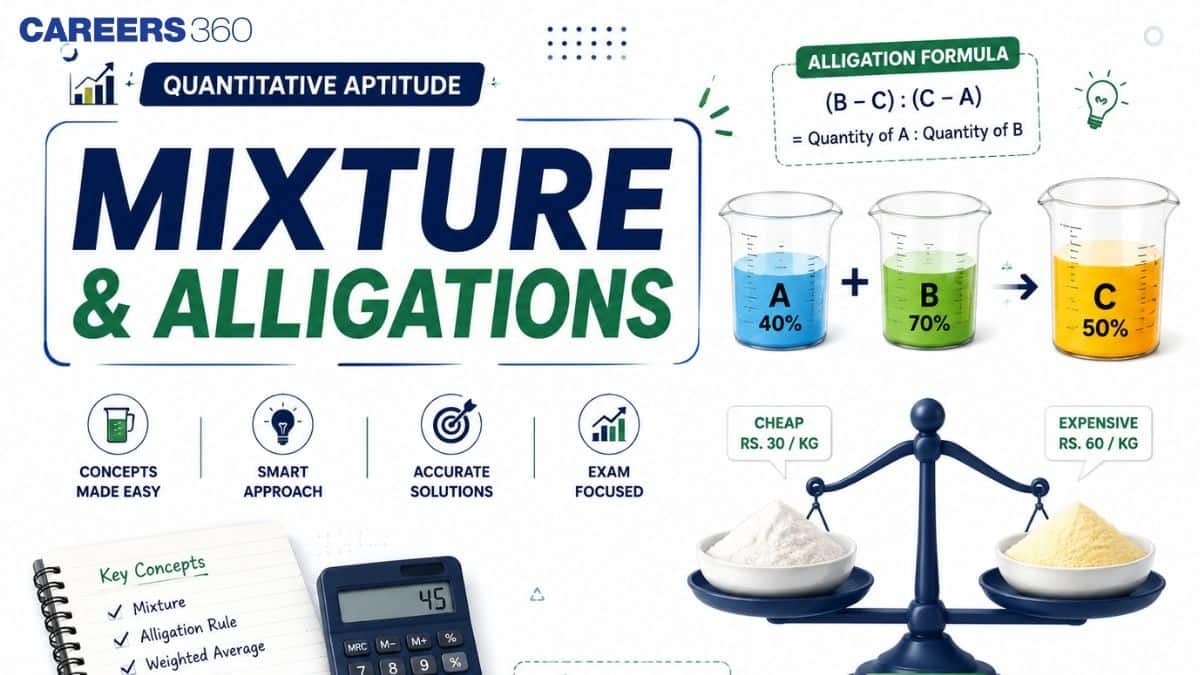
Mixture and Alligation is an important topic in quantitative aptitude that deals with combining two or more ingredients having different values, prices, concentrations, or qualities. It helps determine the ratio in which the components should be mixed to obtain a mixture of a desired value.
This concept is widely used in problems involving milk and water, different varieties of rice, alloys, chemical solutions, and profit-based mixing questions. Mixture and alligation questions are frequently asked in SSC, Bank, CUET, CAT, Railways, Defence, and other competitive examinations.
A mixture is formed when two or more quantities with different characteristics are combined together.
The resulting quantity is called a mixture, and its value depends on the values and quantities of the individual components.
Mixing milk and water
Mixing two varieties of rice
Mixing gold and copper to make an alloy
Mixing tea leaves of different prices
Mixing solutions of different concentrations
A shopkeeper mixes:
5 kg rice costing ₹40 per kg
5 kg rice costing ₹60 per kg
Law Admissions 2026 Open | Avail Merit-Based Scholarships
BBA/MBA/PGDM Early Bird Applications Deadline 06th Nov'26. Apply now using coupon code CAREER250 and get ₹250 off the application fee
The total mixture obtained is:
$5 + 5 = 10$ kg
Average cost of mixture:
$\frac{(5 \times 40) + (5 \times 60)}{10}$
$= \frac{200 + 300}{10}$
$= 50$ Rs per kg
Thus, a new mixture worth ₹50 per kg is formed.
Alligation is a shortcut method used to determine the ratio in which two quantities should be mixed to obtain a mixture with a desired average value.
Instead of using lengthy calculations, the alligation rule directly provides the required mixing ratio.
Suppose rice costing:
₹40 per kg
₹60 per kg
is mixed to obtain rice worth:
₹50 per kg
Using alligation:
| Cheaper Value | Mean Value | Dearer Value |
|---|---|---|
| ₹40 | ₹50 | ₹60 |
Required ratio:
$(60 - 50):(50 - 40)$
$= 10:10$
$= 1:1$
Therefore, the two varieties should be mixed in the ratio:
$1:1$
Mixture and alligation have many practical applications in daily life, business, and industry.
| Situation | Application |
|---|---|
| Milk and Water | Determining concentration after mixing |
| Rice Trading | Mixing different grades of rice |
| Jewellery Making | Mixing metals to form alloys |
| Chemical Industry | Preparing solutions of required strength |
| Tea and Coffee Business | Mixing products of different prices |
| Fuel Blending | Combining fuels of different grades |
A person mixes:
8 litres of milk
2 litres of water
Total mixture:
$8 + 2 = 10$ litres
Milk percentage:
$\frac{8}{10}\times100$
$= 80%$
Water percentage:
$\frac{2}{10}\times100$
$= 20%$
Such questions are commonly asked in aptitude exams.
Mixture and alligation is considered one of the most scoring topics in arithmetic because many questions can be solved quickly using the alligation rule.
It is important because:
frequently asked in competitive exams
helps improve ratio and percentage concepts
useful in profit and loss calculations
involves shortcut-solving techniques
saves time in aptitude tests
has practical real-life applications
| Exam | Importance |
|---|---|
| SSC CGL | High |
| SSC CHSL | High |
| Banking Exams | High |
| CUET | Moderate |
| CAT | Moderate |
| Railways | High |
| NDA & Defence Exams | High |
Students who master mixture and alligation can solve many arithmetic questions quickly, making it an important topic for quantitative aptitude preparation.
We have provided below the types of mixtures and alligations, so that you can understand what is the type and pattern of questions asked.
Simple mixture problems involve the direct combination of two or more substances to form a mixture.
Focus on finding the average price or concentration
Typically solved using alligation or weighted average
Common in basic aptitude questions
Example: Mixing two varieties of tea at different prices to get a desired price per kg.
Replacement problems involve removing a part of the mixture and replacing it with another substance, thereby changing the overall concentration or value.
Often involve successive replacement
Commonly asked in advanced mixture questions
Requires a clear understanding of ratios and percentages
Example: Replacing a portion of a salt solution with water to alter its concentration.
A strong grasp of the concept of mixture and alligation enables you to solve complex exam-level problems with speed and confidence, making it a must-master topic for anyone preparing for competitive exams.
There are various formulas used to solve problems related to mixture and alligation. Let us discuss them one by one with proper examples.
The rule of alligation is used to find the ratio in which two or more ingredients at different prices (or concentrations) must be mixed to produce a mixture at a given price (or concentration).
Formula: $\frac{Quantity \space of \space Cheaper}{Quantity \space of \space Dearer}$ = $\frac{\text{Dearer price - Mean price}}{\text{Mean price - Cheaper price}}$
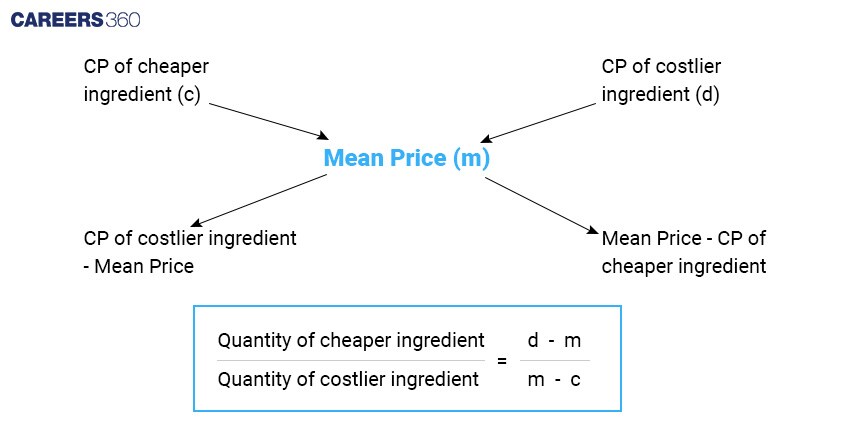
Example: One litre of milk costs INR 40. Water is mixed with milk and the mixture cost becomes INR 30 per litre. Find the ratio of water and milk in the mixture.
Solution: Given: That one litre of milk costs INR 40.
Water is mixed with milk and the mixture cost becomes INR 30 per litre.
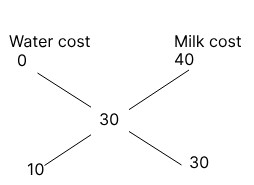
The ratio of water and milk in the mixture = $10:30$ = $1:3$
Hence, the correct answer is $1:3$.
The weighted average method helps in finding the average price (or concentration) of a mixture.
Formula: Weighted Average = $\frac{Q_1×P_1 + Q_2×P_2 + Q_3×P_3 + …….}{Q_1 + Q_2 + Q_3 + …….}$
Where $Q_1, Q_2, Q_3,....$ are quantities and $P_1, P_2, P_3,.....$ are its respective prices or concentration.
Example: The average height of 30 boys in a class is 160 cm. If the average height of the other 20 boys is 165 cm, the average height of the whole class (in cm) is:
Solution: Average height of 30 boys = 160 cm
The average height of the other 20 boys = 165 cm
We have to find out the average height of the whole class which is
= $\frac{30\times 160 + 20\times 165}{30 + 20}$
= $\frac{4800 + 3300}{50}$
= $\frac{8100}{50}$ = 162 cm.
Hence, the correct answer is 162 cm.
In this rule, we target the element in the mixture whose amount does not change but its percentage changes because of the change in the total amount of the mixture.
Example: How many litres of pure water should be added to 50 litres of 30% milk solution so that the resultant mixture is a 20% milk solution?
Solution: The quantity of milk in the solution is $50×\frac{30}{100}=15$ litres, and it will remain the same in the new solution as well.
So, 15 liters = 30% of the first solution =20% of the new solution
Therefore, the quantity of new solution = $15×\frac{100}{20}$ = 75 litres.
Now, the increase in the quantity of the new mixture is because of adding extra water.
Hence, the quantity of water added = 75 – 50 = 25 litres.
Replacement problems involve removing a part of the mixture and replacing it with another substance, which often results in a change in the overall concentration.
Final concentration = Initial concentration × $[1-\frac{\text{Quantity Replaced}}{\text{Total Quantity}}]^n$
where $n$ is the number of times the replacement occurs.
Example: From a cask of milk containing 64 litres, 8 litres are drawn out and the cask is filled up with water. If the same process is repeated a second, then a third time, what will be the proportion of milk to water in the resulting mixture?
Solution: The amount replaced by water each time is 8 litres.
The amount of milk = Initial amount$\times(1- \frac{\text{Amount replaced by water}}{\text{Total Amount}})^n$, where $n$ = No. times process repeated
So, the amount of milk
$= 64\times (1-\frac{8}{64})^3$
$= 64\times (1-\frac{1}{8})^3$
$= 64\times (\frac{7}{8})^3$
$= 64\times \frac{7\times 7\times7}{8\times 8\times 8}$
$= \frac{343}{8}$
Amount of water $= 64 - \frac{343}{8}= \frac{169}{8}$
So, the required ratio $=\frac{343}{8}:\frac{169}{8} =343:169$
Hence, the correct answer is $343:169$.
Mixture and alligation questions are generally solved using either the weighted average formula or the alligation rule. The formula method is useful when quantities are known, while the alligation method helps find the mixing ratio directly.
Understanding these formulas makes it easier to solve questions involving milk and water, rice mixtures, alloys, and solutions.
The value of a mixture is calculated using the weighted average of its components.
The basic formula is:
$Mean\ Value = \frac{Quantity_1 \times Value_1 + Quantity_2 \times Value_2}{Quantity_1 + Quantity_2}$
This formula can be extended for more than two components.
A shopkeeper mixes:
4 kg rice at ₹40 per kg
6 kg rice at ₹60 per kg
Mean price:
$=\frac{4 \times 40 + 6 \times 60}{4+6}$
$=\frac{160+360}{10}$
$=\frac{520}{10}$
$= 52$ Rs. per kg
Thus, the price of the mixture is ₹52 per kg.
The alligation formula is used to find the ratio in which two ingredients should be mixed to obtain a desired mean value.
The formula is:
$Ratio = (Higher\ Value - Mean\ Value):(Mean\ Value - Lower\ Value)$
Or,
$Ratio = (H-M):(M-L)$
Where:
$H$ = Higher value
$M$ = Mean value
$L$ = Lower value
Rice worth ₹40 per kg is mixed with rice worth ₹60 per kg to obtain rice worth ₹50 per kg.
Using formula:
$Ratio = (60-50):(50-40)$
$=10:10$
$=1:1$
Therefore, the two varieties should be mixed in the ratio 1:1.
To solve alligation problems correctly, it is important to understand the terms used.
| Term | Meaning |
|---|---|
| Lower Price | Cost of cheaper ingredient |
| Higher Price | Cost of expensive ingredient |
| Mean Price | Desired price of mixture |
| Ratio | Proportion in which ingredients are mixed |
| Rice Type | Price per kg |
|---|---|
| Variety A | ₹40 |
| Variety B | ₹60 |
| Mixture | ₹50 |
Here:
Lower Price = ₹40
Higher Price = ₹60
Mean Price = ₹50
Using alligation:
$Ratio = (60-50):(50-40)$
$=1:1$
The rule of alligation is a shortcut technique used to determine the ratio in which two ingredients must be mixed to obtain a mixture of a given value.
This method is one of the fastest ways to solve mixture questions in competitive exams.
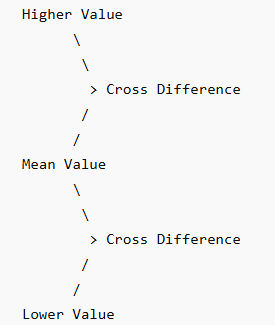
The alligation rule compares the difference between the mean value and the individual values.
The ratio is obtained by taking the cross differences.
Formula:
$Ratio = (Higher\ Value - Mean):(Mean - Lower\ Value)$
The larger difference is written opposite the smaller value and vice versa.
The alligation diagram is represented as:
Example:
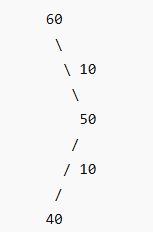
Required Ratio:
$10:10$
$1:1$
Follow these simple steps:
Write the lower value and higher value.
Write the mean value between them.
Find cross differences.
Form the ratio using the differences.
Simplify the ratio if possible.
Mix sugar worth ₹30 per kg and ₹50 per kg to obtain a mixture worth ₹40 per kg.
Cross differences:
$(50-40):(40-30)$
$=10:10$
$=1:1$
Therefore, sugar should be mixed in the ratio:
$1:1$
Most mixture and alligation questions can be solved using either the weighted average formula or the alligation method.
The choice depends on what information is provided in the question.
Use this method when quantities are given.
Calculate total cost of each ingredient.
Add the costs.
Add the quantities.
Divide total cost by total quantity.
Formula:
$Mean\ Value=\frac{\Sigma(Value \times Quantity)}{\Sigma Quantity}$
Mix:
5 litres milk at ₹40 per litre
3 litres milk at ₹60 per litre
Mixture value:
$=\frac{5\times40+3\times60}{5+3}$
$=\frac{200+180}{8}$
$=\frac{380}{8}$
$= 47.5$ Rs.
Use this method when the ratio is required.
Identify lower value.
Identify higher value.
Identify mean value.
Apply alligation formula.
Simplify the ratio.
Mix rice worth:
₹20 per kg
₹35 per kg
to obtain rice worth ₹25 per kg.
Using alligation:
$(35-25):(25-20)$
$=10:5$
$=2:1$
Required ratio:
$2:1$
Both methods are useful, but choosing the correct one saves time.
| Situation | Best Method |
|---|---|
| Quantities are given | Mixture Formula |
| Ratio is required | Alligation Method |
| Average value of mixture is asked | Mixture Formula |
| Competitive exam shortcut needed | Alligation Method |
| Two ingredients are mixed | Alligation Method |
| Multiple quantities are known | Mixture Formula |
In aptitude exams, alligation is usually the faster approach because it directly provides the mixing ratio without lengthy calculations.
The right study material can help you understand mixture and alligation concepts, shortcut techniques, and exam-level questions more effectively. The books below are widely used for school mathematics and competitive exam preparation.
| Book Name | Best For | Why It Helps |
|---|---|---|
| Quantitative Aptitude for Competitive Examinations | SSC, Bank, CUET, Railways | Covers mixture and alligation concepts with numerous practice questions |
| Fast Track Objective Arithmetic | Competitive exams | Includes shortcut methods and advanced aptitude questions |
| Magical Book on Quicker Maths | Speed mathematics | Useful for learning quick calculation techniques |
| Objective Arithmetic | Exam preparation | Provides topic-wise practice and previous-year questions |
| NCERT Mathematics Textbook | School students | Helps build a strong foundation in arithmetic concepts |
Mixture and alligation is one of the easiest arithmetic topics to solve using shortcuts. Learning these tricks can significantly reduce calculation time in competitive exams.
| Trick | Shortcut |
|---|---|
| Use alligation whenever ratio is required | Faster than weighted average calculations |
| Cross-difference method | Directly gives the mixing ratio |
| Check mean value first | Mean must always lie between higher and lower values |
| Simplify ratios immediately | Reduces calculation complexity |
| Convert percentages into fractions | Makes calculations quicker |
| Use alligation for profit-based mixtures | Common in aptitude exams |
| Verify answer using weighted average | Useful for checking accuracy |
These practical tips can help improve speed and accuracy while solving aptitude questions.
| Tip | Explanation |
|---|---|
| Identify whether ratio or average is required | Helps choose the correct method |
| Use alligation for two-component mixtures | Fastest approach in most exams |
| Draw the alligation diagram | Reduces mistakes in ratios |
| Keep units consistent | Use kg, litres, grams, etc., uniformly |
| Watch for replacement questions | These require a different approach |
| Learn common fraction values | Improves calculation speed |
| Practice cross-difference calculations | Frequently used in exams |
The following formulas are the most important for solving mixture and alligation questions quickly.
| Concept | Formula |
|---|---|
| Mean Value of Mixture | $\frac{\sum(Value \times Quantity)}{\sum Quantity}$ |
| Alligation Ratio | $(Higher\ Value - Mean):(Mean - Lower\ Value)$ |
| Basic Alligation Formula | $(H-M):(M-L)$ |
| Quantity from Ratio | Total Quantity × Respective Ratio Part ÷ Sum of Ratios |
| Percentage of Pure Substance | $\frac{Pure\ Quantity}{Total\ Quantity}\times100$ |
| Replacement Formula | Remaining Quantity $= Quantity\left(1-\frac{Removed}{Total}\right)^n$ |
| Weighted Average Formula | $\frac{\sum(wx)}{\sum w}$ |
| Symbol | Meaning |
|---|---|
| $H$ | Higher value |
| $L$ | Lower value |
| $M$ | Mean value |
| $w$ | Weight or quantity |
| $n$ | Number of operations/replacements |
These tables serve as a quick revision sheet for students preparing for SSC, Banking, CUET, CAT, Railways, Defence, and other quantitative aptitude examinations.
Q.1.
In what ratio should sugar at Rs. 30 per kg be mixed with sugar at Rs. 45 per kg so that, on selling the mixture at Rs. 42 per kg, there is a profit of 20%?
$2:1$
$2:3$
$5:2$
$3:5$
Hint: Use the concept of alligation:
Required ratio = (Higher value – Mean value) : (Mean value – Lower value)
Solution:
Let the cost price (CP) of sugar A be Rs. 30 and sugar B be Rs. 45.
Let the CP of the mixture be Rs. $x$.
Now, $\frac{120x}{100}$ = 42
$\therefore x$ = 35
Using the concept of alligation we have,

Required ratio = (Higher value – Mean value) : (Mean value – Lower value)
= $(45 - 35):(35 - 30)$ = $10:5 = 2:1$
Hence, the correct answer is option (1).
Q.2.
In what ratio should tea at Rs. 240 per kg be mixed with tea at Rs. 280 per kg so that, on selling the mixture at Rs. 324 per kg, there is a profit of 20%?
$1:1$
$1:2$
$1:3$
$1:4$
Hint: Required ratio = (Higher value – Mean value) : (Mean value – Lower value)
Solution:
Let the cost price (CP) of Tea A = Rs. 240 and CP of Tea B = Rs. 280
Let the CP of the mixture be Rs. $x$.
The mixture is sold at Rs. 324 with a gain of 20%.
So, $\frac{120x}{100}$ = 324
$\therefore x$ = 270
Thus, the CP of the mixture is Rs. 270.
Now, using the concept of alligation, we get,

Required ratio
= (Higher value – Mean value) : (Mean value – Lower value)
= $(280 - 270):(270 - 240) = 10:30 = 1:3$
Hence, the correct answer is option (3).
Q.3.
A vessel contains 20 L of acid. 4 L of acid is taken out of the vessel and replaced by the same quantity of water. Next, 4 L of the mixture is withdrawn and again the vessel is filled with the same quantity of water. The ratio of the quantity of acid left in the vessel with the quantity of acid initially in the vessel is:
$4:5$
$4:25$
$16:25$
$1:5$
Hint: Use this formula =
Initial quantity ×$(1-\frac{\text{Quantity taken out}}{\text{Original quantity}})^{\text{number of times removed}}$
Solution:
Here,
Remaining acid = Initial quantity × $(1–\frac{\text{Quantity taken out}}{\text{Original quantity}})^{\text{number of times removed}}$
⇒ Remaining acid $=20×(1-\frac{4}{20})^2=20×\frac{4}{5}×\frac{4}{5}= 12.8$ L
So, the required ratio
= $(12.8):(20)$
= $128:200$
= $16:25$
Hence, the correct answer is option (3).
Q.4.
A drum contains 80 litres of ethanol. 20 litres of this liquid is removed and replaced with water. 20 litres of this mixture is again removed and replaced with water. How much water (in litres) is present in this drum now?
45
40
35
44
Hint: Use this formula:
Quantity of ethanol after replacement = ${\text{total mixture}×(\frac{(\text{total mixture – liquid removed}}{\text{total mixture}})^{\text{number of times liquid is replaced}}}$
Solution:
Total volume of mixture = 80 litres
Liquid replaced with water is 20 litres and this process is repeated two times.
Pure ethanol left in the mixture after that
$={\text{total mixture}×(\frac{(\text{total mixture – liquid removed}}{\text{total mixture}})^{\text{no of times liquid is replaced}}}$
$= 80 × (\frac{80-20}{80})^2$
$= 80 × \frac{9}{16}$
$= 45$ litres
So, water present in the final solution = 80 – 45 = 35 litres
Hence, the correct answer is option (3).
Q.5.
The average salary of male employees in a firm was Rs. 5200 and that of females was Rs. 4200. The mean salary of all the employees was Rs. 5000. What is the percentage of female employees?
80%
20%
40%
30%
Hint: Calculate ratios of male and female by the rule of alligation and find the desired value.
Required ratio = (Higher value – Mean value) : (Mean value – Lower value)
Solution:

Given: The average salary of male employees in a firm = Rs. 5200
The average salary of female employees in a firm = Rs. 4200
The average salary of all employees in a firm = Rs. 5000
By using the rule of alligation,
The ratio of the male employees to the female employees = (Higher value – Mean value) : (Mean value – Lower value)
= 800 : 200 = 4 : 1
So, the required percentage of female employees $=\frac{1}{(1+4)} × 100 = 20$%
Hence, the correct answer is option (2).
Q.6.
A bottle is filled with liquid, of which 4 parts are water and 5 parts are fruit extract. How much of the mixture must be drawn off and replaced with water so that the mixture may be half water and half fruit extract?
$\frac{1}{10}$
$\frac{9}{10}$
$\frac{4}{9}$
$\frac{5}{9}$
Hint: When $x$ is a part of the mixture that has drawn off and $v$ is the total volume, then,
Final volume = Initial volume × $(1-\frac{x}{v})^n$, where $n$ = number of replacements.
Solution:
Let $x$ be a part of the mixture that has drawn off and $v$ be the total volume.
Given: Initial ratio = Water : fruit extract = 4 : 5
Final ratio = water : fruit extract = 1 : 1
Taking the volume of fruit extract, we get:
Final volume = initial volume × $(1-\frac{x}{v})^n$
⇒ $\frac{1}{2}$ = $\frac{5}{9}(1-\frac{x}{v})^1$
⇒ $\frac{9}{10}$ = $1-\frac{x}{v}$
⇒ $\frac{x}{v}$ = $\frac{1}{10}$
⇒ $x$ = $\frac{1}{10}v$
Hence, the correct answer is option (1).
Q.7.
A vessel is filled with liquid, 3 parts of which are water and 5 parts syrup. How much of the mixture must be drawn off and replaced with water so that the mixture may be half water and half syrup?
$\frac{1}{3}$
$\frac{1}{4}$
$\frac{1}{5}$
$\frac{1}{7}$
Hint: Solve by assuming that $x$ litre liquid is to be replaced.
Quantity of water in $x$ litre of liquid $=\frac{3x}{8}$
Quantity of syrup in $x$ litre of liquid $=\frac{5x}{8}$
Solution:
Given: Suppose the vessel initially contains 8 litres of liquid.
In this liquid, water is 3 litres and syrup is 5 litres.
So the ratio is $3:5$.
Let $x$ litres of this liquid be replaced with water.
Quantity of water in $x$ litre of liquid $=\frac{3x}{8}$
Quantity of syrup in $x$ litre of liquid $=\frac{5x}{8}$
As per given condition,
The quantity of water in the new mixture is $=3-\frac{3x}{8}+x$
The quantity of syrup in the new mixture is $=5-\frac{5x}{8}$
After replacement, the quantity should be the same.
$3-\frac{3x}{8}+x=5-\frac{5x}{8}$
⇒ $\frac{5x}{8}-\frac{3x}{8}+x=2$
⇒ $\frac{10x}{8}=2$
$\therefore x=\frac{8}{5}$
So, part of the mixture replaced $=\frac{\frac{8}{5}}{8}=\frac{8}{5}×\frac{1}{8}=\frac{1}{5}$
Hence, the correct answer is option (3).
Q.8.
Rice worth Rs.126 per kg and Rs.135 per kg are mixed with a third variety in the ratio of $1:1:2$. If the mixture is worth Rs.153 per kg, then the price of the third variety per kg (in Rs.) is:
182.5
195.5
133.5
175.5
Hint: Find the average price of the first and second varieties. Then, use the rule of alligation.
Solution:
The first and second varieties are mixed in equal proportions.
Their average price = $\frac{126 + 135}{2}$ = Rs.130.50
So, the mixture is formed by mixing two varieties, one at Rs. 130.50 per kg and the other at Rs.$x$ per kg, in the ratio $2:2=1:1$.

By the rule of allegation, we have,
Ratio = (Higher value – Mean value) : (Mean value – Lower value)
⇒ $\frac{1}{1} = \frac{x – 153}{153 - 130.5}$
⇒ $1 = \frac{x – 153}{22.5}$
⇒ $x = 153 + 22.5$
$\therefore x = 175.5$
Hence, the correct answer is option (4).
Q.9.
The average of marks obtained by 100 candidates in a certain examination is 30. If the average marks of the passed candidates are 35 and those of the failed candidates are 10. What is the number of candidates who passed the examination?
60
70
80
90
Hint: You have to make the ratio of pass and fail students to get the answer. Use the alligation rule.
Solution:
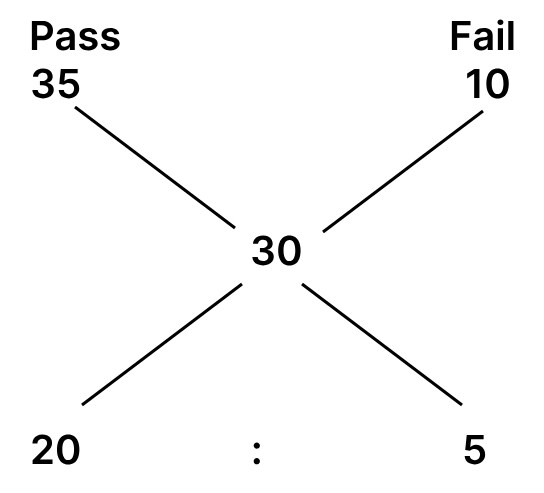
The average marks of the passed candidates are 35 and those of the failed candidates are 10.
Using the alligation method, we get,
The ratio of the number of pass students to fail students = $20:5$ = $4:1$
So, Total students = 4 + 1 = 5 units
According to the question, 5 units = 100
⇒ 1 unit = 20
Passed candidate = 4 units = 4 × 20 = 80
Hence, the correct answer is option (3).
Q.10.
A vessel is filled with liquid, 5 parts of which are water and 11 parts syrup. What part of the mixture must be drawn off and replaced with water so that the mixture may be syrup and water in the ratio $3:2$?
$\frac{14}{45}$
$\frac{27}{35}$
$\frac{36}{65}$
$\frac{7}{55}$
Hint: Let $x$ amount of liquid be replaced by water then find the ratio of syrup and water after replacement and equate them with $3:2$.
Solution:
5 parts water and 11 parts syrup (considering the unit volume of the mixture)
Water = $\frac{5}{16}$ and syrup = $\frac{11}{16}$
Let $x$ amount of liquid is replaced by water.
Water = $\frac{5x}{16}$ and syrup = $\frac{11x}{16}$
According to the question,
$\frac{\frac{11}{16}-\frac{11x}{16}}{\frac{5}{16}+x-\frac{5x}{16}}=\frac{3}{2}$
Or, $\frac{\frac{11}{16}-\frac{11x}{16}}{\frac{5}{16}+\frac{11x}{16}}=\frac{3}{2}$
Or, $\frac{15}{16}+\frac{33x}{16}=\frac{22}{16}-\frac{22x}{16}$
Or, $33x+22x=22-15$
Or, $x=\frac{7}{55}$
Hence, the correct answer is option (4).
Quantitative aptitude consists of various arithmetic topics that are frequently asked in aptitude, entrance, and competitive examinations. The following topics are important for building strong mathematical fundamentals and calculation speed.
Frequently Asked Questions (FAQs)
A mixture is formed when two or more substances with different prices, values, or concentrations are combined to create a single homogeneous entity.
The rule of alligation is used to find the ratio in which two or more ingredients at different prices (or concentrations) must be mixed to produce a mixture at a given price (or concentration).
Formula: $\frac{\text{Quantity of Cheaper}}{\text{Quantity of Dearer}}=\frac{\text{Dearer Price}-\text{Mean Price}}{\text{Mean Price}-\text{Cheaper Price}}$
The two main types of mixtures are homogeneous mixtures and heterogeneous mixtures. Homogeneous mixtures have a uniform composition throughout, with the individual components not visibly distinguishable, such as salt dissolved in water.
Heterogeneous mixtures, on the other hand, have a non-uniform composition, where the individual components remain distinct and can be visually identified, such as a mixture of sand and iron filings.
Alligation is a shortcut technique used to find the mean value of a mixture or the ratio in which two or more components should be mixed.
The two types of alligation are alligation medial and alligation alternate.
Alligation medial is used to find the mean value of a mixture when the quantities and values of individual components are known.
Alligation alternate is used to determine the ratio in which two or more components with known values should be mixed to achieve a desired mean value.
A mixture refers to the combination of two or more substances, while alligation is a shortcut method used to find the ratio in which those substances should be mixed to achieve a specific average value.


Law Admissions 2026 Open | Avail Merit-Based Scholarships
BBA/MBA/PGDM Early Bird Applications Deadline 06th Nov'26. Apply now using coupon code CAREER250 and get ₹250 off the application fee
Ranked #36 amongst institutions in Management by NIRF | 100% Placement
Globally Recognized by AACSB (US) & AMBA (UK) | 18 LPA Avg. CTC for PGPM 2026
NEET PG All India & State College Predictor with Admission Process Guide
Top B-School: Ranked #9 in NIRF Management Rankings 2025.