


Polygon: Definition, Shape, Area Formula, Properties, Examples
From triangular road signs and rectangular screens to hexagonal tiles and octagonal stop signs, polygons are everywhere around us. A polygon is a closed two-dimensional figure formed by joining straight line segments, and it is one of the most important concepts in geometry. Understanding polygons helps in studying shapes, angles, area calculations, and geometric properties used in mathematics and real-life applications. This topic is frequently covered in school mathematics, Olympiads, SSC, Banking, CUET, CAT, Railways, Defence, and other competitive examinations and quantitative aptitude tests. In this article, we will explore the definition of polygons, types of polygons, area formulas, properties, interior and exterior angles, solved examples, and practical applications.
This Story also Contains
- What is a Polygon?
- Types of polygon
- Properties of Polygons
- Polygon Formulas
- Area of Polygons
- Interior and Exterior Angles of Polygons
- How to Identify a Polygon?
- Difference Between Regular and Irregular Polygons
- Diagonals of a Polygon
- Angles of a Polygon
- Interior Angle Sum Formula
- Exterior Angle of a Polygon
- Three-Dimensional Shapes and Polyhedra
- Best Books for Polygons and Geometry
- Shortcut Tips and Tricks for Polygon Questions
- Important Polygon Formula Table
- Practice Questions based on Polygons
- Related Quantitative Aptitude Topics
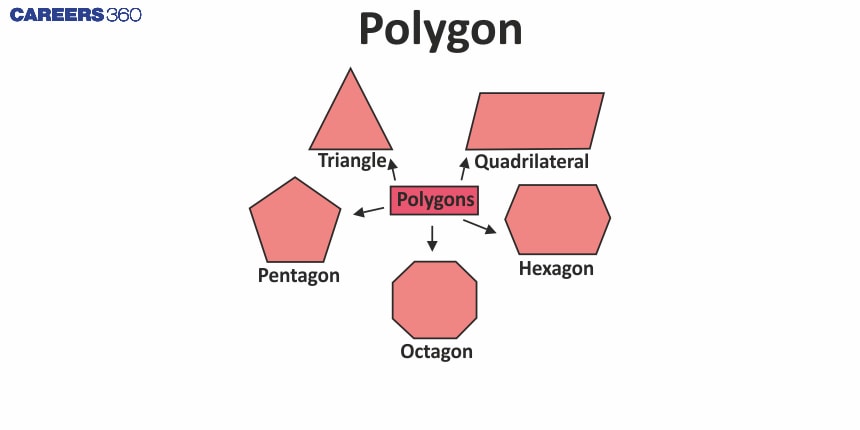
What is a Polygon?
A polygon is one of the most important concepts in geometry and forms the foundation for studying two-dimensional shapes. From simple triangles and rectangles to complex geometric figures, polygons are everywhere in mathematics and daily life. Understanding polygons helps students learn about sides, angles, diagonals, perimeter, area, and other geometric properties that are frequently used in school mathematics and competitive examinations.
Polygon Meaning in Simple Words
In simple words, a polygon is a closed shape formed by joining three or more straight line segments.
A polygon must:
- Be a closed figure
- Have only straight sides
- Have sides that meet only at their endpoints
Examples of Polygons
- Triangle
- Square
- Rectangle
- Pentagon
- Hexagon
- Octagon
Non-Examples of Polygons
- Circle (contains a curved boundary)
- Semicircle
- Open figures
- Shapes with curved sides
For example, a triangle is a polygon because it is a closed figure made of three straight sides, whereas a circle is not a polygon because it contains no straight sides.
Definition of Polygon
A polygon is a closed two-dimensional geometric figure formed by a finite number of straight line segments connected end to end.
The word "polygon" comes from Greek words:
- "Poly" meaning many
- "Gon" meaning angles
Therefore, polygon means "many-angled figure."
Characteristics of a Polygon
- It is a plane (2D) figure.
- It has three or more sides.
- All sides are straight line segments.
- It is completely closed.
- Adjacent sides meet at vertices.
Example
A pentagon has:
- 5 sides
- 5 vertices
- 5 interior angles
Hence, it is a polygon.
Real-Life Examples of Polygons
Polygons can be seen all around us in everyday objects, buildings, signs, and designs. Understanding real-life polygon examples helps connect geometry with practical applications.
| Object | Polygon Shape |
|---|---|
| Traffic sign | Octagon |
| Floor tiles | Hexagon |
| Window frame | Rectangle |
| Kite | Quadrilateral |
| Pizza slice | Triangle |
| Honeycomb cells | Hexagon |
Common Real-Life Polygon Examples
- A rectangular television screen.
- A triangular road warning sign.
- A square chessboard.
- A hexagonal floor tile.
- An octagonal stop sign.
- A pentagonal building design.
These examples demonstrate how polygons are used in architecture, engineering, construction, graphic design, and everyday objects.
Why Polygons are Important in Geometry
Polygons play a fundamental role in geometry because many geometric concepts are based on them. Topics such as angles, area, perimeter, symmetry, and coordinate geometry rely heavily on polygon properties.
Importance of Polygons in Mathematics
- Help understand geometric shapes and structures.
- Form the basis of area and perimeter calculations.
- Used in studying interior and exterior angles.
- Essential for coordinate geometry.
- Important in trigonometry and mensuration.
- Used in geometric proofs and constructions.
- Help develop spatial reasoning skills.
Applications of Polygons
| Field | Application |
|---|---|
| Mathematics | Geometry and mensuration |
| Architecture | Building layouts and floor plans |
| Engineering | Structural design |
| Computer Graphics | 2D and 3D modeling |
| Cartography | Map design |
| Art and Design | Patterns and tessellations |
Polygons can be regular or irregular.
Triangles, squares, and rectangles are some of the examples of polygon.
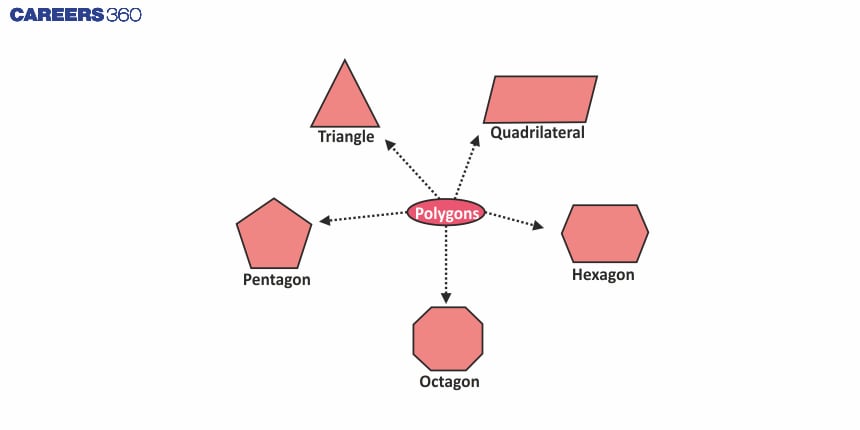
Different shapes of a Polygon
Polygons have different shapes depending on the number of sides they have.
Some of the very common shapes are:
Triangles like equilateral triangles, isosceles triangles, and scalene triangles.
Quadrilaterals like squares, rectangles, rhombuses, parallelograms and kites.
Some of the pictures of different shapes are given below.
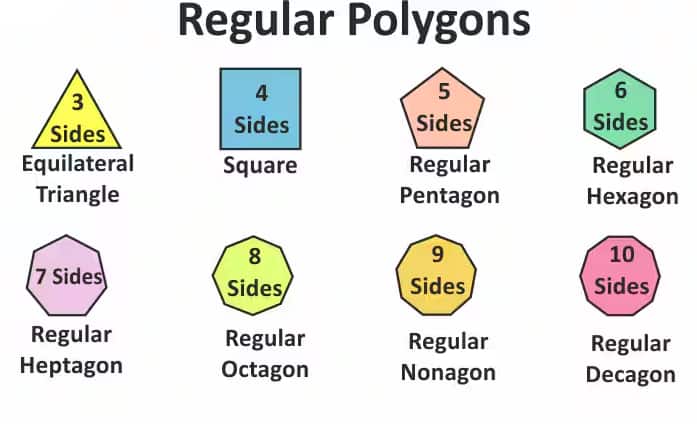
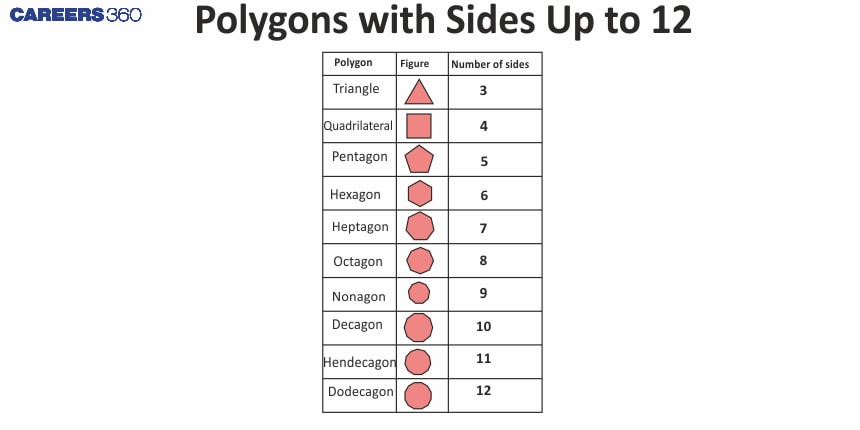
List of Polygons of sides up to 12
Types of polygon
Polygons can be categorised based on their sides and angles into several types. Here are the main types of polygons:
Regular Polygon
Irregular Polygon
Convex Polygon
Concave Polygon
Now we will discuss these types of polygons thoroughly.
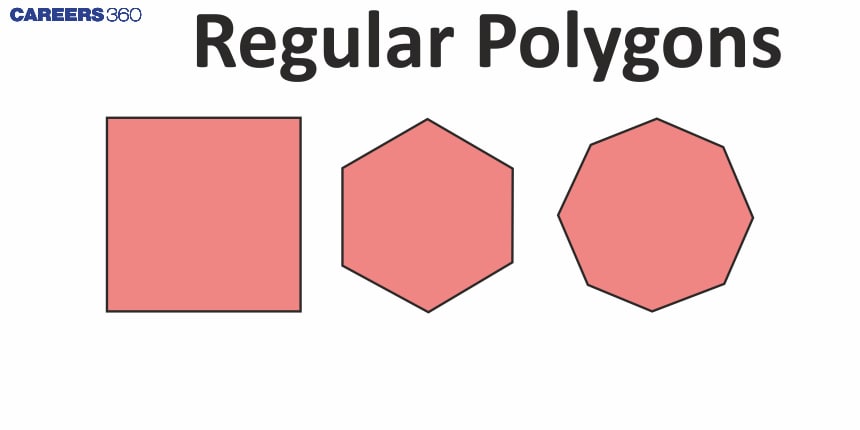
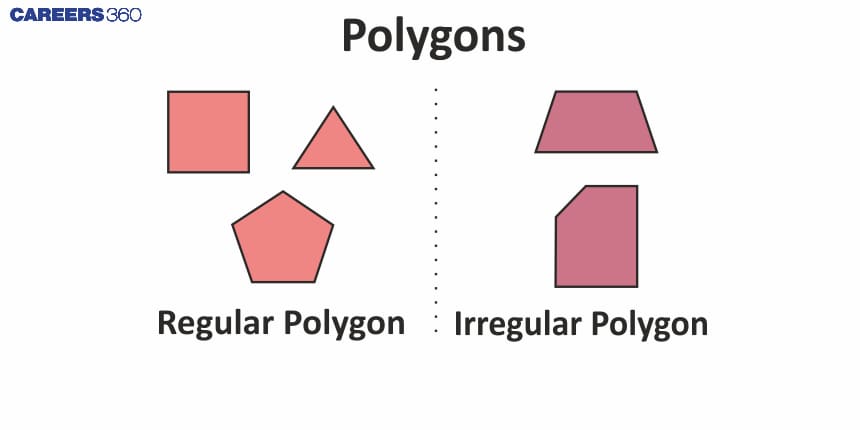
Regular polygons
A polygon with equal sides and equal angles is called a Regular polygon.
Key properties of regular polygons are:
All interior angles are equal.
All sides are equal in length.
Regular polygons are symmetrical.
Some examples of regular polygons are equilateral triangles, squares, regular pentagons and regular hexagons.
Irregular polygons
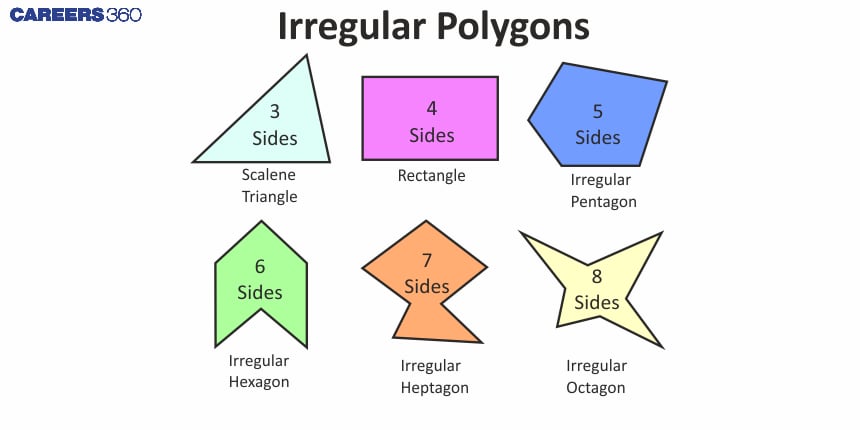
A polygon with sides and angles that are not equal in length is called an Irregular polygon.
Key properties of irregular polygons are:
All interior angles are not equal in measurement.
All sides are not equal in length.
Irregular polygons are not symmetrical.
Some examples of irregular polygons are scalene triangles, irregular pentagons and irregular hexagons.
Convex polygons
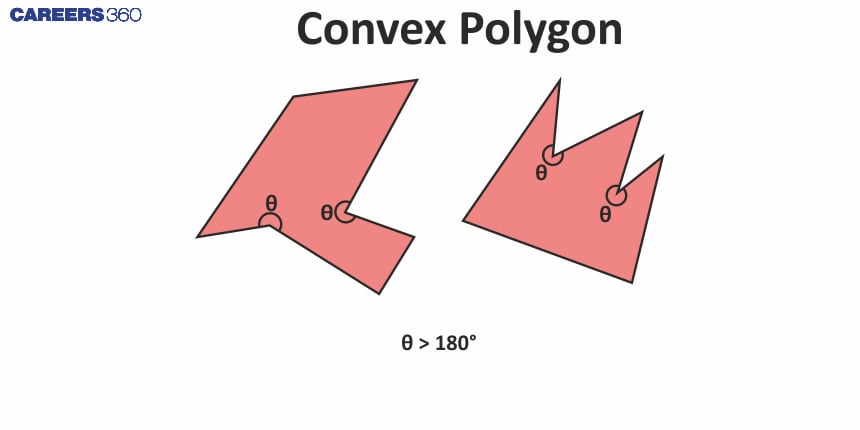
A polygon with interior angles less than 180° is called a Convex polygon. In these polygons, no vertices point inwards.
Key properties of Convex polygons are:
All diagonals lie inside the polygon.
No line segment between two vertices goes outside the polygon.
Some examples of Convex polygons are equilateral triangles, squares, and other polygons where interior angles are less than 180°.
Concave polygons
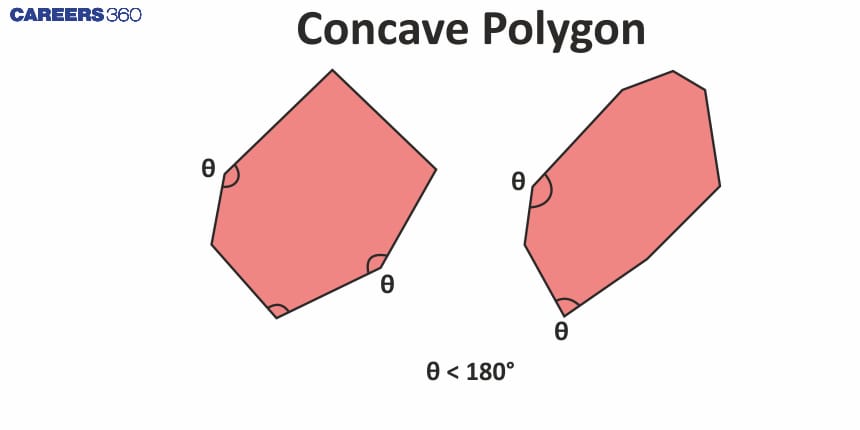
A polygon with at least one interior angle greater than 180° is called a Concave polygon. In these polygons, at least one vertex points inward.
Key properties of Concave polygons are:
At least one diagonal lies outside the polygon.
A line segment between two vertices can go outside the polygon.
Some examples of Concave polygons are star-shaped polygons and some irregularly shaped polygons.
Properties of Polygons
Every polygon has certain geometric properties that help us understand its shape, structure, and behavior. These properties are based on the sides, vertices, angles, diagonals, and symmetry of the polygon. Understanding these polygon properties is essential for solving geometry, mensuration, and quantitative aptitude questions.
Sides of a Polygon
The straight line segments that form the boundary of a polygon are called its sides.
A polygon must have at least three sides.
Examples
- Triangle → 3 sides
- Quadrilateral → 4 sides
- Pentagon → 5 sides
- Hexagon → 6 sides
- Octagon → 8 sides
Key Facts
- All sides are straight line segments.
- Sides meet only at their endpoints.
- The number of sides determines the type of polygon.
Vertices of a Polygon
The points where two sides of a polygon meet are called vertices.
The singular form of vertices is vertex.
Examples
- Triangle → 3 vertices
- Pentagon → 5 vertices
- Hexagon → 6 vertices
Key Facts
- Every polygon has the same number of vertices as sides.
- Interior and exterior angles are formed at the vertices.
Angles of a Polygon
The angle formed between two adjacent sides of a polygon is called an interior angle.
Examples
A regular pentagon has:
- 5 sides
- 5 interior angles
A regular hexagon has:
- 6 sides
- 6 interior angles
Key Facts
- Every polygon has interior angles.
- Closed polygons also have exterior angles.
- The sum of angles depends on the number of sides.
Diagonals of a Polygon
A diagonal is a line segment joining two non-adjacent vertices of a polygon.
Examples
- A quadrilateral has 2 diagonals.
- A pentagon has 5 diagonals.
- A hexagon has 9 diagonals.
Key Facts
- Diagonals lie inside the polygon.
- They divide polygons into triangles.
- They help in area calculations and geometric proofs.
Symmetry in Polygons
Symmetry refers to the balanced arrangement of a shape such that one half mirrors the other.
Types of Symmetry
- Line Symmetry
- Rotational Symmetry
Examples
| Polygon | Lines of Symmetry |
|---|---|
| Equilateral Triangle | 3 |
| Square | 4 |
| Regular Pentagon | 5 |
| Regular Hexagon | 6 |
Key Facts
- Regular polygons have maximum symmetry.
- Irregular polygons may have little or no symmetry.
Polygon Formulas
Polygon formulas are used to calculate angles, diagonals, perimeter, and area. These formulas are among the most important geometry formulas for school mathematics and competitive exams.
Sum of Interior Angles Formula
The sum of all interior angles of an $n$-sided polygon is:
$\text{Sum of Interior Angles}=(n-2)\times180^\circ$
where:
$n=$ Number of sides
Example
For a pentagon:
$(5-2)\times180^\circ$
$=540^\circ$
Therefore, the sum of interior angles of a pentagon is $540^\circ$.
Exterior Angle Formula
The sum of all exterior angles of any polygon is always:
$\text{Sum of Exterior Angles}=360^\circ$
Example
For a regular hexagon:
$\text{Each Exterior Angle}=\frac{360^\circ}{6}$
$=60^\circ$
Number of Diagonals Formula
The number of diagonals in an $n$-sided polygon is:
$\text{Number of Diagonals}=\frac{n(n-3)}{2}$
Example
For a hexagon:
$=\frac{6(6-3)}{2}$
$=\frac{18}{2}$
$=9$
Therefore, a hexagon has 9 diagonals.
Perimeter Formula
The perimeter of a polygon is the total length of all its sides.
For a regular polygon:
$\text{Perimeter}=n\times s$
where:
$n=$ Number of sides
$s=$ Length of each side
Example
For a regular pentagon with side length 8 cm:
$\text{Perimeter}=5\times8$
$=40\text{ cm}$
Area Formula of Regular Polygon
The area of a regular polygon is:
$\text{Area}=\frac{1}{2}\times\text{Perimeter}\times\text{Apothem}$
or
$\text{Area}=\frac{1}{2}Pa$
where:
$P=$ Perimeter
$a=$ Apothem
This formula is commonly used for regular polygons such as pentagons, hexagons, and octagons.
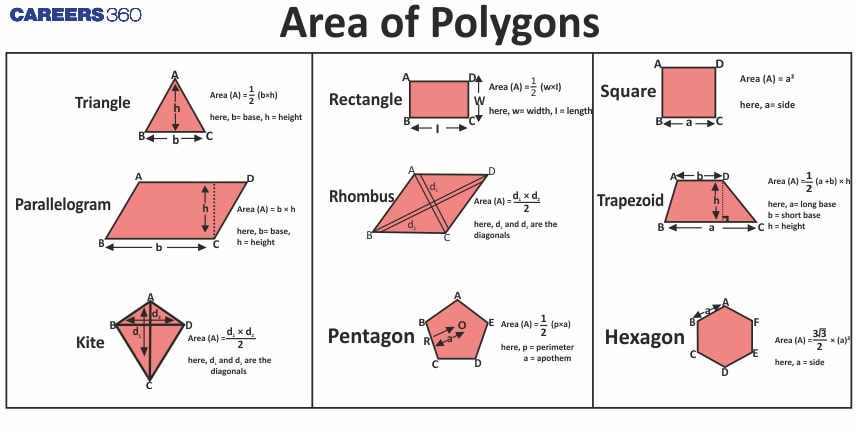
Area of Polygons
The area of a polygon represents the amount of space enclosed within its boundary. Different types of polygons have different area formulas.
Area of Triangle
The area of a triangle is:
$\text{Area}=\frac{1}{2}\times\text{Base}\times\text{Height}$
Example
Base = 8 cm
Height = 5 cm
$\text{Area}=\frac{1}{2}\times8\times5$
$=20\text{ cm}^2$
Area of Quadrilateral
The area formula depends on the type of quadrilateral.
Rectangle
$\text{Area}=\text{Length}\times\text{Breadth}$
Square
$\text{Area}=\text{Side}^2$
Example
For a square of side 6 cm:
$\text{Area}=6^2$
$=36\text{ cm}^2$
Area of Regular Polygon
For any regular polygon:
$\text{Area}=\frac{1}{2}\times\text{Perimeter}\times\text{Apothem}$
Example
Perimeter = 30 cm
Apothem = 8 cm
$\text{Area}=\frac{1}{2}\times30\times8$
$=120\text{ cm}^2$
Area Using Apothem and Perimeter
The apothem-perimeter formula is particularly useful for regular polygons.
$\text{Area}=\frac{1}{2}Pa$
where:
$P=$ Perimeter
$a=$ Apothem
This method avoids dividing the polygon into multiple triangles.
Interior and Exterior Angles of Polygons
Interior and exterior angles are among the most important concepts in polygon geometry. They help determine the shape and properties of a polygon.
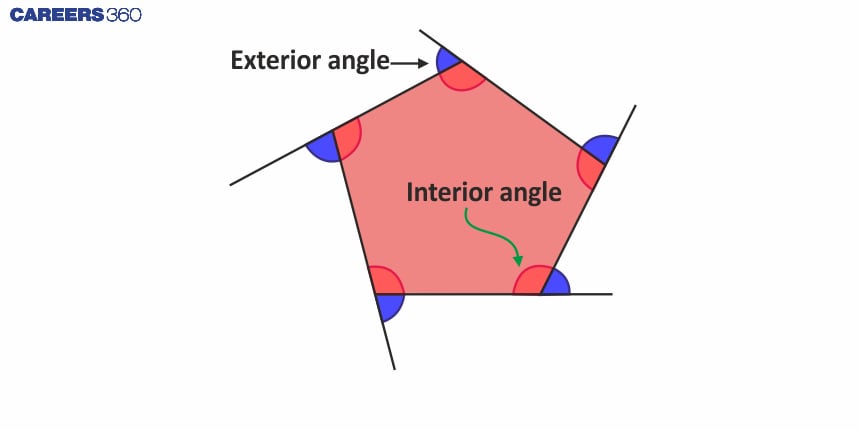
Interior Angles Explained
An interior angle is the angle formed inside a polygon by two adjacent sides.
Formula for Each Interior Angle of a Regular Polygon
$\text{Interior Angle}=\frac{(n-2)\times180^\circ}{n}$
Example
For a regular hexagon:
$\frac{(6-2)\times180^\circ}{6}$
$=\frac{720^\circ}{6}$
$=120^\circ$
Exterior Angles Explained
An exterior angle is formed when one side of a polygon is extended.
Formula for Each Exterior Angle of a Regular Polygon
$\text{Exterior Angle}=\frac{360^\circ}{n}$
Example
For a regular octagon:
$\frac{360^\circ}{8}$
$=45^\circ$
Relationship Between Interior and Exterior Angles
At every vertex of a polygon:
$\text{Interior Angle}+\text{Exterior Angle}=180^\circ$
Example
If the interior angle is:
$140^\circ$
Then,
$\text{Exterior Angle}=180^\circ-140^\circ$
$=40^\circ$
Solved Examples
Example 1
Find the sum of interior angles of a decagon.
Using:
$\text{Sum of Interior Angles}=(n-2)\times180^\circ$
$=(10-2)\times180^\circ$
$=1440^\circ$
Example 2
Find each exterior angle of a regular pentagon.
$\text{Exterior Angle}=\frac{360^\circ}{5}$
$=72^\circ$
How to Identify a Polygon?
Identifying polygons correctly is important because many geometric figures may appear similar but are not polygons.
Characteristics of a Polygon
A figure is a polygon if:
- It is closed.
- It is two-dimensional.
- It has three or more sides.
- All sides are straight line segments.
- Adjacent sides intersect only at endpoints.
Examples of Polygons
- Triangle
- Square
- Rectangle
- Pentagon
- Hexagon
Open vs Closed Figures
A polygon must always be a closed figure.
Closed Figure
A triangle is closed because all sides connect completely.
Open Figure
A shape with a gap between two endpoints is not a polygon.
| Figure Type | Polygon? |
|---|---|
| Closed Triangle | Yes |
| Closed Pentagon | Yes |
| Open Shape | No |
Polygon vs Non-Polygon Shapes
Not every geometric shape is a polygon.
| Polygon Shapes | Non-Polygon Shapes |
|---|---|
| Triangle | Circle |
| Square | Oval |
| Pentagon | Semicircle |
| Hexagon | Curved Figures |
| Octagon | Open Figures |
Quick Identification Rule
A shape is a polygon if it is:
- Closed
- Flat (2D)
- Made entirely of straight line segments
If any side is curved or the figure is open, it is not a polygon.
Difference Between Regular and Irregular Polygons
A polygon can be categorized as a regular or irregular polygon based on the length of its sides and the measure of its angles. The difference between a regular and irregular polygon is given in the following table.
Criteria | Regular Polygon | Irregular polygon |
Length of sides | All sides are equal. | All sides are not equal. |
Interior angles | All interior angles are equal. | All interior angles are not equal. |
Exterior angles | All exterior angles are equal. | All exterior angles are not equal. |
Symmetrical or not | Regular polygons are symmetrical. | Irregular polygons are not symmetrical. |
Uniformity | Regular polygons are uniform in shape. | Irregular polygons have varied shapes. |
Examples | Equilateral triangles, squares, regular pentagons, and regular hexagons. | Scalene triangles, irregular pentagons, and irregular hexagons. |
Diagonals of a Polygon
A diagonal is a line segment that joins two non-adjacent vertices of a polygon. As the number of sides increases, the number of diagonals also increases.
Formula for Number of Diagonals
If a polygon has $n$ sides, then:
$\text{Number of Diagonals}=\frac{n(n-3)}{2}$
where:
$n=$ Number of sides
Common Polygons and Their Diagonals
| Polygon | Number of Diagonals |
|---|---|
| Triangle | 0 |
| Quadrilateral | 2 |
| Pentagon | 5 |
| Hexagon | 9 |
| Heptagon | 14 |
| Octagon | 20 |
| Nonagon | 27 |
| Decagon | 35 |
Example
Find the number of diagonals in an octagon.
Solution:
For an octagon,
$n=8$
Using the formula,
$\text{Number of Diagonals}=\frac{8(8-3)}{2}$
$=\frac{8\times5}{2}$
$=20$
Answer: 20 diagonals
Angles of a Polygon
Every polygon has two types of angles:
- Interior Angles
- Exterior Angles
Understanding these angles is important for solving geometry and polygon-related problems.
Interior Angles
The angles formed inside a polygon by two adjacent sides are called interior angles.
Examples
- A triangle has 3 interior angles.
- A pentagon has 5 interior angles.
- A hexagon has 6 interior angles.
Key Facts
- Every polygon has the same number of interior angles as sides.
- The sum of interior angles depends on the number of sides.
- Interior angles are formed inside the polygon.
Exterior Angles
The angles formed outside a polygon by extending one of its sides are called exterior angles.
Examples
- Every vertex of a polygon has one exterior angle.
- A regular polygon has equal exterior angles.
Key Facts
- The sum of all exterior angles of any polygon is always:
$360^\circ$
- Exterior angles are formed outside the polygon.
- Interior and exterior angles at a vertex are supplementary.
Therefore,
$\text{Interior Angle}+\text{Exterior Angle}=180^\circ$
Example
If an interior angle of a polygon is $140^\circ$, find the corresponding exterior angle.
Solution:
Using,
$\text{Interior Angle}+\text{Exterior Angle}=180^\circ$
$140^\circ+\text{Exterior Angle}=180^\circ$
$\text{Exterior Angle}=180^\circ-140^\circ$
$=40^\circ$
Answer: $40^\circ$
Interior Angle Sum Formula
The sum of the interior angles of a polygon depends on the number of sides.
If a polygon has $n$ sides, then:
$\text{Sum of Interior Angles}=(n-2)\times180^\circ$
For a regular polygon, all interior angles are equal.
Therefore, each interior angle is:
$\text{Each Interior Angle}=\frac{(n-2)\times180^\circ}{n}$
Example
Find the sum of the interior angles of a 12-sided polygon.
Solution:
Using the formula,
$\text{Sum of Interior Angles}=(12-2)\times180^\circ$
$=10\times180^\circ$
$=1800^\circ$
Answer: $1800^\circ$
Exterior Angle of a Polygon
An exterior angle is formed when one side of a polygon is extended beyond a vertex.
A key property of polygons is:
$\text{Sum of Exterior Angles}=360^\circ$
For a regular polygon, all exterior angles are equal.
Therefore, each exterior angle is:
$\text{Each Exterior Angle}=\frac{360^\circ}{n}$
where $n$ is the number of sides.
Example
Find each exterior angle of a regular hexagon.
Solution:
Number of sides,
$n=6$
Using the formula,
$\text{Each Exterior Angle}=\frac{360^\circ}{6}$
$=60^\circ$
Answer: $60^\circ$
Three-Dimensional Shapes and Polyhedra
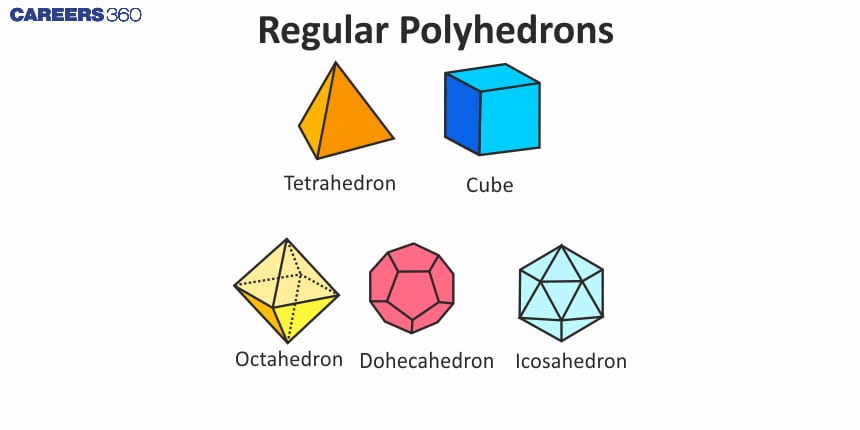
Polygons are two-dimensional closed figures made of straight line segments. A three-dimensional solid whose faces are polygons is called a polyhedron. The plural of polyhedron is polyhedra.
Properties of a Polyhedron
- Faces: Flat polygonal surfaces of the solid.
- Edges: Line segments where two faces meet.
- Vertices: Points where two or more edges meet.
Examples of Polyhedra
- Cube
- Cuboid (Rectangular Prism)
- Triangular Prism
- Pyramid
- Pentagonal Prism
Polyhedra are widely used in geometry, architecture, engineering, and 3D design.
Best Books for Polygons and Geometry
Polygons form a major part of geometry and mensuration. The following books are useful for understanding polygon properties, angles, area formulas, and exam-oriented questions.
| Book Name | Best For | Why It Helps |
|---|---|---|
| NCERT Mathematics | School & Board Exams | Covers polygons and geometry fundamentals |
| Mathematics for Class 9 & 10 – R.D. Sharma | Concept Building | Detailed explanations and examples |
| Plane Geometry – S.L. Loney | Advanced Geometry | Strong theoretical understanding |
| Quantitative Aptitude – R.S. Aggarwal | Competitive Exams | Geometry and mensuration questions |
| Objective Mathematics – Arihant | Entrance Exams | Exam-oriented geometry practice |
Shortcut Tips and Tricks for Polygon Questions
Given below are the shortcut tips and tricks which are related to polygon questions:
| Trick | Shortcut |
|---|---|
| Sum of interior angles | $(n-2)\times180^\circ$ |
| Each exterior angle of regular polygon | $\frac{360^\circ}{n}$ |
| Number of diagonals | $\frac{n(n-3)}{2}$ |
| Triangle interior angle sum | $180^\circ$ |
| Quadrilateral interior angle sum | $360^\circ$ |
| Exterior angles of any polygon | Always $360^\circ$ |
| Regular polygon | All sides and angles equal |
Important Polygon Formula Table
Given below are the important formulae which are related to polygon questions:
| Concept | Formula |
|---|---|
| Sum of Interior Angles | $(n-2)\times180^\circ$ |
| Each Interior Angle of Regular Polygon | $\frac{(n-2)\times180^\circ}{n}$ |
| Sum of Exterior Angles | $360^\circ$ |
| Each Exterior Angle of Regular Polygon | $\frac{360^\circ}{n}$ |
| Number of Diagonals | $\frac{n(n-3)}{2}$ |
| Perimeter of Regular Polygon | $n\times s$ |
| Area of Regular Polygon | $\frac{1}{2}\times\text{Perimeter}\times\text{Apothem}$ |
Common Polygon Names Table
| Number of Sides | Polygon Name |
|---|---|
| 3 | Triangle |
| 4 | Quadrilateral |
| 5 | Pentagon |
| 6 | Hexagon |
| 7 | Heptagon |
| 8 | Octagon |
| 9 | Nonagon |
| 10 | Decagon |
| 12 | Dodecagon |
These tables provide quick revision material for divisibility rules, vector scalar multiplication, and polygon geometry formulas, making them useful for school exams, board exams, JEE, CUET, SSC, Banking, Railways, and other competitive examinations.
Practice Questions based on Polygons
Q1. If the exterior angle of a regular polygon is $18^\circ$, then the number of diagonals in the polygon is:
- 180
- 170
- 150
- 140
Hint: Use:
$\text{Number of sides}=\frac{360^\circ}{\text{Exterior Angle}}$
$\text{Number of Diagonals}=\frac{n(n-3)}{2}$
Solution:
Given,
Each exterior angle of the regular polygon is $18^\circ$.
We know,
$\text{Number of sides}=\frac{360^\circ}{18^\circ}$
$=\frac{360}{18}$
$=20$
Thus, the polygon has 20 sides.
Now,
$\text{Number of Diagonals}=\frac{n(n-3)}{2}$
$=\frac{20(20-3)}{2}$
$=\frac{20\times17}{2}$
$=10\times17$
$=170$
Correct Answer: 170
Q2. There are two regular polygons with numbers of sides equal to $(n-1)$ and $(n+2)$. Their exterior angles differ by $6^\circ$. The value of $n$ is:
- 14
- 12
- 11
- 13
Hint: Use:
$\text{Exterior Angle}=\frac{360^\circ}{\text{Number of Sides}}$
Solution:
Given,
The numbers of sides are $(n-1)$ and $(n+2)$.
Their exterior angles differ by $6^\circ$.
Therefore,
$\frac{360}{n-1}-\frac{360}{n+2}=6$
Taking 360 common,
$360\left(\frac{1}{n-1}-\frac{1}{n+2}\right)=6$
$360\left(\frac{n+2-(n-1)}{(n-1)(n+2)}\right)=6$
$360\left(\frac{3}{(n-1)(n+2)}\right)=6$
$\frac{1080}{(n-1)(n+2)}=6$
$(n-1)(n+2)=180$
$n^2+n-2=180$
$n^2+n-182=0$
$(n+14)(n-13)=0$
$n=-14$ or $n=13$
Since the number of sides cannot be negative,
$n=13$
Correct Answer: 13
Q3. How many diagonals are there in an octagon?
- 12
- 14
- 20
- 24
Hint: Use:
$\text{Number of Diagonals}=\frac{n(n-3)}{2}$
Solution:
Given,
Number of sides of an octagon,
$n=8$
Using the formula,
$\text{Number of Diagonals}=\frac{n(n-3)}{2}$
$=\frac{8(8-3)}{2}$
$=\frac{8\times5}{2}$
$=4\times5$
$=20$
Correct Answer: 20
Q4. If one of the interior angles of a regular polygon is $\frac{15}{16}$ times one of the interior angles of a regular decagon, then find the number of diagonals of the polygon.
- 20
- 14
- 2
- 35
Hint: Use:
$\text{Interior Angle}=\frac{(n-2)\times180^\circ}{n}$
$\text{Number of Diagonals}=\frac{n(n-3)}{2}$
Solution:
Interior angle of a regular decagon:
$=\frac{(10-2)\times180^\circ}{10}$
$=\frac{8\times180^\circ}{10}$
$=144^\circ$
Given,
Interior angle of the required polygon
$=\frac{15}{16}\times144^\circ$
$=135^\circ$
Now,
$\frac{(n-2)\times180^\circ}{n}=135^\circ$
$180n-360=135n$
$45n=360$
$n=8$
Thus, the polygon has 8 sides.
Now,
$\text{Number of Diagonals}=\frac{8(8-3)}{2}$
$=\frac{8\times5}{2}$
$=20$
Correct Answer: 20
Q5. The length and breadth of a rectangle are 8 cm and 6 cm respectively. The rectangle is cut on its four vertices such that the resulting figure is a regular octagon. What is the length of the side (in cm) of the octagon?
- $3\sqrt{11}-7$
- $5\sqrt{13}-8$
- $5\sqrt{7}-11$
- $6\sqrt{11}-9$
Hint: Let the side of the octagon be $a$ cm and apply the Pythagoras theorem.
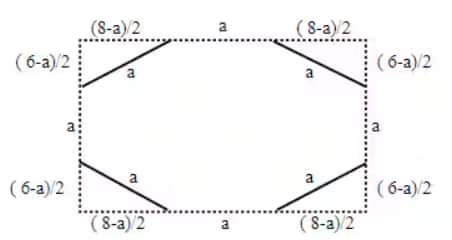
Solution:
Given,
Length of rectangle $=8$ cm
Breadth of rectangle $=6$ cm
Let the side of the regular octagon be $a$ cm.
Using the geometry of the figure,
$a^2=\frac{(8-a)^2}{4}+\frac{(6-a)^2}{4}$
Multiplying both sides by 4,
$4a^2=(8-a)^2+(6-a)^2$
$4a^2=(64-16a+a^2)+(36-12a+a^2)$
$4a^2=100-28a+2a^2$
$2a^2+28a-100=0$
Dividing by 2,
$a^2+14a-50=0$
Using the quadratic formula,
$a=\frac{-14+\sqrt{14^2-4(1)(-50)}}{2}$
$=\frac{-14+\sqrt{196+200}}{2}$
$=\frac{-14+\sqrt{396}}{2}$
$=\frac{-14+6\sqrt{11}}{2}$
$=3\sqrt{11}-7$
Therefore,
$\text{Side of the octagon}=3\sqrt{11}-7$ cm
Correct Answer: $3\sqrt{11}-7$
Q6. ABCDEF is a regular hexagon. The side of the hexagon is 36 cm. What is the area of $\triangle ABC$?
- $324\sqrt{3}\ \text{cm}^2$
- $360\sqrt{3}\ \text{cm}^2$
- $240\sqrt{3}\ \text{cm}^2$
- $192\sqrt{3}\ \text{cm}^2$
Hint: A regular hexagon can be divided into 6 congruent equilateral triangles.
Solution:
Given,
ABCDEF is a regular hexagon.
Side of the hexagon,
$a=36$ cm
Area of a regular hexagon:
$=6\times\frac{\sqrt{3}}{4}a^2$
Substituting $a=36$,
$=6\times\frac{\sqrt{3}}{4}\times(36)^2$
Since the hexagon consists of 6 equal equilateral triangles,
$\text{Area of }\triangle ABC$
$=\frac{1}{6}\times6\times\frac{\sqrt{3}}{4}\times(36)^2$
$=\frac{\sqrt{3}}{4}\times1296$
$=324\sqrt{3}\ \text{cm}^2$
Correct Answer: $324\sqrt{3}\ \text{cm}^2$
Q7. PQRS is a square whose side is 16 cm. What is the value of the side (in cm) of the largest regular octagon that can be cut from the given square?
- $8-4\sqrt{2}$
- $16+8\sqrt{2}$
- $16\sqrt{2}-16$
- $16-8\sqrt{2}$
Hint: Apply the Pythagoras theorem in the corner triangles.
Solution:
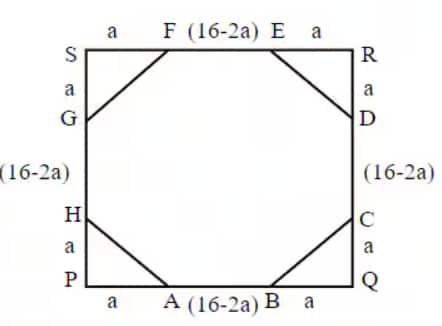
Given,
PQRS is a square of side 16 cm.
Let,
$ER=RD=a$
Then,
$ED=CD=(16-2a)$
From right-angled triangle ERD,
$(16-2a)^2=a^2+a^2$
$(16-2a)^2=2a^2$
Expanding,
$256-64a+4a^2=2a^2$
$2a^2-64a+256=0$
Dividing by 2,
$a^2-32a+128=0$
Using the quadratic formula,
$a=\frac{32\pm\sqrt{32^2-4(1)(128)}}{2}$
$=\frac{32\pm\sqrt{1024-512}}{2}$
$=\frac{32\pm\sqrt{512}}{2}$
$=\frac{32\pm16\sqrt{2}}{2}$
$=16\pm8\sqrt{2}$
Since $a<16$,
$a=16-8\sqrt{2}$
Now,
$\text{Side of octagon}$
$=16-2a$
$=16-2(16-8\sqrt{2})$
$=16-32+16\sqrt{2}$
$=16\sqrt{2}-16$
Correct Answer: $16\sqrt{2}-16$
Q8. If the sum of the measures of all the interior angles of a polygon is $1440^\circ$, find the number of sides of the polygon.
- 8
- 12
- 10
- 14
Hint: Use:
$\text{Sum of Interior Angles}=(n-2)\times180^\circ$
Solution:
Given,
Sum of interior angles
$=1440^\circ$
We know,
$(n-2)\times180^\circ=1440^\circ$
Dividing both sides by $180^\circ$,
$n-2=8$
Adding 2 to both sides,
$n=10$
Therefore, the polygon has 10 sides.
Correct Answer: 10
Q9. The sum of all exterior angles of a polygon is:
- $180^\circ$
- $270^\circ$
- $360^\circ$
- Depends on the number of sides
Hint: This is a standard property of all polygons.
Solution:
For any polygon, whether regular or irregular, the sum of one exterior angle at each vertex is always:
$360^\circ$
This property is independent of the number of sides.
Therefore,
$\text{Sum of Exterior Angles}=360^\circ$
Correct Answer: $360^\circ$
Q10. Find the sum of the interior angles of a 12-sided polygon.
- $1620^\circ$
- $1800^\circ$
- $1440^\circ$
- $1260^\circ$
Hint: Use:
$\text{Sum of Interior Angles}=(n-2)\times180^\circ$
Solution:
Given,
$n=12$
Using the formula,
$\text{Sum of Interior Angles}=(12-2)\times180^\circ$
$=10\times180^\circ$
$=1800^\circ$
Correct Answer: $1800^\circ$
Related Quantitative Aptitude Topics
To gain a deeper understanding of quantitative aptitude, it is helpful to learn other important mathematics topics that complement this concept. These topics are widely used in aptitude tests and play a key role in strengthening fundamental mathematical skills.
Frequently Asked Questions (FAQs)
A closed two-dimensional figure composed of a finite number of straight line segments connected end to end is called a polygon. These line segments are called the sides of a polygon. The point where two line segments meet is called corners or vertices.
Polygons can be regular or irregular.
Triangles, squares, and rectangles are some of the examples of polygon.
A line segment that connects two non-adjacent vertices is called the diagonals of a polygon. The number of diagonals increases as the number of sides increases.
Number of diagonals of a polygon = $\frac{n(n-3)}{2}$, where $n$ = no. of sides of polygon
Triangles do not have diagonals.
Convex Polygon | Concave Polygon |
Interior angles are less than 180 degrees. | Atleast one interior angle is greater than 180 degrees. |
All diagonals lie inside the polygon. | Some of the diagonals can lie outside the polygon. |
A line segment joining two vertices in a convex polygon remains inside or on the boundary. | In a concave polygon, some line segments between vertices will pass outside the polygon. |
Yes, all quadrilaterals are polygons. The definition of a quadrilateral matches the definition of a polygon. Quadrilaterals have four straight sides and four angles.
Example: Square, Parallelogram, Rhombus, etc
But all polygons are not quadrilaterals, as polygons can have more than 4 sides.
Polygons have different shapes depending on the number of sides they have.
Some of the very common shapes are:
Triangles like equilateral triangles, isosceles triangles, and scalene triangles.
Quadrilaterals like squares, rectangles, rhombuses, parallelograms and kites.
Here are the main types of polygons:
Regular Polygon
Irregular Polygon
Convex Polygon
Concave Polygon
The perimeter is:
$\text{Perimeter}=n\times s$
where $n$ is the number of sides and $s$ is the length of one side.
