


Perfect squares and perfect Cubes
Perfect squares and perfect cubes are important concepts in mathematics and quantitative aptitude that help identify numbers obtained by squaring or cubing an integer. For example, 64 is a perfect square because $64 = 8^2$, and it is also a perfect cube because $64 = 4^3$. These concepts are widely used in number system problems, square roots, cube roots, simplification, algebra, and mental calculation techniques. Questions based on perfect squares and perfect cubes are frequently asked in school mathematics, SSC, Banking, CUET, CAT, Railways, Defence, and other competitive examinations. In this article, we will understand the meaning of perfect squares and perfect cubes, important properties, formulas, quantitative aptitude shortcut tricks, solved examples, practice questions, and a mock test to strengthen your mathematical foundation.
What are Perfect Squares and Perfect Cubes?
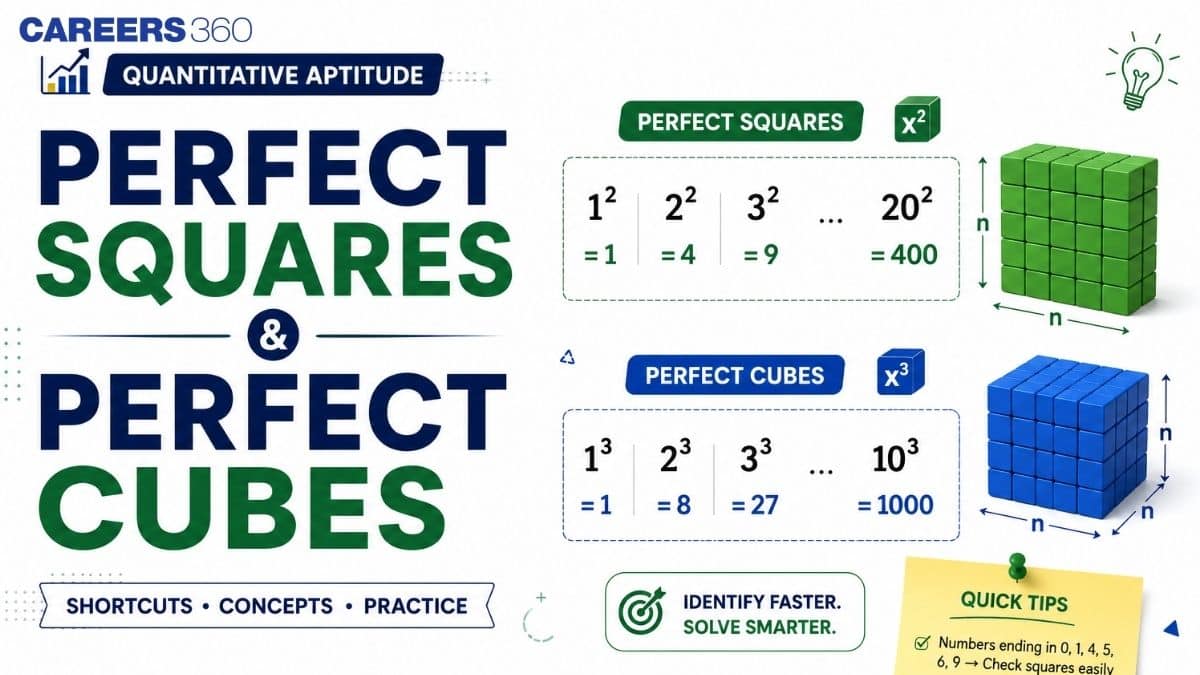
Perfect squares and perfect cubes are special numbers obtained by multiplying an integer by itself two times or three times, respectively. These concepts play an important role in number systems, square roots, cube roots, algebra, and quantitative aptitude.
They are frequently used in school mathematics as well as competitive exams such as SSC, Banking, CUET, CAT, Railways, and Defence examinations.
Perfect Square Meaning in Simple Words
A perfect square is a number obtained when an integer is multiplied by itself.
In other words:
$Perfect\ Square = n^2$
where $n$ is an integer.
Examples
$1 = 1^2$
$4 = 2^2$
$9 = 3^2$
$16 = 4^2$
$25 = 5^2$
Thus, 1, 4, 9, 16, and 25 are perfect square numbers.
Perfect Cube Meaning in Simple Words
A perfect cube is a number obtained when an integer is multiplied by itself three times.
In other words:
$Perfect\ Cube = n^3$
where $n$ is an integer.
Examples
$1 = 1^3$
$8 = 2^3$
$27 = 3^3$
$64 = 4^3$
$125 = 5^3$
Thus, 1, 8, 27, 64, and 125 are perfect cube numbers.
Real-Life Examples of Perfect Squares and Perfect Cubes
Perfect squares and cubes appear in many practical situations.
Examples of Perfect Squares
| Situation | Example |
|---|---|
| Area of a square | Side $= 8$, Area $= 8^2 = 64$ |
| Chessboard arrangement | Equal rows and columns |
| Tile flooring | Square-shaped layouts |
Examples of Perfect Cubes
| Situation | Example |
|---|---|
| Volume of a cube | Side $= 4$, Volume $= 4^3 = 64$ |
| Storage boxes | Cube-shaped containers |
| Building blocks | Cubical structures |
Why Perfect Squares and Perfect Cubes are Important
Perfect squares and cubes are important because they:
- help in finding square roots and cube roots
- are used in algebraic identities
- simplify calculations
- appear frequently in number system questions
- improve mental mathematics skills
- are commonly asked in competitive exams
Perfect Squares
A perfect square is one of the most important concepts in mathematics and number systems. Understanding perfect squares makes it easier to solve square root and simplification problems.
Definition of a Perfect Square
A number is called a perfect square if it can be expressed as:
$n^2$
where $n$ is an integer.
Examples
| Number | Representation |
|---|---|
| 1 | $1^2$ |
| 4 | $2^2$ |
| 9 | $3^2$ |
| 16 | $4^2$ |
| 25 | $5^2$ |
| 36 | $6^2$ |
List of Perfect Squares from 1 to 100
| Number | Perfect Square |
|---|---|
| 1 | 1 |
| 2 | 4 |
| 3 | 9 |
| 4 | 16 |
| 5 | 25 |
| 6 | 36 |
| 7 | 49 |
| 8 | 64 |
| 9 | 81 |
| 10 | 100 |
Properties of Perfect Squares
Some important properties of perfect squares are:
- A perfect square always has an odd number of factors.
- The units digit can only be 0, 1, 4, 5, 6, or 9.
- A perfect square never ends in 2, 3, 7, or 8.
- The square of an even number is even.
- The square of an odd number is odd.
How to Identify a Perfect Square Number
You can identify a perfect square by checking:
Method 1: Square Root Test
If the square root is an integer, the number is a perfect square.
Example:
$\sqrt{81}=9$
Therefore, 81 is a perfect square.
Method 2: Units Digit Check
Numbers ending in:
2, 3, 7, or 8
can never be perfect squares.
Example:
58 is not a perfect square.
Perfect Cubes
A perfect cube is a number obtained by multiplying an integer by itself three times.
Perfect cubes are frequently used in cube root, volume, and algebra-based problems.
Definition of a Perfect Cube
A number is called a perfect cube if it can be written as:
$n^3$
where $n$ is an integer.
Examples
| Number | Representation |
|---|---|
| 1 | $1^3$ |
| 8 | $2^3$ |
| 27 | $3^3$ |
| 64 | $4^3$ |
| 125 | $5^3$ |
List of Perfect Cubes from 1 to 1000
| Number | Perfect Cube |
|---|---|
| 1 | 1 |
| 2 | 8 |
| 3 | 27 |
| 4 | 64 |
| 5 | 125 |
| 6 | 216 |
| 7 | 343 |
| 8 | 512 |
| 9 | 729 |
| 10 | 1000 |
Properties of Perfect Cubes
Important properties of perfect cubes include:
- A perfect cube may end in any digit.
- Every perfect cube has a unique cube root.
- Cube of an even number is even.
- Cube of an odd number is odd.
- Negative numbers can also be perfect cubes.
Example
$(-3)^3=-27$
Hence, -27 is also a perfect cube.
How to Identify a Perfect Cube Number
Method 1: Cube Root Test
If the cube root is an integer, the number is a perfect cube.
Example:
$\sqrt[3]{343}=7$
Therefore, 343 is a perfect cube.
Method 2: Prime Factorization
Every prime factor should occur in groups of three.
Example:
$216 = 2^3 \times 3^3$
Hence, 216 is a perfect cube.
Formula of Perfect Squares and Perfect Cubes
Several formulas and algebraic identities involving squares and cubes are useful for calculations and problem-solving.
Perfect Square Formula
The basic perfect square formula is:
$Perfect\ Square = n^2$
Examples
$11^2=121$
$15^2=225$
$20^2=400$
Perfect Cube Formula
The basic perfect cube formula is:
$Perfect\ Cube = n^3$
Examples
$4^3=64$
$7^3=343$
$10^3=1000$
Common Algebraic Identities Related to Squares and Cubes
Perfect Square Identities
$(a+b)^2=a^2+2ab+b^2$
$(a-b)^2=a^2-2ab+b^2$
$a^2-b^2=(a+b)(a-b)$
Perfect Cube Identities
$(a+b)^3=a^3+3a^2b+3ab^2+b^3$
$(a-b)^3=a^3-3a^2b+3ab^2-b^3$
$a^3+b^3=(a+b)(a^2-ab+b^2)$
$a^3-b^3=(a-b)(a^2+ab+b^2)$
Square Roots and Cube Roots
Square roots and cube roots are inverse operations of squares and cubes. They help determine the original number from a perfect square or perfect cube.
Square Root of a Perfect Square
The square root of a perfect square is the number that produces it when multiplied by itself.
Examples
$\sqrt{25}=5$
$\sqrt{49}=7$
$\sqrt{144}=12$
Cube Root of a Perfect Cube
The cube root of a perfect cube is the number that produces it when multiplied three times.
Examples
$\sqrt[3]{27}=3$
$\sqrt[3]{125}=5$
$\sqrt[3]{512}=8$
Shortcut Methods to Find Square Roots
Method 1: Memorize Common Squares
| Number | Square |
|---|---|
| 11 | 121 |
| 12 | 144 |
| 13 | 169 |
| 14 | 196 |
| 15 | 225 |
Method 2: Prime Factorization
Example:
Find $\sqrt{144}$
$144 = 2^4 \times 3^2$
$= (2^2)^2 \times (3)^2$
$\sqrt{144}=2^2 \times 3$
$=12$
Shortcut Methods to Find Cube Roots
Method 1: Memorize Common Cubes
| Number | Cube |
|---|---|
| 1 | 1 |
| 2 | 8 |
| 3 | 27 |
| 4 | 64 |
| 5 | 125 |
| 6 | 216 |
| 7 | 343 |
| 8 | 512 |
| 9 | 729 |
| 10 | 1000 |
Method 2: Prime Factorization
Example:
Find $\sqrt[3]{216}$
$216 = 2^3 \times 3^3$
Taking one factor from each group of three:
$\sqrt[3]{216}=2 \times 3$
$=6$
These square root and cube root techniques are frequently used in quantitative aptitude, number system questions, and competitive examinations.
Applications of Perfect Squares and Perfect Cubes
Perfect squares and perfect cubes have numerous applications in mathematics, geometry, algebra, quantitative aptitude, engineering, and real-world problem-solving. Understanding their applications helps students solve square root, cube root, number system, and algebra-based questions more efficiently.
Applications of Perfect Squares
Perfect square numbers are widely used in various branches of mathematics and practical calculations.
1. Factoring and Solving Quadratic Equations
Perfect squares frequently appear in algebraic identities, factorization, and quadratic equations.
Example:
$(x+2)^2=x^2+4x+4$
2. Geometry and Surface Area Calculations
Many geometric formulas involve square terms because area is measured in square units.
Example:
$Surface\ Area\ of\ Sphere=4\pi r^2$
3. Series and Sequence Problems
Perfect square numbers often appear in mathematical sequences and number patterns.
Examples:
$1,\ 4,\ 9,\ 16,\ 25,\ 36,\ldots$
Such sequences are frequently asked in quantitative aptitude and reasoning examinations.
4. Higher Mathematics
Perfect squares are used extensively in:
- Algebra
- Coordinate Geometry
- Integration
- Differentiation
- Calculus
They help simplify complex mathematical expressions and equations.
5. Finance and Engineering
Perfect squares are useful in:
- Compound interest calculations
- Engineering measurements
- Structural design and analysis
- Construction planning
These applications help ensure stability, accuracy, and balance in practical projects.
Applications of Perfect Cubes
Perfect cube numbers are equally important in mathematics, geometry, and advanced calculations.
1. Factoring Polynomial Expressions
Perfect cubes are commonly used in algebraic factorization and polynomial identities.
Example:
$a^3-b^3=(a-b)(a^2+ab+b^2)$
2. Geometry and Volume Calculations
Perfect cubes frequently appear in formulas involving volume and three-dimensional measurements.
Example:
$Volume\ of\ Cube=side^3$
Cube numbers help calculate the capacity of cubical objects and structures.
3. Series and Sequence Problems
Perfect cube numbers are commonly used in mathematical patterns and sequences.
Examples:
$1,\ 8,\ 27,\ 64,\ 125,\ 216,\ldots$
These patterns are often tested in competitive examinations.
4. Higher Mathematics
Perfect cubes are applied in:
- Algebra
- Calculus
- Integration
- Differentiation
- Mathematical modelling
They are useful for simplifying cubic expressions and solving advanced mathematical problems.
5. Finance and Engineering
Perfect cubes are used in:
- Financial modelling
- Volume-based calculations
- Engineering design
- Structural analysis
- Scientific computations
These applications help in designing and analyzing three-dimensional systems and models.
Comparison of Applications of Perfect Squares and Perfect Cubes
| Perfect Squares | Perfect Cubes |
|---|---|
| Used in quadratic equations and factorization | Used in polynomial and cubic factorization |
| Applied in area and surface area calculations | Applied in volume calculations |
| Common in square root problems | Common in cube root problems |
| Used in number series and patterns | Used in cube-based sequences and patterns |
| Applied in integration and differentiation | Applied in integration and differentiation |
| Useful in finance, engineering, and design | Useful in finance, engineering, and modelling |
Perfect Squares
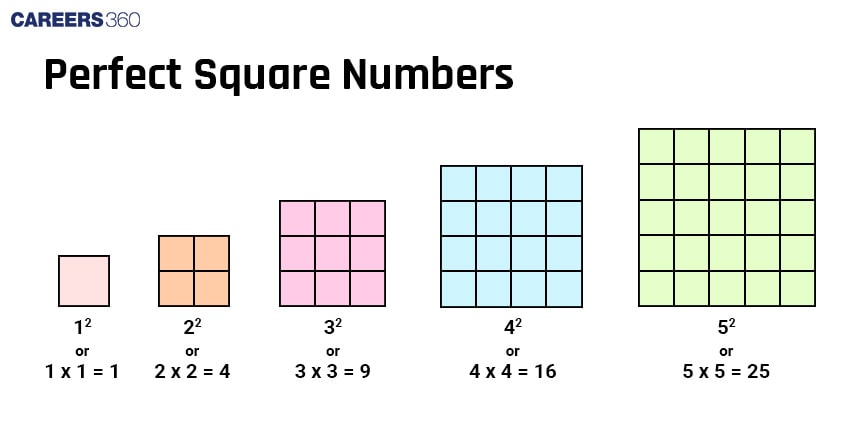
If a number can be expressed as the product of an integer with itself, then that number is called a Perfect square.
In other words, a number "a" is a perfect square if there exists an integer "b" such that a = b2
Example: 4 is a perfect square as 4 = 22, 9 is a perfect square as 9 = 32
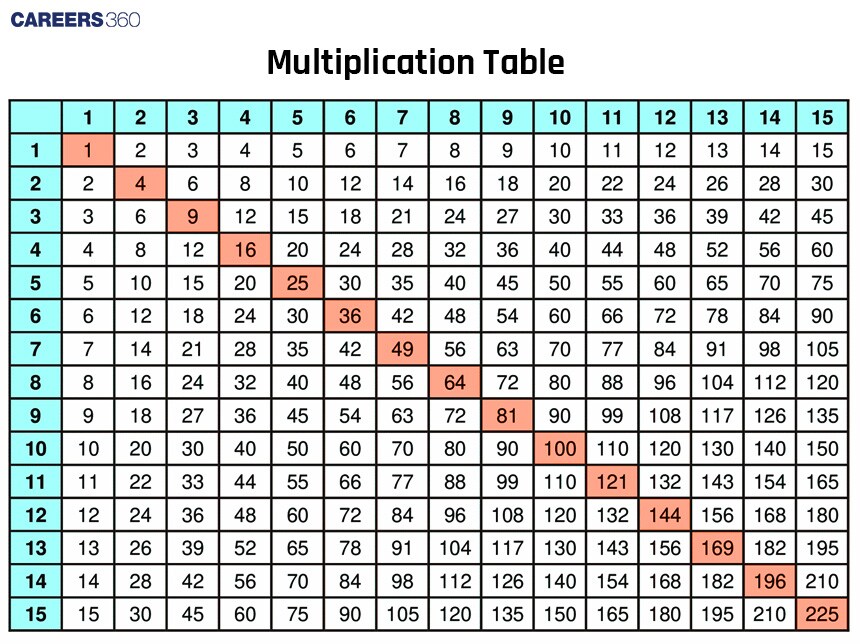
Properties of Perfect Squares
Perfect square numbers possess several unique mathematical properties that help in identifying them quickly and solving square root problems efficiently. These properties are widely used in number systems, algebra, and quantitative aptitude questions.
Non-Negative Property of Perfect Squares
A perfect square is always a non-negative number.
This is because:
- The product of two positive numbers is positive.
- The product of two negative numbers is also positive.
Examples
$8 \times 8 = 64$
$(-8) \times (-8) = 64$
Therefore, perfect squares can never be negative.
Square Root of a Perfect Square
The square root of a perfect square is always an integer.
Examples
$\sqrt{9}=3$
$\sqrt{121}=11$
$\sqrt{225}=15$
Since the square roots are whole numbers, these numbers are perfect squares.
Last Digit of a Perfect Square
A perfect square can only end in:
$0,\ 1,\ 4,\ 5,\ 6,\ 9$
A perfect square can never end in:
$2,\ 3,\ 7,\ 8$
Examples
| Perfect Square | Square Root |
|---|---|
| $100$ | $10$ |
| $121$ | $11$ |
| $144$ | $12$ |
| $169$ | $13$ |
| $196$ | $14$ |
| $225$ | $15$ |
This property is often used to eliminate incorrect options in competitive exams.
Perfect Squares Table (1 to 50)
Memorizing common perfect squares helps in solving square root and simplification questions quickly.
| Number | Square | Number | Square |
|---|---|---|---|
| 1 | 1 | 26 | 676 |
| 2 | 4 | 27 | 729 |
| 3 | 9 | 28 | 784 |
| 4 | 16 | 29 | 841 |
| 5 | 25 | 30 | 900 |
| 6 | 36 | 31 | 961 |
| 7 | 49 | 32 | 1024 |
| 8 | 64 | 33 | 1089 |
| 9 | 81 | 34 | 1156 |
| 10 | 100 | 35 | 1225 |
| 11 | 121 | 36 | 1296 |
| 12 | 144 | 37 | 1369 |
| 13 | 169 | 38 | 1444 |
| 14 | 196 | 39 | 1521 |
| 15 | 225 | 40 | 1600 |
| 16 | 256 | 41 | 1681 |
| 17 | 289 | 42 | 1764 |
| 18 | 324 | 43 | 1849 |
| 19 | 361 | 44 | 1936 |
| 20 | 400 | 45 | 2025 |
| 21 | 441 | 46 | 2116 |
| 22 | 484 | 47 | 2209 |
| 23 | 529 | 48 | 2304 |
| 24 | 576 | 49 | 2401 |
| 25 | 625 | 50 | 2500 |
Factors of a Perfect Square
Perfect square numbers have a unique factor pattern. Unlike most numbers, they always have an odd number of factors because one factor repeats.
Example: Why is 64 a Perfect Square?
$64 = 8^2$
Factors of 64 are:
$1,\ 2,\ 4,\ 8,\ 16,\ 32,\ 64$
Factor pairs:
$1 \times 64 = 64$
$2 \times 32 = 64$
$4 \times 16 = 64$
$8 \times 8 = 64$
Notice that 8 is repeated.
Therefore, 64 is a perfect square number.
Is 50 a Perfect Square?
Factors of 50 are:
$1,\ 2,\ 5,\ 10,\ 25,\ 50$
Factor pairs:
$1 \times 50 = 50$
$2 \times 25 = 50$
$5 \times 10 = 50$
No factor repeats.
Therefore, 50 is not a perfect square number.
Prime Factorization Approach
Prime factorization is one of the easiest ways to determine whether a number is a perfect square.
Rule
In a perfect square, the exponent of every prime factor must be even.
Example: Why is 100 a Perfect Square?
Prime factorization:
$100=2 \times 2 \times 5 \times 5$
$=2^2 \times 5^2$
The exponents of both prime factors are even.
Therefore, 100 is a perfect square.
Is 216 a Perfect Square?
Prime factorization:
$216=2 \times 2 \times 2 \times 3 \times 3 \times 3$
$=2^3 \times 3^3$
The exponents are odd.
Therefore, 216 is not a perfect square.
If one more 2 and one more 3 are multiplied, the exponents become even, and the resulting number becomes a perfect square.
How to Find the Square Root of a Perfect Square Number?
There are three commonly used methods to find the square root of a perfect square.
Methods to Find Square Roots
- Prime Factorization Method
- Long Division Method
- Estimation Method
Prime Factorization Method
In this method, the number is expressed as a product of prime factors and identical factors are paired together.
Steps
- Factorize the number into prime factors.
- Form pairs of identical factors.
- Take one factor from each pair.
- Multiply the selected factors.
Example
Find the square root of 225.
Prime factorization:
$225=3 \times 3 \times 5 \times 5$
$=3^2 \times 5^2$
Taking one factor from each pair:
$3 \times 5=15$
Therefore,
$\sqrt{225}=15$
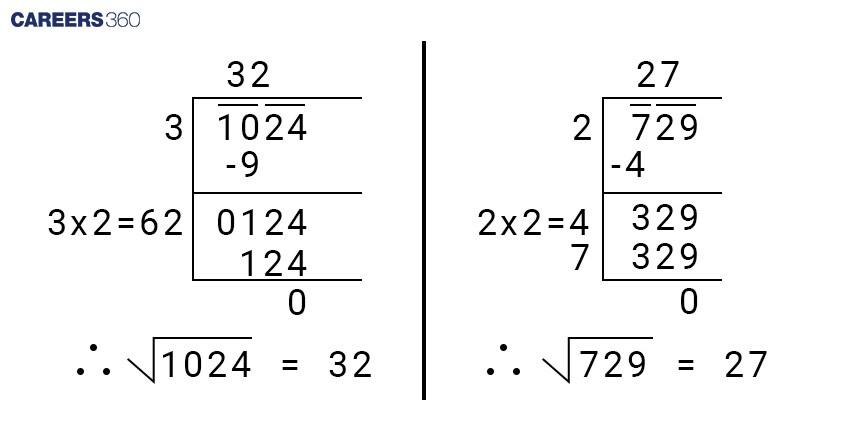
Long Division Method
The long division method is useful for finding square roots of large numbers without using a calculator.
Steps
- Group the digits into pairs from right to left.
- Find the largest number whose square is less than or equal to the first group.
- Subtract and bring down the next pair of digits.
- Double the divisor and determine the next digit.
- Continue the process until all digit pairs are used.
This method provides an accurate square root and is commonly taught in school mathematics.
Estimation Method
The estimation method is useful when an approximate square root is sufficient.
Steps
- Identify the nearest perfect squares around the number.
- Determine between which two squares the number lies.
- Estimate the square root based on proximity.
Example
Find the square root of 200.
We know:
$196 < 200 < 225$
and
$14^2 < 200 < 15^2$
Therefore:
$14 < \sqrt{200} < 15$
Since 200 is closer to 196 than 225,
$\sqrt{200} \approx 14.1$
This method is useful for quick calculations and estimation-based aptitude questions.
Perfect Cubes
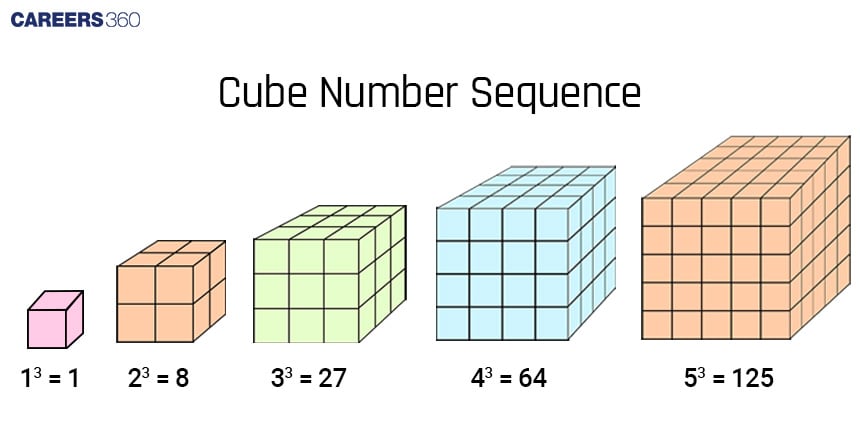
Perfect Cubes
A perfect cube is a number obtained when an integer is multiplied by itself three times. Perfect cubes play an important role in cube roots, algebraic identities, volume calculations, number systems, and quantitative aptitude.
Mathematically, a number $a$ is called a perfect cube if there exists an integer $b$ such that:
$a=b^3$
Examples
$8=2^3$
$27=3^3$
$64=4^3$
$125=5^3$
Therefore, 8, 27, 64, and 125 are perfect cube numbers.
Properties of Perfect Cubes
Perfect cubes have several unique properties that help identify them quickly and solve cube root problems efficiently.
Positive and Negative Perfect Cubes
Unlike perfect squares, perfect cubes can be both positive and negative.
Examples
$(-3)^3=-27$
$(-5)^3=-125$
$4^3=64$
$7^3=343$
Therefore, both positive and negative integers can be perfect cubes.
Cube Root of a Perfect Cube
The cube root of a perfect cube is always an integer.
Examples
$\sqrt[3]{27}=3$
$\sqrt[3]{64}=4$
$\sqrt[3]{125}=5$
Since the cube roots are whole numbers, these numbers are perfect cubes.
Last Digit of a Perfect Cube
Unlike perfect squares, a perfect cube can end with any digit from 0 to 9.
Examples
| Perfect Cube | Cube Root |
|---|---|
| $343$ | $7$ |
| $512$ | $8$ |
| $1728$ | $12$ |
| $2197$ | $13$ |
This property is useful when finding cube roots using shortcut methods.
Perfect Cubes Table (1 to 50)
Memorizing common perfect cubes helps solve cube root and simplification questions quickly.
| Number | Cube | Number | Cube |
|---|---|---|---|
| 1 | 1 | 26 | 17576 |
| 2 | 8 | 27 | 19683 |
| 3 | 27 | 28 | 21952 |
| 4 | 64 | 29 | 24389 |
| 5 | 125 | 30 | 27000 |
| 6 | 216 | 31 | 29791 |
| 7 | 343 | 32 | 32768 |
| 8 | 512 | 33 | 35937 |
| 9 | 729 | 34 | 39304 |
| 10 | 1000 | 35 | 42875 |
| 11 | 1331 | 36 | 46656 |
| 12 | 1728 | 37 | 50653 |
| 13 | 2197 | 38 | 54872 |
| 14 | 2744 | 39 | 59319 |
| 15 | 3375 | 40 | 64000 |
| 16 | 4096 | 41 | 68921 |
| 17 | 4913 | 42 | 74088 |
| 18 | 5832 | 43 | 79507 |
| 19 | 6859 | 44 | 85184 |
| 20 | 8000 | 45 | 91125 |
| 21 | 9261 | 46 | 97336 |
| 22 | 10648 | 47 | 103823 |
| 23 | 12167 | 48 | 110592 |
| 24 | 13824 | 49 | 117649 |
| 25 | 15625 | 50 | 125000 |
Factors of a Perfect Cube
Perfect cube numbers have a characteristic factor structure. Their prime factors occur in groups of three.
Example: Why is 27 a Perfect Cube?
$27=3^3$
Factors of 27 are:
$1,\ 3,\ 9,\ 27$
Factor pairs:
$1 \times 27=27$
$3 \times 9=27$
Since 27 can be expressed as the cube of an integer, it is a perfect cube number.
Is 30 a Perfect Cube?
Factors of 30 are:
$1,\ 2,\ 3,\ 5,\ 6,\ 10,\ 15,\ 30$
Since 30 cannot be expressed in the form:
$n^3$
for any integer $n$, it is not a perfect cube.
Prime Factorization Approach
Prime factorization is one of the easiest methods to determine whether a number is a perfect cube.
Rule
In a perfect cube, the exponent of every prime factor must be a multiple of 3.
Example: Why is 125 a Perfect Cube?
Prime factorization:
$125=5 \times 5 \times 5$
$=5^3$
The exponent of 5 is a multiple of 3.
Therefore, 125 is a perfect cube.
Is 100 a Perfect Cube?
Prime factorization:
$100=2^2 \times 5^2$
The exponents of both prime factors are not multiples of 3.
Therefore, 100 is not a perfect cube.
How to Find the Cube Root of a Perfect Cube Number?
There are three commonly used methods to find cube roots.
Methods to Find Cube Roots
- Prime Factorization Method
- Estimation Method
- Direct Calculation Method
Prime Factorization Method
This is the most commonly used method for finding cube roots.
Steps
- Factorize the number into prime factors.
- Group identical prime factors into triplets.
- Take one factor from each triplet.
- Multiply those factors.
Example
Find the cube root of 512.
Prime factorization:
$512=2^9$
$=2^3 \times 2^3 \times 2^3$
Taking one factor from each triplet:
$2 \times 2 \times 2$
$=8$
Therefore:
$\sqrt[3]{512}=8$
Estimation Method
This method is useful when an approximate cube root is sufficient.
Steps
- Identify the nearest perfect cubes.
- Determine between which cubes the number lies.
- Estimate the cube root based on proximity.
Example
Find the cube root of 250.
We know:
$216 < 250 < 343$
and
$6^3 < 250 < 7^3$
Therefore:
$6 < \sqrt[3]{250} < 7$
Since 250 is closer to 216 than to 343:
$\sqrt[3]{250}\approx 6.3$
This method is useful in estimation-based aptitude questions.
Direct Calculation Method
For smaller perfect cubes, the cube root can often be found directly.
Example
Find the cube root of 8.
$8=2^3$
Therefore:
$\sqrt[3]{8}=2$
Can a Number Be Both a Perfect Square and a Perfect Cube?
Yes. A number can be both a perfect square and a perfect cube. Such numbers are known as perfect sixth powers because they can be expressed in the form:
$n^6$
Example
Consider the number 64.
$64=8^2$
So, 64 is a perfect square.
Also,
$64=4^3$
So, 64 is a perfect cube.
Therefore:
$64=2^6$
Hence, 64 is both a perfect square and a perfect cube. Other examples include:
$1,\ 729,\ 4096$
These numbers satisfy both conditions simultaneously.
Best Books for Perfect Squares and Perfect Cubes
A strong understanding of perfect squares and perfect cubes helps in number systems, square roots, cube roots, simplification, and quantitative aptitude. The books below are useful for concept building and exam preparation.
| Book Name | Best For | Why It Helps |
|---|---|---|
| Quantitative Aptitude for Competitive Examinations | SSC, Bank, CUET, Railways | Covers number systems, square roots, cube roots, and aptitude questions |
| Fast Track Objective Arithmetic | Competitive exams | Includes shortcut methods and fast calculation techniques |
| Magical Book on Quicker Maths | Mental mathematics | Useful for learning square and cube shortcuts |
| NCERT Mathematics Textbook | School students | Provides strong conceptual understanding of squares and cubes |
| Objective Arithmetic | Exam practice | Contains topic-wise practice questions and MCQs |
Shortcut Tips and Tricks for Perfect Squares and Perfect Cubes
Perfect squares and perfect cubes can often be identified quickly using patterns and number properties. These tricks are especially useful in competitive exams.
| Trick | Shortcut |
|---|---|
| Perfect square unit digits | A perfect square can only end in 0, 1, 4, 5, 6, or 9 |
| Not a perfect square | Numbers ending in 2, 3, 7, or 8 are never perfect squares |
| Consecutive square difference | Difference between consecutive squares is odd |
| Perfect cube check | Prime factors must occur in groups of three |
| Cube unit digit trick | Unit digit of cube root can often be identified from cube's last digit |
| Memorize squares | Learn squares from 1 to 30 for faster calculations |
| Memorize cubes | Learn cubes from 1 to 20 for quick cube-root questions |
Tips to Solve Perfect Squares and Perfect Cubes Questions Quickly
These practical exam tips can help improve speed and accuracy.
| Tip | Explanation |
|---|---|
| Learn common squares | Useful for simplification and square-root problems |
| Learn common cubes | Helps solve cube-root questions quickly |
| Use unit digit elimination | Eliminates wrong options in MCQs |
| Apply prime factorization | Reliable method for roots and identification |
| Remember square endings | Helps identify perfect squares instantly |
| Group factors properly | Pair factors for squares and triplets for cubes |
| Practice mental calculations | Improves speed in aptitude exams |
Important Formula Table for Perfect Squares and Perfect Cubes
The formulas below are frequently used in algebra, number systems, square roots, cube roots, and quantitative aptitude.
| Concept | Formula |
|---|---|
| Perfect Square | $n^2$ |
| Perfect Cube | $n^3$ |
| Square Root | $\sqrt{n^2}=n$ |
| Cube Root | $\sqrt[3]{n^3}=n$ |
| Square of Sum | $(a+b)^2=a^2+2ab+b^2$ |
| Square of Difference | $(a-b)^2=a^2-2ab+b^2$ |
| Difference of Squares | $a^2-b^2=(a+b)(a-b)$ |
| Cube of Sum | $(a+b)^3=a^3+3a^2b+3ab^2+b^3$ |
| Cube of Difference | $(a-b)^3=a^3-3a^2b+3ab^2-b^3$ |
| Sum of Cubes | $a^3+b^3=(a+b)(a^2-ab+b^2)$ |
| Difference of Cubes | $a^3-b^3=(a-b)(a^2+ab+b^2)$ |
These tables provide a quick revision sheet for students preparing for school mathematics, SSC, Banking, CUET, CAT, Railways, Defence, and other quantitative aptitude examinations.
Practice Questions based on Perfect squares and cubes
Q1. The least number that divides 37044, gives the result in a perfect cube, is:
- 2
- 4
- 14
- 21
Hint: Factorise 37044 and find which prime factors are not present in groups of 3.
Solution:
We have to find the smallest number that divides 37044 such that the quotient becomes a perfect cube.
Prime factorization:
$37044 = 2 \times 2 \times 3 \times 3 \times 3 \times 7 \times 7 \times 7$
$= 2^2 \times 3^3 \times 7^3$
$= 4 \times (3 \times 7)^3$
$= 4 \times 21^3$
To obtain a perfect cube, the factor $2^2$ must be removed.
Therefore,
Required divisor $= 2^2 = 4$
Correct Answer: 4
Q2. Find the value of $\sqrt[3]{13824}$.
- 38
- 36
- 24
- 28
Hint: Factorise 13824 and group the prime factors into triplets.
Solution:
Prime factorization:
$13824 = 2^9 \times 3^3$
$= 2^3 \times 2^3 \times 2^3 \times 3^3$
$= (2 \times 2 \times 2 \times 3)^3$
$= 24^3$
Therefore,
$\sqrt[3]{13824} = 24$
Correct Answer: 24
Q3. What is the smallest two-digit perfect cube?
- 25
- 27
- 16
- 64
Hint: Check which option can be expressed as the cube of an integer.
Solution:
Checking the options:
$25$ is not a perfect cube.
$27 = 3^3$
$16$ is not a perfect cube.
$64 = 4^3$
Both 27 and 64 are perfect cubes.
Among them, the smallest two-digit perfect cube is:
$27$
Correct Answer: 27
Q4. What is the smallest number by which 625 must be divided so that the quotient is a perfect cube?
- 25
- 5
- 3
- 2
Hint: A perfect cube has prime factors whose powers are multiples of 3.
Solution:
Prime factorization of 625:
$625 = 5^4$
For a number to be a perfect cube, the power of every prime factor must be a multiple of 3.
Currently, the exponent of 5 is 4.
If we divide 625 by 5, we get:
$\frac{625}{5}=125$
$125=5^3$
Since the exponent 3 is a multiple of 3, 125 is a perfect cube.
Also,
$125=5^3$
Therefore, the smallest number by which 625 must be divided is:
$5$
Correct Answer: 5
Q5. A teacher wants to arrange his students in an equal number of rows and columns. If there are 1369 students, the number of students in the last row is:
- 37
- 32
- 63
- 47
Hint: If the number of rows and columns are equal, the total number of students must be a perfect square.
Solution:
The teacher wants to arrange the students in a square formation.
Let the number of students in each row be $x$.
Then,
$x^2=1369$
Taking square root on both sides,
$x=\sqrt{1369}$
$x=37$
Therefore, the students can be arranged in:
- 37 rows
- 37 students in each row
Hence, the number of students in the last row is 37.
Correct Answer: 37
Q6. What is the least number that can be multiplied by 69120 to make it a perfect cube?
- 10
- 50
- 25
- 5
Hint: For a number to be a perfect cube, all prime factor exponents must be multiples of 3.
Solution:
Prime factorization of 69120:
$69120=2^9\times3^3\times5$
For a perfect cube, the exponent of every prime factor must be a multiple of 3.
Here,
- Power of 2 = 9
- Power of 3 = 3
- Power of 5 = 1
To make the exponent of 5 a multiple of 3, we need:
$5^2$
$=25$
Therefore,
$\text{Required number}=25$
Verification:
$69120\times25=2^9\times3^3\times5^3$
All exponents are now multiples of 3.
Hence, the resulting number is a perfect cube.
Correct Answer: 25
Q7. The cube of the sum of two given numbers is 1728, while the product of the two given numbers is 32. Find the positive difference between the cubes of the two given numbers.
- 448
- 576
- 480
- 512
Hint: Let the numbers be $a$ and $b$. First find $a+b$ and then use $(a+b)^2-(a-b)^2=4ab$.
Solution:
Let the two numbers be $a$ and $b$.
Given,
$(a+b)^3=1728$
Taking cube root on both sides,
$a+b=\sqrt[3]{1728}$
$a+b=12$ .......... (1)
Also,
$ab=32$
Using the identity,
$(a+b)^2-(a-b)^2=4ab$
Substituting the values,
$12^2-(a-b)^2=4\times32$
$144-(a-b)^2=128$
$(a-b)^2=16$
$a-b=4$ .......... (2)
Adding equations (1) and (2),
$(a+b)+(a-b)=12+4$
$2a=16$
$a=8$
Substituting $a=8$ in equation (1),
$8+b=12$
$b=4$
Therefore, the two numbers are 8 and 4.
Now,
$\text{Positive difference between their cubes}=8^3-4^3$
$=512-64$
$=448$
Correct Answer: 448
Q8. By what least number should 4320 be multiplied to obtain a number that is a perfect cube?
- 40
- 50
- 60
- 80
Hint: Factorize the given number and make all prime factor exponents multiples of 3.
Solution:
Prime factorization:
$4320=2^5\times3^3\times5$
For a perfect cube, the exponent of every prime factor must be a multiple of 3.
For $2^5$:
We need one more factor of 2.
$2^5\times2=2^6$
For $5^1$:
We need two more factors of 5.
$5^1\times5^2=5^3$
Therefore,
$\text{Required multiplier}=2\times5^2$
$=2\times25$
$=50$
Hence, the least number that should be multiplied is 50.
Correct Answer: 50
Q9. For what value of N, the number 34N will be a perfect cube, where 34N is a 3-digit number?
- 2
- 3
- 4
- 5
Hint: Check for a perfect cube between 340 and 349.
Solution:
We know,
$7^3=343$
The number 343 lies between 340 and 349.
Therefore,
$34N=343$
Comparing both numbers,
$N=3$
Hence, 343 is a perfect cube.
Correct Answer: 3
Q10. What is the smallest value that must be added to 709 so that the resultant is a perfect square?
- 8
- 12
- 20
- 32
Hint: Find the nearest perfect square greater than 709.
Solution:
Let the required number be $x$.
Then,
$709+x=\text{Perfect Square}$
The nearest perfect square greater than 709 is:
$27^2=729$
Therefore,
$x=729-709$
$x=20$
Hence, the smallest value that must be added is 20.
Correct Answer: 20
Related Quantitative Aptitude Topics
The topics listed below are some of the most important quantitative aptitude concepts for exam preparation. Regular practice of these topics can improve accuracy, speed, and overall aptitude performance.
Frequently Asked Questions (FAQs)
The prime factorisation method is the best way to check if a number is a perfect square or perfect cube.
Factorise the numbers into their prime factors.
If the exponents of the numbers in the factorisation are even, then it's a perfect square.
If the exponents of the numbers in the factorisation are a multiple of 3, then it's a perfect cube.
Perfect Square | Perfect Cube |
|
|
| 2. A Perfect cube can be positive or negative. |
| 3. In base 10, a perfect cube can end in any digit. |
We will check if 72 a perfect by the Prime factorisation method.
72 = 2 × 2 × 2 × 3 × 3 = 23 × 32
As we can in the exponent of 3, it is not a multiple of 3.
So, 72 is not a perfect cube.
But if we multiply 72 by 3, the resultant number will be a perfect cube.
A perfect cube is a number obtained by multiplying an integer by itself three times. For example, $27 = 3^3$ and $125 = 5^3$, so 27 and 125 are perfect cubes.
The square root can be found using:
- prime factorization
- repeated division
- memorized square values
Example:
$\sqrt{144}=12$
because
$12^2=144$