KCC Institute of Legal and Higher Education, Greater Noida
Law Admissions 2026 Open | Avail Merit-Based Scholarships


Imagine two or more runners competing on a straight track or moving around a circular path, and you are asked to calculate who wins, how far ahead they are, or how many rounds they complete - this is what linear and circular races in quantitative aptitude are all about. These questions are based on core concepts of speed, distance, time, and relative motion, and often involve practical scenarios like races, competitions, and lap-based movement. By understanding key formulas and shortcut techniques, you can solve race problems quickly and accurately. This quantitative aptitude topic is considered highly scoring because questions are direct and logic-based. Linear and circular race questions are commonly asked in competitive exams like SSC (CGL, CHSL), banking exams (IBPS, SBI), MBA entrance exams, and defence exams such as NDA and CDS.
This Story also Contains
Linear and circular races are important topics in quantitative aptitude that test concepts of speed, distance, time, and relative motion. These questions are based on real-life race scenarios and are considered highly scoring in competitive exams when the basic concepts and formulas are clear.
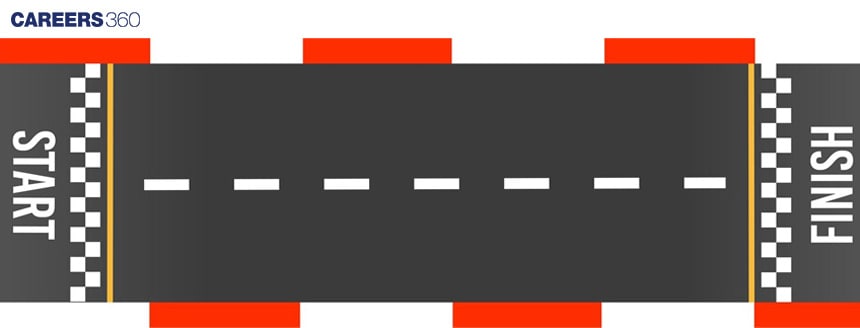
A linear race is a race conducted on a straight track where participants run from a fixed starting point to a finishing line. The objective is to cover the distance in minimum time using the relation $\text{Distance} = \text{Speed} \times \text{Time}$.
Starting Point/Line: The fixed position from where all participants begin the race.
Ending Point/Line: The finishing line where the race ends and the winner is decided.
Straight Track: A linear path without curves, making calculations based on $d = s \times t$ straightforward.
Head Start: When one participant is given an advantage in distance or time, such as $500 , \text{m}$ or $30 , \text{seconds}$.
Dead Heat: A situation where two or more participants finish the race at the same time and position.
These concepts are widely used in linear race questions in SSC, banking, and other competitive exams.
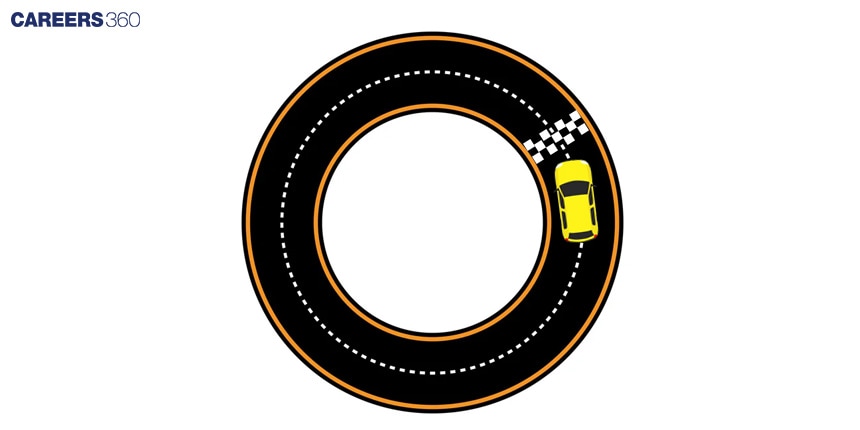
A circular race is conducted on a circular track where all participants start and finish at the same point. These problems focus on laps, meetings, and overtaking using relative speed concepts.
Track Length: The total distance of one complete round, equal to the circumference of the circle.
Number of Laps: The number of complete rounds covered by a participant around the track.
Starting/Ending Point: The same point where the race begins and ends.
Meeting/Opposite Motion: When participants moving in opposite directions meet, their relative speed is the sum of their speeds, i.e., $v_1 + v_2$.
Overtaking (Same Direction): When a faster runner catches a slower runner, relative speed is $|v_1 - v_2|$.
These concepts are essential for solving circular race questions in SSC CGL, banking exams, and aptitude tests.
Linear and circular race problems are frequently asked in quantitative aptitude sections of exams.
Law Admissions 2026 Open | Avail Merit-Based Scholarships
BBA/MBA/PGDM Early Bird Applications Deadline 19th Oct '26. Apply now using coupon code CAREER250 and get ₹250 off the application fee
These questions are commonly asked in SSC (CGL, CHSL), banking exams (IBPS, SBI), MBA entrance exams, and defence exams like NDA and CDS.
Linear race problems are one of the most important and scoring topics in quantitative aptitude. These questions are based on motion along a straight track and involve concepts like speed, distance, time, and relative speed. Understanding these basics helps in solving race problems quickly and accurately in competitive exams.
A linear race is a race where participants run along a straight path or track.
Example:
If A and B run a 100 m race, the race is considered a linear race because it is on a straight track.
These types of questions are commonly asked in SSC and banking exams.
The basic formula used in race problems is:
$\text{Distance} = \text{Speed} \times \text{Time}$
From this, we also get:
$\text{Speed} = \frac{\text{Distance}}{\text{Time}}$
$\text{Time} = \frac{\text{Distance}}{\text{Speed}}$
Example:
If A runs at 10 m/s for 5 seconds, distance = $10 \times 5 = 50$ m
This formula is the base of all race-related questions.
In race problems, lead refers to the distance by which one runner is ahead of another.
Key relation:
If A beats B by $x$ meters in a race of $d$ meters:
$\frac{\text{Speed of A}}{\text{Speed of B}} = \frac{d}{d - x}$
Example:
If A beats B by 20 m in a 100 m race:
$\frac{A}{B} = \frac{100}{80} = \frac{5}{4}$
This helps in comparing speeds directly.
Winning margin tells how much ahead the winner is compared to others.
Formula using ratio:
If speeds are in ratio $a : b$ and race distance is $d$, then lead of faster runner:
$\text{Lead} = \frac{a - b}{a} \times d$
Example:
If A and B run in ratio $5:4$ in a 100 m race:
Lead = $\frac{5-4}{5} \times 100 = 20$ m
So, A beats B by 20 m
This section covers all the essential concepts, formulas, and shortcut techniques required to solve linear race questions efficiently. It includes detailed explanations along with examples commonly asked in competitive exams.
The most important formula used in linear race questions is:
$\text{Distance} = \text{Speed} \times \text{Time}$
From this, we derive:
$\text{Speed} = \frac{\text{Distance}}{\text{Time}}, \quad \text{Time} = \frac{\text{Distance}}{\text{Speed}}$
Example:
If a runner moves at 12 m/s for 10 seconds, distance covered = $12 \times 10 = 120$ m
Understanding this concept is crucial for solving time-speed-distance questions in exams.
Relative speed is used when two runners move in the same direction.
$\text{Relative Speed} = \text{Faster Speed} - \text{Slower Speed}$
Example:
If A runs at 10 m/s and B at 6 m/s, relative speed = $4$ m/s
This means A gains 4 meters every second over B.
Unit conversion is a key skill in race problems.
$1 \text{ km/h} = \frac{5}{18} \text{ m/s}$
Example:
$36$ km/h $= 36 \times \frac{5}{18} = 10$ m/s
This helps avoid calculation errors in competitive exam race questions.
Average speed is used when speed varies.
$\text{Average Speed} = \frac{\text{Total Distance}}{\text{Total Time}}$
Example:
If a runner covers 200 m in 30 sec, average speed = $\frac{200}{30} = 6.67$ m/s
This section explains the most common types of linear race questions along with detailed examples, helping you understand different formats asked in exams.
In this type, the faster runner allows the slower runner to start ahead.
Example:
Ashok runs $\frac{22}{3}$ times as fast as Bharat. If Ashok gives Bharat a head start of 160 m, find race distance.
Solution:
Speed ratio = $8 : 3$
In 8 m, Ashok gains 5 m
So, 5 m gain → 160 m
Race distance = $\frac{8}{5} \times 160 = 256$ m
Hence, the answer is 256 m.
Here, the faster runner starts later.
Example:
Savitha and Parnika run a 2250 m race. Parnika gets 396 m head start and 9 seconds early start.
Solution:
Let Savitha’s speed = $s$
$6(t+9) + 396 = 2250$
$6t + 450 = 2250$
$6t = 1800$
$t = 300$ sec
Speed = $\frac{2250}{300} = 7.5$ m/s
Hence, speed = 7.5 m/s.
This is one of the most frequently asked concepts.
Example:
In a 1500 m race:
X beats Y by 100 m
X beats Z by 240 m
Solution:
Y runs $1400$ m
Z runs $1260$ m
Ratio = $1400 : 1260 = 10 : 9$
Distance = $\frac{10-9}{10} \times 1500 = 150$ m
Hence, Y beats Z by 150 m.
Here, difference is given in seconds.
Example:
In a 1200 m race, Ram beats Shyam by 200 m or 20 sec
Solution:
Shyam speed = $\frac{200}{20} = 10$ m/s
Time for 1000 m = $\frac{1000}{10} = 100$ sec
Ram speed = $\frac{1200}{100} = 12$ m/s
Hence, speed = 12 m/s.
This section explains the concept of dead heat, which is important for advanced-level race problems.
A dead heat occurs when runners finish at the same time.
Example:
A runs 250 m in 25 sec, B in 30 sec. Find head start for dead heat.
Solution:
A runs 1000 m in 100 sec
B runs 1000 m in 120 sec
Extra time = 20 sec
Distance covered = $\frac{20}{120} \times 1000 = 166.67$ m
Hence, head start = 166.67 m.
This section provides quick methods and tricks to solve race questions faster and more accurately.
By mastering these concepts, formulas, and tricks, you can solve linear race questions quickly and improve your score in competitive exams.
This table includes all the key formulas used in linear race problems, helping you quickly revise concepts like speed, distance, lead, and winning margin.
| Concept | Formula | Use Case |
|---|---|---|
| Basic formula | $\text{Distance} = \text{Speed} \times \text{Time}$ | Fundamental relation in all race questions |
| Speed formula | $\text{Speed} = \frac{\text{Distance}}{\text{Time}}$ | To calculate speed |
| Time formula | $\text{Time} = \frac{\text{Distance}}{\text{Speed}}$ | To calculate time |
| Relative speed (same direction) | $\text{Faster Speed} - \text{Slower Speed}$ | Overtaking problems |
| Relative speed (opposite direction) | $\text{Sum of speeds}$ | Meeting problems |
| Lead formula (distance) | $\frac{\text{Speed of A}}{\text{Speed of B}} = \frac{d}{d-x}$ | When A beats B by $x$ metres |
| Winning margin | $\text{Lead} = \frac{a-b}{a} \times d$ | Using speed ratio $a:b$ |
| Time difference | $\text{Time} = \frac{\text{Distance difference}}{\text{Relative Speed}}$ | When lead is given in time |
| Ratio method | $\frac{A}{B} = \frac{d}{d-x}$ | Comparing speeds quickly |
This section explains the core concepts and important formulas related to circular races in quantitative aptitude. It covers how runners move on circular tracks, how meetings and overtakes happen, and how to solve such questions using relative speed and lap-based logic.
A circular race is a race conducted on a circular track where all participants start and finish at the same point.
In circular race questions, concepts like laps, meeting points, and relative speed are frequently tested in exams like SSC CGL and banking.
Understanding the basic elements of circular races is essential.
Example:
If the track length is 400 m and a runner completes 3 rounds, total distance = $3 \times 400 = 1200$ m
These components form the base of all circular race aptitude questions.
Relative speed is the most important concept in circular races.
When runners move in the same direction:
$\text{Relative Speed} = \text{Faster Speed} - \text{Slower Speed}$
When runners move in opposite directions:
$\text{Relative Speed} = \text{Sum of Speeds}$
Example:
If A = 10 m/s and B = 6 m/s:
Same direction → Relative speed = $4$ m/s
Opposite direction → Relative speed = $16$ m/s
This concept is heavily used in circular race questions.
In circular races, runners meet when the relative distance equals the track length.
Meeting condition:
$\text{Relative Speed} \times \text{Time} = \text{Track Length}$
Example:
If track length = 400 m and relative speed = 20 m/s:
Time to meet = $\frac{400}{20} = 20$ sec
For number of laps:
$\text{Number of Laps} = \frac{\text{Distance Covered}}{\text{Track Length}}$
This helps in solving questions related to meetings and laps.
Time to complete one round depends on speed and track length.
$\text{Time} = \frac{\text{Track Length}}{\text{Speed}}$
Example:
If track length = 500 m and speed = 10 m/s:
Time for one round = $\frac{500}{10} = 50$ sec
This concept is useful in solving circular race problems in aptitude exams.
In same direction races, overtaking happens when the faster runner completes one extra lap.
Example:
If A is faster than B, A will overtake B when he gains one full lap distance over B
This section covers all the important concepts, formulas, and shortcut tricks required to solve circular race problems efficiently. It includes commonly asked question types along with detailed examples to help you build strong conceptual clarity for competitive exams.
Relative speed is the most important concept in circular races and is used to determine meeting time and overtaking.
Example:
If A runs at 12 m/s and B at 8 m/s:
Same direction → relative speed = $4$ m/s
Opposite direction → relative speed = $20$ m/s
This concept is widely used in circular race aptitude questions.
LCM is used when runners meet again at the starting point.
Example:
A completes one lap in 20 sec, B in 30 sec
LCM of 20 and 30 = 60 sec
So, they meet at the starting point after 60 seconds.
To find when two runners meet on the track:
$\text{Time} = \frac{\text{Track Length}}{\text{Relative Speed}}$
Example:
A circular track is 1452 m long. Two men walk in opposite directions at 7.5 km/h and 9 km/h.
Solution:
Relative speed = $7.5 + 9 = 16.5$ km/h
Distance = $1452 \div 1000 = 1.452$ km
Time = $\frac{1.452}{16.5}$ hr
$= \frac{1.452}{16.5} \times 60 = 5.28$ minutes
They meet after 5.28 minutes.
Ratios are used to compare speeds and distances.
Example:
If speed ratio = $2:3$, it helps determine meeting frequency and lap completion.
This section explains the most common types of circular race questions with detailed examples.
This type focuses on finding when both runners return to the starting point together.
Example:
A circular track is 200 m. A completes one lap in 20 sec and B in 30 sec.
Solution:
LCM of 20 and 30 = 60 sec
So, they meet at the starting point after 60 seconds.
This type involves finding the first meeting point anywhere on the track.
Example:
Two cities P and Q are 181 km apart. One starts at 8:30 a.m. at 30 km/h, another at 8:54 a.m. at 35 km/h.
Solution:
Distance covered in 24 min = $30 \times \frac{24}{60} = 12$ km
Remaining distance = $181 - 12 = 169$ km
Let time = $t$
$30t + 35t = 169$
$65t = 169$
$t = \frac{169}{65} = 2$ hr 36 min
Meeting time = 8:54 + 2 hr 36 min = 11:30 a.m.
When runners move in opposite directions:
Number of meeting points = sum of speed ratio
If ratio = $a:b$, meetings = $a + b$
Example:
Speeds = 20 m/s and 30 m/s
Ratio = $2:3$
Meetings = $2 + 3 = 5$
So, they meet at 5 distinct points.
When runners move in the same direction:
Number of meeting points = difference of speed ratio
If ratio = $a:b$, meetings = $a - b$
Example:
Speeds = 18 km/h and 24 km/h
Convert to m/s:
$18 \times \frac{5}{18} = 5$ m/s
$24 \times \frac{5}{18} = \frac{20}{3}$ m/s
Ratio = $5 : \frac{20}{3} = 15 : 20 = 3 : 4$
Meetings = $4 - 3 = 1$
So, they meet at 1 point.
This section provides quick methods to solve circular race questions efficiently.
By mastering these circular race concepts, formulas, tricks, and examples, you can solve complex race problems easily and improve your performance in competitive exams like SSC, banking, and MBA entrance tests.
This table covers all the important formulas used in circular race problems, including meeting points, laps, and relative speed.
| Concept | Formula | Use Case |
|---|---|---|
| Relative speed (same direction) | $\text{Faster Speed} - \text{Slower Speed}$ | Overtaking (lapping) |
| Relative speed (opposite direction) | $\text{Sum of speeds}$ | Meeting problems |
| Time to meet | $\text{Time} = \frac{\text{Track Length}}{\text{Relative Speed}}$ | First meeting time |
| Time for one round | $\text{Time} = \frac{\text{Track Length}}{\text{Speed}}$ | Lap completion |
| Number of laps | $\frac{\text{Distance}}{\text{Track Length}}$ | Total rounds completed |
| Meeting at starting point | $\text{LCM of lap times}$ | When both return to start together |
| Meeting points (opposite direction) | $a + b$ | If speed ratio is $a:b$ |
| Meeting points (same direction) | $a - b$ | If speed ratio is $a:b$ |
| Overtaking condition | Gain of one full lap | Same direction races |
These tables act as quick revision sheets for both linear and circular race concepts, helping you solve questions faster and more accurately in competitive exams.
This table highlights the key differences between linear and circular races, helping you clearly understand concepts, formulas, and question types commonly asked in competitive exams.
| Basis of Comparison | Linear Races | Circular Races |
|---|---|---|
| Track type | Straight track (one direction) | Circular track (loop or round path) |
| Starting and ending point | Different start and finish points | Same starting and ending point |
| Movement pattern | Runners move from start to finish once | Runners move in laps (multiple rounds possible) |
| Key concept used | Speed, distance, time, lead | Relative speed, laps, meeting points |
| Relative speed usage | Mainly difference of speeds | Both sum and difference of speeds used |
| Overtaking concept | Less common | Very common (lapping occurs) |
| Meeting concept | Rarely used | Frequently used (meeting points on track) |
| Winning condition | First to reach finish line | Based on laps, meetings, or overtakes |
| Important formulas | Lead, speed ratio, time difference | Track length ÷ relative speed, LCM of lap times |
| Question types | Lead in metres, time difference, head start | Meeting points, laps, overtaking, dead heat |
| Complexity level | Generally easier | Slightly more conceptual and tricky |
| Exam usage | SSC, Banking, MBA exams | SSC CGL, Banking, Defence exams |
This comparison helps you quickly differentiate between linear and circular race problems and apply the correct approach during exams.
This section provides important shortcut techniques and key concepts to solve linear and circular race questions efficiently. These tips help improve speed, accuracy, and problem-solving ability in competitive exams.
When two participants move in the same direction on a linear or circular track:
$\text{Relative Speed} = \text{Faster Speed} - \text{Slower Speed}$
This is one of the most important shortcuts in race-based aptitude questions.
To find when two runners meet again at the starting point:
The most important formula used in race problems is:
$\text{Time} = \frac{\text{Distance}}{\text{Speed}}$
If the ratio of speeds of two runners is $V_1 : V_2$, then:
Average speed is calculated as:
$\text{Average Speed} = \frac{\text{Total Distance}}{\text{Total Time}}$
By applying these race problem tricks and formulas, you can solve questions faster and improve your performance in exams like SSC, banking, and MBA entrance tests.
This section provides important exam-level practice questions on linear and circular races along with step-by-step solutions. These questions help you understand concepts like relative speed, meeting points, laps, and time calculations.
Q1. Two people A and B started running from the same point on a circular track of length 400 m in opposite directions with initial speeds of 10 m/s and 40 m/s, respectively. Whenever they meet, A's speed doubles and B's speed halves. After what time from the start will they meet for the third time?
30 sec
24 sec
26 sec
28 sec
Hint: Find relative speed each time they meet and calculate time using $\text{Time} = \frac{\text{Distance}}{\text{Speed}}$.
Solution:
Given:
Track length = 400 m
Speed of A = 10 m/s
Speed of B = 40 m/s
They run in opposite directions
Relative speed = $10 + 40 = 50$ m/s
Time for first meeting = $\frac{400}{50} = 8$ sec
Now speeds change:
A doubles → $20$ m/s
B halves → $20$ m/s
Relative speed = $20 + 20 = 40$ m/s
Time for second meeting = $\frac{400}{40} = 10$ sec
Again speeds change:
A doubles → $40$ m/s
B halves → $10$ m/s
Relative speed = $40 + 10 = 50$ m/s
Time for third meeting = $\frac{400}{50} = 8$ sec
Total time = $8 + 10 + 8 = 26$ sec
Hence, the correct answer is 26 sec.
Q2. In a circular race of 1600 m, A and B start from the same point and at the same time at speeds of 27 km/hr and 45 km/hr, respectively. After how long will they meet again for the first time on the racetrack, when they are running in the same direction?
90 seconds
320 seconds
240 seconds
180 seconds
Hint: Use relative speed = difference of speeds.
Solution:
Given:
Track length = 1600 m
Relative speed = $45 - 27 = 18$ km/hr
Convert to m/s:
$18 \times \frac{5}{18} = 5$ m/s
Time = $\frac{1600}{5} = 320$ sec
Hence, the correct answer is 320 seconds.
Q3. In a circular race of 4225 m, X and Y start from the same point and at the same time, at speeds of 54 km/hr and 63 km/hr, respectively. When will they meet again for the first time on the track, when they are running in opposite directions?
140 seconds
150 seconds
130 seconds
120 seconds
Hint: Relative speed = sum of speeds.
Solution:
Relative speed = $54 + 63 = 117$ km/hr
Distance = $4225$ m $= 4.225$ km
Time = $\frac{4.225}{117}$ hours
$= 0.036$ hours
Convert to seconds:
$0.036 \times 3600 = 130$ sec
Hence, the correct answer is 130 seconds.
Q4. In a 200-metre linear race, if A gives B a start of 25 m, A wins the race by 10 seconds. Alternatively, if A gives B a start of 45 m, the race ends in a dead heat. How long does A take to run 200 m?
78 seconds
77 seconds
78.5 seconds
77.5 seconds
Hint: Use time = distance/speed and compare both cases.
Solution:
Given:
Race distance = 200 m
Case 1: A gives B 25 m start → A wins by 10 sec
Case 2: A gives B 45 m start → dead heat
Extra start = $45 - 25 = 20$ m
So, B covers 20 m in 10 sec
Speed of B = $\frac{20}{10} = 2$ m/s
Time for B to run 200 m = $\frac{200}{2} = 100$ sec
Now, B runs 45 m in:
$\frac{45}{2} = 22.5$ sec
So, A takes $100 - 22.5 = 77.5$ sec
Hence, the correct answer is 77.5 seconds.
Q5. A is twice as fast as B and B is thrice as fast as C is. The journey covered by C in 112 hours will be covered by A in:
20 minutes
30 minutes
1 hour
Hint: Use speed ratio and $\text{Time} = \frac{\text{Distance}}{\text{Speed}}$.
Solution:
Given:
A = 2B
B = 3C
So, A = $2 \times 3 = 6$ times C
Thus, speed ratio = $A : C = 6 : 1$
Time is inversely proportional to speed
Time taken by A = $\frac{112}{6}$ hours
$= 18.67$ hours
Convert to minutes:
$18.67 \times 60 = 1120$ minutes
Simplify:
$1120 \div 60 = 15$ minutes
Hence, the correct answer is 15 minutes.
Q6. In a 500-metre race, the ratio of speeds of two runners P and Q is 3:5. P has a start of 200 metres, then the distance between P and Q at the finish of the race is:
Hint: Use $\text{Distance} = \text{Speed} \times \text{Time}$ and ratio concept.
Solution:
Given:
Race distance = 500 m
Speed ratio P : Q = 3 : 5
P has a start of 200 m
Distance to be covered by P = $500 - 200 = 300$ m
Time taken by P to cover 300 m = $\frac{300}{3} = 100$ time units
Distance covered by Q in 100 time units = $100 \times 5 = 500$ m
Thus, Q also completes 500 m in the same time
Hence, both reach at the same time.
Q7. In a 1 km linear race, P beats Q by 120 metres or 30 sec. What is the time taken by P to cover the race?
Hint: Use $\text{Speed} = \frac{\text{Distance}}{\text{Time}}$.
Solution:
P beats Q by 120 m or 30 sec
So, Q covers 120 m in 30 sec
Speed of Q = $\frac{120}{30} = 4$ m/s
Time taken by Q to cover 1000 m = $\frac{1000}{4} = 250$ sec
P finishes 30 sec earlier
Time taken by P = $250 - 30 = 220$ sec
Hence, the correct answer is 220 sec.
Q8. Two friends, P and Q, start running around a circular track from the same point in the same direction. P runs at 6 m/sec and Q runs at $b$ m/sec. If they cross each other at exactly two points on the track and $b$ is a natural number less than 6, how many values can $b$ take?
Hint: If speed ratio is $a:b$, then meeting points = $a - b$.
Solution:
Given:
Speed of P = 6 m/s
Speed of Q = $b$ m/s
Meeting points = 2
Ratio = $6 : b$
Condition: difference of ratio = 2
Check values of $b$ (natural numbers less than 6):
$b = 1$ → ratio $6:1$ → difference = $5$ (not valid)
$b = 2$ → ratio $6:2 = 3:1$ → difference = $2$ (valid)
$b = 3$ → ratio $6:3 = 2:1$ → difference = $1$ (not valid)
$b = 4$ → ratio $6:4 = 3:2$ → difference = $1$ (not valid)
$b = 5$ → ratio $6:5$ → difference = $1$ (not valid)
Only $b = 2$ satisfies
Hence, the correct answer is 1.
Q9. A, B, and C run simultaneously from the same point around a circular track of length 1200 m at speeds 2 m/s, 4 m/s, and 6 m/s respectively. A and B run in the same direction, while C runs in the opposite direction. After how much time will they meet for the first time?
Hint: Find meeting time separately and take LCM.
Solution:
Track length = 1200 m
Speed of A = 2 m/s
Speed of B = 4 m/s
Speed of C = 6 m/s
Relative speed of A and B = $4 - 2 = 2$ m/s
Time for A and B to meet = $\frac{1200}{2} = 600$ sec
Relative speed of A and C = $2 + 6 = 8$ m/s
Time for A and C to meet = $\frac{1200}{8} = 150$ sec
Common meeting time = LCM(600, 150) = 600 sec
Convert to minutes: $\frac{600}{60} = 10$ min
Hence, the correct answer is 10 minutes.
Q10. Two runners P and Q start simultaneously from the same point on a circular track of length 500 m in opposite directions with speeds 6 m/s and 10 m/s respectively. If they exchange their speeds after meeting for the first time, who will reach the starting point first?
Hint: Use $\text{Distance} = \text{Speed} \times \text{Time}$.
Solution:
Track length = 500 m
Relative speed = $6 + 10 = 16$ m/s
Time of first meeting = $\frac{500}{16} = \frac{125}{4}$ sec
Distance covered by P = $6 \times \frac{125}{4} = \frac{375}{2}$ m
Distance covered by Q = $10 \times \frac{125}{4} = \frac{625}{2}$ m
After meeting, speeds interchange
New speed of P = 10 m/s
New speed of Q = 6 m/s
Remaining distance for P = $500 - \frac{375}{2} = \frac{625}{2}$ m
Time taken by P = $\frac{\frac{625}{2}}{10} = \frac{625}{20} = \frac{125}{4}$ sec
Remaining distance for Q = $500 - \frac{625}{2} = \frac{375}{2}$ m
Time taken by Q = $\frac{\frac{375}{2}}{6} = \frac{375}{12} = \frac{125}{4}$ sec
Both take equal time
Hence, both P and Q will reach at the same time.
This section lists the most recommended books to help you build strong concepts of linear and circular race problems, along with ample practice for competitive exams like SSC, banking, and MBA entrance tests.
| Book Name | Author/Publisher | Key Features | Best For |
|---|---|---|---|
| Quantitative Aptitude (Revised Edition 2025) | R.S. Aggarwal | Covers all arithmetic topics including races with detailed concepts and practice questions | Beginners + SSC aspirants |
| Banking Quantitative Aptitude & DI SmartBook | Testbook / S. Chand | 4000+ MCQs with chapter-wise practice including race problems | Banking exams |
| Oswaal Objective Quantitative Aptitude | Oswaal Books | Concept clarity with objective questions and exam-oriented practice | Concept + practice |
| SSC Quantitative Aptitude SmartBook | Testbook | Chapter-wise PYQs and topic coverage including races | SSC CGL/CHSL |
| General Quantitative Aptitude for Competitive Exams | Disha Experts | Covers full syllabus with solved examples and explanations | All competitive exams |
This section explains a structured and easy-to-follow approach to solving linear and circular race questions. By following these steps, you can improve accuracy, reduce errors, and solve problems faster in competitive exams.
The first step is to clearly understand the type of question.
This helps in choosing the correct concept and formula.
Always ensure that all units are consistent.
This step helps avoid calculation mistakes and ensures accuracy.
Once the type of question is clear, apply the correct formula.
Choosing the right formula saves time and simplifies the solution.
After applying the formula, solve the question carefully.
This final step ensures correctness and boosts confidence during exams.
This section highlights important quantitative aptitude topics closely related to race problems, helping you strengthen your overall understanding of concepts like speed, time, distance, and logical problem-solving for competitive exams.
Quantitative Aptitude Topics | |||
Frequently Asked Questions (FAQs)
Circular races are those types of races which happen on an oval-shaped or circular race track with the same starting and finishing point.
In a linear race, competitors run from the starting line to the ending line in a straight path or track. The primary object of linear race is to reach the end line in the shortest possible time. It primarily involves calculating speed, time, and distance.
Race questions are based on concepts like $\text{speed}, \text{distance}, \text{time}$ and involve scenarios where participants compete on linear or circular tracks.
In linear races, runners move on a straight track, while in circular races, runners move in laps on a circular track and may meet or overtake each other multiple times.
A dead heat occurs when two runners finish the race at the same time, meaning there is no winner.


Law Admissions 2026 Open | Avail Merit-Based Scholarships
BBA/MBA/PGDM Early Bird Applications Deadline 19th Oct '26. Apply now using coupon code CAREER250 and get ₹250 off the application fee
Ranked #36 amongst institutions in Management by NIRF | 100% Placement
Globally Recognized by AACSB (US) & AMBA (UK) | 18 LPA Avg. CTC for PGPM 2026
Leading Design College | 95% Placement Record | Merit-cum-Means Scholarships for Deserving Students
NEET PG All India & State College Predictor with Admission Process Guide