
Careers360 Logo
ask-icon
share
    Types of Polynomials: Definition, Questions, Formula, Examples

    Types of Polynomials: Definition, Questions, Formula, Examples

    Hitesh SahuUpdated on 15 Apr 2026, 03:57 PM IST

    Imagine you are given an expression like $x^2 + 3x + 2$ or $2x^3 - x + 5$ and asked to identify its type or solve related problems - this is where understanding types of polynomials becomes important. Polynomials are algebraic expressions made up of variables, constants, and powers, and they form the foundation of many topics in mathematics. Questions based on polynomials test your ability to classify expressions, apply formulas, and solve equations efficiently. This topic of quantitative aptitude is widely used in school mathematics as well as competitive exams. In this article, you will learn the definition of polynomials, different types based on degree and terms, important formulas, and examples with questions to help you understand the concept clearly.

    This Story also Contains

    1. What is a Polynomial in Mathematics?
    2. Types of Polynomials Based on Degree of Polynomials
    3. Types of Polynomial Based on Number of Terms
    4. Special Types of Polynomials
    5. Properties of Polynomials
    6. Advanced Properties and Theorems of Polynomials
    7. Polynomial Function and Polynomial Equation
    8. Methods to Solve Polynomial Equations
    9. Operations on Polynomials
    10. Tips and Tricks for Polynomial Problems
    11. Important Formulas for Polynomials (Quick Revision Table)
    12. Best Books for Quantitative Aptitude Preparation
    13. Practice Questions
    14. Related Quantitative Aptitude Topics for Competitive Exams

    What is a Polynomial in Mathematics?

    Polynomials are one of the most important concepts in algebra and are widely used in solving mathematical problems in school as well as competitive exams. A polynomial is an algebraic expression formed using variables, constants, and exponents combined through operations like addition, subtraction, and multiplication. Understanding polynomials is essential for topics such as equations, factorization, and functions.

    Definition of polynomial with examples

    A polynomial is an expression consisting of variables raised to non-negative integer powers along with coefficients.

    • It includes terms like $x$, $x^2$, $x^3$, etc.
    • Each term is connected using + or − signs
    • Exponents must be whole numbers (not fractions or negative)

    Examples of polynomials:

    • $3x^2 + 2x + 1$
    • $5x^3 - x + 7$
    • $4$ (a constant is also a polynomial)

    Non-examples:

    • $1/x$ (negative exponent)
    • $\sqrt{x}$ (fractional exponent)

    These examples help in clearly identifying valid polynomial expressions.

    General form of a polynomial

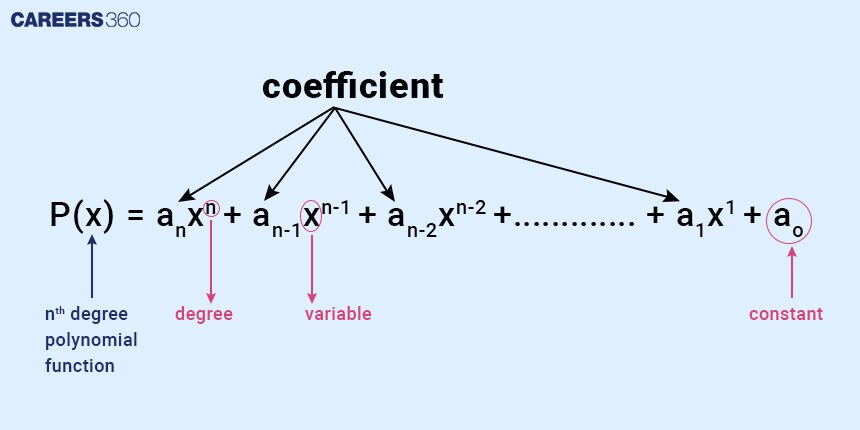
    The standard form of a polynomial is:

    $a_n x^n + a_{n-1} x^{n-1} + \dots + a_1 x + a_0$

    • $a_n, a_{n-1}, \dots, a_0$ are constants called coefficients
    • $n$ is a non-negative integer representing the highest power
    • Terms are arranged in descending order of powers

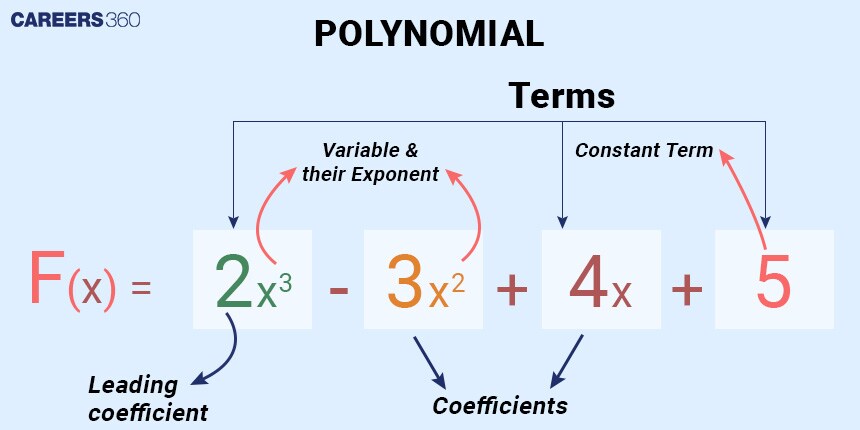
    Example:
    $2x^3 + 3x^2 + 5x + 1$
    Here, $2, 3, 5, 1$ are coefficients and the highest power is $3$

    This form helps in understanding and organizing polynomial expressions.

    Key terms: variables, coefficients, constants, degree

    To solve polynomial questions, it is important to understand its components.

    • Variable: The symbol representing an unknown value, such as $x$
    • Coefficient: The number multiplied with a variable, such as $3$ in $3x^2$
    • Constant: A term without any variable, such as $1$
    • Degree: The highest power of the variable in the polynomial

    Example:
    In $4x^3 + 2x^2 - x + 6$

    • Variable is $x$
    • Coefficients are $4, 2, -1$
    • Constant is $6$
    • Degree is $3$

    Understanding these terms makes it easier to classify and solve polynomial problems.

    Importance of polynomials in algebra and exams

    Polynomials are a core part of algebra and appear frequently in exams.

    • They are used in solving algebraic equations and identities
    • Form the foundation for higher topics like quadratic equations and functions
    • Commonly asked in school exams and competitive exams like JEE
    • Help improve logical thinking and analytical skills

    Mastering polynomials is essential for strong performance in mathematics and aptitude-based exams.

    1726215052155


    1726215052025

    Terms of a Polynomial

    The individual parts that make up a polynomial are called terms. Each term is separated by addition (+) or subtraction (−) signs.

    • In the polynomial $x^2 + 3x + 1$, there are 3 terms: $x^2$, $3x$, and $1$
    • In the polynomial $x^2 + 2x$, there are 2 terms: $x^2$ and $2x$
    • In the polynomial $2x^5$, there is only 1 term: $2x^5$

    Understanding terms is important for identifying the structure and type of a polynomial.

    Degree of a Polynomial

    The degree of a polynomial is the highest exponent (power) of the variable that has a non-zero coefficient.

    • In $F(x) = x^2 + 3x + x^3$, the highest power is $3$, so the degree is $3$
    • In $F(x) = x^6 + x + 1$, the highest power is $6$, so the degree is $6$
    • In $F(x) = 1$, the degree is $0$ since it is a constant polynomial

    Knowing the degree of a polynomial helps in classifying it and solving algebraic problems more efficiently.

    1726215052217

    Types of Polynomials Based on Degree of Polynomials

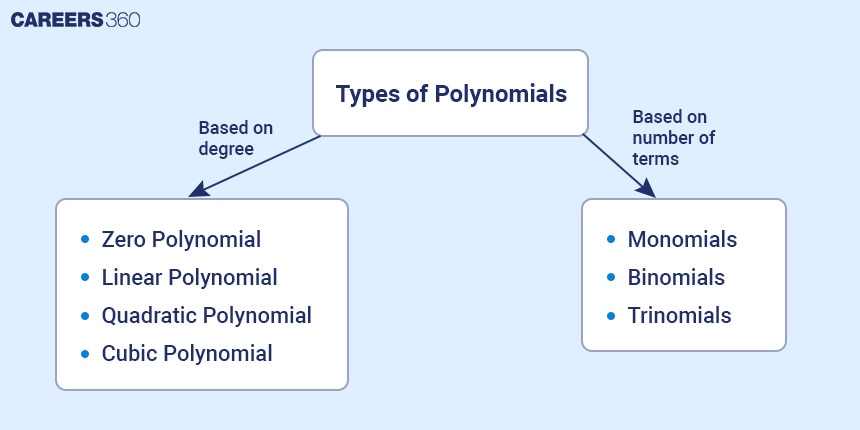
    Polynomials are commonly classified based on their degree, which is the highest power of the variable in the expression. Understanding types of polynomials based on degree is essential for solving algebraic problems and questions in competitive exams.

    Classification of polynomials based on degree

    Type of PolynomialDescriptionExample
    Constant (Zero) PolynomialDegree is $0$ and contains only a constant term$P(x) = 2$, $P(x) = -5$
    Linear PolynomialDegree is $1$$P(x) = 8x$, $P(x) = x + 2$
    Quadratic PolynomialDegree is $2$$x^2 + 2x + 1$, $2x^2$
    Cubic PolynomialDegree is $3$$x^3 + 2x + 1$, $6x^3$
    Biquadratic PolynomialDegree is $4$$2x^4 + x^2 + 1$

    These types of polynomial functions are widely used in algebra, equations, and graph-based problems.

    Types of Polynomial Based on Number of Terms

    Polynomials can also be classified based on the number of terms present in the expression. This classification is important for identifying the structure of algebraic expressions.

    Monomial

    A monomial is a polynomial with only one term.

    • It can contain one or more variables
    • No addition or subtraction within the term

    Examples:

    • $x^2$ (one variable)
    • $x^2 y$ (two variables)
    • $x^2 y z^3$ (three variables)

    Monomials are the simplest form of polynomial expressions.

    Binomial

    A binomial is a polynomial with exactly two terms.

    • Terms are separated by + or − sign
    • Can include one or more variables

    Examples:

    • $x^2 + 3x$
    • $x^2 + 3y$
    • $x^2 + 3yz^3$

    Binomials are commonly used in algebraic identities and factorization.

    Trinomial

    A trinomial is a polynomial with three terms.

    • Terms are connected using addition or subtraction
    • Frequently used in quadratic expressions

    Examples:

    • $x^2 + 3x + 2$
    • $x^2 + 3y + 1$
    • $x^2 + 3y + z^3$

    Trinomials are important for solving quadratic equations and factorization problems.

    Special Types of Polynomials

    Apart from standard classifications, there are some special types of polynomials that are important in advanced algebra and competitive exams.

    Homogeneous Polynomial

    A polynomial in which all terms have the same degree.

    • Each term has equal total power
    • Useful in algebra and higher mathematics

    Example:

    • $x^2 + y^2 + z^2$

    Irreducible Polynomial

    A polynomial that cannot be factorized further over a given field.

    • Cannot be broken into simpler polynomial factors
    • Important in algebraic theory

    Example:

    • $x^2 + 3$

    Monic Polynomial

    A polynomial in which the leading coefficient (coefficient of highest degree term) is $1$.

    • Simplifies many algebraic calculations
    • Common in polynomial equations

    Example:

    • $x^2 + 3x + 1$

    1726215052275

    Properties of Polynomials

    Polynomials have several important properties and theorems that help in solving algebraic equations, factorisation problems, and competitive exam questions efficiently. Understanding these properties of polynomials in algebra is essential for mastering concepts like division, roots, and polynomial behaviour.

    Division Algorithm for Polynomials

    The division algorithm is a fundamental concept used in polynomial division.

    If $f(x)$ is the dividend and $g(x) \neq 0$ is the divisor, then there exist unique polynomials $q(x)$ (quotient) and $r(x)$ (remainder) such that:

    $f(x) = g(x) \cdot q(x) + r(x)$

    • The degree of $r(x)$ is less than the degree of $g(x)$
    • If $r(x) = 0$, then $f(x)$ is exactly divisible by $g(x)$

    This property is widely used in solving polynomial division questions.

    Bezout’s Theorem in Polynomials

    Bezout’s theorem connects polynomials with their greatest common divisor.

    For two polynomials $f(x)$ and $g(x)$, there exist polynomials $a(x)$ and $b(x)$ such that:

    $f(x) \cdot a(x) + g(x) \cdot b(x) = \gcd(f(x), g(x))$

    • Any expression of this form is a multiple of the GCD
    • Useful in solving higher-level algebra problems

    Remainder Theorem

    The remainder theorem is one of the most important results in polynomial algebra.

    If a polynomial $f(x)$ is divided by $(x - a)$, then the remainder is:

    $f(a)$

    This can also be written as:

    $f(x) = (x - a)g(x) + f(a)$

    • Helps in quickly finding remainders without long division
    • Commonly used in competitive exam questions

    Factor Theorem

    The factor theorem is closely related to the remainder theorem.

    A polynomial $f(x)$ has $(x - a)$ as a factor if and only if:

    $f(a) = 0$

    • If $f(a) = 0$, then $(x - a)$ divides $f(x)$ exactly
    • Useful for factorization and finding roots

    Intermediate Value Theorem

    This theorem explains the behavior of polynomials over an interval.

    If $f(x)$ is continuous on $[a, b]$ and $N$ lies between $f(a)$ and $f(b)$, then there exists a value $c \in (a, b)$ such that:

    $f(c) = N$

    • Helps in locating roots of polynomial equations
    • Important in understanding graph behavior

    Algebraic Operations on Polynomials

    Polynomials remain closed under basic algebraic operations.

    Let $f(x)$ and $g(x)$ be polynomials:

    • Degree of $f(x) + g(x)$ is less than or equal to the maximum degree
    • Degree of $f(x) - g(x)$ is less than or equal to the maximum degree
    • Degree of $f(x) \cdot g(x)$ is the sum of their degrees

    These rules are essential for simplifying polynomial expressions.

    Divisibility and Zeros of Polynomials

    If a polynomial $f(x)$ is divisible by another polynomial $g(x)$, then:

    • Every zero of $g(x)$ is also a zero of $f(x)$
    • If $f(a) = 0$, then $a$ is called a zero (root) of the polynomial

    Mathematically:

    $f(x) = g(x) \cdot r(x)$

    This property helps in understanding polynomial roots and factors.

    Divisibility by Co-Prime Polynomials

    If a polynomial $f(x)$ is divisible by two co-prime polynomials $g(x)$ and $h(x)$, then:

    • It is divisible by their product

    $f(x) = g(x) \cdot h(x)$

    • Co-prime polynomials have no common factor except $1$

    This concept is useful in advanced factorization problems.

    Rule of Distinct Roots

    A polynomial of degree $n$ can have at most $n$ distinct roots.

    If

    $f(x) = a_0 + a_1x + a_2x^2 + \dots + a_n x^n$

    then it has at most $n$ distinct solutions.

    • Helps in estimating the number of solutions
    • Important for solving polynomial equations

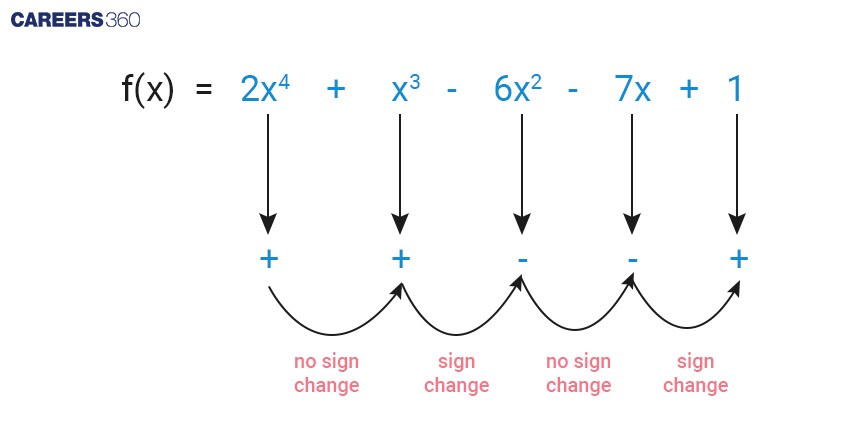
    Descartes’ Rule of Signs

    This rule helps in determining the number of real roots.

    • The number of positive real roots is equal to the number of sign changes or less than it by an even number
    • The number of negative real roots is determined by sign changes in $f(-x)$

    Example:
    $f(x) = 6x^5 + 4x^4 - 2x^3 + x^2 - x - 2$

    Sign changes:

    • $+4x^4 \to -2x^3$
    • $-2x^3 \to +x^2$
    • $+x^2 \to -x$

    Total sign changes = $3$

    So, the number of real roots can be $3$ or $1$

    1726215051833


    Advanced Properties and Theorems of Polynomials

    Polynomials follow several advanced properties and theorems that are essential for solving higher-level algebra questions and competitive exam problems. These concepts help in understanding roots, factorization, and the behavior of polynomial functions.

    Fundamental Theorem of Algebra

    The Fundamental Theorem of Algebra is one of the most important results in polynomial theory.

    • Every non-constant polynomial with complex coefficients has at least one complex root
    • This means all polynomials can be expressed in terms of their roots

    Mathematically:
    $f(x) = a_n (x - r_1)(x - r_2)(x - r_3)\dots(x - r_n)$

    • $a_n$ is the leading coefficient
    • $r_1, r_2, \dots, r_n$ are roots (real or complex)

    This theorem is widely used in solving polynomial equations and factorization.

    Rule of Conjugate Roots

    This rule applies to polynomials with real coefficients.

    • If $a + bi$ is a root, then $a - bi$ is also a root
    • Complex roots always occur in conjugate pairs

    Example:
    If $2 + 3i$ is a root, then $2 - 3i$ is also a root

    This property helps in identifying all roots of a polynomial.

    Polynomial Function and Polynomial Equation

    This section covers the concept of polynomial functions and equations, helping you understand how polynomials are formed and how they are used to solve algebraic problems.

    Polynomial Function

    A polynomial function is a function defined by a polynomial expression.

    General form:
    $f(x) = a_n x^n + a_{n-1} x^{n-1} + \dots + a_0$

    Examples:

    • $f(x) = 2x^2 + 5x + 1$ (quadratic)
    • $f(x) = 8x^3 + 3x + 1$ (cubic)
    • $f(x) = 2x + 3$ (linear)

    Polynomial Equation

    A polynomial equation is formed when a polynomial is set equal to zero.

    General form:
    $f(x) = 0$

    Examples:

    • $2x^2 + 5x + 1 = 0$
    • $8x^3 + 3x + 1 = 0$
    • $2x + 3 = 0$

    Solving polynomial equations means finding the values of $x$ that satisfy the equation.

    Methods to Solve Polynomial Equations

    This section introduces step-by-step methods to solve linear, quadratic, and cubic polynomial equations using standard formulas and techniques.

    Solving Linear Polynomial

    A linear polynomial has degree $1$.

    General form:
    $f(x) = ax + b$

    To solve:
    $ax + b = 0 \Rightarrow x = -\frac{b}{a}$

    Example:
    $5x - 20 = 0 \Rightarrow x = 4$

    Solving Quadratic Polynomial

    A quadratic polynomial has degree $2$.

    General form:
    $ax^2 + bx + c = 0$

    Methods to solve:

    • Mid-term splitting
    • Using sum and product of roots

    Formulas:

    • $\alpha + \beta = -\frac{b}{a}$
    • $\alpha \beta = \frac{c}{a}$

    Example:
    $x^2 + 5x + 6 = (x + 2)(x + 3)$

    Solving Cubic Polynomial

    A cubic polynomial has degree $3$.

    General form:
    $ax^3 + bx^2 + cx + d = 0$

    Key formulas:

    • $\alpha + \beta + \gamma = -\frac{b}{a}$
    • $\alpha \beta \gamma = -\frac{d}{a}$
    • $\alpha \beta + \beta \gamma + \alpha \gamma = \frac{c}{a}$

    Example:
    For $6x^3 + 2x^2 + x + 1$

    • Sum of roots = $-\frac{1}{3}$

    Operations on Polynomials

    This section explains basic operations like addition, subtraction, multiplication, and division of polynomials with examples for better understanding. Polynomials follow standard algebraic operations.

    Addition of Polynomials

    • Add like terms (same powers)

    Example:
    $6xy(2x-4z) + 3yz(2x-3z) + 4xz(3y-2y^2)$
    $= 12x^2y - 6xyz - 9yz^2 - 8xy^2z$

    Subtraction of Polynomials

    • Subtract corresponding terms

    Example:
    $(6x^3 + 2x^2 + 5) - (4x^3 + x^2 - 5) = 2x^3 + x^2 + 10$

    Multiplication of Polynomials

    • Multiply each term and combine

    Example:
    $(x + 2)(y + 5) = xy + 2y + 5x + 10$

    Division of Polynomials

    • Use factorization, long division, or synthetic division

    Example:
    $\frac{x^2 - x - 6}{x + 2} = x - 3$

    Understanding these advanced polynomial properties, theorems, and operations helps in solving algebra problems efficiently and improves performance in exams like boards, JEE, and other competitive tests.

    Tips and Tricks for Polynomial Problems

    This section covers important shortcuts and key formulas that help in solving polynomial questions quickly and accurately in exams. These tips are useful for understanding standard forms, performing operations, and applying root-based formulas efficiently.

    Standard forms of polynomials

    • Linear polynomial: $ax + b$
    • Quadratic polynomial: $ax^2 + bx + c$
    • Cubic polynomial: $ax^3 + bx^2 + cx + d$
    • Biquadratic polynomial: $ax^4 + bx^3 + cx^2 + dx + e$

    Knowing these standard forms helps in quickly identifying the type and degree of a polynomial.

    Rules for polynomial operations

    • Add or subtract only like terms with the same degree
    • Combine coefficients carefully to avoid errors
    • In multiplication, multiply each term of one polynomial with every term of the other
    • Always simplify the result by combining like terms

    These basic rules are essential for solving algebraic expressions correctly.

    Formulas for quadratic polynomials

    For the quadratic equation $ax^2 + bx + c = 0$, if the roots are $\alpha$ and $\beta$:

    • Sum of roots: $\alpha + \beta = -\frac{b}{a}$
    • Product of roots: $\alpha \beta = \frac{c}{a}$

    These formulas are widely used in solving and forming quadratic equations.

    Formulas for cubic polynomials

    For the cubic equation $ax^3 + bx^2 + cx + d = 0$, if the roots are $\alpha$, $\beta$, and $\gamma$:

    • Sum of roots: $\alpha + \beta + \gamma = -\frac{b}{a}$
    • Product of roots: $\alpha \beta \gamma = -\frac{d}{a}$
    • Sum of product of roots taken two at a time: $\alpha \beta + \beta \gamma + \alpha \gamma = \frac{c}{a}$

    These formulas help in solving higher-degree polynomial equations efficiently.

    Important Formulas for Polynomials (Quick Revision Table)

    Here is a structured table of the most important polynomial formulas and identities that are frequently used in algebra and competitive exams:

    ConceptFormulaUse Case
    General form of polynomial$a_n x^n + a_{n-1} x^{n-1} + \dots + a_0$Represents any polynomial
    Linear polynomial root$x = -\frac{b}{a}$Solving $ax + b = 0$
    Quadratic standard form$ax^2 + bx + c$Identifying quadratic equations
    Sum of roots (quadratic)$\alpha + \beta = -\frac{b}{a}$Finding relation between roots
    Product of roots (quadratic)$\alpha \beta = \frac{c}{a}$Used in factorization
    Forming quadratic equation$x^2 - Sx + P$When sum $S$ and product $P$ are given
    Cubic standard form$ax^3 + bx^2 + cx + d$Identifying cubic equations
    Sum of roots (cubic)$\alpha + \beta + \gamma = -\frac{b}{a}$Root relations
    Product of roots (cubic)$\alpha \beta \gamma = -\frac{d}{a}$Used in solving cubic
    Sum of pairwise products$\alpha \beta + \beta \gamma + \alpha \gamma = \frac{c}{a}$Cubic root relations
    Remainder theoremRemainder = $f(a)$When divided by $(x - a)$
    Factor theorem$f(a) = 0$To check if $(x - a)$ is a factor
    Division algorithm$f(x) = g(x)q(x) + r(x)$Polynomial division
    Identity $(a + b)^2$$a^2 + 2ab + b^2$Expansion
    Identity $(a - b)^2$$a^2 - 2ab + b^2$Expansion
    Identity $(a + b)(a - b)$$a^2 - b^2$Factorization
    Cube identity $(a + b)^3$$a^3 + 3a^2b + 3ab^2 + b^3$Higher expansions
    Cube identity $(a - b)^3$$a^3 - 3a^2b + 3ab^2 - b^3$Higher expansions

    Key Takeaways

    • These formulas are essential for solving polynomial equations quickly
    • Root-based formulas help in factorization and equation formation
    • Identities are widely used in simplification and expansion
    • Regular revision improves speed and accuracy in exams

    This table serves as a quick revision guide for all important polynomial formulas.

    Best Books for Quantitative Aptitude Preparation

    Here is a clean and exam-focused list of the most recommended books for Quantitative Aptitude across SSC, Banking, CAT, and other competitive exams:

    Book NameAuthorKey FeaturesBest For
    Quantitative Aptitude for Competitive ExaminationsR.S. AggarwalCovers all basic to advanced topics with a large number of practice questionsBeginners and SSC aspirants
    Fast Track Objective ArithmeticRajesh VermaFocuses on short tricks and faster problem-solving methodsSSC and Banking exams
    Quantitative Aptitude for CATArun SharmaConcept-based learning with difficulty levels for MBA examsCAT and MBA aspirants
    Quantum CATSarvesh K. VermaAdvanced level questions with detailed solutionsCAT and high-level exams
    Magical Book on Quicker MathsM. TyraShortcut techniques and speed improvement methodsSpeed enhancement
    NCERT Mathematics (Class 11 & 12)NCERTStrong foundation building with basic conceptsBeginners and school-level clarity
    Objective ArithmeticS. Chand (Arihant/Other editions)Topic-wise coverage with practice questionsSSC, Banking, Railways
    Data Interpretation & Logical ReasoningArun SharmaHelps with DI along with quant preparationMBA exams

    Practice Questions

    Q1. If $x^{2}-3x+1=0$, then the value of $\left(x + \frac{1}{x}\right)$ is:

    1. 1
    2. 0
    3. 3
    4. 2

    Hint: First, move the $3x$ term to the right and then divide both sides by $x$.

    Solution:

    Given:
    $x^{2}-3x+1=0$

    $⇒ x^{2}+1=3x$

    $⇒ \frac{x^{2} +1}{x}= 3$

    $\therefore x + \frac{1}{x} = 3$

    Hence, the correct answer is 3.

    Q2. What is the value of $64x^{3} + 36x^{2}y + 24xy^{2} + 2y^{3}$, when $x = 3$ and $y = -4$?

    1. 304
    2. 1456
    3. 1584
    4. 432

    Hint: Make the equation in the form of $x^{2}(64x + 36y) + y^{2}(24x + 2y)$.

    Solution:

    Given: $x = 3, y = -4$

    $= x^{2}(64x + 36y) + y^{2}(24x + 2y)$

    $= 3^{2}[(64 × 3) + (36 × -4)] + (-4)^{2}[(24 × 3) + (2 × -4)]$

    $= 9 × [192 -144] + 16 × [72 -8]$

    $= (9 × 48) + (16 × 64)$

    $= 432 + 1024$

    $= 1456$

    Hence, the correct answer is $1456$.

    Q3. If $x, y,$ and $z$ are the three factors of $a^3-7a-6$, then the value of $x+y+z$ will be:

    1. $3a$
    2. $3$
    3. $6$
    4. $a$

    Hint: Split $-7a$ into $(-a-6a)$ to get the factors.

    Solution:

    Given:
    $a^3-7a-6$

    $= a^3-a-6a-6$

    $= a(a^2-1)-6(a+1)$

    $= a(a-1)(a+1)-6(a+1)$

    $= (a+1)(a^2-a-6)$

    $= (a+1)(a-3)(a+2)$

    So, the factors are $(a+1), (a-3), (a+2)$

    $\therefore x+y+z= (a+1)+(a-3)+(a+2)=3a$

    Hence, the correct answer is $3a$.

    Q4. If $(a+b)=5$, then the value of $(a-3)^7+(b-2)^7$ is:

    1. $2^7$
    2. $3^7$
    3. 1
    4. 0

    Hint: Express $a$ in terms of $b$ and substitute.

    Solution:

    Given: $(a+b)=5$

    $⇒ a=5-b$

    $= (5-b-3)^7+(b-2)^7$

    $= (2-b)^7+(b-2)^7$

    $= -(b-2)^7+(b-2)^7$

    $= 0$

    Hence, the correct answer is $0$.

    Q5. If $x^{4}+2x^{3}+ax^{2}+bx+9$ is a perfect square, where $a$ and $b$ are positive real numbers, then the value of $a$ and $b$ are:

    1. $a=5, b=6$
    2. $a=6, b=7$
    3. $a=7, b=7$
    4. $a=7, b=6$

    Hint: Assume the expression is $[(x-\alpha)(x-\beta)]^2$.

    Solution:

    Given:
    $x^{4}+2x^{3}+ax^{2}+bx+9$

    Let the expression be $[(x-\alpha)(x-\beta)]^2$

    So, the roots are $\alpha, \alpha, \beta, \beta$

    Sum of roots = $-\frac{\text{coefficient of } x^3}{\text{coefficient of } x^4}$

    $⇒ \alpha+\alpha+\beta+\beta = -2$

    $⇒ 2(\alpha+\beta) = -2$

    $⇒ \alpha+\beta = -1$

    Product of roots = $\frac{\text{constant term}}{\text{coefficient of } x^4}$

    $⇒ \alpha \cdot \alpha \cdot \beta \cdot \beta = 9$

    $⇒ (\alpha\beta)^2 = 9$

    $⇒ \alpha\beta = \pm 3$

    Now, sum of roots taken two at a time = coefficient of $x^2$

    $a = \alpha^2 + \beta^2 + 4\alpha\beta$

    $⇒ a = (\alpha+\beta)^2 + 2\alpha\beta$

    $⇒ a = (-1)^2 + 2(\pm 3)$

    $⇒ a = 1 \pm 6$

    Since $a$ is positive,

    $⇒ a = 7$

    Now, sum of roots taken three at a time = $-\frac{b}{1}$

    $⇒ -b = 2\alpha^2\beta + 2\alpha\beta^2$

    $⇒ -b = 2\alpha\beta(\alpha+\beta)$

    $⇒ -b = 2(3)(-1)$

    $⇒ -b = -6$

    $⇒ b = 6$

    Hence, the correct answer is $a=7, b=6$.

    Q6. If $a^3+3 a^2+3 a=63$, then the value of $a^2+2 a$ is:

    1. 22
    2. 19
    3. 15
    4. 8

    Hint: Use $(a+1)^3=a^3+3a^2+3a+1$.

    Solution:

    Given:
    $a^3+3a^2+3a=63$

    Add 1 on both sides:

    $a^3+3a^2+3a+1 = 63+1$

    $⇒ (a+1)^3 = 64$

    Take cube root on both sides:

    $a+1 = 4$

    $⇒ a = 4 - 1$

    $⇒ a = 3$

    Now find required value:

    $a^2+2a = 3^2 + 2(3)$

    $⇒ a^2+2a = 9 + 6$

    $⇒ a^2+2a = 15$

    Hence, the correct answer is 15.

    Q7. If $(x-2)$ is a factor of $x^2+3Qx - 2Q$, then the value of $Q$ is:

    1. 2
    2. -2
    3. 1
    4. -1

    Hint: If $(x-a)$ is a factor, then $P(a)=0$.

    Solution:

    Given polynomial:

    $P(x)=x^2+3Qx-2Q$

    Since $(x-2)$ is a factor,

    $⇒ P(2)=0$

    Substitute $x=2$:

    $⇒ 2^2 + 3Q(2) - 2Q = 0$

    $⇒ 4 + 6Q - 2Q = 0$

    $⇒ 4 + 4Q = 0$

    $⇒ 4Q = -4$

    $⇒ Q = -1$

    Hence, the correct answer is $-1$.

    Q8. If $x^{3}+2x^{2}-5x+k$ is divisible by $x+1$, then the value of $k$ is:

    1. -6
    2. -1
    3. 0
    4. 6

    Hint: Use $f(-1)=0$.

    Solution:

    Given:
    $f(x)=x^3+2x^2-5x+k$

    Since divisible by $x+1$,

    $⇒ f(-1)=0$

    Substitute $x=-1$:

    $⇒ (-1)^3 + 2(-1)^2 - 5(-1) + k = 0$

    $⇒ -1 + 2(1) + 5 + k = 0$

    $⇒ -1 + 2 + 5 + k = 0$

    $⇒ 6 + k = 0$

    $⇒ k = -6$

    Hence, the correct answer is $-6$.

    Q9. Which of the following equations has 7 as a root?

    1. $3x^2-6x+2=0$
    2. $x^2-9x+14=0$
    3. $x^2-7x+10=0$
    4. $x^2+3x-12=0$

    Hint: Substitute $x=7$ or factorize.

    Solution:

    Check option 1:

    $3x^2-6x+2=0$

    Substitute $x=7$:

    $⇒ 3(49) - 6(7) + 2 = 147 - 42 + 2 = 107 \neq 0$

    Not a root.

    Check option 2:

    $x^2-9x+14=0$

    Factorize:

    $⇒ x^2 - 7x - 2x + 14 = 0$

    $⇒ x(x-7) -2(x-7) = 0$

    $⇒ (x-7)(x-2)=0$

    $⇒ x=7$ or $x=2$

    Thus, 7 is a root.

    Hence, the correct answer is $x^2-9x+14=0$.

    Q10. One of the factors of the expression $4\sqrt{3}x^{2}+5x-2\sqrt{3}$ is:

    1. $4x+\sqrt{3}$
    2. $4x+3$
    3. $4x-3$
    4. $4x-\sqrt{3}$

    Hint: Factorize using middle-term splitting.

    Solution:

    Given:
    $4\sqrt{3}x^{2}+5x-2\sqrt{3}$

    Split the middle term:

    $= 4\sqrt{3}x^{2} + 8x - 3x - 2\sqrt{3}$

    Group terms:

    $= (4\sqrt{3}x^{2} + 8x) - (3x + 2\sqrt{3})$

    Take common factors:

    $= 4x(\sqrt{3}x + 2) - \sqrt{3}(\sqrt{3}x + 2)$

    Factor common binomial:

    $= (4x - \sqrt{3})(\sqrt{3}x + 2)$

    Hence, one factor is $4x - \sqrt{3}$.

    Hence, the correct answer is $4x-\sqrt{3}$.

    Q11. The term that should be added to $(4x^2+8x)$ so that the resulting expression is a perfect square, is:

    1. 2
    2. 4
    3. $2x$
    4. 1

    Hint: Use identity $(a + b)^2 = a^2 + 2ab + b^2$.

    Solution:

    Given:
    $4x^2 + 8x$

    Write in identity form:

    $4x^2 = (2x)^2$

    $8x = 2 \cdot (2x) \cdot 2$

    So, expression becomes:

    $(2x)^2 + 2(2x)(2)$

    To make it a perfect square, add $2^2 = 4$

    $⇒ 4x^2 + 8x + 4$

    $= (2x)^2 + 2(2x)(2) + 2^2$

    $= (2x + 2)^2$

    The required term is $4$.

    Hence, the correct answer is $4$.

    Related Quantitative Aptitude Topics for Competitive Exams

    This section highlights important quantitative aptitude topics that are closely related to polynomials and frequently asked in competitive exams, helping you strengthen overall problem-solving skills and concept clarity.

    Frequently Asked Questions (FAQs)

    Q: What are the different types of polynomials?
    A:

    Polynomials are classified based on degree such as linear ($ax + b$), quadratic ($ax^2 + bx + c$), cubic ($ax^3 + bx^2 + cx + d$), and based on number of terms such as monomial, binomial, and trinomial.

    Q: How to solve polynomials?
    A:

    In many ways, a polynomial equation can be solved. First, we have to consider the equation equal to zero.

    We have discussed below how to solve three types of polynomial equations.

    • Linear equations: These can be solved simply by isolating the variable.

    • Quadratic equations: These can be solved by either splitting the midterm or finding the sum and product of the roots of the polynomial.

    • Cubic equations: These can be solved by finding the sum and product of the roots of the polynomial.

    Q: How do you find the degree of a polynomial?
    A:

    The degree of a polynomial is the highest power of the variable with a non-zero coefficient, for example, the degree of $3x^4 + 2x^2 + 1$ is $4$.

    Q: What is a Polynomial with Degree 4 Called?
    A:

    A polynomial with degree $4$ is called a quartic polynomial or biquadratic polynomial. It has the general form $ax^4 + bx^3 + cx^2 + dx + e$, where the highest power of the variable is $4$.

    Q: What is the factor theorem?
    A:

    The factor theorem states that if $f(a) = 0$, then $(x - a)$ is a factor of the polynomial $f(x)$.

    Upcoming Exams
    Ongoing Dates
    Chandigarh University (CUCET) Application Date

    25 Oct'25 - 30 May'26 (Online)

    Ongoing Dates
    AIEED Application Date

    1 Nov'25 - 25 May'26 (Online)

    Ongoing Dates
    CUEE Application Date

    1 Dec'25 - 24 May'26 (Online)