


HCF and LCM - Definition, Formula, Full Form, Examples
Imagine two school bells ringing after every 6 minutes and 8 minutes. If both bells ring together now, after how much time will they ring together again? Or if you want to divide 24 chocolates and 36 biscuits into the largest equal groups, how would you do it? These everyday situations are solved using HCF and LCM. HCF (Highest Common Factor) helps find the greatest number that divides two or more numbers exactly, while LCM (Least Common Multiple) helps find the smallest common multiple of given numbers. HCF and LCM are important concepts in arithmetic and quantitative aptitude and are frequently asked in school exams as well as competitive exams like SSC, Banking, NDA, CAT, Railways, and other aptitude tests.
This Story also Contains
- HCF and LCM – Definition, Formula, Full Form, Examples & Questions
- What are HCF and LCM in Mathematics?
- Difference Between HCF and LCM
- How to find the Highest Common Factor/Greatest Common Divisor:
- Methods to Find HCF and LCM
- Important Formulas of HCF and LCM
- Step-by-Step Method to Solve HCF and LCM Questions
- Types of HCF Problems
- Important Properties of HCF
- Types of LCM Problems
- Important Properties of LCM
- Relation between HCF and LCM and the two numbers:
- Best Books for HCF and LCM Preparation
- Important Formula Table for Quick Revision
- Tips and Tricks to Solve HCF and LCM Questions Quickly
- Practice questions:
- Related Quantitative Aptitude Topics

HCF and LCM – Definition, Formula, Full Form, Examples & Questions
HCF and LCM are two of the most important concepts in arithmetic and quantitative aptitude. They help students solve problems related to factors, multiples, divisibility, time intervals, grouping, and scheduling. Questions based on HCF and LCM are frequently asked in school mathematics as well as competitive exams like SSC, Banking, NDA, Railways, CAT, and other aptitude tests.
Understanding the difference between HCF and LCM makes problem-solving faster and helps avoid common mistakes in exams.
What are HCF and LCM in Mathematics?
HCF and LCM are used to compare two or more numbers based on their factors and multiples.
HCF helps find the greatest number that divides given numbers exactly
LCM helps find the smallest number that is exactly divisible by the given numbers
Both concepts are fundamental in number system and simplification chapters.
Definition of HCF with Example
HCF stands for Highest Common Factor.
It is the greatest number that divides two or more numbers exactly without leaving any remainder.
In simple words, HCF is the largest common factor shared by the given numbers.
Example
Find the HCF of $12$ and $18$
Factors of $12$:
$1,\ 2,\ 3,\ 4,\ 6,\ 12$
Factors of $18$:
$1,\ 2,\ 3,\ 6,\ 9,\ 18$
Common factors are:
$1,\ 2,\ 3,\ 6$
The greatest common factor is:
$6$
Therefore, the HCF of $12$ and $18$ is $6$.
Definition of LCM with Example
LCM stands for Least Common Multiple.
It is the smallest number that is exactly divisible by two or more given numbers.
In simple words, LCM is the smallest common multiple shared by the numbers.
Example
Find the LCM of $4$ and $6$
Multiples of $4$:
$4,\ 8,\ 12,\ 16,\ 20,\dots$
Multiples of $6$:
$6,\ 12,\ 18,\ 24,\dots$
The smallest common multiple is:
$12$
Therefore, the LCM of $4$ and $6$ is $12$.
Full Form of HCF and LCM Explained
The full forms are:
HCF = Highest Common Factor
LCM = Least Common Multiple
Some books also use GCD (Greatest Common Divisor) instead of HCF. Both mean the same thing.
HCF focuses on division and factors, while LCM focuses on multiplication and multiples.
Understanding the full form helps students quickly identify which method to use in exam questions.
Real-Life Applications of HCF and LCM
HCF and LCM are not only textbook concepts—they are used in many real-life situations.
Time Interval Problems
Suppose two bells ring every $6$ minutes and $8$ minutes.
To find when they will ring together again, we use LCM.
LCM of $6$ and $8$:
$24$
So, both bells will ring together after $24$ minutes.
Grouping and Distribution Problems
Suppose you want to divide $24$ chocolates and $36$ biscuits into the largest equal groups.
We use HCF here.
HCF of $24$ and $36$:
$12$
So, we can make $12$ equal groups.
Scheduling and Repetition Problems
Bus schedules, machine cycles, repeated events, and work shifts often use LCM.
Packaging and Arrangement Questions
Questions involving maximum equal packing use HCF.
These applications make HCF and LCM very important in daily life and aptitude exams.
Importance of HCF and LCM in Quantitative Aptitude
HCF and LCM are scoring topics in competitive exams because the formulas are simple and direct.
These questions appear in:
SSC CGL
Banking Exams
NDA
Railways
CAT
UPSC foundation mathematics
School exams and Olympiads
Common question types include:
finding HCF and LCM of numbers
word problems on bells and clocks
distribution and grouping problems
fraction-based HCF and LCM questions
formula-based aptitude MCQs
Strong understanding of HCF and LCM improves speed and accuracy in quantitative aptitude.
Difference Between HCF and LCM
Students often confuse HCF and LCM because both involve factors and multiples. However, their purpose is completely different.
Knowing the difference between HCF and LCM is essential for choosing the correct method in exam questions.
HCF vs LCM Explained
HCF is used when we need the greatest possible value that divides all numbers exactly.
LCM is used when we need the smallest possible value that all numbers can divide into exactly.
Example
For numbers $8$ and $12$
HCF:
Factors of $8$ → $1,\ 2,\ 4,\ 8$
Factors of $12$ → $1,\ 2,\ 3,\ 4,\ 6,\ 12$
Greatest common factor = $4$
So, HCF = $4$
LCM:
Multiples of $8$ → $8,\ 16,\ 24,\dots$
Multiples of $12$ → $12,\ 24,\dots$
Smallest common multiple = $24$
So, LCM = $24$
This clearly shows the difference.
Key Differences Between HCF and LCM in Tabular Form
| Basis | HCF | LCM |
|---|---|---|
| Full Form | Highest Common Factor | Least Common Multiple |
| Meaning | Greatest number dividing all numbers exactly | Smallest number divisible by all numbers |
| Based On | Factors | Multiples |
| Result Type | Smaller value | Larger value |
| Used In | Grouping, division, arrangement | Time intervals, repetition, scheduling |
| Also Called | GCD (Greatest Common Divisor) | Lowest Common Multiple |
| Example for $12, 18$ | HCF = $6$ | LCM = $36$ |
This table helps students quickly revise the difference before exams.
When to Use HCF and When to Use LCM
Choosing between HCF and LCM depends on the wording of the question.
Use HCF when the question asks:
greatest number
largest possible group
maximum size
exact division
equal distribution
Use LCM when the question asks:
smallest number
least time
first common occurrence
repeated event
together again
Example
If three lights blink after every $4$, $6$, and $8$ seconds and you need to find when they blink together again → use LCM.
If $48$ apples and $72$ oranges need to be packed into the maximum equal boxes → use HCF.
Recognizing keywords helps solve HCF and LCM questions much faster in competitive exams.
How to find the Highest Common Factor/Greatest Common Divisor:
Understanding how to compute the HCF can greatly simplify mathematical problems and make complex calculations more manageable. There are several methods to find the HCF, each with its unique approach and advantages.
HCF of two or more integers:
Finding the Highest Common Factor (HCF), also known as the Greatest Common Divisor (GCD), of two or more numbers can be done using various methods.
While finding hcf and lcm of two or more numbers, we should consider the following methods:
Calculating HCF by long division method:
When determining the HCF of large numbers, the long-division method works better. The following are the steps to be taken while using the long-division method:
Step 1: First, divide the large number by the smaller number.
Step 2: Then, set the remainder obtained as the new divisor and treat the previous divisor as the new dividend.
Step 3: Next, divide the first divisor by the first remainder.
Step 4: After that, divide the second divisor by the second remainder.
Step 5: Keep doing this until the remainder becomes zero.
Step 6: At last, the divisor, which does not leave a remainder, is the HCF of the two numbers, therefore, the last divisor is the required HCF of the given numbers.
Let's take an example to understand it more clearly.
Find the HCF of 120 and 192 using the long division method.
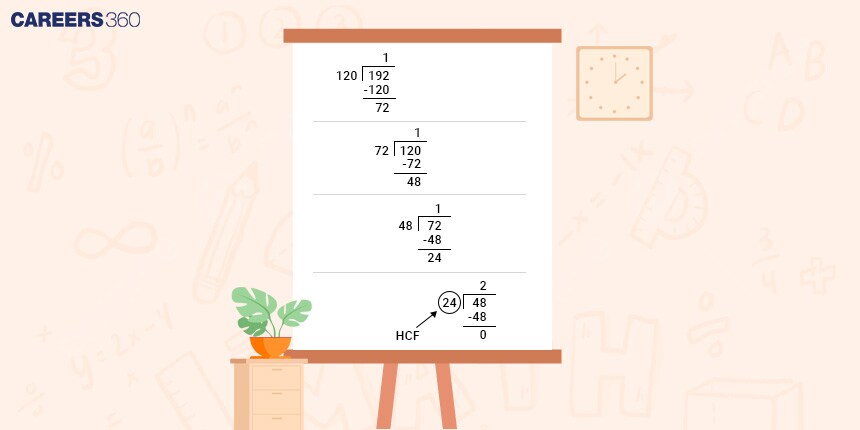
The last divisor is 24, so the HCF of 120 and 192 is 24.
Calculating HCF by Prime Factorisation method:
The prime factorisation method involves breaking down each number into prime factors and then identifying the common prime factors. Here’s a step-by-step guide for using this method:
Step 1: Factorize each number into its prime factors.
Step 2: List all the prime factors of each number.
Step 3: Identify the common prime factors.
Step 4: Take the lowest power of each common prime factor and multiply them to get the HCF.
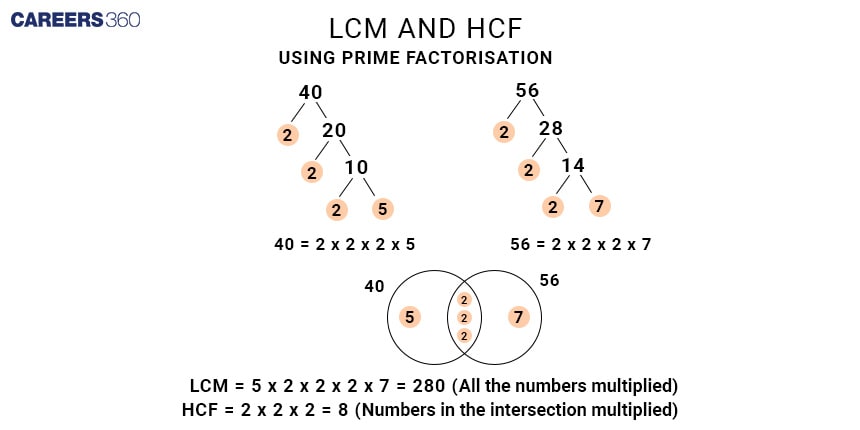
For example, let’s find the HCF of 36 and 60 using the prime factorization method.
Prime factorisation of 36 = $2^2 × 3^2$
Prime factorisation of 60 = $2^2 × 3 × 5$
So, the HCF is $2^2 × 3$ = 12.
Calculating HCF by Repeated Division method:
This method is somewhat similar to the long-division method. Let’s understand this with the following steps.
Step 1: Divide the given numbers by the smallest common prime factor.
Step 2: Divide the following quotients obtained, by their smallest common prime factor.
Step 3: Repeat this process until there is no more common prime factor between the quotients.
Step 4: Multiply all the divisors (prime factors) to get the required HCF.
For example, Let’s find the HCF of 72 and 96 using repeated division.
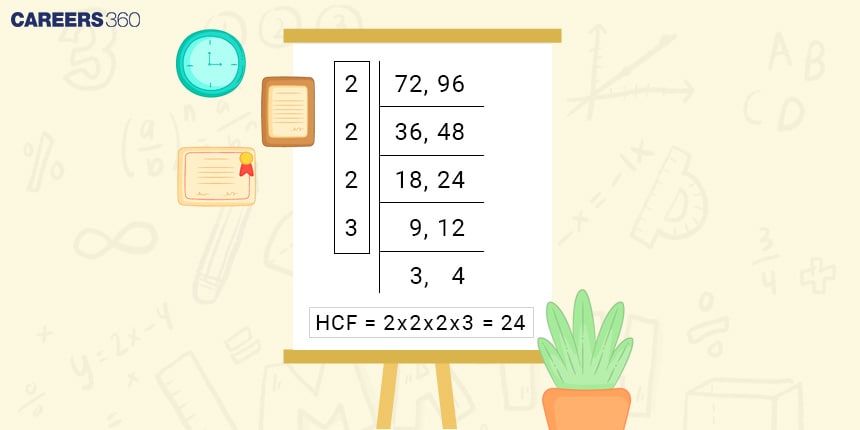
Therefore, the HCF of 72 and 96 is 24.
Calculating HCF by Euclid’s division algorithm:
This method is applicable only for positive integers and it is used to find HCF of two positive integers. According to Euclid’s division lemma, if we have two positive integers a and b (a>b), then there would be whole numbers q and r that satisfy the equation a = bq + r, where $0 \leq r < b$. Here’s a step-by-step guide for using this method:
Step 1: we express the larger number “a” in terms of the smaller number “b” in the quotient remainder form a = bq + r
Step 2: If r = 0, then b is the G.C.D. of a and b.
Step 3: If $r \neq 0$, then we apply this process on b and r.
Step 4: Continue the above process until the remainder is zero.
Step 5: When the remainder is zero, the last divisor at this stage is the HCF of given numbers.
Let’s see an example: Find the G.C.D. of 1180 and 482.
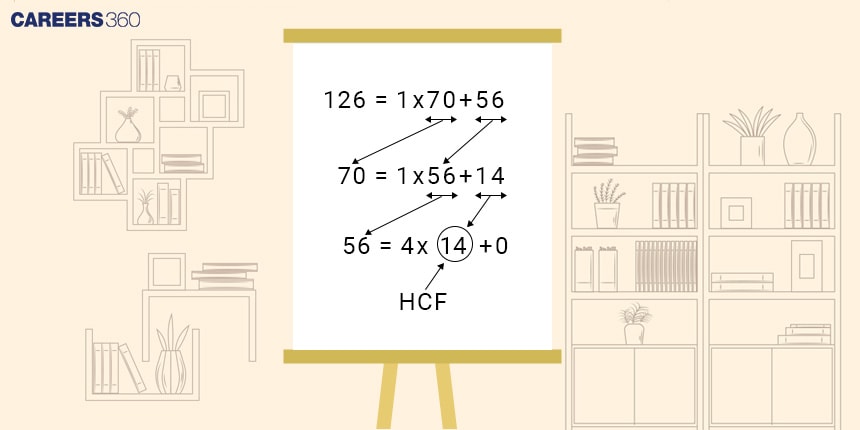
Therefore, the HCF of 1180 and 482 is 2.
Methods to Find HCF and LCM
There are several methods to find HCF and LCM depending on the type of question and the size of the numbers. In school mathematics and competitive exams, students are expected to know multiple approaches so they can choose the fastest method.
The most common methods include prime factorization, division method, listing multiples, and ladder method. Learning shortcut tricks also helps in solving aptitude questions quickly.
Prime Factorization Method
The prime factorization method is one of the easiest and most reliable ways to find both HCF and LCM.
In this method, we first express each number as a product of prime numbers.
For HCF → take only the common prime factors with the smallest powers
For LCM → take all prime factors with the greatest powers
Example
Find the HCF and LCM of $24$ and $36$
Prime factorization of $24$:
$24 = 2 \times 2 \times 2 \times 3 = 2^3 \times 3$
Prime factorization of $36$:
$36 = 2 \times 2 \times 3 \times 3 = 2^2 \times 3^2$
For HCF:
Take common prime factors with smallest powers:
$HCF = 2^2 \times 3 = 12$
For LCM:
Take all prime factors with greatest powers:
$LCM = 2^3 \times 3^2 = 72$
Therefore,
HCF = $12$
LCM = $72$
This method is very common in board exams and aptitude questions.
Division Method for HCF
The division method is mainly used to find the HCF of large numbers quickly.
In this method:
divide the larger number by the smaller number
divide the divisor by the remainder
continue until remainder becomes zero
the last divisor is the HCF
Example
Find the HCF of $48$ and $18$
Step 1:
$48 \div 18 = 2$ remainder $12$
Step 2:
$18 \div 12 = 1$ remainder $6$
Step 3:
$12 \div 6 = 2$ remainder $0$
Since remainder becomes zero, the last divisor is:
HCF = $6$
This method is very useful for large-number calculations.
Listing Multiples Method for LCM
This method is simple and useful for small numbers.
In this method:
write multiples of each number
find the smallest common multiple
Example
Find the LCM of $6$ and $8$
Multiples of $6$:
$6,\ 12,\ 18,\ 24,\ 30,\dots$
Multiples of $8$:
$8,\ 16,\ 24,\ 32,\dots$
The first common multiple is:
$24$
Therefore,
LCM = $24$
This method is ideal for beginners and small-value questions.
Ladder Method for HCF and LCM
The ladder method is a fast and exam-friendly technique for finding both HCF and LCM together.
In this method:
write the numbers side by side
divide by common prime numbers
continue until no common division is possible
Example
Find HCF and LCM of $18,\ 24,\ 30$
$
\begin{array}{r|ccc}
2 & 18 & 24 & 30 \\
3 & 9 & 12 & 15 \\
3 & 3 & 4 & 5 \\
& 1 & 4 & 5
\end{array}$
HCF:
Multiply only common divisors:
$HCF = 2 \times 3 = 6$
LCM:
Multiply all divisors and remaining numbers:
$LCM = 2 \times 3 \times 3 \times 4 \times 5 = 360$
This method is highly useful for SSC and Banking exams.
Short Tricks to Calculate HCF and LCM Quickly
Some shortcut methods help save time during competitive exams.
Important tricks include:
use prime factorization for small numbers
use division method for large numbers
identify keywords like “greatest” for HCF
identify keywords like “smallest” for LCM
use the direct formula for two numbers
These tricks improve both speed and accuracy.
Important Formulas of HCF and LCM
Formula-based questions are common in quantitative aptitude. Students must remember the direct formulas for HCF and LCM to solve questions quickly.
Formula for HCF and LCM of Two Numbers
For any two numbers:
$\text{HCF} \times \text{LCM} = \text{Product of the two numbers}$
This is the most important formula.
Example
If two numbers are $12$ and $18$
HCF = $6$
Then:
$6 \times LCM = 12 \times 18$
$6 \times LCM = 216$
$LCM = 36$
Relation Between HCF and LCM
The direct relation is:
$\text{HCF} \times \text{LCM} = a \times b$
where $a$ and $b$ are the two given numbers.
This formula is frequently used in aptitude MCQs.
Formula Using Product of Two Numbers
If HCF and one number are known, the second number can be found using:
$\text{Second Number} = \frac{\text{HCF} \times \text{LCM}}{\text{First Number}}$
This is useful in missing-number questions.
HCF and LCM Formula for Fractions
For fractions:
$\text{HCF of fractions} = \frac{\text{HCF of numerators}}{\text{LCM of denominators}}$
$\text{LCM of fractions} = \frac{\text{LCM of numerators}}{\text{HCF of denominators}}$
These formulas are important for advanced arithmetic questions.
Formula-Based Shortcut Tricks for Exams
Quick tricks include:
if numbers are co-prime, HCF = $1$
if one number divides another exactly, the smaller number is the HCF
for co-prime numbers, LCM = product of numbers
These shortcuts are highly useful in competitive exams.
Step-by-Step Method to Solve HCF and LCM Questions
Following a structured approach helps students avoid mistakes and improve solving speed.
Identify Whether the Problem Needs HCF or LCM
The first step is to understand what the question is asking.
Use HCF when words like appear:
greatest
largest
maximum
exact division
equal grouping
Use LCM when words like appear:
smallest
least
together again
repeated event
first common occurrence
This step is the most important.
Apply the Correct Method
After identifying the concept:
use prime factorization for exact values
use division method for large numbers
use multiples for small LCM problems
use formulas for shortcut solving
Choosing the correct method saves time.
Simplify the Final Answer
After calculation:
recheck multiplication
verify prime factors
confirm no smaller or larger value exists incorrectly
Many mistakes happen in final simplification.
Verify with Divisibility Rules
Always check the final answer.
For HCF:
The answer must divide all numbers exactly.
For LCM:
The answer must be divisible by all numbers exactly.
Example
If HCF = $6$ for $18$ and $24$
Check:
$18 \div 6 = 3$
$24 \div 6 = 4$
Correct
Verification helps avoid careless mistakes in exams.
Types of HCF Problems
HCF questions in quantitative aptitude are asked in different formats based on divisibility conditions, remainder conditions, and fractions. To solve these questions quickly, students must first identify which type of HCF problem is being asked. Once the pattern is clear, choosing the correct method becomes much easier.
Problems on HCF can mainly be divided into four major categories:
HCF of two or more numbers when there is no remainder
HCF of two or more numbers when the remainder is known
HCF of two or more numbers when the same remainder is left but the remainder is unknown
HCF of two or more fractions
These question types are very common in SSC, Banking, NDA, Railways, CAT, and other competitive exams.
1. HCF of Two or More Numbers if There is No Remainder in Each Case
In this type of question, the required number divides all the given numbers exactly without leaving any remainder.
This means we simply need to find the Highest Common Factor (HCF) of the given numbers using methods like:
Prime factorization
Long division
Repetitive division
Ladder method
This is the most direct and basic type of HCF problem.
Example
Find the greatest number which divides $18$, $24$, and $30$ and leaves no remainder in each case.
Solution
We need to find the HCF of $18$, $24$, and $30$.
Prime factorization of $18$:
$18 = 2 \times 3 \times 3$
$= 2 \times 3^2$
Prime factorization of $24$:
$24 = 2 \times 2 \times 2 \times 3$
$= 2^3 \times 3$
Prime factorization of $30$:
$30 = 2 \times 3 \times 5$
Now identify the common prime factors:
Common factors in all three numbers are:
$2$ and $3$
So,
$\text{HCF} = 2 \times 3 = 6$
Therefore, the greatest number which divides $18$, $24$, and $30$ exactly is $6$.
This is one of the most common HCF questions in arithmetic.
2. HCF of Two or More Numbers if There is a Remainder in Each Case (Remainder is Known)
In some HCF questions, the numbers leave different known remainders when divided by the required number.
In such cases, the rule is:
First subtract the remainder from each number and then calculate the HCF of the new values.
This works because after removing the remainder, the numbers become exactly divisible.
Example
Find the greatest number which when divides $127$ and $191$ leaves remainders $3$ and $5$, respectively.
Solution
Given:
$127$ leaves remainder $3$
$191$ leaves remainder $5$
So, subtract the remainders:
$127 - 3 = 124$
$191 - 5 = 186$
Now we need to find the HCF of $124$ and $186$
Prime factorization of $124$:
$124 = 2 \times 2 \times 31$
$= 2^2 \times 31$
Prime factorization of $186$:
$186 = 2 \times 3 \times 31$
Now identify common prime factors:
$2$ and $31$
So,
$\text{HCF} = 2 \times 31 = 62$
Therefore, the required greatest number is $62$.
This type of remainder-based HCF question is frequently asked in aptitude exams.
3. HCF of Two or More Numbers if There is Equal Remainder in Each Case (Remainder is Unknown)
Sometimes, the question states that all the numbers leave the same remainder when divided by the required number, but the remainder itself is not given.
Usually, three numbers are given in this type of problem.
To solve:
find the difference between all pairs of numbers
then find the HCF of these differences
That HCF becomes the required answer.
This method works because equal remainders cancel out when differences are taken.
Example
Find the greatest number which when divided by $67$, $77$, and $97$ leaves the same remainder.
Solution
Take the differences between the numbers:
$(77 - 67) = 10$
$(97 - 77) = 20$
$(97 - 67) = 30$
Now find the HCF of:
$10,\ 20,\ 30$
Prime factorization:
$10 = 2 \times 5$
$20 = 2^2 \times 5$
$30 = 2 \times 3 \times 5$
Common factors are:
$2 \times 5$
So,
$\text{HCF} = 10$
Therefore, the required greatest number is $10$.
This is an important logical HCF problem type.
4. HCF of Two or More Fractions
To find the HCF of fractions, we use a special formula instead of normal HCF methods.
Formula
$\text{HCF of fractions} = \frac{\text{HCF of numerators}}{\text{LCM of denominators}}$
This formula is important for advanced arithmetic and competitive aptitude.
Students often confuse this with the LCM formula of fractions, so it should be remembered carefully.
Example
Find the HCF of $\frac{4}{5}$ and $\frac{6}{7}$
Solution
Using the formula:
$\text{HCF} = \frac{\text{HCF of 4 and 6}}{\text{LCM of 5 and 7}}$
Step 1: Find HCF of numerators
HCF of $4$ and $6$
Factors of $4$:
$1,\ 2,\ 4$
Factors of $6$:
$1,\ 2,\ 3,\ 6$
Common factors:
$1,\ 2$
So,
$\text{HCF} = 2$
Step 2: Find LCM of denominators
LCM of $5$ and $7$
Since both are prime numbers,
$\text{LCM} = 5 \times 7 = 35$
Now substitute:
$\text{HCF of fractions} = \frac{2}{35}$
Therefore, the required HCF is:
$\frac{2}{35}$
Important Properties of HCF
Learning the important properties of HCF helps students solve questions faster and avoid mistakes in competitive exams.
These properties are very useful in direct concept-based questions.
Property 1: HCF of Any Two or More Numbers is Never Greater Than the Given Numbers
The HCF of any numbers can never be greater than the smallest given number.
It is always less than or equal to the smallest number.
This is because HCF must divide all numbers exactly.
Example
Find the HCF of $4$ and $6$
Factors of $4$:
$1,\ 2,\ 4$
Factors of $6$:
$1,\ 2,\ 3,\ 6$
Greatest common factor:
$2$
Clearly, $2$ is not greater than $4$ or $6$
This proves the property.
Property 2: The HCF of Co-prime Numbers is Always 1
Co-prime numbers are numbers that have no common factor other than $1$.
Their HCF is always $1$.
Example
Find the HCF of $23$ and $24$
Factors of $23$:
$1,\ 23$
Factors of $24$:
$1,\ 2,\ 3,\ 4,\ 6,\ 8,\ 12,\ 24$
Only common factor is:
$1$
Therefore,
$\text{HCF} = 1$
So, $23$ and $24$ are co-prime numbers.
Property 3: The Order of Numbers Does Not Affect the HCF
This means:
$\text{HCF}(a, b) = \text{HCF}(b, a)$
Changing the order of numbers does not change the HCF.
This property is called the commutative property of HCF.
Example
$\text{HCF}(12, 18) = 6$
and
$\text{HCF}(18, 12) = 6$
Both are equal.
So, the order of numbers does not matter.
This helps simplify calculations in exams.
Example: Find the LCM of 12,15 and 18.
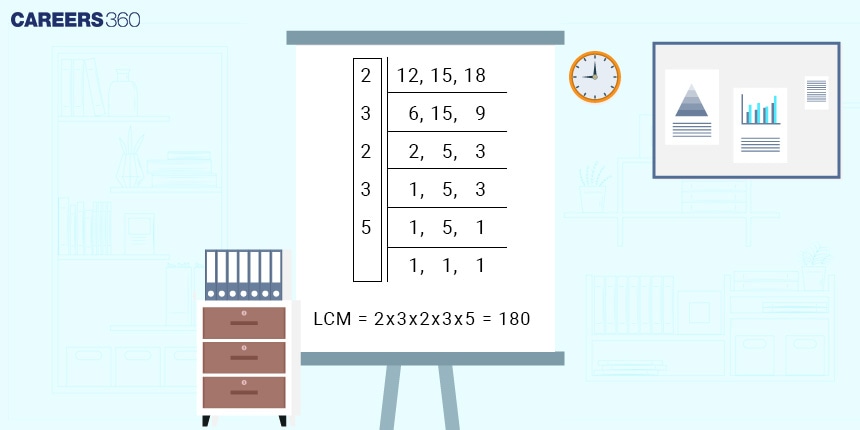
Therefore, the LCM of 12, 15, and 18 is 180.
Types of LCM Problems
LCM questions in quantitative aptitude are asked in different formats based on divisibility, remainder conditions, and fraction-based calculations. Understanding the different types of LCM problems helps students quickly identify the correct method and solve questions faster in exams like SSC, Banking, NDA, Railways, CAT, and other competitive exams.
Problems of LCM can mainly be divided into the following categories:
LCM of two or more numbers when there is no remainder
LCM of numbers when equal remainder is given
LCM of numbers when equal remainder is given and divisibility by another number is required
LCM when the difference between divisor and remainder is the same
LCM when the difference between divisor and remainder is the same and divisibility by another number is required
LCM of fractions
These question types are very important for arithmetic and aptitude preparation.
1. LCM of Two or More Numbers if There is No Remainder in Each Case
In this type of problem, the required number should be exactly divisible by all the given numbers without leaving any remainder.
Here, we simply find the Least Common Multiple (LCM) of the given numbers using methods like:
Prime factorization
Division method
Listing multiples method
Ladder method
This is the most basic and direct type of LCM question.
Example
Find the least number which when divided by $12$, $15$, and $18$ leaves no remainder in each case.
Solution
We need to find the LCM of $12$, $15$, and $18$.
Prime factorization of $12$:
$12 = 2 \times 2 \times 3$
$= 2^2 \times 3$
Prime factorization of $15$:
$15 = 3 \times 5$
Prime factorization of $18$:
$18 = 2 \times 3 \times 3$
$= 2 \times 3^2$
Now take all prime factors with highest powers:
$LCM = 2^2 \times 3^2 \times 5$
$= 4 \times 9 \times 5$
$= 180$
Therefore, the least number which is exactly divisible by $12$, $15$, and $18$ is $180$.
2. LCM of Two or More Numbers if There is an Equal Remainder in Each Case (Remainder is Known)
In this type of question, the required number leaves the same known remainder when divided by all the given numbers.
To solve:
first calculate the LCM of the given numbers
then add the common remainder to the LCM
This gives the required least number.
Example
Find the least number which when divided by $8$, $12$, $18$, and $20$ leaves a remainder of $3$ in each case.
Solution
Prime factorization:
$8 = 2^3$
$12 = 2^2 \times 3$
$18 = 2 \times 3^2$
$20 = 2^2 \times 5$
Take highest powers:
$LCM = 2^3 \times 3^2 \times 5$
$= 8 \times 9 \times 5$
$= 360$
Since remainder is $3$, add it:
Required number
$= 360 + 3$
$= 363$
Therefore, the least required number is $363$.
3. LCM of Numbers if Equal Remainder is Given but the Number Must Also be Divisible by Another Number
Sometimes the question says:
same remainder is left when divided by certain numbers
and the final answer must also be divisible by another number
In such cases:
first find the LCM
form the expression as $LCM \times k + \text{remainder}$
then test values of $k$ until divisibility condition is satisfied
Example
Find the least number which when divided by $2$, $3$, and $4$ leaves remainder $1$ in each case but is divisible by $5$.
Solution
First find the LCM of $2$, $3$, and $4$
$LCM = 12$
Since remainder is $1$, the required number will be of the form:
$12k + 1$
Now check divisibility by $5$
For $k = 1$
$12(1) + 1 = 13$
Not divisible by $5$
For $k = 2$
$12(2) + 1 = 25$
Divisible by $5$
Therefore, the least required number is $25$.
4. LCM if the Difference Between Divisor and Remainder is the Same in Each Case
In this type of problem, the difference between each divisor and its corresponding remainder is the same.
To solve:
first find that common difference
calculate the LCM of the divisors
subtract the common difference from the LCM
This gives the required least number.
Example
Find the least number which when divided by $6$, $10$, $20$, and $36$ leaves remainders $4$, $8$, $18$, and $34$ respectively.
Solution
Find the difference:
$6 - 4 = 2$
$10 - 8 = 2$
$20 - 18 = 2$
$36 - 34 = 2$
The common difference is $2$
Now find the LCM of $6$, $10$, $20$, and $36$
Prime factorization:
$6 = 2 \times 3$
$10 = 2 \times 5$
$20 = 2^2 \times 5$
$36 = 2^2 \times 3^2$
Take highest powers:
$LCM = 2^2 \times 3^2 \times 5$
$= 4 \times 9 \times 5$
$= 180$
Now subtract the common difference:
Required number
$= 180 - 2$
$= 178$
Therefore, the required number is $178$.
5. LCM if Difference Between Divisor and Remainder is Same but Divisible by a Given Number
This is a higher-level LCM problem often asked in SSC and Banking exams.
Here:
difference between divisor and remainder is same
final number must also be divisible by another number
To solve:
first find the LCM
form the expression as $LCM \times k - \text{common difference}$
test values of $k$ for divisibility condition
Example
Find the least multiple of $13$, which when divided by $6$, $8$, $10$, and $12$ leaves remainders $1$, $3$, $5$, and $7$ respectively.
Solution
Find the common difference:
$6 - 1 = 5$
$8 - 3 = 5$
$10 - 5 = 5$
$12 - 7 = 5$
So common difference = $5$
Now find the LCM of $6$, $8$, $10$, and $12$
$LCM = 2^3 \times 3 \times 5$
$= 120$
Required number will be of the form:
$120k - 5$
Now check divisibility by $13$
For $k = 1$
$120(1) - 5 = 115$
Not divisible by $13$
For $k = 2$
$240 - 5 = 235$
Not divisible
For $k = 3$
$360 - 5 = 355$
Not divisible
For $k = 4$
$480 - 5 = 475$
Not divisible
For $k = 5$
$600 - 5 = 595$
Not divisible
For $k = 6$
$720 - 5 = 715$
Divisible by $13$
Therefore, the required number is $715$.
6. LCM of Two or More Fractions
To find the LCM of fractions, we use a special formula.
Formula
$\text{LCM of fractions} = \frac{\text{LCM of numerators}}{\text{HCF of denominators}}$
This formula is important for fraction-based aptitude questions.
Example
Find the LCM of $\frac{2}{3}$ and $\frac{5}{12}$
Solution
Using the formula:
$\text{LCM} = \frac{\text{LCM of 2 and 5}}{\text{HCF of 3 and 12}}$
LCM of $2$ and $5$
Since both are co-prime:
$LCM = 10$
HCF of $3$ and $12$
$HCF = 3$
So,
$\text{LCM} = \frac{10}{3}$
Therefore, the required LCM is $\frac{10}{3}$
Important Properties of LCM
Learning the properties of LCM helps students solve direct aptitude questions quickly and improves conceptual understanding.
Property 1: LCM is Never Less Than the Given Numbers
The LCM of any two or more numbers is always greater than or equal to the largest given number.
It can never be smaller.
Example
LCM of $4$ and $6$ is $12$
Clearly, $12$ is not less than $4$ or $6$
Property 2: LCM of Co-prime Numbers is Equal to Their Product
If two numbers are co-prime, their LCM is simply the product of the numbers.
Example
Find LCM of $20$ and $21$
Since they are co-prime:
$LCM = 20 \times 21 = 420$
Property 3: Order of Numbers Does Not Affect LCM
The LCM remains the same even if the order of numbers changes.
This means:
$\text{LCM}(a, b) = \text{LCM}(b, a)$
Example
$\text{LCM}(12, 18) = 36$
and
$\text{LCM}(18, 12) = 36$
Both are equal.
Relation between HCF and LCM and the two numbers:
The product of LCM and HCF of any two given natural numbers is equivalent to the product of the given numbers.
So, HCF of two numbers × LCM of two numbers = Product of two numbers
Also, HCF of two numbers = $\frac{\text{Product of two numbers}}{\text{LCM of two numbers}}$
Again, LCM of two numbers = $\frac{\text{Product of two numbers}}{\text{HCF of two numbers}}$
Best Books for HCF and LCM Preparation
Choosing the right book is very important for mastering HCF and LCM concepts, especially for competitive exams like SSC, Banking, NDA, Railways, CAT, and other aptitude tests. A good book should provide strong conceptual clarity, shortcut tricks, solved examples, and enough practice questions for exam preparation.
Books like Quantitative Aptitude for Competitive Examinations by R.S. Aggarwal and Fast Track Objective Arithmetic by Rajesh Verma are widely recommended for arithmetic topics including HCF and LCM. These are also commonly listed for government exam preparation resources.
| Book Name | Author / Publisher | Key Features | Best For |
|---|---|---|---|
| Quantitative Aptitude for Competitive Examinations | R.S. Aggarwal | Covers HCF, LCM, number system, simplification, and arithmetic aptitude with solved examples | SSC, Banking, NDA beginners |
| Fast Track Objective Arithmetic | Rajesh Verma | Shortcut tricks, fast-solving methods, and exam-level arithmetic practice | SSC CGL, CHSL, Banking |
| Magical Book on Quicker Maths | M. Tyra | Focus on speed maths, simplification tricks, and fast aptitude solving | Competitive exam speed practice |
| Objective Arithmetic | S.P. Bakshi | Strong arithmetic coverage with chapter-wise practice questions | Banking and government exams |
| How to Prepare for Quantitative Aptitude for CAT | Arun Sharma | Advanced-level aptitude problems and concept-building methods | CAT and MBA entrance exams |
| NCERT Mathematics (Class 6–10) | NCERT | Strong basics of factors, multiples, divisibility, and number system | School + foundation building |
How to Choose the Right Book
For strong basics → NCERT or R.S. Aggarwal
For shortcut tricks → M. Tyra or Rajesh Verma
For Banking exams → S.P. Bakshi
For CAT-level aptitude → Arun Sharma
For speed improvement → Fast Track Objective Arithmetic
These books help students improve both concept clarity and solving speed for HCF and LCM questions.
Important Formula Table for Quick Revision
This quick revision table includes the most important HCF and LCM formulas used in school mathematics and quantitative aptitude exams. These formulas help students solve arithmetic questions faster and avoid calculation mistakes.
| Concept | Formula | Use Case |
|---|---|---|
| HCF and LCM relation | $\text{HCF} \times \text{LCM} = \text{Product of two numbers}$ | Most important formula for two numbers |
| LCM formula | $\text{LCM} = \frac{\text{Product of two numbers}}{\text{HCF}}$ | To find LCM directly |
| HCF formula | $\text{HCF} = \frac{\text{Product of two numbers}}{\text{LCM}}$ | To find HCF directly |
| HCF of fractions | $\frac{\text{HCF of numerators}}{\text{LCM of denominators}}$ | Fraction-based aptitude questions |
| LCM of fractions | $\frac{\text{LCM of numerators}}{\text{HCF of denominators}}$ | Fraction simplification |
| Co-prime numbers | $\text{HCF} = 1$ | Quick identification |
| LCM of co-prime numbers | $\text{LCM} = \text{Product of numbers}$ | Shortcut solving |
| If one number divides another | Smaller number = HCF | Fast concept check |
| Prime factorization rule for HCF | Lowest powers of common primes | HCF by factorization |
| Prime factorization rule for LCM | Highest powers of all primes | LCM by factorization |
These formulas are highly important for SSC, Banking, NDA, Railways, and other competitive exams.
Tips and Tricks to Solve HCF and LCM Questions Quickly
HCF and LCM questions are considered scoring topics in quantitative aptitude because they are formula-based and can be solved quickly using smart tricks. Learning shortcut methods improves speed and accuracy in competitive exams.
Prime Factor Shortcut Methods
Prime factorization is one of the fastest ways to solve HCF and LCM questions.
Shortcut rule:
For HCF → take common prime factors with smallest powers
For LCM → take all prime factors with highest powers
Example
Find HCF and LCM of $18$ and $24$
$18 = 2 \times 3^2$
$24 = 2^3 \times 3$
For HCF:
$2^1 \times 3^1 = 6$
For LCM:
$2^3 \times 3^2 = 72$
This method is highly reliable for direct arithmetic questions.
Divisibility Tricks for Fast Solving
Divisibility rules help quickly identify common factors and save time.
Useful rules:
divisible by $2$ → last digit even
divisible by $3$ → sum of digits divisible by $3$
divisible by $5$ → last digit is $0$ or $5$
divisible by $9$ → sum of digits divisible by $9$
divisible by $10$ → last digit is $0$
Example
Check if $468$ is divisible by $9$
$4 + 6 + 8 = 18$
Since $18$ is divisible by $9$, therefore $468$ is divisible by $9$
This helps quickly identify HCF candidates.
Multiple-Based Quick Calculations
For LCM questions involving small numbers, listing multiples is often faster than full factorization.
Example
Find LCM of $8$ and $12$
Multiples of $8$:
$8,\ 16,\ 24,\dots$
Multiples of $12$:
$12,\ 24,\dots$
The first common multiple is:
$24$
Therefore,
LCM = $24$
This method works well for smaller values and mental calculations.
Competitive Exam Speed Tricks
Some quick exam tricks include:
if numbers are co-prime → HCF = $1$
if one number divides another exactly → smaller number is HCF
for co-prime numbers → LCM = product of numbers
words like “greatest” usually indicate HCF
words like “least” or “together again” usually indicate LCM
Example
Find HCF of $15$ and $28$
Since they have no common factor except $1$
HCF = $1$
Therefore,
LCM = $15 \times 28 = 420$
These tricks are extremely useful in SSC, Banking, and Railway aptitude papers.
Practice questions:
Q.1. Find the least number divisible by 2, 3, 5, 6, 9, and 18 which is a perfect square.
900
400
144
3600
Hint: Find the LCM of 2, 3, 5, 6, 9, and 18.
Solution:
LCM of 2, 3, 5, 6, 9, and 18 = 90
$90 = 2 \times 3 \times 3 \times 5$
As 2 and 5 are not in pairs, we need to multiply 90 by 2 × 5 to make it a perfect square.
$\therefore 90 \times 2 \times 5 = 900$
Hence, the correct answer is option (1).
Q.2. The LCM of $(x^2 − 8x + 15)$ and $(x^2 − 5x + 6)$ is:
$(x − 2) (x − 3) (x − 5)$
$(x − 6)^2 (x + 1) (x − 3)$
$(x − 6) (x + 1) (x − 3)$
$(x + 6) (x + 1) (x − 3)$
Hint: The Least common multiple of two or more algebraic expressions is the expression of the lowest degree (or power) such that the expressions exactly divide it.
x2 − 8x + 15 = (x – 3) (x – 5)
x2 − 5x + 6 = (x – 2) (x – 3)
So, LCM (x2 − 8x + 15, x2 − 5x + 6)
= LCM {(x – 3), (x – 5), (x – 2) and (x – 3)}
= (x – 2) (x – 3) (x − 5)
Hence, the correct answer is option (1).
Q.3.The product of the two numbers is 1500 and their HCF is 10. The number of such possible pairs is/are:
1
3
4
2
Hint: Let the two numbers be $10x$ and $10y$, then find the value of $xy$ and find the possible number of pairs that are co-prime to each other.
Solution:
Given: The product of the two numbers is 1500 and their HCF is 10.
Let the two numbers be $10x$ and $10y$
So, $10x×10y=1500$
⇒ $100xy=1500$
⇒ $xy=15$
Now, 15 = 15 × 1 and 15 = 3 × 5
Therefore, the possible number of pairs that are co-prime to each other is 2.
Hence, the correct answer is option (4).
Q.4. The least common multiple of a and b is 42. The LCM of 5a and 11b is:
2310
4620
210
462
Hint: Multiply the LCM of (a, b) and the LCM of (5, 11) as 5 and 11 are co-prime numbers.
Solution:
The least common multiple of a and b is 42
According to the question,
LCM(a, b) = 42
LCM(5a, 11b) = LCM of (5, 11) $\times$ LCM of (a,b)
LCM(5a, 11b) = 55 $\times$ 42 = 2310
Hence, the correct answer is option (1).
Q.5. A number, when divided by 15 and 18 every time, leaves 3 as a remainder, the least possible number is:
83
103
39
93
Hint: Find the LCM of 15 and 18.
Solution:
Given,
A number, when divided by 15 and 18 every time, leaves 3 as a remainder.
LCM of 15 and 18 = 2 × 3 × 3 × 5 = 90
It leaves 3 as a remainder in each case
So, the required least number = 90 + 3 = 93
Hence, the correct answer is option (4).
Q.6. The ratio of the two numbers is 4 : 5, and their HCF is 3. What is their LCM?
48
80
60
36
Hint: Product of two numbers = LCM × HCF
Solution:
The ratio of the two numbers is 4 : 5.
Let the numbers be 4$x$, 5$x$.
Their HCF = $x$ as 4, 5 are coprime.
So, $x$ = 3
Numbers are 4 × 3 = 12, 5 × 3 = 15
We know the product of two numbers = LCM × HCF
⇒ 12 × 15 = LCM × 3
$\therefore$ LCM = 60
Hence, the correct answer is option (3).
Q.7. If three numbers are in the ratio of 1 : 3 : 7, and their LCM is 336, then their HCF is:
16
18
10
12
Hint: Assume the numbers are $x, 3x, 7x$ and their LCM = $21x$, which is equal to $336$.
Solution:
Three numbers are in the ratio of $1 : 3 : 7$.
Let the numbers be $x, 3x, 7x$.
Their LCM = $21x$
According to the question,
$21x = 336$
$\therefore x = 16$
So, the numbers are 16, 16 × 3 = 48, 16 × 7 = 112
$\therefore$ HCF of 16, 48, and 112 is 16.
Hence, the correct answer is option (1).
Q.8. The HCF of two numbers 960 and 1020 is:
40
120
60
80
Hint: HCF is the highest common factor. Find common factors between 960 and 1020.
Solution:
Factors of 960 = 2 × 2 × 2 × 2 × 2 × 2 × 3 × 5
Factors of 1020 = 2 × 2 × 3 × 5 × 17
Therefore, the HCF of 960 and 1020 = 2 × 2 × 3 × 5 = 60
Hence, the correct answer is option (3).
Q.9. Find the sum of the numbers between 550 and 700 such that when they are divided by 12, 16, and 24, leave the remainder of 5 in each case.
1980
1887
1860
1867
Hint: Find the LCM of 12, 16, and 24.
Solution:
LCM of 12, 16, and 24 = 48
Multiples of 48 which are between 550 and 700 such that they leave a remainder of 5 are:
48 × 12 + 5 = 581
48 × 13 + 5 = 629
48 × 14 + 5 = 677
Therefore, the sum of these numbers = 581 + 629 + 677 = 1887
Hence, the correct answer is option (2).
Q.10. The greatest four-digit number which is exactly divisible by 15, 24, and 40 is:
9960
9940
9950
9920
Hint: First, find the LCM of the given numbers. Then, find the remainder when the highest 4-digit number is divided by LCM.
Solution:
LCM of 15, 24, and 40 = 120
Greatest four-digit number = 9999
On dividing 9999 by 120,
9999 = 120 × 83 + 39
Remainder = 39
Therefore, the greatest number divisible by 15, 24, and 40 = 9999 – 39 = 9960
Hence, the correct answer is option (1).
Q.11. The LCM of $x$ and $y$ is 441 and their HCF is 7. If $x$ = 49 then find $y$.
56
36
65
63
Hint: Use the formula, LCM × HCF = $x$ × $y$
Solution:
Given:
LCM of $x$ and $y$ = 441, HCF = 7 and $x$ = 49
Now, LCM × HCF = $x$ × $y$
⇒ 441 × 7 = 49 × $y$
$\therefore y$ = $\frac{441}{7}$ = 63
Hence, the correct answer is option (4).
Q.12. Find the largest number which completely divides 24, 56, and 96.
4
1
8
2
Hint: First, factorise the given numbers. Then, find their HCF.
Solution:
24 = 2 × 2 × 2 × 3
56 = 2 × 2 × 2 × 7
96 = 2 × 2 × 2 × 2 × 2 × 3
The largest number which completely divides 24, 56, and 96
= HCF of 24, 56, and 96
= 2 × 2 × 2
= 8
Hence, the correct answer is option (3).
Q.13. The HCF and LCM of the two numbers are 126 and 9 respectively. If one of the numbers is 18, then what is the other number?
63
36
84
24
Hint: Let the two numbers be a and b. Then, a × b = HCF × LCM
Solution:
The product of two numbers is equal to the product of their HCF (Highest Common Factor) and LCM (Least Common Multiple).
Let the two numbers as a and b, with a = 18 (given). The HCF is 126 and the LCM is 9.
⇒ a × b = HCF × LCM
⇒ 18 × b = 126 × 9
⇒ b = 63
Hence, the correct answer is option (1).
Q.14. The sides of a triangular field are 62 m, 186 m, and 279 m. Find the greatest length of tape that would be able to measure each of them exactly without any fractions.
62 m
93 m
31 m
30 m
Hint: Calculate the highest common factor (HCF) of the sides of the triangular field i.e. 62 m, 186 m, and 279 m.
Solution:
The greatest length of tape that would be able to measure each side of the triangular field exactly without any fractions is the highest common factor (HCF) of the lengths of the sides.
Now, 62 = 31 × 2, 186 = 31 × 2 × 3 and 279 = 31 × 3 × 3
So, the HCF of 62, 186, and 279 is 31.
Hence, the correct answer is option (3).
Q.15. What is the greatest positive integer that divides 554, 714, and 213 leaving the remainder 43, 57, and 67 respectively?
95
71
83
73
Hint: By subtracting the remainder from the given numbers and taking HCF to get the answer.
Solution:
Deducting the remainder:
554 – 43 = 511
714 – 57 = 657
213 – 67 = 146
Now, Factors of 511 = 73 × 7
Factors of 657 = 73 × 3 × 3
Factors of 146 = 73 × 2
HCF of 551, 657, and 146 = 73
Hence, the correct answer is option (4).
Q.16. Find the LCM of 25, 30, 50, and 75.
15
150
18
75
Hint: The least common multiple (LCM) of two or more numbers is the lowest possible number that can be divisible by all the numbers.
Solution:
Factors of 25 = 5 × 5
Factors of 30 = 5 × 3 × 2
Factors of 50 = 5 × 5 × 2
Factors of 75 = 5 × 5 × 3
LCM of 25, 30, 50, and 75 = 5 × 5 × 3 × 2 = 150
Hence, the correct answer is option (2).
Q.17. The HCF of $\frac{3}{4}, \frac{7}{8}$, and $\frac{13}{14}$ is:
$\frac{1}{36}$
$\frac{1}{56}$
$\frac{1}{70}$
$\frac{1}{50}$
Hint: The highest common factor (HCF) of fractions is calculated as the HCF of the numerators divided by the least common multiple (LCM) of the denominators.
Solution:
The highest common factor (HCF) of fractions is calculated as the HCF of the numerators divided by the least common multiple (LCM) of the denominators.
HCF of the numerators (3, 7, 13) is 1.
LCM of the denominators (4, 8, 14) is 56.
So, HCF of $\frac{3}{4}, \frac{7}{8}$, and $\frac{13}{14}$ = $\frac{1}{56}$
Hence, the correct answer is option (2).
Q.18. The greatest number of five digits which is divisible by 13, 15, 18, and 21 is:
99120
98280
96840
95830
Hint: Find the least common multiple (LCM) of 13, 15, 18, and 21.
Solution:
The least common multiple (LCM) of 13, 15, 18, and 21 is 8190.
The greatest number of five digits is 99999.
We need to find the largest multiple of 8190 that is less than or equal to 99999.
Dividing 99999 by 8190 gives a quotient of 12 and a remainder.
The largest number less than 99999 that is divisible by 13, 15, 18, and 21 is 12 × 8190 = 98280
Hence, the correct answer is option (2).
Q.19. The ratio of the two numbers is 5 : 7 and their HCF is 3. Their LCM is:
75
125
105
35
Hint: The least common multiple (LCM) of two numbers is given by the product of the two numbers divided by their HCF.
Solution:
The two numbers are in the ratio 5 : 7, and their highest common factor (HCF) is 3. Therefore, the numbers are 5 × 3 = 15 and 7 × 3 = 21.
The least common multiple (LCM) of two numbers is given by the product of the two numbers divided by their HCF. So, the LCM of 15 and 21 is:
LCM = $\frac{15 \times 21}{3}$ = 105
Hence, the correct answer is option (3).
Q.20. Find the HCF of $\frac{11}{25}, \frac{9}{20}, \frac{16}{15}$, and $\frac{10}{33}$.
$\frac{1}{3300}$
$\frac{1}{330}$
$\frac{1}{33}$
$\frac{1}{300}$
Hint: The highest common factor (HCF) of fractions is calculated as the HCF of the numerators divided by the least common multiple (LCM) of the denominators.
Solution:
The highest common factor (HCF) of fractions is calculated as the HCF of the numerators divided by the least common multiple (LCM) of the denominators.
The numerators of the given fractions are 11, 9, 16, and 10.
The HCF of these numbers is 1.
The denominators of the given fractions are 25, 20, 15, and 33.
The LCM of these numbers is 3300.
Therefore, the HCF of the given fractions is $\frac{1}{3300}$.
Hence, the correct answer is option (1).
Related Quantitative Aptitude Topics
This section covers other important Quantitative Aptitude topics related to HCF and LCM, helping students build a stronger foundation in arithmetic and number system concepts. It includes frequently asked topics like divisibility rules, simplification, percentages, ratios, and number-based problem-solving for competitive exams.
Quantitative Aptitude Topics | |||
Frequently Asked Questions (FAQs)
HCF of two numbers × LCM of two numbers = Product of two numbers
That is the product of LCM and HCF of any two given natural numbers is equivalent to the product of the given numbers.
HCF stands for Highest Common Factor, and LCM stands for Least Common Multiple. HCF helps find the greatest number that divides given numbers exactly, while LCM helps find the smallest number that is exactly divisible by the given numbers.
HCF is based on common factors and gives the greatest possible divisor, while LCM is based on common multiples and gives the smallest common multiple. HCF is usually smaller, while LCM is usually larger.
HCF can be found using prime factorization, division method, or ladder method. In prime factorization, we take the common prime factors with the smallest powers.
Co-prime numbers are numbers whose HCF is $1$. For example, $8$ and $15$ are co-prime because they have no common factor except $1$.
