Global Institute of Business Studies, Bengaluru
BBA/MBA/PGDM Early Bird Applications Deadline 06th Nov'26. Apply now using coupon code CAREER250 and get ₹250 off the application fee


Preparing for IPMAT Indore 2027 Quantitative Ability? The biggest mistake is treating every chapter as equally important. Although IIM Indore has not yet announced the official IPMAT 2027 exam date, the test is expected to be conducted in May 2027 based on the usual schedule. That gives aspirants time to identify the most important Quant topics, study recurring PYQ patterns and build speed before the exam. But which chapters should you prioritise first? This article breaks down the key areas and their likely importance for IPMAT 2027.
This Story also Contains

Understanding the exam structure helps students to prepare efficiently. So here is a brief overview of the IPMAT exam structure.
Section | Sub-Section | No. of Questions | Time Allotted | Weightage (%) |
Quantitative Ability | MCQ | 30 | 40 mins | 33.33% |
Short Answer (SA) | 15 | 40 mins | 16.66% | |
Verbal Ability | MCQ | 45 | 40 mins | 50% |
Total | 90 | 120 mins |
This overview will help students to understand the important sections and plan as per that.
If we check the IPMAT previous year analysis meticulously, we get a fair idea about the important topics from which most of the questions repeat. Most of the arithmetic questions are from percentages, profit & loss, time & work or ratio & proportions. We have prepared the following table to give important IPMAT quant topics.
Topic Area | Important Topics | Priority for Preparation |
Arithmetic | Percentages, Profit & Loss, Ratio & Proportion, Averages, Time, Speed & Distance, Time & Work | High |
Algebra | Linear Equations, Quadratic Equations, Inequalities, Algebraic Expressions | High |
Number System | Divisibility, HCF & LCM, Remainders, Number Properties | High |
Geometry & Mensuration | Lines & Angles, Triangles, Circles, Areas & Volumes | Moderate to High |
Modern Mathematics | Permutation & Combination, Probability, Set Theory | Moderate |
Tables, Bar Graphs, Pie Charts, Caselets | Moderate | |
Logical/Quantitative Applications | Series, Data-based numerical problems, Mathematical reasoning | Moderate |
Mentioning the most frequent topics in the above table, we have outlined the ways of the students' preparation process. This will help them immensely.
A detailed report on topic-wise IPMAT quant weightage is very important. For that, we need to assess previous years' question papers and analysis. We have prepared the following table, mentioning the approximate total number of questions and the approximate number of questions per topic every year.
Quant Topic / Chapter | Approx. Questions in 5 Years | Approx. Questions per Year | Topic-wise Trend |
30-35 | 6-7 | Very High | |
Arithmetic | 25-30 | 5-6 | Very High |
Modern Mathematics | 25-30 | 5-6 | Very High |
Geometry & Mensuration | 15-20 | 3-4 | High |
Number System | 10-15 | 2-3 | Moderate |
Data Interpretation | 10-15 | 2-3 | Moderate |
Permutation & Combination | 8-10 | 1-2 | Moderate |
Probability | 5-8 | 1-2 | Moderate |
Functions | 5-8 | 1-2 | Moderate |
Sequence & Series / Progressions | 5-8 | 1-2 | Moderate |
Matrices & Determinants | 5-7 | 1 | Moderate |
Logarithms | 5-7 | 1 | Moderate |
Set Theory | 4-6 | 1 | Moderate |
Trigonometry | 3-5 | 0-1 | Low-Moderate |
This table puts more stress on the total number of questions in previous years and approximately year-wise questions. We have also segregated the topic-wise trend to mark the important topics.
Also read,
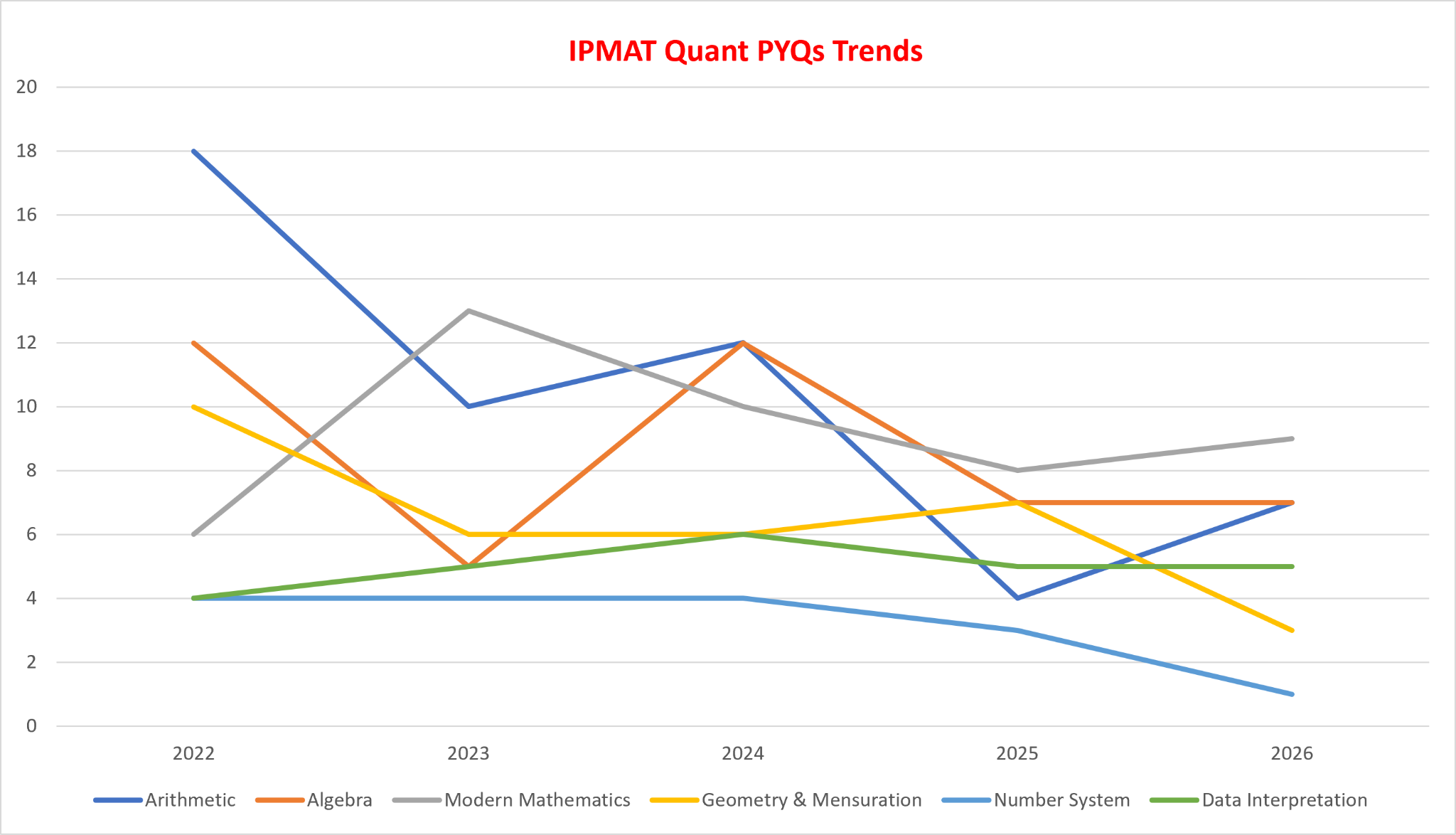
IPMAT previous year analysis clearly tells us the full story of how arithmetic and algebra questions topped the chart and how modern math questions are increasing year by year. Geometry and mensuration questions are also equally important. The following table and line graph will show us a clear picture of IPMAT quantitative aptitude trends over the previous years.
Quantitative Aptitude Topic | 2022 | 2023 | 2024 | 2025 | 2026 |
Arithmetic | 18 | 10 | 12 | 4 | 7 |
Algebra | 12 | 5 | 12 | 7 | 7 |
Modern Mathematics | 6 | 13 | 10 | 8 | 9 |
Geometry & Mensuration | 10 | 6 | 6 | 7 | 3 |
Number System | 4 | 4 | 4 | 3 | 1 |
Data Interpretation | 4 | 5 | 6 | 5 | 5 |
These year wise values of the number of questions will clearly show the trend of the question paper.
Beginners can be divided into two sections. One who is strong in Mathematics and has already appeared in many state and national level competitive exams. And the other, who is brand new in this competitive exam world and has a medium base of Mathematics knowledge.
Here are some tips for both types of students for IPMAT quant topics preparation.
Every student should first check the IPMAT previous year analysis and get the idea of the question types and important chapters.
Follow a standard book such as RD Sharma to build a strong base and practice before moving to another format of preparation.
Taking timed based mock tests after finishing one chapter is very important to understand your preparation stage. If you score decent marks on a chapter, then move on to the next chapter. Otherwise, recheck that chapter once again from different resources to understand more efficiently.
Beginners should have a routine dividing all the chapters and give at least 1 to 1.5 hours regularly to practice mathematics.
Mock tests are the platform where students can assess their preparation. Also, they can understand which stage of the preparation phase they are in. There should be a strategy for taking mock tests to obtain the full results.
Before taking the mock, revise important formulas and theorems. Also, set a realistic target for yourself. That target should increase test by test.
During the mock, focus more on time management skills and accuracy. Skip complex questions at the start of the mock.
After the test, analyse all the questions, answered, unanswered or skipped. Identify your weaker areas and work on them.
The best strategy to analyse mock tests is:
If you have “high accuracy but low attempts”, then you must have speed issues. The simple solution is that you have to practice many time based mock tests.
If you have “low accuracy but high attempts”, then that student is using high guesswork and choosing wrong questions. They have to strengthen their base.
If you have “low accuracy and low attempts”, then focus on high weightage chapters and work on them for the start.
If you have “good accuracy and high attempts”, that means all of your strategies are working fine. Keep up the good work and maintain consistency.
Get up to 100% scholarship on B.Des. & BBA admissions through your CUET-UG score | No. 1 Design & Fashion Institute by ASSOCHAM, India Today, Outlook and The Week rankings
Leading Design College | 95% Placement Record | Merit-cum-Means Scholarships for Deserving Students
Free Mock Test: IPMAT Indore Free Mock Test
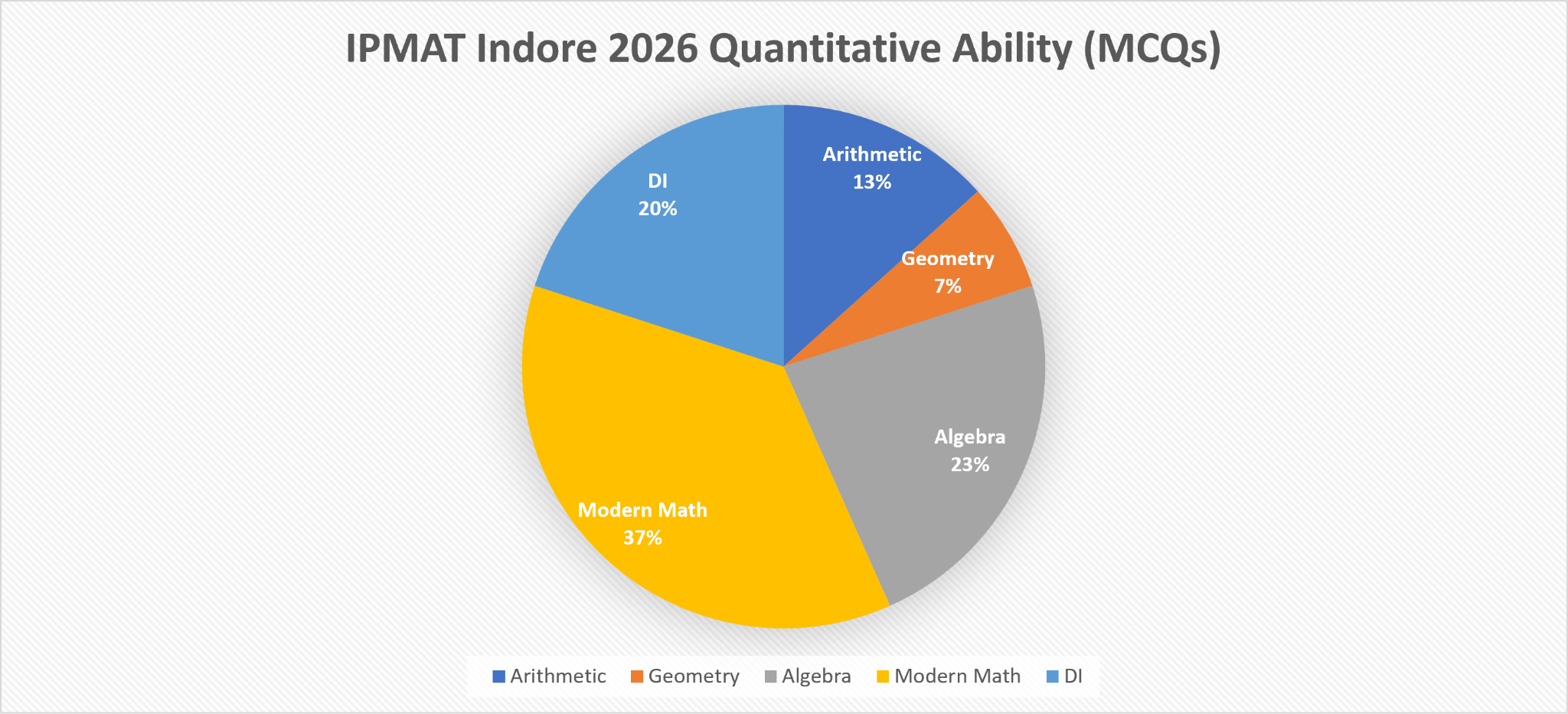
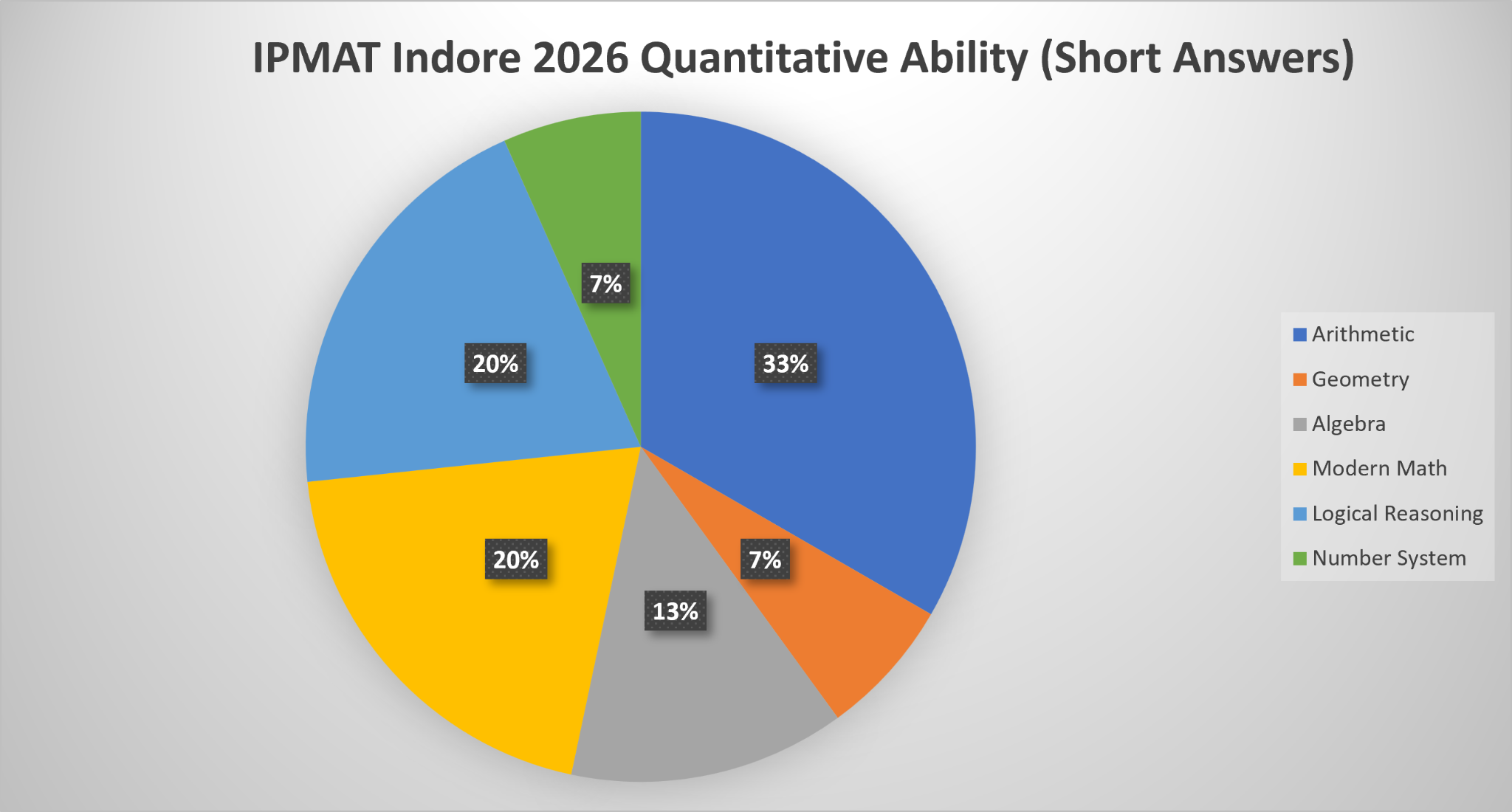
This is the IPMAT Indore Quant Section analysis for the recently concluded exam. It will help students identify important chapters and topics from the Quant section.
Area
Topics
No. of Questions
Weightage
Arithmetic
Averages, Ratios & Proportions
2
6.67%
Arithmetic
Time & Work, TSD
2
6.67%
Geometry
Co-ordinate Geometry
2
6.67%
Algebra
Logarithm, Surds and Indices
3
10%
Algebra
Linear, Quadratic, Polynomials
4
13.33%
Modern Math
Set Theory, Probability, Permutation & Combination
5
16.67%
Modern Math
Sequence & Series
2
6.67%
Modern Math
Functions, Graphs and Inequalities
3
10%
Modern Math
Matrices and Determinants
1
3.33%
DI
Tabular Data
6
20%
Total
30
100%
Area
Topics
No. of Questions
Weightage
Arithmetic
Percentages, Profit & Loss, SI/CI
3
20%
Arithmetic
Time Speed Distance (Races, Relative Speed)
2
13.33%
Geometry
Cyclic Quadrilateral
1
6.67%
Numbers
Remainders
1
6.67%
Algebra
Linear and Quadratic Equations
2
13.33%
Modern Math
Inequalities, Maxima Minima
2
13.33%
Modern Math
Matrices
1
6.67%
Logical Reasoning
Puzzle
3
20%
Total
15
100%
Question 1:
The number of four-digit integers which are greater than 1000 and divisible by both 2 and 3, but not by 5, is:
Answer:
Number of 4-digit numbers divisible by both 2 and 3
$=$ Number of 4 -digit numbers divisible by the LCM (2 & 3), i.e. 6.
$
=\left[\frac{9999}{6}\right]-\left[\frac{1000}{6}\right]=1666-166=1500
$
Number of 4 -digit numbers divisible by 2,3 and 5
$=$ Number of 4-digit numbers divisible by LCM $(2,3,5)$
$
\text { = i.e. } 30 \text {. }
$
$
=\left[\frac{9999}{30}\right]-\left[\frac{1000}{30}\right]=333-33=300
$
$\therefore$ Number of 4 -digit numbers divisible by $2 \& 3$ but not 5
$=($ Number of 4 -digit divisibly by 2 & 3 i.e. 6) -
(Number of 4-digit nos. divisibly by $2,3 \& 5$ )
$=1500-300=1200$
Question 2:
In a room, there are n persons whose average height is 160 cm. If m more persons, whose average height is 172 cm, enter the room, then the average height of all persons in the room becomes 164 cm. Then m : n is:
Answer:
$
\text { Average }=\frac{\text { Sum of observaitons }}{\text { Number of observations }}
$
Sum of heights of $n$ persons $=$ Average height $\times$ Number of persons$
=160 \times n
$
Similarly, sum of heights of ' m ' persons $=172 \times \mathrm{m}$
Average height of all persons
$
\begin{aligned}
& =\frac{\text { Sum of height all the persons }}{\text { Total number of persons }} \\
& 164=\frac{160 \mathrm{n}+172 \mathrm{~m}}{\mathrm{~m}+\mathrm{n}} \\
& \Rightarrow 164(m+n)=160 \mathrm{n}+172 \mathrm{~m} \\
& =4 \mathrm{n}=8 \mathrm{~m} \\
& \Rightarrow \frac{m}{n}=\frac{4}{8}=\frac{1}{2} \\
& \Rightarrow \mathrm{~m}: \mathrm{n}=1: 2
\end{aligned}
$
Question 3:
The numbers $-16,2^{x+3}-2^{2 x-1}-16,2^{2 x-1}+16$ are in an arithmetic progression. Then $x$ equals:
Answer:
If $\mathrm{a}, \mathrm{b}, \mathrm{c}$ are 3 terms in A.P then $\frac{a+b}{2}=b$ or, $a+c=2 b$
So, $-16,2^{x+3}-2^{2 x-1}-16,2^{2 x-1}+16$ are in A.P.
We can say, $-16+2^{2 x-1}+16=2\left[2^{x+3}-2^{2 x-1}-16\right]$
$\Rightarrow \quad 2^{2 x} 2^{-1}=2^{x+4}-2^{2 x}-16 \times 2$
$\Rightarrow \frac{2^{2 x}}{2}=2^x \cdot 2^4-2^{2 x}-32$
eqn.(1)
put $2^{\mathrm{x}}=\mathrm{t} \& 2^{2 \mathrm{x}}=\mathrm{t}^2$
the eqn. becomes
$
\begin{aligned}
& \frac{t^2}{2}=16 t-t^2-32 \\
& \Rightarrow t^2=32 t-2 t^2-32 \times 2 \\
& \Rightarrow 3 t^2-32 t+32 \times 2=0 \\
& \Rightarrow 3 t^2-32 t+64=0 \\
& \Rightarrow t=8 \text { or } \frac{8}{3}
\end{aligned}
$
As $\mathrm{t}=2^{\mathrm{x}}$, it can not be a fraction
$
\begin{aligned}
& \therefore \mathrm{t}=2^{\mathrm{x}}=8 \text { (only) } \\
& \therefore \mathrm{x}=3
\end{aligned}
$
Question 4:
A new sequence is obtained from the sequence of positive integers (1, 2, 3,...) by deleting all the perfect squares. Then the 2022nd term of the new sequence is.
Answer:
A perfect square near a natural number can be found by the hit and trial method, unless it is a large number with more than 4 digits.
$\Rightarrow$ Original sequence : $1,2,3,4,5,6, \ldots \ldots$.
$\Rightarrow$ New sequence : $2,3,5,6,7,8,10$,
$\Rightarrow$ Thus before 2018 , there are 44 perfect squares $\left(44^2=1936\right)$.
$\Rightarrow$ Thus, 44 numbers will be missing in the new sequence compared to the original, thus the 2018th number will be $2018+44=2062$
Students often tend to mistake here by ticking 2062.
$\Rightarrow\left[45^2=2025\right]$ will be included in the new sequence too, thus $2062+1=\underline{2063}$.
Now, to get the 2022 nd term, we add 4 to $2063=2067$.
Question 5:
If $\log _{x^2} y+\log _{y^2} x=1$ and $\mathrm{y}=\mathrm{x}^2-30$. Then the value of $x^2+y^2$ is:
Answer:
Given $\log _{x^2} y+\log _{y^2} x=1$ and $y=x^2-30$
$
\begin{aligned}
& \log _{x^2} y+\log _{y^2} x=1 \\
& =\frac{1}{2}\left[\log _x y+\log _y x\right]=1 \\
& =\log _x y+\log _y x=2 \\
& =\log _x y+\frac{1}{\log _x y}=2\left[\therefore \log _y x=\frac{1}{\log _y x}\right]
\end{aligned}
$
We know, if $a$ is a positive number, then $a+\frac{1}{a}=2$, only when $\mathrm{a}=1$
Applying it in eq. (1), we can say
$
\log _x y=1 \text { or } y=x
$
So putting $y=x$, in the $2^{\text {nd }}$ given eqn. $y=x^2-30$
We get $x=x^2-30$
$
\begin{aligned}
& x^2-x-30=0 \\
& x^2+5 x-6 x-30=0
\end{aligned}
$
$(x-6)(x+5)=0$
This gives $x=6$ or $x=-5$.
Since domain constraints require $x > 0$, we discard $x = -5$.
Thus, $x = 6$
$\therefore x^2 + y^2 = 6^2 + 6^2 = 36 + 36 = 72$
Here are some of the resources for the IPMAT 2027 that students can use for a quick revision.
Title | Links |
IPMAT Mock Test Series PDF (5 Sets) | |
IPMAT 2019 Question Paper | |
IIM Indore IPMAT 2016 Sample Paper | |
IPMAT Rohtak 2025 Memory Based Questions and Exam Analysis |
Frequently Asked Questions (FAQs)
Previous year questions don't exactly repeat in IPMAT, but question types or theories do repeat.
No, it doesn't give students an extra advantage in IPMAT. But it is always good to have a higher grade in 12th grade.
Yes. With persistent practice and an adequate routine, you can crack IPMAT in 40 days.
Some of the topics from which most of the questions came in the previous five years are Arithmetic, algebra and geometry. Still, students have to focus on other topics too for good marks in IPMAT.

On Question asked by student community
Hello there,
Since your son is in Class 12 Commerce with Applied Mathematics, he has a very good combination for management entrance preparation. It is absolutely possible to prepare for both IPMAT and CUET together, but the preparation should be planned carefully.
What I would suggest
Hello Dear Student,
Yes, you are eligible for the IIM Indore IPM program as Mathematics and specific streams are not mandatory, and dual/additional marksheets from recognized state boards are accepted during verification as long as age and passing year rules are met.
Hope it helps!
Hi,
You can refer to books like AP Bhardwaj for legal aptitude, RS Aggarwal for reasoning, and dedicated guides like CULET Guide by Dipanjan Mitra for best preparation for CULET. Additionally, you can refer to the CULET previous year question papers .
The IPMAT (Integrated Programme in Management Aptitude Test) syllabus for 2026 is structured around three main, demanding sections designed to test your analytical and verbal abilities at an advanced level.
Here is the essential syllabus breakdown:
Quantitative Ability (QA): This section is highly crucial. It tests advanced
Hello there!
IPMAT ( Integrated Program in Management Aptitude Test) is an entrance exam conducted by IIM Indore for the admission in its five years course Integrated Program in Management Program (IPM).
One can directly appear for this exam just after completion of your 12th standard in any stream, you

BBA/MBA/PGDM Early Bird Applications Deadline 06th Nov'26. Apply now using coupon code CAREER250 and get ₹250 off the application fee
Ranked #36 amongst institutions in Management by NIRF | 100% Placement
Get up to 100% scholarship on B.Des. & BBA admissions through your CUET-UG score | No. 1 Design & Fashion Institute by ASSOCHAM, India Today, Outlook and The Week rankings
Leading Design College | 95% Placement Record | Merit-cum-Means Scholarships for Deserving Students
NAAC A++ Accredited | Ranked #11 by NIRF
NAAC A+ Accredited| Ranked #24 in University Category by NIRF