


Algebra - Definition, Basics, Branches, Facts, Examples
Have you ever wondered how mathematicians represent unknown quantities and solve complex problems using symbols instead of numbers? This powerful mathematical language is known as algebra. Often referred to as the foundation of modern mathematics, algebra helps us express relationships, solve equations, identify patterns, and model real-world situations. From simple arithmetic operations to advanced concepts used in science, engineering, economics, and computer programming, algebra is everywhere. Understanding algebra not only improves problem-solving skills but also lays the groundwork for higher mathematics. In this article, we will explore the definition of algebra, its fundamental concepts, major branches, important facts, examples, and real-world applications.
This Story also Contains
- What is Algebra?
- Basics of Algebra
- History and Development of Algebra
- Branches of Algebra
- Algebra Formula Chart
- Algebraic Expressions
- Algebraic Equations
- Algebraic Identities
- Properties of Algebra
- Important Facts About Algebra
- Applications of Algebra
- Algebra vs Arithmetic
- Best Books for Algebra
- Shortcut Tips and Tricks for Algebra
- Important Formula Table
- Solved examples based on Algebra
- Related Topics to Algebra
What is Algebra?
Algebra includes almost everything ranging from solving elementary equations to the study of abstractions. Algebra formulas are included in most of the maths chapters which students at various stages of their life come across during their academic journey. The concept of algebra has wide ranging applications in our daily life. It is really helpful in finding the unknown quantities and we come across such situations almost daily in our lives.
Algebra Formula

Algebra helps solve complex mathematical equations or expressions within no time and also enables us to derive unknown quantities, for example bank interest, percentages, etc.
Basics of Algebra
Algebra is built on a few fundamental concepts that help represent numbers, quantities, and relationships using symbols. Understanding variables, constants, expressions, and algebraic operations is essential before moving on to equations, identities, and advanced algebraic topics. These basics form the foundation of mathematics and are widely used in science, engineering, economics, and computer programming.
Variables and Constants
Variables and constants are the building blocks of algebra.
A variable is a symbol, usually represented by letters such as $x$, $y$, $a$, or $n$, whose value can change.
Examples:
In $x+5$, $x$ is a variable.
In $2a+7$, $a$ is a variable.
A constant is a fixed value that does not change.
Examples:
In $x+5$, the number $5$ is a constant.
In $3y-8$, the number $8$ is a constant.
Examples of Variables and Constants
| Expression | Variable | Constant |
|---|---|---|
| $x+10$ | $x$ | $10$ |
| $3y+7$ | $y$ | $7$ |
| $a^2+4$ | $a$ | $4$ |
| $5m-12$ | $m$ | $12$ |
Variables help represent unknown quantities, while constants provide fixed numerical values within algebraic expressions.
Algebraic Expressions
An algebraic expression is a mathematical phrase that combines variables, constants, and mathematical operations.
Unlike equations, algebraic expressions do not contain an equal sign.
Examples:
$x+5$
$3a-7$
$2x^2+4x+1$
$\frac{m+n}{2}$
Algebraic expressions are used to represent real-life situations mathematically.
For example:
If the price of one notebook is ₹20 and you buy $x$ notebooks, the total cost can be represented as:
$20x$
Types of Algebraic Expressions
| Type | Example |
|---|---|
| Monomial | $5x$ |
| Binomial | $x+3$ |
| Trinomial | $x^2+2x+1$ |
| Polynomial | $x^3+2x^2+5x+1$ |
Algebraic expressions form the basis for solving equations and mathematical models.
Terms, Coefficients, and Factors
Every algebraic expression consists of terms, coefficients, and factors.
Terms
A term is a single mathematical component separated by plus or minus signs.
For example, in:
$3x^2+5x-7$
the terms are:
$3x^2$
$5x$
$-7$
Coefficients
A coefficient is the numerical value multiplied by a variable.
For example:
In $5x$, the coefficient is $5$.
In $-3y^2$, the coefficient is $-3$.
Factors
Factors are the quantities multiplied together to form a term.
For example:
In $6xy$,
the factors are:
$6$
$x$
$y$
Example Breakdown
For the expression:
$4x^2y$
| Component | Value |
|---|---|
| Coefficient | $4$ |
| Variables | $x, y$ |
| Factors | $4, x, x, y$ |
| Term | $4x^2y$ |
Understanding these concepts is important for simplifying and factorizing expressions.
Algebraic Operations
Algebra involves several mathematical operations performed on variables and expressions.
Addition
Like terms can be added together.
Example:
$3x+5x=8x$
Subtraction
Like terms can also be subtracted.
Example:
$7y-2y=5y$
Multiplication
Variables and coefficients can be multiplied.
Example:
$3x \times 2x=6x^2$
Division
Algebraic expressions can be divided by simplifying common factors.
Example:
$\frac{12x}{3}=4x$
These operations help solve equations, simplify expressions, and manipulate mathematical formulas.
History and Development of Algebra
The history of algebra spans thousands of years and reflects humanity's efforts to solve numerical and practical problems systematically. Over time, algebra evolved from simple arithmetic methods to one of the most important branches of modern mathematics.
Origin of Algebra
The word Algebra comes from the Arabic word "Al-Jabr", which means "reunion of broken parts" or "restoration."
The term was introduced by the Persian mathematician Muhammad ibn Musa al-Khwarizmi in his famous mathematical work written around 820 CE.
Ancient civilizations such as:
Egyptians
Babylonians
Greeks
Indians
used early algebraic methods to solve practical problems involving trade, land measurement, and astronomy.
Contributions of Ancient Mathematicians
Many mathematicians contributed to the development of algebra.
Babylonian Mathematicians
Babylonians developed methods for solving quadratic equations nearly 4,000 years ago.
Greek Mathematicians
Greek scholars introduced geometric methods to solve algebraic problems.
Indian Mathematicians
Indian mathematicians made significant advances in algebra.
Notable contributions include:
Use of zero
Development of number systems
Solutions of quadratic equations
Al-Khwarizmi
Al-Khwarizmi is often called the Father of Algebra because he systematically explained methods for solving equations.
His work laid the foundation for modern algebraic notation and techniques.
Evolution of Modern Algebra
As mathematics progressed, algebra expanded far beyond solving simple equations.
During the Renaissance:
Symbolic notation was introduced.
Variables began to be represented by letters.
Polynomial equations were studied extensively.
During the 19th and 20th centuries:
Abstract algebra emerged.
Group theory was developed.
Matrix algebra became important.
Linear algebra gained practical applications.
Today, algebra plays a major role in:
Computer science
Artificial intelligence
Data science
Engineering
Economics
Importance of Algebra in Mathematics
Algebra serves as a bridge between arithmetic and advanced mathematics.
Why Algebra is Important
Helps solve equations systematically.
Develops logical and analytical thinking.
Forms the basis of calculus and higher mathematics.
Supports scientific and engineering calculations.
Models real-world relationships mathematically.
Enables problem-solving in various fields.
Without algebra, many modern technological and scientific advancements would not be possible.
Branches of Algebra
Algebra has evolved into several specialized branches, each focusing on different mathematical structures and applications.
Elementary Algebra
Elementary algebra is the first level of algebra studied in schools.
It focuses on:
Variables
Expressions
Equations
Polynomials
Basic identities
Examples:
Solving $x+5=12$
Simplifying $2x+3x$
Elementary algebra forms the foundation for all advanced algebraic studies.
Intermediate Algebra
Intermediate algebra expands upon elementary algebra and introduces more complex concepts.
Topics include:
Quadratic equations
Rational expressions
Radicals
Functions
Inequalities
Examples:
Solving $x^2-5x+6=0$
Graphing algebraic functions
This branch prepares students for higher mathematics.
Abstract Algebra
Abstract algebra studies algebraic structures rather than specific numbers.
Important structures include:
Groups
Rings
Fields
Vector spaces
Abstract algebra focuses on understanding mathematical relationships at a deeper theoretical level.
Applications include:
Cryptography
Coding theory
Advanced mathematics
Linear Algebra
Linear algebra deals with vectors, matrices, and systems of linear equations.
Major topics include:
Vector spaces
Eigenvalues
Linear transformations
Applications of linear algebra:
Computer graphics
Machine learning
Engineering
Physics
Data science
It is one of the most widely used branches of modern mathematics.
Boolean Algebra
Boolean algebra deals with logical values and binary variables.
Instead of numerical values, it uses:
True and False
1 and 0
Basic operations include:
AND
OR
NOT
Applications include:
Digital circuits
Computer programming
Search algorithms
Artificial intelligence
Boolean algebra forms the foundation of modern computing systems.
Modern Algebra
Modern algebra is an advanced branch that studies abstract mathematical systems and structures.
It includes:
Group Theory
Ring Theory
Field Theory
Module Theory
Modern algebra is widely used in:
Quantum mechanics
Cryptography
Computer science
Mathematical research
It provides a deeper understanding of the structure and behavior of mathematical objects and forms an essential part of higher mathematics.
Vector Algebra
Vector algebra class 12 involves algebraic operations across vectors, involving the magnitude and direction of vectors. Vector algebra helps for various applications in physics, and engineering to perform addition and multiplication operations with physical quantities, represented as vectors in 3-D space. Length of line between the two points P and Q is called the magnitude of vector and the direction or displacement of point P to point Q is called the direction of vector PQ.

Relational Algebra in DBMS
When we look at the applications of algebra in computers and applied fields, in database theory we use algebra structure for the process of modelling and it helps us to define certain queries which are famously known as query languages or SQL. This is known as relational algebra. This helps us to store and preserve huge quantities of data in an easy and efficient way. It is often meant for computer enthusiasts and IT domain people who wish to pursue career in computers and related domains.
Algebra Formula Chart
Algebra Formula Chart is given below:

Now, let us look into some algebra questions and answers.
Algebraic Expressions
Algebraic expressions are mathematical combinations of variables, constants, and arithmetic operations such as addition, subtraction, multiplication, and division. Unlike equations, algebraic expressions do not contain an equal sign. They are used to represent unknown quantities and mathematical relationships in a concise form.
Monomials
A monomial is an algebraic expression consisting of only one term. It may contain a constant, a variable, or a product of constants and variables with non-negative integer exponents.
Examples of Monomials
$5x$
$7y^2$
$12$
$3ab$
Characteristics of Monomials
Contains only one term.
No addition or subtraction within the expression.
Variables have non-negative integer exponents.
Forms the building block of more complex algebraic expressions.
Binomials
A binomial is an algebraic expression containing exactly two unlike terms connected by addition or subtraction.
Examples of Binomials
$x+5$
$2a-b$
$y^2+3y$
Characteristics of Binomials
Contains two distinct terms.
Terms are separated by either "+" or "−".
Commonly used in factorization and algebraic identities.
Trinomials
A trinomial is an algebraic expression containing exactly three terms.
Examples of Trinomials
$x^2+5x+6$
$a^2+ab+b^2$
$2x^2+3x+1$
Characteristics of Trinomials
Contains three unlike terms.
Frequently appears in quadratic equations.
Can often be factorized into binomials.
Polynomials
A polynomial is an algebraic expression consisting of one or more terms involving variables raised to non-negative integer powers.
Examples of Polynomials
$5x^3+2x^2-x+7$
$x^4+3x^2+1$
$2a^5-4a^2+6$
Types of Polynomials by Number of Terms
| Type | Number of Terms |
|---|---|
| Monomial | 1 |
| Binomial | 2 |
| Trinomial | 3 |
| Polynomial | One or more terms |
Polynomials play a central role in algebra, calculus, coordinate geometry, and higher mathematics.
Algebraic Equations
An algebraic equation is a mathematical statement showing that two expressions are equal. Equations contain variables whose values can be determined by solving the equation.
Linear Equations
A linear equation is an equation in which the highest power of the variable is 1.
General Form
$ax+b=0$
where $a\neq0$
Examples
$2x+5=15$
$3y-7=11$
Characteristics
Produces a straight-line graph.
Has one solution in one variable.
Forms the foundation of algebra.
Quadratic Equations
A quadratic equation is an equation in which the highest power of the variable is 2.
General Form
$ax^2+bx+c=0$
where $a\neq0$
Examples
$x^2-5x+6=0$
$2x^2+3x-2=0$
Characteristics
May have two real roots, one repeated root, or complex roots.
Graph forms a parabola.
Widely used in geometry and physics.
Polynomial Equations
Polynomial equations involve variables raised to positive integer powers.
Examples
$x^3-4x+1=0$
$x^4-5x^2+4=0$
Characteristics
Degree determines the nature of the equation.
Can have multiple roots.
Important in advanced algebra and calculus.
Systems of Equations
A system of equations consists of two or more equations involving the same variables.
Example
$x+y=10$
$x-y=2$
Applications
Finding unknown quantities.
Economic modelling.
Engineering calculations.
Optimization problems.
Algebraic Identities
Algebraic identities are equations that remain true for all values of the variables involved. They simplify calculations and help in factorization and expansion.
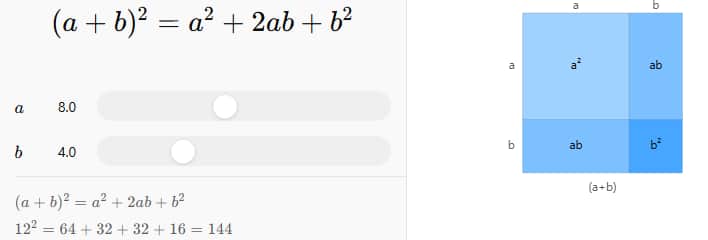
Square of Sum Identity
The square of the sum of two quantities is:
Example
$(x+3)^2=x^2+6x+9$
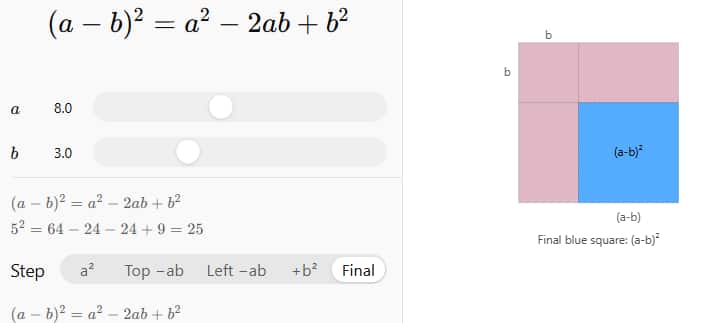
Square of Difference Identity
The square of the difference of two quantities is:
Example
$(x-4)^2=x^2-8x+16$
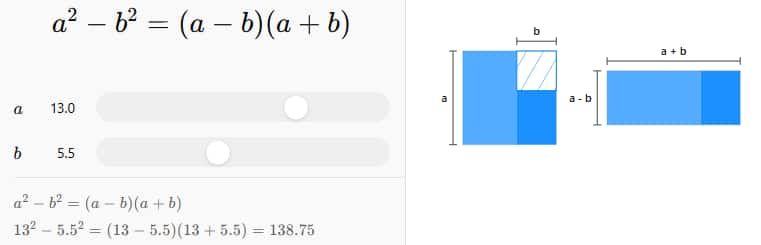
Difference of Squares Identity
The difference of two perfect squares is:
Example
$x^2-25=(x-5)(x+5)$
Cube Identities
Some important cube identities are:
$(a+b)^3=a^3+3a^2b+3ab^2+b^3$
$(a-b)^3=a^3-3a^2b+3ab^2-b^3$
$a^3+b^3=(a+b)(a^2-ab+b^2)$
$a^3-b^3=(a-b)(a^2+ab+b^2)$
These identities are extensively used in algebraic simplification and factorization.
Properties of Algebra
Algebra follows several fundamental properties that simplify mathematical operations and equation solving.
Commutative Property
The order of numbers does not affect the result.
Addition
$a+b=b+a$
Multiplication
$ab=ba$
Example
$5+3=3+5$
$4\times2=2\times4$
Associative Property
The grouping of numbers does not affect the result.
Addition
$(a+b)+c=a+(b+c)$
Multiplication
$(ab)c=a(bc)$
Example
$(2+3)+4=2+(3+4)$
Distributive Property
Multiplication distributes over addition and subtraction.
Formula
$a(b+c)=ab+ac$
Example
$3(x+4)=3x+12$
This property is widely used in algebraic expansion.
Identity Property
An identity element leaves a number unchanged.
Additive Identity
$a+0=a$
Multiplicative Identity
$a\times1=a$
Example
$8+0=8$
$8\times1=8$
Inverse Property
Every number has an inverse that reverses an operation.
Additive Inverse
$a+(-a)=0$
Multiplicative Inverse
$a\times\frac{1}{a}=1$
where $a\neq0$
Example
$5+(-5)=0$
$5\times\frac{1}{5}=1$
Important Facts About Algebra
Algebra is often called the language of mathematics because it helps represent unknown values and relationships using symbols.
Role of Variables in Algebra
Variables are symbols that represent unknown or changing quantities.
Common variables include:
$x$
$y$
$z$
$a$
$b$
Variables allow mathematicians to create general formulas and solve real-world problems.
Importance of Equations
Equations help determine unknown values and model relationships between quantities.
They are used in:
Mathematics
Science
Engineering
Economics
Computer programming
Algebra and Logical Thinking
Algebra develops logical reasoning and analytical thinking.
It helps students:
Identify patterns.
Solve problems systematically.
Understand mathematical structures.
Develop critical thinking skills.
Algebra in Everyday Life
Algebra appears in daily activities such as:
Budget planning
Shopping discounts
Calculating interest
Measuring distances
Business forecasting
Even simple financial decisions often involve algebraic thinking.
Applications of Algebra
Algebra is one of the most widely used branches of mathematics with applications across numerous disciplines.
Applications in Mathematics
Algebra forms the basis for:
Geometry
Trigonometry
Calculus
Coordinate Geometry
Statistics
Applications in Science
Scientists use algebra to:
Express physical laws.
Calculate experimental results.
Model natural phenomena.
Analyze data.
Applications in Engineering
Engineering applications include:
Structural design
Electrical circuits
Fluid mechanics
Machine design
Computer modelling
Applications in Economics and Finance
Algebra helps in:
Profit and loss calculations.
Interest computations.
Investment analysis.
Financial forecasting.
Economic modelling.
Algebra vs Arithmetic
Although both are branches of mathematics, algebra and arithmetic differ significantly in their approach and applications.
Key Differences
Arithmetic focuses on numbers and calculations, whereas algebra focuses on variables and relationships.
Similarities
Both involve:
Mathematical operations
Problem-solving
Logical reasoning
Numerical calculations
Comparison Table
| Algebra | Arithmetic |
|---|---|
| Uses variables and symbols | Uses numbers only |
| Solves equations | Performs calculations |
| Deals with unknown quantities | Deals with known quantities |
| More abstract | More concrete |
| Foundation for higher mathematics | Foundation of basic mathematics |
Arithmetic Example
$15+25=40$
All quantities are known.
Algebra Example
$x+25=40$
The value of $x$ is unknown and must be determined.
Solving:
$x=40-25$
$x=15$
This illustrates how algebra extends arithmetic by introducing variables and equations to solve unknown quantities.
Best Books for Algebra
Algebra forms the foundation of higher mathematics and is essential for understanding equations, functions, coordinate geometry, and calculus. These books provide strong conceptual knowledge and practice.
| Book Name | Best For | Why It Helps |
|---|---|---|
| NCERT Mathematics Class 9–12 | School Students | Strong foundation in algebraic concepts |
| Algebra – R.D. Sharma | Board Exams | Detailed explanations and examples |
| Higher Algebra – Hall & Knight | Advanced Mathematics | Comprehensive algebra theory |
| Objective Mathematics – R.S. Aggarwal | Competitive Exams | Algebra-focused aptitude questions |
| Cengage Algebra | JEE Preparation | Advanced algebra and problem-solving techniques |
Shortcut Tips and Tricks for Algebra
Understanding patterns and algebraic identities can significantly reduce calculation time and simplify complex expressions.
| Trick | Explanation |
|---|---|
| Memorize Algebraic Identities | Useful for expansion and factorization |
| Combine Like Terms First | Simplifies expressions quickly |
| Factor Before Expanding | Often saves time |
| Use Common Factors | Makes equations easier to solve |
| Check Signs Carefully | Avoids common algebraic errors |
| Substitute Values Strategically | Simplifies calculations |
| Verify Final Answer | Helps identify mistakes in equations |
Important Formula Table
This formula sheet contains some of the most frequently used algebra formulas and identities.
| Concept | Formula |
|---|---|
| Square of Sum | $(a+b)^2=a^2+2ab+b^2$ |
| Square of Difference | $(a-b)^2=a^2-2ab+b^2$ |
| Difference of Squares | $a^2-b^2=(a+b)(a-b)$ |
| Cube of Sum | $(a+b)^3=a^3+3a^2b+3ab^2+b^3$ |
| Cube of Difference | $(a-b)^3=a^3-3a^2b+3ab^2-b^3$ |
| Sum of Cubes | $a^3+b^3=(a+b)(a^2-ab+b^2)$ |
| Difference of Cubes | $a^3-b^3=(a-b)(a^2+ab+b^2)$ |
| Quadratic Formula | $x=\frac{-b\pm\sqrt{b^2-4ac}}{2a}$ |
Solved examples based on Algebra
Example 1: Solve the equation $2 x-6=6 x-8$.
Solution:
Given,
$
2 x-6=6 x-8
$
Adding 6 on both sides,
$
\begin{aligned}
& 2 x-6+6=6 x-8+6 \\
& 2 x=6 x-2 \\
& -4 x=-2 \\
& x= \frac{1}{2}
\end{aligned}
$
Example 2: Using the $(\mathrm{a}+\mathrm{b})^2$ formula in algebra, find the value of $(102)^2$.
Solution:
Given: $(102)^2=(100+2)^2$
Using algebra formula $(a+b)^2=a^2+2 a b+b^2$, we have,
$
\begin{aligned}
& (100+2)^2=(100)^2+2(2)(100)+(2)^2 \\
& (102)^2=10404
\end{aligned}
$
Example 3: Find the value of x in the following equation using the Algebra concepts. $3 x+8=$ 20
Solution:
$
\begin{aligned}
& 3 x+8=20 \\
& 3 x=20-8 \\
& 3 x=12 \\
& x=4
\end{aligned}
$
Therefore, the value of $x=4$
Example 4: Ten less than a number equals to two. What is the number?
Solution:
Using the concepts of Algebra, we will assume the number to be a variable. Let the number be y. As per the question, we can write $y-10=2$. On solving this, we get $y=12$. Therefore, the required number is 12 .
Example 5: Find the value of x in the following equation using the Algebra concepts. $45 \mathrm{x}+4=$$
25
$
Solution:
$
\begin{aligned}
& 45 x+4=25 \\
& 45 x=25-4 \\
& 45 x=21 \\
& x= \frac{21}{45}
\end{aligned}
$
Therefore, the value of $x= \frac{21}{45} $
For more such questions, refer algebra worksheet.
Related Topics to Algebra
Algebra is interconnected with many branches of mathematics. Exploring related topics can strengthen your problem-solving abilities and improve your understanding of mathematical relationships and patterns.
| Algebra Class 6 | Algebraic Identities Class 8 |
| Algebraic Expressions | Algebraic Identities Class 9 |
| a cube plus b cube |
Frequently Asked Questions (FAQs)
Muhammad ibn Musa al Khwarizmi is known as father of algebra.
Algebra Calculator is a calculator that gives step by step solution to any algebra problem.
Relational algebra in dbms means the use of algebra to contain the data and maintain database in computers with languages such as SQL. It is also known as RDBMS.
They include Monomial or polynomial equations, Exponential equations,Trigonometric equations, etc.
Vector Algebra is the branch of Algebra that basically involves the analysis and study of vectors which are defined as quantities that have both magnitude and direction in physics.

Questions related to
On Question asked by student community
Hi Vansh,
Here the Question Paper of SSC Board
https://www.careers360.com/download/maharashtra-ssc-board-ebooks-and-sample-papers
https://school.careers360.com/boards/msbshse/maharashtra-ssc-question-papers