Sharda University Admissions 2026
Admission Against Cancellation/Lapsed Seats | Pay 500 Application Fee instead of ₹1500 | NIRF Ranked 87 | NAAC A+ Grade | Upto 100% scholarship


IPMAT short answer questions require a different approach because the answer must be worked out without relying on multiple-choice options. In the IPMAT Indore exam, Quantitative Ability included 15 Short Answer questions, alongside 30 MCQs, with 40 minutes allotted to the section and no negative marking for the Short Answer component.
For IPMAT 2027 preparation, what changes when the options disappear? Read the complete article for the IPMAT Indore short answer strategy, question types, calculation techniques and practice plan.
Feature | Latest Indore Reference |
Section | Quantitative Ability |
Short Answer questions | 15 |
MCQs | 30 |
Section time | 40 minutes |
Short Answer negative marking | No |
Answer format | Numerical answer |
Key preparation difference | No answer options |
The 2026 IPMAT Indore structure should be treated as the latest completed-paper reference. Candidates should check the official notification for IPMAT 2027 before relying on the exact exam pattern.
IPMAT short answer questions are numerical-answer questions in which candidates solve the problem and enter the answer rather than selecting an option.
The latest IPMAT Indore structure included:
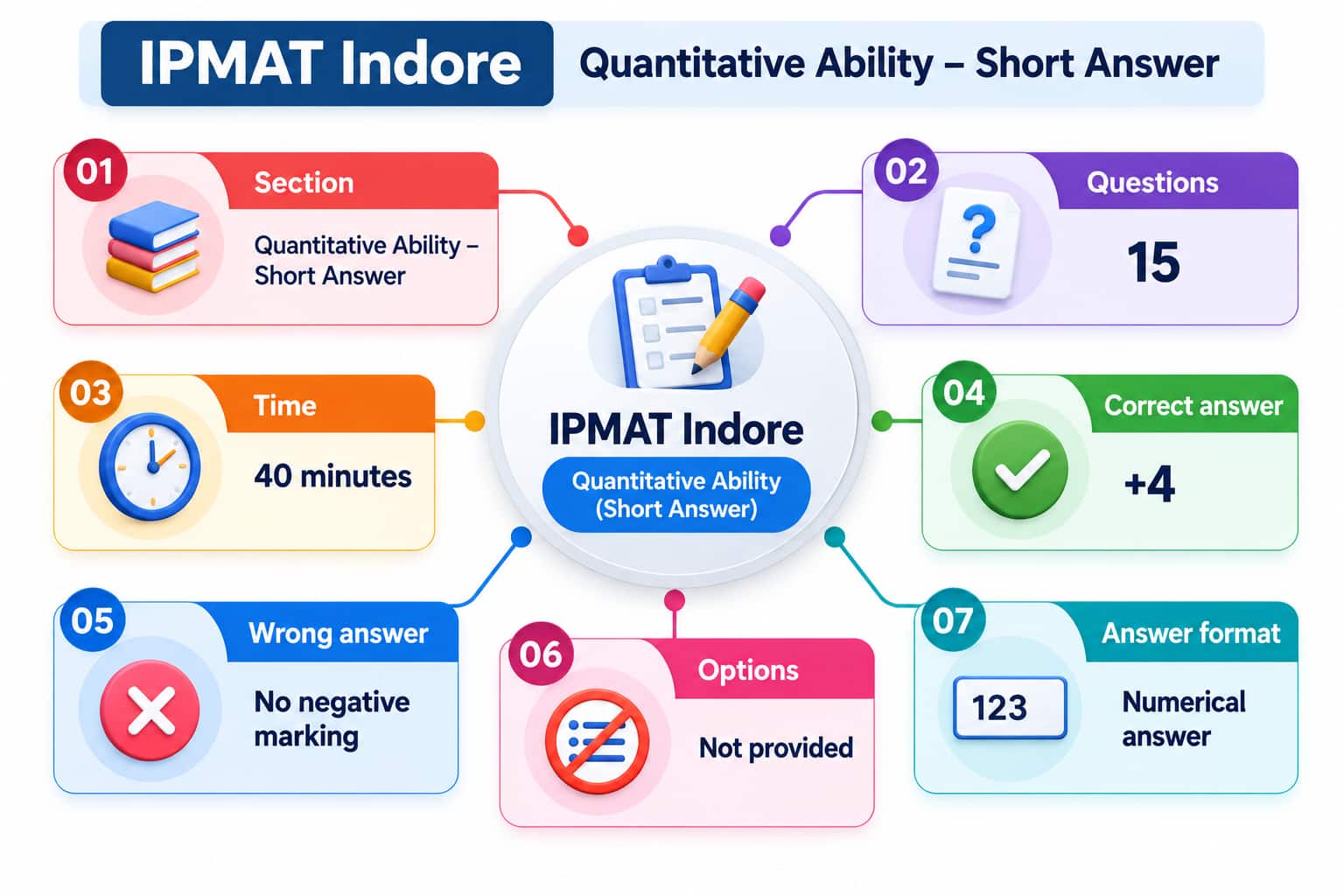
The 2026 paper analysis also reported that the Short Answer questions were generally more direct than the MCQs, while the MCQs were more challenging.
For IPMAT 2027 preparation, the structure is the latest completed-paper reference; candidates should follow the official notification when the 2027 admission process is announced.
Options can provide useful information during an MCQ. They can sometimes help with elimination, substitution or back-solving. IPMAT no-options questions remove these shortcuts.
The candidate must:
Understand the question.
Select the correct method.
Perform the calculation.
Verify the result.
Enter the numerical answer accurately.
This makes conceptual clarity and calculation discipline particularly important.
The Short Answer section uses the Quantitative Ability syllabus, but recent question analysis shows several areas that can produce direct numerical-answer problems.
Topic | Useful Short Answer Practice |
Arithmetic | Percentage, averages, profit and loss, Simple Interest and Compound Interest |
Algebra | Equations, inequalities, functions and logarithms |
Number System | Remainders, factors and divisibility |
Sequences | Arithmetic Progression, GP and sequence-based calculations |
Geometry | Coordinate geometry and direct numerical problems |
Modern Mathematics | P&C, probability and related calculations |
Work-rate and efficiency problems | |
Speed, distance and relative movement |
The IPMAT Indore 2026 paper analysis reported questions involving areas such as equations, inequalities, functions, logarithms, AP/GP, arithmetic, geometry, probability, matrices and number-system concepts.
The absence of options changes the solving process.
A candidate cannot eliminate three incorrect choices and arrive at the answer. The numerical value has to be derived independently.
Even when the concept is simple, an arithmetic mistake can change the final answer.
The IPMAT exam pattern has no negative marking for Short Answer questions, unlike the MCQ component, which carries a -1 penalty for an incorrect answer.
This distinction should be incorporated into mock-test analysis and question selection.
Feature | Short Answer | MCQ |
Answer format | Numerical answer | Select an option |
Option elimination | Not available | Available |
Back-solving | Limited/not applicable | Can be useful |
Calculation accuracy | Critical | Important |
Conceptual understanding | Critical | Critical |
Negative marking* | No in 2026 Indore pattern | -1 in 2026 Indore pattern |
One of the most useful changes in preparation is to stop depending on answer choices during practice.
For every numerical question:
Read the problem completely.
Write the required quantity.
Select the formula or method.
Solve independently.
Check the calculation.
Record the final numerical answer.
Admission Against Cancellation/Lapsed Seats | Pay 500 Application Fee instead of ₹1500 | NIRF Ranked 87 | NAAC A+ Grade | Upto 100% scholarship
NAAC A Grade | 27+ Years of Excellence in Education | Affiliated to BNU | AICTE & GoK Approved | Scholarships upto 100%
This develops the exact skill required for the no-options format.
A strong calculation routine can prevent avoidable mistakes.
Keep fractions rather than converting them into decimals too early.
For example, use 3/8 instead of 0.375 when the calculation can remain fractional.
Negative signs are particularly important in algebraic expressions and equations.
Before entering the answer, verify whether the question asks for:
Value of x
Number of solutions
Remainder
Number of factors
Maximum/minimum value
Sum
Difference
Percentage
A correct calculation can still produce the wrong answer if the requested quantity is misunderstood.
Preparation should progress through three stages.
Start with individual topics such as Arithmetic, Algebra, Number System and Geometry.
The objective is to learn how to derive answers without options.
Once individual topics are comfortable, combine different concepts in one set.
This prevents candidates from identifying the method simply because the chapter name is already known.
Finally, solve 15-question sets under a 40-minute limit to reproduce the latest IPMAT Indore section structure.
The focus should be on both accuracy and time spent per question.
The IPMAT Indore examination has 40 minutes for each section.
For 15 Short Answer questions, the average theoretical time is around 2 minutes 40 seconds per question. However, this should not become a rigid rule.
Some questions may take less than a minute, while others may require longer calculations.
A practical approach is:
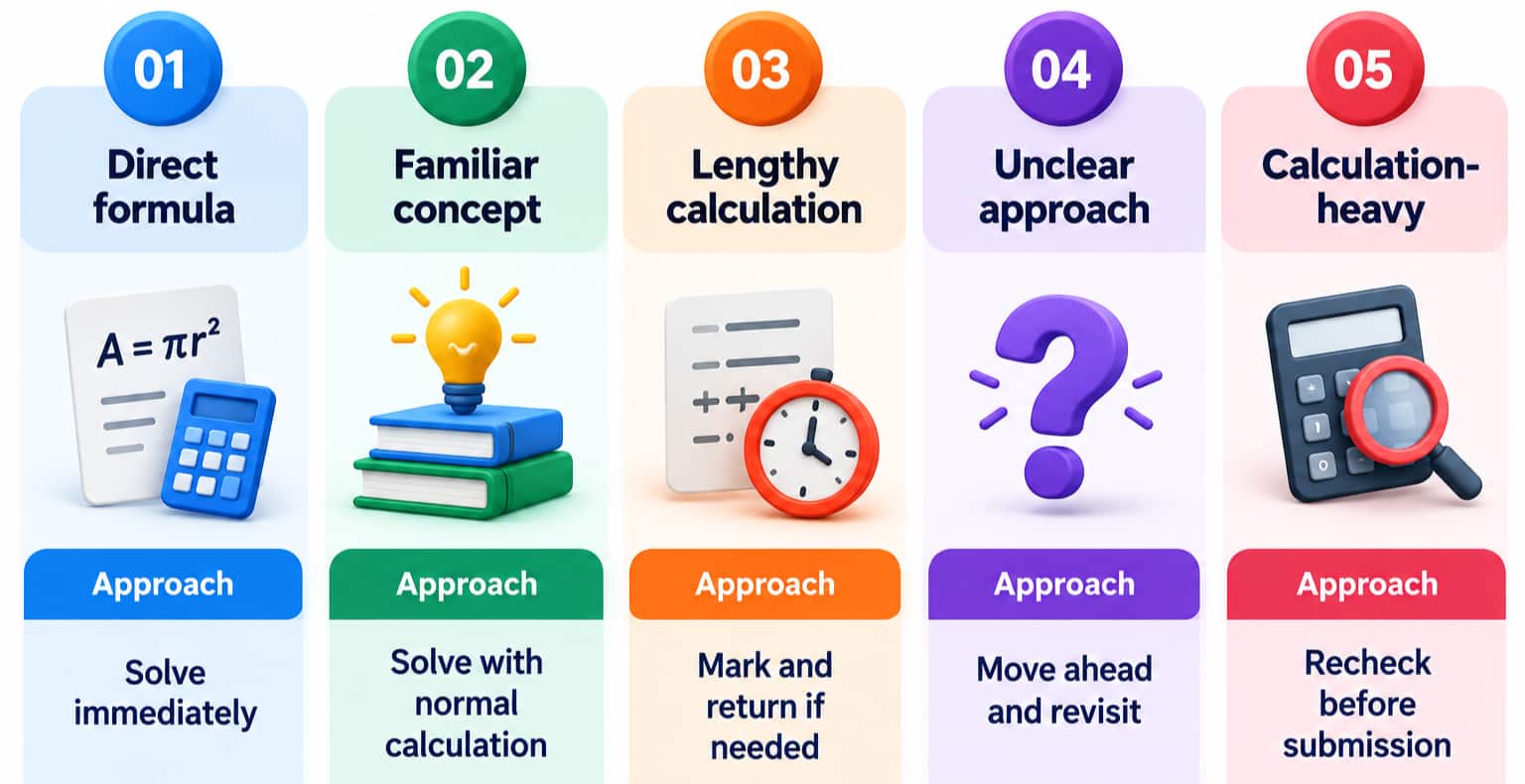
The objective is to avoid spending excessive time on one question simply because there are no options.
Algebra deserves special attention because the 2026 analysis reported substantial representation of equations, inequalities, functions, logarithms and sequences.
Practice should include:
Linear and quadratic equations
Inequalities
Functions
Logarithms
AP and GP
Modulus-based problems
Sequence-based numerical questions
6 Lakh+ CUET Registrations | 500+ Companies Visited for Placement Top Recruiters: Apple Inc., Amazon, IBM, CISCO, Meta, Microsoft, Google
The key preparation change is to derive the final numerical value rather than using options to test possible answers.
Arithmetic questions can be particularly suitable for no-options practice because many produce direct numerical answers.
Focus on:
Percentages
Averages
Profit and loss
Simple Interest and compound interest
Time and work
Time-speed-distance
After solving, repeat the calculation mentally or through a shorter method wherever possible. This helps reduce calculation time without compromising accuracy.
Number System preparation should include questions involving:
Remainders
Divisibility
Factors
HCF and LCM
Unit digits
Number properties
Integer solutions
These topics often require logical manipulation rather than lengthy calculations, making them useful for timed Short Answer practice.
Practising only MCQs can create a habit of checking choices rather than deriving the answer.
A candidate may calculate correctly but enter an intermediate value instead of the requested final answer.
No-options questions require precision. Rushing can turn a correct method into an incorrect response.
A quick second check can catch sign, arithmetic or transcription errors.
Preparation should gradually include mixed and higher-level questions so that the numerical-answer format becomes familiar under pressure.
After every mock, create a separate Short Answer error log.
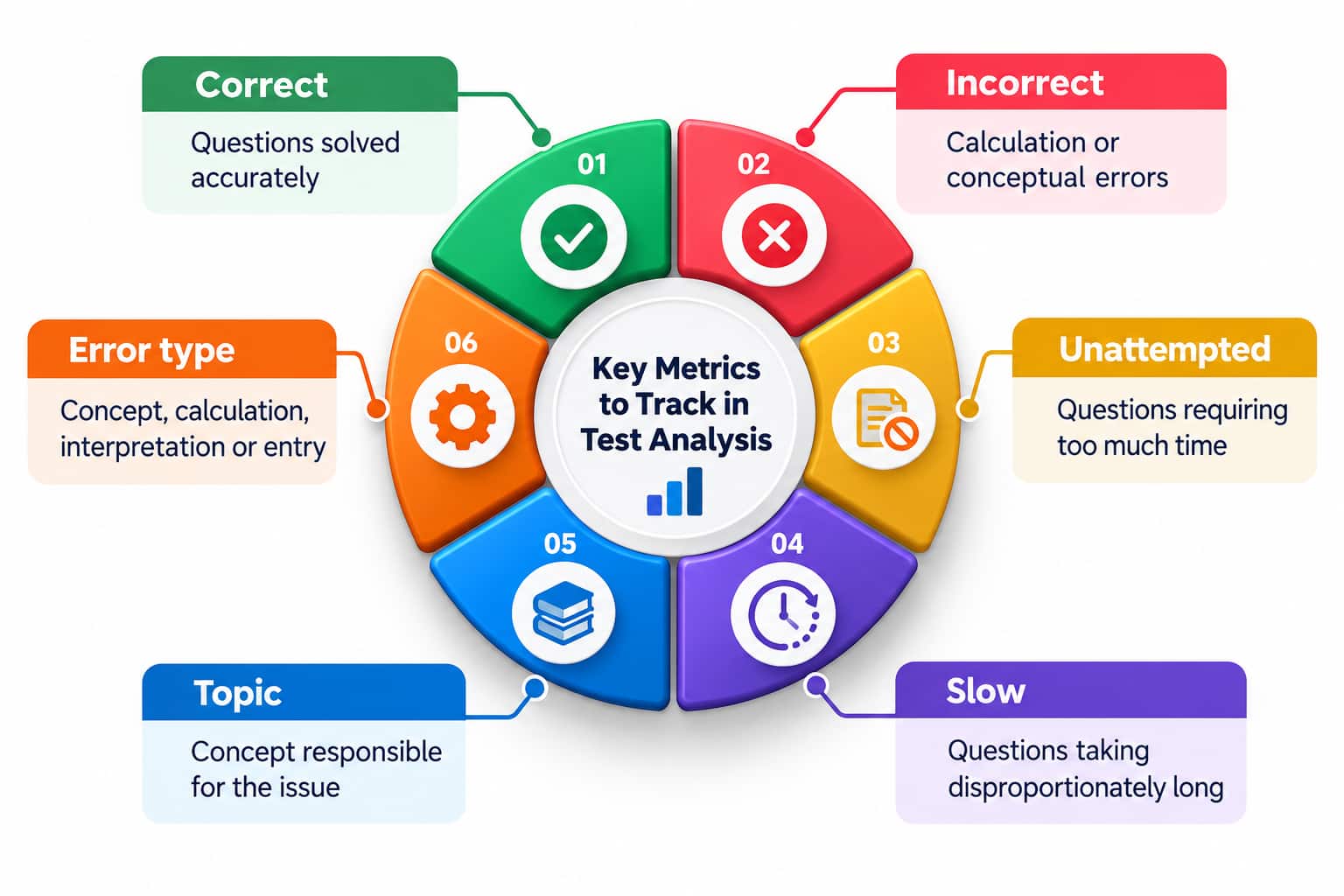
This helps distinguish a topic weakness from a calculation weakness.
A compact daily routine can include:
Practice | Suggested Focus |
20 minutes | Concept revision |
30 minutes | Topic-wise numerical questions |
20 minutes | No-options mixed questions |
10 minutes | Error-log revision |
As preparation advances, the time should shift from concept learning towards mixed timed sets and previous-year questions.
Previous-year questions are particularly useful because they show how concepts are converted into numerical-answer problems.
For 2027 preparation, candidates should therefore use the latest available IPMAT Indore papers as a format reference while continuing to follow the official notification for any future changes.
Practise IPMAT Mock Test for Indore level questions in a timed environment to improve speed, accuracy and exam readiness.
Practise now: IPMAT Indore Free Mock Test
Attempt IPMAT Rohtak level questions under timed conditions and assess preparation across key sections.
Practise now: IPMAT Rohtak Free Mock Test
Practise multiple IPMAT mock sets with exam-style questions to strengthen concepts, speed and question-solving accuracy.
Download now: IPMAT Mock Test PDF
Before moving to the next practice set, check:
Can the question be solved without options?
Is the method clear before calculation begins?
Are calculations being performed accurately?
Is enough time being spent on each question?
Are repeated calculation errors being recorded?
Is the final answer being verified?
Are mixed Short Answer sets being practised regularly?
Are previous-year questions included?
IPMAT Short Answer preparation requires strong concepts, accurate calculations and regular no-options practice. Focus on IPMAT Previous Year Question Papers, timed 15-question sets and careful error analysis to build confidence with numerical-answer questions.
Frequently Asked Questions (FAQs)
They are Quantitative Ability questions where candidates derive and enter the numerical answer instead of selecting from multiple options.
The Quantitative Ability Short Answer section has 15 questions.
There is no negative marking for Short Answer questions.
Solve numerical questions without looking at answer choices, then verify the final answer and identify calculation or conceptual errors.
Arithmetic, Algebra, Number System, Sequences, Geometry and Modern Mathematics are important areas for Short Answer practice.

On Question asked by student community
Hello there,
Since your son is in Class 12 Commerce with Applied Mathematics, he has a very good combination for management entrance preparation. It is absolutely possible to prepare for both IPMAT and CUET together, but the preparation should be planned carefully.
What I would suggest
Hello Dear Student,
Yes, you are eligible for the IIM Indore IPM program as Mathematics and specific streams are not mandatory, and dual/additional marksheets from recognized state boards are accepted during verification as long as age and passing year rules are met.
Hope it helps!
Hi,
You can refer to books like AP Bhardwaj for legal aptitude, RS Aggarwal for reasoning, and dedicated guides like CULET Guide by Dipanjan Mitra for best preparation for CULET. Additionally, you can refer to the CULET previous year question papers .
The IPMAT (Integrated Programme in Management Aptitude Test) syllabus for 2026 is structured around three main, demanding sections designed to test your analytical and verbal abilities at an advanced level.
Here is the essential syllabus breakdown:
Quantitative Ability (QA): This section is highly crucial. It tests advanced
Hello there!
IPMAT ( Integrated Program in Management Aptitude Test) is an entrance exam conducted by IIM Indore for the admission in its five years course Integrated Program in Management Program (IPM).
One can directly appear for this exam just after completion of your 12th standard in any stream, you

BBA 2027 Early Bird Applications Deadline 30th Sept'26. Apply now using coupon code CAREER250 and get ₹250 off the application fee | 100% Placements with 260+ Recruiters
Last Date to Apply: 17th August | QS I-Gauge Diamond Rated | NAAC A+ Accredited | 621 Recruitment Partners | INR 40 LPA Highest CTC | 4482 Job offers
Recognized as Category-1 Deemed to be University by UGC | 41,000 + Alumni Imprints Globally | Students from over 20+ countries
NAAC Accredited | #7 by IIRF in Uttar Pradesh | Scholarships Available
Applications fee waiver for all prgrammes | B.Sc (Hons) Admissions 2026 Now Open | Ranked Among the Top 100 Universities in the World by QS World University Rankings 2025
10000+ Alumni across the globe | Scholarships available