


Arithmetic Progression: Definition, Formulas, Sum and Examples
Have you ever noticed patterns such as 2, 5, 8, 11, 14, ... where each term increases by the same amount? Such sequences are known as arithmetic progressions (AP), one of the most fundamental topics in algebra and sequences. Arithmetic progression appears in everyday situations such as salary increments, savings plans, seating arrangements, and counting patterns. Understanding AP helps students solve problems involving sequences, series, and mathematical reasoning, making it an essential topic for school mathematics and competitive examinations. In this article, we will explore the definition of arithmetic progression, important formulas, properties, derivations, solved examples, and practical applications.
This Story also Contains
- What is Arithmetic Progression (AP)?
- Basics of Arithmetic Progression
- The general term of an AP ($t_n$)
- Types of AP
- The sum of n terms of an AP:
- Arithmetic Mean (AM)
- Important Properties of an AP
- Best Books for Arithmetic Progression
- Shortcut Tips and Tricks for Arithmetic Progression
- Important Formula Table
- Solved Examples Based on Arithmetic Progression
- Related Topics to Arithmetic Progression
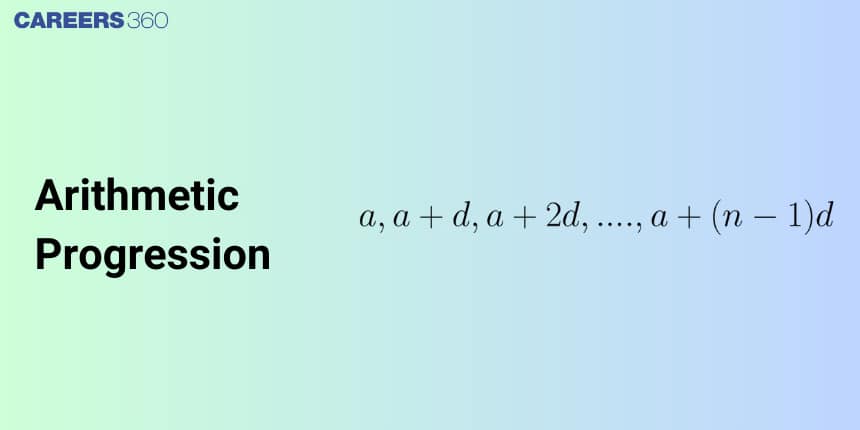
What is Arithmetic Progression (AP)?
An arithmetic progression (AP) is a mathematical sequence of numbers where the difference between any two consecutive terms is constant. In this progression, each term, except the first term, is obtained by adding a fixed number to its previous term. This fixed term is called the common difference. For example, 1, 5, 9, 13, ……. is an arithmetic progression where the common difference is (5 - 1) = (9 - 5) = (13 - 9) = 4.
Comparison with Geometric Progression and Harmonic Progression
Arithmetic Progression | Geometric Progression | Harmonic Progression | |
Definition | A sequence with a constant difference between consecutive terms. | A sequence with a constant ratio between consecutive terms. | A sequence where each term is the reciprocal of an arithmetic sequence. |
Example | 2, 5, 8, 11, 14, ….. It is an Arithmetic Progression. | 2, 6, 18, 54, 162,...... It is a Geometric Progression. | $\frac{1}{2}, \frac{1}{3}, \frac{1}{4},......$ It is a Harmonic Progression |
Common difference/ ratio | A fixed amount is added or subtracted between consecutive terms, which is called the common difference. | A fixed number is multiplied or divided between consecutive terms, which is called the common ratio. | Not applicable |
Application | The financial calculation, time-based progression. | Growth models, compound interest, exponential decay. | Problems involving reciprocals, harmonic mean. |
Basics of Arithmetic Progression
Arithmetic Progression (AP) is one of the most fundamental concepts in sequences and series. It describes a sequence of numbers in which the difference between any two consecutive terms remains constant. This constant difference creates a predictable pattern, making arithmetic progression useful in mathematics, finance, economics, statistics, and real-life situations such as salary increments, savings plans, and population studies.
Understanding the basic components of an arithmetic progression is essential before learning formulas such as the nth term and the sum of n terms.
Terms of an Arithmetic Progression
The numbers that make up an arithmetic progression are called its terms. Each term is obtained by adding a fixed value, known as the common difference, to the previous term.
Example 1
Consider the sequence:
$2,\ 5,\ 8,\ 11,\ 14,\ 17,\dots$
Here:
- First term = 2
- Second term = 5
- Third term = 8
- Fourth term = 11
Each number in the sequence is called a term of the arithmetic progression.
Example 2
$20,\ 17,\ 14,\ 11,\ 8,\dots$
This is also an arithmetic progression because the difference between consecutive terms remains constant.
Types of Terms in AP
| Term | Meaning |
|---|---|
| First Term | Starting term of the sequence |
| Second Term | Next term after the first term |
| nth Term | Any general term in the sequence |
| Last Term | Final term in a finite AP |
Importance of Terms in AP
The terms help us:
- Identify patterns in sequences.
- Find missing values.
- Calculate the nth term.
- Determine the sum of terms.
- Solve sequence-related problems.
First Term and Common Difference
Every arithmetic progression is completely determined by two quantities:
- First Term ($a$)
- Common Difference ($d$)
First Term
The first term is the initial value from which the arithmetic progression begins.
It is usually represented by: $a$
For example, in: $4,\ 9,\ 14,\ 19,\dots$ the first term is: $a=4$
Common Difference
The common difference is the fixed value added to each term to obtain the next term.
It is represented by: $d$
Formula:
$d=\text{Next Term} - \text{Previous Term}$
Example 1
Sequence:
$3,\ 7,\ 11,\ 15,\dots$
$d=7-3=4$
$d=11-7=4$
$d=15-11=4$
Therefore: $d=4$
Example 2
Sequence:
$25,\ 20,\ 15,\ 10,\dots$
$d=20-25=-5$
$d=15-20=-5$
Therefore: $d=-5$
Positive and Negative Common Difference
| Type of AP | Common Difference |
|---|---|
| Increasing AP | $d>0$ |
| Decreasing AP | $d<0$ |
| Constant Sequence | $d=0$ |
Why Common Difference is Important
The common difference:
- Determines the pattern of the sequence.
- Helps find future terms.
- Is used in all AP formulas.
- Indicates whether the sequence increases or decreases.
General Form of an Arithmetic Progression
The general form of an arithmetic progression is:
$a,\ a+d,\ a+2d,\ a+3d,\ a+4d,\dots$
where:
- $a$ = first term
- $d$ = common difference
Understanding the Pattern
Observe:
First term: $a$
Second term: $a+d$
Third term: $a+2d$
Fourth term: $a+3d$
Fifth term: $a+4d$
Each new term is obtained by adding one more common difference.
Example
Let: $a=5$
$d=3$
Substituting into the general form:
$5,\ 8,\ 11,\ 14,\ 17,\dots$
nth Term from the General Form
Looking at the pattern:
| Term Number | Expression |
|---|---|
| 1st | $a$ |
| 2nd | $a+d$ |
| 3rd | $a+2d$ |
| 4th | $a+3d$ |
| nth | $a+(n-1)d$ |
Thus, the nth term formula becomes: $a_n=a+(n-1)d$
This formula is one of the most important formulas in arithmetic progression.
Identifying an Arithmetic Progression
Before applying AP formulas, it is important to verify whether a given sequence is actually an arithmetic progression.
Method 1: Check Consecutive Differences
Find the difference between successive terms.
If all differences are equal, the sequence is an arithmetic progression.
Example 1
Sequence:
$6,\ 10,\ 14,\ 18,\ 22$
Differences:
$10-6=4$
$14-10=4$
$18-14=4$
$22-18=4$
Since all differences are equal, this is an arithmetic progression.
Example 2
Sequence:
$5,\ 10,\ 20,\ 40$
Differences:
$10-5=5$
$20-10=10$
$40-20=20$
The differences are not equal.
Therefore, it is not an arithmetic progression.
Method 2: Use the Common Difference Property
A sequence is an AP if:
$\text{Second Term} - \text{First Term}=\text{Third Term} - \text{Second Term}$ and so on.
Method 3: Check the General Pattern
If the sequence can be written in the form:
$a,\ a+d,\ a+2d,\ a+3d,\dots$
then it is an arithmetic progression.
Examples of Arithmetic Progressions
| Sequence | Common Difference |
|---|---|
| $2,\ 4,\ 6,\ 8,\dots$ | 2 |
| $10,\ 15,\ 20,\ 25,\dots$ | 5 |
| $100,\ 90,\ 80,\ 70,\dots$ | -10 |
| $7,\ 7,\ 7,\ 7,\dots$ | 0 |
Examples That Are Not Arithmetic Progressions
| Sequence | Reason |
|---|---|
| $2,\ 4,\ 8,\ 16,\dots$ | Differences are not constant |
| $1,\ 4,\ 9,\ 16,\dots$ | Differences vary |
| $3,\ 6,\ 12,\ 24,\dots$ | Multiplication pattern instead of addition |
Understanding how to identify an arithmetic progression is the first step toward mastering AP formulas, nth term calculations, arithmetic means, and sums of arithmetic series.
The general term of an AP ($t_n$)
The general term or the nth term of an arithmetic sequence can be expressed in two ways i.e. the nth term of an AP from the beginning and the nth term of an AP from the last. We will discuss these two ways below.
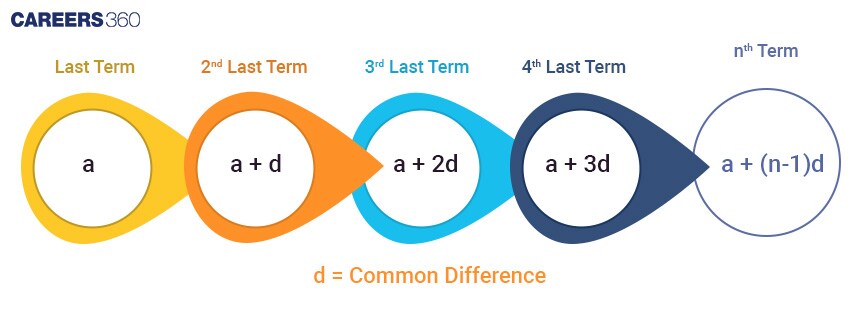
The nth term of an AP from the beginning:
The general term of the nth term from the beginning of an AP where the first term is $a$, the common difference is $d$, and the number of terms is $n$ is given by the formula:
$t_n = a + (n - 1)d$.
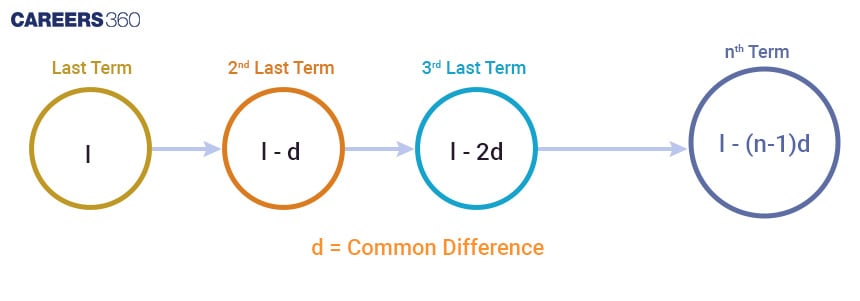
The nth term of an AP from the last:
The nth term of an AP from the last, where the last term is $l$, the common difference is $d$, and the number of terms is $n$, is given by the formula:
$t_n = l - (n - 1)d$.
The nth term of an AP if the mth term is given but the first term is not given:
The mth term of an AP is given.
So, $t_m=a+(m-1)d$, where $a$ is the first term and $d$ is the common difference.
Since the first term is not given, we need to find the first term in terms of the given mth term.
So, $a = t_m - (m-1)d$
Now, for the nth term,
$t_n = a+(n-1)d = t_m - (m-1)d + (n-1)d = t_m - md + d + nd - d = t_m + (n-m)d$
Therefore, $t_n = t_m + (n - m)d$ is the required nth term of an AP when the mth term is given but the first term is not given.
The sum of Arithmetic progressions
The sum, $S_n$ of n terms of an AP with the first term ‘a’ and common difference ‘d’ is given by
$\begin{aligned} & S_n=\frac{n}{2}[2 a+(n-1) d] \\ & \text { OR } \\ & S_n=\frac{n}{2}[a+l] \\ & a \rightarrow \text { first term } \\ & d \rightarrow \text { common difference } \\ & n \rightarrow \text { number of terms }\end{aligned}$
Types of AP
There are mainly two types of arithmetic progressions, categorized based on their properties and applications. One is Finite AP and the other one is Infinite AP. For better understanding let us discuss them in detail.
Finite AP:
The Finite AP is a sequence with a finite number of terms. The first term, last term, common difference, and the number of terms can be identified from the series.
For example, 2, 4, 6, 8, 10 is a finite AP, where the first term $a$ = 4, the last term $l$ = 10, the common difference $d$ = 10 - 8 = 8 - 6 = 6 - 4 = 4 - 2 = 2, and the number of terms $n$ = 5.
Infinite AP:
The Infinite AP is a sequence with an infinite number of terms, that continues indefinitely. The first term and the common difference can be identified from the sequence but the number of terms and the last term are unknown.
For example, 3, 6, 9, 12, 15, ….. is an Infinite AP, where the first term $a$ = 3, the common difference $d$ = 15 - 12 = 12 - 9 = 9 - 6 = 6 - 3 = 3, but the last term ($l$) and the number of terms ($n$) are unknown.
Decreasing AP:
An arithmetic progression is decreasing if the common difference $d$ is negative. This means that each term is smaller than the previous term.
For example, 10, 8, 6, 4, 2, …. is a decreasing AP.
Increasing AP:
An arithmetic progression is increasing if the common difference $d$ is positive. This means that each term is larger than the previous term.
For example, 2, 3, 4, 5, ….. is an increasing AP.
The sum of n terms of an AP:
In the 19th century in Germany, a Math class for grade 10 was going on. The teacher asked the students to find the sum of all numbers from 1 to 100. While the students were struggling with the calculations, one boy quickly called out the correct answer as 5050. This boy was none other than the great German mathematician Carl Friedrich Gauss. How did he arrive at the sum so quickly?
Gauss observed that pairing the numbers from the beginning and the end of the sequence resulted in sums that were constant. Specifically, he paired the first number with the last, the second number with the second last, and so on. Each pair had the same sum.
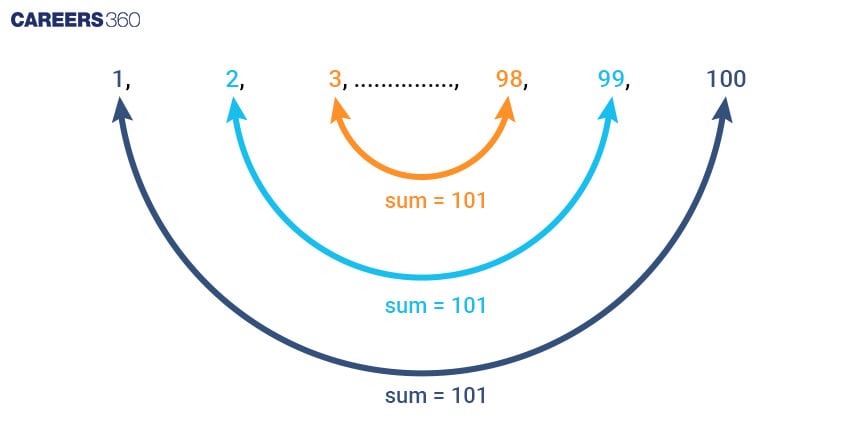
We can see that in sequences 1, 2, 3, ..., 100, there are 50 such pairs whose sum is 101. Thus, the sum of all terms of this sequence is 50 × 101 = 5050.
The sum of n terms of an AP can be calculated using two formulas, let us have a clear understanding of them.
The sum of AP when the last term is not given:
When the last term of the AP is not given we can calculate the sum of the terms of an AP by using the formula:
$S_n = \frac{n}{2}[2a+(n-1)d]$, where $a$ is the first term, $d$ is the common difference, $n$ is the number of terms and $S_n$ is the sum of the terms.
Let’s see how this formula came to be.
Let $a, a+d, a+2d, a+3d, …., a+(n-1)d$ be an AP, where $a$ is the first term, $d$ is the common difference, and $n$ is the number of terms.
Now, the sum = $S_n = a + a + d + a + 2d + a + 3d + …. + a + (n-1)d$
Also we can write in reverse, $S_n = a + (n-1)d + a + (n-2)d + ….. + a + d + a$
Now, adding these two we get,
$2S_n = [a + a + (n-1)d] + [a + d + a + (n-2)d] + …… + [a + (n-1)d + a]$
⇒ $2S_n = [2a + (n-1)d] + [2a + (n-1)d] + …… + [2a + (n-1)d]$
⇒ $2S_n = n[2a + (n-1)d]$
⇒ $S_n = \frac{n}{2}[2a + (n-1)d]$
Therefore, the formula of the sum of AP is $S_n = \frac{n}{2}[2a + (n-1)d]$.
The sum of AP when the last term is given:
When the last term of the AP is given we can calculate the sum of the terms of an AP by using the formula:
$S_n = \frac{n}{2}(a + l)$, where $a$ is the first term, $l$ is the last term, $n$ is the number of terms and $S_n$ is the sum of the terms.
Again let’s see how this formula came to be.
We know the sum of the terms of an AP,
$S_n = \frac{n}{2}[2a + (n-1)d]$
⇒ $S_n = \frac{n}{2}[a + a + (n-1)d]$ …………. (1)
We also know the formula of the last term $l = a + (n-1)d$
Putting this value in the equation (1) we get,
⇒ $S_n = \frac{n}{2}[a + l]$
Therefore, the formula of the sum of the terms of an AP, when the last term is given is,
$S_n = \frac{n}{2}[a + l]$
Arithmetic Mean (AM)
The arithmetic mean (AM), often referred to simply as the mean or average, is a measure of central tendency that is commonly used in statistics and mathematics. It indicates the central value of a set of numbers. The arithmetic mean of a set of $n$ numbers is calculated by summing all the numbers and then dividing by $n$.
For example, AM of 2, 4, 6, 8, 10 is $\frac{2 + 4 + 6 + 8 + 10}{5} = 6$.
Important Properties of an AP
1. If a fixed number is added to or subtracted from each term of a given A.P., then the resulting series is also an A.P. and its common difference remains the same.
2. If each term of an A.P. is multiplied by a fixed constant or divided by a non-zero fixed constant then the resulting series is also in A.P.
3. If $a_1, a_2, a_3 \ldots$ and $b_1, b_2, b_3 \ldots$ are two A.P’s, then $a_1 \pm b_1, a_2 \pm b_2, a_3 \pm b_3 \ldots$ are also in A.P.
4. If terms of an A.P. are taken at equal intervals, then the new sequence formed as also an A.P.
e.g., If from A.P., 1, 3, 5, 7, 9, 11, 13,.... we take terms at equal intervals, let's say first, third, fifth, seventh,....terms, then the resultant sequence will be 1, 5, 9, 13, ....which is also an A.P.
5. If $a_1, a_2, a_3, \ldots, a_n$ are in A.P., then $a_r=\frac{a_{r-k}+a_{r+k}}{2}, \forall k, 0 \leq k \leq n-r$
6. Choosing terms in A.P.
If some of a few terms (like 3, 4, or 5 terms) in an A.P. is given in the problem, then selecting the following terms reduces the calculation
- If we need to choose three terms in an A.P., then choose $(a-d), a,(a+d)$
[Note: Here the first term is $a-d$, and the common difference is $d$]
- If we need to choose four terms in an A.P., then choose $(a-3 d),(a-d),(a+d),(a+3 d)$
[Note: Here first term is $a-3d$, and the common difference is $2d$]
- If we need to choose five terms in an A.P., then choose $(a-2 d),(a-d), a,(a+d)$, $(\mathrm{a}+2 \mathrm{~d})$
[Note: Here the first term is $a-2d$, and the common difference is $d$]
7. The sum of terms equidistant from the beginning and end of an AP is constant and it equals the sum of the first and the last terms.
$a_1+a_n=a_2+a_{n-1}=a_3+a_{n-2}=\ldots \ldots=a_r+a_{n-r+1}$
8. If $a, b, c$ are in A.P., then $2 b=a+c$
Best Books for Arithmetic Progression
Arithmetic progression is one of the most important topics in sequences and series. These books help develop a strong understanding of AP concepts, formulas, and applications.
| Book Name | Best For | Why It Helps |
|---|---|---|
| NCERT Mathematics Class 10 & 11 | School Students | Covers AP fundamentals thoroughly |
| Mathematics – R.D. Sharma | Board Exams | Detailed derivations and examples |
| Objective Mathematics – R.S. Aggarwal | Competitive Exams | Aptitude-focused questions |
| Cengage Algebra | JEE Preparation | Advanced sequence and series coverage |
| Higher Algebra – Hall & Knight | Advanced Mathematics | Strong theoretical explanations |
Shortcut Tips and Tricks for Arithmetic Progression
A few simple shortcuts can help solve AP questions quickly and efficiently in examinations.
| Trick | Explanation |
|---|---|
| Remember the nth Term Formula | Most AP questions start with it |
| Identify Common Difference First | Key to solving AP problems |
| Use Average Property | Middle term equals average of equidistant terms |
| Check Sequence Pattern | Quickly identify AP |
| Sum Formula Saves Time | Avoid manual addition |
| Consecutive AP Terms Differ by d | Useful for equation-based questions |
| Verify Arithmetic Difference | Ensure the sequence is actually an AP |
Important Formula Table
This formula sheet provides a quick revision of the most important arithmetic progression formulas.
| Concept | Formula |
|---|---|
| First Term | $a$ |
| Common Difference | $d$ |
| nth Term | $a_n=a+(n-1)d$ |
| Sum of First n Terms | $S_n=\frac{n}{2}[2a+(n-1)d]$ |
| Alternative Sum Formula | $S_n=\frac{n}{2}(a+l)$ |
| Common Difference | $d=a_n-a_{n-1}$ |
| Arithmetic Mean Between a and b | $\frac{a+b}{2}$ |
Solved Examples Based on Arithmetic Progression
Example 1. The sum of 10 terms of the arithmetic series is 390. If the third term of the series is 19, find the first term.
Solution:
Given: The sum of 10 terms of the arithmetic series is 390.
So, $n=10$
The third term of the series is 19.
Let the first term of the series be $a$.
We know, sum of arithmetic progression (A.P.) = $\frac{n}{2}[2a+(n-1)d]$
$n^{th}$ term = $a+(n-1)d$
So, $3^{rd}$ term ⇒ $a+(3-1)d=19$
⇒ $a+2d=19$ ----------------------------(1)
Sum of 10 terms = $\frac{10}{2}[2a+(10-1)d] =390$
⇒ $2a+9d=78$ ---------(2)
Multiplying 9 with equation (1) and 2 with equation (2), we get,
⇒ $9a+18d=171$ ------------------------(3)
⇒ $4a+18d=156$ ------------------------(4)
Subtracting (4) from (3), we get,
$5a=15$
$\therefore a=3$
Hence, the required answer is 3.
Example 2: What is the sum of the first 9 terms of an arithmetic progression, if the first term is 7 and the last term is 55?
Solution:
Given: The first term is 7 and the last term is 55.
Using the formula, S9 = $\frac{n}{2}(a+l)$
Where $a$ is the first term, $l$ is the last term of the A.P., and n is the number of terms.
By putting the value of 1st and last term,
⇒ S9 = $\frac{9}{2}$(7 + 55)
⇒ S9 = $\frac{9}{2}$ × 62
$\therefore$ S9 = 9 × 31 = 279
Hence, the required answer is 279.
Example 3: If $P=2^2+6^2+10^2+14^2+....+ 94^2$ and $Q=1^2+5^2+9^2+...+81^2$, then what is the value of $P - Q$?
Solution:
Given: $P=2^2+6^2+10^2+14^2+....+94^2$ and $Q=1^2+5^2+9^2+...+81^2$
$⇒P-Q = (2^{2}-1^{2})+(6^{2}-5^{2})+(10^{2}-9^{2})+....+(82^{2}-81^{2})+86^{2}+90^{2}+94^{2}$
$⇒P-Q=3+11+19+27+.......+163(\text{A.P. with 21 terms})+86^{2}+90^{2}+94^{2}$
$⇒P-Q=\frac{21}{2}[2×3+(21–1)8]+86^{2}+90^{2}+94^{2}$
$⇒P-Q=\frac{21}{2}[6+(20)8]+86^{2}+90^{2}+94^{2}$
$⇒P-Q=\frac{21}{2}[166]+(90-4)^{2}+90^{2}+(90+4)^{2}$
$⇒P-Q=1743+(90^{2}-2×90×4+4^{2})+90^{2}+(90^{2}+4^{2}+2×90×4)$
$⇒P-Q=1743+8100+16+8100+8100+16$
$\therefore P-Q=26075$
Hence, the required answer is 26075.
Example 4: Three numbers are in Arithmetic Progression (A.P.) whose sum is 30 and the product is 910. Then the greatest number in the AP is
Solution:
Let three numbers in A.P. be a – d, a, and a + d, respectively.
According to the question, a – d + a + a + d = 30
⇒ 3a = 30
⇒ a = $\frac{30}{3}$ = 10
Again, a×(a – d)×(a + d) = 910
⇒ 10×(10 – d)×(10 + d) = 910
⇒ 100 – d2 = 91
⇒ d2 = 100 – 91 = 9
⇒ d = $\sqrt{9}$ = 3
$\therefore$ Largest number = a + d = 10 + 3 = 13
Hence, the required answer is 13.
Example 5: The first term of an arithmetic progression is 22 and the last term is –11. If the sum is 66, the number of terms in the sequence is
Solution:
Let the first term as $a$, the last term as $l$, and the number of terms as $n$.
Given: $a$ = 22, $l$ = –11
The sum of an arithmetic progression is given by
$S = \frac{n}{2}(a + l)$
⇒ 66 = $\frac{n}{2}$(22 – 11)
$\therefore n$ = 12
Hence, the correct answer is option (2).
Example 6: The $8^{\text {th }}$ common term of the series $
\begin{aligned}
& \mathrm{S}_1=3+7+11+15+19+\cdots \\
& \mathrm{S}_2=1+6+11+16+21+\cdots
\end{aligned}
$
is $\qquad$
[JEE MAINS 2023]
Solution
$8^{\text {th }}$ common term of the series
$
\begin{aligned}
& \mathrm{S}_1=3+7+11+15+19+\ldots \ldots \\
& \mathrm{S}_2=1+6+11+16+21+\ldots \ldots
\end{aligned}
$
First common term $=11$
common diff of the AP of common terms
$
\begin{aligned}
& =\mathrm{L} . \mathrm{C} . \mathrm{M} \text { of }\{4,5\} \\
& =20
\end{aligned}
$
$
\begin{aligned}
& \therefore \mathrm{AP} \\
& 11,31,51, \quad \ldots \ldots \\
& \mathrm{T}_8=11+(8-1) 20 \\
& =11+140 \\
& \mathrm{~T}_8=151
\end{aligned}
$
Hence, the answer is (151).
Example 7: Let $a, b, c>1, a^3, b^3$ and $c^3$ be in A.P., and $\log _a b, \log _c$ a and $\log _b c$ be in G.P. If the sum of first 20 terms of an A.P., whose first term is $\frac{a+4 b+c}{3}$ and the common difference is $\frac{a-8 b+c}{10}$ is -444, then abc is equal to:
[JEE MAINS 2023]
Solution
$
\begin{aligned}
& \text { If } \log _{\mathrm{a}} \mathrm{b}, \log _{\mathrm{c}} a, \log _b c \rightarrow \text { G.P. } \\
& \left(\log _c a\right)^2=\log _a b \times \log _b c \\
& \left(\log _{\mathrm{c}} \mathrm{a}\right)^2=\log _{\mathrm{a}} \mathrm{c} \\
& \Rightarrow\left(\log _c a\right)^2=\frac{1}{\log _c a} \\
& \Rightarrow\left(\log _{\mathrm{c}} \mathrm{a}\right)^3=1 \\
& \Rightarrow \log _{\mathrm{c}} \mathrm{a}=1 \\
& \mathrm{a}=\mathrm{c} \\
& \text { If } a^3 b^3 c^3 \rightarrow \mathrm{A} . \mathrm{P} \\
& 2 b^3=a^3+c^3 \\
& \text { If } \mathrm{a}=\mathrm{c} \\
& \Rightarrow \mathrm{a}=\mathrm{b}=\mathrm{c} \\
\end{aligned}
$
For AP
$
\begin{aligned}
& A=\frac{a+4 a+a}{3} \quad D=\frac{a-8 a+a}{10} \\
& \mathrm{~A}=2 \mathrm{a} \quad \mathrm{D}=\frac{-3 \mathrm{a}}{5} \\
& S_{20}=\frac{20}{2}\left[2 \times 2 a+(20-1)\left(\frac{-3 a}{5}\right)\right] \\
& =10\left[4 a-\frac{57 a}{5}\right] \\
& =10\left[-\frac{37 a}{5}\right]=-444 \\
& \Rightarrow \mathrm{a}=\frac{444 \times 5}{37 \times 10} \\
& a=6 \\
& \Rightarrow \mathrm{abc}=6 \times 6 \times 6=216 \\
&
\end{aligned}
$
Example 8: If $a_1, a_2, a_3 \ldots \ldots$ and $b_1, b_2, b_3 \ldots \ldots$ are A.P., and $a_1=2, a_{10}=3, a_1 b_1=1=a_{10} b_{10}$ then $a_4 b_4$ is equal to
[JEE MAINS 2023]
Solution
$
\begin{aligned}
& \mathrm{a}_1=2, \quad \mathrm{a}_{10}=2+(10-1) \mathrm{d}=3 \Rightarrow \mathrm{d}=\frac{1}{9} \\
& \mathrm{a}_4=2+(4-1) \times \frac{1}{9}=\frac{7}{3} \\
& \mathrm{a}_1 \mathrm{~b}_1=1 \Rightarrow \mathrm{b}_1=\frac{1}{2}, \quad \mathrm{a}_{10} \mathrm{~b}_{10}=1 \Rightarrow \mathrm{b}_{10}=\frac{1}{3} \\
& \mathrm{~b}_{10}=\frac{1}{2}+(10-1) \times \mathrm{d}=\frac{1}{3} \Rightarrow 9 \mathrm{~d}=-\frac{1}{6} \Rightarrow \mathrm{d}=-\frac{1}{5^4} \\
& \mathrm{~b}_4=\frac{1}{2}+(4-1) \times\left(-\frac{1}{54}\right)=\frac{1}{2}-\frac{1}{18}=\frac{4}{9} \\
& \mathrm{a}_4 \mathrm{~b}_4=\frac{7}{3} \times \frac{4}{9}=\frac{28}{27}
\end{aligned}
$
Example 9: If the 10th term of an A.P. is $\frac{1}{20}$ and its 20th term is $\frac{1}{10}$, then the sum of its first 200 terms is
[JEE MAINS 2023]
Solution
$
\begin{aligned}
& a_{10}=a+9 d=1 / 20 \\
& a_{20}=a+19 d=1 / 10
\end{aligned}
$
On subtracting them, we get $d=1 / 200$
$
\begin{aligned}
& a+9 / 10=1 / 20 \Rightarrow a=1 / 200 \\
& S_{200}=\frac{200}{2}[2 / 200+(199) \times 1 / 200]=\frac{201}{2}
\end{aligned}
$
Example 10: Let $f: R \rightarrow R$ be such that for all $x \in R\left(2^{1+x}+2^{1-x}\right), f(x)$ and $\left(3^x+3^{-x}\right)$ are in A.P., then the minimum value of $f(x)$ is:
[JEE MAINS 2023]
Solution
If $a, b, c$ are in $A P$, then $2 b=a+c$
$
2 f(x)=\left(2 \frac{1}{2^x}+2.2^x\right)+\left(3^x+\frac{1}{3^x}\right)
$
Now, $A M \geq G M$
$
\begin{aligned}
& \frac{a+b}{2} \geq \sqrt{a b} \\
& \frac{3^x+\frac{1}{3^x}}{2} \geq \sqrt{1} \\
& \left(3^x+\frac{1}{3^x}\right) \geqslant 2
\end{aligned}
$
Value equals 2 at $3^x=\frac{1}{3^x} \Rightarrow x=0$
Similarly, $\frac{1}{2^x}+2^x \geq 2$, and this holds at $x=0$
So, $2($ minimum of $f(x))=2(2)+(2)$ $\min f(x)=3$
Related Topics to Arithmetic Progression
Arithmetic progression forms the foundation of sequences and series in mathematics. Exploring related topics can help you better understand number patterns, series formulas, and their applications in higher mathematics and competitive examinations.
Frequently Asked Questions (FAQs)
\begin{aligned} & S_n=\frac{n}{2}[2 a+(n-1) d] \\ & \mathrm{OR} \\ & S_n=\frac{n}{2}[a+l] \\ & a \rightarrow \text { first term } \\ & d \rightarrow \text { common difference } \\ & n \rightarrow \text { number of terms }\end{aligned}
Yes, if a fixed number is added to or subtracted from each term of a given A.P., then the resulting series is also an A.P. and its common difference remains the same.
If the AP has only a finite number of terms, then the AP is called a finite AP.
Eg- 2, 4, 6, 8
If we need to choose five terms in an A.P., then choose $(a-2 d),(a-d), a,(a+d)$, and $(a+2 d)$. Here the first term is $a-2 d$, and the common difference is $d$
An arithmetic progression is a sequence in which each term increases or decreases by a constant term or fixed number. This fixed number is called the common difference of an AP and is generally denoted by ‘d’.