
Search Colleges, Exams, Schools & more


Login
MBA vs Engineering Salary 2026: Deloitte Report Shows 52% Pay Gap
#MBA
Recently, Deloitte released its Deloitte India’s Campus Workforce Trends 2026 report, which highlighted how MBA is emerging as more than just a qualification for students and paying higher than the conventional engineering degree, debunking the fact that management degrees are losing relevance in the market.
MBA Admission 2027-29 | MBA Application Deadlines 2027
This Story also Contains
- Which Institutes are Included?
- MBA Paying Higher than Engineering
- Why Are Companies Moving From Engineers to MBAs?
- Campus Hiring Trends in India: AI, Skills and Recruitment in 2026
The methodology of the Deloitte survey assesses 505 institutions identified by way of the National Institutional Ranking Framework. Within each category of institutions, either MBA or BTech, Deloitte places 40 institutions in tier 1 immediately after the top 10 institutes.
MBA vs Engineering Salary 2026: What Does the Deloitte Report Say?
Institutional category | MBA average annual compensation | Engineering average annual compensation |
Top 10 institutions | Rs 27.4 lakh | Rs 18.7 lakh |
Tier-3 institutions | Rs 8.4 lakh | Rs 5.75 lakh |
Which Institutes are Included?
The Deloitte survey included BITS Pilani, IIT Indore, NIT Rourkela, IIT Dhanbad, Jadavpur University, NIT Calicut, etc as part of tier 1 NIRF-ranked engineering colleges, whereas tier-1 MBA institutions included IIM Raipur, IIM Trichy, IIT Madras, IIT Kharagpur, SP Jain, IMI Delhi, and more.
MBA Paying Higher than Engineering
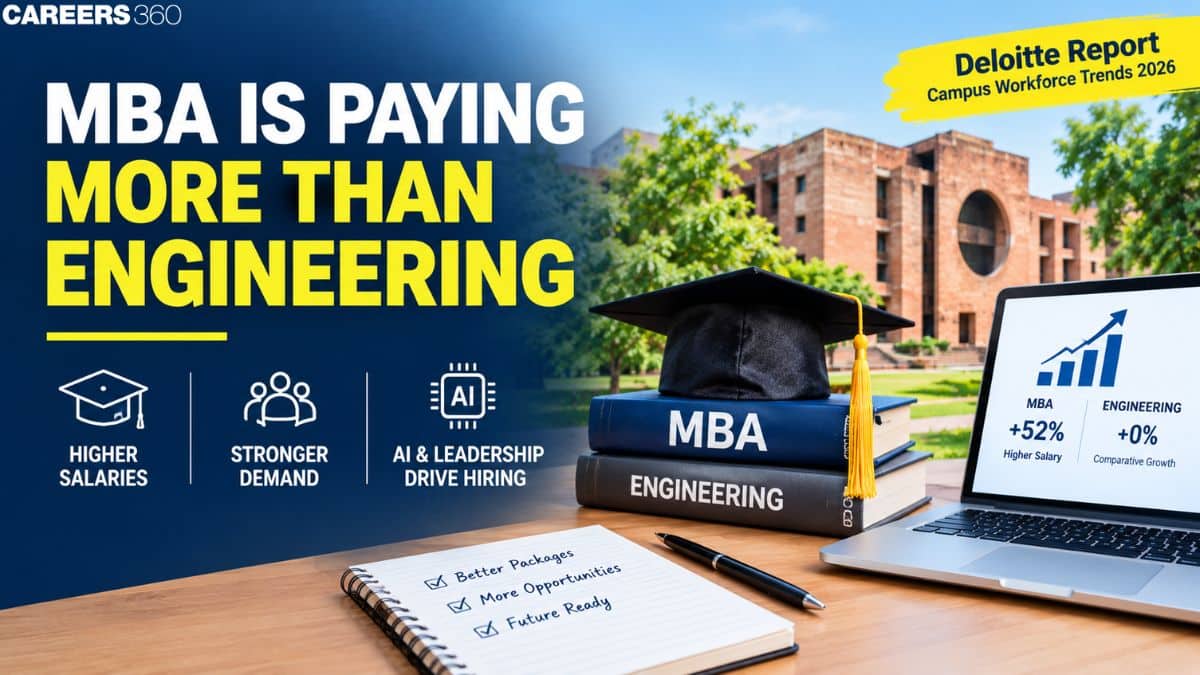
According to the Deloitte report, the Class of 2026 for MBA offered average salaries 52% higher than roles in the engineering domain. The increase in the MBA average salary was 47% last year for the Class of 2025 and is now projected to further increase to 59% next year for the Class of 2027.
The MBA institution placed in the top tier (that is, top 10 colleges) reflected an average annual compensation of around Rs. 27.4 lakh, more than 3.3 times the annual average salary of Rs. 8.4 lakh recorded at the tier-3 level.
However, Engineering graduates fall short in salary comparison with MBAs, with top 10 institute annual average compensation standing at Rs. 18.7 lakh, while it remained around Rs. 5.75 lakh in the case of tier-3 engineering colleges.
Related: IIM Placement 2026: Consulting | IIM Finance Placement 2026
Why Are Companies Moving From Engineers to MBAs?
According to the 250 organisations surveyed by Deloitte, campus recruiters are more inclined and willing to pay more to candidates who can connect available technology with business. This year, all 250 organizations placed greater emphasis on management-oriented roles or leadership-oriented positions rather than only technical roles.
This trend reflects the growing demand for professionals who can pair technological aptitude and analytical skills with commercial interests and strategic decision-making. Basically, professionals who can translate technology into business outcomes.
Campus Hiring Trends in India: AI, Skills and Recruitment in 2026
According to Deloitte India’s Campus Workforce Trends 2026 report, India’s campus hiring trends are shifting towards a more selective, skill-oriented workforce approach, where companies are putting resources into early career hiring, specialised recruitment teams, and ways to take interns into full-time employment.
Campus recruitment trend | Figure reported in the supplied draft |
Organisations with dedicated campus recruitment teams | 80% |
Organisations reporting new roles or skill requirements arising from AI developments | 35% |
Comparable figure for FY 2025 | 21% |
Organisations reporting that AI and agentic AI are changing recruitment processes | 86% |
Reported compensation premium for AI and data skills | 20–25% |
Reported premium for analytical thinking and problem-solving skills | 10–15% |
Following this, 80% of the organizations have a dedicated campus recruitment team, and pre-placement offer (PPO) conversions have also increased across categories. Moreover, AI is said to have changed the recruitment landscape, with 35% of organisations reporting new roles and skill requirements arising out of new developments in AI. It was 21% in FY 2025.
Overall, 86% of organisations feel AI and agentic AI are changing recruitment in areas of resume screening, assessments, and candidate evaluation. In addition to this, campus packages are largely influenced by the institute of the candidate, the role being offered, and skills of the candidate.
The survey also highlighted that candidates showing AI and data skills can get a premium of over 20-25% in annual compensation, while Analytical thinking and problem-solving skills are attracting a premium of 10-15%. As a result, recruiters are now giving more weight to behavioural abilities, learning aptitude, diversity, and employee retention.
MBA Core Functional Specialisations – Free eBooks
MBA Specialisation | What the eBook Covers | Download eBook |
Marketing Management | Top colleges, rankings, fees, placements and career options | |
Human Resource Management | Top HR colleges, rankings, fees, placements and careers | |
Financial Management & Services | Finance colleges, rankings, fees, placements and careers | |
Operations Management | Private colleges for operations, rankings, fees, placements and careers | |
Project Management | Colleges, rankings, fees, placements and careers | |
International Business | Top IB colleges, rankings, fees, placements and career opportunities |
Frequently Asked Questions (FAQs)
Q: Do MBA graduates earn more than engineering graduates in India?
A:
The figures attributed to Deloitte India's Campus Workforce Trends 2026 report indicate higher average compensation for MBA roles in the comparisons presented. However, individual salaries vary by institution, role, industry, skills and experience.
Q: What is the average salary at top MBA institutions according to the report?
A:
The supplied draft reports average annual compensation of around Rs 27.4 lakh at the top 10 MBA institutions. This figure should be verified against the original report before publication.
Q: What is the average salary at top engineering institutions?
A:
The supplied draft reports average annual compensation of around Rs 18.7 lakh at the top 10 engineering institutions. Candidates should check the report's methodology to understand the institutions and roles included.
Q: Why are companies placing greater emphasis on management skills?
A:
The report, as described in the supplied draft, highlights employer interest in candidates who can connect technology with business objectives, alongside analytical thinking, problem-solving and leadership capabilities.
Q: How is AI affecting campus recruitment in India?
A:
The supplied figures suggest that organisations are identifying new roles and skill requirements associated with AI. AI is also affecting recruitment processes such as résumé screening, assessments and candidate evaluation.
Q: Should students choose an MBA over engineering because of salary differences?
A:
Not on the basis of these figures alone. Students should consider their interests, aptitude, preferred career paths, programme costs, institutional quality and employment opportunities before choosing a degree.
Articles
Upcoming Mba Exams

Certifications By Top Providers
Explore Top Universities Across Globe
Popular Courses and Specializations
Popular Branches
Popular Courses
- MBA in Rural Management Course, Eligibility, Admission, Fees, Colleges, Syllabus, Subjects, Career
- B.Tech in Power System Engineering: Courses, Fees, Jobs, Scope
- B.A. Italian - Course, Eligibility, Admission, Syllabus, Scope
- Post Graduate Diploma in Accommodation Operation: Course, Exams, Fees, Colleges, Career
- B.A. Social Work - Course, Eligibility, Syllabus, Colleges, Fees, Career Scope
List of MBA colleges
Browse Mba Colleges by State
Questions related to MBA
On Question asked by student community
Have a question related to MBA ?
Dear Student, Amrita Vishwa Vidyapeetham Online MBA should be evaluated primarily on the recognition and approval applicable to the specific programme and admission session. UGC entitlement is particularly important when checking the validity of an online degree. AICTE approval, NAAC accreditation and NBA accreditation should also be understood separately because
Hi, your BSc Agriculture background can fit well with both ABM and FABM, so your non-engineering background should not stop you from considering either option. ABM can give you broader exposure to areas such as agribusiness, marketing, supply chain and rural business, while FABM is more closely focused on food
The total fee for a two-year MBA varies considerably depending on the institution, university, specialisation and whether it is a government, private or autonomous institution.
Apart from tuition fees, you may also have to pay examination fees, registration charges, hostel and mess fees, library charges and other institutional charges. Therefore,
Hello there,
For MBA HR students, practical skills are just as important as theoretical knowledge. Along with understanding HR concepts, it is important to develop skills that are actually used in day-to-day HR work and can help you perform confidently in internships and placements.
One of the most important areas
Hello Aspirant,
That’s a great start! If you are preparing for the UGAT 2027 with the aim of getting admission to the Integrated MBA programme at the University of Kashmir, you should first make sure that UGAT is the correct entrance route for that programme, as admission rules can change

Applications for Admissions are open.
BBA/MBA/PGDM Early Bird Applications Deadline 19th Oct '26. Apply now using coupon code CAREER250 and get ₹250 off the application fee
Great Lakes Institute of Management, Chennai
ApplyGlobally Recognized by AACSB (US) & AMBA (UK) | 18 LPA Avg. CTC for PGPM 2026
XAT
Apply75+ years of legacy | #1 Entrance Exam | Score accepted by 250+ BSchools
School of Business, UPES, Dehradun
ApplyRanked #36 amongst institutions in Management by NIRF | 100% Placement
IBSAT
ApplyGateway to IBS Hyderabad & 8 other IBS campuses | Scholarships worth 10 CR
K J Somaiya Institute of Management, Mumbai
ApplyHighest Package 29.30 LPA | 12 LPA Median CTC | 230+ Recruiters | AACSB Accredited | Ranked 51 in Asia by QS International