Sharda University Admissions 2026
Admission Against Cancellation/Lapsed Seats | Pay 500 Application Fee instead of ₹1500 | NIRF Ranked 87 | NAAC A+ Grade | Upto 100% scholarship


B Tech in Power System Engineering is an intersection of electric power,transmission & distribution, and power equipment. This branch of engineering mainly deals with the generation, distribution, and transmission of electric power as well as the electrical devices connected to systems such as generators, transformers, and motors. Bachelor of Technology in Power System Engineering is a four-year undergraduate course divided into eight semesters.
This Story also Contains
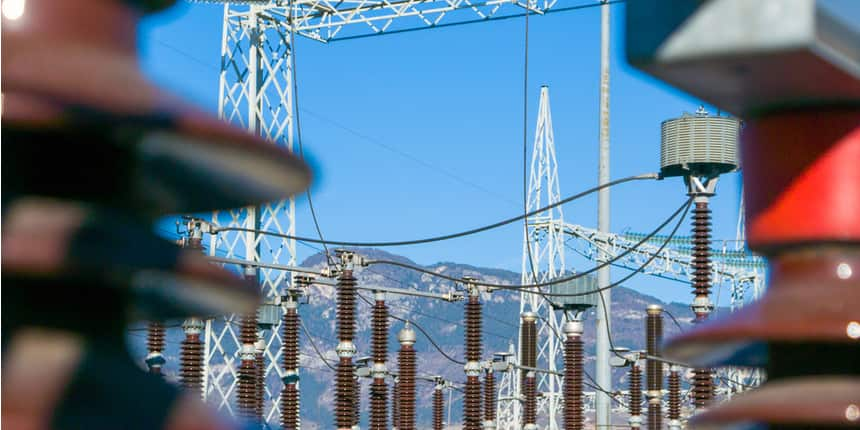
In this undergraduate engineering course, students are familiarised with the concept of a power system, its control, and management. It also offers specialisation in subjects like energy conservation, sustainable development, and renewable energy engineering. Power system engineering is the section of electrical engineering that gives students knowledge about power systems and their applications.
Course Name | B Tech in Power System Engineering |
Type of Course | Bachelor Degree |
Eligibility | 10+2 with science stream |
Admission Process | Entrance test |
Duration | Four years |
Examination Type | Semester System |
Average fees for the entire duration | Rs. 3 LPA |
Average Salary | Rs. 4 LPA |
Job profiles | Power Electronics Engineer, Electrical Project Engineer, Test Engineer, Design Engineer, Safety Officer, Power Technician, Electrical Engineer, and Circuits Engineer |
Top recruiters | Fire Departments, Fire Equipment and Manufacturers, Consulting Engineering Firms, Government Sector, Research & Laboratories, Hospitals and Health Care Centers, Insurance firms, Universities & Colleges |
Candidates must hold the following credentials to be eligible for B Tech Power System Engineering. The B Tech Power System Engineering eligibility criteria might slightly differ from college to college. Some B Tech Power System Engineering colleges also provide students with scholarships.
There are different ways to get admission in universities as some of the universities conduct entrance exams, while a few select direct admission as their primary admission process. Every top institute conducts an entrance exam for admission to their colleges. Therefore, to pursue a B Tech Power System Engineering course in top institutes in India, candidates need to qualify for their respective entrance exams.
Admission Process for BTech Power System Engineering
Candidates who have qualified for the entrance exams are required to submit essential documents to get admission to colleges that offer B Tech in Power System Engineering. The following is the procedure for admission to top colleges.
Candidates need to qualify for the engineering entrance exams that are conducted all over in India in order to study in the best institute of India. Mentioned below are the top engineering entrance exams for the power system engineering course.
Exam Name | Conducting Body | Exam Schedule |
|---|---|---|
National Testing Agency | ||
Indian Institute of Technology Bombay | ||
Birla Institute of Technology and Science | ||
Vellore Institute of Technology |
A cut-off score for a B Tech Power System Engineering course is a set of criteria used to assess a student's merit or test performance. The qualifying tests and the number of applicants who take the entrance exam, which varies per institution, decide the B Tech Power System Engineering course cutoff.
Candidates pursuing B Tech Power System Engineering must possess few skills to get the utmost knowledge of their B Tech Power System Engineering studies. The candidates must possess essential skills which help the candidates to build their careers easily. Students with a B Tech Power System Engineering will need the following skill sets to advance in the chosen field of engineering.
Communication Skills | Power Techniques |
Technical Skills | Maths Skills |
Organising Skills | Knowledge of Circuits |
Motivational Skills | Leadership Skills |
B Tech Power System Engineering subjects and syllabus is divided into four years and eight semesters. The subjects will differ from one college to another. The below syllabus is taken from the University School of Engineering and Technology, Delhi.
Semester 1 | |
Applied Physics Lab | |
Applied Physics | Electrical Technology Lab |
Manufacturing Processes | Engineering Graphics Lab |
Electrical Technology | |
Human Values and Professional Ethics | Fundamentals of Computing |
Semester 2 | |
Introduction to Programming | |
Electronic Devices | Engineering Mechanics |
Communication Skills | Environmental Studies |
Programming Lab | Electronic Devices Lab |
Engineering Mechanics Lab | Environmental Studies Lab |
Semester 3 | |
Material Science and Metallurgy | Circuits and Systems |
Thermodynamics for Power Engineers | Analog Electronics |
Strength of Materials and Theory of Machine | Electrical Machines |
Thermodynamics for Power Engineers Lab | Strength of Materials and Theory of Machines Lab. |
Analog Electronics Lab | Electrical Machines Lab |
Semester 4 | |
Power Generation Engineering | Energy Conversion |
Heat and Mass Transfer | Fluid Mechanics |
Switching Theory and Logic Design | Control Systems |
Fluid Mechanics Lab | Heat and Mass Transfer Lab |
Semester 5 | |
Communication Skills for Professionals | Steam Generator and Its Auxiliaries |
Steam Turbine and Its Auxiliaries | Electrical Generator and Auxiliaries |
Refrigeration and Air Conditioning | Industrial Management |
Communication Skills for Professionals Lab | Practical Training/In-house Training |
Semester 6 | |
Load Dispatch and Electricity Regulations | Power Plant Commissioning |
Power Plant Control and Instrumentation | Power System, Transmission and Distribution |
I. C. Engines and Gas Dynamics | Machine Design |
Rotational On-Job Training | Power Electronics and Electric Drives Lab |
Semester 7 | |
Power Plant Operation | Renewable Energy Resources |
Power Plant Performance and Efficiency | Power System Protection and Switchgear |
Information Technology and its Applications | Rotor Dynamics |
Sociology and Elements of Indian History for Engineers | Finite Element Methods |
Semester 8 | |
Human Values and Professional Ethics-II | Environmental Management |
Microprocessor and Microcontroller | Mechanical Vibrations |
Power System Analysis and Stability | Robotics |
Data Communication and Networks | Cryogenic Engineering |
Total Quality Management | High Voltage AC and DC Technology |
In India, there are numerous colleges that provide B Tech Power System Engineering courses. The course fees in B Tech Power System Engineering colleges range between Rs 2 lakhs to 5 Lakhs. The fee structures for the top B Tech Power System Engineering colleges may depend on all other factors like the intake of students, the course they choose, and the rank scored in the entrance exam.
A B Tech Power System Engineering opens up a variety of job opportunities. All of the topics required for a bachelor's degree are covered in the courses. The subjects covered in the course are the same as those covered in the 10+2 class. Students who choose this course must have a knowledge of electrical systems and the responsibilities of an electrical systems engineer. The power systems engineer supervises his team's work and ensures that the power plant runs efficiently. There are also power applications engineers who are in charge of establishing power applications in the plant.
After earning a B Tech Power System Engineering degree, candidates are most likely to work in a power system laboratory or at a power business plant. Although he or she will work on a regular or weekly basis.
In today's world, every country is looking for new sources of energy, so this is one of the most important sectors for them. As the Indian population has grown at a great rate, natural resources have been severely becoming less in India. Entrepreneurs have already begun to heavily invest in this business in order to reduce future power depletion. Government bodies are waiting for highly qualified and skilled power system engineers who will be responsible for resolving the country's power crisis. Here, are a few job profiles mentioned below:
Power Electronics Engineer: Power Electronics Engineer is responsible for designing, and developing power and controls electronic equipment. He or she will work with circuits and other electronic equipment, components, or systems.
Power Engineer: Power engineers are in charge of the safe and efficient operation and maintenance of industrial power-generating equipment. Equipment include boilers, steam and gas turbines, generators, gas and diesel internal combustion engines, pumps, condensers, compressors, pressure vessels, and associated controls.
Test Engineer: Test Engineers are responsible for extensively inspecting materials, methods, and mechanical or electrical systems to ensure that customers receive high-quality, working goods. They perform tests on various components and features to discover and resolve technological faults.
Power Plant Operations Engineer: A power plant operations engineer is in charge of the day-to-day operations of a power plant. Their primary responsibilities include conducting operational tests, performing preventative maintenance on machines, inspecting thermal systems, and collaborating with other plant personnel.
Power Application Engineer: A Power Application engineer is in charge of power plants and contributes to the execution of many projects involving extensive technical studies of electrical power systems, including power flow, short circuits, protection, stability, switching, and renewable integration, among other things.
Top Recruiters for BTech Power System Engineering Graduates:
Colleges and Universities | Research and Development |
IBM India Pvt. Ltd. | IT Companies |
GE India Technology Pvt. Ltd. | Infosys |
Oracle India Pvt. Ltd. | Wipro |
Candidates interested in working power industry will benefit greatly from a B Tech graduates. Engineers keep an eye on the quality and dependability of electrical systems. Graduates of this programme can also pursue employment in management or technical positions in industry or public utilities. Schedule flexibility is an advantage for BTech Power System Engineering students. Online programmes provide students with greater flexibility than on-campus programmes. They can fit in classwork on weekends or during breaks. However, he or she must be aware of the exam date and deadlines. Candidates can work in both private and public organisations.
The remuneration in the power sector depends upon the capabilities of the individual and their tenure in that company. The job profile is also a component as salary alters for each job profile. Experience and proficiency in their subdomain are key for engineers to gain a lucrative salary. Stated below are some salary figures for a few job profiles.
| Job Position | Average Salary |
|---|---|
Power Electronics Engineer | Rs 4.5 lakh p.a. (approx) |
Power Engineer | Rs 5 lakh p.a. (approx) |
Test Engineer | Rs 4.1 lakh p.a. (approx) |
Power Distribution System Engineer | Rs 4.5 lakh p.a. (approx) |
Power Plant Operations Engineer | Rs 5.3 lakh p.a. (approx) |
Choosing a good college that offers B.Tech in power system engineering is very difficult, however, it is also the most important step in the career of a student. Mentioned below is a list of top institutes for this engineering B Tech Power System Engineering course.
There are only a few colleges offering B Tech Power System Engineering courses across India. The fees in private colleges are more than in public colleges. The college fees may vary from institute to institute. These colleges also provide placement assistance to students at top companies.
There are only a few government colleges offering admission to B Tech courses, with various specialisations. The tuition fee for government colleges is comparatively less than for private colleges. The students from government colleges will have the benefit of getting scholarships from the government and other charity funds.
Frequently Asked Questions (FAQs)
It involves the study of distribution, transmission, and generation of electric power connected to systems such as generators, transformers, and motors.
There are excellent career opportunities in this field with the right qualifications and training
. Electrical designers are tasked with using their knowledge and skills to design circuit layouts to ensure the accurate distribution and flow of electricity.
Some of the few colleges which are best for studying power system engineering -
1. IIT Bombay
2. IIT Kharagpur
3. IIT Delhi
4. IIT Warangal
5. NIT Trichy, Warangal, Calicut
Hope this answer helps !
Graduates having a degree of B.Tech in Power System Engineering work in sectors such as power generation, energy sustainability, developing new ways to produce renewable energy.
The syllabus for JEE (Main & Advanced) and other entrance tests is nearly the same. Thus, there is not much difference in these entrance tests.


Recognized as Category-1 Deemed to be University by UGC | 41,000 + Alumni Imprints Globally | Students from over 20+ countries
100+ Recruiters | 1200+ Placements of 2026 Batch | NBA & NAAC Accredited | Highest CTC 37 LPA
NAAC A++ Grade | Recognized as Category-1 Deemed to be University by UGC | 41,000 + Alumni Imprints Globally
Apply for B.E at East Point College of Engineering and Technology | Affiliated to VTU | AICTE Approved | NBA Accredited | Highest CTC 33 LPA
NAAC A+ Accredited | Highest CTC 45 LPA | Scholarships Available
6 Lakh+ CUET Registrations | 500+ Companies Visited for Placement Top Recruiters: Apple Inc., Amazon, IBM, CISCO, Meta, Microsoft, Google