
Search Colleges, Exams, Schools & more


Login
SNAP 2026 Quantitative Ability requires a smart combination of topic prioritisation, calculation speed and accuracy. With the SNAP exam scheduled for December 13, 19 and 26, 2026, candidates should focus on important areas such as arithmetic, algebra, number system, geometry and data interpretation while learning shortcuts to solve numerical questions faster. This article covers the most-asked topics based on previous-year memory-based papers, their preparation priority and practical speed tricks to help candidates prepare effectively for SNAP 2026.

Explore MBA scholarship opportunities across India’s top B-schools. Scholarships - Top 100 B-Schools in India
SNAP Free Mock Test: Attempt a free SNAP mock test to evaluate your readiness and improve speed and accuracy before the exam.
SNAP 2026 Quantitative Ability: Most-Asked Topics and Weightage
The Quantitative Ability, Data Interpretation and Data Sufficiency section contains 20 questions. SNAP does not publish a guaranteed topic-wise weightage, so use previous-year memory-based questions to guide your preparation rather than treating predicted counts as official.
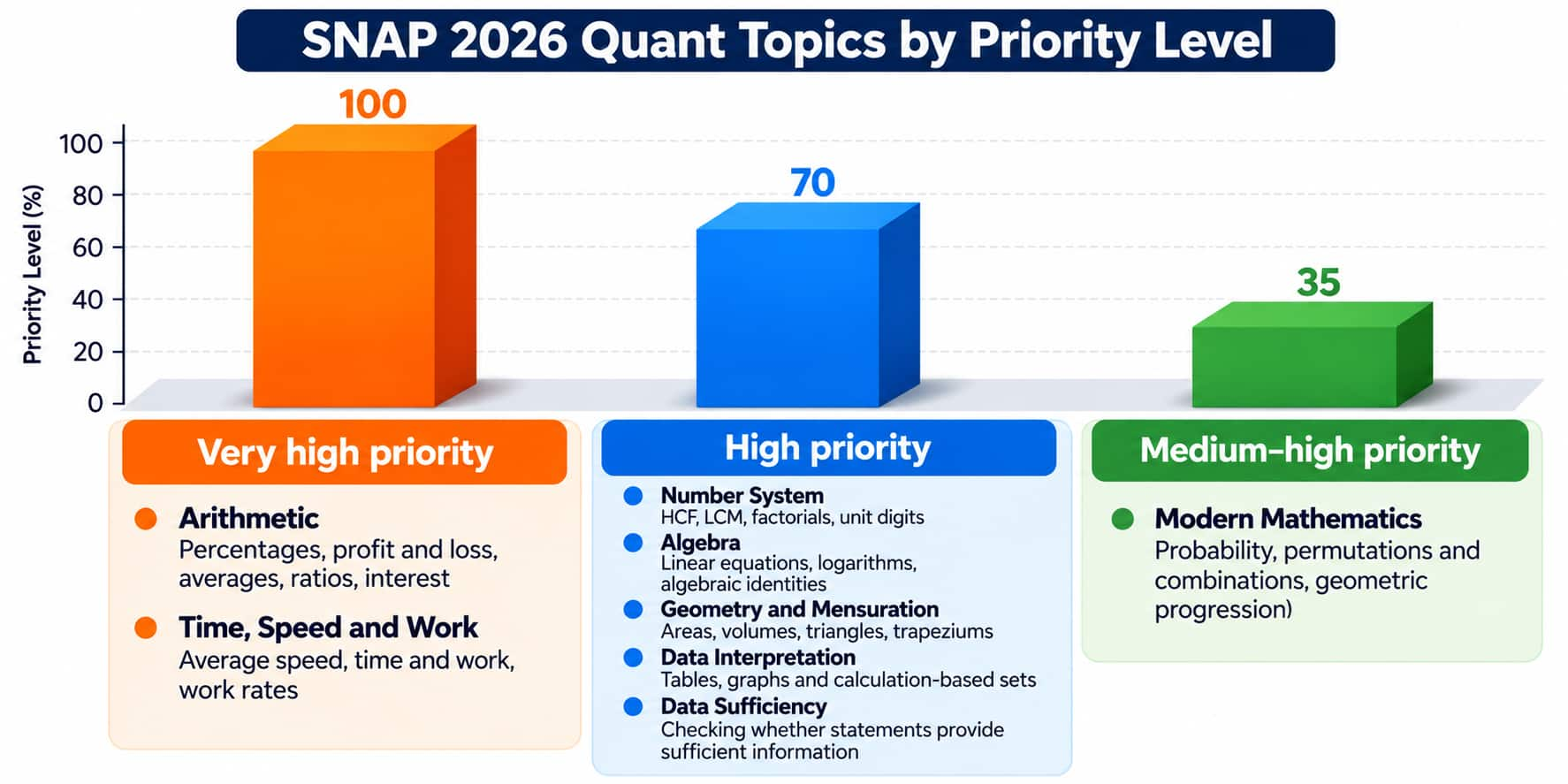
SNAP 2026 Quantitative Ability: Important Topics
SNAP 2026 Quantitative Ability covers numerical concepts, mathematical reasoning and data-based questions. Candidates should revise the following topics and their key subtopics for comprehensive preparation.
Quant topic | Important subtopics to prepare |
Arithmetic | Percentages, profit and loss, ratios and proportions, averages, simple interest and compound interest |
Time, Speed and Work | Time and work, pipes and cisterns, time, speed, distance, trains, average speed |
Number System | HCF, LCM, divisibility, remainders, factorials, unit digits |
Algebra | Linear equations, quadratic equations, algebraic identities, logarithms |
Geometry | Triangles, circles, angles, quadrilaterals, basic geometric properties |
Mensuration | Areas, perimeters, surface areas and volumes |
Modern Mathematics | Probability, permutations and combinations, sequences and geometric progression |
Data Interpretation (DI) | Tables, bar graphs, pie charts, line graphs and percentage-based calculations |
Data Sufficiency (DS) | Evaluating whether one or more statements provide sufficient information |
Candidates should practise these topics through a mix of formula-based questions, multi-step calculations and timed exercises to improve speed and accuracy for SNAP 2026.
SNAP Quantitative Ability: Question Types to Practise
SNAP Previous-year questions from memory-based papers of 2023, 2024 and 2025 include several useful question patterns. Practise these formats without assuming the same questions will appear in 2026.
Question pattern | Topic |
Profit after a change in an item's price | Profit and loss |
Average speed across equal distances | Time, speed and distance |
Finding numbers using HCF and LCM | Number System |
Unit digit of a factorial expression | Number System |
Probability involving dice | Probability |
Solving simultaneous equations | Algebra |
Simplifying logarithmic expressions | Algebra |
Finding the area of a trapezium | Mensuration |
Reading numerical values from a graph | Data Interpretation |
Correcting an average after a recording error | Averages |
SNAP 2026 Quantitative Ability: 5 Speed Tricks
These methods reduce calculation steps or help you reach an answer faster. Practise each one with different values so you know when it applies.
1. Successive Percentage Changes: Use the Net Change Formula
Instead of applying two percentage changes one after another, use:
Netchange=a+b+ab100
Treat an increase as positive and a decrease as negative.
Example: An item's price increases by 20% and then decreases by 10%.
20+(-10)+20(-10)100=8%
Answer: The final price is 8% higher than the original price.
This shortcut avoids calculating the intermediate price. It works for successive percentage changes when the signs of increases and decreases are handled correctly.
2. Equal-Distance Average Speed: Use the Product-Sum Formula
For two journeys covering equal distances at speeds a and b:
Averagespeed=2aba+b
Example: A vehicle travels equal distances at 40 km/h and 60 km/h.
2406040+60=48km/h
Answer: 48 km/h.
Do not take the simple average of 40 and 60. This shortcut applies to equal distances, not automatically to equal travel times.
3. Average Correction: Adjust Only the Difference
When one value is recorded incorrectly, you do not need to recalculate the entire average.
Correctaverage=Originalaverage+Correctvalue-Recordedvaluen
Here, n is the number of observations.
Example: The average of 20 students' scores is 45. A score of 35 was recorded instead of 55.
Correctaverage=45+55-3520=46
Answer: 46.
The shortcut works because changing one observation changes the total by exactly the difference between the two values.
4. HCF and LCM: Find the Product Directly
For two positive integers a and b:
Example: The HCF of two numbers is 8 and their LCM is 120.
ab=8120=960
Answer: The product of the numbers is 960.
This immediately gives the product when the question asks for it. If the question asks for the individual numbers, you will need the additional conditions provided.
5. Quadratic Equations: Use the Sum and Product of Roots
For a quadratic equation:
ax2+bx+c=0
The sum and product of its roots are:
+=-ba,=ca
Example: For x2-7x+12=0:
+=7,=12
The two numbers that add to 7 and multiply to 12 are 3 and 4.
Answer: The roots are 3 and 4.
This helps identify roots quickly when the factors are simple, without using the full quadratic formula.
SNAP 2026 Quantitative Ability: How to Practise These Tricks?
Below is the practice flow to use these tricks in your preparation:
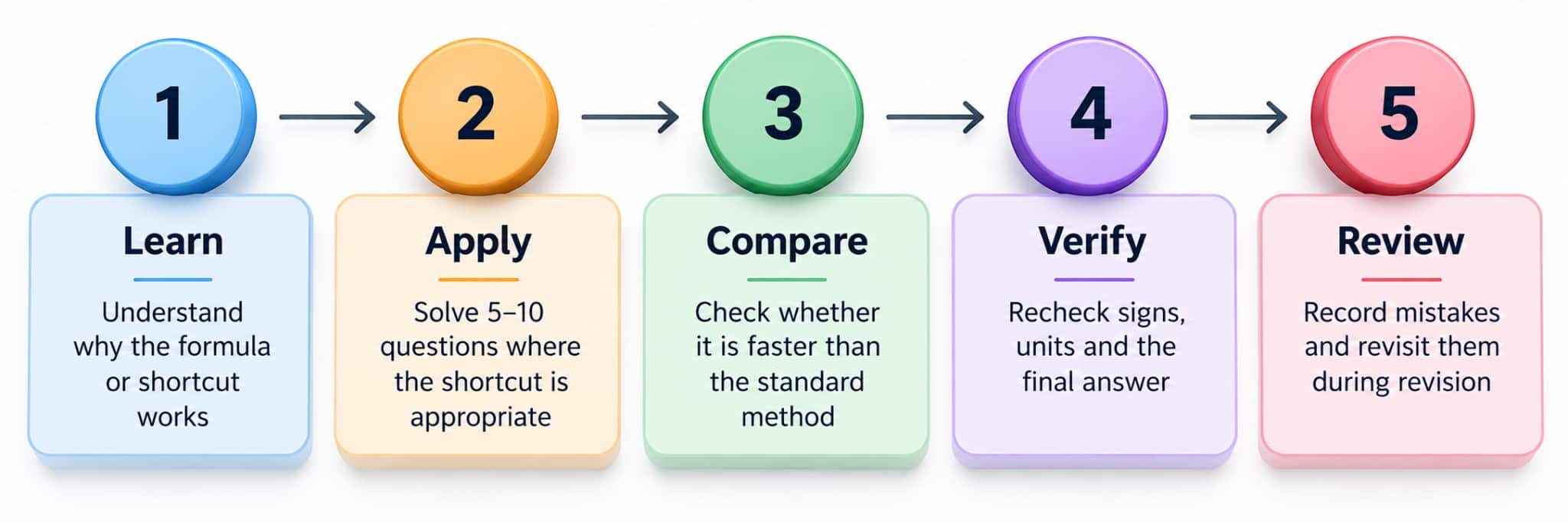
With approximately eight weeks remaining before the first test, practise these shortcuts alongside topic-wise questions and timed mixed sets. The aim is not to use a trick for every question, but to recognise when it offers a faster and reliable solution.
SNAP 2026 Quantitative Ability: Questions to Practise Before the Exam
Practise these original SNAP-level questions based on important Quantitative Ability topics. The questions are designed to test calculation speed, concept clarity and shortcut application.
Question 1: Percentages
The price of a product is increased by 25%. By what percentage must the increased price be reduced to bring it back to its original price?
A. 15%
B. 20%
C. 25%
D. 30%
Question 2: Profit and Loss
A shopkeeper marks an article 40% above its cost price and offers a discount of 15% on the marked price. What is his profit percentage?
A. 15%
B. 17%
C. 19%
D. 21%
Question 3: Averages
The average age of 15 students is 18 years. When a teacher joins the group, the average age becomes 20 years. What is the teacher's age?
A. 40 years
B. 45 years
C. 50 years
D. 55 years
Question 4: HCF and LCM
The HCF and LCM of two positive integers are 8 and 240, respectively. If one integer is 40, find the other integer.
A. 42
B. 48
C. 56
D. 60
Question 5: Algebra
If x-1x=3, where x0, find x2+1x2.
A. 7
B. 9
C. 11
D. 13
Question 6: Probability
Two fair dice are rolled simultaneously. What is the probability that the sum of the numbers obtained is either 7 or 11?
A. 16
B. 29
C. 518
D. 13
Question 7: Time and Work
A can complete a job in 15 days, while B can complete it in 10 days. They work together for 3 days, after which A leaves. How many additional days will B need to finish the remaining work?
A. 3 days
B. 4 days
C. 5 days
D. 6 days
Question 8: Geometry and Mensuration
The length of a rectangle is increased by 20%, while its breadth is decreased by 10%. What is the percentage change in its area?
A. 8% increase
B. 8% decrease
C. 10% increase
D. 10% decrease
Answer Key with Quick Solutions
1. B. 20%
Assume the original price is ₹100. The increased price is ₹125. The reduction required is ₹25, which is
2. B. 19%
Assume the cost price is ₹100. The marked price is ₹140, and the selling price after a 15% discount is ₹119. Profit = 19%.
3. C. 50 years
Total age of students = 1518=270. Total age of 16 people = 1620=320. Teacher's age = 320-270=50.
4. B. 48
Product of the integers = HCF × LCM = 8240=1920. The other integer is 1920/40=48.
5. C. 11
Squaring the expression gives x2-2+1x2=9. Therefore, x2+1x2=11.
6. B. 29.
Sum 7 has 6 outcomes and sum 11 has 2 outcomes. Probability = (6+2)/36=2/9.
7. C. 5 days
Combined work rate = 1/15+1/10=1/6. In 3 days, they complete half the work. B completes the remaining half in 0.5(1/10)=5 days.
8. A. 8% increase
New area multiplier = 1.200.90=1.08. Therefore, the area increases by 8%.
SNAP 2026 ebooks
Explore SNAP 2026 ebooks and question papers to revise Ethics, Morality & Values, practise Quant and DI questions, analyse mock tests, and understand past exam patterns.
SNAP 2026: Ethics, Morality & Values Notes | |
SNAP 2026: Best 50 Questions Quantitative, Data Interpretation & Data Sufficiency | |
SNAP 2026 Mock Test Analysis PDF | |
SNAP 2025 Question Paper with Solutions | |
SNAP Past 5 Years Question Papers (2021-2025) |
Industry and Sector-Focused MBA Specialisations - Free eBooks
MBA Specialisation | What the eBook Covers | Download eBook |
|---|---|---|
Healthcare & Hospital Management | Colleges, rankings, fees, salary and careers | |
Pharmaceutical Management | Pharma MBA colleges, rankings, fees, placements and career options | |
Supply Chain & Logistics | Colleges, rankings, fees, salary and careers | |
Retail Management | Colleges, rankings, fees, placements and career options | |
Insurance & Banking | Colleges, rankings, fees, placements and career opportunities | |
Aviation Management | Colleges, rankings, fees, placements and career paths | |
Travel & Tourism | Colleges, rankings, fees, placements and career opportunities |
Frequently Asked Questions (FAQs)
Q: Which topics should I prioritise for SNAP 2026 Quantitative Ability?
A:
Start with arithmetic, time and work, speed and distance, Number System and Algebra. Also practise geometry, Modern Mathematics, Data Interpretation and Data Sufficiency.
Q: Is official topic-wise weightage available for SNAP 2026?
A:
No guaranteed topic-wise question distribution is provided here. The priorities in this article are preparation recommendations based on recurring question styles in previous-year memory-based papers.
Q: Which speed tricks are useful for SNAP Quantitative Ability?
A:
Successive percentage changes, equal-distance average speed, average correction, the HCF-LCM relationship and quadratic root relationships can reduce calculation steps when applied under the right conditions.
Q: Are speed tricks enough to score well?
A:
No. Shortcuts work only when you understand the underlying concept. Combine them with formula revision, question practice and timed mock tests.
Q: How can candidates improve accuracy in SNAP Quantitative Ability?
A:
Candidates can improve accuracy by revising formulas, practising topic-wise questions, checking calculations and analysing mistakes in mock tests. Avoid rushing through familiar questions, and verify signs, units and percentage changes before selecting an answer.
Articles
Related Stories
|
Upcoming Mba Exams

Certifications By Top Providers
Explore Top Universities Across Globe
Popular Courses and Specializations
List of colleges accepting SNAP
Browse Mba Colleges by State
Questions related to SNAP
On Question asked by student community
Have a question related to SNAP ?
You can find all the information here:
CAT- https://www.careers360.com/mba/articles/cat-exam-dates
SNAP- https://www.careers360.com/mba/articles/snap-exam-dates
Hi Student
Getting 70 percentile in the SNAP examination is well within the range of SSBF Pune. You can register and apply for admission to the college. Click on the link below to learn more about the admission process, dates, fees, etc.
Hello candidate,
SIBM Pune over the years has been known for its holistic development of students . SIBM Pune courses include MBA, MBA Executive and MBA Innovation and Entrepreneurship programmes in various specialisations.
Symbiosis Centre for Management and Human Resource Development, Pune was established in 1993. Admission to SCMHRD Pune
Yes, you can definitely prepare better for the SNAP Quantitative Ability section by keeping a complete formula list with you. Instead of memorising everything randomly, it helps to organise formulas chapter-wise so you can revise faster.
Here is a useful formula list for the SNAP Quant section:
1. Arithmetic
•
Hi there,
You have to apply separately for each symbiosis college, like SIBM Pune, as they as not automatically included. The CAT form automatically includes many IIMs, but the SNAP exam is a separate test that is given for admission to Symbiosis Institute, which requires its own separate application and

Applications for Admissions are open.
Globally Recognized by AACSB (US) & AMBA (UK) | 18 LPA Avg. CTC for PGPM 2026
XAT
Apply75+ years of legacy | #1 Entrance Exam | Score accepted by 250+ BSchools
IBSAT
ApplyGateway to IBS Hyderabad & 8 other IBS campuses | Scholarships worth 10 CR
K J Somaiya Institute of Management, Mumbai
ApplyHighest Package 29.30 LPA | 12 LPA Median CTC | 230+ Recruiters | AACSB Accredited | Ranked 51 in Asia by QS International
ISBR Business School, Bangalore
ApplyEarly Application Round Deadline: 27th Oct’26 | 400+ Recruiters | Highest CTC 17.2 LPA | Average CTC 8 LPA | 92% Avg. Placements | Ranked as Platinum Institute | Awarded Best Business School of the Year
IMI, Delhi
ApplyLast Date to Apply - 19th December 2026 | Highest CTC 68.66 LPA | Average CTC 18.08 LPA | Top 25% Average CTC 24.66 LPA
SNAP Notifications
Never miss SNAP update
Get timely SNAP updates directly to your inbox. Stay informed!