Symbiosis Institute of Business Management, Noida
1 Exam accepted by 17 Top Symbiosis Institutes for 32 MBA programmes.


The SNAP 2026 exam requires candidates to solve different types of Logical Reasoning questions within a limited time. This section tests skills such as identifying patterns, understanding relationships, interpreting statements, and solving puzzles. Topics like coding-decoding, number series, blood relations, seating arrangements, and syllogisms are useful to include in your preparation.
This Story also Contains
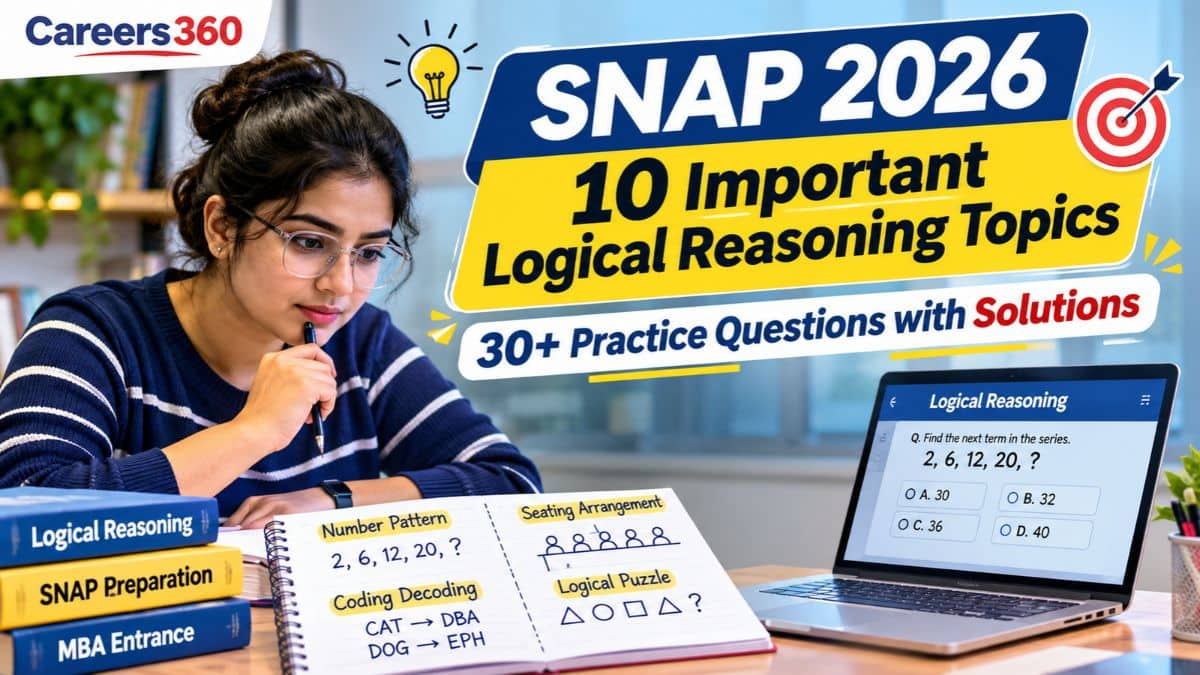
The SNAP 2026 exam will be conducted on December 13, 19, and 26, 2026, giving candidates three test dates to choose from. This article covers 10 important Logical Reasoning topics, with thirty practice questions for each topic, along with solutions and answers. You will also find preparation tips to help you improve your speed, avoid common mistakes, and prepare more effectively for the SNAP 2026 exam.
The Logical Reasoning section of SNAP 2026 tests a candidate's ability to analyse information, identify patterns, solve puzzles, and draw logical conclusions. Questions can cover topics such as coding-decoding, blood relations, seating arrangements, series, syllogisms, and statement-based reasoning.
Particulars | Details |
Exam | SNAP 2026 |
Section | Analytical and Logical Reasoning |
Number of questions | 20 |
Total marks | 20 |
Marks per correct answer | +1 |
Negative marking | −0.25 for each incorrect answer |
Total exam duration | 60 minutes |
Section-wise time limit | No separate fixed time limit specified |
Question format | Objective-type questions with four options |
Logical Reasoning is an important part of the SNAP exam pattern. It tests a candidate's ability to identify patterns, interpret information, understand relationships, and draw logical conclusions. Questions can range from simple coding-decoding and number series to seating arrangements and multi-condition puzzles.
Practising different SNAP question types helps candidates recognise familiar patterns and solve problems faster. The following sections cover 10 important Logical Reasoning topics, with three practice questions for each topic, along with step-by-step solutions and answers.
Coding-decoding questions test your ability to identify a rule used to transform letters, words, or numbers into a code. Common patterns include alphabet shifting, reverse alphabet coding, and numerical values assigned to letters.
Question 1: If CAT is coded as DBU, how will DOG be coded using the same rule?
A. EPH
B. EOG
C. FPH
D. EPG
Solution: Each letter is shifted one position forward in the alphabet.
D → E
O → P
G → H
Answer: A. EPH
Question 2: If BOOK is coded as 2-15-15-11, how will PEN be coded?
A. 16-5-14
B. 15-5-14
C. 16-6-14
D. 16-5-13
Solution: Each letter is represented by its position in the English alphabet. P = 16, E = 5, and N = 14.
Answer: A. 16-5-14
Question 3: In a certain code, TABLE is written as ELBAT. How will CHAIR be written?
A. RIAHC
B. RIHAC
C. RAIHC
D. HCAIR
Solution: The word is written in reverse order. Reversing CHAIR gives RIAHC.
Answer: A. RIAHC
Series questions require candidates to identify a relationship between consecutive numbers or letters. The Series Pattern may involve addition, subtraction, multiplication, squares, cubes, or alternate sequences.
Question 1: Find the missing number: 3, 8, 15, 24, 35, ?
A. 46
B. 48
C. 49
D. 50
Solution: The differences are +5, +7, +9, and +11. The next difference is +13.
35 + 13 = 48.
Answer: B. 48
Question 2: Find the missing term: A, C, F, J, O, ?
A. T
B. U
C. V
D. W
Solution: The letters advance by +2, +3, +4, and +5 positions. The next jump is +6. O + 6 positions = U.
Answer: B. U
Question 3: Find the missing number: 2, 6, 18, 54, ?
A. 108
B. 126
C. 162
D. 216
Solution: Each term is multiplied by 3. Therefore, 54 × 3 = 162.
Answer: C. 162
Question 4: Find the missing term:
2, 6, 15, 31, 56, __?
A. 81
B. 92
C. 96
D. 101
Answer: B. 92.
Solution: The differences between the terms are perfect squares:
6 − 2 = 4 (2²)
15 − 6 = 9 (3²)
31 − 15 = 16 (4²)
56 − 31 = 25 (5²)
Next difference = 36 (6²), so 56 + 36 = 92
Blood relation questions test your understanding of family relationships. They may involve multiple generations, coded relationships, or identifying how one person is related to another.
Question 1: A is the brother of B. B is the mother of C. How is A related to C?
A. Father
B. Maternal uncle
C. Brother
D. Grandfather
Solution: B is C's mother, and A is B's brother. Therefore, A is C's maternal uncle.
Answer: B. Maternal uncle
Question 2: Pointing to a woman, Ravi says, "She is the daughter of my mother's only son." How is the woman related to Ravi?
A. Sister
B. Daughter
C. Niece
D. Cousin
Solution: Ravi's mother's only son is Ravi himself. His daughter is therefore the woman being described.
Answer: B. Daughter
Question 3: P is the father of Q. Q is the sister of R. How is P related to R?
A. Uncle
B. Brother
C. Father
D. Grandfather
Solution: Q and R are siblings. Since P is Q's father, he is also R's father.
Answer: C. Father
Question 4: Pointing to a man, Leena says, "He is the brother of the only daughter of my maternal grandmother."
How is the man related to Leena?
A. Cousin
B. Brother
C. Grandfather
D. Maternal uncle
Answer: D. Maternal uncle
Solution: Leena’s maternal grandmother is her mother’s mother.
Direction sense questions involve movement, turns, and distances. Candidates must track a person's position and determine the final direction or distance from the starting point.
Question 1: A person walks 5 km north, then 3 km east. In which direction is the person from the starting point?
A. North-west
B. North-east
C. South-east
D. South-west
Solution: The person moves north and then east. The final position is diagonally north-east of the starting point.
Answer: B. North-east
Question 2: Riya faces north. She turns right, then right again. Which direction is she facing now?
A. North
B. South
C. East
D. West
Solution: From north, the first right turn leads to east. The second right turn leads to south.
Answer: B. South
Question 3: A man walks 8 km east and then 6 km south. How far is he from his starting point?
A. 10 km
B. 12 km
C. 14 km
D. 16 km
Solution: The movements form a right-angled triangle. Using the Pythagorean theorem:
Distance = √(8² + 6²) = √100 = 10 km.
Answer: A. 10 km
Seating arrangement questions require candidates to arrange people according to given conditions. These questions may involve linear rows, circular arrangements, or positions relative to other people.
Question 1: Five people, A, B, C, D, and E, sit in a row facing north. A sits at the extreme left, B sits immediately to the right of A, and E sits at the extreme right. C sits immediately to the left of E. Who sits in the middle?
A. A
B. B
C. C
D. D
Solution: The arrangement is A – B – D – C – E. The third position is occupied by D.
Answer: D. D
Question 2: Four people P, Q, R, and S sit in a row facing north. P sits to the left of Q, R sits to the right of Q, and S sits to the right of R. Who sits at the extreme right?
A. P
B. Q
C. R
D. S
Solution: The order is P – Q – R – S. Therefore, S occupies the extreme right.
Answer: D. S
Question 3: Six people sit in a row facing north. M sits third from the left, and N sits immediately to the right of M. What is N's position from the left?
A. Second
B. Third
C. Fourth
D. Fifth
Solution: M occupies the third position. N sits immediately to M's right, so N occupies the fourth position.
Answer: C. Fourth
Syllogism questions present statements followed by conclusions. Candidates must determine which conclusions logically follow from the statements without using outside information.
Question 1: Statements:
All roses are flowers.
All flowers are plants.
Conclusions:
I. All roses are plants.
II. All plants are roses.
A. Only I follows
B. Only II follows
C. Both follow
D. Neither follows
Solution: Since all roses are flowers and all flowers are plants, all roses must be plants. However, the statements do not establish that all plants are roses.
Answer: A. Only I follows
Question 2: Statements:
Some books are novels.
All novels are interesting.
Conclusions:
I. Some books are interesting.
II. All books are interesting.
A. Only I follows
B. Only II follows
C. Both follow
D. Neither follows
Solution: The books that are novels must be interesting. Therefore, some books are interesting. There is no information proving that every book is interesting.
Answer: A. Only I follows
Question 3: Statements:
No cats are dogs.
Some pets are cats.
Conclusions:
I. Some pets are not dogs.
II. No pets are dogs.
A. Only I follows
B. Only II follows
C. Both follow
D. Neither follows
Solution: The pets that are cats cannot be dogs. Hence, some pets are not dogs. The statements do not establish that no pet can be a dog.
Answer: A. Only I follows
Question 4: Statements:
All poets are imaginative.
Some imaginative people are engineers.
No engineer is careless.
All careless people are impatient.
Conclusions:
I. Some imaginative people are not careless.
II. No poet is careless.
III. Some engineers are not careless.
Which conclusions necessarily follow?
A. Only I
B. Only II
C. Only I and III
Answer: C. Only I and III.
Solution:
Conclusion I – Some imaginative people are not careless: Follows
Some imaginative people are engineers.
No engineer is careless.
So the imaginative people who are engineers cannot be careless. This means at least some imaginative people are not careless.
Conclusion II – No poet is careless: Does not follow
All poets are imaginative, but the statements never link poets to engineers or to careless people.
A poet may or may not be careless, so we cannot say “no poet is careless” for sure.
Conclusion III – Some engineers are not careless: Follows
“No engineer is careless” means every engineer is not careless.
If all engineers are not careless, then some engineers are also not careless. (When “No A is B” is true, “Some A are not B” is always true.)
The statement “All careless people are impatient” plays no part in any of these conclusions. It is only there to confuse.
So only Conclusions I and III follow.
Analogy questions ask candidates to identify a relationship between two words, numbers, or letters and apply the same relationship to another pair. Classification questions require identifying the item that does not belong to a group.
Question 1: Book is to Read as Food is to:
A. Cook
B. Eat
C. Buy
D. Serve
Solution: A book is read, while food is eaten. Both pairs represent an object and its primary activity.
Answer: B. Eat
Question 2: Find the odd one out.
A. Square
B. Triangle
C. Circle
D. Rectangle
Solution: A square, triangle, and rectangle have straight sides and vertices. A circle has no straight sides or vertices.
Answer: C. Circle
Question 3: 4 : 16 :: 7 : ?
A. 21
B. 28
C. 42
D. 49
Solution: The second number is the square of the first number. Since 4² = 16, the corresponding number is 7² = 49.
Answer: D. 49
Clock questions test concepts such as the angle between the hands of a clock. Calendar questions involve days, dates, leap years, and the number of odd days in a given period.
Question 1: What is the angle between the hour hand and the minute hand at 3:00?
A. 60°
B. 90°
C. 120°
D. 180°
Solution: At 3:00, the minute hand points at 12 and the hour hand points at 3. Each hour mark represents 30°.
Angle = 3 × 30° = 90°.
Answer: B. 90°
Question 2: If today is Monday, what day will it be after 10 days?
A. Wednesday
B. Thursday
C. Friday
D. Saturday
Solution: Ten days contain one complete week and three additional days. Three days after Monday is Thursday.
Answer: B. Thursday
Question 3: How many days are there in a leap year?
A. 364
B. 365
C. 366
D. 367
Solution: A leap year has 366 days, including 29 days in February.
Answer: C. 366
Statement-based reasoning tests the ability to interpret information and assess conclusions, assumptions, causes, and effects. The answer must be based on the information provided rather than personal beliefs.
Question 1: Statement: The city administration has introduced additional buses during peak hours to reduce overcrowding.
Which assumption is most reasonable?
A. All passengers prefer buses.
B. Overcrowding is partly caused by high passenger demand during peak hours.
C. Private vehicles are no longer allowed.
D. Every bus is overcrowded throughout the day.
Solution: Adding buses during peak hours is intended to handle higher passenger demand. The statement does not support the other assumptions.
Answer: B. Overcrowding is partly caused by high passenger demand during peak hours.
Question 2: Statement: A company has introduced work-from-home options to reduce office operating costs.
Which conclusion is most reasonable?
A. The company wants to reduce some office-related expenses.
B. The company will close all its offices immediately.
C. Every employee prefers working from home.
D. The company will stop hiring employees.
Solution: The stated purpose of the policy is to reduce office operating costs. The other options introduce information not provided in the statement.
Answer: A. The company wants to reduce some office-related expenses.
Question 3: Statement: Students who regularly practise mock tests often become more familiar with exam timing and question formats.
Which conclusion follows most reasonably?
A. Mock tests guarantee a high score.
B. Regular mock-test practice can help students prepare for the exam format.
C. Students who do not take mock tests cannot pass.
D. Mock tests are more important than studying concepts.
Solution: The statement supports the benefit of mock tests in familiarising students with timing and question formats. It does not guarantee success or suggest that other preparation methods are unnecessary.
Answer: B. Regular mock-test practice can help students prepare for the exam format.
Question 4: Statement: A public library extends its weekday operating hours because a significant proportion of working students report that they cannot access its resources during regular daytime hours.
Which assumption is necessary for the decision to achieve its intended purpose?
A. All working students prefer studying in libraries rather than at home.
B. At least some of the affected students will be able to use the library during the extended hours.
C. Extending operating hours will eliminate every difficulty students face while studying.
D. Students who do not work are unlikely to use the library in the evening.
Solution: B. At least some of the affected students will be able to use the library during the extended hours.
Puzzle questions combine several conditions to determine an order, match people with attributes, or identify a possible arrangement. They often require candidates to organise information systematically before reaching a conclusion.
Question 1: Three friends, A, B and C, each have a different favourite colour: red, blue or green. A likes red. C does not like green. Which colour does B like?
A. Red
B. Blue
C. Green
D. Cannot be determined
Answer: C. Green
Solution:
A likes red, so B and C are left with blue and green.
C does not like green, so C must like blue.
The only colour left for B is green.
Question 2: Four students, P, Q, R, and S, stand in a line. P stands before Q, Q stands before R, and R stands before S. Who stands second?
A. P
B. Q
C. R
D. S
Solution: The conditions establish the order P – Q – R – S. Q stands second.
Answer: B. Q
Question 3: Three boxes, A, B, and C, contain one item each: a pen, a pencil, and an eraser. Box A contains the pen. Box B does not contain the eraser. What does Box C contain?
A. Pen
B. Pencil
C. Eraser
D. Cannot be determined
Solution: Box A contains the pen, so Boxes B and C must contain the pencil and eraser in some order. Since B does not contain the eraser, B contains the pencil. Therefore, C contains the eraser.
Answer: C. Eraser
Preparing for SNAP 2026 Logical Reasoning requires regular practice, a clear understanding of question patterns, and effective time management. Candidates should focus on building accuracy first and then work on solving questions within a limited time.
Start by covering key topics such as coding-decoding, number series, blood relations, direction sense, seating arrangements, syllogisms, analogies, and puzzles. Practise basic questions before moving to more complex problems. This approach helps build a strong foundation and makes it easier to recognise familiar patterns during the exam.
SNAP is a speed-focused exam, so solving questions quickly without compromising accuracy is important. Set a time limit for each practice session and gradually improve your solving speed. Begin with standalone questions and then move to mixed practice sets. If a question takes too long, move ahead and return to it later if time permits.
Attempt SNAP-style mock tests regularly to understand the exam format and evaluate your preparation. After each test, review incorrect answers, questions that took too long, and concepts you found difficult. Maintain an error log and revise those topics before your next mock test. Use the results to adjust your study plan and focus on areas that need improvement.
Revise alphabet positions, direction rules, clock-angle formulas, number-series patterns, and basic syllogism rules regularly. For seating arrangements and puzzles, practise organising clues in tables or diagrams. Shortcuts are useful when they help you solve a question accurately, but avoid memorising methods without understanding the underlying logic.
Set aside dedicated time each day for Logical Reasoning practice. Divide your sessions between learning concepts, solving questions, and revising mistakes. For example, you can spend one session on a specific topic, another on timed questions, and a short final session reviewing difficult problems. Consistency will help improve familiarity, accuracy, and confidence before the SNAP 2026 exam
Get the download links of top ebooks to ace the SNAP 2026 exam with high marks below:
SNAP 2026: Ethics, Morality & Values Notes | |
SNAP 2026: Best 50 Questions Quantitative, Data Interpretation & Data Sufficiency | |
SNAP 2026 Mock Test Analysis PDF | |
SNAP 2025 Question Paper with Solutions | |
SNAP Mock Test 1 | |
SNAP Mock Test 2 |
Frequently Asked Questions (FAQs)
Important topics include coding-decoding, series, blood relations, direction sense, seating arrangements, syllogisms, analogies, clocks and calendars, statement-based reasoning, and puzzles.
The SNAP exam pattern lists 20 questions for Analytical and Logical Reasoning, carrying 20 marks. Candidates should check the official SNAP 2026 notification for confirmation of the latest pattern.
Practise topic-wise questions under time limits, learn common patterns, and attempt regular mock tests. Analyse mistakes after each test to identify areas that need improvement.
The difficulty level varies by question type and exam session. Questions may involve straightforward patterns or multi-step puzzles. Regular practice can help candidates improve their accuracy and speed.
Exact questions are not guaranteed to repeat every year. However, familiar question formats and concepts, such as coding-decoding, series, seating arrangements, and syllogisms, are useful areas to practise.

On Question asked by student community
You can find all the information here:
CAT- https://www.careers360.com/mba/articles/cat-exam-dates
SNAP- https://www.careers360.com/mba/articles/snap-exam-dates
Hi Student
Getting 70 percentile in the SNAP examination is well within the range of SSBF Pune. You can register and apply for admission to the college. Click on the link below to learn more about the admission process, dates, fees, etc.
Hello candidate,
SIBM Pune over the years has been known for its holistic development of students . SIBM Pune courses include MBA, MBA Executive and MBA Innovation and Entrepreneurship programmes in various specialisations.
Symbiosis Centre for Management and Human Resource Development, Pune was established in 1993. Admission to SCMHRD Pune
Yes, you can definitely prepare better for the SNAP Quantitative Ability section by keeping a complete formula list with you. Instead of memorising everything randomly, it helps to organise formulas chapter-wise so you can revise faster.
Here is a useful formula list for the SNAP Quant section:
1. Arithmetic
•
Hi there,
You have to apply separately for each symbiosis college, like SIBM Pune, as they as not automatically included. The CAT form automatically includes many IIMs, but the SNAP exam is a separate test that is given for admission to Symbiosis Institute, which requires its own separate application and

Globally Recognized by AACSB (US) & AMBA (UK) | 18 LPA Avg. CTC for PGPM 2026
Register for XAT 2027 by 28th Oct to become eligible to take the Mock Test | 75+ years of legacy | #1 Entrance Test | 100+ Test Cities | 250+ B-Schools accept XAT Score
Gateway to IBS Hyderabad & 8 other IBS campuses | Scholarships worth 10 CR
Highest Package 29.30 LPA | 12 LPA Median CTC | 230+ Recruiters | AACSB Accredited | Ranked 51 in Asia by QS International
Among top 6% B-Schools globally to be accredited by AACSB | Highest Package-35 LPA
Application Deadline: 1st Dec'26 | 400+ Recruiters | Highest CTC 17.2 LPA | Average CTC 8 LPA | 92% Avg. Placements | Awarded Best Business School of the Year