IBSAT 2026-ICFAI Business School MBA/PGPM 2027
Gateway to IBS Hyderabad & 8 other IBS campuses | Scholarships worth 10 CR


SNAP 2026 Quantitative, DI and DS preparation becomes easier when the right topics are prioritised rather than treating every concept equally. With the exam scheduled for December 13, December 19 and December 26, 2026, understanding the recurring areas can help make practice more targeted and efficient. Which Quant topics deserve greater attention, and how should DI and DS be approached? Read the complete article for the SNAP 2026 topic-wise strategy, preparation plan and key areas to focus on.

Feature | SNAP 2026 |
Section | Quantitative, Data Interpretation & Data Sufficiency |
Questions | 20 |
Total SNAP test duration | 60 minutes |
Correct answer | +1 |
Incorrect answer | -0.25 |
Tests | Up to 3 |
Score considered | Highest score |
The section combines core mathematics with data-based and statement-sufficiency topics from SNAP 2026 preparation.
Area | Important Topics |
Arithmetic | Percentages, Ratio & Proportion, Averages, Profit & Loss, SI & Compound Interest, Time & Work, Time-Speed-Distance, Mixtures |
Number System | Divisibility, HCF & LCM, Factors, Remainders, Unit Digit |
Algebra | Linear Equations, Quadratic Equations, Inequalities, Identities, Exponents and Surds |
Geometry & Mensuration | Lines, Angles, Triangles, Circles, Quadrilaterals, Areas and Volumes |
Modern Mathematics | Permutations & Combinations, Probability, Progressions |
Tables, Bar Graphs, Pie Charts, Line Graphs, Caselets | |
Data Sufficiency | Arithmetic, Algebra, Number System and Geometry-based statements |
The official SNAP 2026 exam pattern shows that the SNAP 2026 exam will have 20 questions for Quantitative, Data Interpretation & Data Sufficiency.
Arithmetic should form the foundation of SNAP Quantitative Aptitude preparation because several topics can be solved through standard concepts and quick calculations.
Arithmetic
Important areas include:
Percentages
Ratio and Proportion
Profit and Loss
Simple Interest and Compound Interest
Time-Speed-Distance
Percentage and ratio concepts are particularly useful because the same calculations frequently support DI questions.
Preparation should cover:
HCF and LCM
Remainders
Factors
Number properties
Fractions and decimals
Short questions from these areas can become useful scoring opportunities when the underlying concepts are well practiced.
Focus on:
Linear equations
Quadratic equations
Algebraic identities
Inequalities
Exponents
Surds
Basic functions
The emphasis should be on recognising the structure of a question quickly rather than using lengthy calculations.
Important topics include:
Lines and angles
Triangles
Circles
Quadrilaterals
Area and perimeter
Volume
Basic 2D and 3D mensuration
Formula revision should be combined with application-based practice.
Data Interpretation tests two skills together: understanding the information presented and calculating what the question requires.
DI Type | What to Practice |
Tables | Ratios, percentages, averages and comparisons |
Bar Graphs | Differences, ratios and percentage changes |
Pie Charts | Fractions, percentages and angular values |
Line Graphs | Trends and changes over time |
Caselets | Converting written data into equations or calculations |
Mixed Data | Selecting relevant information from multiple formats |
Read the units and labels first.
Identify exactly what the question asks.
Avoid calculating values that are not required.
Use fractions and percentage equivalents wherever possible.
Compare the options before performing lengthy calculations.
Practice sets under a time limit.
Test centres are available in 70+ cities across India | 75,000+ aspirants apply for the NMAT exam | Accepted by 58+ institutions like NMIMS, KJSIM, ISB, SPJIMR and Great Lakes.
Among top 6% B-Schools globally to be accredited by AACSB | Highest Package-35 LPA
DI preparation should be linked with Arithmetic because percentages, ratios and averages frequently form the calculation base of data sets.
Data Sufficiency requires a different approach from conventional Quantitative Aptitude.
The objective is generally to determine whether the information provided is sufficient to answer the question, rather than necessarily calculating the answer completely.
Number System
Percentages
Ratios
Averages
Equations
Time and Work
Time-Speed-Distance
Geometry
A useful practice method is to test each statement independently before combining the statements. This prevents unnecessary calculations and helps identify sufficiency faster.
Preparation time can be allocated according to the importance of each broad area.
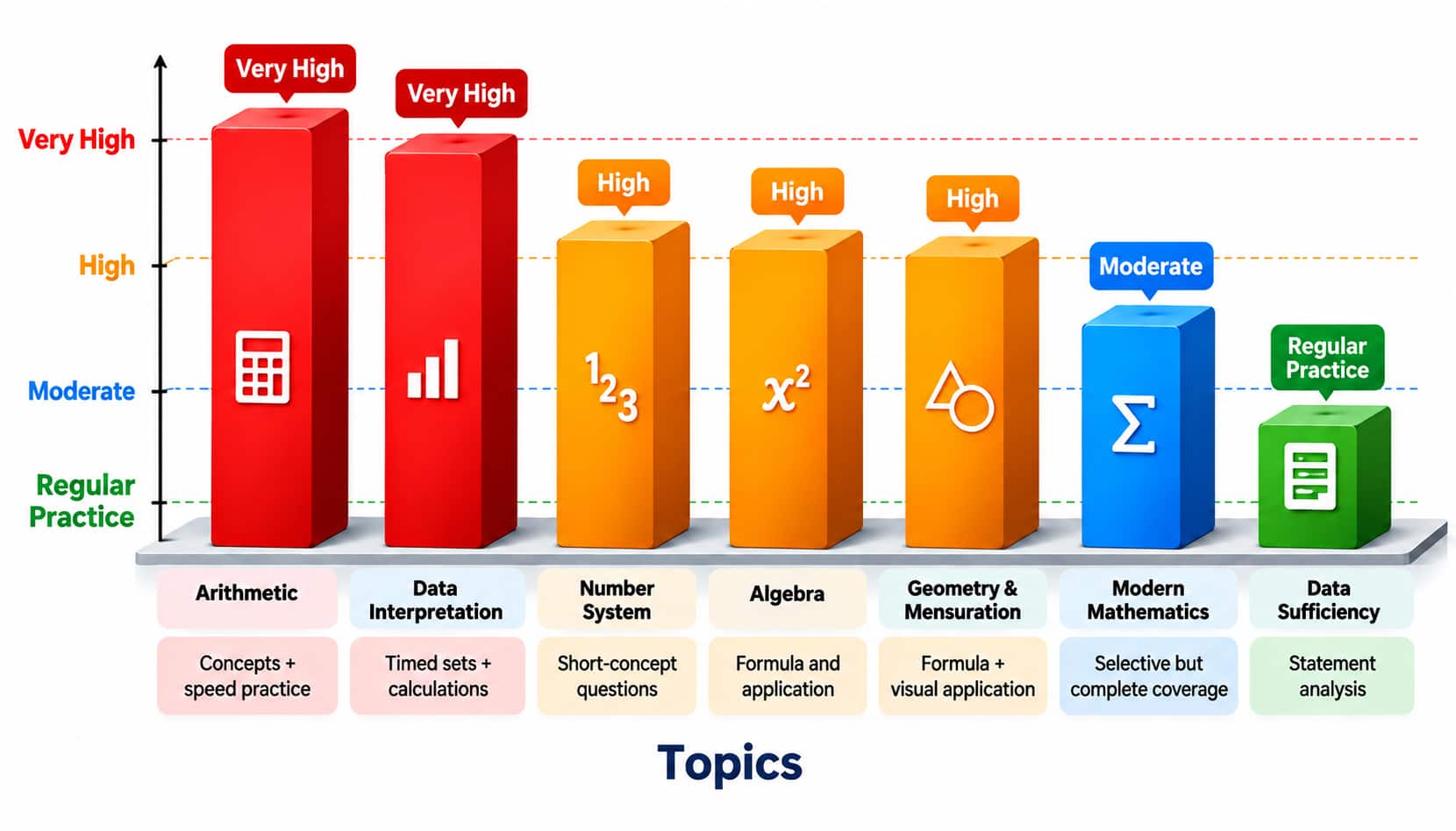
This is a preparation framework, not an official weightage prediction. The official SNAP exam pattern confirms the section contains 20 questions, while the exact topic distribution can vary across tests.
A four-stage approach can help build concepts first and then improve speed.
Start with Percentage, Ratio, Average, Profit and Loss, Time and Work and Time-Speed-Distance.
Once Arithmetic fundamentals are comfortable, move to the remaining core Quant areas.
Do not postpone DI and DS until the final stage. Include short DI sets and Data Sufficiency questions throughout preparation.
Once individual topics are comfortable, combine them in timed sets so that question selection becomes part of preparation.
Fast calculations can save valuable time in a 60-minute examination.
Regularly revise:
Common fractions
Percentage-fraction conversions
Squares
Cubes
Multiplication shortcuts
Ratio conversions
Approximation
Percentage increase and decrease
Useful conversions include:
25%=1/4
12.5%=1/8
33.33%1/3
16.67%1/6
These relationships can simplify both Quantitative and DI calculations.
A weekly practice cycle can maintain balanced coverage.
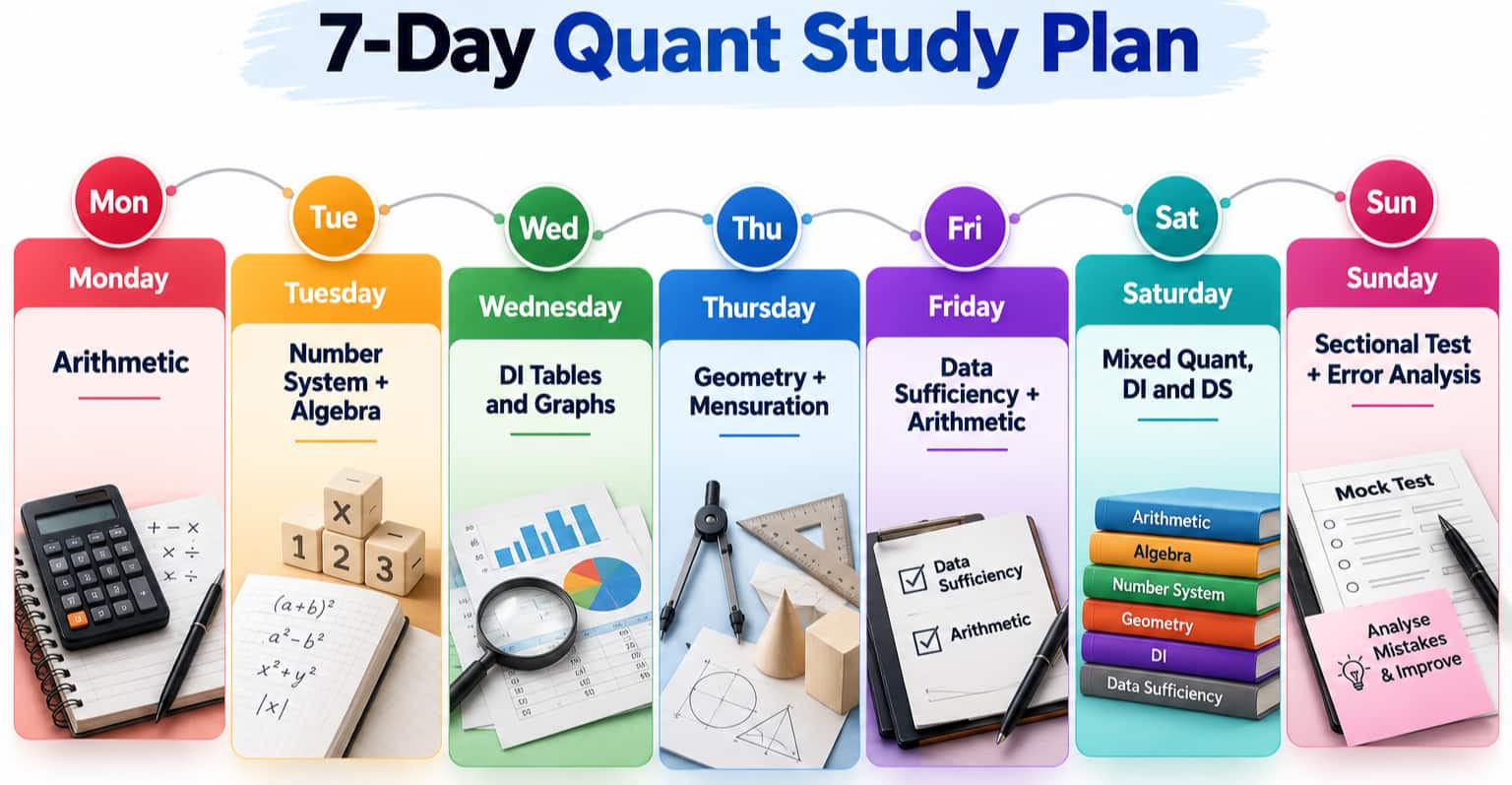
The schedule can be adjusted according to the candidate's SNAP preparation level and the time remaining before SNAP.
The official SNAP 2026 test lasts 60 minutes, and candidates can move between sections in any order. Each correct answer carries one mark and an incorrect answer attracts a 25% penalty.
This makes mock analysis particularly important.
After each mock, classify questions into:
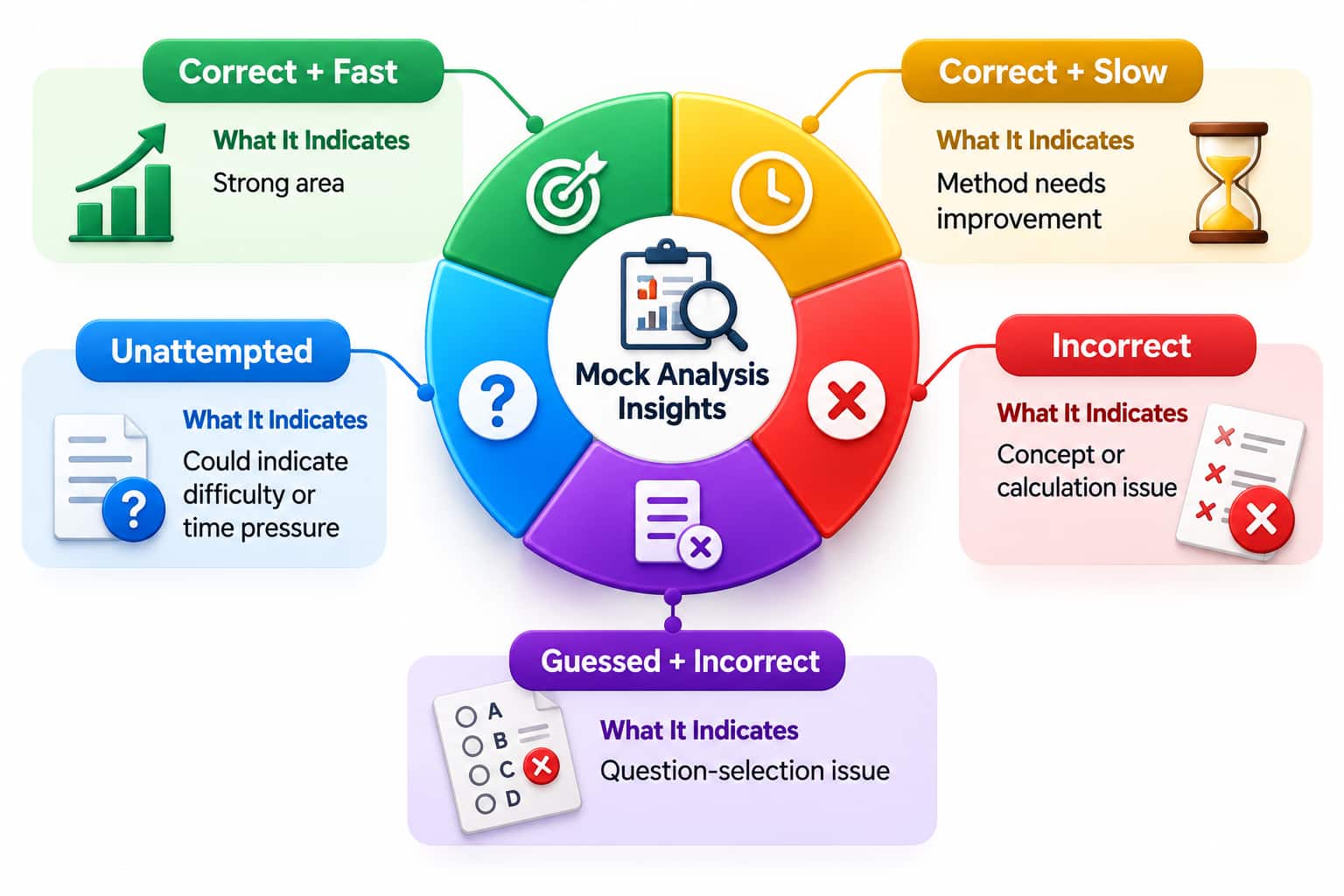
The aim is not simply to increase attempts but to improve the quality and efficiency of attempts.
Several preparation habits can reduce efficiency:
Spending too long on a difficult Quant question
Treating every DI set as compulsory
Solving Data Sufficiency questions completely when only sufficiency is required
Ignoring units in DI
Memorising formulas without application practice
Practising only chapter-wise questions
Avoiding mixed timed sets
Taking mocks without analysing mistakes
Because SNAP permits up to three tests and considers the highest score, mock practice can also help candidates understand which preparation gaps remain before later attempts.
Before entering the final revision phase, candidates can use this checklist:
Area | Must-Cover Topics |
Arithmetic | Percentage, Ratio, Average, Profit & Loss, SI & CI, TSD, Time & Work |
Number System | Divisibility, HCF-LCM, Factors, Remainders, Unit Digit |
Algebra | Equations, Quadratics, Identities, Inequalities, Surds |
Geometry | Triangles, Circles, Angles, Quadrilaterals, Mensuration |
Modern Mathematics | Probability, P&C, Progressions |
DI | Tables, Bar Graphs, Pie Charts, Line Graphs, Caselets |
DS | Arithmetic, Algebra, Number System, Geometry |
Topic-wise practice should be followed by SNAP-specific questions and timed tests.
Use focused notes to revise important concepts, formulas and question-solving approaches.
Download now: SNAP 2026 Quantitative, DI and DS Preparation Resources
Practice the official mock format and review the solutions to understand question selection and timing.
Practice now: SNAP 2025 Official Mock Test with Solutions
Use previous-year questions to understand the style and level of questions asked in the examination.
Practice now: SNAP 2024 Question Paper with Solutions
A full-length mock can help measure speed, accuracy, question selection and overall readiness under the 60-minute format.
Attempt now: SNAP 2026 Free Mock Test
Focus on concept clarity, calculation speed and smart question selection. Since, the SNAP 2026 dates are December 13, 19 and 26, candidates should start from topic-wise practice to mixed sets, sectional tests and attempt full-length mocks.
Frequently Asked Questions (FAQs)
Percentages, Ratio and Proportion, Averages, Profit and Loss, Time-Speed-Distance, Time and Work, Number System, Algebra and Geometry are important topics to cover.
The SNAP 2026 exam has 20 questions in the Quantitative, Data Interpretation & Data Sufficiency section.
Practice tables, bar graphs, pie charts, line graphs and caselets while improving calculations involving percentages, ratios and averages.
Practice determining whether the given statements provide sufficient information independently or together, rather than solving the entire problem unnecessarily.
Yes. Arithmetic includes important areas such as percentages, ratios, averages, profit and loss, interest, time and work, and time-speed-distance.

On Question asked by student community
You can find all the information here:
CAT- https://www.careers360.com/mba/articles/cat-exam-dates
SNAP- https://www.careers360.com/mba/articles/snap-exam-dates
Dear Student,
SIBM Nagpur SNAP 2025 Cutoff is expected to be on higher side this year, around 93+ percentile if we look at the trends of the previous years. As per the SNAP 2025 score vs percentile, to match the SIBM Nagpur SNAP 2025 cutoff one need to score around
Hi Student
Getting 70 percentile in the SNAP examination is well within the range of SSBF Pune. You can register and apply for admission to the college. Click on the link below to learn more about the admission process, dates, fees, etc.
Hello candidate,
SIBM Pune over the years has been known for its holistic development of students . SIBM Pune courses include MBA, MBA Executive and MBA Innovation and Entrepreneurship programmes in various specialisations.
Symbiosis Centre for Management and Human Resource Development, Pune was established in 1993. Admission to SCMHRD Pune
Yes, you can definitely prepare better for the SNAP Quantitative Ability section by keeping a complete formula list with you. Instead of memorising everything randomly, it helps to organise formulas chapter-wise so you can revise faster.
Here is a useful formula list for the SNAP Quant section:
1. Arithmetic
•

Globally Recognized by AACSB (US) & AMBA (UK) | 18 LPA Avg. CTC for PGPM 2026
Gateway to IBS Hyderabad & 8 other IBS campuses | Scholarships worth 10 CR
Among top 6% B-Schools globally to be accredited by AACSB | Highest Package-35 LPA
Test centres are available in 70+ cities across India | 75,000+ aspirants apply for the NMAT exam | Accepted by 58+ institutions like NMIMS, KJSIM, ISB, SPJIMR and Great Lakes.
400+ Recruiters | Highest CTC 17.2 LPA | Average CTC 8 LPA | 92% Avg. Placements | Ranked as Platinum Institute | Awarded Best Business School of the Year
Application Open | Scholars’ Round Deadline: 14th Nov’26 | Earn upto 50% merit Scholarship + 10% for top performers | EFMD Accredited | AACSB & Business Graduates Association Member | Highest CTC 28 LPA