Great Lakes Institute of Management, Chennai
Globally Recognized by AACSB (US) & AMBA (UK) | 18 LPA Avg. CTC for PGPM 2026


It is well known that MBA, as a qualification is coming under scrutiny for its failure to keep pace with Return on Investment. For more than a decade, MBA fees in India climbed steadily upward while placement outcomes have moved in the opposite direction. And when it happens at even the IIM’s, India’s premier institutions for management education, it paints a sorry picture.
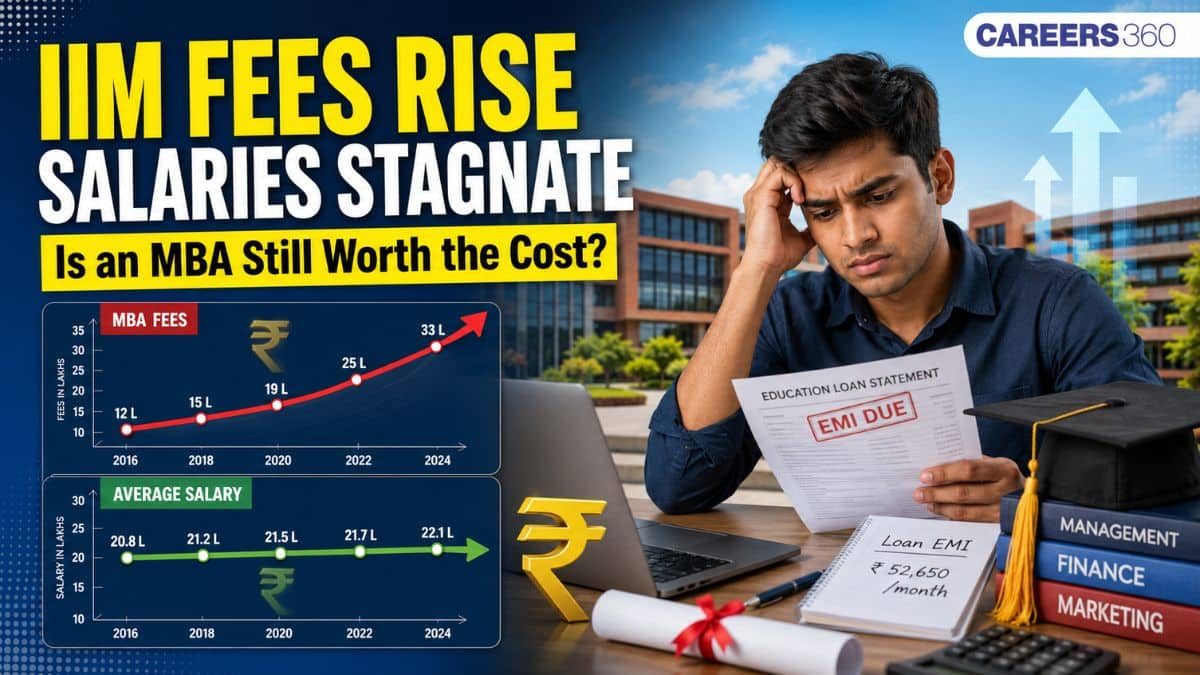
Careers360 analysed all the Indian Institutes of Management (IIMs), the autonomous though publicly funded management institutions. We looked at the data of IIMs, because the rest of the sector tend to follow what IIMs do. However, while they manage to move the cost downwards, the student outcomes, more often than not, do not move in sync with the IIMs.
Across the 20 IIMs, roughly 7,320 students were admitted in 2022–23, and about 99% of eligible graduates were eventually placed. The overall IIM median salary that year stood at Rs. 21.34 lakh.
But the trend since then has been on a downward path. In 2023-24, the Median salary fell to Rs. 20.61 lakhs and in 2024-25, it was Rs. 21.02 lakh. The IIM median salary over two years actually declined by about 1.5%, even as inflation rose an estimated 17.6%. In real terms, that means IIM graduates' purchasing power has eroded, salaries fell while the fees increased.
IIM Fee Increases: Outpacing Inflation
While placement outcomes have stagnated or slipped, IIM fees have moved sharply upward. Over just a two-year period, individual IIMs raised fees anywhere from 6% to over 40%. Zooming out to a roughly ten-year window (2015–17 through 2024–26), the increases are even starker:
Institute | Salary 22-23 | Salary 23-24 | Salary 24-25 | Salary Chg | Fees 22-24 | Fees 24-26 | Fees Chg |
IIM Amritsar | 15.94L | 15.60L | 12.29L | -3.65L (-22.90%) | 15.20L | 18.10L | +19.08% |
IIM Bodh Gaya | 15.50L | 13.00L | 12.12L | -3.38L (-21.81%) | - | 15.42L | - |
IIM Kashipur | 17.20L | 15.03L | 14.46L | -2.74L (-15.93%) | 15.42L | 17.21L | +11.61% |
IIM Raipur | 20.00L | 17.50L | 18.40L | -1.60L (-8.00%) | - | 16.74L | - |
IIM Udaipur | 18.53L | 18.00L | 17.10L | -1.43L (-7.74%) | 17.30L | 19.26L | +11.33% |
IIM Shillong | 26.09L | 25.67L | 25.00L | -1.09L (-4.18%) | - | 26.18L | - |
IIM Vizag | 16.00L | 15.50L | 15.00L | -1.00L (-6.25%) | 15.04L | 17.82L | +18.48% |
IIM Sambalpur | 16.00L | 13.15L | 15.03L | -0.97L (-6.08%) | 10.50L | 15.05L | +43.33% |
IIM Tiruchirappalli | 18.60L | 18.10L | 18.00L | -0.60L (-3.23%) | 16.50L | 19.50L | +18.18% |
IIM Bangalore | 33.00L | 32.50L | 32.61L | -0.39L (-1.18%) | 24.50L | 26.00L | +6.12% |
These IIMs are public institutions, originally built and subsidized with taxpayer money. Even accounting for inflation, fee growth at this scale suggests something beyond simple cost-of-living adjustments - and because IIMs are seen as sector leaders, their fee hikes effectively give "permission" for every other B-school to raise prices too.
LATEST:
To understand what this means for an individual student, consider a representative scenario:
Total cost of education (fees plus accrued interest on an education loan) of around Rs.30 lakh,
Starting salary of Rs. 15 lakh which is roughly the median for many mid-tier IIMs.
Take-home pay on a Rs. 15 lakh CTC works out to roughly Rs. 90,000/month
A prudent EMI shouldn't exceed about 33% of take-home pay of around Rs. 30,000/month.
EMI increasing by 10% each year, based on the earning potential
Year | EMI / Month (Rs.) | Total Paid in Year (Rs) | Interest Paid (Rs.) | Principal Paid (Rs.) | Balance at Year-End (Rs.) |
1 | 30,000 | 3,60,000 | 2,97,172 | 62,828 | 29,37,172 |
2 | 33,000 | 3,96,000 | 2,88,897 | 1,07,103 | 28,30,069 |
3 | 36,300 | 4,35,600 | 2,75,815 | 1,59,785 | 26,70,284 |
4 | 39,930 | 4,79,160 | 2,57,030 | 2,22,130 | 24,48,154 |
5 | 43,923 | 5,27,076 | 2,31,512 | 2,95,564 | 21,52,591 |
6 | 48,315 | 5,79,784 | 1,98,079 | 3,81,705 | 17,70,886 |
7 | 53,147 | 6,37,762 | 1,55,377 | 4,82,385 | 12,88,500 |
8 | 58,462 | 7,01,538 | 1,01,859 | 5,99,679 | 6,88,821 |
9 | 64,308 | 7,24,579 | 35,758 | 6,88,821 | 0 |
TOTAL | - | 48,41,499 | 18,41,499 | 30,00,000 | - |
Total cost of education of Rs. 30 lakh,
Starting salary of Rs. 15 lakh
Take-home pay of roughly Rs. 90,000/month
EMI of 33% of take-home pay of around Rs. 30,000/month.
EMI at a flat 30,000 PM
Year | EMI / Month (Rs. ) | Total Paid in Year (Rs. ) | Interest Paid (Rs.) | Principal Paid (Rs.) | Balance at Year-End (Rs.) |
1 | 30,000 | 3,60,000 | 2,97,172 | 62,828 | 29,37,172 |
2 | 30,000 | 3,60,000 | 2,90,593 | 69,407 | 28,67,765 |
3 | 30,000 | 3,60,000 | 2,83,325 | 76,675 | 27,91,091 |
4 | 30,000 | 3,60,000 | 2,75,297 | 84,703 | 27,06,388 |
5 | 30,000 | 3,60,000 | 2,66,427 | 93,573 | 26,12,815 |
6 | 30,000 | 3,60,000 | 2,56,629 | 1,03,371 | 25,09,443 |
7 | 30,000 | 3,60,000 | 2,45,804 | 1,14,196 | 23,95,248 |
8 | 30,000 | 3,60,000 | 2,33,847 | 1,26,153 | 22,69,095 |
9 | 30,000 | 3,60,000 | 2,20,637 | 1,39,363 | 21,29,731 |
10 | 30,000 | 3,60,000 | 2,06,044 | 1,53,956 | 19,75,775 |
11 | 30,000 | 3,60,000 | 1,89,922 | 1,70,078 | 18,05,698 |
12 | 30,000 | 3,60,000 | 1,72,113 | 1,87,887 | 16,17,811 |
13 | 30,000 | 3,60,000 | 1,52,439 | 2,07,561 | 14,10,249 |
14 | 30,000 | 3,60,000 | 1,30,705 | 2,29,295 | 11,80,954 |
15 | 30,000 | 3,60,000 | 1,06,694 | 2,53,306 | 9,27,648 |
16 | 30,000 | 3,60,000 | 80,170 | 2,79,830 | 6,47,818 |
17 | 30,000 | 3,60,000 | 50,868 | 3,09,132 | 3,38,686 |
18 | 30,000 | 3,57,184 | 18,498 | 3,38,686 | ₹0 |
TOTAL | - | 64,77,184 | 34,77,184 | 30,00,000 | - |
At a 10% interest rate, a Rs. 30,000 EMI would take 18 years to clear a Rs. 30 lakh loan
And this is the scenario for students placed at the median salary of Rs.15 Lacs. In the bottom half of IIMs, graduates placed below the median and even at Rs. 6-8 lakh who cannot even service the EMI at all, and may carry the debt indefinitely.
At IIM Calcutta, for instance, RTI data reportedly shows a placement range from a high of Rs. 1.45 crore down to a low of just Rs. 6 lakh, with an average/median around Rs. 32-33 lakh. If even a top-ranked, publicly funded IIM shows this much dispersion, the picture is likely worse across the broader B-school landscape.
Data on India's Top 100 best B Schools as ranked by NIRF, about 35 of them at the bottom averaged a median salary of 7.93 lacs - with many graduates placed at as less as Rs. 3-4 lakh. For these graduates, the take-home pay is too low to meaningfully service any education loan, let alone cover living costs in a different city.
Read More: MBA Placement Realities: IIM vs Top 10 MBA Colleges Median Salary
Field | 2022-23 | 2023-24 | 2024-25 |
Intake | 10884 | 11929 | 13105 |
Admitted (1st Year) | 10341 | 11676 | 12868 |
Graduated | 9799 | 11187 | 12409 |
Placed | 7542 | 8689 | 11234 |
Higher Studies | 324 | 360 | 379 |
Placement % | 79.60% | 80.25% | 93.38% |
Placement % Against Graduated | 76.97% | 77.67% | 90.53% |
Placement % Against Admitted | 72.93% | 74.42% | 87.30% |
Median Salary | Rs. 7,49,407 | Rs. 7,60,485 | Rs. 7,93,292 |
The Core Question: Because IIMs are publicly funded and carry outsized influence over the sector, the pattern of raising fees faster than placement outcomes raises a broader question: should institutions built on public investment be leading fee increases, or should they be leading efforts to keep management education affordable and outcomes strong enough that students can realistically repay what they borrow? This would also ensure that other institutions are careful in fees increases. Is there a larger responsibility on public institutions?
For now, a growing share of MBA graduates, even if they are from India's most prestigious institutes, face a decade or more of loan repayment before the degree pays for itself.

On Question asked by student community
Dear Student, Amrita Vishwa Vidyapeetham Online MBA should be evaluated primarily on the recognition and approval applicable to the specific programme and admission session. UGC entitlement is particularly important when checking the validity of an online degree. AICTE approval, NAAC accreditation and NBA accreditation should also be understood separately because
Hi, your BSc Agriculture background can fit well with both ABM and FABM, so your non-engineering background should not stop you from considering either option. ABM can give you broader exposure to areas such as agribusiness, marketing, supply chain and rural business, while FABM is more closely focused on food
The total fee for a two-year MBA varies considerably depending on the institution, university, specialisation and whether it is a government, private or autonomous institution.
Apart from tuition fees, you may also have to pay examination fees, registration charges, hostel and mess fees, library charges and other institutional charges. Therefore,
Hello there,
For MBA HR students, practical skills are just as important as theoretical knowledge. Along with understanding HR concepts, it is important to develop skills that are actually used in day-to-day HR work and can help you perform confidently in internships and placements.
One of the most important areas
Hello Aspirant,
That’s a great start! If you are preparing for the UGAT 2027 with the aim of getting admission to the Integrated MBA programme at the University of Kashmir, you should first make sure that UGAT is the correct entrance route for that programme, as admission rules can change

BBA/MBA/PGDM Early Bird Applications Deadline 06th Nov'26. Apply now using coupon code CAREER250 and get ₹250 off the application fee
Globally Recognized by AACSB (US) & AMBA (UK) | 18 LPA Avg. CTC for PGPM 2026
75+ years of legacy | #1 Entrance Exam | Score accepted by 250+ BSchools
Ranked #36 amongst institutions in Management by NIRF | 100% Placement
Gateway to IBS Hyderabad & 8 other IBS campuses | Scholarships worth 10 CR
Get up to 100% scholarship on B.Des. & BBA admissions through your CUET-UG score | No. 1 Design & Fashion Institute by ASSOCHAM, India Today, Outlook and The Week rankings