Great Lakes Institute of Management, Chennai
Globally Recognized by AACSB (US) & AMBA (UK) | 18 LPA Avg. CTC for PGPM 2026


The AIMS Test for Management Admissions (ATMA) assesses candidates’ quantitative, verbal, and analytical reasoning skills for admission to management programmes. To score well in Quantitative Skills, aspirants need strong mathematical fundamentals, regular practice, and effective time management. This article covers the ATMA 2027 Quantitative Skills syllabus, important topics, solved practice questions, key formulas, preparation strategies, mock-test analysis, and recommended books. It also highlights common mistakes and practical techniques to improve calculation speed, accuracy, and confidence while preparing for the exam.
This Story also Contains

Know All About ATMA: Download the eBook to learn about the ATMA exam pattern, eligibility criteria, and other important details.- Download Now
The ATMA Quantitative Skills component consists of two sections, each containing 30 questions and carrying a time limit of 30 minutes. Together, the two sections contain 60 questions. The complete ATMA exam has 180 questions across six sections and lasts three hours.
Correct answer: +1 mark
Incorrect answer: −0.25 marks
Unattempted question: 0 marks
Candidates should practise managing time within each 30-minute section and prioritise questions they can solve accurately.
Under ATMA Quantitative Skills, candidates are tested on a variety of topics that assess numerical ability, logical reasoning, and problem-solving. Key areas include arithmetic, algebra, geometry, mensuration, percentages, ratios, time-speed-distance, and data interpretation. Mastery of these topics helps improve accuracy, speed, and overall performance in the ATMA exam.
Important Topics for ATMA Quantitative Skills |
Arithmetic |
Algebra |
Geometry |
Mensuration |
Number system |
Probability |
Logarithm |
Data Interpretation |
Here are some ATMA 2027 Quantitative Aptitude Tips to ace the section. To clear the quantitative section, you need to understand the types of questions asked by analysing previous years. Question papers and prioritise the high-weightage questions during preparation.
Here, we provide a few examples from each topic to help you understand the types of questions asked in ATMA.
Question 1: In a classroom, there are 30 students. Of these, 18 students like Mathematics, 15 like Science, and 10 like both subjects. How many students do not like either subject?
Solution:
Total number of students, $n(U)=30$.
Let $M$ represent the set of students who like Mathematics and $S$ represent the set of students who like Science.
Given, $n(M)=18$, $n(S)=15$, and $n(M\cap S)=10$.
Using the inclusion-exclusion principle, the number of students who like at least one subject is $n(M\cup S)=n(M)+n(S)-n(M\cap S)=18+15-10=23$.
Therefore, the number of students who do not like either subject is $n(U)-n(M\cup S)=30-23=7$.
Hence, the correct answer is 7 students.
Question 2: In how many different ways can the letters of the word 'VIRTUAL' be arranged among themselves?
Options:
(a) $840$
(b) $5040$
(c) $2520$
(d) $1680$
Solution:
The word VIRTUAL contains 7 distinct letters: V, I, R, T, U, A, and L.
The number of different arrangements of $n$ distinct letters is given by $n!$.
Therefore, the number of arrangements is $7!=7\times6\times5\times4\times3\times2\times1=5040$.
Hence, the correct answer is Option (b) – 5040.
Question 1: Which of the following is the smallest 5-digit number that is exactly divisible by 526?
$10520$
$11046$
$10516$
$10424$
Solution:
The smallest 5-digit number is $10000$.
When $10000$ is divided by $526$, we get $10000=526\times19+6$, leaving a remainder of $6$.
To obtain the smallest 5-digit number exactly divisible by $526$, we need to add $526-6=520$.
Therefore, the required number is $10000+520=10520$.
Hence, the correct answer is Option 1 – $10520$.
Question 2: The sum of two numbers is 35 and their product is 250. What is the sum of the reciprocals of these numbers?
Options:
(a) $\frac{6}{25}$
(b) $\frac{4}{25}$
(c) $\frac{9}{50}$
(d) $\frac{7}{50}$
Solution:
Let the two numbers be $a$ and $b$.
Given, $a+b=35$ and $ab=250$.
The sum of their reciprocals is $\frac{1}{a}+\frac{1}{b}=\frac{a+b}{ab}$.
Substituting the given values, $\frac{a+b}{ab}=\frac{35}{250}=\frac{7}{50}$.
Hence, the correct answer is Option (d) – $\frac{7}{50}$.
Question 3: Find the maximum number of girls among whom 2,923 bags and 3,239 eyeliners can be distributed such that each student gets the same number of bags and the same number of eyeliners.
Options:
(a) $80$
(b) $79$
(c) $78$
(d) $81$
Solution:
To distribute both items equally among the maximum number of girls, we need to find the HCF (Highest Common Factor) of $2923$ and $3239$.
Using the Euclidean algorithm, $3239-2923=316$.
Next, $2923=316\times9+79$ and $316=79\times4$.
Therefore, the HCF of $2923$ and $3239$ is $79$.
Hence, the maximum number of girls is Option (b) – $79$.
Question 1: A father gives 8% of his monthly income to both his sons as pocket money. The elder son gets 85% of the total amount given to both sons. He spends 90% of the amount and saves INR 17. What is the father's monthly income?
Solution:
Let the father's monthly income be $X$.
Money given to both sons = $8%$ of $X=0.08X$.
Money given to the elder son = $85%$ of $0.08X=0.068X$.
Since the elder son spends $90%$ of the amount, he saves $10%$.
Money saved by the elder son = $10%$ of $0.068X=0.0068X$.
Given that the amount saved is INR $17$, we get $0.0068X=17$.
Therefore, $X=\frac{17}{0.0068}=2500$.
Hence, the correct answer is INR 2,500.
Question 2: The product of 10% of a positive number and 5% of the same number is 0.125. What is half of that number?
Options:
(a) 2.5
(b) 2.7
(c) 3
(d) 5
Solution:
Let the positive number be $x$.
According to the question, $(10%\text{ of }x)\times(5%\text{ of }x)=0.125$.
Substituting the percentage values, $0.1x\times0.05x=0.125$.
Therefore, $0.005x^2=0.125$, so $x^2=\frac{0.125}{0.005}=25$.
Since $x$ is positive, $x=5$.
Half of the number is $\frac{5}{2}=2.5$.
Hence, the correct answer is (a) 2.5.
Question 3: A 480-metre-long train crosses a platform in 240 seconds. What is the speed of the train?
Options:
(a) 4 m/s
(b) 2 m/s
(c) 3 m/s
(d) Cannot be determined
Solution:
To cross a platform completely, a train travels a distance equal to the sum of its own length and the platform's length.
Therefore, $\text{Distance}=480+\text{Platform length}$.
The speed of the train is $\text{Speed}=\frac{\text{Distance}}{\text{Time}}$.
Since the platform's length is not given, the total distance travelled cannot be determined. Hence, the speed of the train cannot be calculated uniquely.
Therefore, the correct answer is (d) Cannot be determined.
Question 4: The price of 8 chairs is equal to that of 2 tables. The price of 12 chairs and 2 tables together is INR 4,000. The total price of 10 chairs and 1 table is:
Options:
(a) INR 2,700
(b) INR 2,800
(c) INR 1,900
(d) INR 2,870
Solution:
Let the price of one chair be INR $c$ and the price of one table be INR $t$.
According to the first condition, $8c=2t$, which gives $t=4c$.
According to the second condition, $12c+2t=4000$.
Substituting $t=4c$, we get $12c+2(4c)=4000$, so $20c=4000$.
Therefore, $c=200$ and $t=4(200)=800$.
The total price of 10 chairs and 1 table is $10c+t=10(200)+800=2800$.
Hence, the correct answer is (b) INR 2,800.
Question: The perimeter of a sector of a circle is 24 cm and the radius is 3 cm. Calculate the area (in cm$^2$) of the sector.
Solution:
Given, the perimeter of the sector = $24$ cm and radius $r=3$ cm.
The perimeter of a sector = $2r+l$, where $l$ is the length of the arc.
Substituting the values, $24=2(3)+l$, so $l=24-6=18$ cm.
We know that the area of a sector is $\frac{1}{2}lr$. Therefore, $\text{Area}=\frac{1}{2}\times18\times3=27$ cm$^2$.
Hence, the correct answer is 27 cm$^2$.
Question: The perimeter of a square is twice the perimeter of a rectangle. If the perimeter of the square is 56 cm and the length of the rectangle is 9 cm, what is the difference between the breadth of the rectangle and the side of the square?
Options:
(a) 7 cm
(b) 9 cm
(c) 11 cm
(d) 5 cm
Solution:
The perimeter of the square is $56$ cm. Therefore, its side is $\frac{56}{4}=14$ cm.
The perimeter of the rectangle is half the perimeter of the square, i.e., $\frac{56}{2}=28$ cm.
Using the perimeter formula for a rectangle, $2(l+b)=28$, where $l=9$ cm and $b$ is the breadth.
Substituting the values, $2(9+b)=28$, so $9+b=14$ and $b=5$ cm.
The difference between the side of the square and the breadth of the rectangle is $14-5=9$ cm.
Hence, the correct answer is (b) 9 cm.
Question: A man riding a bicycle completes one lap of a square field along its perimeter at a speed of 39.6 km/h in 1 minute 20 seconds. What is the area of the field?
Options:
(a) 52,900 sq m
(b) 44,100 sq m
(c) 48,400 sq m
(d) Cannot be determined
Solution:
Given, speed = $39.6$ km/h and time = $1$ minute $20$ seconds = $80$ seconds.
Converting the speed into metres per second, $\text{Speed}=39.6\times\frac{5}{18}=11$ m/s.
The distance travelled in $80$ seconds is $11\times80=880$ m.
Since the man completes one lap along the perimeter of the square field, the perimeter of the square is $880$ m.
Therefore, the side of the square is $\frac{880}{4}=220$ m.
The area of the square is $220^2=48,400$ m$^2$.
Hence, the correct answer is (c) 48,400 sq m.
Question: If $a+b+c=19$ and $ab+bc+ca=120$, then what is the value of $a^3+b^3+c^3-3abc$?
Solution:
We know that $a^3+b^3+c^3-3abc=(a+b+c)\left[(a+b+c)^2-3(ab+bc+ca)\right]$.
Substituting the given values, we get $a^3+b^3+c^3-3abc=19\left[19^2-3(120)\right]=19(361-360)=19(1)=19$.
Hence, the correct answer is 19.
Data Interpretation:
The following graph shows the number of illiterates in different states of a country in the year 2021.
The total number of illiterates in the four states is $4,50,000$.
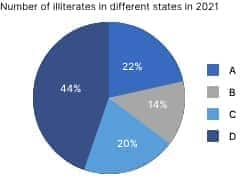
The following graph shows the number of illiterates in different states of a country in the year 2021.
Total illiterates in 4 states = 4,50,000
The percentage of illiterates in state D is $44%$.
Therefore, the percentage of illiterates in states A, B, and C combined is $100%-44%=56%$.
The required percentage is $\frac{\text{Illiterates in A, B, and C}}{\text{Illiterates in D}}\times100=\frac{56}{44}\times100=127.27%$.
Hence, the correct answer is 127.27%.
Check previous years’ question papers to identify the weightage of each topic and incorporate the same in your preparation.
We have made a small analysis for you as provided below:
Topic | Number of Questions that came in the previous year |
Modern Math | 12 |
Number system | 11 |
Arithmetic | 9 |
Geometry | 8 |
Algebra | 5 |
Data Interpretation | 15 |
A good ATMA 2027 Quantitative Preparation Guide will always focus on mastering the basic concepts of Mathematics at the beginning of the preparation.
Having a solid foundation in basic concepts of Mathematics is always a plus point for ATMA aspirants.
Here are some ways to build the basics of Mathematics.
Study NCERT textbooks: NCERT textbooks are a very good tool to master the basic concepts of mathematics.
Memorise key formulas: Make a chart or use flashcards to remember all the important formulas of Mathematics.
Sharpen mental math: Use mental calculation for basic arithmetic operations. Practice solving without using a calculator during preparation.
Understanding of real-life concepts: Arithmetic problems like profit loss, average, interests, work done, pipes and cistern are based on real-life situations. It is important to understand these concepts before attempting to solve them.
Balancing conceptual clarity with the right speed is the mantra for success. Here are tips to strike the right balance.
Conceptual clarity: Students often start to practice Mathematical problems without clearing their basics and start making lots of mistakes. That is why focus on fully understanding each topic before attempting timed-based practice.
Speed comes naturally: When your concepts are clear, then you can solve questions with accuracy and faster times.
You will also develop skills like mental math and shortcut tricks to save time.
Regular practice will help to improve speed gradually. By the time the exam comes, you will be ready to complete the Quant section within the allotted time.
Here are some ATMA 2027 math preparation tips that will be helpful to students who are aiming to get admitted to a top B school.
Here are important topics of Arithmetic and Algebra respectively which students need to master to achieve high percentile. The candidates should be able to complete these topics before the ATMA 2027 exam dates.
Section | Topic Name |
Arithmetic | |
Algebra |
|
Data Interpretation is an important area to practise for ATMA Quantitative Skills. Candidates should build confidence in interpreting tables, charts, graphs, and caselets, while practising calculations involving percentages, ratios, and averages.
Here are some tips for DI preparation.
Understand the types of problems and practice them during mock tests to interpret data quickly.
Practice basic arithmetic operations like percentages, ratios, and averages to work with the datasets.
Pay attention to the datasets like pie charts, and focus on the proportion of each section. In bar and line graphs, look for scales, intervals and trends.
There will be irrelevant points in the datasets. Skim the data if you have to and underline the important data points for your reference.
Solve easier DI questions first to secure marks and gain confidence to attempt the complex ones.
Here are some ATMA 2027 Quantitative practice tips that will help students boost their performance. Previous year sample papers are essential during the preparation of ATMA.
Here are some ways to use ATMA's previous year's sample papers effectively.
ATMA 2027 Sample papers contain various types of questions which are important for this year's exam as well. You can get an in-depth idea about those types of questions.
Attempt the sample papers to check your score in previous years and compare them with the required percentile for top B-schools.
Practising ATMA 2027 e-books with time constraints will help to get familiar with the real exam environment.
From the sample papers, get an idea about the diversity of the questions and practice in that direction.
You will also be aware of the common pitfalls and challenges in this section.
Mock tests are an integral part of the preparation process for ATMA. Here are the points of how students should utilise the mock tests to maximise their scores.
Mock tests are prepared closely following the real exam pattern and syllabus. So you will get an in-depth idea about the questions that will be asked in the real exam.
You can enhance your time management skills by giving regular mock tests.
Students can also identify their strengths and weaknesses after reviewing the mock test results and give more attention to those weaker sections.
Consistent practice of mock tests will increase your speed as well as accuracy.
Giving full-length mock tests will also build your mental stamina to sit for 180 minutes in one sitting which is critical for performing well in the exam.
Mock tests improve your educated guessing skills for the questions you are unsure of. After practicing lots of mock tests, you will be able to identify quickly which options should be canceled out and from which you have to choose to get the answer.
Here are some tips that you can use to sharpen your quantitative skills and help you to solve mathematical problems fast.
Enhancing mental calculations can save valuable time during the exam. Here are some techniques which you can use to sharpen your mental calculation.
Practice mental math calculations without a calculator and challenge yourself every day.
Use approximation and estimation techniques to round off numbers for quicker calculations and adjust at the end.
Games like crosswords, sudoku, and chess help to sharpen your mind.
Memorize the multiplication tables, squares and cubes of numbers up to 20.
When you work with bigger numbers, break them into smaller components and work with them.
Spend 10-15 minutes every day to solve simple math in your head.
There are no values of mock tests if you do not review the results of those tests properly. Here are some tips which you can use to analyze mock test results.
Review: After attempting the ATMA mock tests, review thoroughly to identify the reason for the wrong answers and unanswered questions. Mark the categories where the most negative markings are happening and devise a plan to improve them.
Mistakes types and how to deal with them:
If it is a calculation error, then focus on the calculations next time and revise them at the end.
If it is a conceptual error, then give more attention to that chapter and take a topicwise test on that chapter.
If you are taking too much time on any specific types of questions, then look for alternate methods to solve those problems in a quicker time.
Unanswered questions: Check the reason for the unanswered questions to understand. If it is for the time constraints or the difficulty level of the question.
Next mock test goal: Set yourself a goal for the next mock test to improve accuracy and performance.
There will be a sectional cutoff time of 30 minutes for each section. So building a strategy for complex and lengthy questions is necessary to perform well in the exam.
Complex quant problems consume too much time during the mock tests as well as exams. Here are some tips that you can use to solve these questions quickly.
Every problem has its unique way of solving. Understand the problem type first, then approach to solve it.
Break the complex problems into manageable chunks and understand each part separately.
Use tricks like breaking the percentages, Vedic math, squares, and cubes up to 20.
Use approximation techniques to round off the numbers and calculate easily. Adjust at the end if needed.
For geometry and mensuration problems, use diagrams to visualize the situation better and solve it more efficiently.
Eliminate obvious wrong options and use the other options in the question to check if they satisfy the constraints or not. This is a time-saving way to solve lengthy questions.
Practice lots of complex problems beforehand so that you can solve them during the actual exam easily.
Difficult questions are part and parcel of the exam. Students can solve difficult problems with the right mindset and approach.
Here are some approaches to handling difficult problems.
Break the question into smaller parts and see if you can solve it part by part.
If a question seems unfamiliar, think about similar types of problems faced in mock tests. Apply familiar strategies and see if they help to simplify the problem.
Eliminating the obvious wrong options and using the remaining values in the question to check if they met the constraints is a quicker way to solve difficult questions.
Practice various types of problems during preparation and build the basic foundation of every chapter.
Many difficult problems can be solved using easier concepts. However, students often complicate them after overthinking the problem. Do not second guess yourself and trust your initial instinct.
Knowing all the important formulae and theorems will benefit students during the quantitative skills section.
Revise the following formulas regularly and practise applying them to different question types. Memorising a formula is not enough; understanding when to use it is equally important.
Topic | Formula |
Pythagoras theorem | $c^2 = a^2 + b^2$ |
Probability formula | $\text{Required Probability} = \dfrac{\text{Number of Favourable Outcomes}}{\text{Total Number of Outcomes}}$ |
Profit percentage | $\dfrac{\text{Selling Price} - \text{Cost Price}}{\text{Cost Price}} \times 100$ |
Loss percentage | $\dfrac{\text{Cost Price} - \text{Selling Price}}{\text{Cost Price}} \times 100$ |
Discount percentage | $\dfrac{\text{Discount Amount}}{\text{Marked Price}} \times 100$ |
Percentage change | $\dfrac{\text{New Value} - \text{Old Value}}{\text{Old Value}} \times 100$ |
Time-Speed-Distance | $\text{Speed} = \dfrac{\text{Distance}}{\text{Time}}$ |
Average speed | $\text{Average Speed} = \dfrac{\text{Total Distance}}{\text{Total Time}}$ |
Rule of Mixture and Alligation | $\text{Required Ratio} = (\text{Higher Value} - \text{Mean Value}) : (\text{Mean Value} - \text{Lower Value})$ |
Time & Work | $\text{Work Done} = \text{Rate of Work} \times \text{Time}$ |
Simple interest | $\text{SI} = \dfrac{P \times R \times T}{100}$ |
Compound Interest | $\text{CI} = P\left(1 + \dfrac{R}{100}\right)^T - P$ |
Use these formulas during timed practice and maintain a separate list of formulas you frequently forget or apply incorrectly. Revise that list before each mock test.
A systematic approach towards the weaker sections is necessary.
Review the results of mock tests and sample papers to check which sections you lack preparation for and in which section mistakes are happening frequently.
Revisit the fundamentals of those chapters and go through them. Use different books, online platform video tutorials, and materials to clear the concepts.
Now take section-wise tests on those sections and see if the problems persist or not. During the initial tests, focus on accuracy rather than speed. Speed will gradually increase once you have a grasp on the fundamentals.
Having a proper idea about which books are essential during preparation is very important.
Here are the names of some important books that will improve your Mathematics section.
Quantitative Aptitude for Competitive Examinations by R.S. Aggarwal
How to Prepare for Quantitative Aptitude for CAT by Arun Sharma
Fast Track Objective Arithmetic by Rajesh Verma
On exam day, the ATMA 2027 Quantitative section requires focus, speed, and strategy. Stay calm, read each question carefully, and manage your time efficiently. Prioritize accuracy over attempting all questions, and use shortcuts for calculations wherever possible.
Allocate a fixed amount of time for each question or section. Don’t spend too long on a single problem; move on if it seems too tough. This ensures you attempt all questions without leaving easy marks behind.
Many mistakes happen because candidates rush through the question. Pay attention to details, units, and what is specifically being asked before solving. Misreading a small word can change the entire solution.
Begin with questions you find simple or familiar. This builds confidence, warms up your mind, and secures quick marks early in the section, leaving more time for complex problems later.
Familiarise yourself with formulas, tricks, and approximation methods before the exam. Techniques like Vedic math, percentage shortcuts, or ratio methods can save precious minutes and increase speed without compromising accuracy.
Random guessing can reduce your score due to negative marking. Attempt only those questions you have a reasonable chance of solving correctly, and leave difficult ones for review if time permits.
Stress can cloud judgment and slow calculations. Take deep breaths if you feel anxious, maintain steady pacing, and focus on one question at a time. A calm mindset improves both accuracy and speed.
ATMA 2027 Preparation Tips and Study Material
Download the preparation guide to explore effective study strategies and strengthen your ATMA 2027 preparation.
Effective time management is key in the ATMA Quantitative section. Quickly scan the paper to identify easy questions, allocate time for each topic, and tackle confident ones first. Save challenging problems for later, use shortcuts where possible, and keep an eye on your pace to ensure all questions are attempted without rushing.
Spend the first 2–3 minutes scanning the entire section. Identify the questions that seem easy or familiar. This helps you plan your approach and ensures you don’t miss out on straightforward marks.
Start with questions you are confident about. Solving them first builds momentum, boosts confidence, and secures easy marks early on.
Divide your total time among different topics like arithmetic, algebra, geometry, and data interpretation. This prevents spending too much time on one area and helps cover all sections efficiently.
Apply formulas, approximation techniques, and mental math tricks wherever possible. These can significantly speed up calculations and save valuable minutes.
Don’t get stuck on difficult questions at the start. Skip them initially and return only if time permits. This reduces stress and ensures maximum attempt rate.
Here are some common mistakes which students should avoid during the preparation time and in the actual exam as well.
Students often neglect basic calculation errors during mock tests and do not work on them. It is necessary to address them during the preparation to not repeat them in the actual exam.
Error type: Some basic calculation errors like misplacing decimal points or misinterpreting signs happen during the exam.
Solutions to avoid them:
These mistakes generally happen because of rushing through questions and panicking.
Always recheck the calculations.
Sometimes slowing down is necessary to improve accuracy.
Sharpen mental math skills to minimize silly errors.
Misreading graphs, charts, or tables is a common mistake among students in the DI section. This happens when students overlook important information like scales, units, or percentage differences.
Read the graphs carefully and analyze the axes and labels.
Highlight the key details as there will be irrelevant points in the question.
Ensure the basic calculations are right.
Frequently Asked Questions (FAQs)
It's advisable to avoid learning new concepts in the final days before the exam. Instead, focus on revising and strengthening your understanding of previously studied material.
Yes, for every incorrect answer, 0.25 marks are deducted. Therefore, it's crucial to attempt questions you're confident about.
It's advisable to avoid learning new concepts in the final days before the exam. Instead, focus on revising and strengthening your understanding of previously studied material.
In the last few weeks before the exam:
Review the weak areas and work on improving them.
Create a summary of shortcut tricks and important formulas
Take 3-4 mock tests every week and review the results.
Practice the previous year's sample papers to get accustomed to the exam settings.
The most important topics in Quantitative skills are:
Arithmetic
Algebra
Geometry
Modern Math
Data Interpretation
Yes, the sectional time limit is 30 minutes and there will be 6 sections consisting of 30 questions each.
Daily 2 hours practice of Quant and 1 hour practice for DI chapters is enough to perform well in the exam. For working professionals, daily 2 hours and at the weekends extensive practice is necessary.

On Question asked by student community
Hi there,
Atma Ram Sanatan Dharma College (ARSD), part of the University of Delhi, is well-regarded for its BSc Mathematics (Hons) program. It offers a structured curriculum covering algebra, analysis, statistics, and applied mathematics, along with exposure to research opportunities. The faculty is experienced, and the college provides good infrastructure
If you're searching for “Atma Malik Institute of Engineering” under ATMA (AIMS Test for Management Admissions), it won't show up—because ATMA exam is only for MBA/management admissions , and engineering colleges like Atma Malik Institute of Technology & Research aren’t part of that process. The MBA exam ATMA is completely
No, it's not mandatory but if you've those score then your option will be vast. Maximum Universities have their own selection process & own exams. If you have those good score they'll prefer you. But as per AICTE rules you have to have one national or state basis entrance exam
Yes, there will be an ATMA admission exam in 2025. The next ATMA exam will be administered via computer on June 1, 2025. The June session is now accepting registrations, which will end on May 20, 2025. In India, the ATMA test is administered several times a year for admission
Hey Madhura
Yes ATMA is held in July as well. Based on the latest official schedule
July 2025 session of ATMA will be conducted on 27 July 2025 in a centre based online format
Registration opens from 2 June and closes on 15 July 2025
Best wishes for your future.

Globally Recognized by AACSB (US) & AMBA (UK) | 18 LPA Avg. CTC for PGPM 2026
75+ years of legacy | #1 Entrance Exam | Score accepted by 250+ BSchools
Gateway to IBS Hyderabad & 8 other IBS campuses | Scholarships worth 10 CR
Highest Package 29.30 LPA | 12 LPA Median CTC | 230+ Recruiters | AACSB Accredited | Ranked 51 in Asia by QS International
Early Application Round Deadline: 27th Oct’26 | 400+ Recruiters | Highest CTC 17.2 LPA | Average CTC 8 LPA | 92% Avg. Placements | Awarded Best Business School of the Year
Last Date to Apply - 19th December 2026 | Highest CTC 68.66 LPA | Average CTC 18.08 LPA | Top 25% Average CTC 24.66 LPA