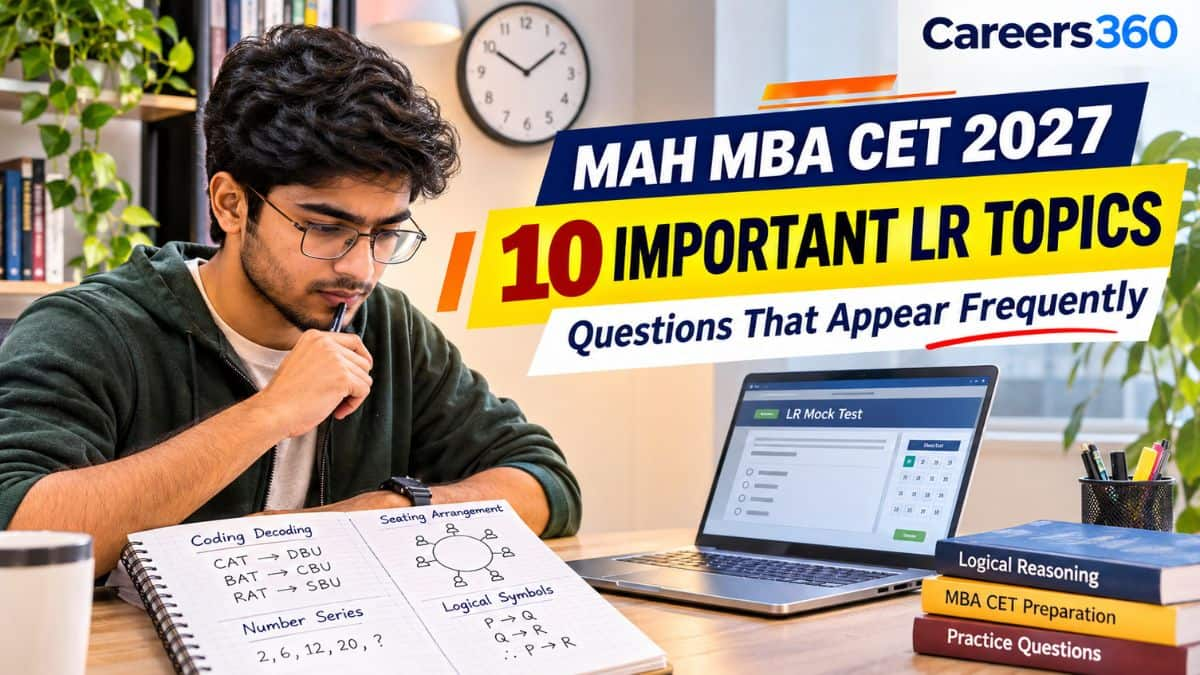
The Logical Reasoning (LR) section of MAH MBA CET tests your ability to identify patterns, interpret relationships and solve problems under time pressure. Previous-year exam analyses from 2024, 2025 and 2026 report recurring question types such as coding-decoding, blood relations, series, direction sense, syllogisms and seating arrangements.
This Story also Contains
MAH MBA CET LR Question Types That Repeat Frequently
Which MAH MBA CET LR Topics Should You Practise First?
MAH MBA CET Logical Reasoning Questions with Answers
MAH MBA CET LR Preparation 2027: 10 Reasoning Topics You Should Practise First
Understanding these question types helps you prepare systematically and identify the topics that need more practice. However, the frequency and difficulty of questions vary across MAH MBA CET exam shifts. You should prioritise recurring topics without assuming that every topic will appear in every paper.
MAH MBA CET LR Question Types That Repeat Frequently
Several question types have appeared in reported analyses across multiple exam years. Preparing these topics can help you recognise familiar reasoning patterns, although the actual number of questions may differ between shifts.
1. Coding-Decoding
Coding-decoding appeared in reported exam analyses across 2024, 2025 and 2026. These questions test your ability to identify rules used to transform letters, numbers, words or symbols into a coded form.
What to practise:
Letter and number coding
Word-based coding
Symbol-based coding
Patterns in coded sequences
K J Somaiya Institute of Management, Mumbai
Highest Package 29.30 LPA | 230+ Recruiters | AACSB Accredited | Ranked 51 in Asia by QS International
Practise identifying letter positions, numerical differences, reverse alphabet patterns and combinations of multiple rules. Check whether the same rule applies consistently before selecting an answer.
2. Blood Relations
Blood relation questions appeared in analyses from all three years. They test your ability to establish family relationships using direct statements or descriptions involving multiple people.
Boost your MBA admission chances with the MAH CET MBA College Predictor. Get a personalized list of colleges based on your percentile and expected cutoff trends.
Draw a family tree when a question includes several people and generations. Mark gender and relationships clearly to avoid confusing terms such as maternal uncle, paternal aunt, nephew and niece.
3. Number and Alphabetical Series
Number Series questions appeared in reported analyses for 2024, 2025 and 2026. You may need to identify a missing term, find the incorrect element or determine the rule connecting letters and numbers.
What to practise:
Missing number series
Alphabetical series
Alternating patterns
Letter-number combinations
IBSAT
Gateway to IBS Hyderabad & 8 other IBS campuses | Scholarships worth 10 CR
Check for differences, multiplication, division, squares, cubes and alternating operations. For alphabetical series, convert letters into their numerical positions to identify hidden patterns.
4. Direction Sense
Direction-based questions appeared across the three years. These questions require you to track movement, turns, distances or a person's final position relative to the starting point.
What to practise:
Left and right turns
Final direction and position
Distance-based movement
Questions combining directions with relationships
Use a simple diagram with north, south, east and west marked clearly. Track every turn in sequence instead of attempting to remember the entire movement mentally.
5. Seating Arrangements and Logical Puzzles
Arrangement and scheduling questions appeared in reported analyses for 2024 and 2025. Arrangements were also reported in 2026, although their frequency varied across shifts.
What to practise:
Linear and circular arrangements
Two-row seating
Scheduling and sequencing
Grouping and conditional puzzles
Convert the given conditions into diagrams or tables before evaluating the answer choices. Start with definite information, such as a fixed position or a person sitting at an end, and then apply the remaining conditions.
6. Syllogisms
Syllogisms appeared in reported analyses for 2024, 2025 and 2026. These questions require you to determine which conclusions follow logically from the given statements.
What to practise:
All, some and no statements
Valid and invalid conclusions
Venn diagram-based reasoning
Questions involving multiple statements
Use only the information provided in the question. A conclusion that seems reasonable in real life is not necessarily logically valid. Venn diagrams can help you check whether a conclusion must be true.
7. Clocks and Calendars
Clock and calendar questions were reported in the 2024 and 2025 analyses and appeared in the 2026 topic-wise analysis as well. These questions test your understanding of time, clock-hand positions, dates and day calculations.
What to practise:
Clock-hand angles and positions
Day and date calculations
Odd days
Calendar patterns
Focus on understanding the underlying methods rather than memorising individual answers. Practise calculating angles between clock hands and determining weekdays using calendar rules.
8. Ranking and Order
Ranking and order-based questions appeared in reported analyses for 2025 and 2026. They involve determining relative positions using clues about height, rank, age or sequence.
What to practise:
Rank from the left or right
Position from the top or bottom
Relative ordering
Multiple ranking conditions
Read carefully whether a rank is measured from the beginning or the end. For questions involving total positions, distinguish between the number of people ahead of someone and the person's actual rank.
9. Input-Output and Sequential Reasoning
Input-output questions were reported in the 2024 and 2026 analyses. These questions require you to identify rules applied to sequences of words, numbers or other elements across successive steps.
What to practise:
Number rearrangement
Word rearrangement
Step-wise rules
Predicting the next stage of an operation
Compare consecutive steps to determine which elements change position and which remain fixed. Once you identify the operation, use it to predict the next step or answer the question.
10. Data Sufficiency and Other Reasoning Questions
Data sufficiency, analogy, odd-one-out and other standalone reasoning questions also appear in previous-year analyses. Their presence and frequency vary by shift.
Practise determining whether the given information is sufficient to answer a question, identifying relationships between pairs of items and spotting elements that do not follow a common rule.
For data sufficiency, focus on whether the statements provide enough information to reach a definite answer. You do not always need to calculate the answer itself.
Which MAH MBA CET LR Topics Should You Practise First?
A priority-based MAH MBA CET preparation plan helps you cover recurring question types before moving to less familiar formats. The following order is based on the recurrence of topics in reported 2024–2026 analyses and is a preparation recommendation, not an official prediction of the next paper.
Priority
Topics
High
Coding-decoding, blood relations, number and alphabetical series, direction sense
MAH MBA CET Logical Reasoning Questions with Answers
Practising MAH MBA CET sample questions helps you understand how recurring Logical Reasoning concepts are tested in MAH MBA CET. The following 10 questions cover coding-decoding, blood relations, series, direction sense, seating arrangements, syllogisms, ranking, calendars and data sufficiency.
1. Coding-Decoding
Question: If CAT is coded as DBU, how will DOG be coded using the same rule?
A. EPH
B. EOG
C. DPH
D. FQI
Answer: A. EPH
Explanation: Each letter moves one position forward in the alphabet. D becomes E, O becomes P and G becomes H. Therefore, DOG is coded as EPH.
2. Blood Relations
Question: A is the sister of B. B is the son of C. How is A related to C?
A. Mother
B. Daughter
C. Sister
D. Aunt
Answer: B. Daughter
Explanation: B is C's son, and A is B's sister. Therefore, A is C's daughter.
3. Number Series
Question: Find the missing number in the series: 3, 8, 15, 24, 35, ?
A. 44
B. 46
C. 48
D. 50
Answer: C. 48
Explanation: The differences between consecutive numbers are 5, 7, 9 and 11. The next difference is 13. Therefore, 35 + 13 = 48.
4. Direction Sense
Question: A person walks 5 km north, turns right and walks 3 km, then turns right again and walks 5 km. Where is the person relative to the starting point?
A. 3 km east
B. 3 km west
C. 5 km north
D. 5 km south
Answer: A. 3 km east
Explanation: The person walks 5 km north and then 5 km south, cancelling the vertical movement. The remaining movement is 3 km east.
5. Seating Arrangements
Question: P, Q and R sit in a row. P sits to the left of Q, and Q sits to the left of R. Which statement must be true?
A. R sits to the left of P.
B. P sits to the left of R.
C. Q sits to the right of R.
D. P sits immediately beside R.
Answer: B. P sits to the left of R.
Explanation: Since P is to the left of Q and Q is to the left of R, P must be to the left of R. However, P and R do not necessarily sit next to each other.
6. Syllogisms
Question: Consider the following statements:
All roses are flowers.
Some flowers are red.
Conclusion: Some roses are red.
Does the conclusion follow?
A. Yes, the conclusion always follows.
B. No, the conclusion does not necessarily follow.
C. Yes, because all flowers are roses.
D. The statements contradict each other.
Answer: B. No, the conclusion does not necessarily follow.
Explanation: The red flowers mentioned in the second statement may or may not be roses. The statements do not establish that any rose is red.
7. Ranking and Order
Question: Riya ranks 12th from the top and 18th from the bottom in a class. How many students are in the class?
A. 28
B. 29
C. 30
D. 31
Answer: B. 29
Explanation: Total students = Rank from the top + Rank from the bottom − 1.
Total students = 12 + 18 − 1 = 29.
8. Clocks and Calendars
Question: If today is Monday, what day will it be 45 days from today?
A. Tuesday
B. Wednesday
C. Thursday
D. Friday
Answer: C. Thursday
Explanation: A week has seven days. Dividing 45 by 7 leaves a remainder of 3. Three days after Monday is Thursday.
9. Input-Output and Number Patterns
Question: Find the next number in the sequence: 2, 6, 18, 54, ?
A. 108
B. 126
C. 162
D. 216
Answer: C. 162
Explanation: Each number is multiplied by 3 to obtain the next number. Therefore, 54 × 3 = 162.
10. Data Sufficiency
Question: Is x an even integer?
Statement I: x is divisible by 4.
Statement II: x is divisible by 2.
Which statement is sufficient to answer the question?
A. Statement I alone
B. Statement II alone
C. Either statement alone
D. Neither statement alone
Answer: C. Either statement alone
Explanation: Every integer divisible by 4 is even, and every integer divisible by 2 is even. Therefore, either statement independently establishes that x is even.
Q: Which LR topics repeat most often in MAH MBA CET?
A:
Coding-decoding, blood relations, series, direction sense, arrangements and syllogisms recur in multiple reported exam analyses. Their exact frequency varies across shifts.
Q: Are seating arrangement questions important for MAH MBA CET?
A:
Yes. Arrangement and scheduling questions appeared in reported analyses for 2024 and 2025, and arrangements were also reported in 2026. Practise linear, circular and conditional arrangements.
Q: Can previous-year questions predict the exact LR paper?
A:
No. Previous-year questions help identify recurring concepts and formats, but they cannot guarantee which topics or how many questions will appear in a future shift.
Q: Should I prepare clocks and calendars for MAH MBA CET LR?
A:
Yes. Both topics have appeared in reported analyses across multiple years. Cover their basic methods alongside other reasoning topics.
Q: How can I improve my MAH MBA CET LR score?
A:
Practise topic-wise questions, review incorrect answers and solve timed mixed sets. Use mock tests to identify weak areas and improve your speed without compromising accuracy.
The MHA MBA CET is available on our official website. The MBA CET 2025 exam for MBA admission takes place on April 1, 2 and 3, 2025. Candidates check the previous year's questions using the previous year's question paper and understand the structure of the exam pattern. Using the
With a 91.16 percentile in MAH MBA CET 2025, you have a good chance of securing admission in decent MBA colleges in Maharashtra. While top institutes like JBIMS or Sydenham may be out of reach, colleges such as PUMBA, SIES, Chetana’s, MET, and DY Patil are realistic options. Among these,
With 91.16 percentile, you can target top-tier MBA colleges like PUMBA (Pune University), MET Mumbai, SIESCOMS Navi Mumbai, and NL Dalmia. Welingkar and K J Somaiya may be slightly out of reach but possible under lower cutoffs or spot round.
With 42 percentile in MAH MBA CET, it is very difficult to get admission in good or top MBA colleges through CAP rounds. Most of the well-known colleges in Maharashtra like JBIMS, SIMSREE, Welingkar, and PUMBA usually take students who score more than 90 or 99 percentile. Even average colleges
Register for XAT 2027 by 28th Oct to become eligible to take the Mock Test | 75+ years of legacy | #1 Entrance Test | 100+ Test Cities | 250+ B-Schools accept XAT Score
Application Deadline: 1st Dec'26 | 400+ Recruiters | Highest CTC 17.2 LPA | Average CTC 8 LPA | 92% Avg. Placements | Awarded Best Business School of the Year
A career as Marketing Director is also known as a marketing expert who is responsible for the overall marketing aspect of the company. He or she oversees plans and develops the company's budget. The marketing Director collaborates with the business team to plan and develop the marketing and branding strategies for the company's products or services.
A Business Development Executive identifies and pursues new business opportunities to drive company growth. They generate leads, build client relationships, develop sales strategies, and analyse market trends. Collaborating with internal teams, they aim to meet sales targets. With experience, they can advance to managerial roles, playing a key role in expanding the company’s market presence and revenue.
Content Marketing Specialists are also known as Content Specialists. They are responsible for crafting content, editing and developing it to meet the requirements of digital marketing campaigns. To ensure that the material created is consistent with the overall aims of a digital marketing campaign, content marketing specialists work closely with SEO and digital marketing professionals.
A Sales Manager leads a sales team to meet targets, formulates strategies, analyses performance, and monitors market trends. They typically hold a degree in management or related fields, with an MBA offering added value. The role often demands over 40 hours a week. Strong leadership, planning, and analytical skills are essential for success in this career.
A marketing manager is a person who oversees a company or product marketing. He or she can be in charge of multiple programmes or goods or can be in charge of one product. He or she is enthusiastic, organised, and very diligent in meeting financial constraints. He or she works with other team members to produce advertising campaigns and decides if a new product or service is marketable.
A Marketing manager plans and executes marketing initiatives to create demand for goods and services and increase consumer awareness of them. A marketing manager prevents unauthorised statements and informs the public that the business is doing everything to investigate and fix the line of products. Students can pursue an MBA in Marketing Management courses to become marketing managers.
An SEO Analyst is a web professional who is proficient in the implementation of SEO strategies to target more keywords to improve the reach of the content on search engines. He or she provides support to acquire the goals and success of the client’s campaigns.
Digital marketing is growing, diverse, and is covering a wide variety of career paths. Each job function aids in the development of effective digital marketing strategies and techniques. The aims and objectives of the individuals who opt for a career as a digital marketing executive are similar to those of a marketing professional: to build brand awareness, promote company services or products, and increase conversions. Individuals who opt for a career as Digital Marketing Executives, unlike traditional marketing companies, communicate effectively through suitable technology platforms.
Individuals who opt for a career as a business analyst look at how a company operates. He or she conducts research and analyses data to improve his or her knowledge about the company. This is required so that an individual can suggest the company strategies for improving their operations and processes.
In a business analyst job role a lot of analysis is done, things are learned from past mistakes and the successful strategies are enhanced further. A business analyst goes through real-world data in order to provide the most feasible solutions to an organisation. Students can pursue Business Analytics to become Business Analysts.
2 Jobs Available
Never miss MAH MBA CET update
Get timely MAH MBA CET updates directly to your inbox. Stay informed!