Great Lakes Institute of Management, Chennai
Globally Recognized by AACSB (US) & AMBA (UK) | 18 LPA Avg. CTC for PGPM 2026


With XAT 2027 scheduled for January 3, 2027, CAT aspirants have limited time to adapt their preparation strategy for the next MBA entrance examination. Candidates who perform well in CAT mock tests may find XAT mocks more challenging because of the dedicated Decision Making section, different verbal question types, lengthy QA-DI problems and a distinct marking scheme.

However, a lower XAT mock score does not necessarily indicate weaker aptitude or inadequate preparation. It may reflect unfamiliarity with Decision Making, inefficient question selection, excessive negative marking or difficulty managing the time available. Candidates should therefore evaluate their accuracy, sectional scores, attempted questions and unanswered-question penalty rather than relying only on their overall score.
This article explains why XAT mocks can feel more difficult than CAT mocks, how to calculate and interpret XAT mock scores, and how to identify the areas that need improvement before XAT 2027.
Why Do XAT Mocks Feel Harder Than CAT Mocks?
XAT and CAT test overlapping aptitude areas, but their question styles and decision-making demands differ.
XAT includes a separate Decision Making (DM) section. Questions present business situations, workplace conflicts and ethical dilemmas. Candidates must select the most appropriate action based on the information provided.
For example, a case may describe a manager who discovers that a team member has manipulated sales figures to meet a target. The options may include reporting the employee, investigating the matter, confronting the employee or discussing the issue with senior management.
More than one option may appear reasonable. The challenge is to identify the most balanced and practical decision.
CAT does not have a dedicated section with this format. This makes DM a new challenge for candidates who have prepared mainly through CAT mocks.
CAT VARC places significant emphasis on Reading Comprehension and verbal reasoning. XAT also tests these skills but may include questions involving critical reasoning, complex passages, vocabulary and literary interpretation.
The difficulty often comes from closely worded options. Two choices may appear correct, but one may introduce an assumption that the passage does not support.
XAT Quantitative Aptitude and Data Interpretation covers arithmetic, algebra, geometry, mensuration and modern mathematics.
Some questions require multiple steps and careful calculations. A candidate may understand the concept but still spend too much time reaching the answer.
This can make XAT mocks feel slower and more demanding than CAT practice tests.
XAT deducts 0.25 marks for every incorrect answer. It also applies a penalty of 0.10 marks for each unattempted question after the first eight unattempted questions in Part 1.
This creates two risks:
Random guessing can reduce the score.
Leaving too many questions unanswered can also attract a penalty.
The combination makes question selection an important part of XAT preparation.
Test Your Preparation!
Get familiar with the CAT exam pattern, practise important questions and assess your performance with a free CAT mock test. Identify your strengths and weaknesses while improving your speed and accuracy.
CAT and XAT may test similar aptitude skills, but their question formats, section structure and marking schemes create different challenges for candidates.
Area | CAT | XAT |
Verbal | Reading Comprehension and Verbal Ability | VALR, including RC, critical reasoning, vocabulary and verbal ability |
Reasoning | Dedicated DILR section | Dedicated Decision Making section, with logical reasoning also assessed in VALR |
Quantitative Aptitude | Quantitative Ability | |
No separate DM section | Dedicated DM section with personal and professional scenarios | |
General Awareness | No separate GK section | Separate GK section |
Unattempted questions | No penalty for leaving questions unanswered | First 12 unanswered questions in Part 1 carry no penalty; each additional unanswered question attracts -0.10 |
The difference is not that every XAT question is harder than every CAT question. XAT demands a different combination of reasoning, judgement, calculation and time management.
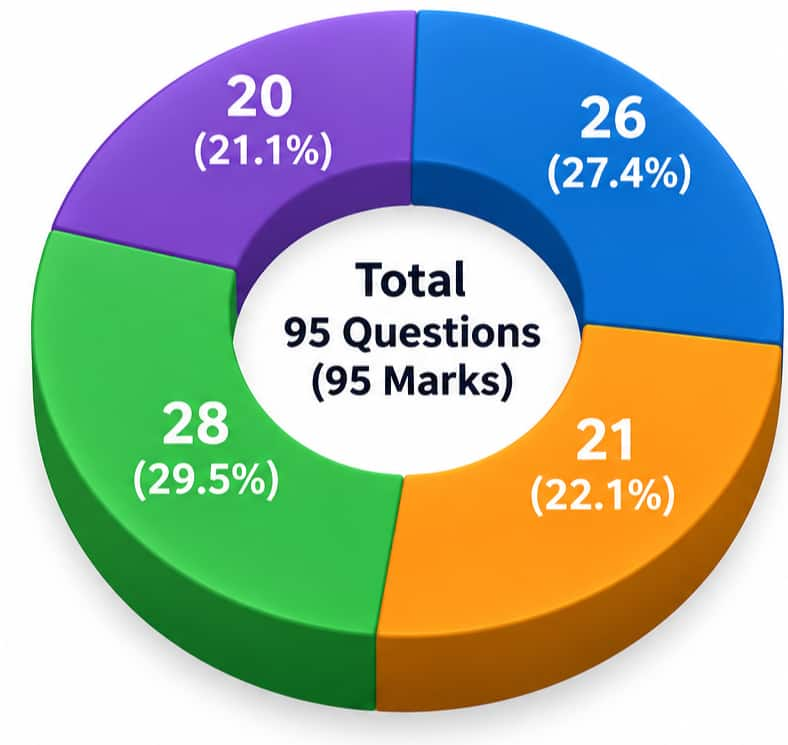
The official XAT 2027 pattern lists 95 questions across four sections.
Section | Questions | Marks |
Verbal Ability and Logical Reasoning | 26 | 26 |
Decision Making | 21 | 21 |
Quantitative Ability and Data Interpretation | 28 | 28 |
General Knowledge | 20 | 20 |
Total | 95 | 95 |
Correct answer: +1 mark
Incorrect answer: -0.25 mark
First eight unattempted questions in Part 1: No penalty
Every additional unattempted question in Part 1: -0.10 mark
General Knowledge: No negative marking
The first part covers VALR, DM and QA-DI. GK is conducted separately and does not contribute to the overall percentile or cutoff score, although it may be considered during XLRI's selection process.
Practise Before the Exam!
Prepare for XAT 2027 with a free mock test designed to help you experience the exam format, practise different question types and evaluate your readiness. Work on your time management and improve your overall performance.
A total XAT score alone does not explain mock performance. The number of correct answers, incorrect attempts, unanswered questions and sectional scores must be reviewed together.
The basic calculation for Part 1 is:
Net score = Correct answers − (0.25 × Incorrect answers) − (0.10 × Excess unattempted questions)
Consider this example:
XAT 2027 marking rule | Marks |
Correct answer | +1 |
Incorrect answer in Part 1 | -0.25 |
First 12 unattempted questions in Part 1 | No penalty |
Each additional unattempted question in Part 1 | -0.10 |
Incorrect answer in GK | No negative marking |
Unattempted GK question | No negative marking |
The first eight unattempted questions attract no penalty. The remaining 17 attract a deduction of 1.7 marks.
34-4-1.7=28.3
The net Part 1 score is 28.3 marks.
GK marks should be tracked separately because they do not contribute to the overall percentile calculation.
A candidate scoring 28 marks may have very different strengths and weaknesses from another candidate with the same score.
Section | Correct | Incorrect | Net score before unattempted penalty |
VALR | 11 | 5 | 9.75 |
Decision Making | 12 | 4 | 11 |
QA-DI | 11 | 7 | 9.25 |
Total | 34 | 16 | 30 |
The final score is lower after applying the unattempted-question penalty.
This breakdown shows that Decision Making is the strongest section in this example, while QA-DI needs more attention.
A high number of attempts does not always indicate a good performance.
Consider two mock attempts:
Performance | Mock A | Mock B |
Questions attempted | 45 | 55 |
Correct | 34 | 35 |
Incorrect | 11 | 20 |
Accuracy | 75.6% | 63.6% |
Mock B has more attempts but only one additional correct answer. The extra attempts have increased negative marking.
This indicates that question selection and accuracy need improvement before increasing attempts.
There is no universal score that guarantees a particular percentile across all XAT mocks. Difficulty varies between test series, and the actual examination may have a different score distribution.
The following interpretation is more useful than applying a fixed score target.
Mock performance | What it indicates | What to improve |
Low score, low accuracy | Conceptual gaps or poor question selection | Fundamentals and question analysis |
Low score, high accuracy | Too few questions attempted | Speed and question selection |
High attempts, low accuracy | Excessive guessing | Elimination and decision-making |
Good overall score, weak section | Uneven preparation | Sectional practice |
Stable score across mocks | Consistent performance | Improve the weakest section |
A mock test is useful only when the mistakes are reviewed properly. The following method helps identify the reason behind a low score.
A conceptual error occurs when the underlying topic is not understood. A selection error occurs when too much time is spent on a question that should have been skipped.
These require different solutions. Revising formulas will not fix poor question selection.
For every incorrect DM question, examine why the selected option failed. Check whether it ignored a stakeholder, relied on an unsupported assumption or created an unnecessary conflict.
The goal is to understand the reasoning behind the best option.
Mark questions that consumed too much time. A lengthy question is not automatically worth attempting. Compare the time spent with the marks earned.
Record the question type, reason for the mistake and the action required.
For example:
Question type | Mistake | Action |
DM caselet | Chose an extreme option | Practise balanced decisions |
RC inference | Added an outside assumption | Revisit passage evidence |
Geometry | Calculation error | Practise multi-step problems |
DI set | Spent too long | Improve set selection |
Mock quality matters more than the total number of tests. A practical approach is to take one full-length mock regularly, review it in detail and use the next practice session to address the identified weaknesses.
As the exam approaches, focus on:
Taking mocks under the actual time limit.
Practising DM caselets regularly.
Improving accuracy in VALR and QA-DI.
Avoiding random guesses.
Reviewing the unattempted-question penalty.
Tracking sectional performance across multiple mocks.
A single difficult mock should not lead to a complete change in preparation strategy. Look for patterns across at least three to four tests.
Prepare for CAT 2026 and XAT 2027 with curated eBooks covering section-wise preparation, previous year questions, mock tests, exam analysis, and effective test-taking strategies. Explore the top 10 recommended resources for each exam to strengthen concepts, improve accuracy, and understand your mock test performance.
Frequently Asked Questions (FAQs)
XAT mocks include Decision Making, complex verbal reasoning and potentially calculation-heavy QA-DI questions. These formats require skills that are not tested in exactly the same way in CAT.
XAT can feel tougher because of Decision Making and its different marking scheme. Actual difficulty varies by year and section.
Yes. The first eight unattempted questions in Part 1 carry no penalty. Each additional unattempted question attracts a deduction of 0.10 marks.
No. GK does not contribute to the overall percentile or cutoff score. However, it may be considered during the XLRI selection process.
No. The examinations have different structures, question types and marking rules. Scores should be evaluated separately.

On Question asked by student community
Hello Student, exam-centre availability can change depending on the live slots shown during the XAT application process. I would suggest checking Chikkaballapura directly in the test-city selection before completing the application. If the city is not appearing, it may mean that the centre is unavailable or not offered for that
You can find all the information here:
CAT- https://www.careers360.com/mba/articles/cat-exam-dates
SNAP- https://www.careers360.com/mba/articles/snap-exam-dates
You can check the XIMB XAT Cutoff 2026 to determine the percentile for non-domicile female candidates.
The IRMA XAT 2026 cutoff is expected to be in the range of 55 to 60 percentile for ST category candidates. At an XAT score of 47 percentile, it is unlikely to get a PI call for the IRMA MBA admission 2026.

Globally Recognized by AACSB (US) & AMBA (UK) | 18 LPA Avg. CTC for PGPM 2026
Applications Closing Soon! | 75+ years of legacy | #1 Entrance Test | 100+ Test Cities | 250+ B-Schools accept XAT Score
Gateway to IBS Hyderabad & 8 other IBS campuses | Scholarships worth 10 CR
Highest Package 29.30 LPA | 230+ Recruiters | AACSB Accredited | Ranked 51 in Asia by QS International
India’s only private university to be ranked for Graduate Employability | 6000+ Placements | 800+ Recruiters | 75 LPA-Highest Salary
UG Scholar's Round Deadline: 1st Dec'26 | PG Early Decision Round Deadline: 24th Dec'26 | Earn upto 50% merit Scholarship + 10% for top performers | AACSB (USA) & AMDISA Member | Highest CTC 28 LPA