
Search Colleges, Exams, Schools & more


Login
MAT December 2026 Preparation: 6-Week Study Plan, Section-Wise Strategy and Mock Tests

MAT December 2026 preparation: The All India Management Association (AIMA) will conduct the MAT December 2026 paper-based test (PBT) on December 20 and the computer-based test (CBT) on December 27, 2026. That leaves candidates about six weeks from mid-November to finish the syllabus, take mocks and revise. A MAT study plan matters more than long hours, because MAT tests speed and accuracy across five sections in just 120 minutes.
This Story also Contains
- MAT December 2026 Exam Dates
- MAT Exam Pattern 2026: Know Before You Plan
- MAT 6 Weeks Plan: Week-by-Week MAT Study Plan
- How to Prepare for MAT: Section-Wise Strategy
- MAT Mock Tests: How Many and How to Analyse
- Best E-Books for MAT Preparation
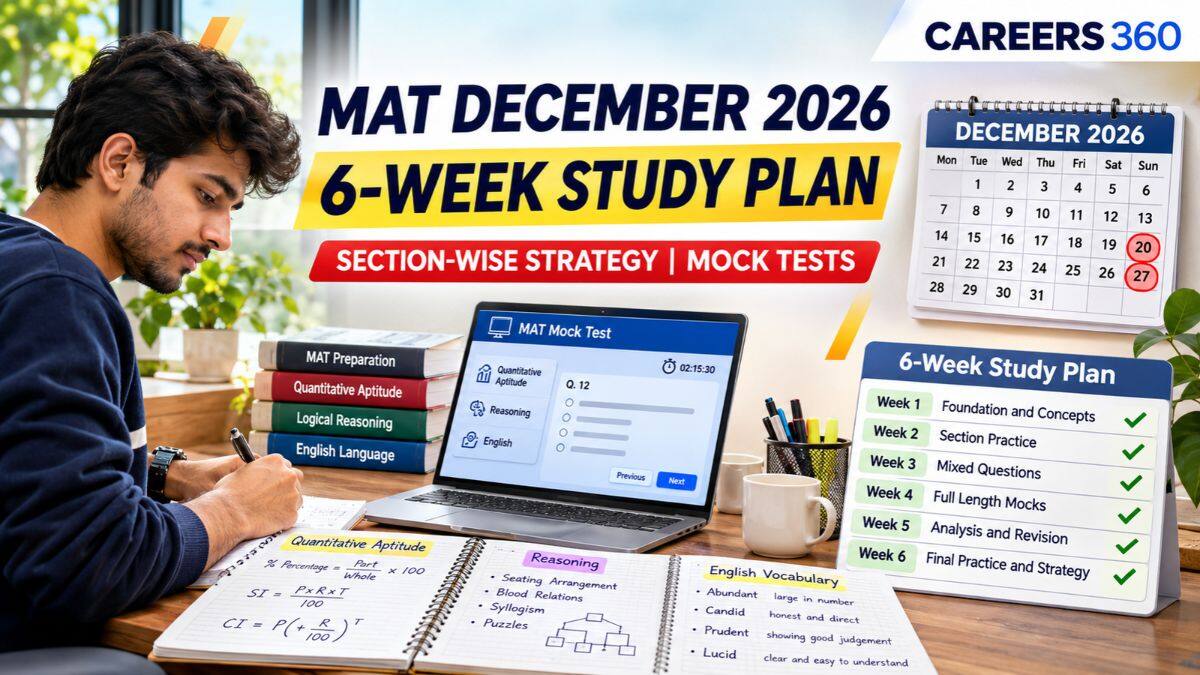
This article gives a week-by-week MAT 6-week plan, a section-wise strategy on how to prepare for MAT, and practical MAT exam tips for the final days. Candidates who have not applied yet can still complete the MAT registration 2026 till December 14 (PBT) or December 21 (CBT).
MAT December 2026 Exam Dates
Event | PBT | CBT |
Registration start | September 28, 2026 | September 28, 2026 |
Last date to apply | December 14, 2026 | December 21, 2026 |
Admit card release | December 17, 2026 | December 24, 2026 |
MAT exam date | December 20, 2026 | December 27, 2026 |
Result (expected) | First week of January 2027 | First week of January 2027 |
MAT Exam Pattern 2026: Know Before You Plan
The MAT paper has 150 multiple-choice questions, split equally across five sections of 30 questions each, to be solved in 120 minutes. Each correct answer earns 1 mark and each wrong answer costs 0.25 marks. The PBT and CBT modes follow the same pattern and difficulty level.
MAT Section | Questions | Marks |
Language Comprehension | 30 | 30 |
Intelligence and Critical Reasoning | 30 | 30 |
Mathematical Skills | 30 | 30 |
Data Analysis and Sufficiency | 30 | 30 |
Economic and Business Environment (Indian and Global Environment) | 30 | 30 |
Total | 150 | 150 |
Check: MAT Exam Pattern 2026 | MAT Syllabus 2026
MAT 6 Weeks Plan: Week-by-Week MAT Study Plan
The plan below runs from November 16 to December 27, 2026, and assumes 4 to 5 hours of study a day. Weeks 1 to 3 build concepts, Weeks 4 and 5 shift to mocks, and Week 6 is for revision. PBT candidates should finish Week 5 by December 19 and treat December 20 as exam day.
Week | Dates | Main focus | Recommended targets |
Week 1 | November 16–22 | Diagnostic test and concept revision | 1 diagnostic mock; arithmetic basics; 2 RC passages daily; vocabulary and grammar revision |
Week 2 | November 23–29 | High-priority Quant, Reasoning and DI topics | 20–25 Quant questions daily; 1 Reasoning set; 1 DI set; 2 RC passages |
Week 3 | November 30–December 6 | Complete remaining syllabus | Data sufficiency, critical reasoning, grammar, current affairs; 2 full-length mocks |
Week 4 | December 7–13 | Mock tests and error analysis | 3 full-length mocks; analyse each; revise weak topics |
Week 5 | December 14–20 | Final PBT preparation and CBT continuation | PBT candidates: final revision and exam on December 20; CBT candidates: 2–3 mocks and weak-topic repair |
Week 6 | December 21–27 | CBT final revision | CBT candidates: 1–2 mocks early in the week, formula revision and exam on December 27 |
Week 1 (November 16 to 22): Analyse and Build Basics
Start with one full-length MAT mock to see where you stand. Then cover percentages, profit and loss, ratio, averages and simple interest in Mathematical Skills. Read two passages daily and note unfamiliar words, as Language Comprehension rewards regular reading.
Week 2 (November 23 to 29): Cover High-Weightage Topics
Move to algebra, time and work, time, speed and distance, and mensuration. In reasoning, practise series, blood relations, coding-decoding and seating arrangements. Begin one Data Interpretation set daily, starting with tables and bar graphs.
Week 3 (November 30 to December 6): Finish the Syllabus
Complete data sufficiency, critical reasoning (assumptions, conclusions, strengthen and weaken) and grammar. Revise current affairs from the last six months for the Economic and Business Environment section. Take two full-length mocks this week to test the concepts.
Week 4 (December 7 to 13): Shift to Mocks
Take a full mock every alternate day and spend the next day analysing it. Keep an error log of every wrong or skipped question, with the reason. Fix the top three weak topics from this log before Week 5.
Week 5 (December 14 to 20): Exam Simulation
Take mocks at the same time as your exam slot. Practise picking easy questions first and skipping lengthy ones. PBT candidates should practise on OMR sheets and appear for the exam on December 20.
Week 6 (December 21 to 27): Revise and Rest
No new topics in the final week. Revise formula sheets, your error log and vocabulary notes. Take only two mocks, sleep well, and keep December 26 light before the CBT on December 27.
Also Read: MAT Preparation Tips 2026
How to Prepare for MAT: Section-Wise Strategy
Each MAT section needs a different approach. The table lists the topics to prioritise, followed by tips for each section.
Section | Important Topics | Ideal Time in Exam |
Language Comprehension | Reading comprehension, synonyms and antonyms, para jumbles, fill in the blanks, error spotting | 22 to 25 minutes |
Intelligence and Critical Reasoning | Series, coding-decoding, blood relations, seating arrangement, syllogisms, critical reasoning | 25 minutes |
Mathematical Skills | Percentages, profit and loss, time and work, TSD, ratio, algebra, geometry, mensuration | 30 minutes |
Data Analysis and Sufficiency | Tables, bar and pie charts, line graphs, caselets, data sufficiency | 28 to 30 minutes |
Economic and Business Environment | Current affairs, business news, economy, awards, government schemes | 10 minutes |
Language Comprehension
Read one editorial daily from a national newspaper to build reading speed. Attempt RC passages first in the exam, as they carry the most questions in this section. For vocabulary, learn words in context rather than from long lists.
Intelligence and Critical Reasoning
Most reasoning questions in MAT are puzzle-based and need practice, not theory. Solve at least one arrangement set and ten mixed questions a day. Learn to spot a lengthy set within 30 seconds and skip it.
Mathematical Skills
This is usually the toughest section for non-engineering candidates. Focus on arithmetic first, as it forms the bulk of the section. Keep a formula sheet and memorise squares up to 30, cubes up to 20 and fraction-percentage conversions to save time.
Data Analysis and Sufficiency
Speed in calculation decides your score here. Practise approximation and percentage change daily. For data sufficiency, learn the standard answer options by heart so you do not waste time re-reading them.
Economic and Business Environment
Revise current affairs from June to December 2026. Since many colleges ignore this section, do not spend more than 10 minutes on it in the exam.
Check: MAT Sample Papers
MAT Mock Tests: How Many and How to Analyse
Aim for 12 to 15 full-length mocks over the six weeks, most of them in Weeks 4 and 5. Analysing a mock matters as much as taking it. After each test, sort mistakes into three groups: concept gaps, silly errors and time-outs, and fix the first group first.
Take AIMA's official MAT practice tests to get used to the actual interface.
Track your score and accuracy for each section across mocks.
Keep accuracy above 80 per cent, since every wrong answer costs 0.25 marks.
Also Read: MAT Mock Test 2026
Best E-Books for MAT Preparation
Candidates can check out the trendy ebooks for MAT preparations in the table below:
MAT 2026 July GK Capsule Current Affairs & Static GK | |
MAT 2026 August Current Affairs & Static GK | |
MAT Intelligence and Critical Reasoning Sample Paper | |
MAT 2026 August Current Affairs & Static GK | |
MAT Intelligence and Critical Reasoning Sample Paper | |
MAT Blood Relations: 40 Questions with Tricks & Solutions | |
MAT DI Caselets: 30 Practice Sets with Solutions |
Also Read: MAT Score vs Percentile
Frequently Asked Questions (FAQs)
Q: Is six weeks enough for MAT December 2026 preparation?
A:
Yes. MAT is easy to moderate in difficulty, and six weeks are enough if you study 4 to 5 hours daily, cover the syllabus in three weeks and spend the rest on mocks and revision.
Q: How to prepare for MAT in 6 weeks while working?
A:
Working candidates can study 2 to 3 hours on weekdays and 6 to 7 hours on weekends. Use weekdays for concepts and practice, and weekends for full-length mocks and analysis.
Q: Which is the most scoring section in MAT?
A:
Language Comprehension and Intelligence and Critical Reasoning are usually the most scoring, as they need less calculation. Mathematical Skills and Data Analysis take more time per question.
Q: How many mock tests should I take before MAT December 2026?
A:
Take 12 to 15 full-length mocks, mostly in the last three weeks. Analyse each one before taking the next.
Q: Is there negative marking in MAT 2026?
A:
Yes. Each wrong answer carries a deduction of 0.25 marks. Unattempted questions carry no penalty.
Articles
Related Stories
|
Upcoming Mba Exams

Certifications By Top Providers
Explore Top Universities Across Globe
Popular Courses and Specializations
List of colleges accepting MAT
Browse Mba Colleges by State
Questions related to MAT
On Question asked by student community
Have a question related to MAT ?
Hello Student,
You can check the resource provided below:
https://school.careers360.com/articles/nmms-question-papers
Hope this helps!
Hey there
Agar aap pooch rahe hain ki phone asli hai ya fake, to phone ka model name/number, IMEI number, bill, aur seller details check karein. IMEI ko phone mein *#06# dial karke bhi dekh sakte hain. Agar aap phone ka model ya photo share kar dein, to main aapko
Hello Student,
You can check the KMAT Previous Year Question Papers on Careers360 for practice and preparation.
https://www.careers360.com/mba/articles/kmat-karnataka-previous-year-question-papers
Hope this helps!
Hi Shivangi Gupta
For the NMMS 2025-26 SAT and MAT question papers, you can check the Careers360 NMMS question paper page. It provides state-wise papers and resources for both MAT and SAT.
Hello Student,
What is it that you are trying to ask?

Applications for Admissions are open.
Globally Recognized by AACSB (US) & AMBA (UK) | 18 LPA Avg. CTC for PGPM 2026
XAT
ApplyApplications Closing Soon! | 75+ years of legacy | #1 Entrance Test | 100+ Test Cities | 250+ B-Schools accept XAT Score
IBSAT
ApplyGateway to IBS Hyderabad & 8 other IBS campuses | Scholarships worth 10 CR
K J Somaiya Institute of Management, Mumbai
ApplyHighest Package 29.30 LPA | 230+ Recruiters | AACSB Accredited | Ranked 51 in Asia by QS International
CII School of Logistics, Noida
ApplyIndia’s only private university to be ranked for Graduate Employability | 6000+ Placements | 800+ Recruiters | 75 LPA-Highest Salary
Jagan Institute of Management Studies, Rohini, Delhi
ApplyElite round PGDM applications are closing on 27th Nov 2026 | Highest CTC 28 LPA | Average CTC 10.67 LPA
MAT Notifications
Never miss MAT update
Get timely MAT updates directly to your inbox. Stay informed!